headlight SUZUKI GRAND VITARA 2014 User Guide
[x] Cancel search | Manufacturer: SUZUKI, Model Year: 2014, Model line: GRAND VITARA, Model: SUZUKI GRAND VITARA 2014Pages: 337, PDF Size: 6.21 MB
Page 103 of 337
3-2
OPERATING YOUR VEHICLE
79K21-03E
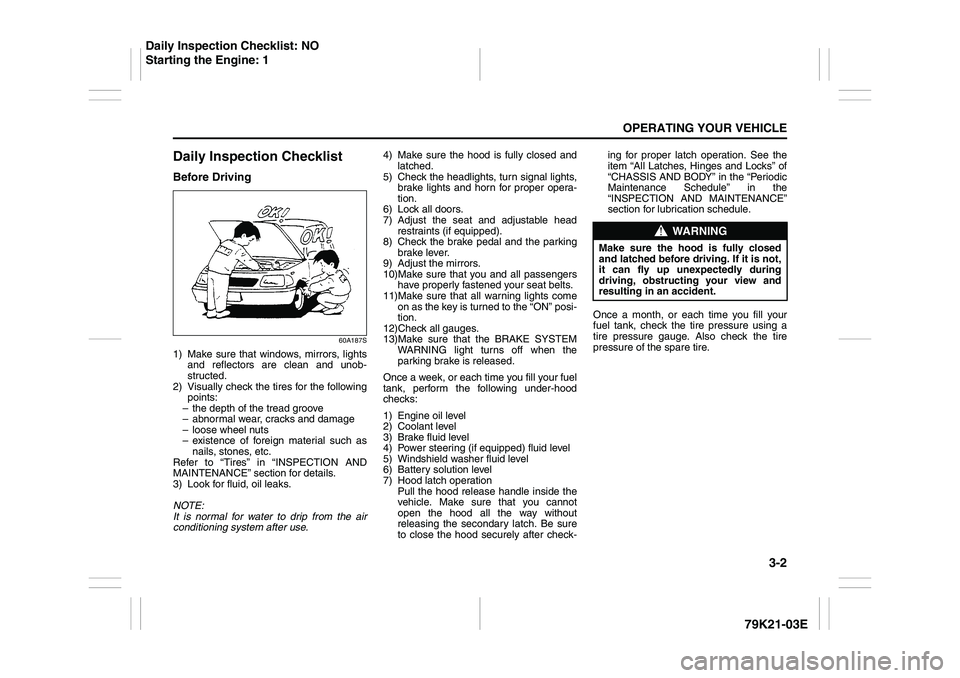
Daily Inspection ChecklistBefore Driving
60A187S
1) Make sure that windows, mirrors, lights
and reflectors are clean and unob-
structed.
2) Visually check the tires for the following
points:
– the depth of the tread groove
– abnormal wear, cracks and damage
– loose wheel nuts
– existence of foreign material such as
nails, stones, etc.
Refer to “Tires” in “INSPECTION AND
MAINTENANCE” section for details.
3) Look for fluid, oil leaks.
NOTE:
It is normal for water to drip from the air
conditioning system after use.4) Make sure the hood is fully closed and
latched.
5) Check the headlights, turn signal lights,
brake lights and horn for proper opera-
tion.
6) Lock all doors.
7) Adjust the seat and adjustable head
restraints (if equipped).
8) Check the brake pedal and the parking
brake lever.
9) Adjust the mirrors.
10)Make sure that you and all passengers
have properly fastened your seat belts.
11)Make sure that all warning lights come
on as the key is turned to the “ON” posi-
tion.
12)Check all gauges.
13)Make sure that the BRAKE SYSTEM
WARNING light turns off when the
parking brake is released.
Once a week, or each time you fill your fuel
tank, perform the following under-hood
checks:
1) Engine oil level
2) Coolant level
3) Brake fluid level
4) Power steering (if equipped) fluid level
5) Windshield washer fluid level
6) Battery solution level
7) Hood latch operation
Pull the hood release handle inside the
vehicle. Make sure that you cannot
open the hood all the way without
releasing the secondary latch. Be sure
to close the hood securely after check-ing for proper latch operation. See the
item “All Latches, Hinges and Locks” of
“CHASSIS AND BODY” in the “Periodic
Maintenance Schedule” in the
“INSPECTION AND MAINTENANCE”
section for lubrication schedule.
Once a month, or each time you fill your
fuel tank, check the tire pressure using a
tire pressure gauge. Also check the tire
pressure of the spare tire.
WARNING
Make sure the hood is fully closed
and latched before driving. If it is not,
it can fly up unexpectedly during
driving, obstructing your view and
resulting in an accident.
Daily Inspection Checklist: NO
Starting the Engine: 1
Page 249 of 337
INSPECTION AND MAINTENANCE
7
79K21-03E
60G410
INSPECTION AND MAINTENANCEMaintenance Schedule ....................................................... 7-2
Periodic Maintenance Schedule ........................................ 7-3
Maintenance Recommended under Severe Driving
Conditions ........................................................................... 7-7
Drive Belt ............................................................................. 7-9
Engine Oil and Filter ........................................................... 7-10
Engine Coolant .................................................................... 7-13
Air Cleaner ........................................................................... 7-16
Spark Plugs ......................................................................... 7-16
Gear Oil ................................................................................ 7-17
Clutch Pedal ........................................................................ 7-20
Automatic Transmission Fluid ........................................... 7-20
Brakes .................................................................................. 7-22
Steering Wheel .................................................................... 7-24
Tires ...................................................................................... 7-25
Battery .................................................................................. 7-36
Fuses .................................................................................... 7-36
Headlight Aiming ................................................................. 7-39
Bulb Replacement ............................................................... 7-40
Wiper Blades ....................................................................... 7-46
Windshield Washer Fluid ................................................... 7-49
Air Conditioning System .................................................... 7-49
Page 284 of 337
7-35INSPECTION AND MAINTENANCE
79K21-03E
gers in your vehicle, the amount of
available cargo and luggage load
capacity is 650 lbs (1400 – 750 (5 x
150) = 650 lbs).
5) Determine the combined weight of
luggage and cargo being loaded on
the vehicle. That weight may not
safely exceed the available cargo
and luggage load capacity calcu-
lated in Step 4.
6) If your vehicle will be towing a
trailer, load from your trailer will be
transferred to your vehicle. Consult
this manual to determine how this
reduces the available cargo and
luggage load capacity of your vehi-
cle.
Vehicle Loading Example
As an example, suppose that the Tire
and Loading Information label on your
vehicle indicates that your vehicle’s
total load capacity is 950 lbs. If you
were to drive your vehicle with one
passenger, and the total combined
weight of you and your passenger was
350 lbs, then the cargo and luggage
capacity of your vehicle would be 600
lbs (950 – 350 = 600 lbs).
If you later added 2 more passengers,
having a combined weight of 325 lbs,
the cargo and luggage capacity of
your vehicle would be reduced from600 lbs to 275 lbs (600 – 325 = 275
lbs). As you can see, as the number
and combined weight of vehicle occu-
pants increase, the vehicle’s cargo
and luggage capacity decreases.
Suppose again, that you were to take
a trip in your vehicle with the same
three passengers described above,
and you decided to tow a trailer having
a trailer tongue weight of 75 lbs. The
cargo and luggage capacity would be
reduced again, to 200 lbs (275 – 75 =
200 lbs).
Determining Compatibility of Tire
and Vehicle Load Limits
The tires on your vehicle, when they
are inflated to the recommended tire
inflation pressure, have a load-carry-
ing capacity that is greater than the
load that will be on the tires when the
vehicle is at its GVWR or GAWR limit.
Never use replacement tires that have
a load-carrying capacity less than the
original tires on your vehicle. Tire load-
carrying capacity information is
molded into the tire sidewall typically
shown as “Max. Load”. Use of replace-
ment tires with a lower load-carrying
capacity than the original tires, or fail-
ure to keep the tires inflated to recom-
mended tire pressure, may reduce the
GVWR or GAWR limit of your vehicle.NOTE:
Use of replacement tires with a higher
load-carrying capacity than the origi-
nal tires, or using a tire inflation pres-
sure higher than the recommended
tire inflation pressure, will not increase
the GVWR or GAWR limit of your vehi-
cle.
Fuses: 7
Headlight Aiming:
Bulb Replacement: 7
Page 288 of 337
7-39INSPECTION AND MAINTENANCE
79K21-03E
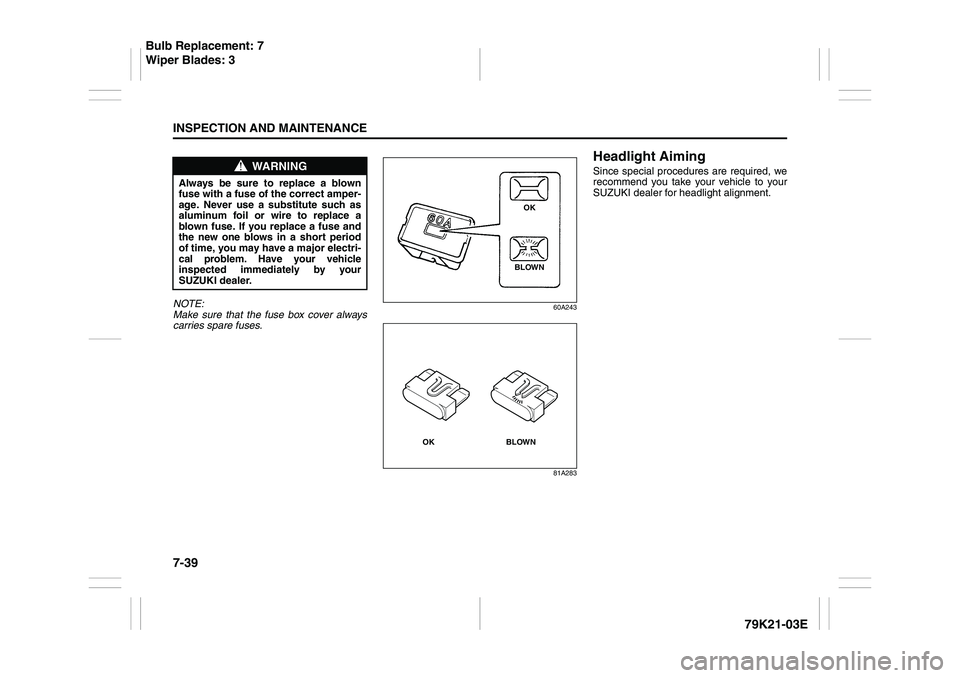
NOTE:
Make sure that the fuse box cover always
carries spare fuses.
60A243
81A283
Headlight AimingSince special procedures are required, we
recommend you take your vehicle to your
SUZUKI dealer for headlight alignment.
WARNING
Always be sure to replace a blown
fuse with a fuse of the correct amper-
age. Never use a substitute such as
aluminum foil or wire to replace a
blown fuse. If you replace a fuse and
the new one blows in a short period
of time, you may have a major electri-
cal problem. Have your vehicle
inspected immediately by your
SUZUKI dealer.
BLOWNOKBLOWN OK
Bulb Replacement: 7
Wiper Blades: 3
Page 289 of 337
7-40
INSPECTION AND MAINTENANCE
79K21-03E
Bulb ReplacementNOTE:
If it is difficult to replace headlight bulbs or
clearance light bulbs due to under-hood
components trust this job to your dealer.
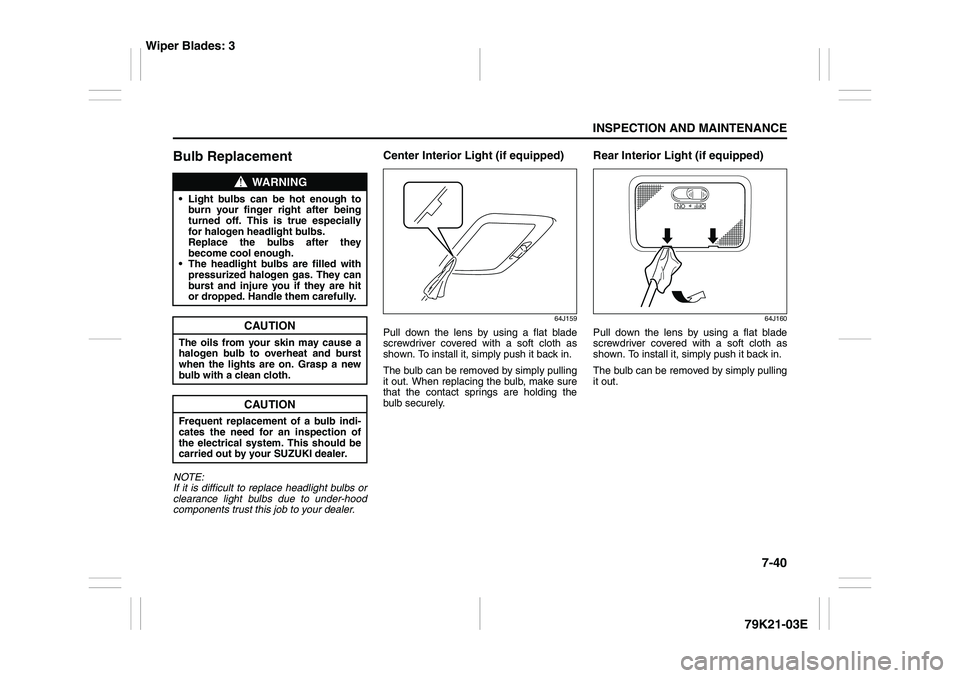
Center Interior Light (if equipped)
64J159
Pull down the lens by using a flat blade
screwdriver covered with a soft cloth as
shown. To install it, simply push it back in.
The bulb can be removed by simply pulling
it out. When replacing the bulb, make sure
that the contact springs are holding the
bulb securely.
Rear Interior Light (if equipped)
64J160
Pull down the lens by using a flat blade
screwdriver covered with a soft cloth as
shown. To install it, simply push it back in.
The bulb can be removed by simply pulling
it out.
WARNING
Light bulbs can be hot enough to
burn your finger right after being
turned off. This is true especially
for halogen headlight bulbs.
Replace the bulbs after they
become cool enough.
The headlight bulbs are filled with
pressurized halogen gas. They can
burst and injure you if they are hit
or dropped. Handle them carefully.
CAUTION
The oils from your skin may cause a
halogen bulb to overheat and burst
when the lights are on. Grasp a new
bulb with a clean cloth.
CAUTION
Frequent replacement of a bulb indi-
cates the need for an inspection of
the electrical system. This should be
carried out by your SUZUKI dealer.
Wiper Blades: 3
Page 290 of 337
7-41INSPECTION AND MAINTENANCE
79K21-03E
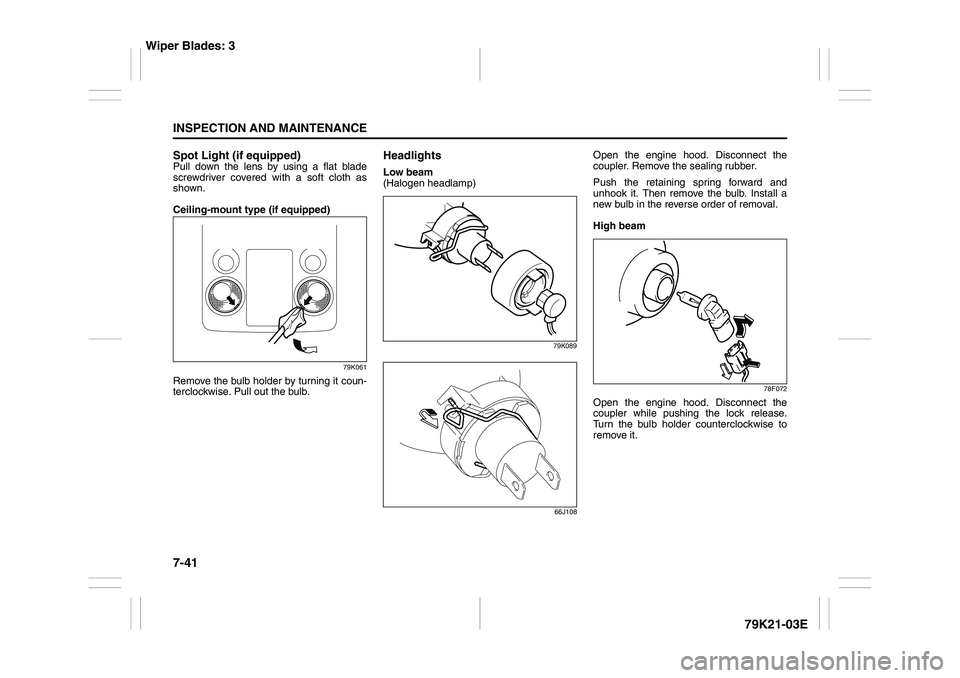
Spot Light (if equipped)Pull down the lens by using a flat blade
screwdriver covered with a soft cloth as
shown.
Ceiling-mount type (if equipped)
79K061
Remove the bulb holder by turning it coun-
terclockwise. Pull out the bulb.
HeadlightsLow beam
(Halogen headlamp)
79K089
66J108
Open the engine hood. Disconnect the
coupler. Remove the sealing rubber.
Push the retaining spring forward and
unhook it. Then remove the bulb. Install a
new bulb in the reverse order of removal.
High beam
78F072
Open the engine hood. Disconnect the
coupler while pushing the lock release.
Turn the bulb holder counterclockwise to
remove it.
Wiper Blades: 3
Page 306 of 337
8-7EMERGENCY SERVICE
79K21-03E
Jump Starting Instructions
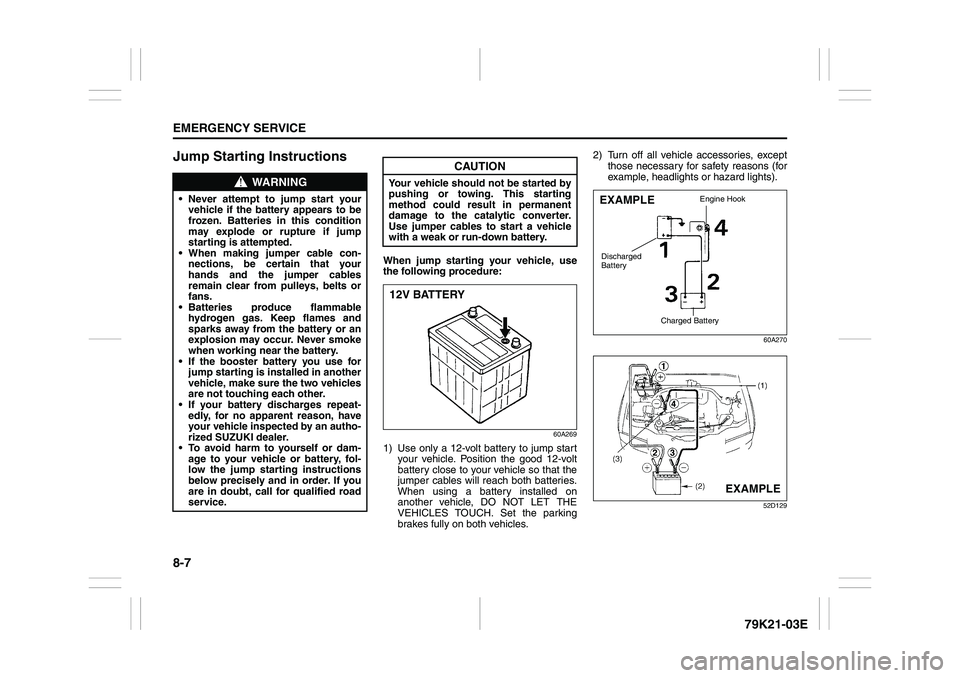
When jump starting your vehicle, use
the following procedure:
60A269
1) Use only a 12-volt battery to jump start
your vehicle. Position the good 12-volt
battery close to your vehicle so that the
jumper cables will reach both batteries.
When using a battery installed on
another vehicle, DO NOT LET THE
VEHICLES TOUCH. Set the parking
brakes fully on both vehicles.2) Turn off all vehicle accessories, except
those necessary for safety reasons (for
example, headlights or hazard lights).
60A270
52D129
WARNING
Never attempt to jump start your
vehicle if the battery appears to be
frozen. Batteries in this condition
may explode or rupture if jump
starting is attempted.
When making jumper cable con-
nections, be certain that your
hands and the jumper cables
remain clear from pulleys, belts or
fans.
Batteries produce flammable
hydrogen gas. Keep flames and
sparks away from the battery or an
explosion may occur. Never smoke
when working near the battery.
If the booster battery you use for
jump starting is installed in another
vehicle, make sure the two vehicles
are not touching each other.
If your battery discharges repeat-
edly, for no apparent reason, have
your vehicle inspected by an autho-
rized SUZUKI dealer.
To avoid harm to yourself or dam-
age to your vehicle or battery, fol-
low the jump starting instructions
below precisely and in order. If you
are in doubt, call for qualified road
service.
CAUTION
Your vehicle should not be started by
pushing or towing. This starting
method could result in permanent
damage to the catalytic converter.
Use jumper cables to start a vehicle
with a weak or run-down battery.12V BATTERY
EXAMPLE
Engine Hook
Charged Battery
Discharged
Battery
EXAMPLE
Page 307 of 337
8-8
EMERGENCY SERVICE
79K21-03E
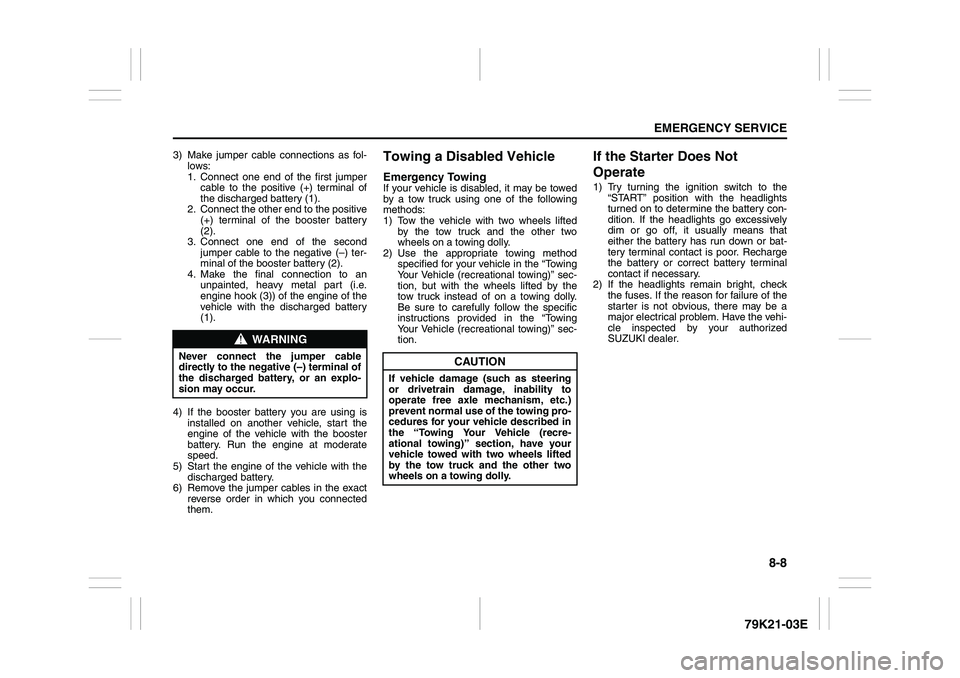
3) Make jumper cable connections as fol-
lows:
1. Connect one end of the first jumper
cable to the positive (+) terminal of
the discharged battery (1).
2. Connect the other end to the positive
(+) terminal of the booster battery
(2).
3. Connect one end of the second
jumper cable to the negative (–) ter-
minal of the booster battery (2).
4. Make the final connection to an
unpainted, heavy metal part (i.e.
engine hook (3)) of the engine of the
vehicle with the discharged battery
(1).
4) If the booster battery you are using is
installed on another vehicle, start the
engine of the vehicle with the booster
battery. Run the engine at moderate
speed.
5) Start the engine of the vehicle with the
discharged battery.
6) Remove the jumper cables in the exact
reverse order in which you connected
them.
Towing a Disabled VehicleEmergency TowingIf your vehicle is disabled, it may be towed
by a tow truck using one of the following
methods:
1) Tow the vehicle with two wheels lifted
by the tow truck and the other two
wheels on a towing dolly.
2) Use the appropriate towing method
specified for your vehicle in the “Towing
Your Vehicle (recreational towing)” sec-
tion, but with the wheels lifted by the
tow truck instead of on a towing dolly.
Be sure to carefully follow the specific
instructions provided in the “Towing
Your Vehicle (recreational towing)” sec-
tion.
If the Starter Does Not
Operate1) Try turning the ignition switch to the
“START” position with the headlights
turned on to determine the battery con-
dition. If the headlights go excessively
dim or go off, it usually means that
either the battery has run down or bat-
tery terminal contact is poor. Recharge
the battery or correct battery terminal
contact if necessary.
2) If the headlights remain bright, check
the fuses. If the reason for failure of the
starter is not obvious, there may be a
major electrical problem. Have the vehi-
cle inspected by your authorized
SUZUKI dealer.
WARNING
Never connect the jumper cable
directly to the negative (–) terminal of
the discharged battery, or an explo-
sion may occur.
CAUTION
If vehicle damage (such as steering
or drivetrain damage, inability to
operate free axle mechanism, etc.)
prevent normal use of the towing pro-
cedures for your vehicle described in
the “Towing Your Vehicle (recre-
ational towing)” section, have your
vehicle towed with two wheels lifted
by the tow truck and the other two
wheels on a towing dolly.
Page 315 of 337
9-4
APPEARANCE CARE
79K21-03E
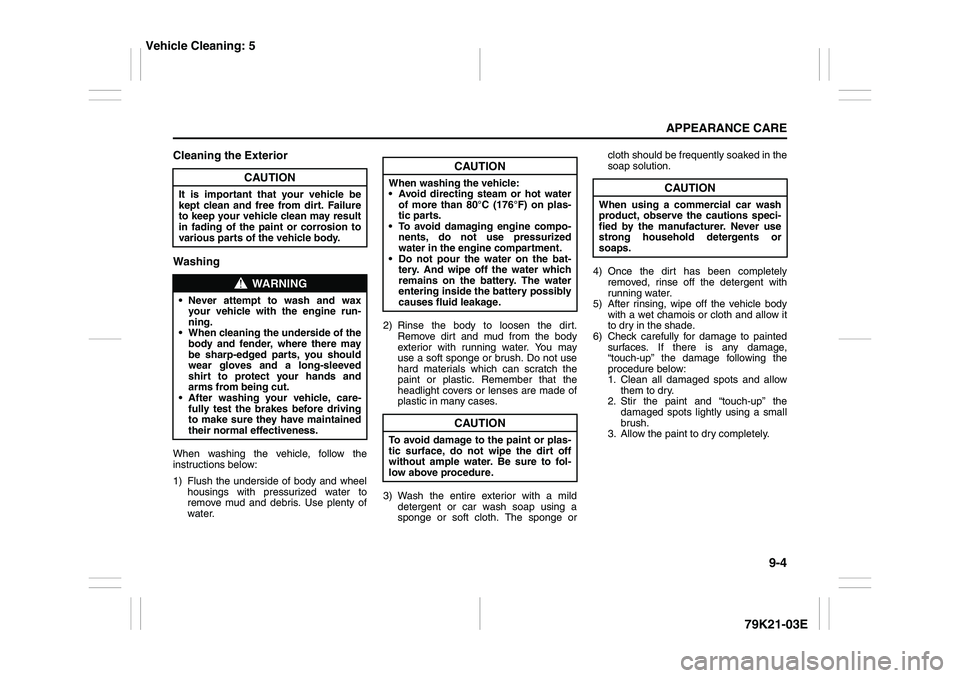
Cleaning the Exterior
WashingWhen washing the vehicle, follow the
instructions below:
1) Flush the underside of body and wheel
housings with pressurized water to
remove mud and debris. Use plenty of
water.2) Rinse the body to loosen the dirt.
Remove dirt and mud from the body
exterior with running water. You may
use a soft sponge or brush. Do not use
hard materials which can scratch the
paint or plastic. Remember that the
headlight covers or lenses are made of
plastic in many cases.
3) Wash the entire exterior with a mild
detergent or car wash soap using a
sponge or soft cloth. The sponge orcloth should be frequently soaked in the
soap solution.
4) Once the dirt has been completely
removed, rinse off the detergent with
running water.
5) After rinsing, wipe off the vehicle body
with a wet chamois or cloth and allow it
to dry in the shade.
6) Check carefully for damage to painted
surfaces. If there is any damage,
“touch-up” the damage following the
procedure below:
1. Clean all damaged spots and allow
them to dry.
2. Stir the paint and “touch-up” the
damaged spots lightly using a small
brush.
3. Allow the paint to dry completely.
CAUTION
It is important that your vehicle be
kept clean and free from dirt. Failure
to keep your vehicle clean may result
in fading of the paint or corrosion to
various parts of the vehicle body.
WARNING
Never attempt to wash and wax
your vehicle with the engine run-
ning.
When cleaning the underside of the
body and fender, where there may
be sharp-edged parts, you should
wear gloves and a long-sleeved
shirt to protect your hands and
arms from being cut.
After washing your vehicle, care-
fully test the brakes before driving
to make sure they have maintained
their normal effectiveness.
CAUTION
When washing the vehicle:
Avoid directing steam or hot water
of more than 80°C (176°F) on plas-
tic parts.
To avoid damaging engine compo-
nents, do not use pressurized
water in the engine compartment.
Do not pour the water on the bat-
tery. And wipe off the water which
remains on the battery. The water
entering inside the battery possibly
causes fluid leakage.
CAUTION
To avoid damage to the paint or plas-
tic surface, do not wipe the dirt off
without ample water. Be sure to fol-
low above procedure.
CAUTION
When using a commercial car wash
product, observe the cautions speci-
fied by the manufacturer. Never use
strong household detergents or
soaps.
Vehicle Cleaning: 5
Page 329 of 337
12-3
SPECIFICATIONS
79K21-03E
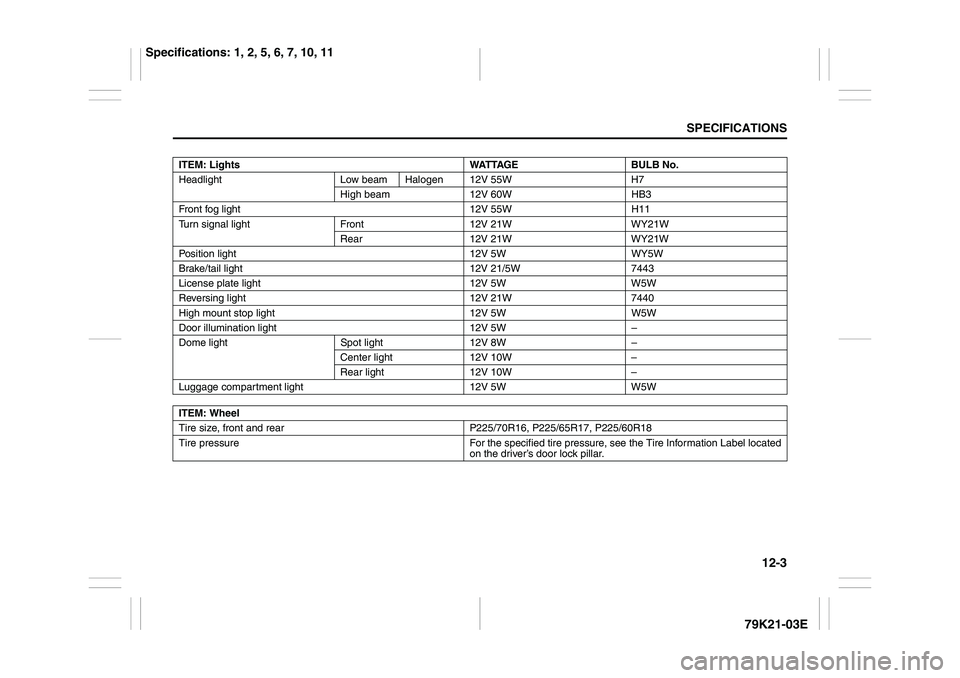
ITEM: Lights WATTAGE BULB No.
Headlight Low beam Halogen 12V 55W H7
High beam 12V 60W HB3
Front fog light 12V 55W H11
Turn signal light Front 12V 21W WY21W
Rear 12V 21W WY21W
Position light 12V 5W WY5W
Brake/tail light 12V 21/5W 7443
License plate light 12V 5W W5W
Reversing light 12V 21W 7440
High mount stop light 12V 5W W5W
Door illumination light 12V 5W –
Dome light Spot light 12V 8W –
Center light 12V 10W –
Rear light 12V 10W –
Luggage compartment light 12V 5W W5W
ITEM: Wheel
Tire size, front and rear P225/70R16, P225/65R17, P225/60R18
Tire pressure For the specified tire pressure, see the Tire Information Label located
on the driver’s door lock pillar.
Specifications: 1, 2, 5, 6, 7, 10, 11