rim SUZUKI GRAND VITARA 2014 Owners Manual
[x] Cancel search | Manufacturer: SUZUKI, Model Year: 2014, Model line: GRAND VITARA, Model: SUZUKI GRAND VITARA 2014Pages: 337, PDF Size: 6.21 MB
Page 275 of 337
7-26
INSPECTION AND MAINTENANCE
79K21-03E
*The letters ZR may be used on tires
with a maximum speed capability over
149 mph and will always be used on
tires with a maximum speed capability
over 186 mph.
J. M+S Marking
This marking indicates the tire
has some mud and snow capabili-
ties and is designed for all-season
use.
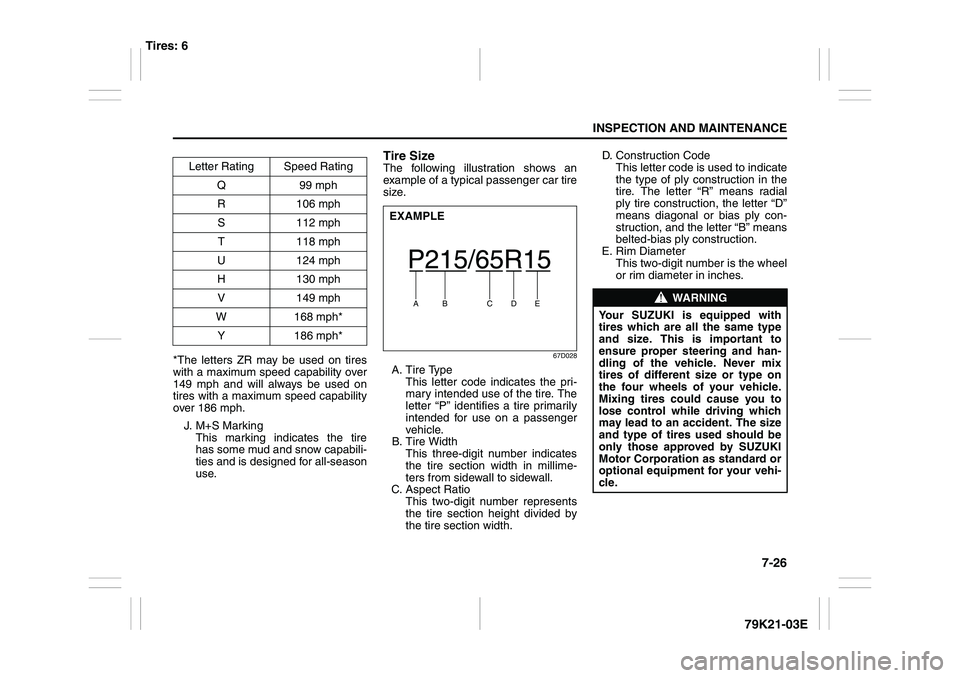
Tire SizeThe following illustration shows an
example of a typical passenger car tire
size.
67D028
A. Tire Type
This letter code indicates the pri-
mary intended use of the tire. The
letter “P” identifies a tire primarily
intended for use on a passenger
vehicle.
B. Tire Width
This three-digit number indicates
the tire section width in millime-
ters from sidewall to sidewall.
C. Aspect Ratio
This two-digit number represents
the tire section height divided by
the tire section width.D. Construction Code
This letter code is used to indicate
the type of ply construction in the
tire. The letter “R” means radial
ply tire construction, the letter “D”
means diagonal or bias ply con-
struction, and the letter “B” means
belted-bias ply construction.
E. Rim Diameter
This two-digit number is the wheel
or rim diameter in inches. Letter Rating Speed Rating
Q99 mph
R 106 mph
S 112 mph
T 118 mph
U 124 mph
H 130 mph
V 149 mph
W 168 mph*
Y 186 mph*
A
B
C
D
E
EXAMPLE
WARNING
Your SUZUKI is equipped with
tires which are all the same type
and size. This is important to
ensure proper steering and han-
dling of the vehicle. Never mix
tires of different size or type on
the four wheels of your vehicle.
Mixing tires could cause you to
lose control while driving which
may lead to an accident. The size
and type of tires used should be
only those approved by SUZUKI
Motor Corporation as standard or
optional equipment for your vehi-
cle.
Tires: 6
Page 277 of 337
7-28
INSPECTION AND MAINTENANCE
79K21-03E
tire gauge until you reach the cor-
rect pressure.
5) If the air pressure is too low, fill the
tire with air at a service station until
it reaches the recommended pres-
sure.
6) Make sure all tires have the same
air pressure (unless the owner’s
manual indicates otherwise).
Tire InspectionInspect your vehicle’s tires at least
once a month by performing the fol-
lowing checks:
1) Measure the air pressure with a tire
gauge. Adjust the pressure if nec-
essary. Remember to check the
spare tire, too. Refer to the “Mea-
suring Air Pressure” section.
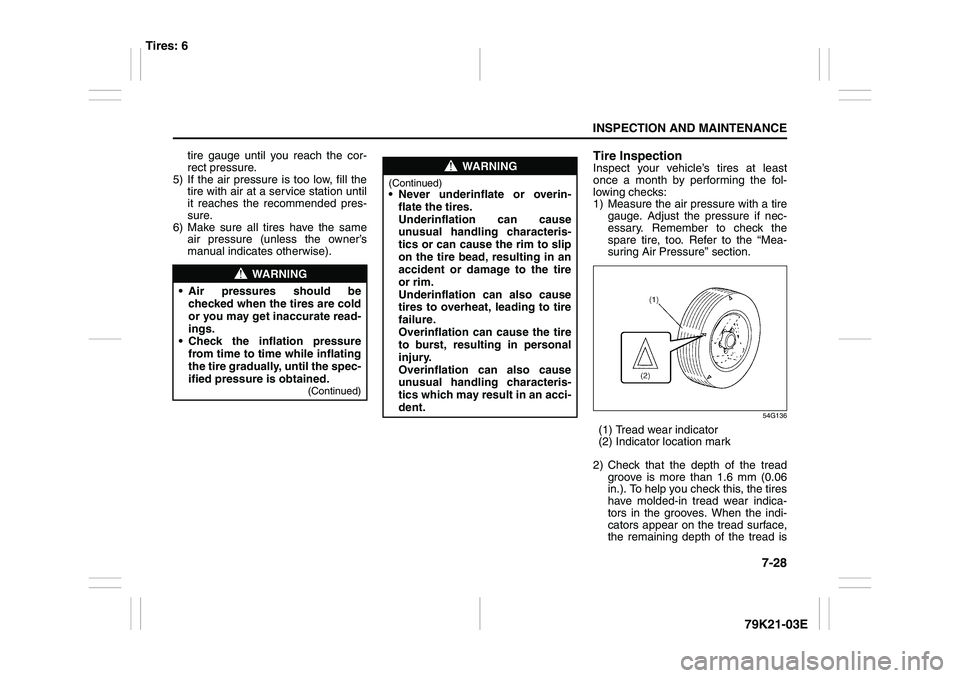
54G136
(1) Tread wear indicator
(2) Indicator location mark
2) Check that the depth of the tread
groove is more than 1.6 mm (0.06
in.). To help you check this, the tires
have molded-in tread wear indica-
tors in the grooves. When the indi-
cators appear on the tread surface,
the remaining depth of the tread is
WARNING
Air pressures should be
checked when the tires are cold
or you may get inaccurate read-
ings.
Check the inflation pressure
from time to time while inflating
the tire gradually, until the spec-
ified pressure is obtained.
(Continued)
WARNING
(Continued) Never underinflate or overin-
flate the tires.
Underinflation can cause
unusual handling characteris-
tics or can cause the rim to slip
on the tire bead, resulting in an
accident or damage to the tire
or rim.
Underinflation can also cause
tires to overheat, leading to tire
failure.
Overinflation can cause the tire
to burst, resulting in personal
injury.
Overinflation can also cause
unusual handling characteris-
tics which may result in an acci-
dent.
Tires: 6
Page 281 of 337
7-32
INSPECTION AND MAINTENANCE
79K21-03E Snow Tires
Your vehicle is equipped with all-sea-
son tires which are designed for use in
summer and most winter conditions.
For improved traction in severe winter
conditions, SUZUKI recommends
mounting radial snow tires on all four
wheels. Snow tires must be the same
size as the standard tires. Also be sure
to use the tires of the same type and
brand on all four wheels of your vehi-
cle.
GLOSSARY OF TIRE TERMI-
NOLOGYAccessory Weight – the combined
weight (in excess of those standard
items which may be replaced) of auto-
matic transmission, power steering,
power brakes, power windows, power
seats, radio, and heater, to the extent
that these items are available as fac-
tory-installed equipment (whether
installed or not).
Cold Tire Inflation Pressure – the pres-
sure in a tire that has been driven less
than 1 mile or has been standing for
three hours or more.
Curb Weight – the weight of a motor
vehicle with standard equipment
including the maximum capacity of
fuel, oil, and coolant, and, if so
equipped, air conditioning and addi-
tional weight optional engine.
Intended Outboard Sidewall – (1) the
sidewall that contains a whitewall,
bears white lettering or bears manu-
facturer, brand, and/or model name
molding that is higher or deeper than
the same molding on the other side-
wall of the tire, or (2) the outward fac-
ing sidewall of an asymmetrical tire
that has a particular side that mustalways face outward when mounted
on a vehicle.
Maximum Inflation Pressure – the
maximum cold inflation pressure a tire
is designed to support in normal ser-
vice.
Maximum Loaded Vehicle Weight –
the sum of curb weight, accessory
weight, vehicle capacity weight (total
load capacity), and production options
weight.
Normal Occupant Weight – 68 kilo-
grams times the number of occupants
specified in the second column of
Table 1 (shown below).
Occupant distribution – distribution of
occupants in a vehicle as specified in
the third column of Table 1 (shown
below).
Production Options Weight – the com-
bined weight of those installed regular
production options weighing over 2.3
kilograms in excess of those standard
items which they replace, not previ-
ously considered in curb weight or
accessory weight, including heavy
duty brakes, ride levelers, roof rack,
heavy duty battery, and special trim.
WARNING
(Continued) Do not use tire chains on the
spare tire. If you must use tire
chains, rearrange the wheels so
standard tires and wheels are
fitted to the rear axle.
Replace the spare tire with a
new one as soon as the tread
wear indicator appears.
When replacing the spare tire,
use a replacement tire with the
exact same size and construc-
tion.
Battery: 9
Fuses: 7
Page 282 of 337
7-33INSPECTION AND MAINTENANCE
79K21-03E
Recommended Inflation Pressure –
the cold tire inflation pressure recom-
mended by a manufacturer.
Rim – metal support for a tire or tire
and tube assembly upon which the tire
beads are seated.
Vehicle Capacity Weight – the rated
cargo and luggage load plus 68 kilo-
grams (150 lbs) times the vehicle’s
designated seating capacity.
Vehicle Maximum Load on the Tire –
the load on an individual tire that is
determined by distributing to each axle
its share of the maximum loaded vehi-
cle weight and dividing by two.
Vehicle Normal Load on the Tire – the
load on an individual tire that is deter-
mined by distributing to each axle its
share of the curb weight, accessory
weight, and normal occupant weight
(distributed in accordance with Table 1
shown below) and dividing by 2.TABLE 1 – Occupant Loading and
Distribution For Vehicle Normal
Load For Various Designated Seat-
ing Capacities
Vehicle LoadingYour vehicle was designed for specific
load capacities. The load capacities of
your vehicle are indicated by the
Gross Vehicle Weight Rating (GVWR),
the Gross Axle Weight Rating (GAWR,
front and rear), and the total load
capacity, the seating capacity, and the
cargo load capacity. The GVWR and
GAWR (front and rear) are listed on
the Safety Certification Label which is
located below the driver’s side door
latch striker. The total load capacity
and seating capacity are listed on the
Tire and Loading Information Labelwhich is located below the Safety Cer-
tification Label. The cargo load capac-
ity can be determined as described
below.
Cargo Load Capacity – Maximum
weight of cargo and luggage that the
vehicle can safely carry. Cargo load
capacity is the difference between the
total load capacity of the vehicle and
the total combined weight of all vehicle
occupants. Refer to “Steps for Deter-
mining Correct Load Limit” for details
on how to determine cargo load
capacity.
GVWR – Maximum permissible overall
weight of the fully loaded vehicle
(including all the occupants, accesso-
ries and cargo plus the trailer tongue
weight if towing a trailer).
GAWR – (Front and Rear) Maximum
permissible weight on an individual
axle.
Seating Capacity – Maximum number
of occupants the vehicle is designed to
carry.
NOTE:
Even though the number of occupants
is within the seating capacity, you still
must make sure that you do not Designated
seating
capacity,
number of
occupantsVehicle
normal
load,
number of
occupantsOccupant
distribution
in a
normally
loaded
vehicle
2 through 4 2 2 in front
5 through 10 3 2 in front,
1 in sec-
ond seat
Fuses: 7
Page 285 of 337
7-36
INSPECTION AND MAINTENANCE
79K21-03E
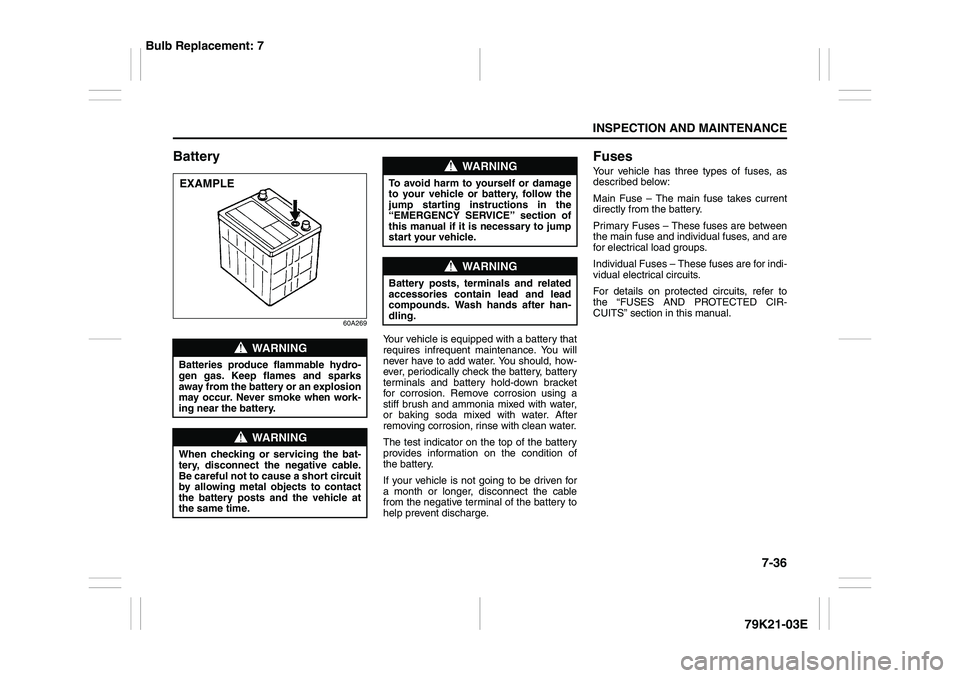
Battery
60A269
Your vehicle is equipped with a battery that
requires infrequent maintenance. You will
never have to add water. You should, how-
ever, periodically check the battery, battery
terminals and battery hold-down bracket
for corrosion. Remove corrosion using a
stiff brush and ammonia mixed with water,
or baking soda mixed with water. After
removing corrosion, rinse with clean water.
The test indicator on the top of the battery
provides information on the condition of
the battery.
If your vehicle is not going to be driven for
a month or longer, disconnect the cable
from the negative terminal of the battery to
help prevent discharge.
FusesYour vehicle has three types of fuses, as
described below:
Main Fuse – The main fuse takes current
directly from the battery.
Primary Fuses – These fuses are between
the main fuse and individual fuses, and are
for electrical load groups.
Individual Fuses – These fuses are for indi-
vidual electrical circuits.
For details on protected circuits, refer to
the “FUSES AND PROTECTED CIR-
CUITS” section in this manual.
WARNING
Batteries produce flammable hydro-
gen gas. Keep flames and sparks
away from the battery or an explosion
may occur. Never smoke when work-
ing near the battery.
WARNING
When checking or servicing the bat-
tery, disconnect the negative cable.
Be careful not to cause a short circuit
by allowing metal objects to contact
the battery posts and the vehicle at
the same time.EXAMPLE
WARNING
To avoid harm to yourself or damage
to your vehicle or battery, follow the
jump starting instructions in the
“EMERGENCY SERVICE” section of
this manual if it is necessary to jump
start your vehicle.
WARNING
Battery posts, terminals and related
accessories contain lead and lead
compounds. Wash hands after han-
dling.
Bulb Replacement: 7
Page 286 of 337
7-37INSPECTION AND MAINTENANCE
79K21-03E
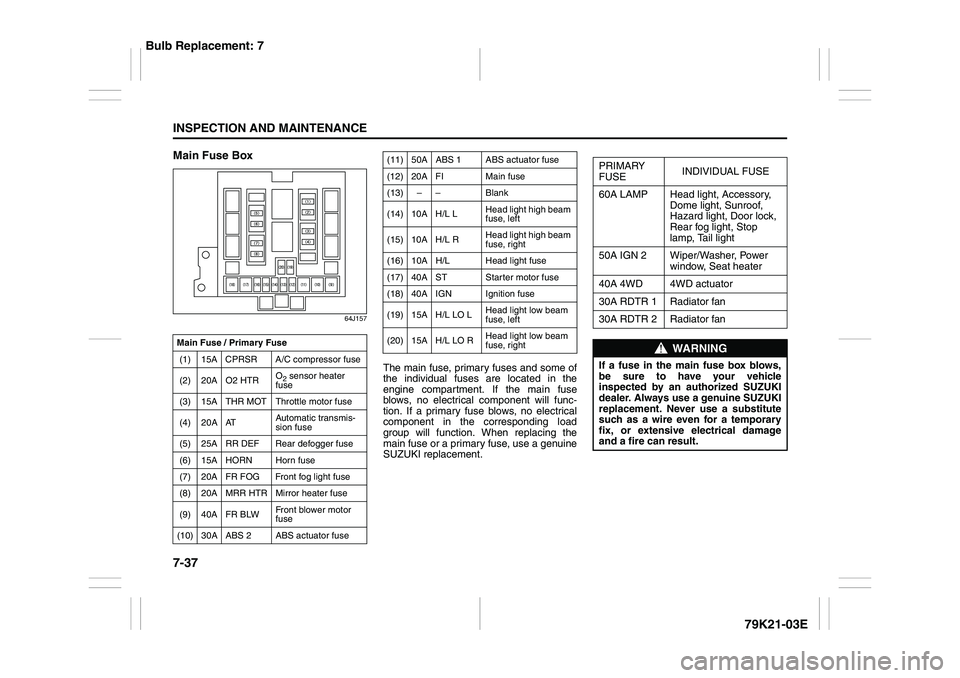
Main Fuse Box
64J157
The main fuse, primary fuses and some of
the individual fuses are located in the
engine compartment. If the main fuse
blows, no electrical component will func-
tion. If a primary fuse blows, no electrical
component in the corresponding load
group will function. When replacing the
main fuse or a primary fuse, use a genuine
SUZUKI replacement.
Main Fuse / Primary Fuse
(1) 15A CPRSR A/C compressor fuse
(2) 20A O2 HTRO
2 sensor heater
fuse
(3) 15A THR MOT Throttle motor fuse
(4) 20A ATAutomatic transmis-
sion fuse
(5) 25A RR DEF Rear defogger fuse
(6) 15A HORN Horn fuse
(7) 20A FR FOG Front fog light fuse
(8) 20A MRR HTR Mirror heater fuse
(9) 40A FR BLWFront blower motor
fuse
(10) 30A ABS 2 ABS actuator fuse
(11) 50A ABS 1 ABS actuator fuse
(12) 20A FI Main fuse
(13) – – Blank
(14) 10A H/L LHead light high beam
fuse, left
(15) 10A H/L RHead light high beam
fuse, right
(16) 10A H/L Head light fuse
(17) 40A ST Starter motor fuse
(18) 40A IGN Ignition fuse
(19) 15A H/L LO LHead light low beam
fuse, left
(20) 15A H/L LO RHead light low beam
fuse, right
PRIMARY
FUSEINDIVIDUAL FUSE
60A LAMP Head light, Accessory,
Dome light, Sunroof,
Hazard light, Door lock,
Rear fog light, Stop
lamp, Tail light
50A IGN 2 Wiper/Washer, Power
window, Seat heater
40A 4WD 4WD actuator
30A RDTR 1 Radiator fan
30A RDTR 2 Radiator fan
WARNING
If a fuse in the main fuse box blows,
be sure to have your vehicle
inspected by an authorized SUZUKI
dealer. Always use a genuine SUZUKI
replacement. Never use a substitute
such as a wire even for a temporary
fix, or extensive electrical damage
and a fire can result.
Bulb Replacement: 7
Page 293 of 337
7-44
INSPECTION AND MAINTENANCE
79K21-03E
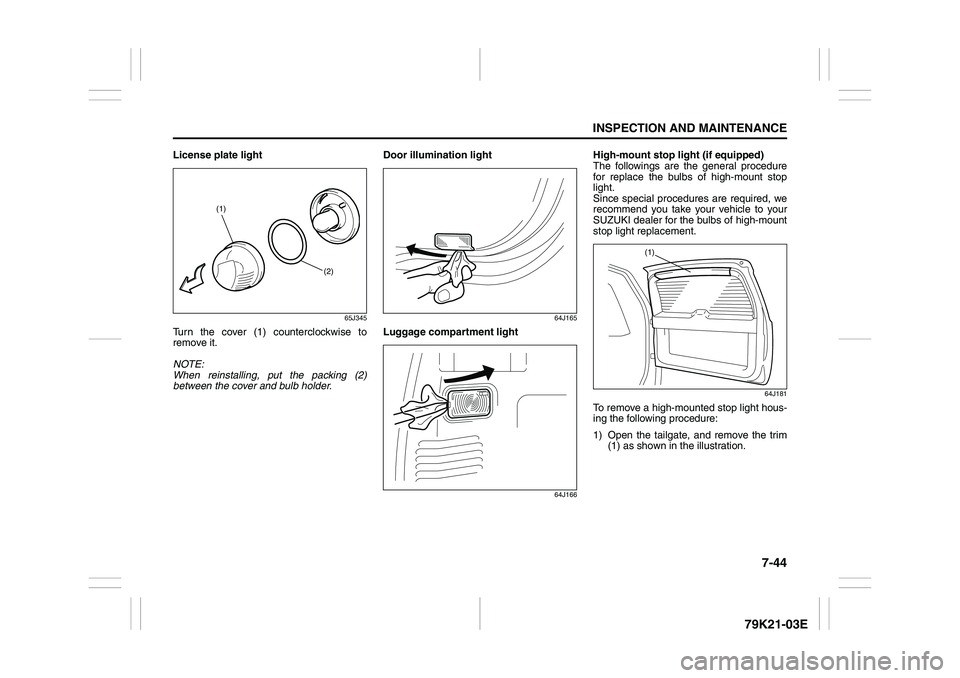
License plate light
65J345
Turn the cover (1) counterclockwise to
remove it.
NOTE:
When reinstalling, put the packing (2)
between the cover and bulb holder.Door illumination light
64J165
Luggage compartment light
64J166
High-mount stop light (if equipped)
The followings are the general procedure
for replace the bulbs of high-mount stop
light.
Since special procedures are required, we
recommend you take your vehicle to your
SUZUKI dealer for the bulbs of high-mount
stop light replacement.
64J181
To remove a high-mounted stop light hous-
ing the following procedure:
1) Open the tailgate, and remove the trim
(1) as shown in the illustration.
(1)
(2)
(1)