warning SUZUKI GRAND VITARA 2015 Owners Manual
[x] Cancel search | Manufacturer: SUZUKI, Model Year: 2015, Model line: GRAND VITARA, Model: SUZUKI GRAND VITARA 2015Pages: 482, PDF Size: 21 MB
Page 288 of 482
5-46
OTHER CONTROLS AND EQUIPMENT
54P00-01E
Part 15 of the FCC Rules
FCC Warning:
Any unauthorized changes or modifica-
tions to this equipment would void the
user’s authority to operate this device.The Bluetooth
® word mark and logo are
registered trademarks and are owned by
the Bluetooth SIG, Ink.
NOTE:
This equipment complies with FCC radia-
tion exposure limits set forth for uncon-
trolled equipment and meets the FCC
radio frequency (RF) Exposure Guidelines
in Supplement C to OET65. This equip-
ment has very low level of RF energy
which does not comply with maximum per-
missive exposure (MPE) evaluation. But it
is desirable that it should be installed and
operated with at least 20cm and more
between the radiator and person’s body
(excluding extremities: hands, wrists, feet
and ankles).Stop using this unit and a Bluetooth
®
ready device whenever requested.
This unit shares the communication fre-
quency with other private or public wireless
communication equipment such as a wire-
less LAN and other wireless communica-
tion radios.
You should stop using this unit whenever
you are notified that your unit disturbs
other wireless communication immediately.
WA R N I N G
This is a class I laser product. Use of
controls or adjustments or perfor-
mance of procedures other than
those specified herein may result in
hazardous radiation exposure.
Do not open covers and do not
attempt to repair this unit by yourself.
Ask an authorized dealer for the
repair.
Page 335 of 482
6-3
VEHICLE LOADING AND TOWING
54P00-01E
Tires
Mirrors
Check if your vehicle’s mirrors meet local
requirements for mirrors used on towing
vehicles. If they do not, you must install the
required mirrors before you tow.
Vehicle/trailer loading
To load your vehicle and trailer properly,
you must know how to measure gross
trailer weight and trailer nose weight.
Gross trailer weight is the weight of the
trailer plus all the cargo in it. You can mea-
sure gross trailer weight by putting the fully
loaded trailer on a vehicle scale.
Nose weight is the downward force
exerted on the tow bar by the trailer cou-pler, with the trailer fully loaded and the
coupler at its normal towing height. This
weight can be measured using a bathroom
scale.
The weight of your loaded trailer (gross
trailer weight) should never exceed towing
capacity.
Distribute cargo in your trailer so that nose
weight is about 10% of gross trailer weight,
but does not exceed the maximum vertical
load on trailer hitch point. You should mea-
sure gross trailer weight and nose weight
before towing to check that your load is
properly distributed.
Additional trailer towing warnings
WA R N I N G
When towing a trailer, it is very
important for your vehicle and trailer
to have properly inflated tires. Your
vehicle’s tires should be inflated to
the pressures listed on your vehicles
tire information label. If laden pres-
sures are listed on the label, the tires
should be inflated to the laden pres-
sures. Inflate trailer tires according to
the specifications provided by the
trailer manufacturer.
WA R N I N G
Improper weight distribution of your
trailer may result in poor vehicle han-
dling and swaying of the trailer.
Always check that trailer nose weight
is about 10% of gross trailer weight,
but does not exceed the maximum
vertical load on trailer hitch point.
Also check that the cargo is properly
secured. Failure to observe this
requirement may result in an acci-
dent.
WA R N I N G
Never overload cargo on your trailer
or your vehicle. Gross trailer weight
must never exceed towing capacity.
Gross vehicle weight (sum of the
weights of the vehicle, all the occu-
pants, accessories including tow
bars and a trailer hitch, cargo and
trailer nose weight) must never
exceed the Gross Vehicle Weight Rat-
ing (GVWR) listed in “SPECIFICA-
TIONS” section.
WA R N I N G
Connect trailer lights and hook up
safety chains every time you tow.
NOTICE
Because towing a trailer puts addi-
tional stress on your vehicle, more
frequent maintenance will be
required than under normal driving
conditions. Follow the schedule in
“Maintenance recommended under
severe driving conditions”.
Page 339 of 482
7-1
INSPECTION AND MAINTENANCE
54P00-01E
60B128S
WA R N I N G
Take extreme care when working on
your vehicle to prevent accidental
injury. Carefully observe the follow-
ing precautions:
• To prevent damage or unintended
activation of the air bag system or
seat belt pretensioner system, check
that the battery is disconnected and
the ignition switch has been in
“LOCK” position or the ignition
mode has been “LOCK” (OFF) for at
least 90 seconds before performing
any electrical service work on your
SUZUKI vehicle. Do not touch air
bag system components, seat belt
pretensioner system components or
wires.
The wires are wrapped with yellow
tape or yellow tubing, and the cou-
plers are yellow for easy identifica-
tion.
• Do not leave the engine running in
garages or other confined areas.
(Continued)
WA R N I N G
(Continued)
• When the engine is running, keep
hands, clothing, tools, and other
objects away from the fan and drive
belt. Even though the fan may not
be moving, it can automatically
turn on without warning.
• When it is necessary to perform
service work with the engine run-
ning, check that the parking brake
is set fully and the transaxle is in
Neutral.
• Do not touch ignition wires or other
ignition system parts when starting
the engine or when the engine is
running, or you could receive an
electric shock.
• Be careful not to touch a hot
engine, exhaust manifold and
pipes, muffler, radiator and water
hoses.
• Do not allow smoking, sparks, or
flames around fuel or the battery.
Flammable fumes are present.
• Do not get under your vehicle if it is
supported only with the portable
jack provided in your vehicle.
• Be careful not to cause accidental
short circuits between the positive
and negative battery terminals.
(Continued)
WA R N I N G
(Continued)
• Keep used oil, coolant, and other
fluids away from children and pets.
Dispose of used fluids properly;
never pour them on the ground,
into sewers, etc.
Page 360 of 482
7-22
INSPECTION AND MAINTENANCE
54P00-01E
Pull out the oil dipstick, wipe oil off with a
clean cloth, insert the dipstick all the way
into the engine, and then remove it again.
The oil on the stick should be between the
upper and lower limits shown on the stick.
If the oil level indication is near the lower
limit, add enough oil to raise the level to
the upper limit.NOTE:
When the soot particles accumulated in
the DPF
® are combusted, the amount of
the engine oil may increase due to the dilu-
tion with the fuel. This is not a vehicle mal-
function. The soot particles accumulated in
the DPF
® are combusted automatically
during driving. However, they may not be
combusted in the following cases.
• When you drive at low speed for a long
time
• When you repeat a short-time or short-
distance driving
1) When the DPF
® warning light comes
on, drive at a speed of 50 km/h (31
mph) or higher for more than 25 min-
utes to regenerate the DPF
® properly.
For details, refer to “Diesel particulate
filter (DPF
®)” in “OPERATING YOUR
VEHICLE” section.
2) When the oil change request light
blinks, change the engine oil and oil fil-
ter, and reset the oil life monitoring sys-
tem. To reset the oil life monitoring
system, consult your SUZUKI dealer.
3) When the engine oil level exceeds the
MAX level on the dipstick, consult your
SUZUKI dealer.
Refilling
81A147
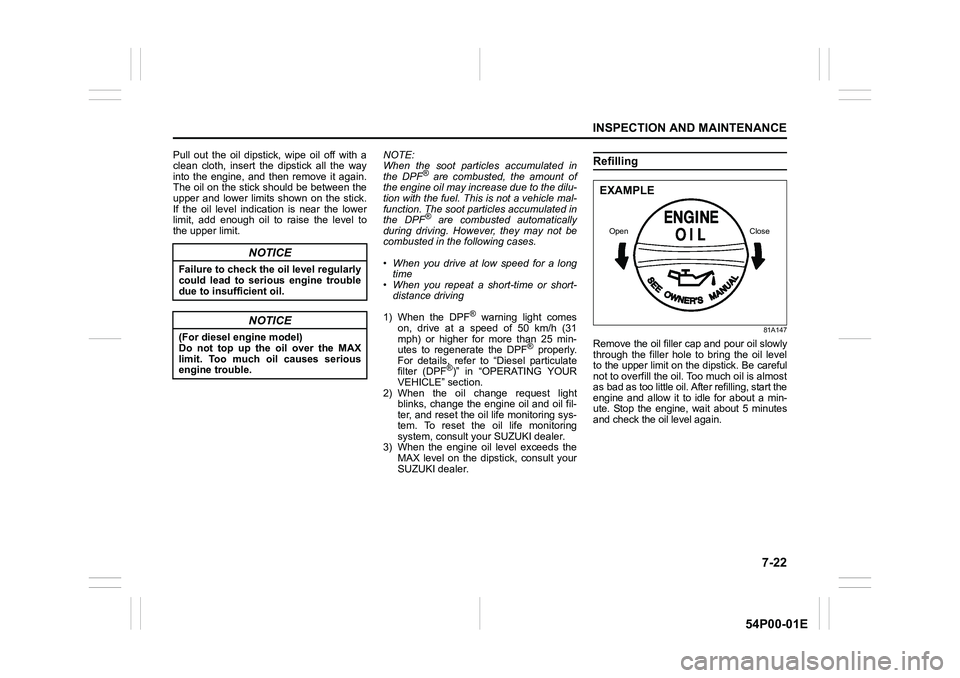
Remove the oil filler cap and pour oil slowly
through the filler hole to bring the oil level
to the upper limit on the dipstick. Be careful
not to overfill the oil. Too much oil is almost
as bad as too little oil. After refilling, start the
engine and allow it to idle for about a min-
ute. Stop the engine, wait about 5 minutes
and check the oil level again.
NOTICE
Failure to check the oil level regularly
could lead to serious engine trouble
due to insufficient oil.
NOTICE
(For diesel engine model)
Do not top up the oil over the MAX
limit. Too much oil causes serious
engine trouble.
EXAMPLE
Open Close
Page 371 of 482
7-33
INSPECTION AND MAINTENANCE
54P00-01E
Fuel filter (diesel engine)
If the fuel filter warning light comes on
when driving, there is a possibility that
water is in the fuel filter. Drain water as
soon as possible. Have your vehicle
inspected by an authorized SUZUKI
dealer.
Brakes
Brake fluid
61MM0B067
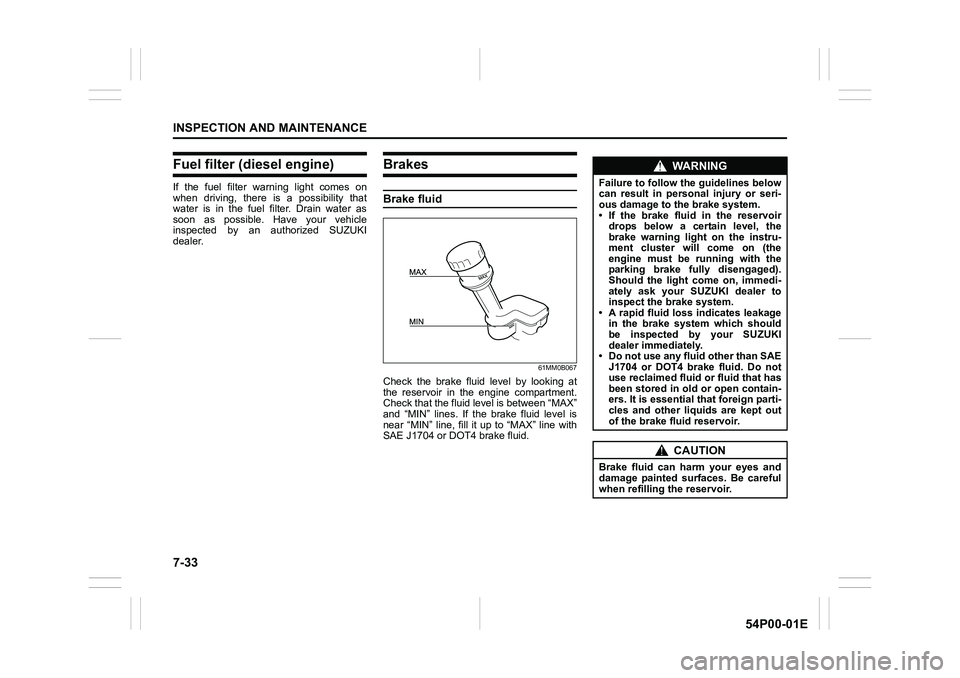
Check the brake fluid level by looking at
the reservoir in the engine compartment.
Check that the fluid level is between “MAX”
and “MIN” lines. If the brake fluid level is
near “MIN” line, fill it up to “MAX” line with
SAE J1704 or DOT4 brake fluid.
WA R N I N G
Failure to follow the guidelines below
can result in personal injury or seri-
ous damage to the brake system.
• If the brake fluid in the reservoir
drops below a certain level, the
brake warning light on the instru-
ment cluster will come on (the
engine must be running with the
parking brake fully disengaged).
Should the light come on, immedi-
ately ask your SUZUKI dealer to
inspect the brake system.
• A rapid fluid loss indicates leakage
in the brake system which should
be inspected by your SUZUKI
dealer immediately.
• Do not use any fluid other than SAE
J1704 or DOT4 brake fluid. Do not
use reclaimed fluid or fluid that has
been stored in old or open contain-
ers. It is essential that foreign parti-
cles and other liquids are kept out
of the brake fluid reservoir.
CAUTION
Brake fluid can harm your eyes and
damage painted surfaces. Be careful
when refilling the reservoir.
Page 374 of 482
7-36
INSPECTION AND MAINTENANCE
54P00-01E
Tires
80JS025
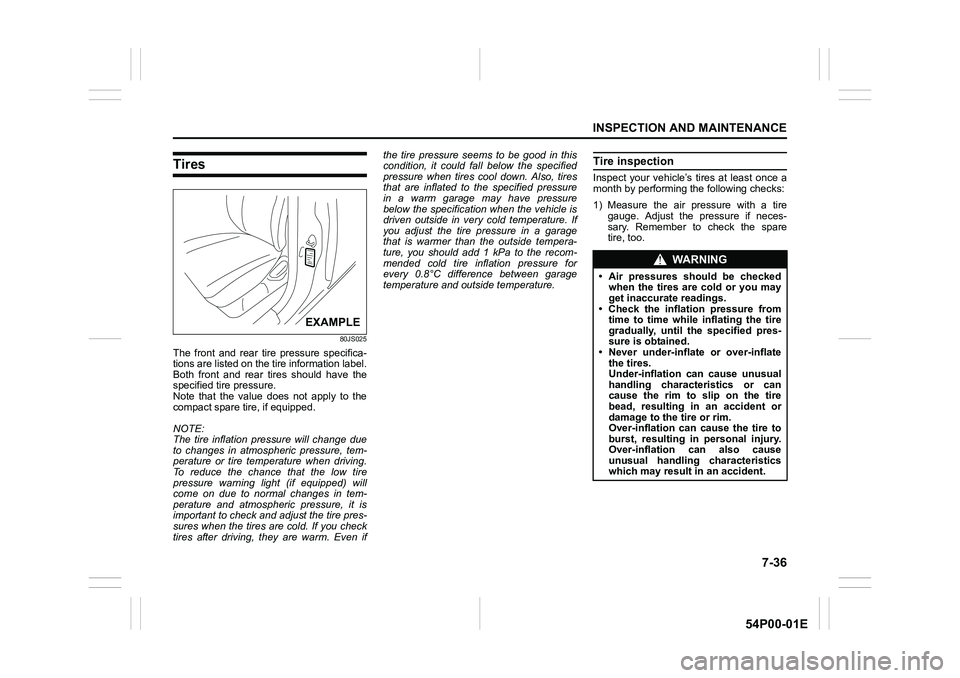
The front and rear tire pressure specifica-
tions are listed on the tire information label.
Both front and rear tires should have the
specified tire pressure.
Note that the value does not apply to the
compact spare tire, if equipped.
NOTE:
The tire inflation pressure will change due
to changes in atmospheric pressure, tem-
perature or tire temperature when driving.
To reduce the chance that the low tire
pressure warning light (if equipped) will
come on due to normal changes in tem-
perature and atmospheric pressure, it is
important to check and adjust the tire pres-
sures when the tires are cold. If you check
tires after driving, they are warm. Even ifthe tire pressure seems to be good in this
condition, it could fall below the specified
pressure when tires cool down. Also, tires
that are inflated to the specified pressure
in a warm garage may have pressure
below the specification when the vehicle is
driven outside in very cold temperature. If
you adjust the tire pressure in a garage
that is warmer than the outside tempera-
ture, you should add 1 kPa to the recom-
mended cold tire inflation pressure for
every 0.8°C difference between garage
temperature and outside temperature.
Tire inspection
Inspect your vehicle’s tires at least once a
month by performing the following checks:
1) Measure the air pressure with a tire
gauge. Adjust the pressure if neces-
sary. Remember to check the spare
tire, too.
EXAMPLE
WA R N I N G
• Air pressures should be checked
when the tires are cold or you may
get inaccurate readings.
• Check the inflation pressure from
time to time while inflating the tire
gradually, until the specified pres-
sure is obtained.
• Never under-inflate or over-inflate
the tires.
Under-inflation can cause unusual
handling characteristics or can
cause the rim to slip on the tire
bead, resulting in an accident or
damage to the tire or rim.
Over-inflation can cause the tire to
burst, resulting in personal injury.
Over-inflation can also cause
unusual handling characteristics
which may result in an accident.
Page 402 of 482
8-2
EMERGENCY SERVICE
54P00-01E
3) Turn on the hazard warning flasher if
your vehicle is near traffic.
4) Block the front and rear of the wheel
diagonally opposite of the wheel being
lifted.
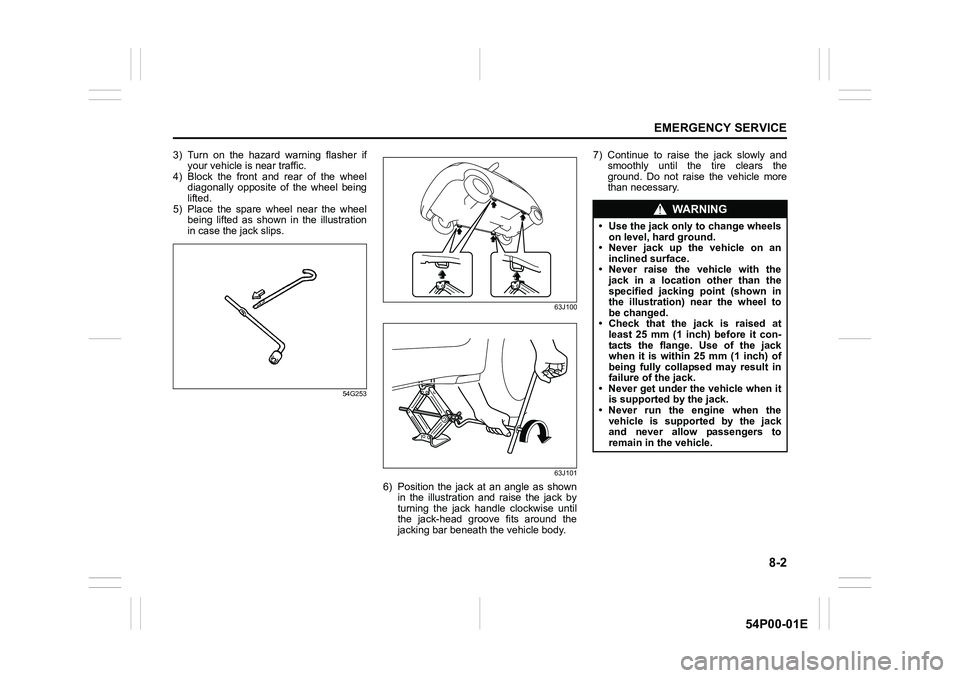
5) Place the spare wheel near the wheel
being lifted as shown in the illustration
in case the jack slips.
54G25363J100
63J101
6) Position the jack at an angle as shown
in the illustration and raise the jack by
turning the jack handle clockwise until
the jack-head groove fits around the
jacking bar beneath the vehicle body.7) Continue to raise the jack slowly and
smoothly until the tire clears the
ground. Do not raise the vehicle more
than necessary.
WA R N I N G
• Use the jack only to change wheels
on level, hard ground.
• Never jack up the vehicle on an
inclined surface.
• Never raise the vehicle with the
jack in a location other than the
specified jacking point (shown in
the illustration) near the wheel to
be changed.
• Check that the jack is raised at
least 25 mm (1 inch) before it con-
tacts the flange. Use of the jack
when it is within 25 mm (1 inch) of
being fully collapsed may result in
failure of the jack.
• Never get under the vehicle when it
is supported by the jack.
• Never run the engine when the
vehicle is supported by the jack
and never allow passengers to
remain in the vehicle.
Page 407 of 482
8-7
EMERGENCY SERVICE
54P00-01E
Emergency repair
1) Place the vehicle on level, hard ground.
Set the parking brake firmly and shift
into “R” (Reverse).
Turn on the hazard warning flasher if
your vehicle is near traffic.
Block the front and rear of the wheel
diagonally opposite of the wheel being
repaired.
2) Take out the sealant bottle and the
compressor.
3) At the top of the compressor, remove
the cap that covers the socket for the
sealant bottle, and then screw the bot-
tle into the socket.
4) Unscrew the valve cap from the tire
valve.
5) Connect the air hose of the air com-
pressor to the tire valve.
6) Connect the power plug of the com-
pressor to the accessory socket. Start
the engine. Switch on the compressor.
Inflate the tire to the required air pres-
sure.
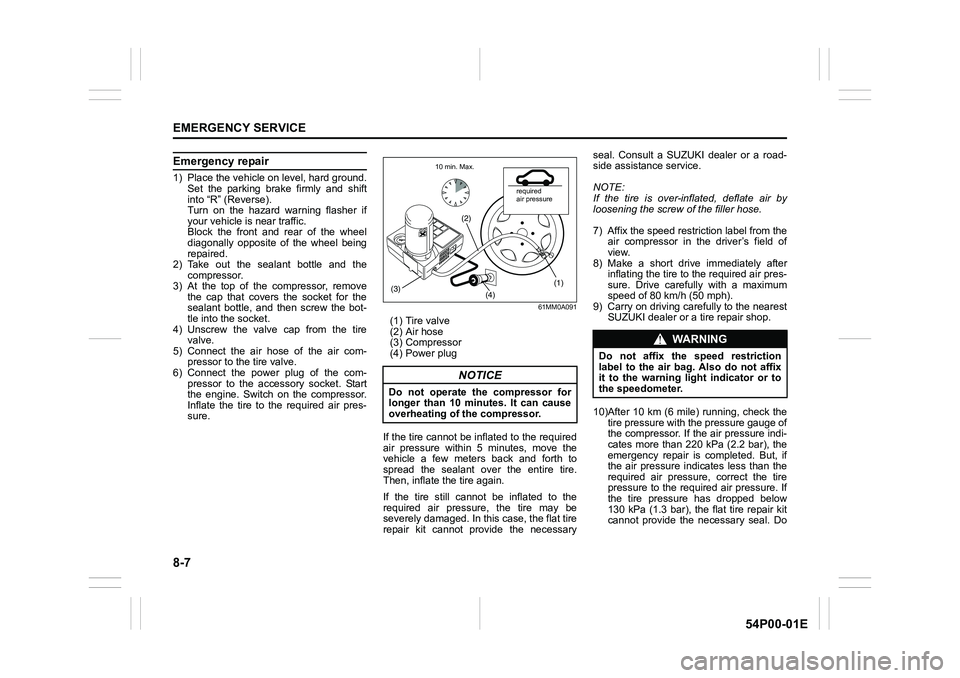
61MM0A091
(1) Tire valve
(2) Air hose
(3) Compressor
(4) Power plug
If the tire cannot be inflated to the required
air pressure within 5 minutes, move the
vehicle a few meters back and forth to
spread the sealant over the entire tire.
Then, inflate the tire again.
If the tire still cannot be inflated to the
required air pressure, the tire may be
severely damaged. In this case, the flat tire
repair kit cannot provide the necessaryseal. Consult a SUZUKI dealer or a road-
side assistance service.
NOTE:
If the tire is over-inflated, deflate air by
loosening the screw of the filler hose.
7) Affix the speed restriction label from the
air compressor in the driver’s field of
view.
8) Make a short drive immediately after
inflating the tire to the required air pres-
sure. Drive carefully with a maximum
speed of 80 km/h (50 mph).
9) Carry on driving carefully to the nearest
SUZUKI dealer or a tire repair shop.
10)After 10 km (6 mile) running, check the
tire pressure with the pressure gauge of
the compressor. If the air pressure indi-
cates more than 220 kPa (2.2 bar), the
emergency repair is completed. But, if
the air pressure indicates less than the
required air pressure, correct the tire
pressure to the required air pressure. If
the tire pressure has dropped below
130 kPa (1.3 bar), the flat tire repair kit
cannot provide the necessary seal. Do
NOTICE
Do not operate the compressor for
longer than 10 minutes. It can cause
overheating of the compressor.
(1)
(4)
(2)
(3)
required
air pressure 10 min. Max.
WA R N I N G
Do not affix the speed restriction
label to the air bag. Also do not affix
it to the warning light indicator or to
the speedometer.
Page 433 of 482
12-3
SUPPLEMENT
54P00-01E
Seat belt warning
Follow this warning as well as the instruc-
tion for seat belt in this book.
In the case where a “Seat Belt Assembly”
incorporates an “Automatic Length Adjust-
ing and Locking Retractor” or an “Emer-
gency Locking Retractor”.
For Mexico
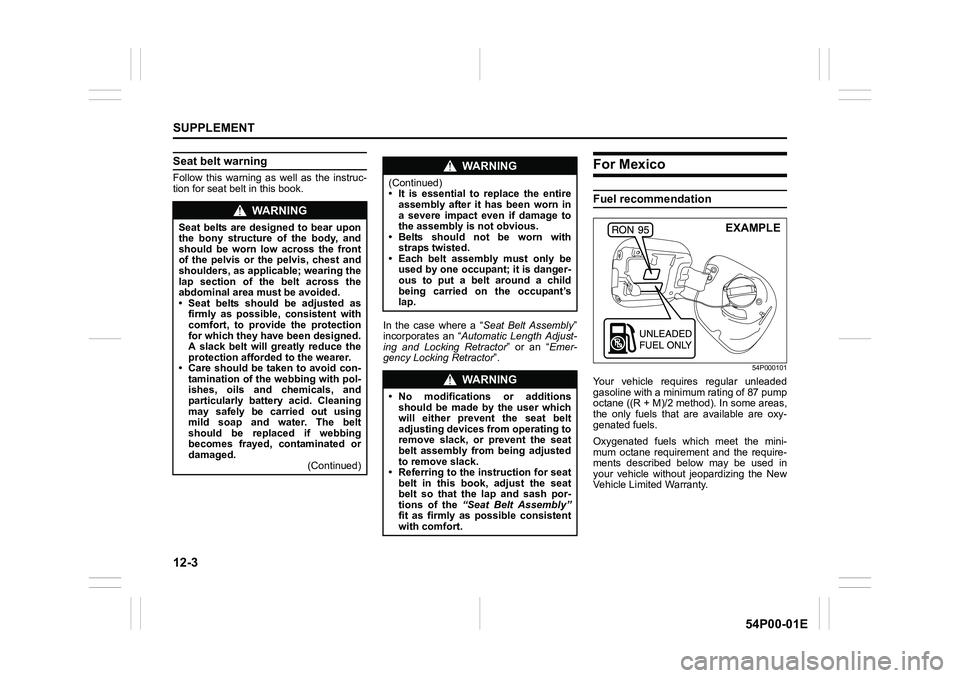
Fuel recommendation
54P000101
Your vehicle requires regular unleaded
gasoline with a minimum rating of 87 pump
octane ((R + M)/2 method). In some areas,
the only fuels that are available are oxy-
genated fuels.
Oxygenated fuels which meet the mini-
mum octane requirement and the require-
ments described below may be used in
your vehicle without jeopardizing the New
Vehicle Limited Warranty.
WA R N I N G
Seat belts are designed to bear upon
the bony structure of the body, and
should be worn low across the front
of the pelvis or the pelvis, chest and
shoulders, as applicable; wearing the
lap section of the belt across the
abdominal area must be avoided.
• Seat belts should be adjusted as
firmly as possible, consistent with
comfort, to provide the protection
for which they have been designed.
A slack belt will greatly reduce the
protection afforded to the wearer.
• Care should be taken to avoid con-
tamination of the webbing with pol-
ishes, oils and chemicals, and
particularly battery acid. Cleaning
may safely be carried out using
mild soap and water. The belt
should be replaced if webbing
becomes frayed, contaminated or
damaged.
(Continued)
WA R N I N G
(Continued)
• It is essential to replace the entire
assembly after it has been worn in
a severe impact even if damage to
the assembly is not obvious.
• Belts should not be worn with
straps twisted.
• Each belt assembly must only be
used by one occupant; it is danger-
ous to put a belt around a child
being carried on the occupant’s
lap.
WA R N I N G
• No modifications or additions
should be made by the user which
will either prevent the seat belt
adjusting devices from operating to
remove slack, or prevent the seat
belt assembly from being adjusted
to remove slack.
• Referring to the instruction for seat
belt in this book, adjust the seat
belt so that the lap and sash por-
tions of the “Seat Belt Assembly”
fit as firmly as possible consistent
with comfort.
EXAMPLE
Page 437 of 482
12-7
SUPPLEMENT
54P00-01E
How to stop the alarm
Should the alarm be triggered accidentally,
unlock the doors using the keyless push
start system remote controller, the request
switch or the keyless entry system trans-
mitter, or press the engine switch to
change the ignition mode to “ON” or turn
the ignition switch to “ON” position. The
alarm will then stop.
NOTE:
Even after the alarm has stopped, if you
lock the doors using the keyless push
start system remote controller, the
request switch or the keyless entry sys-
tem transmitter, the theft deterrent alarm
system will be rearmed with a delay of
about 20 seconds.
If you disconnect the battery while the
theft deterrent alarm system is in the
armed condition or the alarm is actually
in operation, the alarm will be triggered
or re-triggered when the battery is then
reconnected, although, in the latter case,
the alarm remains stopped for the period
between disconnection and reconnec-
tion of the battery.
Even after the alarm has stopped at the
end of the predetermined operation time,
it will be triggered again if any door or
engine hood (for EU specification vehi-
cle) is opened without disarming the
theft deterrent alarm system.Checking whether the alarm has been
triggered during parking
If the alarm was triggered due to an unau-
thorized entry into the vehicle and you then
press the engine switch to change the igni-
tion mode to “ON” or turn the ignition
switch to “ON” position, the theft deterrent
light will blink rapidly for about 8 seconds
and a buzzer will beep 4 times during this
period. If this happens, check whether your
vehicle has been broken into while you
were away from it.
Enabling and disabling the theft deter-
rent alarm system
The theft deterrent alarm system can be
either enabled or disabled.
When enabled (factory setting)
When the system is enabled, it causes the
hazard warning lights to flash for about 40
seconds if any of the alarm trigger condi-
tions is met. The system also causes the
interior buzzer to beep intermittently for
about 10 seconds, which is followed by
intermittent sounding of the horn for about
30 seconds.
The theft deterrent light continues to blink
during this time.
When disabled
When the system is disabled, it stays dis-
armed even if you perform any system
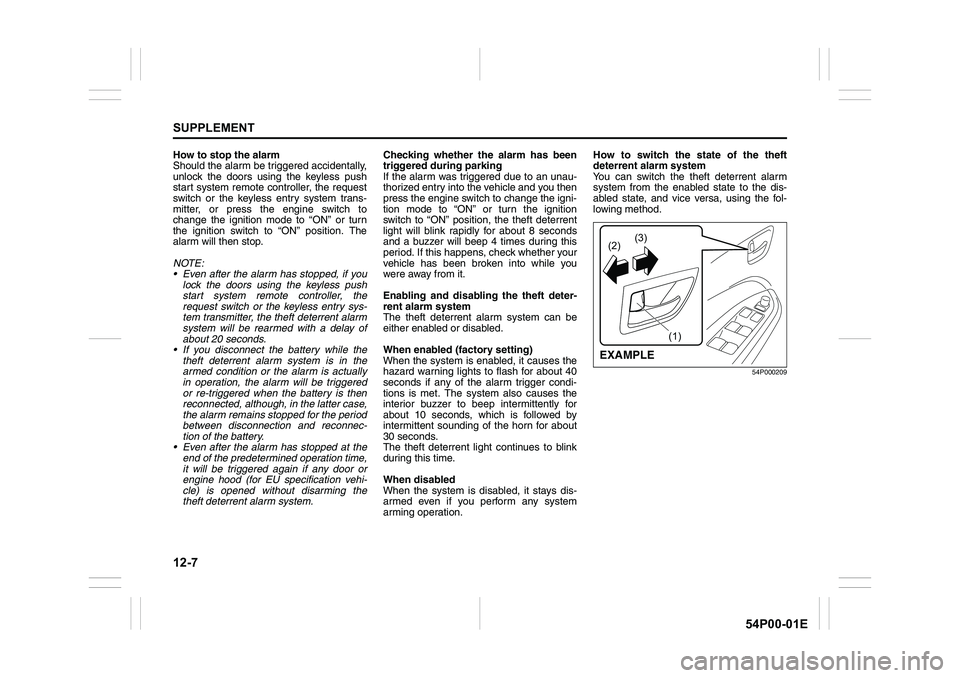
arming operation.How to switch the state of the theft
deterrent alarm system
You can switch the theft deterrent alarm
system from the enabled state to the dis-
abled state, and vice versa, using the fol-
lowing method.
54P000209
(2)(3)
(1)
EXAMPLE