brake sensor SUZUKI GRAND VITARA 2015 User Guide
[x] Cancel search | Manufacturer: SUZUKI, Model Year: 2015, Model line: GRAND VITARA, Model: SUZUKI GRAND VITARA 2015Pages: 482, PDF Size: 21 MB
Page 196 of 482
3-56
OPERATING YOUR VEHICLE
54P00-01E
NOTE:
Even if you switch the frontal collision
warning timing, the warning brake system,
brake assist system and automatic brake
system timing will not change.
Warning brake system
When you are operating at a speed of
approximately 30 km/h (19 mph) or over
and if the driver cannot take or is insufficient
to take evasive action such as brake opera-
tion and steering operation after frontal colli-
sion warning activates, the system applies
brake lightly.
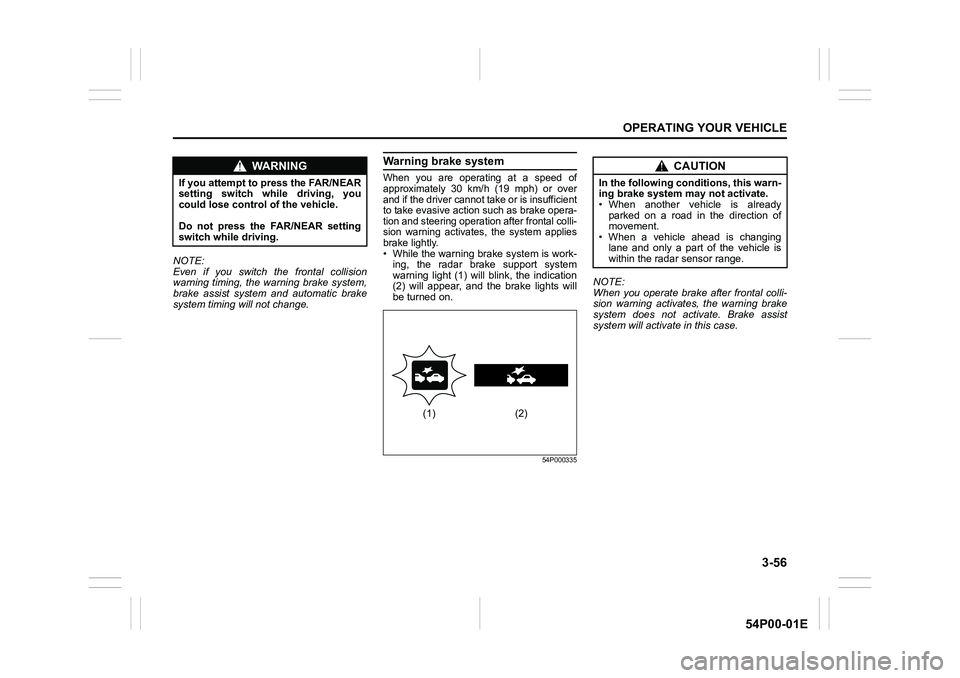
• While the warning brake system is work-
ing, the radar brake support system
warning light (1) will blink, the indication
(2) will appear, and the brake lights will
be turned on.
54P000335
NOTE:
When you operate brake after frontal colli-
sion warning activates, the warning brake
system does not activate. Brake assist
system will activate in this case.
WA R N I N G
If you attempt to press the FAR/NEAR
setting switch while driving, you
could lose control of the vehicle.
Do not press the FAR/NEAR setting
switch while driving.
(1) (2)
CAUTION
In the following conditions, this warn-
ing brake system may not activate.
• When another vehicle is already
parked on a road in the direction of
movement.
• When a vehicle ahead is changing
lane and only a part of the vehicle is
within the radar sensor range.
Page 198 of 482
3-58
OPERATING YOUR VEHICLE
54P00-01E
• In the following situations, the radar sen-
sor might not function properly. Turn it off
and have it inspected by an authorized
SUZUKI dealer.
– When there is a minor crash and the
radar sensor is damaged or hindered
– When the warning brake system and
automatic brake system are activated
more than necessary
54P000337
54P000336
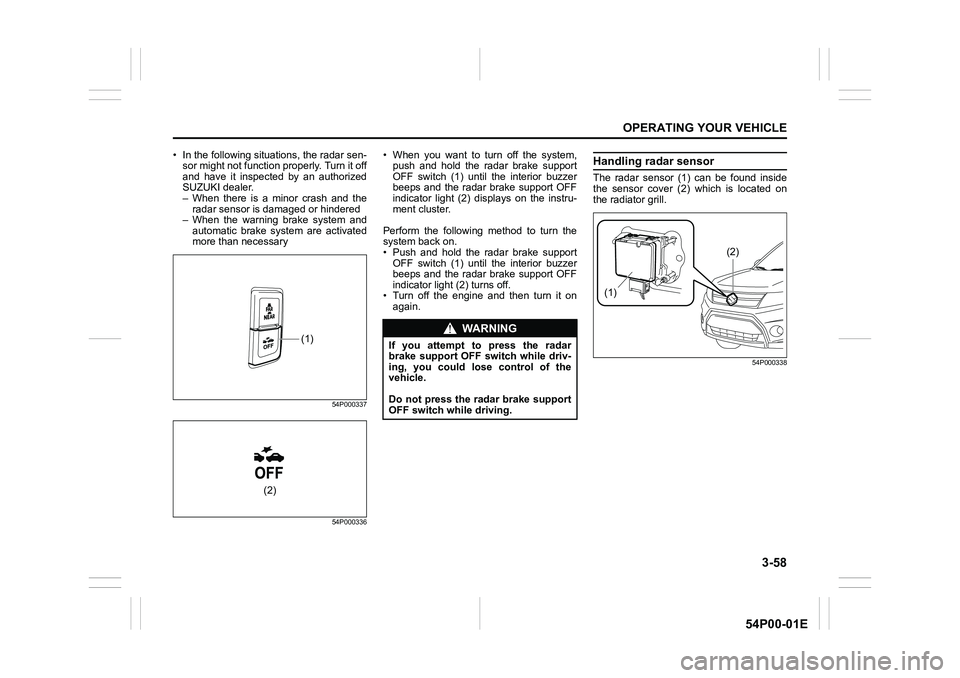
• When you want to turn off the system,
push and hold the radar brake support
OFF switch (1) until the interior buzzer
beeps and the radar brake support OFF
indicator light (2) displays on the instru-
ment cluster.
Perform the following method to turn the
system back on.
• Push and hold the radar brake support
OFF switch (1) until the interior buzzer
beeps and the radar brake support OFF
indicator light (2) turns off.
• Turn off the engine and then turn it on
again.Handling radar sensor
The radar sensor (1) can be found inside
the sensor cover (2) which is located on
the radiator grill.
54P000338
(1)
(2)
WA R N I N G
If you attempt to press the radar
brake support OFF switch while driv-
ing, you could lose control of the
vehicle.
Do not press the radar brake support
OFF switch while driving.
(1)
(2)
Page 199 of 482
3-59
OPERATING YOUR VEHICLE
54P00-01E
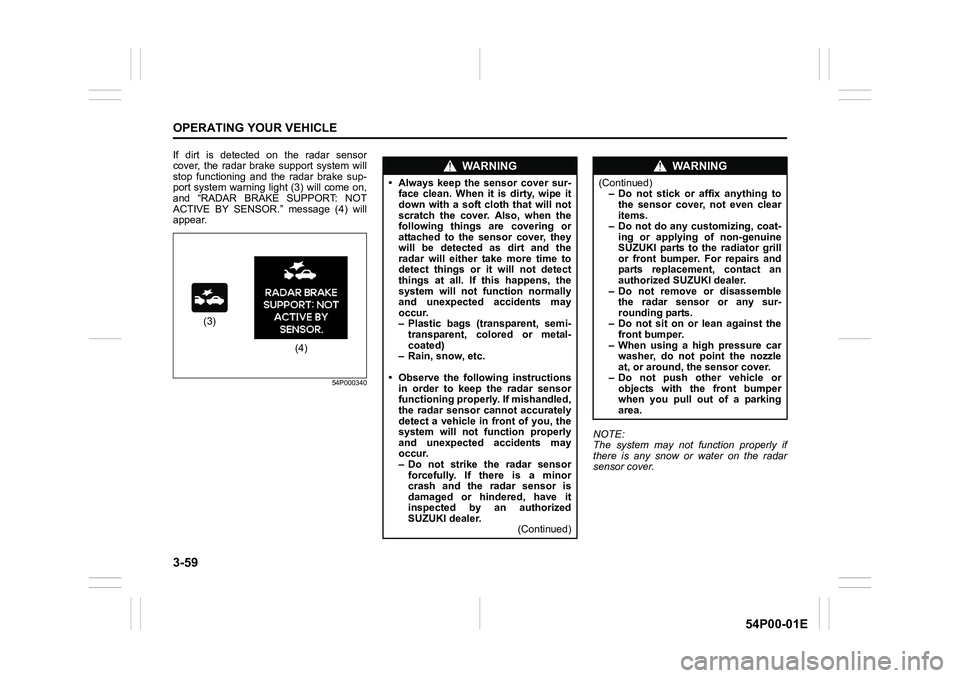
If dirt is detected on the radar sensor
cover, the radar brake support system will
stop functioning and the radar brake sup-
port system warning light (3) will come on,
and “RADAR BRAKE SUPPORT: NOT
ACTIVE BY SENSOR.” message (4) will
appear.
54P000340
NOTE:
The system may not function properly if
there is any snow or water on the radar
sensor cover.
(3)
(4)
WA R N I N G
• Always keep the sensor cover sur-
face clean. When it is dirty, wipe it
down with a soft cloth that will not
scratch the cover. Also, when the
following things are covering or
attached to the sensor cover, they
will be detected as dirt and the
radar will either take more time to
detect things or it will not detect
things at all. If this happens, the
system will not function normally
and unexpected accidents may
occur.
– Plastic bags (transparent, semi-
transparent, colored or metal-
coated)
– Rain, snow, etc.
• Observe the following instructions
in order to keep the radar sensor
functioning properly. If mishandled,
the radar sensor cannot accurately
detect a vehicle in front of you, the
system will not function properly
and unexpected accidents may
occur.
– Do not strike the radar sensor
forcefully. If there is a minor
crash and the radar sensor is
damaged or hindered, have it
inspected by an authorized
SUZUKI dealer.
(Continued)
WA R N I N G
(Continued)
– Do not stick or affix anything to
the sensor cover, not even clear
items.
– Do not do any customizing, coat-
ing or applying of non-genuine
SUZUKI parts to the radiator grill
or front bumper. For repairs and
parts replacement, contact an
authorized SUZUKI dealer.
– Do not remove or disassemble
the radar sensor or any sur-
rounding parts.
– Do not sit on or lean against the
front bumper.
– When using a high pressure car
washer, do not point the nozzle
at, or around, the sensor cover.
– Do not push other vehicle or
objects with the front bumper
when you pull out of a parking
area.
Page 200 of 482
3-60
OPERATING YOUR VEHICLE
54P00-01E
When dirt is detected on the sensor
cover
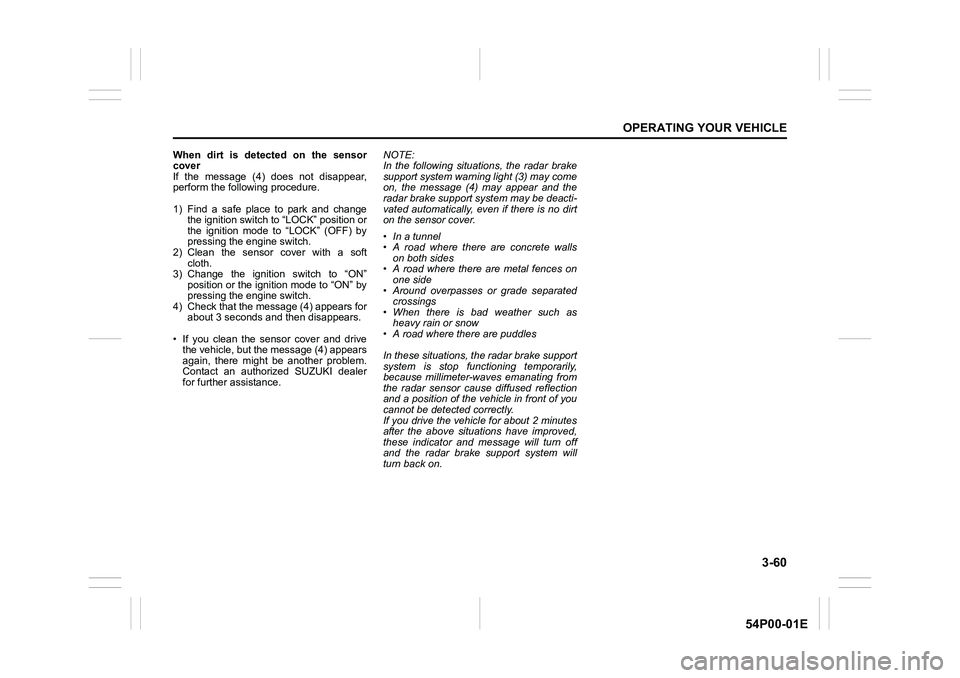
If the message (4) does not disappear,
perform the following procedure.
1) Find a safe place to park and change
the ignition switch to “LOCK” position or
the ignition mode to “LOCK” (OFF) by
pressing the engine switch.
2) Clean the sensor cover with a soft
cloth.
3) Change the ignition switch to “ON”
position or the ignition mode to “ON” by
pressing the engine switch.
4) Check that the message (4) appears for
about 3 seconds and then disappears.
• If you clean the sensor cover and drive
the vehicle, but the message (4) appears
again, there might be another problem.
Contact an authorized SUZUKI dealer
for further assistance.NOTE:
In the following situations, the radar brake
support system warning light (3) may come
on, the message (4) may appear and the
radar brake support system may be deacti-
vated automatically, even if there is no dirt
on the sensor cover.
• In a tunnel
• A road where there are concrete walls
on both sides
• A road where there are metal fences on
one side
• Around overpasses or grade separated
crossings
• When there is bad weather such as
heavy rain or snow
• A road where there are puddles
In these situations, the radar brake support
system is stop functioning temporarily,
because millimeter-waves emanating from
the radar sensor cause diffused reflection
and a position of the vehicle in front of you
cannot be detected correctly.
If you drive the vehicle for about 2 minutes
after the above situations have improved,
these indicator and message will turn off
and the radar brake support system will
turn back on.
Page 202 of 482
3-62
OPERATING YOUR VEHICLE
54P00-01E
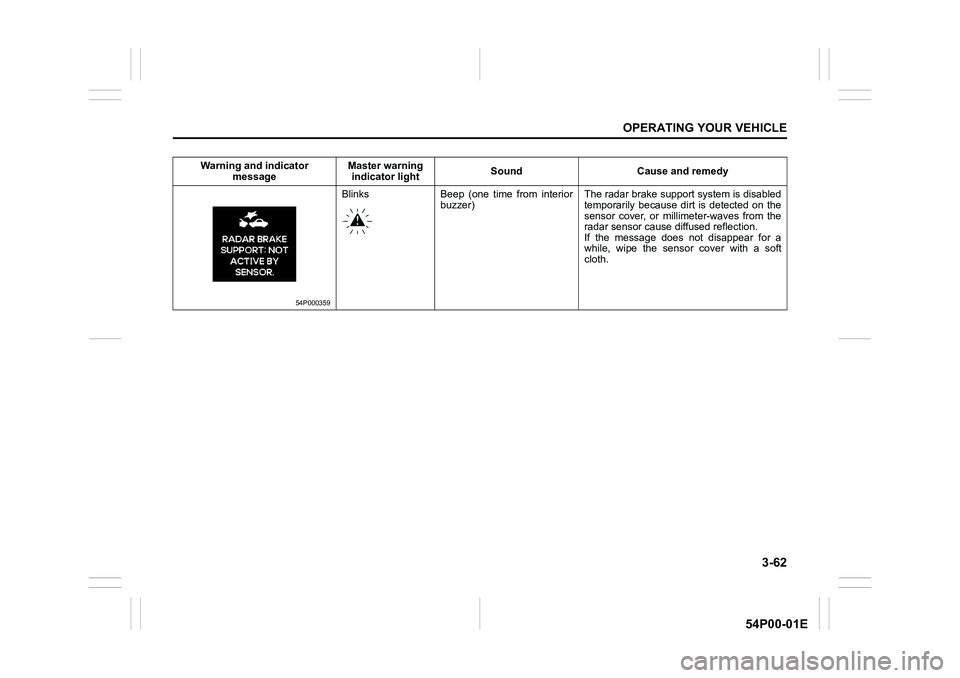
Warning and indicator
messageMaster warning
indicator lightSound Cause and remedy
54P000359
Blinks Beep (one time from interior
buzzer)The radar brake support system is disabled
temporarily because dirt is detected on the
sensor cover, or millimeter-waves from the
radar sensor cause diffused reflection.
If the message does not disappear for a
while, wipe the sensor cover with a soft
cloth.
Page 206 of 482
3-66
OPERATING YOUR VEHICLE
54P00-01E
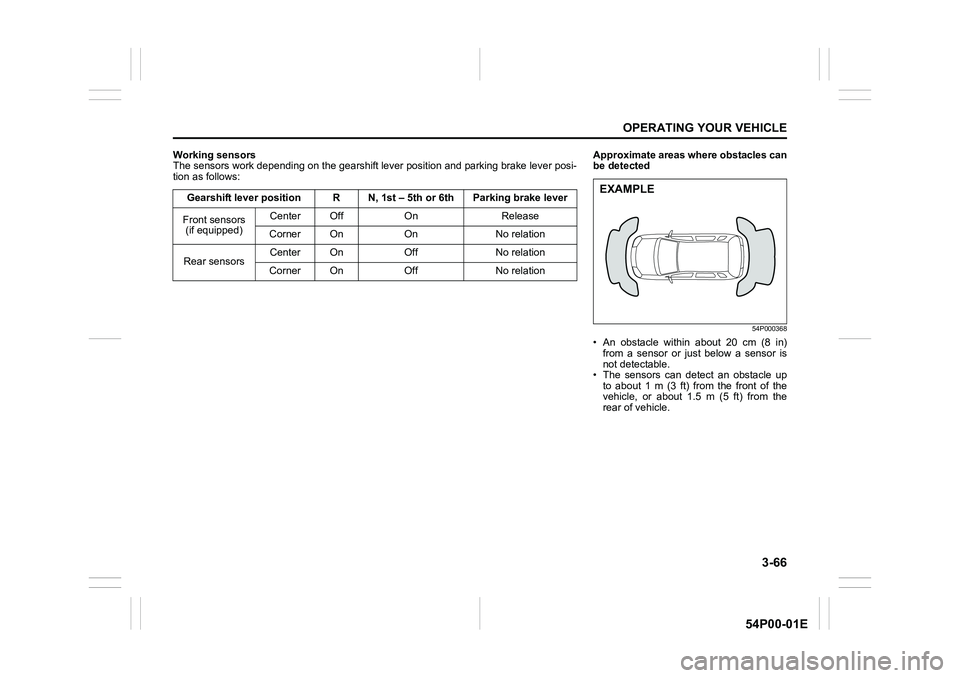
Working sensors
The sensors work depending on the gearshift lever position and parking brake lever posi-
tion as follows:
Gearshift lever position R N, 1st – 5th or 6th Parking brake lever
Front sensors
(if equipped)Center Off On Release
Corner On On No relation
Rear sensorsCenter On Off No relation
Corner On Off No relationApproximate areas where obstacles can
be detected
54P000368
• An obstacle within about 20 cm (8 in)
from a sensor or just below a sensor is
not detectable.
• The sensors can detect an obstacle up
to about 1 m (3 ft) from the front of the
vehicle, or about 1.5 m (5 ft) from the
rear of vehicle.
EXAMPLE
Page 218 of 482
3-78
OPERATING YOUR VEHICLE
54P00-01E
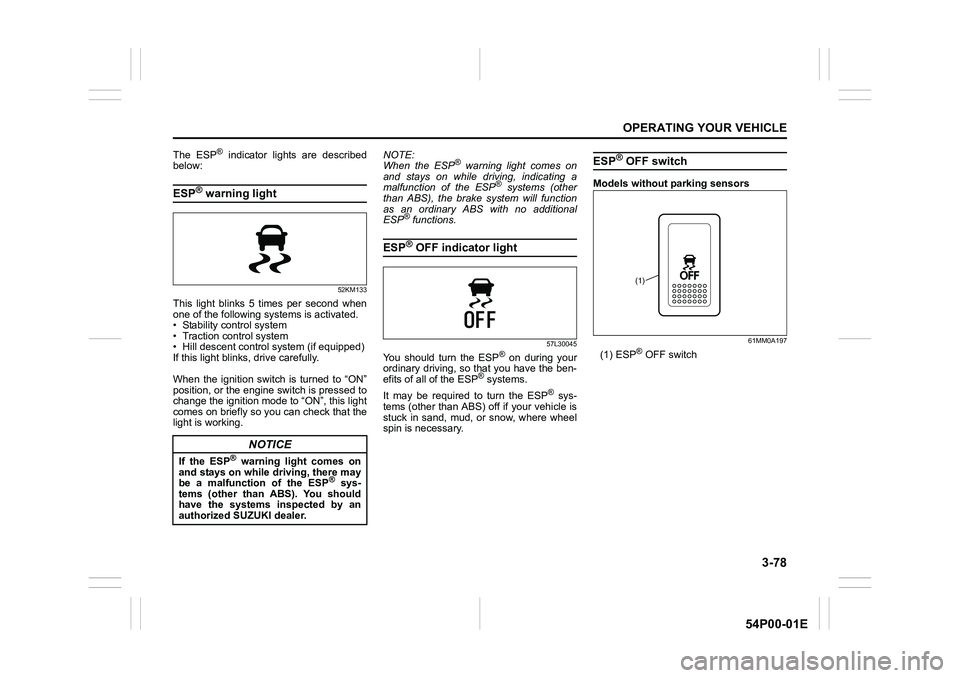
The ESP® indicator lights are described
below:
ESP® warning light
52KM133
This light blinks 5 times per second when
one of the following systems is activated.
• Stability control system
• Traction control system
• Hill descent control system (if equipped)
If this light blinks, drive carefully.
When the ignition switch is turned to “ON”
position, or the engine switch is pressed to
change the ignition mode to “ON”, this light
comes on briefly so you can check that the
light is working.NOTE:
When the ESP
® warning light comes on
and stays on while driving, indicating a
malfunction of the ESP
® systems (other
than ABS), the brake system will function
as an ordinary ABS with no additional
ESP
® functions.
ESP® OFF indicator light
57L30045
You should turn the ESP® on during your
ordinary driving, so that you have the ben-
efits of all of the ESP
® systems.
It may be required to turn the ESP
® sys-
tems (other than ABS) off if your vehicle is
stuck in sand, mud, or snow, where wheel
spin is necessary.
ESP® OFF switch
Models without parking sensors
61MM0A197
(1) ESP® OFF switch
NOTICE
If the ESP® warning light comes on
and stays on while driving, there may
be a malfunction of the ESP
® sys-
tems (other than ABS). You should
have the systems inspected by an
authorized SUZUKI dealer.
(1)
Page 219 of 482
3-79
OPERATING YOUR VEHICLE
54P00-01E
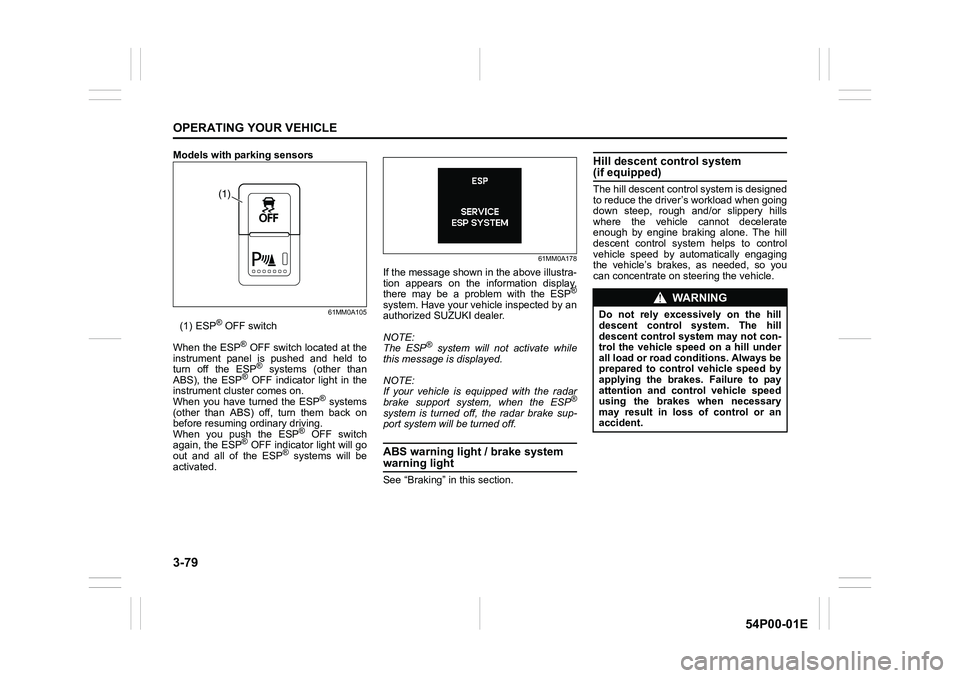
Models with parking sensors
61MM0A105
(1) ESP® OFF switch
When the ESP
® OFF switch located at the
instrument panel is pushed and held to
turn off the ESP
® systems (other than
ABS), the ESP® OFF indicator light in the
instrument cluster comes on.
When you have turned the ESP
® systems
(other than ABS) off, turn them back on
before resuming ordinary driving.
When you push the ESP
® OFF switch
again, the ESP® OFF indicator light will go
out and all of the ESP® systems will be
activated.
61MM0A178
If the message shown in the above illustra-
tion appears on the information display,
there may be a problem with the ESP
®
system. Have your vehicle inspected by an
authorized SUZUKI dealer.
NOTE:
The ESP
® system will not activate while
this message is displayed.
NOTE:
If your vehicle is equipped with the radar
brake support system, when the ESP
®
system is turned off, the radar brake sup-
port system will be turned off.
ABS warning light / brake system
warning light
See “Braking” in this section.
Hill descent control system (if equipped)
The hill descent control system is designed
to reduce the driver’s workload when going
down steep, rough and/or slippery hills
where the vehicle cannot decelerate
enough by engine braking alone. The hill
descent control system helps to control
vehicle speed by automatically engaging
the vehicle’s brakes, as needed, so you
can concentrate on steering the vehicle.(1)
WA R N I N G
Do not rely excessively on the hill
descent control system. The hill
descent control system may not con-
trol the vehicle speed on a hill under
all load or road conditions. Always be
prepared to control vehicle speed by
applying the brakes. Failure to pay
attention and control vehicle speed
using the brakes when necessary
may result in loss of control or an
accident.
Page 334 of 482
6-2
VEHICLE LOADING AND TOWING
54P00-01E
NOTE:
If your vehicle has a parking sensor sys-
tem, set the system to the trailer mode via
the information display. When this mode is
set, the rear corner and rear center sen-
sors are inhibited from operating. Refer to
“Information display” in “BEFORE DRIV-
ING” section.
To w b a r s
Only use a tow bar that is designed to
attach to the chassis of your vehicle, and a
hitch that is designed to bolt to this tow bar.
We recommend that you use a genuine
SUZUKI tow bar (available as option), or
equivalent.
Safety chains
Always attach safety chains between your
vehicle and trailer. Cross safety chains
under the nose of the trailer so that the
nose will not drop to the road if the trailer
becomes separated from the tow bar. Fol-
low the manufacturer’s recommendation
for attaching safety chains. Always leave
just enough slack to permit full turning.
Never allow safety chains to drag on the
road.
Trailer lights
Check that your trailer is equipped with
lights which meet local requirements.
Always check for the proper operation of
all trailer lights before you start to tow.
Brakes
WA R N I N G
For vehicles equipped with the radar
brake support system, if your vehicle
is used to tow a trailer, press the
radar brake support OFF switch and
turn off the radar brake support sys-
tem. If not, unexpected accidents
related to the system being turned on
may occur.
NOTICE
Trailer towing puts additional stress
on the engine, drive train and brakes
of your vehicle. Never tow a trailer
during the first 960 km (600 miles) of
vehicle operation.
WA R N I N G
Never use a tow bar which attaches
to the axle or the bumper of your
vehicle.
WA R N I N G
Never attach safety chains to the
bumper of your vehicle. Secure con-
nections so that they cannot come
loose.
WA R N I N G
Never connect trailer lights directly
into your vehicle’s electrical system,
or electrical system damage may
occur.
WA R N I N G
If trailer brakes are used, follow all
instructions provided by the manu-
facturer. Never connect to the brake
system of your vehicle and never
take an electrical supply directly from
the wiring harness.
Page 408 of 482
8-8
EMERGENCY SERVICE
54P00-01E
not use the tire and consult a SUZUKI
dealer or a roadside assistance service.Using compressor to inflate a tire
1) Place the vehicle on level, hard ground.
Set the parking brake firmly and shift
into “R” (Reverse).
2) Take out the compressor.
3) Unscrew the valve cap from the tire
valve.
4) Connect the air hose of the compressor
to the tire valve.
5) Connect the power plug of the com-
pressor to the accessory socket. Start
the engine. Switch on the compressor.
Inflate the tire to the required air pres-
sure.
Jump-starting instructions
WA R N I N G
Check the tire pressure and confirm
the completion of the emergency
repair after 10 km (6 mile) of running.
NOTICE
Have the tire renewed at the nearest
SUZUKI dealer. When reusing the
sealed tire, consult a tire repair shop.
The wheel can be reused after wiping
sealant off completely with cloth in
order to prevent rust, but the tire
valve and tire pressure monitoring
system (TPMS) sensor must be
renewed.
Dispose of the sealant bottle at a
SUZUKI dealer or in accordance with
your regional codes and practices.
After using the sealant bottle, replace
it with a new bottle from your SUZUKI
dealer.
NOTICE
Do not operate the compressor for
longer than 10 minutes. It can cause
overheating of the compressor.
WA R N I N G
• Never attempt to jump-start your
vehicle if the battery appears to be
frozen. Batteries in this condition
may explode.
• When making jump lead connec-
tions, check that your hands and
the jump leads remain clear from
pulleys, belts or fans.
• Batteries produce flammable
hydrogen gas. Keep flames and
sparks away from the battery or an
explosion may occur. Never smoke
when working near the battery.
• If the booster battery you use for
jump-starting is installed in another
vehicle, check that the two vehicles
are not touching each other.
• If your battery discharges repeat-
edly, for no apparent reason, have
your vehicle inspected by an
authorized SUZUKI dealer.
• To avoid harm to yourself or dam-
age to your vehicle or battery, fol-
low the jump-starting instructions
below.
If you are in doubt, call for qualified
road service.