check oil SUZUKI GRAND VITARA 2017 Owner's Manual
[x] Cancel search | Manufacturer: SUZUKI, Model Year: 2017, Model line: GRAND VITARA, Model: SUZUKI GRAND VITARA 2017Pages: 482, PDF Size: 21 MB
Page 364 of 482
7-26
INSPECTION AND MAINTENANCE
54P00-01E
Refill with oil and oil leakage check
1) Pour oil through the filler hole and
install the filler cap.
For the approximate capacity of the oil,
refer to “Capacities” in “SPECIFICA-
TIONS” section.
2) Start the engine and carefully check the
oil filter and the drain plug for leakage.
Run the engine at various speeds for at
least 5 minutes.
3) Stop the engine and wait about 5 min-
utes. Check the oil level again and add
oil if necessary. Check for leakage
again.
Engine coolant
Selection of coolant
To maintain optimum performance and
durability of your engine, use SUZUKI gen-
uine coolant or equivalent.
NOTE:
If you replace the engine coolant with cool-
ant other than “SUZUKI LLC: Super
(Blue)”, follow the schedule of “SUZUKI
LLC: Standard (Green)”. To see the detail
of the maintenance schedule, refer to
“Maintenance schedule” in this section.
This type of coolant is the best for cooling
system for the following reasons:
• The coolant helps maintain proper
engine temperature.
• It gives proper protection against freez-
ing and boiling.
• It gives proper protection against corro-
sion and rust.
Failure to use the proper coolant can dam-
age your cooling system. Your authorizedSUZUKI dealer can help you select the
proper coolant.
NOTICE
• When replacing the oil filter, it is
recommended that you use a genu-
ine SUZUKI replacement filter. If
you use an aftermarket filter, check
that it is of equivalent quality and
follow the manufacturer’s instruc-
tions.
• Oil leakage from the periphery of
the oil filter or drain plug indicate
incorrect installation or gasket
damage. If you find any leakage or
are not sure that the filter has been
properly tightened, have the vehi-
cle inspected by your SUZUKI
dealer.
NOTICE
“SUZUKI LLC: Super (Blue) coolant”;
This coolant is already diluted to the
proper percentage. Do not dilute with
distilled water additionally. Doing so
may result in the possibility of freez-
ing and/or overheating coolant.
NOTICE
To avoid damaging your cooling sys-
tem:
• Always use a high quality ethylene
glycol base non-silicate type cool-
ant diluted with distilled water at
the correct mixture concentration.
• Check that the proper mix is 50/50
coolant to distilled water and in no
case higher than 70/30. Concentra-
tions greater than 70/30 coolant to
distilled water will cause overheat-
ing conditions.
• Do not use straight coolant nor
plain water (except “SUZUKI LLC:
Super (Blue)”).
• Do not add extra inhibitors or addi-
tives. They may not be compatible
with your cooling system.
• Do not mix different types of base
coolants. Doing so may result in
accelerated seal wear and/or the
possibility of severe overheating
and extensive engine damage.
Page 366 of 482
7-28
INSPECTION AND MAINTENANCE
54P00-01E
If the coolant level is below “LOW” mark,
more coolant should be added. When the
engine is cool, remove the degassing tank
cap by turning it counterclockwise slowly to
release any pressure. And add coolant
until the degassing tank level reaches
“FULL” mark. Never fill the degassing tank
above “FULL” mark.
Coolant replacement
Since special procedures are required, ask
your authorized SUZUKI dealer for this job.
Air cleaner
If the air cleaner is clogged with dust, there
will be greater intake resistance, resulting
in decreased power output and increased
fuel consumption.
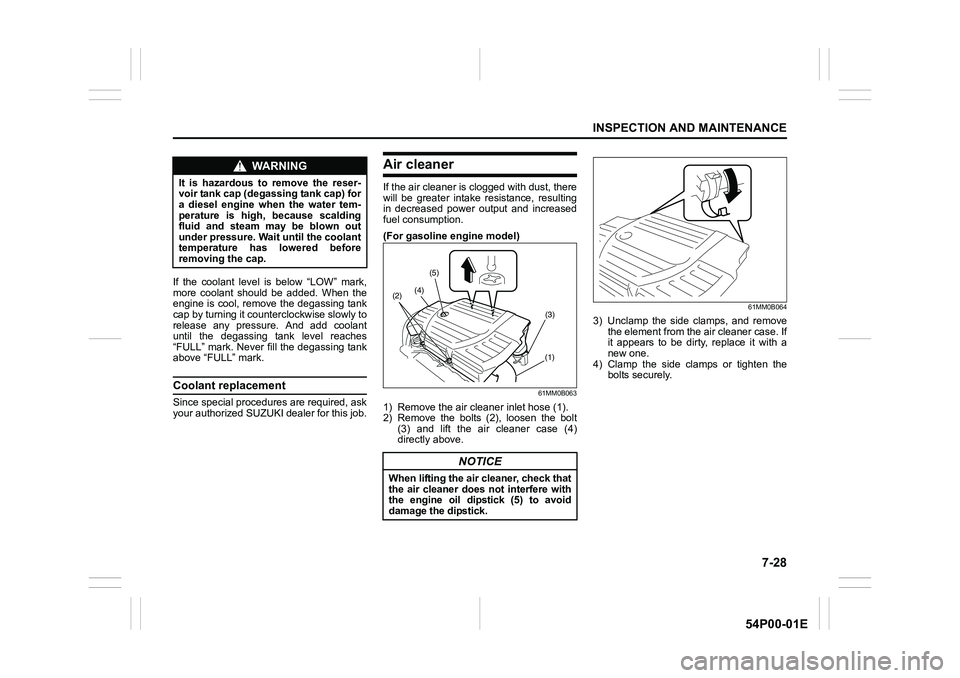
(For gasoline engine model)
61MM0B063
1) Remove the air cleaner inlet hose (1).
2) Remove the bolts (2), loosen the bolt
(3) and lift the air cleaner case (4)
directly above.
61MM0B064
3) Unclamp the side clamps, and remove
the element from the air cleaner case. If
it appears to be dirty, replace it with a
new one.
4) Clamp the side clamps or tighten the
bolts securely.
WA R N I N G
It is hazardous to remove the reser-
voir tank cap (degassing tank cap) for
a diesel engine when the water tem-
perature is high, because scalding
fluid and steam may be blown out
under pressure. Wait until the coolant
temperature has lowered before
removing the cap.
NOTICE
When lifting the air cleaner, check that
the air cleaner does not interfere with
the engine oil dipstick (5) to avoid
damage the dipstick.
(4)(5)
(1) (2)
(3)
Page 367 of 482
7-29
INSPECTION AND MAINTENANCE
54P00-01E
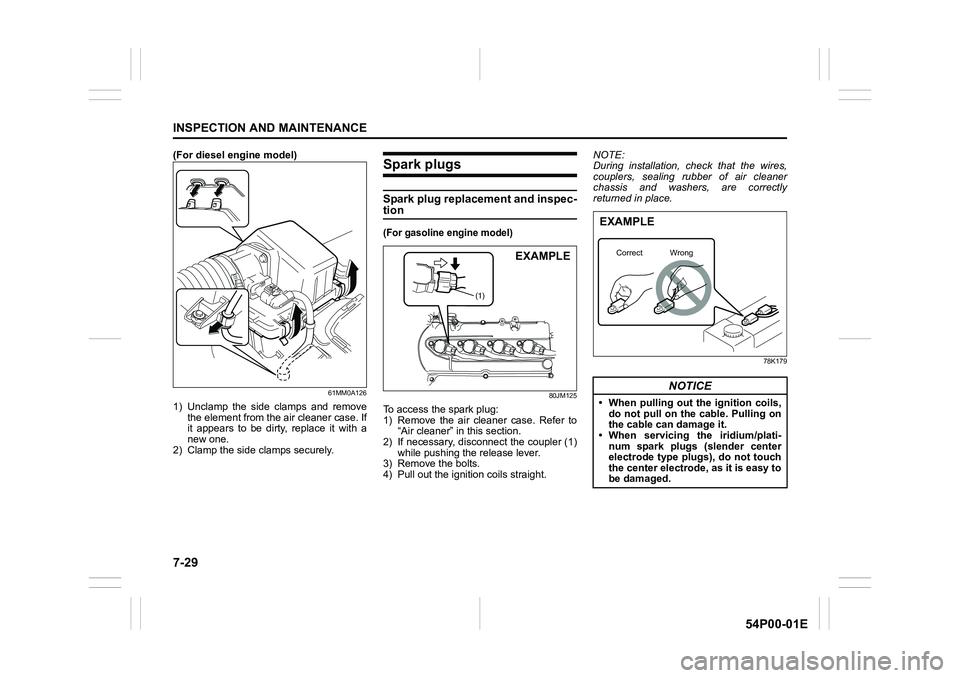
(For diesel engine model)
61MM0A126
1) Unclamp the side clamps and remove
the element from the air cleaner case. If
it appears to be dirty, replace it with a
new one.
2) Clamp the side clamps securely.
Spark plugs
Spark plug replacement and inspec-
tion
(For gasoline engine model)
80JM125
To access the spark plug:
1) Remove the air cleaner case. Refer to
“Air cleaner” in this section.
2) If necessary, disconnect the coupler (1)
while pushing the release lever.
3) Remove the bolts.
4) Pull out the ignition coils straight.NOTE:
During installation, check that the wires,
couplers, sealing rubber of air cleaner
chassis and washers, are correctly
returned in place.
78K179
(1)
EXAMPLE
NOTICE
• When pulling out the ignition coils,
do not pull on the cable. Pulling on
the cable can damage it.
• When servicing the iridium/plati-
num spark plugs (slender center
electrode type plugs), do not touch
the center electrode, as it is easy to
be damaged.
EXAMPLE
Correct Wrong
Page 369 of 482
7-31
INSPECTION AND MAINTENANCE
54P00-01E
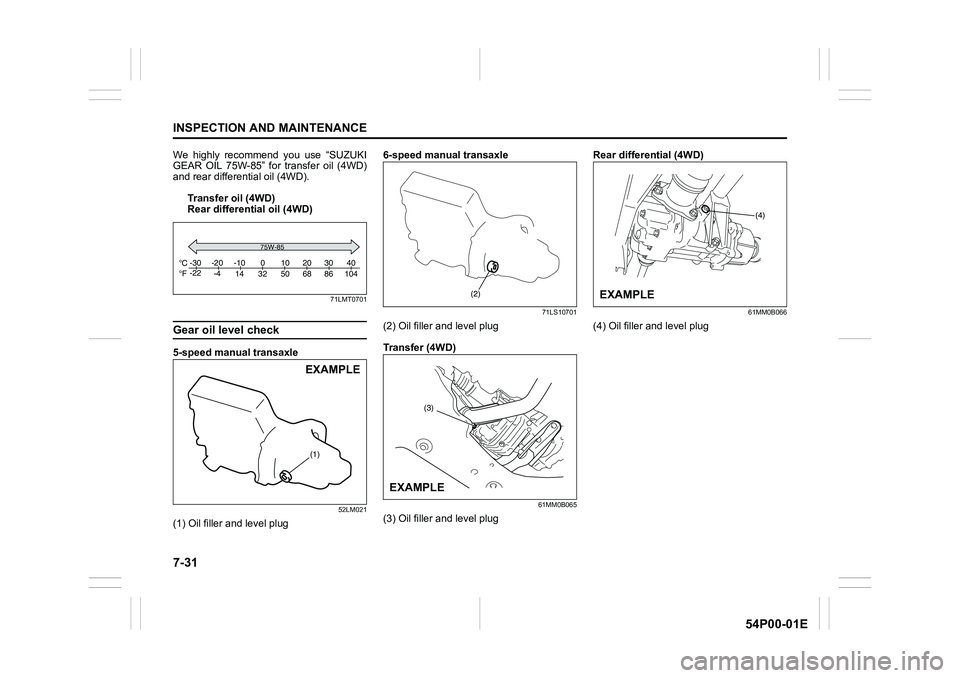
We highly recommend you use “SUZUKI
GEAR OIL 75W-85” for transfer oil (4WD)
and rear differential oil (4WD).
Transfer oil (4WD)
Rear differential oil (4WD)
71LMT0701
Gear oil level check
5-speed manual transaxle
52LM021
(1) Oil filler and level plug6-speed manual transaxle
71LS10701
(2) Oil filler and level plug
Transfer (4WD)
61MM0B065
(3) Oil filler and level plug Rear differential (4WD)
61MM0B066
(4) Oil filler and level plug
C
Fo o-30
-22-20
-4-10
14 32 50 68 86 104010203040
75W-85
(1)
EXAMPLE
(2)
(3)
EXAMPLE
(4)
EXAMPLE
Page 370 of 482
7-32
INSPECTION AND MAINTENANCE
54P00-01E
To check the gear oil level, use the fol-
lowing procedure:
1) Park the vehicle on a level surface with
the parking brake applied. Then, stop
the engine.
2) Remove the oil filler and level plug.
For the manual transaxle;
3) If gear oil flows from the plug hole, the
oil level is correct. Reinstall the plug. If
gear oil does not flow from the plug
hole, add oil through the filler plug hole
until oil flows a little from the plug hole.
For the transfer and rear differential;
3) Check the inside of the hole with your
finger. If the oil level comes up to the
bottom of the plug hole, the oil level is
correct. If so, reinstall the plug.
4) If the oil level is low, add gear oil
through the oil filler and level plug hole
until the oil level reaches the bottom of
the filler hole, and then reinstall the
plug.
Tightening torque for oil filler and level
plug
Manual transaxle (1) or (2):
21 Nm (2.1 kg-m, 15.5 lb-ft)
Transfer (3) / Rear differential (4):
23 Nm (2.3 kg-m, 17.0 lb-ft)
Gear oil change
Since special procedures, materials and
tools are required, ask your authorized
SUZUKI dealer for this job.
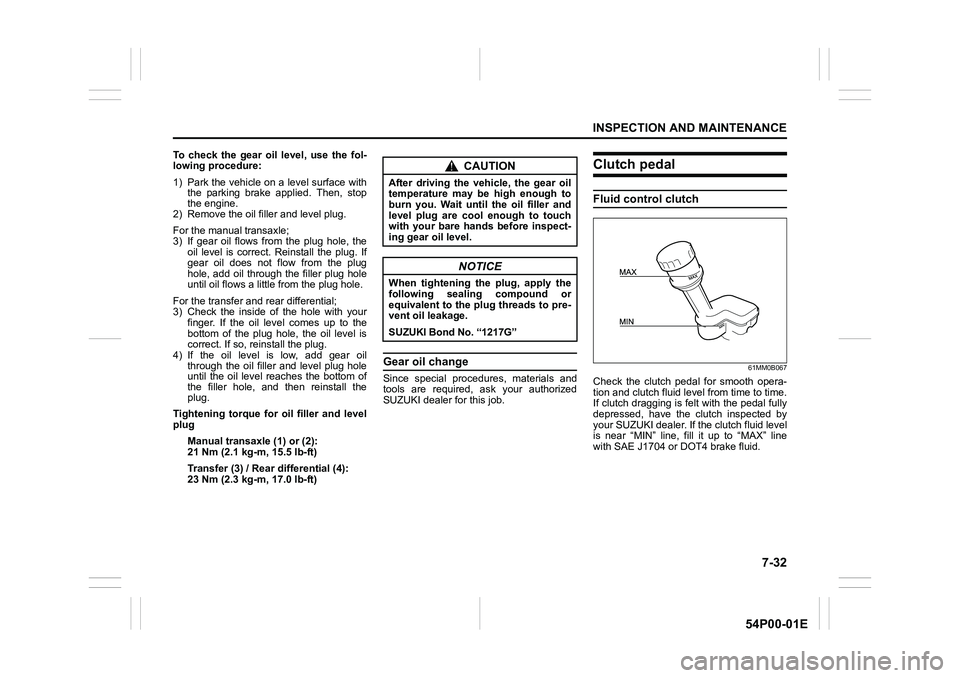
Clutch pedal
Fluid control clutch
61MM0B067
Check the clutch pedal for smooth opera-
tion and clutch fluid level from time to time.
If clutch dragging is felt with the pedal fully
depressed, have the clutch inspected by
your SUZUKI dealer. If the clutch fluid level
is near “MIN” line, fill it up to “MAX” line
with SAE J1704 or DOT4 brake fluid.
CAUTION
After driving the vehicle, the gear oil
temperature may be high enough to
burn you. Wait until the oil filler and
level plug are cool enough to touch
with your bare hands before inspect-
ing gear oil level.
NOTICE
When tightening the plug, apply the
following sealing compound or
equivalent to the plug threads to pre-
vent oil leakage.
SUZUKI Bond No. “1217G”
Page 397 of 482
7-59
INSPECTION AND MAINTENANCE
54P00-01E
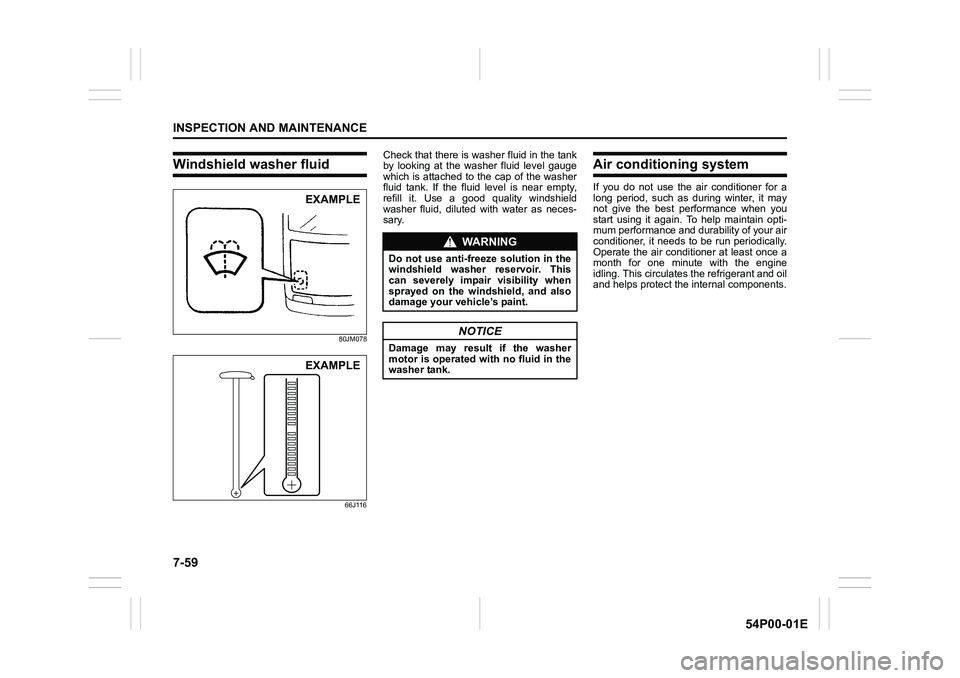
Windshield washer fluid
80JM078
66J116
Check that there is washer fluid in the tank
by looking at the washer fluid level gauge
which is attached to the cap of the washer
fluid tank. If the fluid level is near empty,
refill it. Use a good quality windshield
washer fluid, diluted with water as neces-
sary.Air conditioning system
If you do not use the air conditioner for a
long period, such as during winter, it may
not give the best performance when you
start using it again. To help maintain opti-
mum performance and durability of your air
conditioner, it needs to be run periodically.
Operate the air conditioner at least once a
month for one minute with the engine
idling. This circulates the refrigerant and oil
and helps protect the internal components.
EXAMPLE
EXAMPLE
WA R N I N G
Do not use anti-freeze solution in the
windshield washer reservoir. This
can severely impair visibility when
sprayed on the windshield, and also
damage your vehicle’s paint.
NOTICE
Damage may result if the washer
motor is operated with no fluid in the
washer tank.
Page 404 of 482
8-4
EMERGENCY SERVICE
54P00-01E
NOTE:
For more details, contact an authorized
SUZUKI dealer.
Changing wheels
To change a wheel, use the following pro-
cedure:
1) Remove the jack, tools and spare
wheel from the vehicle.
2) Loosen, but do not remove the wheel
bolts.
3) Jack up the vehicle (follow the jacking
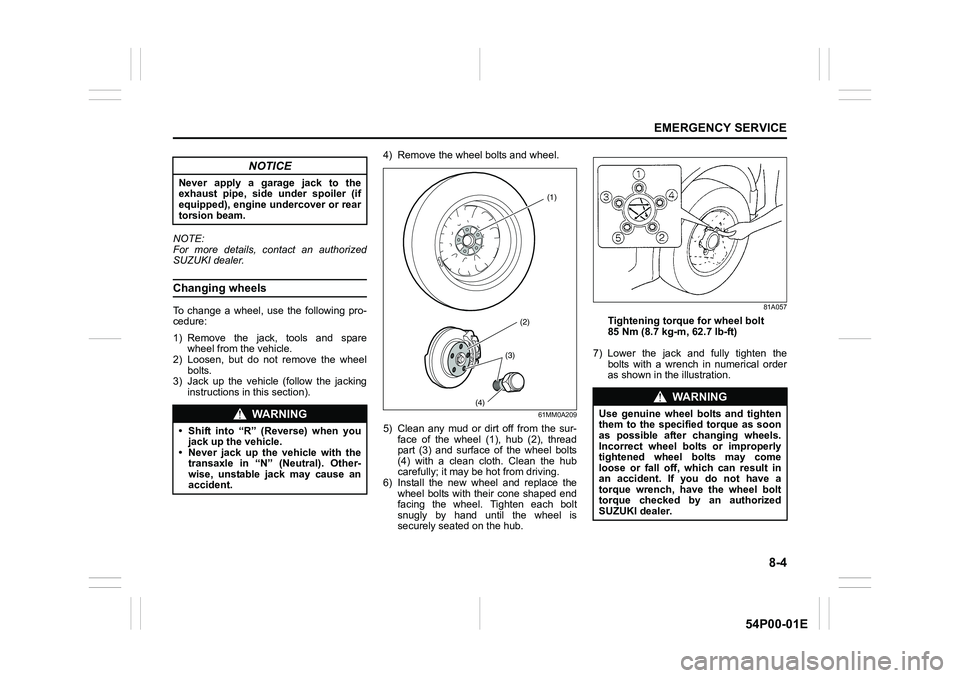
instructions in this section).4) Remove the wheel bolts and wheel.
61MM0A209
5) Clean any mud or dirt off from the sur-
face of the wheel (1), hub (2), thread
part (3) and surface of the wheel bolts
(4) with a clean cloth. Clean the hub
carefully; it may be hot from driving.
6) Install the new wheel and replace the
wheel bolts with their cone shaped end
facing the wheel. Tighten each bolt
snugly by hand until the wheel is
securely seated on the hub.
81A057
Tightening torque for wheel bolt
85 Nm (8.7 kg-m, 62.7 lb-ft)
7) Lower the jack and fully tighten the
bolts with a wrench in numerical order
as shown in the illustration.
NOTICE
Never apply a garage jack to the
exhaust pipe, side under spoiler (if
equipped), engine undercover or rear
torsion beam.
WA R N I N G
• Shift into “R” (Reverse) when you
jack up the vehicle.
• Never jack up the vehicle with the
transaxle in “N” (Neutral). Other-
wise, unstable jack may cause an
accident.
(2)
(4)
(1)
(3)
WA R N I N G
Use genuine wheel bolts and tighten
them to the specified torque as soon
as possible after changing wheels.
Incorrect wheel bolts or improperly
tightened wheel bolts may come
loose or fall off, which can result in
an accident. If you do not have a
torque wrench, have the wheel bolt
torque checked by an authorized
SUZUKI dealer.
Page 412 of 482
8-12
EMERGENCY SERVICE
54P00-01E
Engine trouble: Overheating
The engine could overheat temporarily
under severe driving conditions. If the
engine coolant temperature gauge indi-
cates overheating during driving:
1) Turn off the air conditioner, if equipped.
2) Take the vehicle to a safe place and
park.
3) Run the engine at a normal idle speed
for a few minutes until the indicator is
within the normal, acceptable tempera-
ture range between “H” and “C”.If the temperature indication does not
come down to within the normal, accept-
able range:
1) Turn off the engine and check that the
water pump belt and pulleys are not
damaged or slipping. If any abnormality
is found, correct it.
2) Check the coolant level in the reservoir.
If it is found to be lower than “LOW”
line, check radiator, water pump, radia-
tor hoses and heater hoses for leakage.
If leakage that may cause overheating
is found, do not run the engine until
these problems have been corrected.
3) If leakage is not found, carefully add
coolant to the reservoir and then the
radiator, if necessary. (Refer to “Engine
coolant” in “INSPECTION AND MAIN-
TENANCE” section.)
NOTE:
If engine overheats and you are not sure
what to do, contact your SUZUKI dealer.
79J007
WA R N I N G
If you see or hear escaping steam,
stop the vehicle in a safe place and
immediately turn off the engine to
cool it. Do not open the hood when
steam is present. When the steam
can no longer be seen or heard, open
the hood to see if the coolant is still
boiling. If it is, you must wait until it
stops boiling before you proceed.WA R N I N G
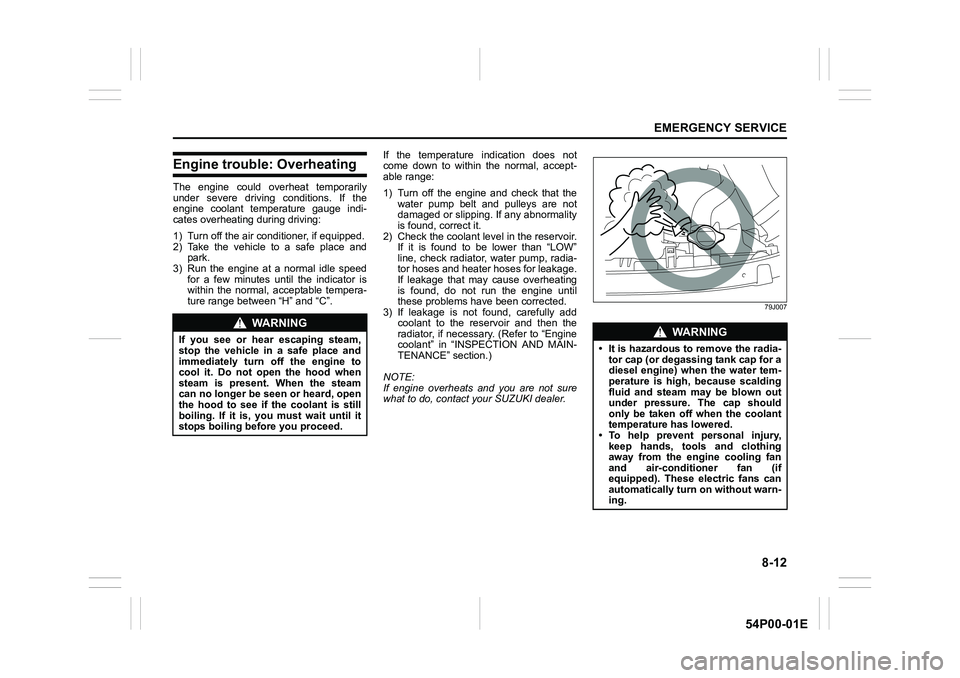
• It is hazardous to remove the radia-
tor cap (or degassing tank cap for a
diesel engine) when the water tem-
perature is high, because scalding
fluid and steam may be blown out
under pressure. The cap should
only be taken off when the coolant
temperature has lowered.
• To help prevent personal injury,
keep hands, tools and clothing
away from the engine cooling fan
and air-conditioner fan (if
equipped). These electric fans can
automatically turn on without warn-
ing.
Page 415 of 482
9-1
APPEARANCE CARE
54P00-01E
Corrosion prevention
It is important to take good care of your
vehicle to protect it from corrosion. Listed
below are instructions for how to maintain
your vehicle to prevent corrosion. Please
read and follow these instructions carefully.
Important information about corro-
sion
Common causes of corrosion
1) Accumulation of road salt, dirt, moisture
or chemicals in hard-to-reach areas of
the vehicle underbody or frame.
2) Chipping, scratches and any damage to
treated or painted metal surfaces
resulting from minor accidents or abra-
sion by stones and gravel.
Environmental conditions which accel-
erate corrosion
1) Road salt, dust control chemicals, sea
air or industrial pollution will all acceler-
ate the corrosion of metal.
2) High humidity will increase the rate of
corrosion particularly when the tem-
perature range is just above the freez-
ing point.
3) Moisture in certain areas of a vehicle
for an extended period of time may pro-
mote corrosion even though other body
sections may be completely dry.4) High temperatures will cause an accel-
erated rate of corrosion to parts of the
vehicle which are not well-ventilated to
permit quick drying.
This information illustrates the necessity of
keeping your vehicle (particularly the
underbody) as clean and dry as possible. It
is equally important to repair any damage
to the paint or protective coatings as soon
as possible.How to help prevent corrosion
Wash your vehicle frequently
The best way to preserve the finish on your
vehicle and to help avoid corrosion is to
keep it clean with frequent washing.
Wash your vehicle at least once during the
winter and once immediately after the win-
ter. Keep your vehicle, particularly the
underside, as clean and dry as possible.
If you frequently drive on salted roads,
your vehicle should be washed at least
once a month during the winter. If you live
near the ocean, your vehicle should be
washed at least once a month throughout
the year.
For washing instructions, refer to “Vehicle
cleaning” section.Remove foreign material deposits
Foreign material such as salts, chemicals,
road oil or tar, tree sap, bird droppings and
industrial fall-out may damage the finish of
your vehicle if it is left on painted surfaces.
Remove these types of deposits as quickly
as possible. If these deposits are difficult to
wash off, an additional cleaner may be
required. Check that any cleaner you use
is not harmful to painted surfaces and is
specifically intended for your purposes.
Follow the manufacturer’s directions when
using these special cleaners.
Repair finish damage
Carefully examine your vehicle for damage
to the painted surfaces. Should you find
any chips or scratches in the paint, touch
them up immediately to prevent corrosion
from starting. If the chips or scratches have
gone through to the bare metal, have a
qualified body shop make the repair.
Keep passenger and luggage compart-
ments clean
Moisture, dirt or mud can accumulate
under the floor mats and may cause corro-
sion. Occasionally, check under these
mats to ensure that this area is clean and
dry. More frequent checks are necessary if
the vehicle is used for off-road driving or in
wet weather.
Certain cargos such as chemicals, fertiliz-
ers, cleaners, salts, etc. are extremely cor-
rosive by nature. These products should
be transported in sealed containers. If they
Page 419 of 482
9-5
APPEARANCE CARE
54P00-01E
6) Check carefully for damage to painted
surfaces. If there is any damage, touch
up the damage following the procedure
below:
1. Clean all damaged spots and allow
them to dry.
2. Stir the paint and touch up the dam-
aged spots lightly using a small
brush.
3. Allow the paint to dry completely.Waxing
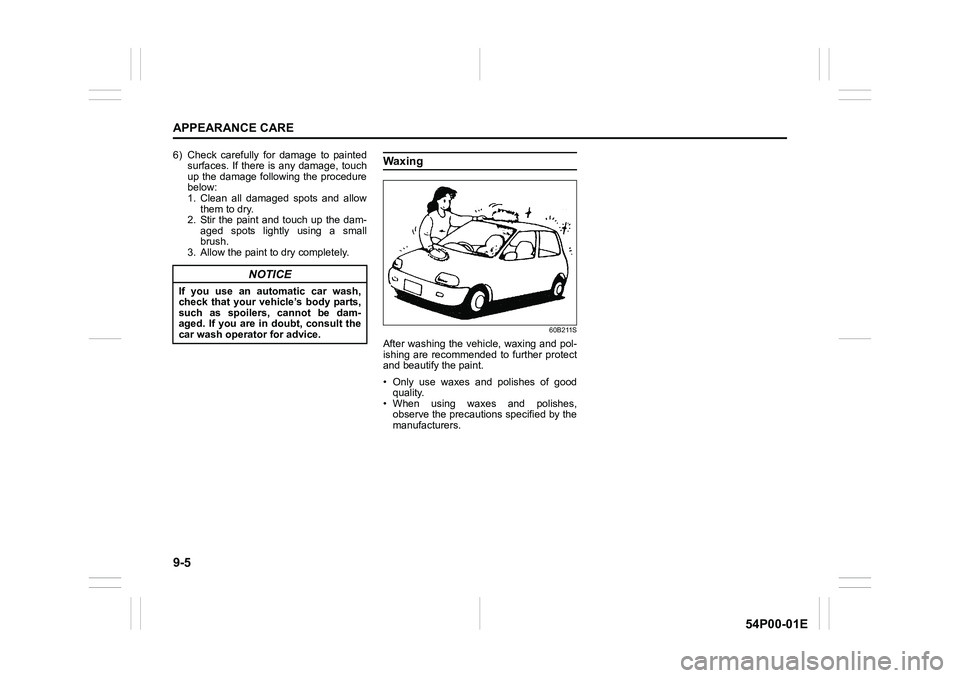
60B211S
After washing the vehicle, waxing and pol-
ishing are recommended to further protect
and beautify the paint.
• Only use waxes and polishes of good
quality.
• When using waxes and polishes,
observe the precautions specified by the
manufacturers.
NOTICE
If you use an automatic car wash,
check that your vehicle’s body parts,
such as spoilers, cannot be dam-
aged. If you are in doubt, consult the
car wash operator for advice.