check engine SUZUKI GRAND VITARA 2017 Workshop Manual
[x] Cancel search | Manufacturer: SUZUKI, Model Year: 2017, Model line: GRAND VITARA, Model: SUZUKI GRAND VITARA 2017Pages: 482, PDF Size: 21 MB
Page 226 of 482
3-86
OPERATING YOUR VEHICLE
54P00-01E
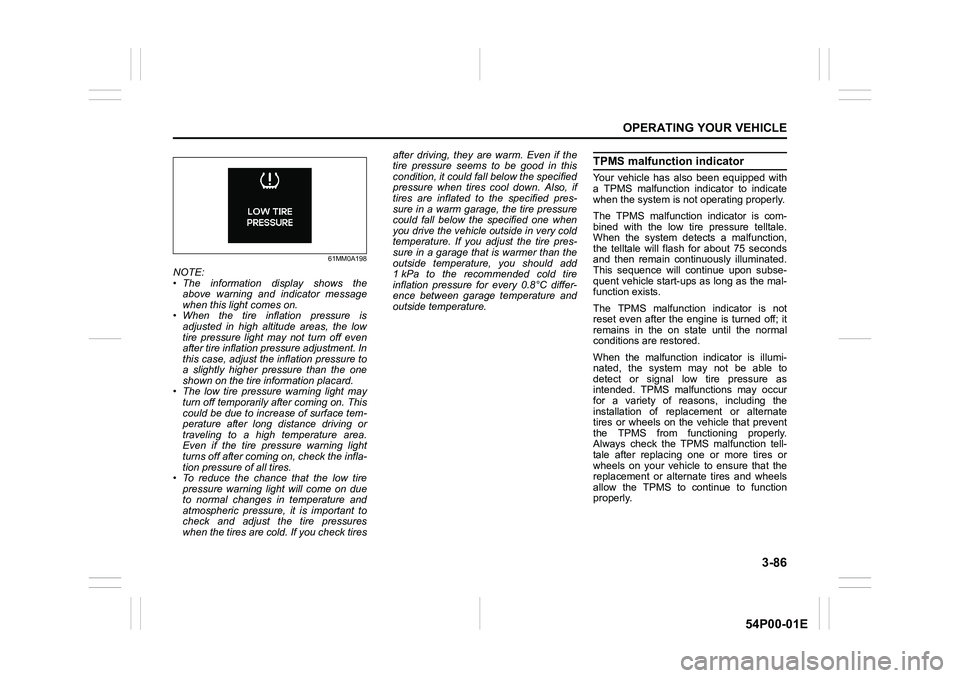
61MM0A198
NOTE:
• The information display shows the
above warning and indicator message
when this light comes on.
• When the tire inflation pressure is
adjusted in high altitude areas, the low
tire pressure light may not turn off even
after tire inflation pressure adjustment. In
this case, adjust the inflation pressure to
a slightly higher pressure than the one
shown on the tire information placard.
• The low tire pressure warning light may
turn off temporarily after coming on. This
could be due to increase of surface tem-
perature after long distance driving or
traveling to a high temperature area.
Even if the tire pressure warning light
turns off after coming on, check the infla-
tion pressure of all tires.
• To reduce the chance that the low tire
pressure warning light will come on due
to normal changes in temperature and
atmospheric pressure, it is important to
check and adjust the tire pressures
when the tires are cold. If you check tiresafter driving, they are warm. Even if the
tire pressure seems to be good in this
condition, it could fall below the specified
pressure when tires cool down. Also, if
tires are inflated to the specified pres-
sure in a warm garage, the tire pressure
could fall below the specified one when
you drive the vehicle outside in very cold
temperature. If you adjust the tire pres-
sure in a garage that is warmer than the
outside temperature, you should add
1 kPa to the recommended cold tire
inflation pressure for every 0.8°C differ-
ence between garage temperature and
outside temperature.
TPMS malfunction indicator
Your vehicle has also been equipped with
a TPMS malfunction indicator to indicate
when the system is not operating properly.
The TPMS malfunction indicator is com-
bined with the low tire pressure telltale.
When the system detects a malfunction,
the telltale will flash for about 75 seconds
and then remain continuously illuminated.
This sequence will continue upon subse-
quent vehicle start-ups as long as the mal-
function exists.
The TPMS malfunction indicator is not
reset even after the engine is turned off; it
remains in the on state until the normal
conditions are restored.
When the malfunction indicator is illumi-
nated, the system may not be able to
detect or signal low tire pressure as
intended. TPMS malfunctions may occur
for a variety of reasons, including the
installation of replacement or alternate
tires or wheels on the vehicle that prevent
the TPMS from functioning properly.
Always check the TPMS malfunction tell-
tale after replacing one or more tires or
wheels on your vehicle to ensure that the
replacement or alternate tires and wheels
allow the TPMS to continue to function
properly.
Page 238 of 482
4-4
DRIVING TIPS
54P00-01E
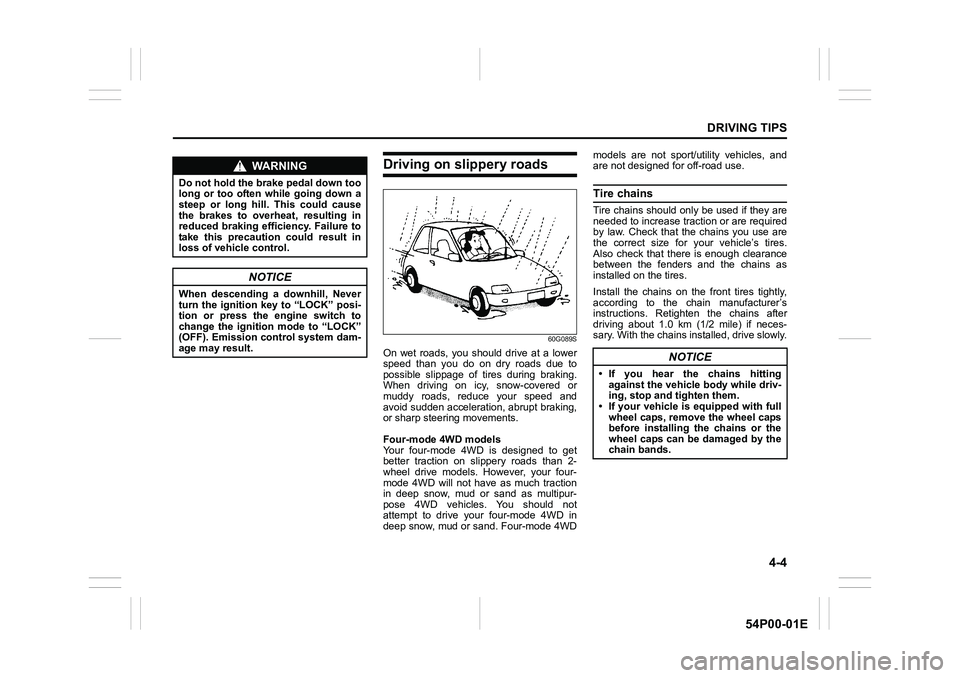
Driving on slippery roads
60G089S
On wet roads, you should drive at a lower
speed than you do on dry roads due to
possible slippage of tires during braking.
When driving on icy, snow-covered or
muddy roads, reduce your speed and
avoid sudden acceleration, abrupt braking,
or sharp steering movements.
Four-mode 4WD models
Your four-mode 4WD is designed to get
better traction on slippery roads than 2-
wheel drive models. However, your four-
mode 4WD will not have as much traction
in deep snow, mud or sand as multipur-
pose 4WD vehicles. You should not
attempt to drive your four-mode 4WD in
deep snow, mud or sand. Four-mode 4WDmodels are not sport/utility vehicles, and
are not designed for off-road use.
Tire chains
Tire chains should only be used if they are
needed to increase traction or are required
by law. Check that the chains you use are
the correct size for your vehicle’s tires.
Also check that there is enough clearance
between the fenders and the chains as
installed on the tires.
Install the chains on the front tires tightly,
according to the chain manufacturer’s
instructions. Retighten the chains after
driving about 1.0 km (1/2 mile) if neces-
sary. With the chains installed, drive slowly.
WA R N I N G
Do not hold the brake pedal down too
long or too often while going down a
steep or long hill. This could cause
the brakes to overheat, resulting in
reduced braking efficiency. Failure to
take this precaution could result in
loss of vehicle control.
NOTICE
When descending a downhill, Never
turn the ignition key to “LOCK” posi-
tion or press the engine switch to
change the ignition mode to “LOCK”
(OFF). Emission control system dam-
age may result.
NOTICE
• If you hear the chains hitting
against the vehicle body while driv-
ing, stop and tighten them.
• If your vehicle is equipped with full
wheel caps, remove the wheel caps
before installing the chains or the
wheel caps can be damaged by the
chain bands.
Page 239 of 482
4-5
DRIVING TIPS
54P00-01E
Stuck vehicle
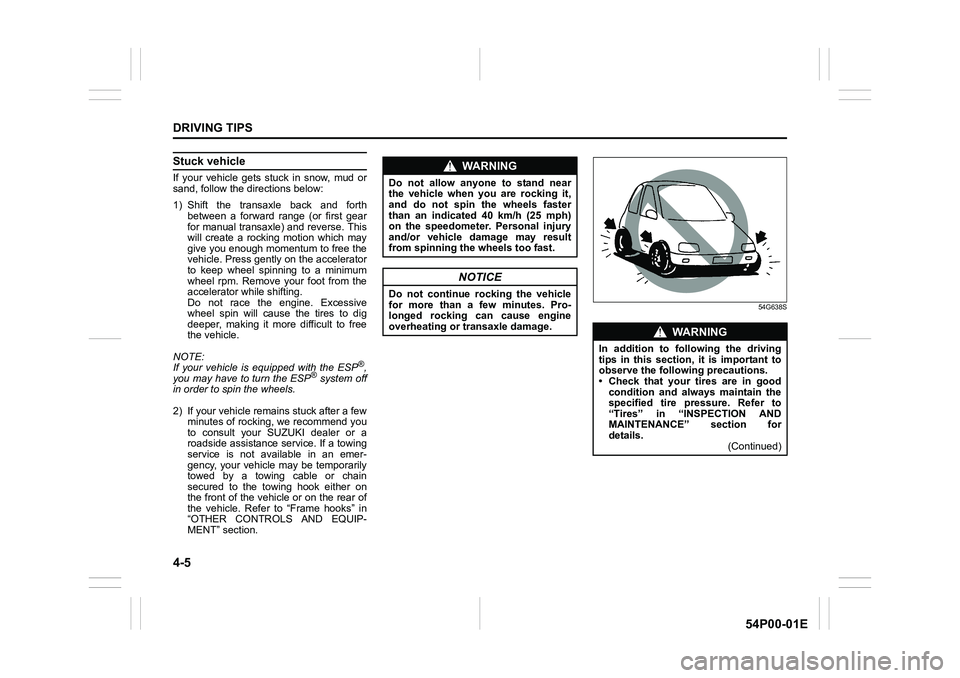
If your vehicle gets stuck in snow, mud or
sand, follow the directions below:
1) Shift the transaxle back and forth
between a forward range (or first gear
for manual transaxle) and reverse. This
will create a rocking motion which may
give you enough momentum to free the
vehicle. Press gently on the accelerator
to keep wheel spinning to a minimum
wheel rpm. Remove your foot from the
accelerator while shifting.
Do not race the engine. Excessive
wheel spin will cause the tires to dig
deeper, making it more difficult to free
the vehicle.
NOTE:
If your vehicle is equipped with the ESP
®,
you may have to turn the ESP® system off
in order to spin the wheels.
2) If your vehicle remains stuck after a few
minutes of rocking, we recommend you
to consult your SUZUKI dealer or a
roadside assistance service. If a towing
service is not available in an emer-
gency, your vehicle may be temporarily
towed by a towing cable or chain
secured to the towing hook either on
the front of the vehicle or on the rear of
the vehicle. Refer to “Frame hooks” in
“OTHER CONTROLS AND EQUIP-
MENT” section.
54G638S
WA R N I N G
Do not allow anyone to stand near
the vehicle when you are rocking it,
and do not spin the wheels faster
than an indicated 40 km/h (25 mph)
on the speedometer. Personal injury
and/or vehicle damage may result
from spinning the wheels too fast.
NOTICE
Do not continue rocking the vehicle
for more than a few minutes. Pro-
longed rocking can cause engine
overheating or transaxle damage.
WA R N I N G
In addition to following the driving
tips in this section, it is important to
observe the following precautions.
• Check that your tires are in good
condition and always maintain the
specified tire pressure. Refer to
“Tires” in “INSPECTION AND
MAINTENANCE” section for
details.
(Continued)
Page 244 of 482
5-2
OTHER CONTROLS AND EQUIPMENT
54P00-01E
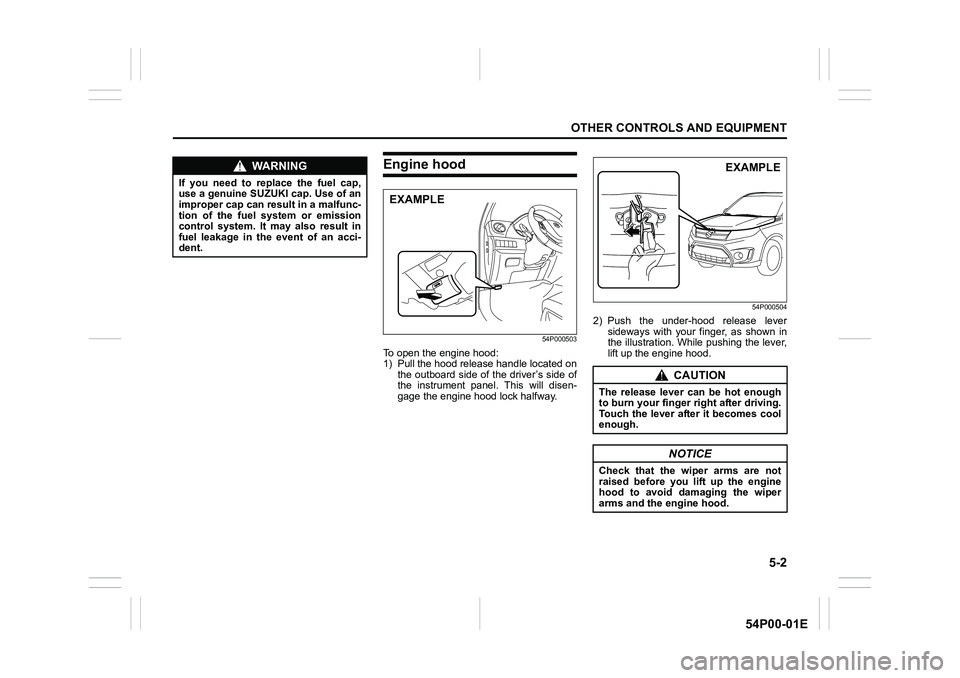
Engine hood
54P000503
To open the engine hood:
1) Pull the hood release handle located on
the outboard side of the driver’s side of
the instrument panel. This will disen-
gage the engine hood lock halfway.
54P000504
2) Push the under-hood release lever
sideways with your finger, as shown in
the illustration. While pushing the lever,
lift up the engine hood.
WA R N I N G
If you need to replace the fuel cap,
use a genuine SUZUKI cap. Use of an
improper cap can result in a malfunc-
tion of the fuel system or emission
control system. It may also result in
fuel leakage in the event of an acci-
dent.
EXAMPLE
CAUTION
The release lever can be hot enough
to burn your finger right after driving.
Touch the lever after it becomes cool
enough.
NOTICE
Check that the wiper arms are not
raised before you lift up the engine
hood to avoid damaging the wiper
arms and the engine hood.
EXAMPLE
Page 245 of 482
5-3
OTHER CONTROLS AND EQUIPMENT
54P00-01E
54P000505
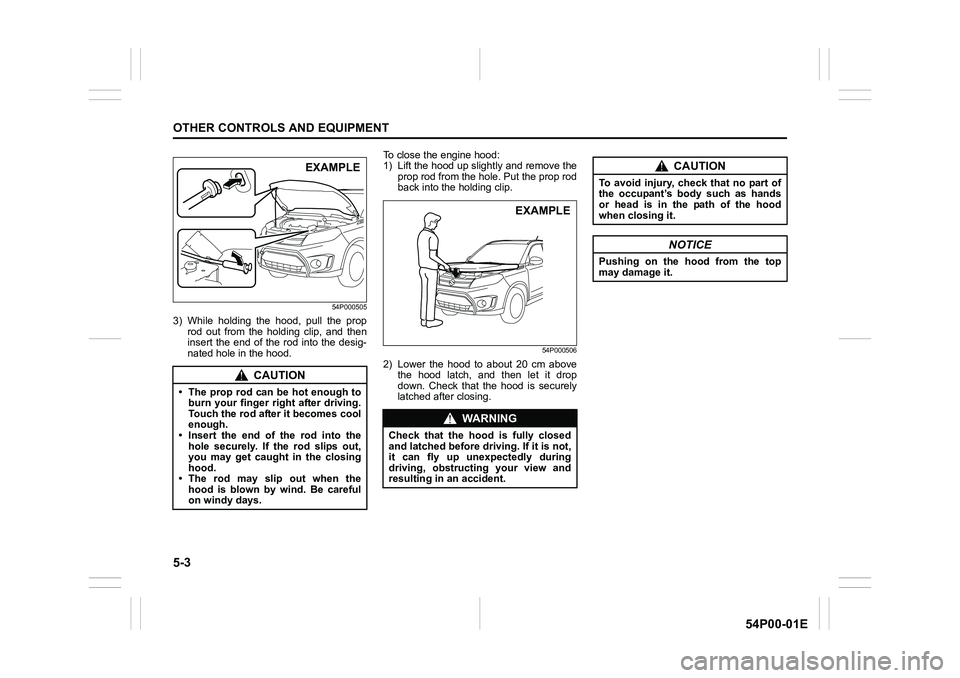
3) While holding the hood, pull the prop
rod out from the holding clip, and then
insert the end of the rod into the desig-
nated hole in the hood.To close the engine hood:
1) Lift the hood up slightly and remove the
prop rod from the hole. Put the prop rod
back into the holding clip.
54P000506
2) Lower the hood to about 20 cm above
the hood latch, and then let it drop
down. Check that the hood is securely
latched after closing.
CAUTION
• The prop rod can be hot enough to
burn your finger right after driving.
Touch the rod after it becomes cool
enough.
• Insert the end of the rod into the
hole securely. If the rod slips out,
you may get caught in the closing
hood.
• The rod may slip out when the
hood is blown by wind. Be careful
on windy days.
EXAMPLE
WA R N I N G
Check that the hood is fully closed
and latched before driving. If it is not,
it can fly up unexpectedly during
driving, obstructing your view and
resulting in an accident.
EXAMPLE
CAUTION
To avoid injury, check that no part of
the occupant’s body such as hands
or head is in the path of the hood
when closing it.
NOTICE
Pushing on the hood from the top
may damage it.
Page 251 of 482
5-9
OTHER CONTROLS AND EQUIPMENT
54P00-01E
USB socket (if equipped)
54P000512
Connect your portable digital music player,
etc. to this socket to enjoy music through
the vehicle’s audio system. Refer to “Audio
system (Type A / Type B) (if equipped)” in
this section.
Sunroof (if equipped)
You can tilt or slide the sunroof by operating
the sunroof switch after pressing the engine
switch to change the ignition mode to “ON”.
65D612
• Close the sunroof when you leave the
vehicle unattended.
• Periodically inspect the guide rail for dirt
and clean it if any dirt has accumulated.
WA R N I N G
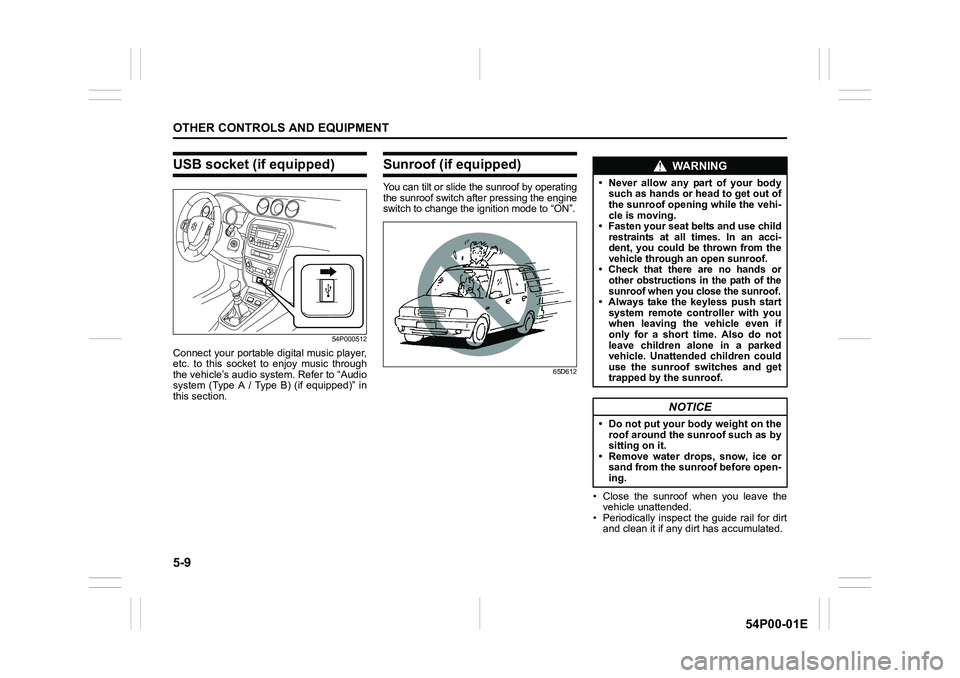
• Never allow any part of your body
such as hands or head to get out of
the sunroof opening while the vehi-
cle is moving.
• Fasten your seat belts and use child
restraints at all times. In an acci-
dent, you could be thrown from the
vehicle through an open sunroof.
• Check that there are no hands or
other obstructions in the path of the
sunroof when you close the sunroof.
• Always take the keyless push start
system remote controller with you
when leaving the vehicle even if
only for a short time. Also do not
leave children alone in a parked
vehicle. Unattended children could
use the sunroof switches and get
trapped by the sunroof.
NOTICE
• Do not put your body weight on the
roof around the sunroof such as by
sitting on it.
• Remove water drops, snow, ice or
sand from the sunroof before open-
ing.
Page 334 of 482
6-2
VEHICLE LOADING AND TOWING
54P00-01E
NOTE:
If your vehicle has a parking sensor sys-
tem, set the system to the trailer mode via
the information display. When this mode is
set, the rear corner and rear center sen-
sors are inhibited from operating. Refer to
“Information display” in “BEFORE DRIV-
ING” section.
To w b a r s
Only use a tow bar that is designed to
attach to the chassis of your vehicle, and a
hitch that is designed to bolt to this tow bar.
We recommend that you use a genuine
SUZUKI tow bar (available as option), or
equivalent.
Safety chains
Always attach safety chains between your
vehicle and trailer. Cross safety chains
under the nose of the trailer so that the
nose will not drop to the road if the trailer
becomes separated from the tow bar. Fol-
low the manufacturer’s recommendation
for attaching safety chains. Always leave
just enough slack to permit full turning.
Never allow safety chains to drag on the
road.
Trailer lights
Check that your trailer is equipped with
lights which meet local requirements.
Always check for the proper operation of
all trailer lights before you start to tow.
Brakes
WA R N I N G
For vehicles equipped with the radar
brake support system, if your vehicle
is used to tow a trailer, press the
radar brake support OFF switch and
turn off the radar brake support sys-
tem. If not, unexpected accidents
related to the system being turned on
may occur.
NOTICE
Trailer towing puts additional stress
on the engine, drive train and brakes
of your vehicle. Never tow a trailer
during the first 960 km (600 miles) of
vehicle operation.
WA R N I N G
Never use a tow bar which attaches
to the axle or the bumper of your
vehicle.
WA R N I N G
Never attach safety chains to the
bumper of your vehicle. Secure con-
nections so that they cannot come
loose.
WA R N I N G
Never connect trailer lights directly
into your vehicle’s electrical system,
or electrical system damage may
occur.
WA R N I N G
If trailer brakes are used, follow all
instructions provided by the manu-
facturer. Never connect to the brake
system of your vehicle and never
take an electrical supply directly from
the wiring harness.
Page 339 of 482
7-1
INSPECTION AND MAINTENANCE
54P00-01E
60B128S
WA R N I N G
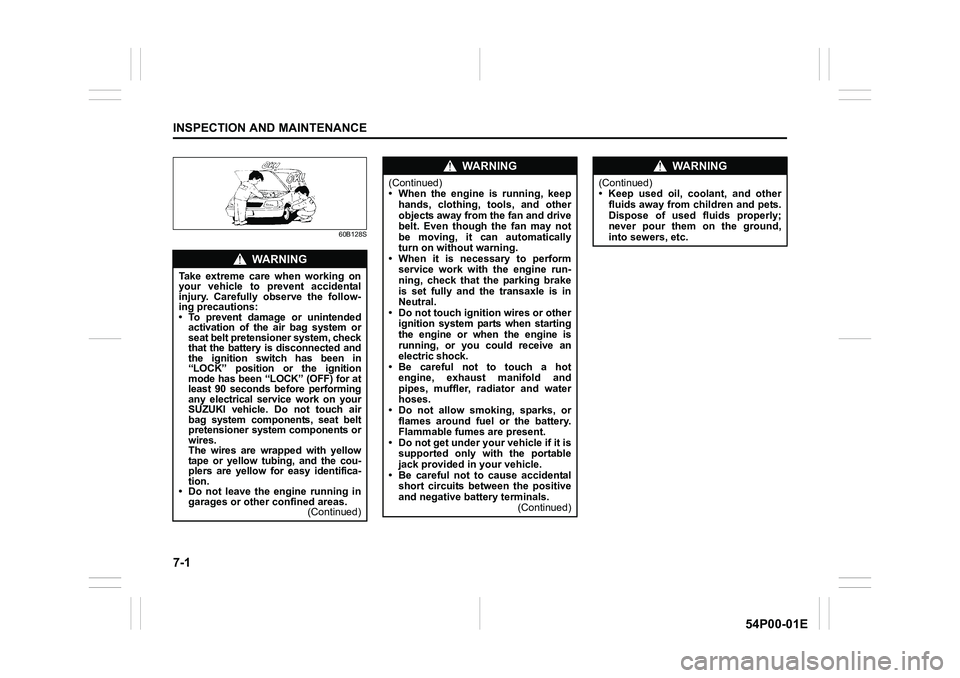
Take extreme care when working on
your vehicle to prevent accidental
injury. Carefully observe the follow-
ing precautions:
• To prevent damage or unintended
activation of the air bag system or
seat belt pretensioner system, check
that the battery is disconnected and
the ignition switch has been in
“LOCK” position or the ignition
mode has been “LOCK” (OFF) for at
least 90 seconds before performing
any electrical service work on your
SUZUKI vehicle. Do not touch air
bag system components, seat belt
pretensioner system components or
wires.
The wires are wrapped with yellow
tape or yellow tubing, and the cou-
plers are yellow for easy identifica-
tion.
• Do not leave the engine running in
garages or other confined areas.
(Continued)
WA R N I N G
(Continued)
• When the engine is running, keep
hands, clothing, tools, and other
objects away from the fan and drive
belt. Even though the fan may not
be moving, it can automatically
turn on without warning.
• When it is necessary to perform
service work with the engine run-
ning, check that the parking brake
is set fully and the transaxle is in
Neutral.
• Do not touch ignition wires or other
ignition system parts when starting
the engine or when the engine is
running, or you could receive an
electric shock.
• Be careful not to touch a hot
engine, exhaust manifold and
pipes, muffler, radiator and water
hoses.
• Do not allow smoking, sparks, or
flames around fuel or the battery.
Flammable fumes are present.
• Do not get under your vehicle if it is
supported only with the portable
jack provided in your vehicle.
• Be careful not to cause accidental
short circuits between the positive
and negative battery terminals.
(Continued)
WA R N I N G
(Continued)
• Keep used oil, coolant, and other
fluids away from children and pets.
Dispose of used fluids properly;
never pour them on the ground,
into sewers, etc.
Page 340 of 482
7-2
INSPECTION AND MAINTENANCE
54P00-01E
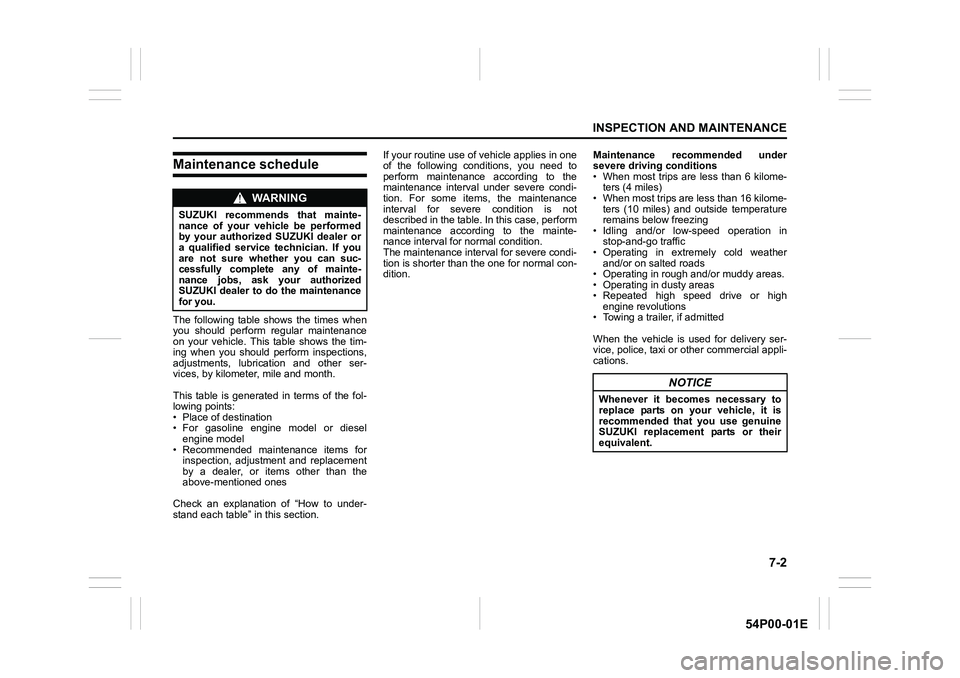
Maintenance schedule
The following table shows the times when
you should perform regular maintenance
on your vehicle. This table shows the tim-
ing when you should perform inspections,
adjustments, lubrication and other ser-
vices, by kilometer, mile and month.
This table is generated in terms of the fol-
lowing points:
• Place of destination
• For gasoline engine model or diesel
engine model
• Recommended maintenance items for
inspection, adjustment and replacement
by a dealer, or items other than the
above-mentioned ones
Check an explanation of “How to under-
stand each table” in this section.If your routine use of vehicle applies in one
of the following conditions, you need to
perform maintenance according to the
maintenance interval under severe condi-
tion. For some items, the maintenance
interval for severe condition is not
described in the table. In this case, perform
maintenance according to the mainte-
nance interval for normal condition.
The maintenance interval for severe condi-
tion is shorter than the one for normal con-
dition.Maintenance recommended under
severe driving conditions
• When most trips are less than 6 kilome-
ters (4 miles)
• When most trips are less than 16 kilome-
ters (10 miles) and outside temperature
remains below freezing
• Idling and/or low-speed operation in
stop-and-go traffic
• Operating in extremely cold weather
and/or on salted roads
• Operating in rough and/or muddy areas.
• Operating in dusty areas
• Repeated high speed drive or high
engine revolutions
• Towing a trailer, if admitted
When the vehicle is used for delivery ser-
vice, police, taxi or other commercial appli-
cations.
WA R N I N G
SUZUKI recommends that mainte-
nance of your vehicle be performed
by your authorized SUZUKI dealer or
a qualified service technician. If you
are not sure whether you can suc-
cessfully complete any of mainte-
nance jobs, ask your authorized
SUZUKI dealer to do the maintenance
for you.
NOTICE
Whenever it becomes necessary to
replace parts on your vehicle, it is
recommended that you use genuine
SUZUKI replacement parts or their
equivalent.
Page 345 of 482
7-7
INSPECTION AND MAINTENANCE
54P00-01E
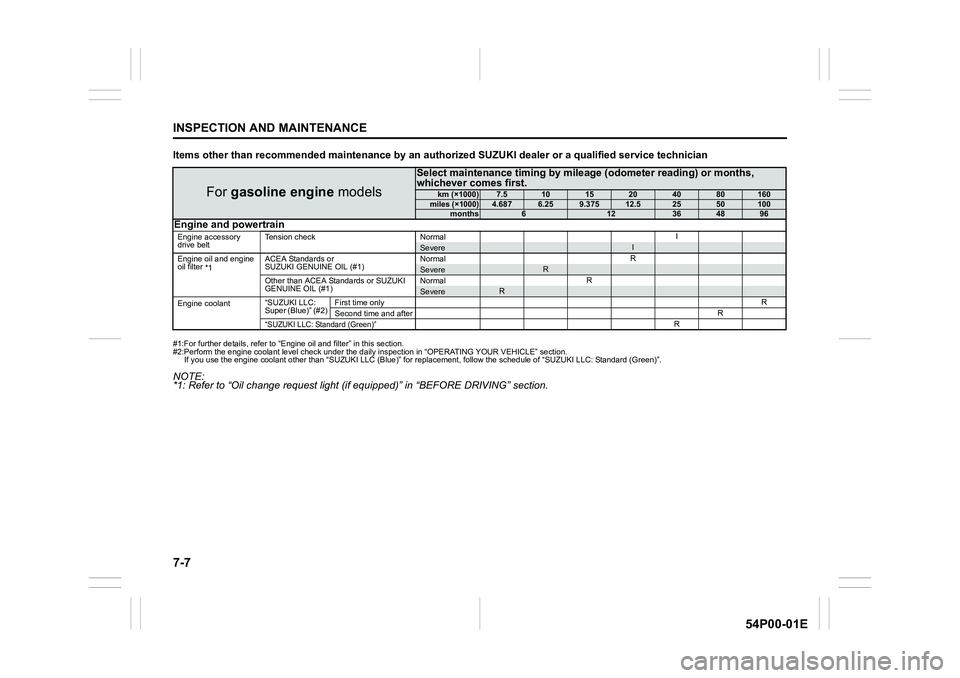
Items other than recommended maintenance by an authorized SUZUKI dealer or a qualified service technician
#1:For further details, refer to “Engine oil and filter” in this section.
#2:Perform the engine coolant level check under the daily inspection in “OPERATING YOUR VEHICLE” section.
If you use the engine coolant other than “SUZUKI LLC (Blue)” for replacement, follow the schedule of “SUZUKI LLC: Standard (Green)”.
NOTE:
*1: Refer to “Oil change request light (if equipped)” in “BEFORE DRIVING” section.
For gasoline engine models
Select maintenance timing by mileage (odometer reading) or months,
whichever comes first.
km (×1000)7.51015204080160miles (×1000)4.6876.259.37512.52550100months612364896Engine and powertrain
Engine accessory
drive beltTension check NormalISevereI
Engine oil and engine
oil filter
*1ACEA Standards or
SUZUKI GENUINE OIL (#1)NormalRSevereR
Other than ACEA Standards or SUZUKI
GENUINE OIL (#1)NormalRSevereR
Engine coolant“SUZUKI LLC:
Super (Blue)” (#2) First time only R
Second time and afterR
“SUZUKI LLC: Standard (Green)”R