mirrors SUZUKI GRAND VITARA 2017 Owners Manual
[x] Cancel search | Manufacturer: SUZUKI, Model Year: 2017, Model line: GRAND VITARA, Model: SUZUKI GRAND VITARA 2017Pages: 482, PDF Size: 21 MB
Page 14 of 482
ILLUSTRATED TABLE OF CONTENTS
54P00-01E
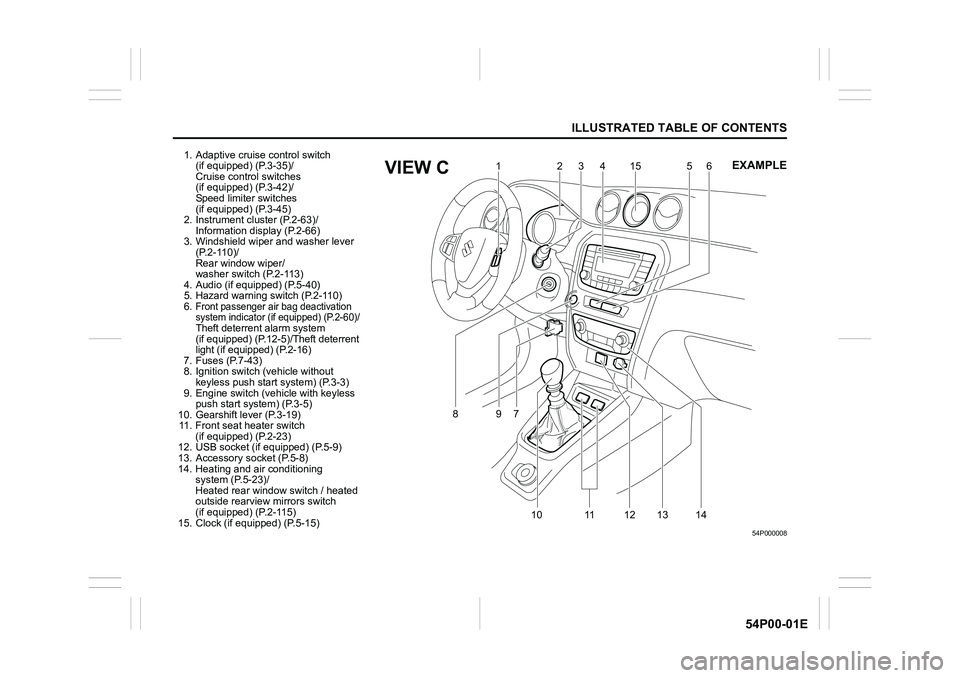
1. Adaptive cruise control switch
(if equipped) (P.3-35)/
Cruise control switches
(if equipped) (P.3-42)/
Speed limiter switches
(if equipped) (P.3-45)
2. Instrument cluster (P.2-63)/
Information display (P.2-66)
3. Windshield wiper and washer lever
(P.2-110)/
Rear window wiper/
washer switch (P.2-113)
4. Audio (if equipped) (P.5-40)
5. Hazard warning switch (P.2-110)
6.
Front passenger air bag deactivation
system indicator (if equipped) (P.2-60)/
Theft deterrent alarm system
(if equipped) (P.12-5)/Theft deterrent
light (if equipped) (P.2-16)
7. Fuses (P.7-43)
8. Ignition switch (vehicle without
keyless push start system) (P.3-3)
9. Engine switch (vehicle with keyless
push start system) (P.3-5)
10. Gearshift lever (P.3-19)
11. Front seat heater switch
(if equipped) (P.2-23)
12. USB socket (if equipped) (P.5-9)
13. Accessory socket (P.5-8)
14. Heating and air conditioning
system (P.5-23)/
Heated rear window switch / heated
outside rearview mirrors switch
(if equipped) (P.2-115)
15. Clock (if equipped) (P.5-15)
54P000008
16
75
89
10 11 12 13 1415 234EXAMPLEVIEW C
Page 22 of 482
BEFORE DRIVING
2
54P00-01E
60G404
BEFORE DRIVING
Keys ...................................................................................... 2-1
Door locks ............................................................................ 2-2
Keyless push start system remote controller /
Keyless entry system transmitter ...................................... 2-6
Theft deterrent light (if equipped) ...................................... 2-16
Windows .............................................................................. 2-16
Mirrors .................................................................................. 2-20
Front seats ........................................................................... 2-21
Rear seats ............................................................................ 2-24
Seat belts and child restraint systems .............................. 2-28
Child restraint system ........................................................ 2-40
Supplemental restraint system (air bags) ......................... 2-50
Instrument cluster ............................................................... 2-63
Speedometer ....................................................................... 2-64
Tachometer .......................................................................... 2-64
Fuel gauge ........................................................................... 2-64
Temperature gauge ............................................................. 2-65
Brightness control .............................................................. 2-65
Information display ............................................................. 2-66
Warning and indicator lights .............................................. 2-88
Lighting control lever ........................................................2-102
Front fog light switch (if equipped) ..................................2-107
Headlight leveling switch (if equipped) ............................2-108
Turn signal control lever ...................................................2-108
Hazard warning switch ......................................................2-110
Windshield wiper and washer lever .................................2-110
Tilt/telescoping steering lock lever ..................................2-114
Horn .....................................................................................2-115
Heated rear window switch / heated outside rearview
mirror switch (if equipped) ................................................2-115
Page 42 of 482
2-20
BEFORE DRIVING
54P00-01E
Mirrors
Inside rearview mirror
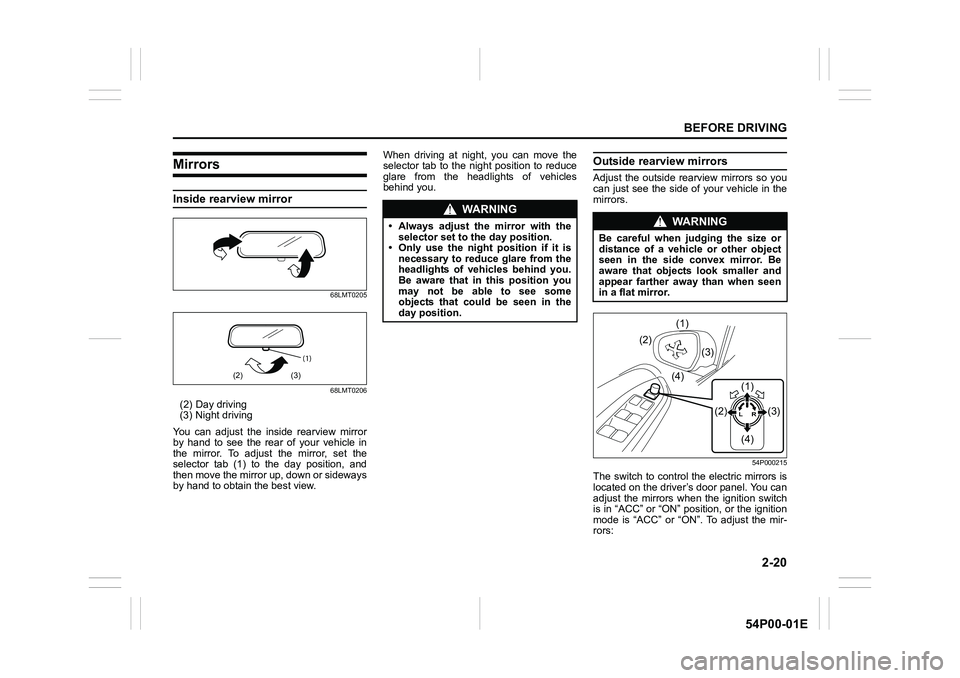
68LMT0205
68LMT0206
(2) Day driving
(3) Night driving
You can adjust the inside rearview mirror
by hand to see the rear of your vehicle in
the mirror. To adjust the mirror, set the
selector tab (1) to the day position, and
then move the mirror up, down or sideways
by hand to obtain the best view.When driving at night, you can move the
selector tab to the night position to reduce
glare from the headlights of vehicles
behind you.
Outside rearview mirrors
Adjust the outside rearview mirrors so you
can just see the side of your vehicle in the
mirrors.
54P000215
The switch to control the electric mirrors is
located on the driver’s door panel. You can
adjust the mirrors when the ignition switch
is in “ACC” or “ON” position, or the ignition
mode is “ACC” or “ON”. To adjust the mir-
rors:
(1)
(2) (3)
WA R N I N G
• Always adjust the mirror with the
selector set to the day position.
• Only use the night position if it is
necessary to reduce glare from the
headlights of vehicles behind you.
Be aware that in this position you
may not be able to see some
objects that could be seen in the
day position.WA R N I N G
Be careful when judging the size or
distance of a vehicle or other object
seen in the side convex mirror. Be
aware that objects look smaller and
appear farther away than when seen
in a flat mirror.
(2)
(3) (1)
(1)
(3) (2)
(4) (4)
LR
Page 43 of 482
2-21
BEFORE DRIVING
54P00-01E
1) Move the selector switch to the left or
right to select the mirror you wish to
adjust.
2) Press the outer part of the switch that
corresponds to the direction in which
you wish to move the mirror.
3) Return the selector switch to the center
position to help prevent unintended
adjustment.
NOTE:
If your vehicle is equipped with the heated
outside rearview mirrors, refer to “Heated
rear window switch / heated outside rear-
view mirror switch (if equipped)” in this
section.Outside rearview mirror folding switch (if equipped)
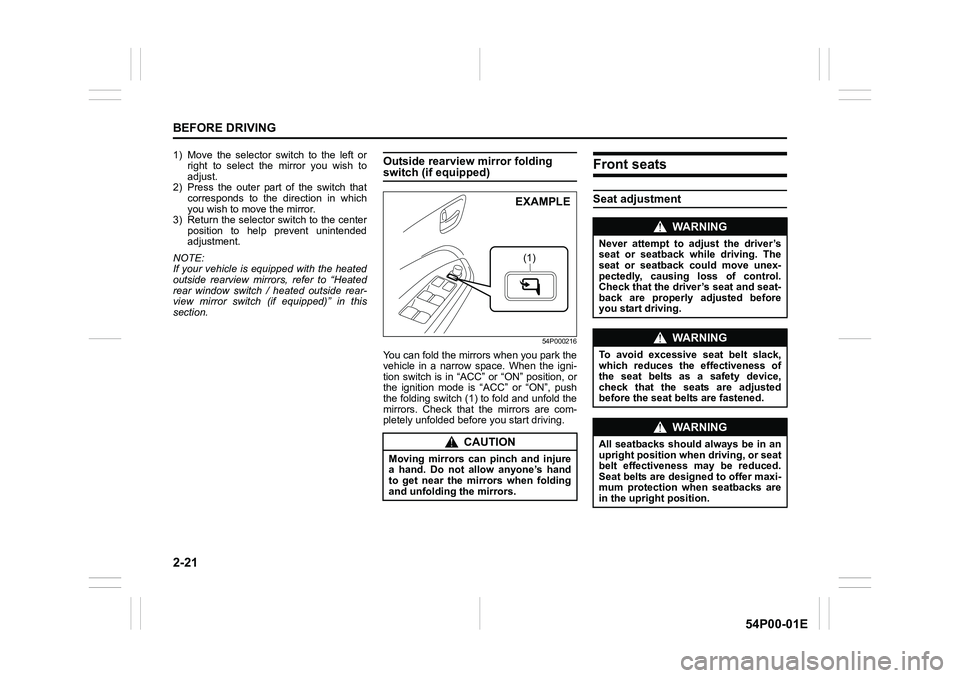
54P000216
You can fold the mirrors when you park the
vehicle in a narrow space. When the igni-
tion switch is in “ACC” or “ON” position, or
the ignition mode is “ACC” or “ON”, push
the folding switch (1) to fold and unfold the
mirrors. Check that the mirrors are com-
pletely unfolded before you start driving.
Front seats
Seat adjustment
CAUTION
Moving mirrors can pinch and injure
a hand. Do not allow anyone’s hand
to get near the mirrors when folding
and unfolding the mirrors.
(1)
EXAMPLE
WA R N I N G
Never attempt to adjust the driver’s
seat or seatback while driving. The
seat or seatback could move unex-
pectedly, causing loss of control.
Check that the driver’s seat and seat-
back are properly adjusted before
you start driving.
WA R N I N G
To avoid excessive seat belt slack,
which reduces the effectiveness of
the seat belts as a safety device,
check that the seats are adjusted
before the seat belts are fastened.
WA R N I N G
All seatbacks should always be in an
upright position when driving, or seat
belt effectiveness may be reduced.
Seat belts are designed to offer maxi-
mum protection when seatbacks are
in the upright position.
Page 137 of 482
2-115
BEFORE DRIVING
54P00-01E
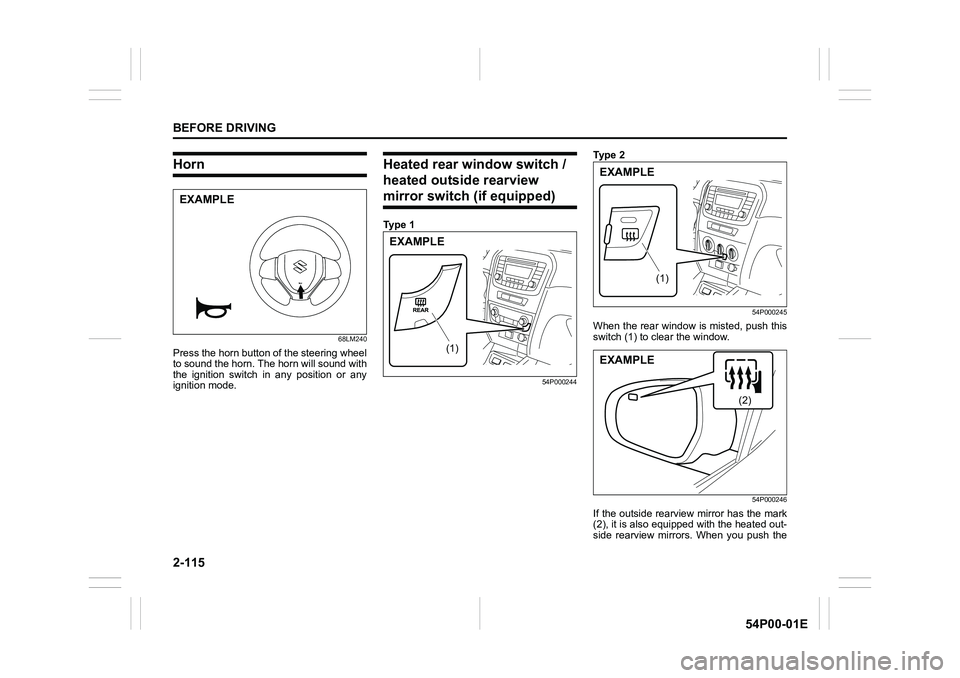
Horn
68LM240
Press the horn button of the steering wheel
to sound the horn. The horn will sound with
the ignition switch in any position or any
ignition mode.
Heated rear window switch /
heated outside rearview
mirror switch (if equipped)
Ty p e 1
54P000244
Ty p e 2
54P000245
When the rear window is misted, push this
switch (1) to clear the window.
54P000246
If the outside rearview mirror has the mark
(2), it is also equipped with the heated out-
side rearview mirrors. When you push the
EXAMPLE
(1)
EXAMPLE
(1)
EXAMPLE
(2)
EXAMPLE
Page 138 of 482
2-116
BEFORE DRIVING
54P00-01E
switch (1), both the heated outside rear-
view mirrors and the heated rear window
will operate simultaneously.
An indicator light will be lit when the defog-
ger is on. The defogger will work only
when the engine is running. To turn off the
defogger, push the switch (1) again.
NOTE:
• The defogger will work only when the
engine is running.
• The defogger will automatically turn off
after the defogger remains on for 15 min-
utes to prevent discharging of the bat-
tery.
• If your vehicle is equipped with heated
outside rearview mirrors, only the
driver’s side outside rearview mirror has
the mark (2), but both outside rearview
mirrors work simultaneously.
NOTICE
The heated rear window and the
heated outside rearview mirrors (if
equipped) use a large amount of elec-
tricity. Turn off the switch after the
window and mirrors have become
clear.
Page 141 of 482
3-1
OPERATING YOUR VEHICLE
54P00-01E
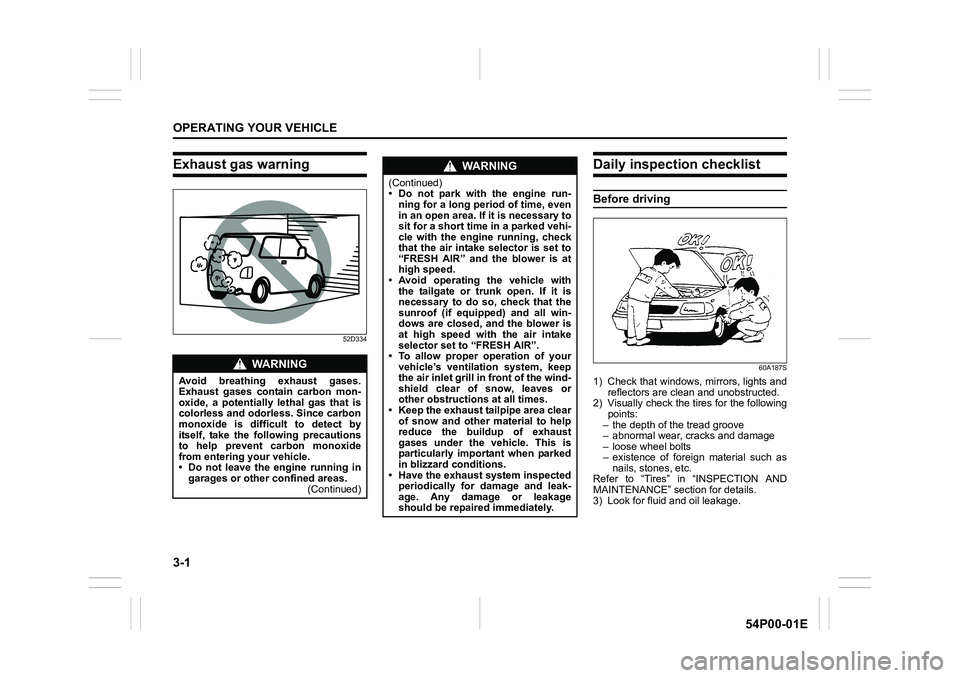
Exhaust gas warning
52D334
Daily inspection checklist
Before driving
60A187S
1) Check that windows, mirrors, lights and
reflectors are clean and unobstructed.
2) Visually check the tires for the following
points:
– the depth of the tread groove
– abnormal wear, cracks and damage
– loose wheel bolts
– existence of foreign material such as
nails, stones, etc.
Refer to “Tires” in “INSPECTION AND
MAINTENANCE” section for details.
3) Look for fluid and oil leakage.
WA R N I N G
Avoid breathing exhaust gases.
Exhaust gases contain carbon mon-
oxide, a potentially lethal gas that is
colorless and odorless. Since carbon
monoxide is difficult to detect by
itself, take the following precautions
to help prevent carbon monoxide
from entering your vehicle.
• Do not leave the engine running in
garages or other confined areas.
(Continued)
WA R N I N G
(Continued)
• Do not park with the engine run-
ning for a long period of time, even
in an open area. If it is necessary to
sit for a short time in a parked vehi-
cle with the engine running, check
that the air intake selector is set to
“FRESH AIR” and the blower is at
high speed.
• Avoid operating the vehicle with
the tailgate or trunk open. If it is
necessary to do so, check that the
sunroof (if equipped) and all win-
dows are closed, and the blower is
at high speed with the air intake
selector set to “FRESH AIR”.
• To allow proper operation of your
vehicle’s ventilation system, keep
the air inlet grill in front of the wind-
shield clear of snow, leaves or
other obstructions at all times.
• Keep the exhaust tailpipe area clear
of snow and other material to help
reduce the buildup of exhaust
gases under the vehicle. This is
particularly important when parked
in blizzard conditions.
• Have the exhaust system inspected
periodically for damage and leak-
age. Any damage or leakage
should be repaired immediately.
Page 142 of 482
3-2
OPERATING YOUR VEHICLE
54P00-01E
NOTE:
It is normal for water to drip from the air
conditioning system after use.
4) Check that the hood is fully closed and
latched.
5) Check the headlights, turn signal lights,
brake lights and horn for proper opera-
tion.
6) Adjust the seat and head restraint.
7) Check the brake pedal and the parking
brake lever.
8) Adjust the mirrors.
9) Check that you and all passengers
have properly fastened your seat belts.
10)Check that all warning lights come on
as the ignition switch is turned to “ON”
position or the engine switch is pressed
to change the ignition mode to “ON”.
11)Check all gauges.
12)Check that the brake system warning
light turns off when the parking brake is
released.
Once a week, or each time you fill your fuel
tank, perform the following under-hood
checks:
1) Engine oil level
2) Coolant level
3) Brake fluid level
4) Battery solution level
5) Windshield washer fluid level
6) Hood latch operation
Pull the hood release handle inside the
vehicle. Check that you cannot openthe hood all the way without releasing
the secondary latch. Close the hood
securely after checking for proper latch
operation. See the item “All latches,
hinges and locks” of “Chassis, body
and others” in “Maintenance schedule”
in “INSPECTION AND MAINTE-
NANCE” section for lubrication sched-
ule.
Once a month, or each time you fill your
fuel tank, check the tire pressure using a
tire pressure gauge. Also check the tire
pressure of the spare tire.Engine oil consumption
It is normal for the engine to consume
some engine oil during normal vehicle
operation.
The amount of engine oil consumption
depends on viscosity and quality of the oil
and your driving conditions.
More oil is consumed during high-speed
driving and when there is frequent acceler-
ation and deceleration. Under high loads,
your engine also will consume more oil.
A new engine also consumes more oil,
since its pistons, piston rings and cylinder
walls have not yet become conditioned.
New engines reach the normal level of oil
consumption only after approximately
5000 km (3000 miles) driving.
Oil consumption:
Max. 1.0 L per 1000 km
(1 Qt. per 600 miles)
When judging the amount of oil consump-
tion, note that the oil may become diluted
and it is difficult to judge the accurate oil
level.
As an example, if a vehicle is used for
repeated short trips, and consumes a nor-
mal amount of oil, the dipstick may not
show any drop in the oil level at all, even
after 1000 km (600 miles) or more of driv-
ing. This is because the oil gradually
becomes diluted with fuel or moisture,
WA R N I N G
Check that the hood is fully closed
and latched before driving. If it is not,
it can fly up unexpectedly during
driving, obstructing your view and
resulting in an accident.
Page 204 of 482
3-64
OPERATING YOUR VEHICLE
54P00-01E
Parking sensors (if equipped)
61MM0A192
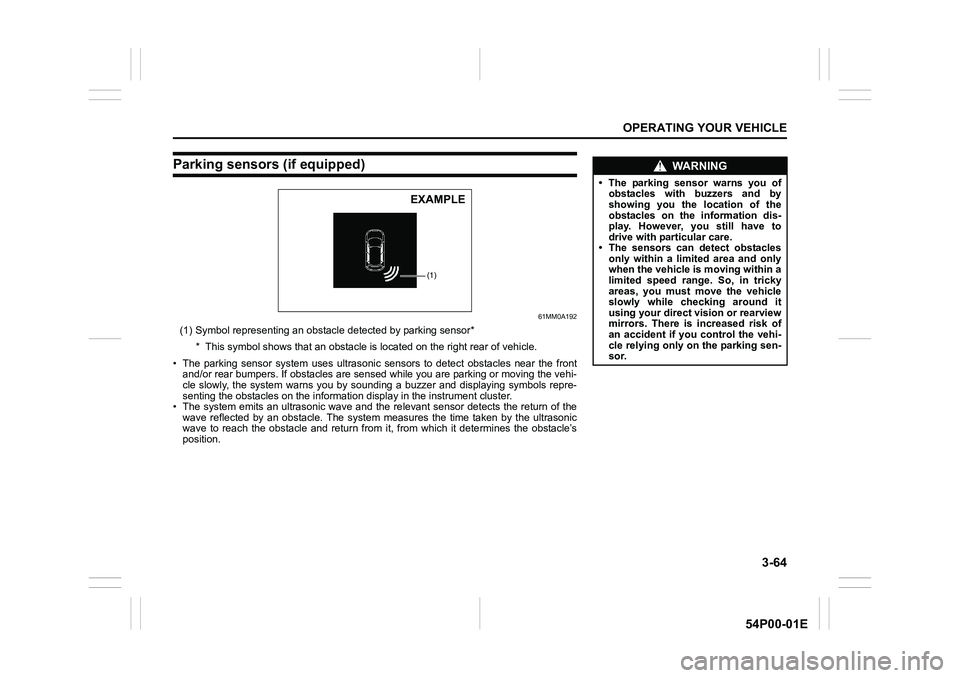
(1) Symbol representing an obstacle detected by parking sensor*
* This symbol shows that an obstacle is located on the right rear of vehicle.
• The parking sensor system uses ultrasonic sensors to detect obstacles near the front
and/or rear bumpers. If obstacles are sensed while you are parking or moving the vehi-
cle slowly, the system warns you by sounding a buzzer and displaying symbols repre-
senting the obstacles on the information display in the instrument cluster.
• The system emits an ultrasonic wave and the relevant sensor detects the return of the
wave reflected by an obstacle. The system measures the time taken by the ultrasonic
wave to reach the obstacle and return from it, from which it determines the obstacle’s
position.
(1)
EXAMPLE
WA R N I N G
• The parking sensor warns you of
obstacles with buzzers and by
showing you the location of the
obstacles on the information dis-
play. However, you still have to
drive with particular care.
• The sensors can detect obstacles
only within a limited area and only
when the vehicle is moving within a
limited speed range. So, in tricky
areas, you must move the vehicle
slowly while checking around it
using your direct vision or rearview
mirrors. There is increased risk of
an accident if you control the vehi-
cle relying only on the parking sen-
sor.
Page 335 of 482
6-3
VEHICLE LOADING AND TOWING
54P00-01E
Tires
Mirrors
Check if your vehicle’s mirrors meet local
requirements for mirrors used on towing
vehicles. If they do not, you must install the
required mirrors before you tow.
Vehicle/trailer loading
To load your vehicle and trailer properly,
you must know how to measure gross
trailer weight and trailer nose weight.
Gross trailer weight is the weight of the
trailer plus all the cargo in it. You can mea-
sure gross trailer weight by putting the fully
loaded trailer on a vehicle scale.
Nose weight is the downward force
exerted on the tow bar by the trailer cou-pler, with the trailer fully loaded and the
coupler at its normal towing height. This
weight can be measured using a bathroom
scale.
The weight of your loaded trailer (gross
trailer weight) should never exceed towing
capacity.
Distribute cargo in your trailer so that nose
weight is about 10% of gross trailer weight,
but does not exceed the maximum vertical
load on trailer hitch point. You should mea-
sure gross trailer weight and nose weight
before towing to check that your load is
properly distributed.
Additional trailer towing warnings
WA R N I N G
When towing a trailer, it is very
important for your vehicle and trailer
to have properly inflated tires. Your
vehicle’s tires should be inflated to
the pressures listed on your vehicles
tire information label. If laden pres-
sures are listed on the label, the tires
should be inflated to the laden pres-
sures. Inflate trailer tires according to
the specifications provided by the
trailer manufacturer.
WA R N I N G
Improper weight distribution of your
trailer may result in poor vehicle han-
dling and swaying of the trailer.
Always check that trailer nose weight
is about 10% of gross trailer weight,
but does not exceed the maximum
vertical load on trailer hitch point.
Also check that the cargo is properly
secured. Failure to observe this
requirement may result in an acci-
dent.
WA R N I N G
Never overload cargo on your trailer
or your vehicle. Gross trailer weight
must never exceed towing capacity.
Gross vehicle weight (sum of the
weights of the vehicle, all the occu-
pants, accessories including tow
bars and a trailer hitch, cargo and
trailer nose weight) must never
exceed the Gross Vehicle Weight Rat-
ing (GVWR) listed in “SPECIFICA-
TIONS” section.
WA R N I N G
Connect trailer lights and hook up
safety chains every time you tow.
NOTICE
Because towing a trailer puts addi-
tional stress on your vehicle, more
frequent maintenance will be
required than under normal driving
conditions. Follow the schedule in
“Maintenance recommended under
severe driving conditions”.