emergency SUZUKI GRAND VITARA 2019 User Guide
[x] Cancel search | Manufacturer: SUZUKI, Model Year: 2019, Model line: GRAND VITARA, Model: SUZUKI GRAND VITARA 2019Pages: 482, PDF Size: 21 MB
Page 231 of 482
3-91
OPERATING YOUR VEHICLE
54P00-01E
Replacing tires and/or wheels
If you got a flat tire and replaced it with the
spare tire, SUZUKI recommends that you
have an authorized SUZUKI dealer mount
a new tire on the wheel that had the flat
tire. The TPMS is already set up to recog-
nize the ID code of the original wheel, and
normal TPMS operation will be restored.
If you need to replace any wheels on your
vehicle, your dealer must check that TPMS
sensors are installed in the new wheels
and must set up the TPMS to recognize
the new sensors.
NOTE:
A TPMS sensor is not installed in the spare
tire. You should use the spare tire only in
an emergency situation, and should
replace the spare tire as soon as possible
to restore normal TPMS operation.The tire pressure monitoring system, trans-
mitter model S180052024 and receiver
model 40398036 are in compliance with
the essential requirements and other rele-
vant provisions of Directive 1999/5/EC.
WA R N I N G
Use of tires or wheels not recom-
mended by SUZUKI can result in fail-
ure of the TPMS.
When replacing tires and wheels, use
only tires and wheels recommended
by SUZUKI as standard or optional
equipment for your vehicle. Refer to
“Tires” in “INSPECTION AND MAIN-
TENANCE” section for additional
information.
Page 262 of 482
5-20
OTHER CONTROLS AND EQUIPMENT
54P00-01E
You can use the roof rails or the roof rack
anchors to attach the optional roof rack
which is available at your SUZUKI dealer.
If you use a roof rack, observe the instruc-
tions and precautions in this section and
provided with the roof rack.
• Check that the roof rack is securely
installed.
• To mount various types of cargo (such
as skis, bicycles, etc.) properly, use suit-
able attachments which are available at
your SUZUKI dealer. Install the attach-
ments properly and securely according
to the instructions provided. Do not
mount cargo directly on the roof panel.
The cargo can damage the roof panel.
• The gross weight of the roof rack plus
cargo must not exceed the loading
capacity.
– Roof rails: 75 kg (165 lbs)
– Roof rack anchors: 50 kg (110 lbs)
Also, do not let the gross vehicle weight
(fully loaded vehicle including driver,
passengers, cargo, roof load and trailer
tongue weight) exceed the Gross Vehi-
cle Weight Rating (GVWR) listed in
“SPECIFICATIONS” section.
• Mount and secure the cargo onto the
roof rack properly according to the
instructions provided. Stow the heaviest
items at the bottom and distribute the
cargo as evenly as possible.
• Do not carry large items that hang over
the bumpers or the sides of the vehicle.Otherwise, these items could block your
view.
• Secure the front and rear ends of long
items such as wood panels and surf-
boards, to both the front and rear of the
vehicle. You should protect the painted
surfaces of the vehicle from scuffing
caused by tie-down ropes.
• Check periodically that the roof rack is
securely installed and free from damage.
• For vehicles with roof rack anchors,
check that the anchors are covered with
the caps when not in use.Frame hooks
Your SUZUKI not recommend you use the
frame hooks for towing another vehicle.
SUZUKI was originally designed to tow
your vehicle on the road emergency tow-
ing.
If your vehicle needs to be towed in an
emergency, refer to “Towing” in “EMER-
GENCY SERVICE” section.
WA R N I N G
• Abrupt maneuvers or failure to
properly secure cargo can allow
the cargo to fly off the vehicle and
hit others, causing personal injury
or property damage.
• Mount cargo securely and avoid
abrupt maneuvers such as jackrab-
bit starts, sharp turns, fast corner-
ing and sudden braking. Check
periodically that cargo is securely
fastened.
• Large, bulky, long or flat items can
affect vehicle aerodynamics or be
caught by the wind, and can reduce
vehicle control resulting in an acci-
dent and personal injury. Drive cau-
tiously at a safely reduced speed
when carrying this type of cargo.
WA R N I N G
Observe the following instructions
when using frame hooks. The towing
hook or vehicle body may break and
cause serious injury or damage.
• Do not use the frame hooks for
towing another vehicle.
• Avoid pulling the vehicle to get out
of severe snowy, muddy or sandy
conditions, sudden starts or erratic
driving maneuvers which could
cause excessive stress on the tow-
ing hook.
In such case, we recommend that
you contact a professional service.
Page 263 of 482
5-21
OTHER CONTROLS AND EQUIPMENT
54P00-01E
Front
54P000527
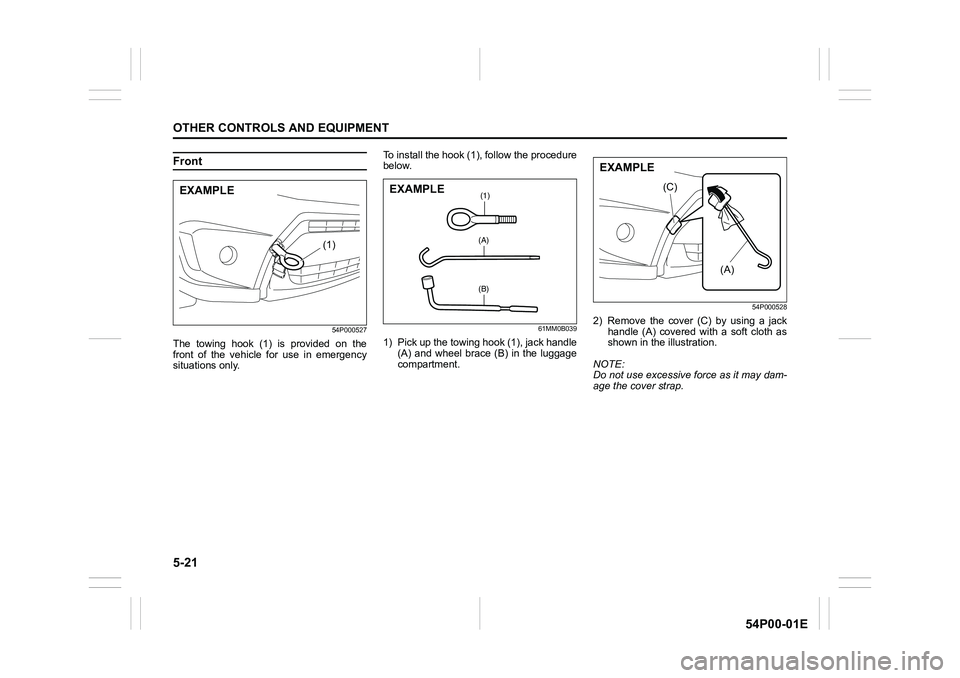
The towing hook (1) is provided on the
front of the vehicle for use in emergency
situations only.To install the hook (1), follow the procedure
below.
61MM0B039
1) Pick up the towing hook (1), jack handle
(A) and wheel brace (B) in the luggage
compartment.
54P000528
2) Remove the cover (C) by using a jack
handle (A) covered with a soft cloth as
shown in the illustration.
NOTE:
Do not use excessive force as it may dam-
age the cover strap.
(1)
EXAMPLE(1)
(A)
(B)
EXAMPLE
(A)
(C)
EXAMPLE
Page 264 of 482
5-22
OTHER CONTROLS AND EQUIPMENT
54P00-01E
54P000529
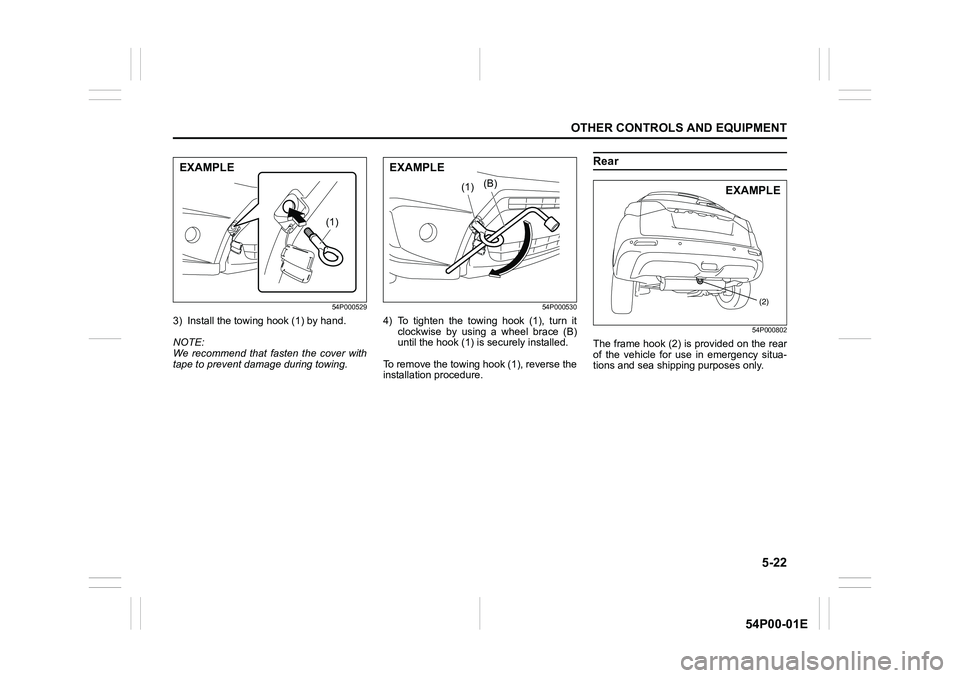
3) Install the towing hook (1) by hand.
NOTE:
We recommend that fasten the cover with
tape to prevent damage during towing.
54P000530
4) To tighten the towing hook (1), turn it
clockwise by using a wheel brace (B)
until the hook (1) is securely installed.
To remove the towing hook (1), reverse the
installation procedure.
Rear
54P000802
The frame hook (2) is provided on the rear
of the vehicle for use in emergency situa-
tions and sea shipping purposes only.
(1)
EXAMPLE
(B)(1)
EXAMPLE
(2)
EXAMPLE
Page 290 of 482
5-48
OTHER CONTROLS AND EQUIPMENT
54P00-01E
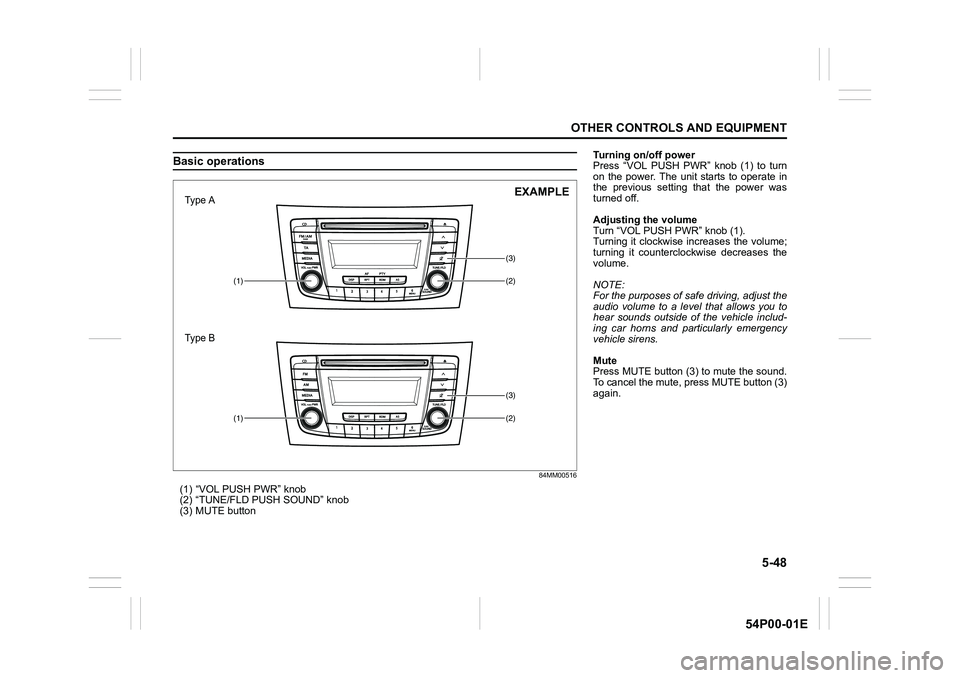
Basic operations
84MM00516
(1) “VOL PUSH PWR” knob
(2) “TUNE/FLD PUSH SOUND” knob
(3) MUTE button
(2)
(3)
(1)
(2)
(3)
(1)
Type A
Type BEXAMPLE
Turning on/off power
Press “VOL PUSH PWR” knob (1) to turn
on the power. The unit starts to operate in
the previous setting that the power was
turned off.
Adjusting the volume
Turn “VOL PUSH PWR” knob (1).
Turning it clockwise increases the volume;
turning it counterclockwise decreases the
volume.
NOTE:
For the purposes of safe driving, adjust the
audio volume to a level that allows you to
hear sounds outside of the vehicle includ-
ing car horns and particularly emergency
vehicle sirens.
Mute
Press MUTE button (3) to mute the sound.
To cancel the mute, press MUTE button (3)
again.
Page 298 of 482
5-56
OTHER CONTROLS AND EQUIPMENT
54P00-01E
TA standby
At the moment traffic information is
received while the source is set to CD,
USB, iPod
®, or Bluetooth®audio with TA
activated, the source is automatically
changed to radio. After reception of traffic
information, the source, which was
selected before being changed to radio,
resumes.
NOTE:
If no TP station can be received while the
unit stands by for TA, it automatically
searches for a TP station.
EON (Enhanced Other Network)
When the EON data is received with TP or
TA activated, “EON” indicator lights up,
and the traffic information from a network
other than the currently received station is
allowed to be received.
Emergency announcement reception
Emergency announcements are automati-
cally received and displayed.
Page 336 of 482
6-4
VEHICLE LOADING AND TOWING
54P00-01E
WA R N I N G
Your vehicle should be handled in a
different way when towing a trailer.
For the safety of yourself and others,
observe the following precautions:
• Practice turning, stopping, and
reversing before you begin towing
a trailer in traffic. Do not tow a
trailer in traffic until you are confi-
dent that you can handle the vehi-
cle and trailer safely.
• Never exceed towing speed limits
or 80 km/h (50 mph), whichever is
lower.
• Never drive at a speed that causes
shaking or swaying of the trailer. If
you notice even the slightest sign
of shaking or swaying, slow down.
• When roads are wet, slippery or
rough, drive at a slower speed than
you would on dry or smooth roads.
Failure to slow down when road
conditions are bad can result in
loss of control.
• Always have someone guide you
when reversing.
(Continued)
WA R N I N G
(Continued)
• Allow adequate stopping distance.
Stopping distance is increased
when you tow a trailer. For each 16
km/h (10 mph) of speed, allow at
least one vehicle and trailer length
between you and the vehicle
ahead. Allow a greater stopping
distance if roads are wet or slip-
pery.
• If the trailer has over-run brakes,
apply the brakes gradually to avoid
snatching caused by the trailer
wheels locking.
• Slow down before corners and
maintain a steady speed while cor-
nering. Deceleration or accelera-
tion while cornering can result in
loss of control. Remember that a
larger than normal turning radius is
needed because the trailer wheels
will be closer than vehicle wheels
to the inside of the turn.
• Avoid sudden acceleration and
stopping of the vehicle. Do not
make quick maneuvers unless they
are necessary.
• Slow down in cross winds and be
prepared for gusts of wind from
large passing vehicles.
(Continued)
WA R N I N G
(Continued)
• Be careful when overtaking other
vehicles. Allow enough room for
your trailer before changing lanes,
and use turn signal lights properly
in advance.
• Slow down and shift into a lower
gear before you reach long or steep
downhill grades. It is hazardous to
attempt downshifting while you are
descending a hill.
• Do not step on the brake pedal
strongly. This could cause the
brakes to over-heat resulting in
reduced braking efficiency. Use
engine braking as much as possi-
ble.
• Because of the added trailer
weight, your engine may overheat
on hot days when going up long or
steep hills. Pay attention to your
engine temperature gauge. If it indi-
cates overheating, pull off the road
and stop the vehicle in a safe place.
Refer to “Engine trouble: Overheat-
ing” in “EMERGENCY SERVICE”
section.
Page 376 of 482
7-38
INSPECTION AND MAINTENANCE
54P00-01E
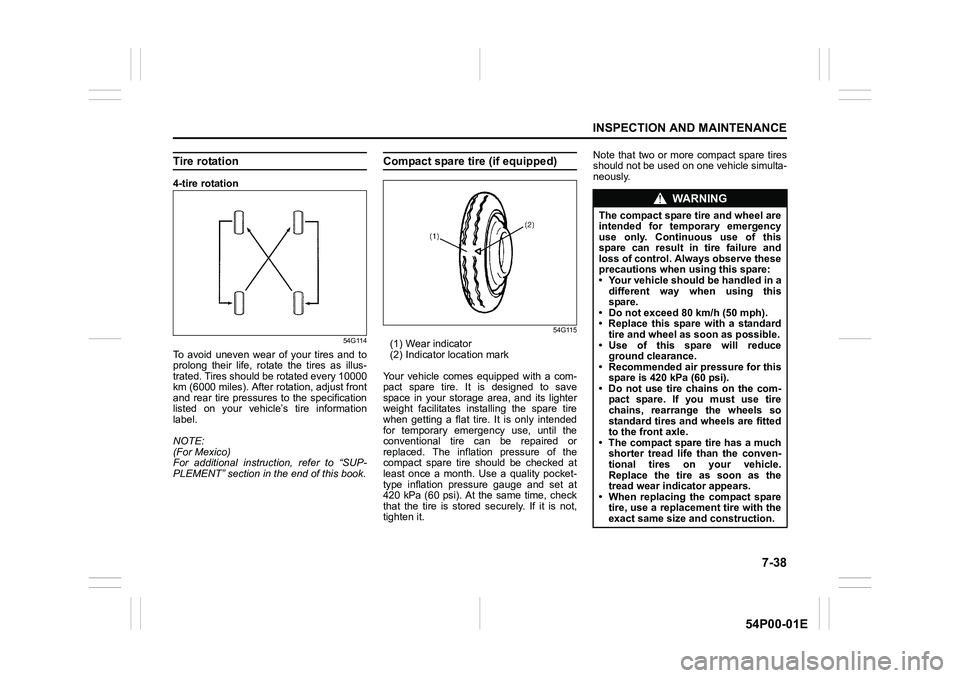
Tire rotation
4-tire rotation
54G114
To avoid uneven wear of your tires and to
prolong their life, rotate the tires as illus-
trated. Tires should be rotated every 10000
km (6000 miles). After rotation, adjust front
and rear tire pressures to the specification
listed on your vehicle’s tire information
label.
NOTE:
(For Mexico)
For additional instruction, refer to “SUP-
PLEMENT” section in the end of this book.
Compact spare tire (if equipped)
54G115
(1) Wear indicator
(2) Indicator location mark
Your vehicle comes equipped with a com-
pact spare tire. It is designed to save
space in your storage area, and its lighter
weight facilitates installing the spare tire
when getting a flat tire. It is only intended
for temporary emergency use, until the
conventional tire can be repaired or
replaced. The inflation pressure of the
compact spare tire should be checked at
least once a month. Use a quality pocket-
type inflation pressure gauge and set at
420 kPa (60 psi). At the same time, check
that the tire is stored securely. If it is not,
tighten it.Note that two or more compact spare tires
should not be used on one vehicle simulta-
neously.
WA R N I N G
The compact spare tire and wheel are
intended for temporary emergency
use only. Continuous use of this
spare can result in tire failure and
loss of control. Always observe these
precautions when using this spare:
• Your vehicle should be handled in a
different way when using this
spare.
• Do not exceed 80 km/h (50 mph).
• Replace this spare with a standard
tire and wheel as soon as possible.
• Use of this spare will reduce
ground clearance.
• Recommended air pressure for this
spare is 420 kPa (60 psi).
• Do not use tire chains on the com-
pact spare. If you must use tire
chains, rearrange the wheels so
standard tires and wheels are fitted
to the front axle.
• The compact spare tire has a much
shorter tread life than the conven-
tional tires on your vehicle.
Replace the tire as soon as the
tread wear indicator appears.
• When replacing the compact spare
tire, use a replacement tire with the
exact same size and construction.
Page 377 of 482
7-39
INSPECTION AND MAINTENANCE
54P00-01E
Battery
52KM160
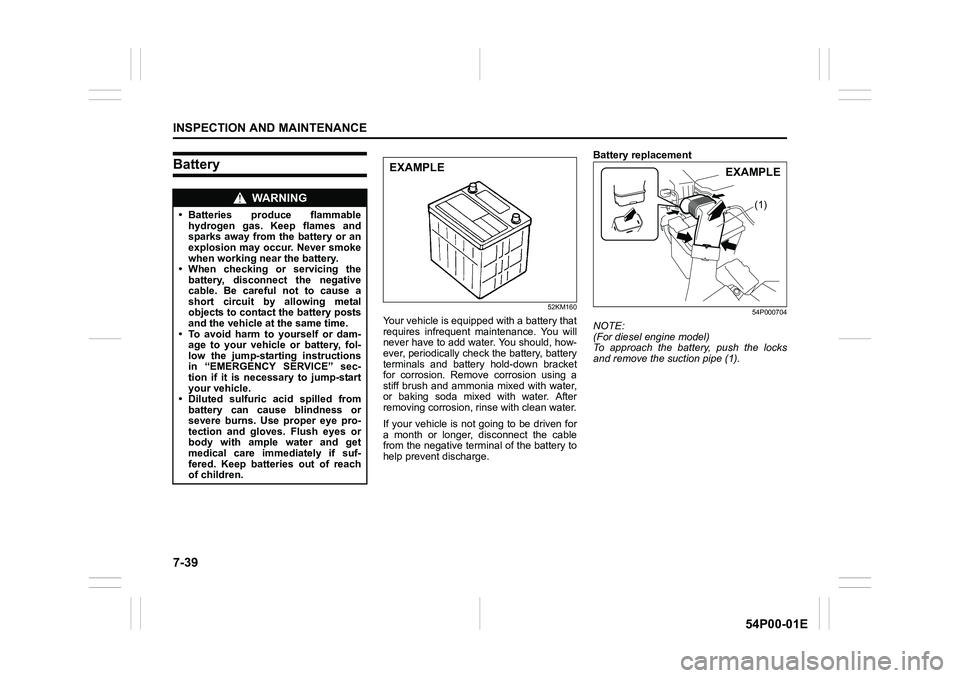
Your vehicle is equipped with a battery that
requires infrequent maintenance. You will
never have to add water. You should, how-
ever, periodically check the battery, battery
terminals and battery hold-down bracket
for corrosion. Remove corrosion using a
stiff brush and ammonia mixed with water,
or baking soda mixed with water. After
removing corrosion, rinse with clean water.
If your vehicle is not going to be driven for
a month or longer, disconnect the cable
from the negative terminal of the battery to
help prevent discharge.Battery replacement54P000704
NOTE:
(For diesel engine model)
To approach the battery, push the locks
and remove the suction pipe (1).
WA R N I N G
• Batteries produce flammable
hydrogen gas. Keep flames and
sparks away from the battery or an
explosion may occur. Never smoke
when working near the battery.
• When checking or servicing the
battery, disconnect the negative
cable. Be careful not to cause a
short circuit by allowing metal
objects to contact the battery posts
and the vehicle at the same time.
• To avoid harm to yourself or dam-
age to your vehicle or battery, fol-
low the jump-starting instructions
in “EMERGENCY SERVICE” sec-
tion if it is necessary to jump-start
your vehicle.
• Diluted sulfuric acid spilled from
battery can cause blindness or
severe burns. Use proper eye pro-
tection and gloves. Flush eyes or
body with ample water and get
medical care immediately if suf-
fered. Keep batteries out of reach
of children.
EXAMPLE
(1)
EXAMPLE
Page 400 of 482
EMERGENCY SERVICE
8
54P00-01E
60G411
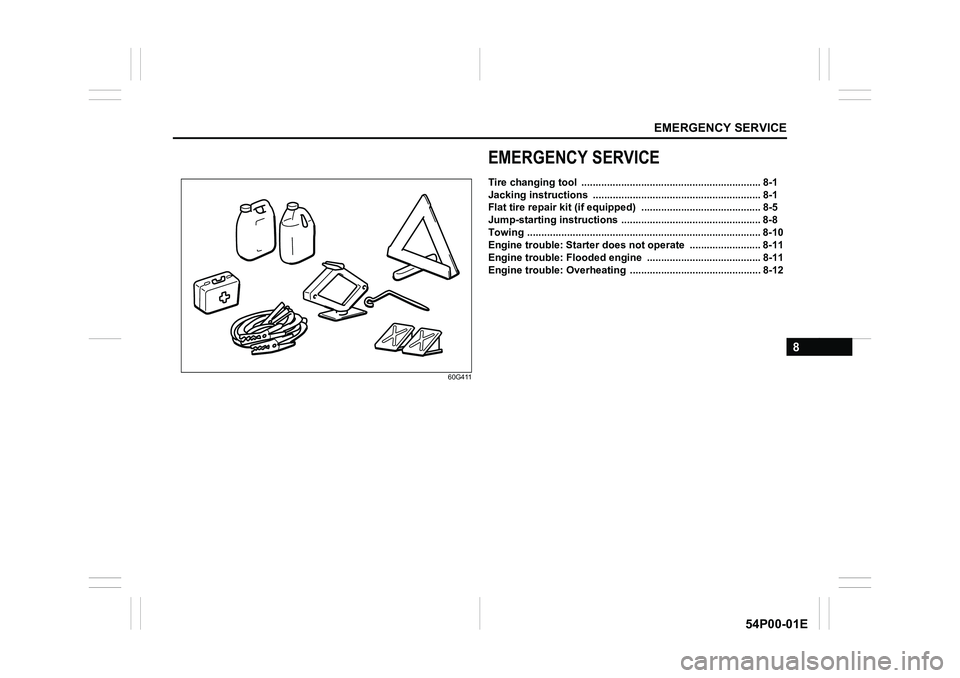
EMERGENCY SERVICE
Tire changing tool ............................................................... 8-1
Jacking instructions ........................................................... 8-1
Flat tire repair kit (if equipped) .......................................... 8-5
Jump-starting instructions ................................................. 8-8
Towing .................................................................................. 8-10
Engine trouble: Starter does not operate ......................... 8-11
Engine trouble: Flooded engine ........................................ 8-11
Engine trouble: Overheating .............................................. 8-12