maintenance SUZUKI GRAND VITARA 2020 User Guide
[x] Cancel search | Manufacturer: SUZUKI, Model Year: 2020, Model line: GRAND VITARA, Model: SUZUKI GRAND VITARA 2020Pages: 482, PDF Size: 21 MB
Page 224 of 482
3-84
OPERATING YOUR VEHICLE
54P00-01E
affect the vehicle’s handling and stopping
ability.
Please note that the TPMS is not a substi-
tute for proper tire maintenance, and it is
the driver’s responsibility to maintain cor-
rect tire pressure, even if under-inflation
has not reached the level to trigger illumi-
nation of the TPMS low tire pressure tell-
tale.
WA R N I N G
Relying only on the tire pressure
monitoring system to determine
when it is necessary to add air to the
tires can result in loss of control or
an accident.
Check tire inflation pressures
monthly when the tires are cold. If
necessary, adjust them to the recom-
mended inflation pressure as speci-
fied on the vehicle’s tire information
placard and in this owner’s manual.
Refer to “Tires” in “INSPECTION AND
MAINTENANCE” section.
WA R N I N G
Failure to take corrective action when
the low tire pressure warning light is
not working or when it comes on and
blinks while driving can lead to an
accident.
If the low tire pressure warning light
does not come on for 2 seconds after
the ignition switch is turned to “ON”
position or the engine switch is
pressed to change the ignition mode
to “ON”, or comes on and blinks
while driving, have your vehicle
inspected by an authorized SUZUKI
dealer. Even if the light turns off after
blinking, indicating that the monitor-
ing system has recovered, you
should still have the system checked
by your authorized SUZUKI dealer.
WA R N I N G
The load-carrying capacity of your
tires is reduced at lower inflation
pressures. If your tires are even mod-
erately under-inflated, the load on the
tires may exceed the load-carrying
capacity of the tires, which could lead
to tire failure. The low tire pressure
warning light will not alert you to this
condition, because it only comes on
when one or more of your tires
becomes significantly under-inflated.
Check and adjust your tire inflation
pressure at least once a month. Refer
to “Tires” in “INSPECTION AND
MAINTENANCE” section.
Page 239 of 482
4-5
DRIVING TIPS
54P00-01E
Stuck vehicle
If your vehicle gets stuck in snow, mud or
sand, follow the directions below:
1) Shift the transaxle back and forth
between a forward range (or first gear
for manual transaxle) and reverse. This
will create a rocking motion which may
give you enough momentum to free the
vehicle. Press gently on the accelerator
to keep wheel spinning to a minimum
wheel rpm. Remove your foot from the
accelerator while shifting.
Do not race the engine. Excessive
wheel spin will cause the tires to dig
deeper, making it more difficult to free
the vehicle.
NOTE:
If your vehicle is equipped with the ESP
®,
you may have to turn the ESP® system off
in order to spin the wheels.
2) If your vehicle remains stuck after a few
minutes of rocking, we recommend you
to consult your SUZUKI dealer or a
roadside assistance service. If a towing
service is not available in an emer-
gency, your vehicle may be temporarily
towed by a towing cable or chain
secured to the towing hook either on
the front of the vehicle or on the rear of
the vehicle. Refer to “Frame hooks” in
“OTHER CONTROLS AND EQUIP-
MENT” section.
54G638S
WA R N I N G
Do not allow anyone to stand near
the vehicle when you are rocking it,
and do not spin the wheels faster
than an indicated 40 km/h (25 mph)
on the speedometer. Personal injury
and/or vehicle damage may result
from spinning the wheels too fast.
NOTICE
Do not continue rocking the vehicle
for more than a few minutes. Pro-
longed rocking can cause engine
overheating or transaxle damage.
WA R N I N G
In addition to following the driving
tips in this section, it is important to
observe the following precautions.
• Check that your tires are in good
condition and always maintain the
specified tire pressure. Refer to
“Tires” in “INSPECTION AND
MAINTENANCE” section for
details.
(Continued)
Page 272 of 482
5-30
OTHER CONTROLS AND EQUIPMENT
54P00-01E
Head cooled/Feet warmed heating
Select BI-LEVEL and FRESH AIR, the
temperature selector to the desired tem-
perature position, and the blower speed
selector to the desired blower speed posi-
tion. Unless the temperature selector is in
the fully cold position or fully hot position,
the air that comes out of the center and
side outlets will be cooler than the air that
comes out of the floor outlets.
Normal cooling
Set the air flow selector to VENTILATION,
the temperature selector to the desired tem-
perature position and the blower speed
selector to the desired blower speed posi-
tion, and turn on “A/C” switch. Setting the
blower speed selector to a higher blower
speed position increases cooling efficiency.
You can switch the air intake selector to
either FRESH AIR or RECIRCULATED
AIR as you desire. Choosing RECIRCU-
LATED AIR increases cooling efficiency.
Quick cooling (using recirculated air)
The control settings are the same as for
normal cooling except you select RECIR-
CULATED AIR and the highest blower
speed.NOTE:
• If you select RECIRCULATED AIR for an
extended period of time, the air in the
vehicle can become contaminated.
Therefore, you should occasionally
select FRESH AIR.
• If your vehicle has been left in the sun
with the windows closed, it will cool
faster if you open the windows briefly
while you operate the air conditioner with
the air intake selector at FRESH AIR and
the blower at high speed.
Dehumidifying
Set the air flow selector to a desired air
flow selector position, the temperature
selector to the desired temperature posi-
tion and the blower speed selector to the
desired blower speed position. Also select
FRESH AIR and turn on “A/C” switch.
NOTE:
Because the air conditioner dehumidifies
the air, turning it on will help keep the win-
dows clear, even when blowing heated air
using DEFROST or HEAT & DEFROST
functions.
54P000540
NOTE:
If you need maximum defrosting:
• select DEFROST and FRESH AIR,
• set the blower speed selector to high,
• adjust the temperature selector to the
hot end,
• turn on “A/C” switch, and
• adjust the side outlets so the air blows
on the side windows.
Maintenance
If you do not use the air conditioner for a
long period, such as during winter, it may
not give the best performance when you
start using it again. To help maintain opti-
mum performance and durability of your air
conditioner, it needs to be run periodically.
Operate the air conditioner at least once a
month for one minute with the engine
EXAMPLE
Page 273 of 482
5-31
OTHER CONTROLS AND EQUIPMENT
54P00-01E
idling. This circulates the refrigerant and oil
and helps protect the internal components.
If your air conditioner is equipped with air
filters, clean or replace them as specified
in “Maintenance schedule” in “INSPEC-
TION AND MAINTENANCE” section.
(For EU countries)
NOTE:
Your vehicle uses the air conditioning
refrigerant HFO-1234yf, commonly called
R-1234yf. R-1234yf replaced R-134a for
automotive applications. Other refriger-
ants are available, but only R-1234yf
should be used in your vehicle.(Except for EU countries)
NOTE:
Your vehicle uses the air conditioning
refrigerant HFC-134a, commonly called
R-134a. R-134a replaced R-12 around
1993 for automotive applications. Other
refrigerants are available, including recy-
cled R-12, but only R-134a should be used
in your vehicle.
NOTICE
Using the wrong refrigerant may
damage your air conditioning sys-
tem. Use R-1234yf only. Do not mix or
replace the R-1234yf with other refrig-
erants.
NOTICE
Using the wrong refrigerant may
damage your air conditioning sys-
tem. Use R-134a only. Do not mix or
replace the R-134a with other refrig-
erants.
Page 280 of 482
5-38
OTHER CONTROLS AND EQUIPMENT
54P00-01E
Maintenance
If you do not use the air conditioner for a
long period, such as during winter, it may
not give the best performance when you
start using it again. To help maintain opti-
mum performance and durability of your air
conditioner, it needs to be run periodically.
Operate the air conditioner at least once a
month for one minute with the engine
idling. This circulates the refrigerant and oil
and helps protect the internal components.
Your air conditioner is equipped with air fil-
ters. Clean or replace them as specified in
“Maintenance schedule” in “INSPECTION
AND MAINTENANCE” section. Have this
job done by your SUZUKI dealer as the
lower glove box must be lowered for this
job.
(For EU countries)
NOTE:
Your vehicle uses the air conditioning
refrigerant HFO-1234yf, commonly called
R-1234yf. R-1234yf replaced R-134a for
automotive applications. Other refriger-
ants are available, but only R-1234yf
should be used in your vehicle.(Except for EU countries)
NOTE:
Your vehicle uses the air conditioning
refrigerant HFC-134a, commonly called
R-134a. R-134a replaced R-12 around
1993 for automotive applications. Other
refrigerants are available, including recy-
cled R-12, but only R-134a should be used
in your vehicle.
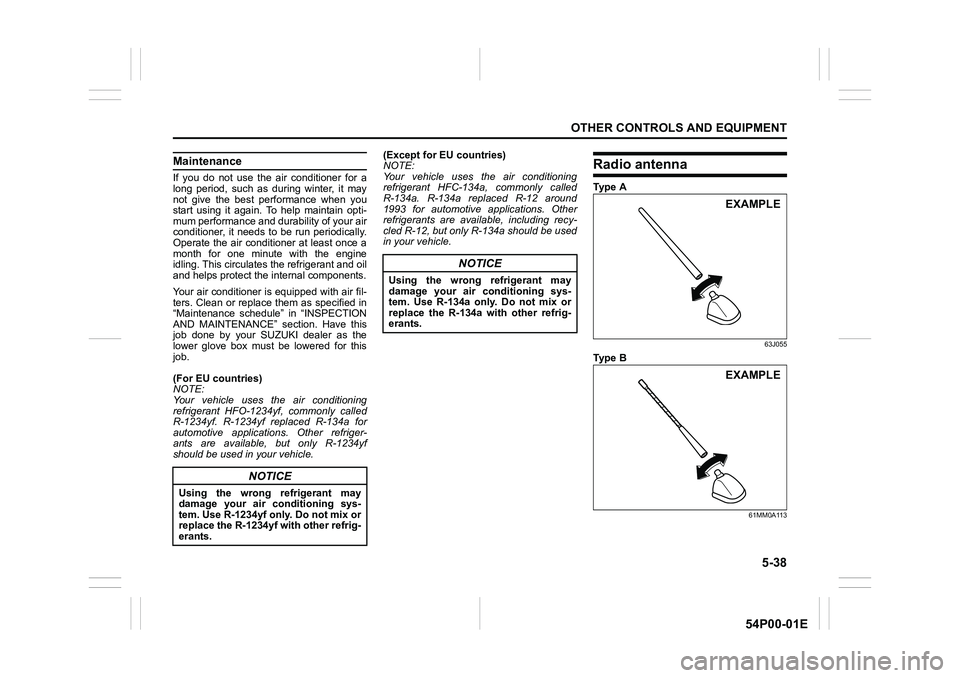
Radio antenna
Ty p e A
63J055
Ty p e B
61MM0A113
NOTICE
Using the wrong refrigerant may
damage your air conditioning sys-
tem. Use R-1234yf only. Do not mix or
replace the R-1234yf with other refrig-
erants.
NOTICE
Using the wrong refrigerant may
damage your air conditioning sys-
tem. Use R-134a only. Do not mix or
replace the R-134a with other refrig-
erants.
EXAMPLE
EXAMPLE
Page 335 of 482
6-3
VEHICLE LOADING AND TOWING
54P00-01E
Tires
Mirrors
Check if your vehicle’s mirrors meet local
requirements for mirrors used on towing
vehicles. If they do not, you must install the
required mirrors before you tow.
Vehicle/trailer loading
To load your vehicle and trailer properly,
you must know how to measure gross
trailer weight and trailer nose weight.
Gross trailer weight is the weight of the
trailer plus all the cargo in it. You can mea-
sure gross trailer weight by putting the fully
loaded trailer on a vehicle scale.
Nose weight is the downward force
exerted on the tow bar by the trailer cou-pler, with the trailer fully loaded and the
coupler at its normal towing height. This
weight can be measured using a bathroom
scale.
The weight of your loaded trailer (gross
trailer weight) should never exceed towing
capacity.
Distribute cargo in your trailer so that nose
weight is about 10% of gross trailer weight,
but does not exceed the maximum vertical
load on trailer hitch point. You should mea-
sure gross trailer weight and nose weight
before towing to check that your load is
properly distributed.
Additional trailer towing warnings
WA R N I N G
When towing a trailer, it is very
important for your vehicle and trailer
to have properly inflated tires. Your
vehicle’s tires should be inflated to
the pressures listed on your vehicles
tire information label. If laden pres-
sures are listed on the label, the tires
should be inflated to the laden pres-
sures. Inflate trailer tires according to
the specifications provided by the
trailer manufacturer.
WA R N I N G
Improper weight distribution of your
trailer may result in poor vehicle han-
dling and swaying of the trailer.
Always check that trailer nose weight
is about 10% of gross trailer weight,
but does not exceed the maximum
vertical load on trailer hitch point.
Also check that the cargo is properly
secured. Failure to observe this
requirement may result in an acci-
dent.
WA R N I N G
Never overload cargo on your trailer
or your vehicle. Gross trailer weight
must never exceed towing capacity.
Gross vehicle weight (sum of the
weights of the vehicle, all the occu-
pants, accessories including tow
bars and a trailer hitch, cargo and
trailer nose weight) must never
exceed the Gross Vehicle Weight Rat-
ing (GVWR) listed in “SPECIFICA-
TIONS” section.
WA R N I N G
Connect trailer lights and hook up
safety chains every time you tow.
NOTICE
Because towing a trailer puts addi-
tional stress on your vehicle, more
frequent maintenance will be
required than under normal driving
conditions. Follow the schedule in
“Maintenance recommended under
severe driving conditions”.
Page 338 of 482
INSPECTION AND MAINTENANCE
7
54P00-01E
60G410
INSPECTION AND MAINTENANCE
Maintenance schedule ........................................................ 7-2
Drive belt .............................................................................. 7-20
Engine oil and filter ............................................................. 7-20
Engine coolant .................................................................... 7-26
Air cleaner ............................................................................ 7-28
Spark plugs .......................................................................... 7-29
Gear oil ................................................................................. 7-30
Clutch pedal ......................................................................... 7-32
Fuel filter (diesel engine) .................................................... 7-33
Brakes .................................................................................. 7-33
Steering ................................................................................ 7-35
Tires ...................................................................................... 7-36
Battery .................................................................................. 7-39
Fuses .................................................................................... 7-41
Headlight aiming ................................................................. 7-44
Bulb replacement ................................................................ 7-45
Wiper blades ........................................................................ 7-55
Windshield washer fluid ..................................................... 7-59
Air conditioning system ..................................................... 7-59
Page 339 of 482
7-1
INSPECTION AND MAINTENANCE
54P00-01E
60B128S
WA R N I N G
Take extreme care when working on
your vehicle to prevent accidental
injury. Carefully observe the follow-
ing precautions:
• To prevent damage or unintended
activation of the air bag system or
seat belt pretensioner system, check
that the battery is disconnected and
the ignition switch has been in
“LOCK” position or the ignition
mode has been “LOCK” (OFF) for at
least 90 seconds before performing
any electrical service work on your
SUZUKI vehicle. Do not touch air
bag system components, seat belt
pretensioner system components or
wires.
The wires are wrapped with yellow
tape or yellow tubing, and the cou-
plers are yellow for easy identifica-
tion.
• Do not leave the engine running in
garages or other confined areas.
(Continued)
WA R N I N G
(Continued)
• When the engine is running, keep
hands, clothing, tools, and other
objects away from the fan and drive
belt. Even though the fan may not
be moving, it can automatically
turn on without warning.
• When it is necessary to perform
service work with the engine run-
ning, check that the parking brake
is set fully and the transaxle is in
Neutral.
• Do not touch ignition wires or other
ignition system parts when starting
the engine or when the engine is
running, or you could receive an
electric shock.
• Be careful not to touch a hot
engine, exhaust manifold and
pipes, muffler, radiator and water
hoses.
• Do not allow smoking, sparks, or
flames around fuel or the battery.
Flammable fumes are present.
• Do not get under your vehicle if it is
supported only with the portable
jack provided in your vehicle.
• Be careful not to cause accidental
short circuits between the positive
and negative battery terminals.
(Continued)
WA R N I N G
(Continued)
• Keep used oil, coolant, and other
fluids away from children and pets.
Dispose of used fluids properly;
never pour them on the ground,
into sewers, etc.
Page 340 of 482
7-2
INSPECTION AND MAINTENANCE
54P00-01E
Maintenance schedule
The following table shows the times when
you should perform regular maintenance
on your vehicle. This table shows the tim-
ing when you should perform inspections,
adjustments, lubrication and other ser-
vices, by kilometer, mile and month.
This table is generated in terms of the fol-
lowing points:
• Place of destination
• For gasoline engine model or diesel
engine model
• Recommended maintenance items for
inspection, adjustment and replacement
by a dealer, or items other than the
above-mentioned ones
Check an explanation of “How to under-
stand each table” in this section.If your routine use of vehicle applies in one
of the following conditions, you need to
perform maintenance according to the
maintenance interval under severe condi-
tion. For some items, the maintenance
interval for severe condition is not
described in the table. In this case, perform
maintenance according to the mainte-
nance interval for normal condition.
The maintenance interval for severe condi-
tion is shorter than the one for normal con-
dition.Maintenance recommended under
severe driving conditions
• When most trips are less than 6 kilome-
ters (4 miles)
• When most trips are less than 16 kilome-
ters (10 miles) and outside temperature
remains below freezing
• Idling and/or low-speed operation in
stop-and-go traffic
• Operating in extremely cold weather
and/or on salted roads
• Operating in rough and/or muddy areas.
• Operating in dusty areas
• Repeated high speed drive or high
engine revolutions
• Towing a trailer, if admitted
When the vehicle is used for delivery ser-
vice, police, taxi or other commercial appli-
cations.
WA R N I N G
SUZUKI recommends that mainte-
nance of your vehicle be performed
by your authorized SUZUKI dealer or
a qualified service technician. If you
are not sure whether you can suc-
cessfully complete any of mainte-
nance jobs, ask your authorized
SUZUKI dealer to do the maintenance
for you.
NOTICE
Whenever it becomes necessary to
replace parts on your vehicle, it is
recommended that you use genuine
SUZUKI replacement parts or their
equivalent.
Page 341 of 482
7-3
INSPECTION AND MAINTENANCE
54P00-01E
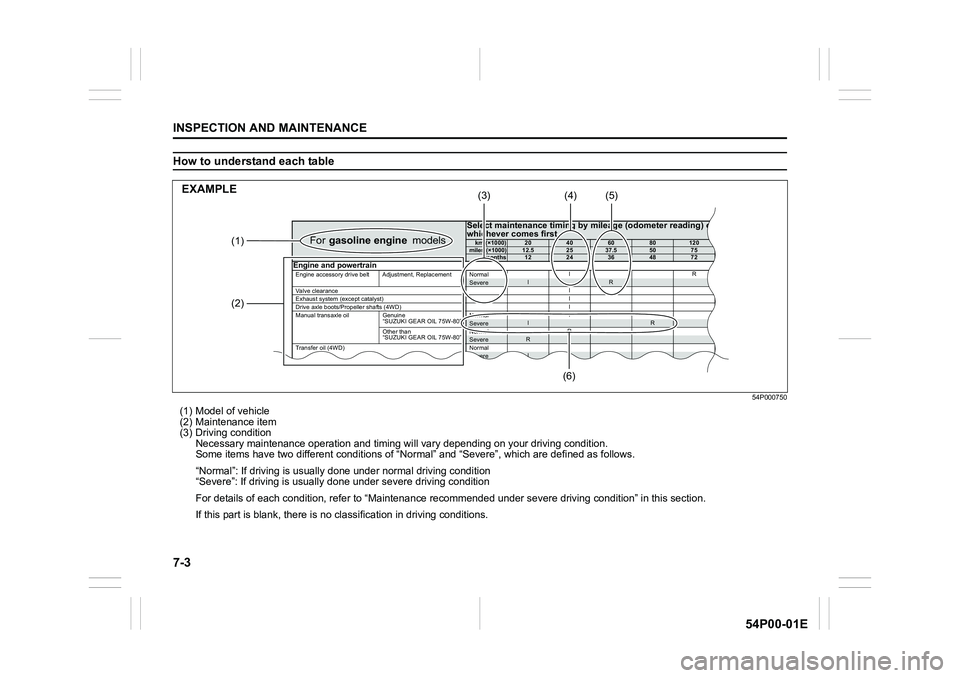
How to understand each table
54P000750
(1) Model of vehicle
(2) Maintenance item
(3) Driving condition
Necessary maintenance operation and timing will vary depending on your driving condition.
Some items have two different conditions of “Normal” and “Severe”, which are defined as follows.
“Normal”: If driving is usually done under normal driving condition
“Severe”: If driving is usually done under severe driving condition
For details of each condition, refer to “Maintenance recommended under severe driving condition” in this section.
If this part is blank, there is no classification in driving conditions.
Forgasoline engine models
Select maintenance timing by mileage (odometer reading) or
whichever comes first.
km (×1000)20406080120miles (×1000)12.52537.55075months1224364872Engine and powertrainEngine accessory drive belt Adjustment, Replacement NormalR ISevereIRValve clearanceI
Exhaust system (except catalyst)I
Drive axle boots/Propeller shafts (4WD)I
Manual transaxle oil Genuine
“SUZUKI GEAR OIL 75W-80”NormalI
SevereIROther than
“SUZUKI GEAR OIL 75W-80”NormalRSevereRl a m r o N ) D W 4 ( l i o r e f s n a r TISevereIR
(2)(3) (4) (5)
(1)
(6)
EXAMPLE