Fog SUZUKI IGNIS 2017 User Guide
[x] Cancel search | Manufacturer: SUZUKI, Model Year: 2017, Model line: IGNIS, Model: SUZUKI IGNIS 2017Pages: 505, PDF Size: 8.36 MB
Page 221 of 505
3-68
OPERATING YOUR VEHICLE
75RM4-01E
72M20405
• When your vehicle is weighed down byheavy items in the luggage compartment
or rear seat
• When the tires are not inflated to the rec- ommended tire inflation pressure or the
tires are worn
• With tire chains or non-specified sized
tires equipped
• When you have a temporarily repaired flat tire
• With a modified suspension equipped
• When passing through the entrance or exit of the tunnel and the brightness is
changed extremely
• When driving without lighting the head- lights at night or in tunnels
• When driving on a steep slope or sharp curves
• When the optical axis of the headlight is
deviated
• With modified headlights and/or front fog lights equipped
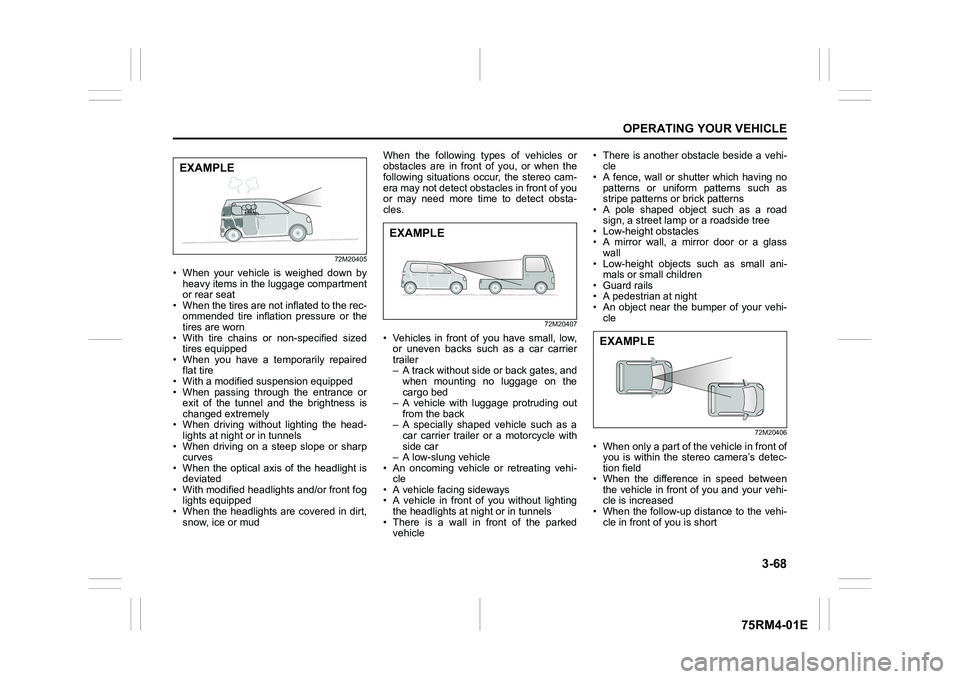
• When the headlights are covered in dirt, snow, ice or mud When the following types of vehicles or
obstacles are in front of you, or when the
following situations occur, the stereo cam-
era may not detect obstacles in front of you
or may need more time to detect obsta-
cles.
72M20407
• Vehicles in front of you have small, low,
or uneven backs such as a car carrier
trailer
– A track without side or back gates, andwhen mounting no luggage on the
cargo bed
– A vehicle with luggage protruding out
from the back
– A specially shaped vehicle such as a car carrier trailer or a motorcycle with
side car
– A low-slung vehicle
• An oncoming vehicle or retreating vehi-
cle
• A vehicle facing sideways
• A vehicle in front of you without lighting
the headlights at n ight or in tunnels
• There is a wall in front of the parked vehicle • There is another obstacle beside a vehi-
cle
• A fence, wall or shutter which having no
patterns or uniform patterns such as
stripe patterns or brick patterns
• A pole shaped object such as a road
sign, a street lamp or a roadside tree
• Low-height obstacles
• A mirror wall, a mirror door or a glass
wall
• Low-height objects such as small ani- mals or small children
• Guard rails
• A pedestrian at night
• An object near the bumper of your vehi- cle
72M20406
• When only a part of the vehicle in front ofyou is within the stereo camera’s detec-
tion field
• When the difference in speed between the vehicle in front of you and your vehi-
cle is increased
• When the follow-up distance to the vehi- cle in front of you is short
EXAMPLE
EXAMPLE
EXAMPLE
Page 274 of 505

5-19OTHER CONTROLS AND EQUIPMENT
75RM4-01E
75RM402
NOTE:
The mark of “USE WITH” (5)
To clear fog on the windshield and/or the
side windows quickly, set the air flow
selector (3) to “HEAT & DEFROST” or
“DEFROST” and air intake selector (4) to
“FRESH AIR”. These positioning will clear
the fogged windshield and/or the side win-
dows faster than the “RECIRCULATED
AIR”.
System operating instructionsNatural ventilation
Select VENTILATION and FRESH AIR, the
temperature selector to the desired tem-
perature position, and the blower speed
selector to off. Fresh air will flow through
the vehicle during driving.
Forced ventilation
The control settings are the same as for
natural ventilation except you set the
blower speed selector to a position other
than off.
Normal heating (using outside air)
Select HEAT and FRESH AIR, the tem-
perature selector to the desired tempera-
ture position and the blower speed selector
to the desired blower speed position. Set-
ting the blower speed selector to a higher
blower speed position increases heating
efficiency.
Quick heating (using recirculated air)
The control settings are the same as for
normal heating except you select RECIR-
CULATED AIR. If you use this heating
method for an extended period of time, the
air in the vehicle can become contami-
nated and the windows can become misty.
Therefore, use this method only for quick
heating and change to the normal heating
method as soon as possible. Head cooled/Feet warmed heating
Select BI-LEVEL and FRESH AIR, the
temperature selector to the desired tem-
perature position, and the blower speed
selector to the desired blower speed posi-
tion. Unless the temperature selector is in
the fully cold position or fully hot position,
the air that comes out of the center and
side outlets will be cooler than the air that
comes out of the floor outlets.
Defrosting/Feet warmed heating
Select HEAT & DEFROST and FRESH
AIR, the temperatur
e selector to the
desired temperature position, and the
blower speed selector to high. When the
windshield has become clear, set the
blower speed selector to the desired
blower speed position.
Defrosting
Select DEFROST and FRESH AIR, the
temperature selector to the desired tem-
perature position (higher temperature pro-
vides more efficient defrosting), and the
blower speed selector to high. When the
windshield has become clear, set the
blower speed selector to the desired
blower speed position.
(3)
(5)
Page 275 of 505
5-20
OTHER CONTROLS AND EQUIPMENT
75RM4-01E
75RM357
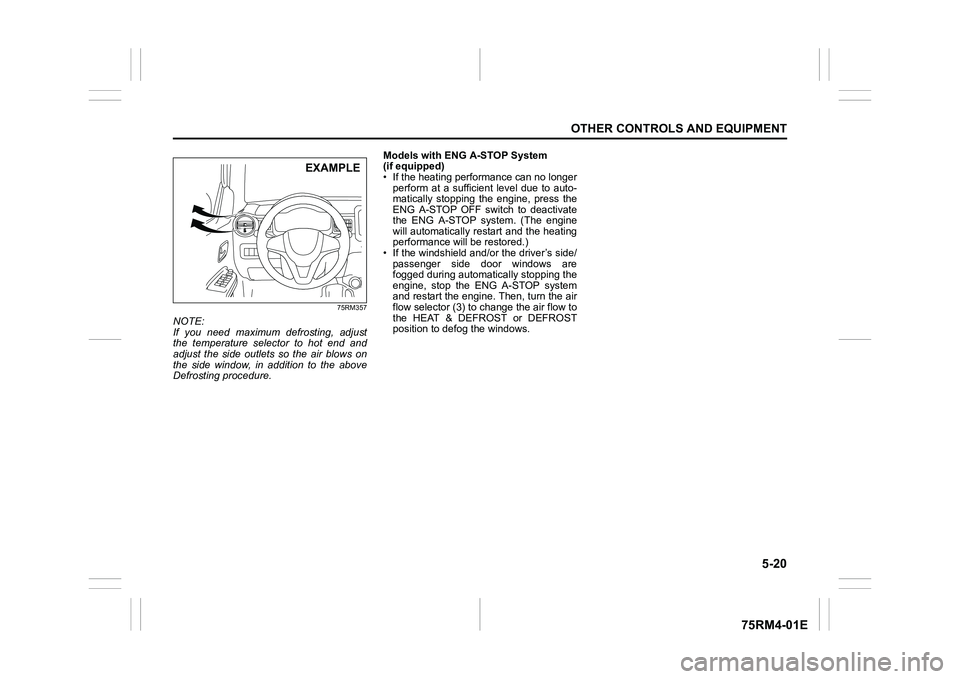
NOTE:
If you need maximum defrosting, adjust
the temperature selector to hot end and
adjust the side outlets so the air blows on
the side window, in addition to the above
Defrosting procedure.Models with ENG A-STOP System
(if equipped)
• If the heating performance can no longer
perform at a sufficient level due to auto-
matically stopping the engine, press the
ENG A-STOP OFF switch to deactivate
the ENG A-STOP system. (The engine
will automatically restart and the heating
performance will be restored.)
• If the windshield and/or the driver’s side/ passenger side door windows are
fogged during automatic ally stopping the
engine, stop the ENG A-STOP system
and restart the engine. Then, turn the air
flow selector (3) to c hange the air flow to
the HEAT & DEFROST or DEFROST
position to defog the windows.
EXAMPLE
Page 278 of 505
5-23OTHER CONTROLS AND EQUIPMENT
75RM4-01E
75RM403
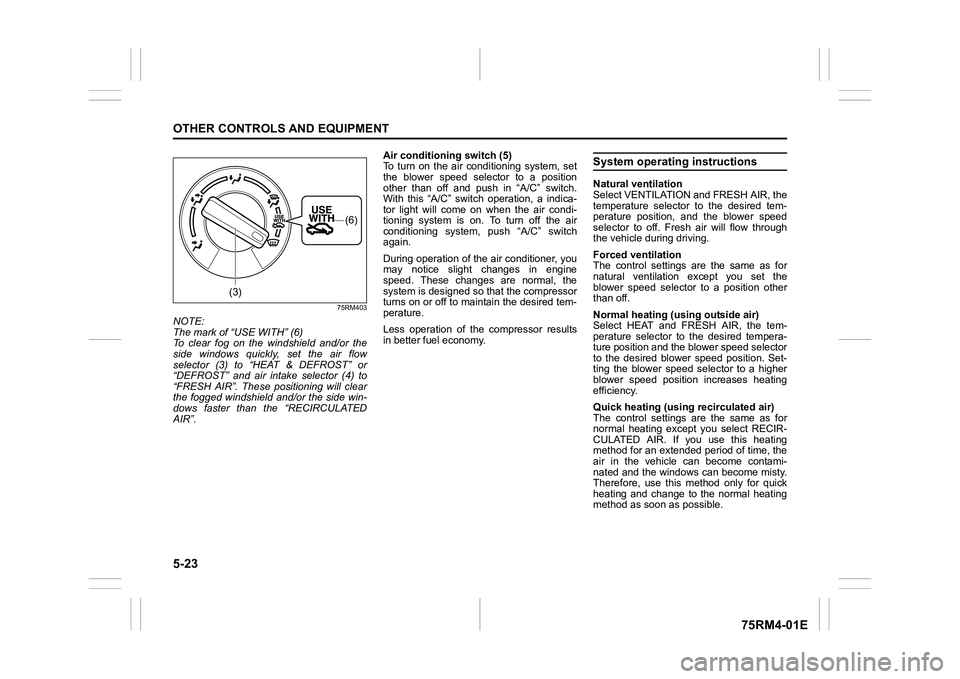
NOTE:
The mark of “USE WITH” (6)
To clear fog on the windshield and/or the
side windows quickly, set the air flow
selector (3) to “HEAT & DEFROST” or
“DEFROST” and air intake selector (4) to
“FRESH AIR”. These positioning will clear
the fogged windshield and/or the side win-
dows faster than the “RECIRCULATED
AIR”. Air conditioning switch (5)
To turn on the air conditioning system, set
the blower speed selector to a position
other than off and push in “A/C” switch.
With this “A/C” switch operation, a indica-
tor light will come on when the air condi-
tioning system is on. To turn off the air
conditioning system,
push “A/C” switch
again.
During operation of the air conditioner, you
may notice slight changes in engine
speed. These changes are normal, the
system is designed so that the compressor
turns on or off to maintain the desired tem-
perature.
Less operation of the compressor results
in better fuel economy.
System operating instructionsNatural ventilation
Select VENTILATION and FRESH AIR, the
temperature selector to the desired tem-
perature position, and the blower speed
selector to off. Fresh air will flow through
the vehicle during driving.
Forced ventilation
The control settings are the same as for
natural ventilation except you set the
blower speed selector to a position other
than off.
Normal heating (using outside air)
Select HEAT and FRESH AIR, the tem-
perature selector to the desired tempera-
ture position and the blower speed selector
to the desired blower speed position. Set-
ting the blower speed selector to a higher
blower speed position increases heating
efficiency.
Quick heating (using recirculated air)
The control settings are the same as for
normal heating except you select RECIR-
CULATED AIR. If you use this heating
method for an extended period of time, the
air in the vehicle can become contami-
nated and the windows can become misty.
Therefore, use this method only for quick
heating and change to the normal heating
method as soon as possible.
(3)
(6)
Page 280 of 505
5-25OTHER CONTROLS AND EQUIPMENT
75RM4-01E
Models with ENG A-STOP System
(if equipped)
• If the heating performance can no longerperform at a sufficient level due to auto-
matically stopping the engine, press the
ENG A-STOP OFF switch to deactivate
the ENG A-STOP system. (The engine
will automatically restart and the air con-
ditioning performanc e will be restored.)
• If the windshield and/or the driver’s side/ passenger side door windows are
fogged during automatic ally stopping the
engine, stop the ENG A-STOP system
and restart the engine. Then, turn the air
flow selector (3) to change the air flow to
the HEAT & DEFROST or DEFROST
position to defog the windows.
MaintenanceIf you do not use the air conditioner for a
long period, such as during winter, it may
not give the best performance when you
start using it again. To help maintain opti-
mum performance and durability of your air
conditioner, it needs to be run periodically.
Operate the air conditioner at least once a
month for one minute with the engine
idling. This circulates the refrigerant and oil
and helps protect the internal components.
If your air conditioner is equipped with air
filters, clean or replace them as specified
in “Maintenance schedule” in the
“INSPECTION AND MAINTENANCE” sec-
tion.
(For vehicles using “HFO-1234yf” refrig-
erant)
NOTE:
Your vehicle uses the air conditioning
refrigerant HFO-1234yf, commonly called
R-1234yf. R-1234yf replaced R-134a for
automotive applications. Other refriger-
ants are available, but only R-1234yf
should be used in your vehicle.
NOTICE
Using the wrong refrigerant may
damage your air conditioning sys-
tem. Use R-1234yf only. Do not mix or
replace the R-1234yf with other refrig-
erants.
(Except for vehicles using “HFO-1234yf”
refrigerant)
NOTE:
Your vehicle uses the air conditioning
refrigerant HFC-134a, commonly called
R-134a. R-134a replaced R-12 around
1993 for automotive applications. Other
refrigerants are available, including recy-
cled R-12, but only R-134a should be used
in your vehicle.
NOTICE
Using the wrong refrigerant may
damage your air conditioning sys-
tem. Use R-134a only. Do not mix or
replace the R-134a with other refrig-
erants.
Page 285 of 505
5-30
OTHER CONTROLS AND EQUIPMENT
75RM4-01E
You can use the air conditioning switch (6)
to manually turn the air conditioner on or off
according to your preference. When you
turn the air conditioning switch off, the cli-
mate control system cannot lower the inside
temperature below outside temperature.
To turn the climate control system off, push
“OFF” switch (7).
NOTE:
If “AUTO” on the display blinks, there is a
problem in the heating system and/or air
conditioning system. Yo u should have the
system inspected by an authorized
SUZUKI dealer.
NOTE:
• To find the temperature at which you are
most comfortable, start with the 22°C
(72°F) or 25°C (75°F) setting. (the tem-
perature vary depending on vehicle
specifications.).
• If you push the temperature selector (1) until “HI” or “LO” appears on the display,
the climate control system will operate at
maximum heating or cooling and the
blower will run at full speed.
• To avoid blowing cold air in cold weather or hot air in hot weather, the system will
delay turning on the blower until warmed
or chilled air is available.
• If your vehicle has been left in the sun with the windows closed, it will cool
faster if you open the windows briefly.
• Even under the automat ic operation, you
can set individual selectors to the manual mode. The manually selected functions
are maintained, and the other functions
remain under automatic operation.
• If the windshield and/or the front door windows are fogged, push the defrost
switch (5) to turn on the defroster, or
push the air flow selector (4) to change
the air flow to HEAT & DEFROST posi-
tion to defog the windows.
• To return the blower speed selector (2), air intake selector (3 ), and air flow selec-
tor (4) to automatic operation, push
“AUTO” switch (8).
75RM148
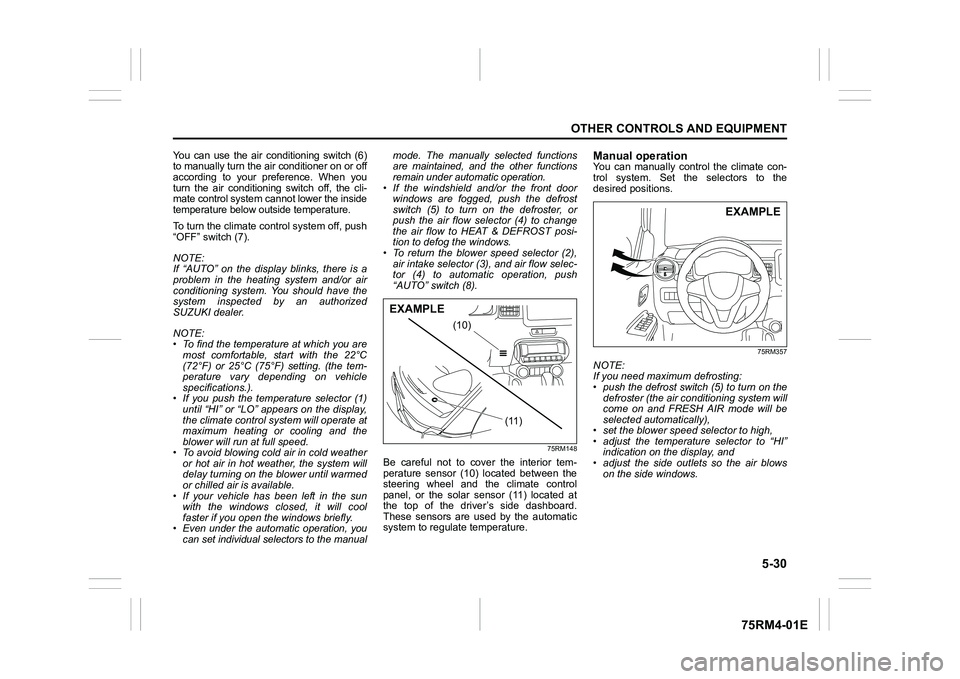
Be careful not to cover the interior tem-
perature sensor (10) located between the
steering wheel and the climate control
panel, or the solar sensor (11) located at
the top of the driver’s side dashboard.
These sensors are used by the automatic
system to regula te temperature.
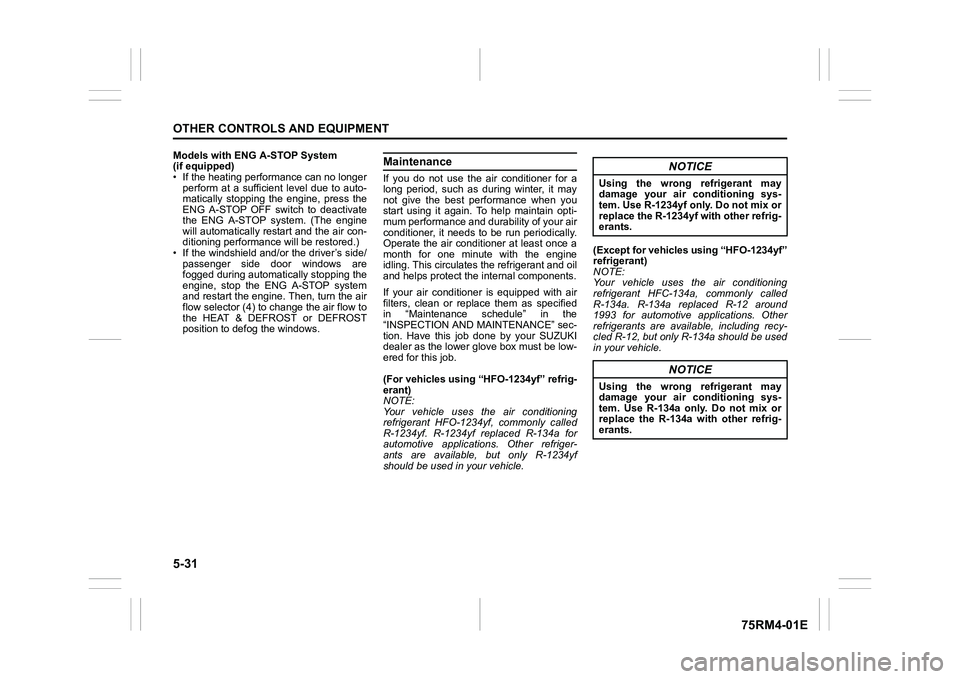
Manual operationYou can manually control the climate con-
trol system. Set the selectors to the
desired positions.
75RM357
NOTE:
If you need maximum defrosting:
• push the defrost switch (5) to turn on the
defroster (the air conditioning system will
come on and FRESH AIR mode will be
selected automatically),
• set the blower speed selector to high,
• adjust the temperature selector to “HI” indication on the display, and
• adjust the side outlets so the air blows on the side windows.
(10)
(11)
EXAMPLE
EXAMPLE
Page 286 of 505
5-31OTHER CONTROLS AND EQUIPMENT
75RM4-01E
Models with ENG A-STOP System
(if equipped)
• If the heating performance can no longerperform at a sufficient level due to auto-
matically stopping the engine, press the
ENG A-STOP OFF switch to deactivate
the ENG A-STOP system. (The engine
will automatically restart and the air con-
ditioning performanc e will be restored.)
• If the windshield and/or the driver’s side/ passenger side door windows are
fogged during automatic ally stopping the
engine, stop the ENG A-STOP system
and restart the engine. Then, turn the air
flow selector (4) to change the air flow to
the HEAT & DEFROST or DEFROST
position to defog the windows.
MaintenanceIf you do not use the air conditioner for a
long period, such as during winter, it may
not give the best performance when you
start using it again. To help maintain opti-
mum performance and durability of your air
conditioner, it needs to be run periodically.
Operate the air conditioner at least once a
month for one minute with the engine
idling. This circulates the refrigerant and oil
and helps protect the internal components.
If your air conditioner is equipped with air
filters, clean or replace them as specified
in “Maintenance schedule” in the
“INSPECTION AND MAINTENANCE” sec-
tion. Have this job done by your SUZUKI
dealer as the lower glove box must be low-
ered for this job.
(For vehicles using “HFO-1234yf” refrig-
erant)
NOTE:
Your vehicle uses the air conditioning
refrigerant HFO-1234yf, commonly called
R-1234yf. R-1234yf replaced R-134a for
automotive applications. Other refriger-
ants are available, but only R-1234yf
should be used in your vehicle. (Except for vehicles using “HFO-1234yf”
refrigerant)
NOTE:
Your vehicle uses the air conditioning
refrigerant HFC-134a, commonly called
R-134a. R-134a replaced R-12 around
1993 for automotive applications. Other
refrigerants are available, including recy-
cled R-12, but only R-134a should be used
in your vehicle.
NOTICE
Using the wrong refrigerant may
damage your air conditioning sys-
tem. Use R-1234yf only. Do not mix or
replace the R-1234yf with other refrig-
erants.
NOTICE
Using the wrong refrigerant may
damage your air conditioning sys-
tem. Use R-134a only. Do not mix or
replace the R-134a with other refrig-
erants.
Page 395 of 505
7-46
INSPECTION AND MAINTENANCE
75RM4-01E
*1: Models with ENG A-STOP
*2: CVT models with ENG A-STOP
*3: Auto Gear Shift models
*4: Models with Auto-on headlight system
*5: Models with front fog light The main fuse, primary fuses and some of
the individual fuses are located in the
engine compartment. If the main fuse
blows, no electrical component will func-
tion. If a primary fuse blows, no electrical
component in the corresponding load
group will function. When replacing the
main fuse, a primary fuse or an individual
fuse, use a genuine S
UZUKI replacement.
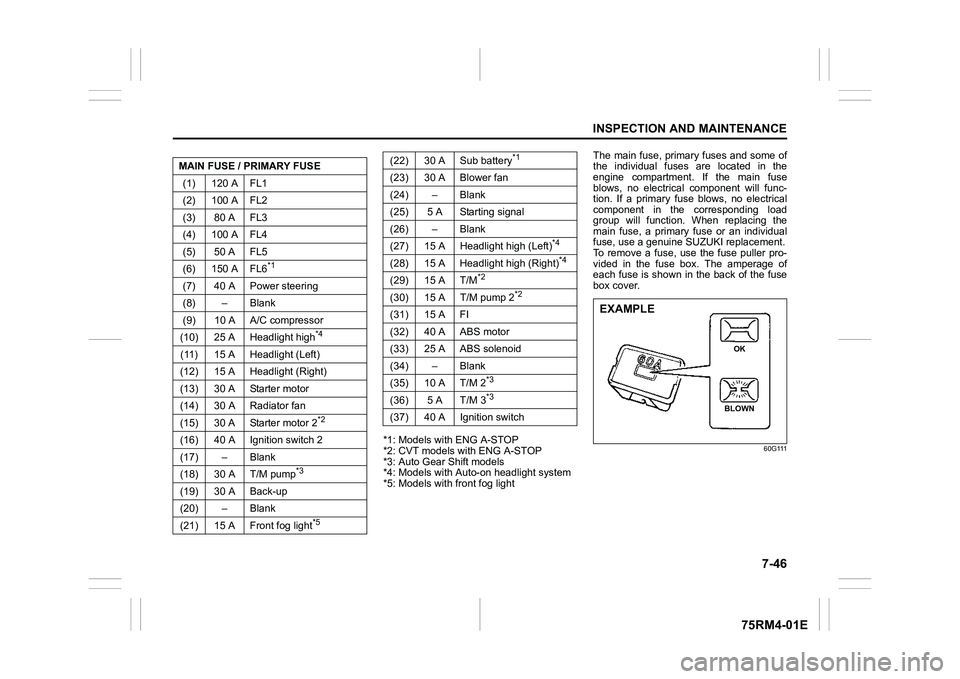
To remove a fuse, use the fuse puller pro-
vided in the fuse box. The amperage of
each fuse is shown in the back of the fuse
box cover.
60G111
MAIN FUSE / PRIMARY FUSE
(1) 120 A FL1
(2) 100 A FL2
(3) 80 A FL3
(4) 100 A FL4
(5) 50 A FL5
(6) 150 A FL6
*1
(7) 40 A Power steering
(8) – Blank
(9) 10 A A/C compressor
(10) 25 A Headlight high
*4
(11) 15 A Headlight (Left)
(12) 15 A Headlight (Right)
(13) 30 A Starter motor
(14) 30 A Radiator fan
(15) 30 A Starter motor 2
*2
(16) 40 A Ignition switch 2
(17) – Blank
(18) 30 A T/M pump
*3
(19) 30 A Back-up
(20) – Blank
(21) 15 A Front fog light
*5
(22) 30 A Sub battery
*1
(23) 30 A Blower fan
(24) – Blank
(25) 5 A Starting signal
(26) – Blank
(27) 15 A Headlight high (Left)
*4
(28) 15 A Headlight high (Right)
*4
(29) 15 A T/M
*2
(30) 15 A T/M pump 2
*2
(31) 15 A FI
(32) 40 A ABS motor
(33) 25 A ABS solenoid
(34) – Blank
(35) 10 A T/M 2
*3
(36) 5 A T/M 3
*3
(37) 40 A Ignition switch
EXAMPLE
BLOWN OK
Page 396 of 505
7-47INSPECTION AND MAINTENANCE
75RM4-01E
NOTE:
Check that the fuse box always carries
spare fuses.
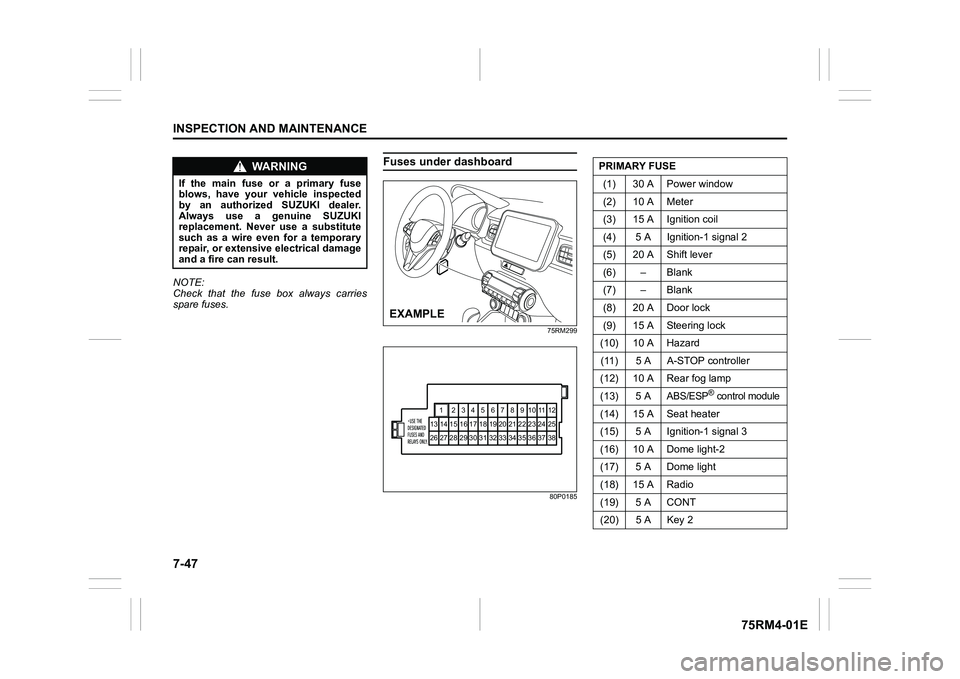
Fuses under dashboard
75RM299
80P0185
WA R N I N G
If the main fuse or a primary fuse
blows, have your vehicle inspected
by an authorized SUZUKI dealer.
Always use a genuine SUZUKI
replacement. Never use a substitute
such as a wire even for a temporary
repair, or extensive electrical damage
and a fire can result.
EXAMPLE
12 15
28
14
27
13
26 3
16
29 4
17
30 5
18
31 6
19
32 7
20
33 8
21
34 9
22
35 10
23
36 11
24
37 12
25
38
35,0Ν5Υа)86(
(1) 30 A Power window
(2) 10 A Meter
(3) 15 A Ignition coil
(4) 5 A Ignition-1 signal 2
(5) 20 A Shift lever
(6) – Blank
(7) – Blank
(8) 20 A Door lock
(9) 15 A Steering lock
(10) 10 A Hazard (11) 5 A A-STOP controller
(12) 10 A Rear fog lamp
(13) 5 A
ABS/ESP
® control module
(14) 15 A Seat heater
(15) 5 A Ignition-1 signal 3
(16) 10 A Dome light-2
(17) 5 A Dome light
(18) 15 A Radio
(19) 5 A CONT
(20) 5 A Key 2
Page 397 of 505
7-48
INSPECTION AND MAINTENANCE
75RM4-01E
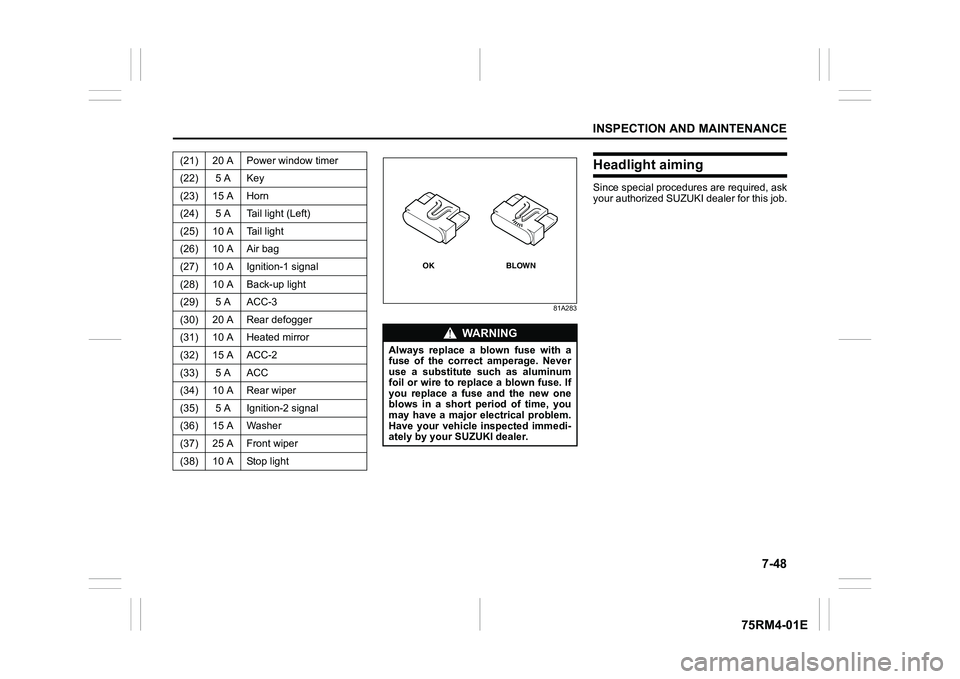
81A283
Headlight aimingSince special procedures are required, ask
your authorized SUZUKI dealer for this job.
(21) 20 A Power window timer
(22) 5 A Key
(23) 15 A Horn
(24) 5 A Tail light (Left)
(25) 10 A Tail light
(26) 10 A Air bag
(27) 10 A Ignition-1 signal
(28) 10 A Back-up light
(29) 5 A ACC-3
(30) 20 A Rear defogger
(31) 10 A Heated mirror
(32) 15 A ACC-2
(33) 5 A ACC
(34) 10 A Rear wiper
(35) 5 A Ignition-2 signal
(36) 15 A Washer
(37) 25 A Front wiper
(38) 10 A Stop light
WA R N I N G
Always replace a blown fuse with a
fuse of the correct amperage. Never
use a substitute such as aluminum
foil or wire to replace a blown fuse. If
you replace a fuse and the new one
blows in a short period of time, you
may have a major electrical problem.
Have your vehicle inspected immedi-
ately by your SUZUKI dealer.
BLOWN
OK