change wheel SUZUKI IGNIS 2017 User Guide
[x] Cancel search | Manufacturer: SUZUKI, Model Year: 2017, Model line: IGNIS, Model: SUZUKI IGNIS 2017Pages: 505, PDF Size: 8.36 MB
Page 232 of 505
3-79OPERATING YOUR VEHICLE
75RM4-01E
NOTE:
• If the ESP
® system is activated, you may
hear a clunking noise and/or feel pulsat-
ing in the brake pedal. This is normal
and indicates that the brake fluid pres-
sure is being controlled properly.
• You may hear an operation sound when you start the engine or after the vehicle
begins to move. This means that the
above systems are in the self-check
mode. This sound does not indicate a
malfunction. The ESP
® indicator lights are described
below:
ESP
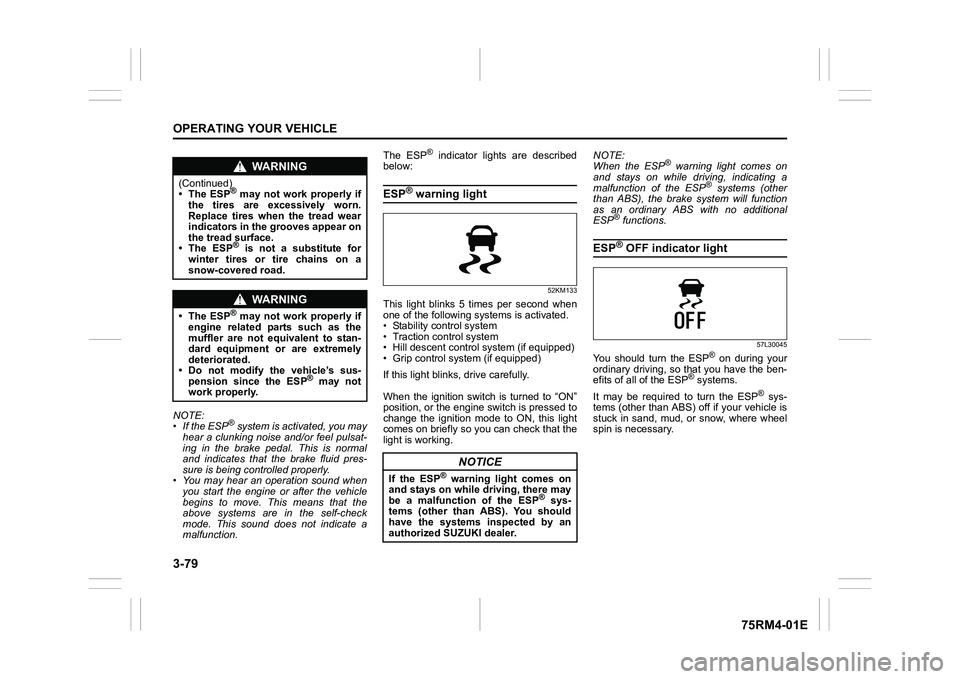
® warning light
52KM133
This light blinks 5 times per second when
one of the following sy stems is activated.
• Stability control system
• Traction control system
• Hill descent control system (if equipped)
• Grip control system (if equipped)
If this light blinks, drive carefully.
When the ignition switch is turned to “ON”
position, or the engine switch is pressed to
change the ignition mode to ON, this light
comes on briefly so you can check that the
light is working. NOTE:
When the ESP
® warning light comes on
and stays on while driving, indicating a
malfunction of the ESP
® systems (other
than ABS), the brake system will function
as an ordinary ABS with no additional
ESP
® functions.
ESP
® OFF indicator light
57L30045
You should turn the ESP
® on during your
ordinary driving, so that you have the ben-
efits of all of the ESP
® systems.
It may be required to turn the ESP
® sys-
tems (other than ABS) off if your vehicle is
stuck in sand, mud, or snow, where wheel
spin is necessary.
WA R N I N G
(Continued)
• The ESP
® may not work properly if
the tires are excessively worn.
Replace tires when the tread wear
indicators in the grooves appear on
the tread surface.
• The ESP® is not a substitute for
winter tires or tire chains on a
snow-covered road.
WA R N I N G
• The ESP
® may not work properly if
engine related parts such as the
muffler are not equivalent to stan-
dard equipment or are extremely
deteriorated.
• Do not modify the vehicle’s sus- pension since the ESP
® may not
work properly.
NOTICE
If the ESP
® warning light comes on
and stays on while driving, there may
be a malfunction of the ESP
® sys-
tems (other than ABS). You should
have the systems inspected by an
authorized SUZUKI dealer.
Page 240 of 505
3-87OPERATING YOUR VEHICLE
75RM4-01E
The low tire pressure warning light can
come on due to normal causes such as
natural air leakage and pressure changes
caused by changes in temperature or
atmospheric pressure. Adjusting the air
pressure in the tires to the pressure shown
on the tire information placard should
cause the low tire pressure warning light to
turn off.
To make the low tire pressure warning light
go off, adjust the tire pressures when the
tires are cold, and drive the vehicle for
about 10 minutes.
When the adjusted tire pressure is recog-
nized, the low tire pressure warning light
will go off and the information display
shows the current tire pressure (if you
select the TPMS monitor).If the light turns on again shortly after
adjusting the pressure in your tires, you
may have a flat tire. If you have a flat tire,
replace it with the spare tire (if equipped).
Refer to “Jacking instructions” in the
“EMERGENCY SERVICE” section. Refer
to “Replacing tires and/or wheels” for
instructions on how to restore normal oper-
ation of the tire pressure monitoring sys-
tem after you have
had a flat tire.
WA R N I N G
Continuing to drive with the low tire
pressure warning light on can lead to
an accident, resulting in severe injury
or death.
If the low tire pressure warning light
comes on and stays on, reduce your
speed and avoid abrupt steering and
braking. Be aware that driving on a
significantly unde r-inflated tire can
cause the tire to overheat and can
lead to tire failure, and may affect
steering control and brake effective-
ness. Stop in a safe place as soon as
possible and check your tires.
• If you have a flat tire, replace it with the spare tire (if e quipped). Refer to
“Jacking instructions” in the
“EMERGENCY SERVICE” section
for tire replacement. Also refer to
“Replacing tires and/or wheels” for
instructions on how to restore nor-
mal operation of the TPMS after
you have had a flat tire. (Continued)
WA R N I N G
(Continued)
• If your vehicle is equipped with a
flat tire repair kit instead of a spare
tire, refer to “Flat tire repair kit” in
the “EMERGENCY SERVICE” sec-
tion for instructions on how to per-
form an emergency repair of a flat
tire.
• If one or more of your tires is under-inflated, adjust the inflation
pressure in all of your tires to the
recommended inflation pressure as
soon as possible.
NOTICE
If the low tire pressure warning light
does not go off even when you drive
for more than 10 minutes after adjust-
ing the cold tire pressure, there may
be a problem with the TPMS. Have
your vehicle inspected by an autho-
rized SUZUKI dealer.
Page 241 of 505
3-88
OPERATING YOUR VEHICLE
75RM4-01E
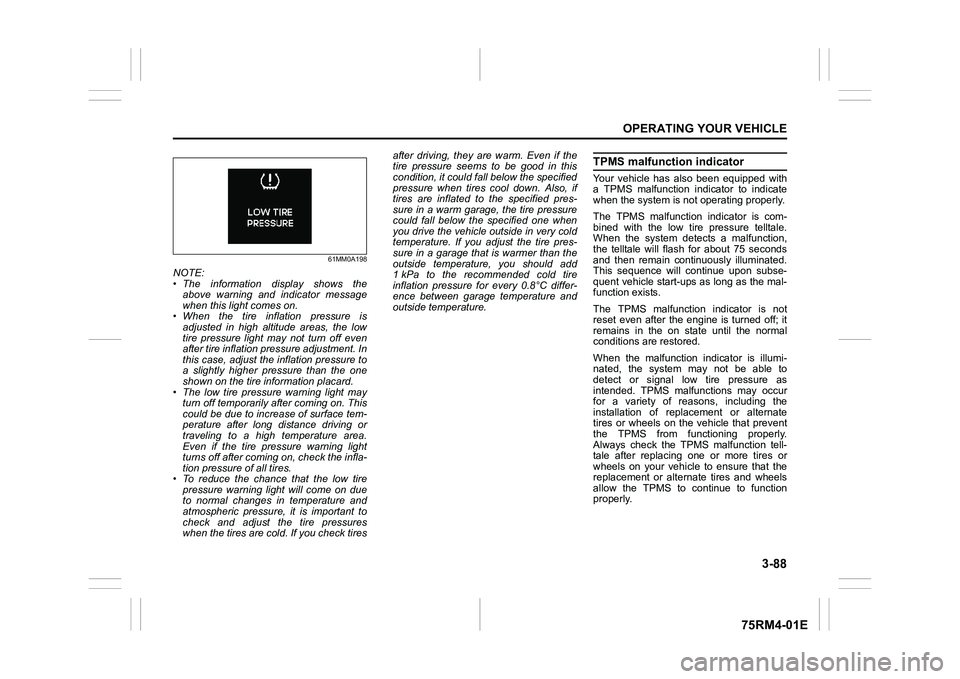
61MM0A198
NOTE:
• The information display shows theabove warning and indicator message
when this light comes on.
• When the tire inflation pressure is
adjusted in high altitude areas, the low
tire pressure light may not turn off even
after tire inflation pressure adjustment. In
this case, adjust the inflation pressure to
a slightly higher pressure than the one
shown on the tire information placard.
• The low tire pressure warning light may turn off temporarily after coming on. This
could be due to increase of surface tem-
perature after long distance driving or
traveling to a high temperature area.
Even if the tire pressure warning light
turns off after coming on, check the infla-
tion pressure of all tires.
• To reduce the chance that the low tire pressure warning light will come on due
to normal changes in temperature and
atmospheric pressure, it is important to
check and adjust the tire pressures
when the tires are cold. If you check tires after driving, they are warm. Even if the
tire pressure seems to be good in this
condition, it could fall below the specified
pressure when tires cool down. Also, if
tires are inflated to the specified pres-
sure in a warm garage, the tire pressure
could fall below the specified one when
you drive the vehicle outside in very cold
temperature. If you adjust the tire pres-
sure in a garage that is warmer than the
outside temperature, you should add
1 kPa to the recommended cold tire
inflation pressure for every 0.8°C differ-
ence between garage temperature and
outside temperature.
TPMS malfunction indicatorYour vehicle has also been equipped with
a TPMS malfunction indicator to indicate
when the system is not operating properly.
The TPMS malfunction indicator is com-
bined with the low tire pressure telltale.
When the system detects a malfunction,
the telltale will flash for about 75 seconds
and then remain continuously illuminated.
This sequence will continue upon subse-
quent vehicle start-ups as long as the mal-
function exists.
The TPMS malfunction indicator is not
reset even after the engine is turned off; it
remains in the on state until the normal
conditions are restored.
When the malfunction indicator is illumi-
nated, the system may not be able to
detect or signal low tire pressure as
intended. TPMS malfunctions may occur
for a variety of reasons, including the
installation of replacement or alternate
tires or wheels on the vehicle that prevent
the TPMS from functioning properly.
Always check the TPMS malfunction tell-
tale after replacing one or more tires or
wheels on your vehicle to ensure that the
replacement or alternate tires and wheels
allow the TPMS to continue to function
properly.
Page 251 of 505
4-4
DRIVING TIPS
75RM4-01E
CVT
75RM296
• When climbing steep hills, the vehiclemay begin to slow down and show a lack
of power. If this happens, you should
shift to a lower gear so that the engine
will again be operating in its normal
power range. Shift rapidly to prevent the
vehicle from losing momentum.
• When driving down a hill, the engine
should be used for braking by shifting to
the next lower gear.
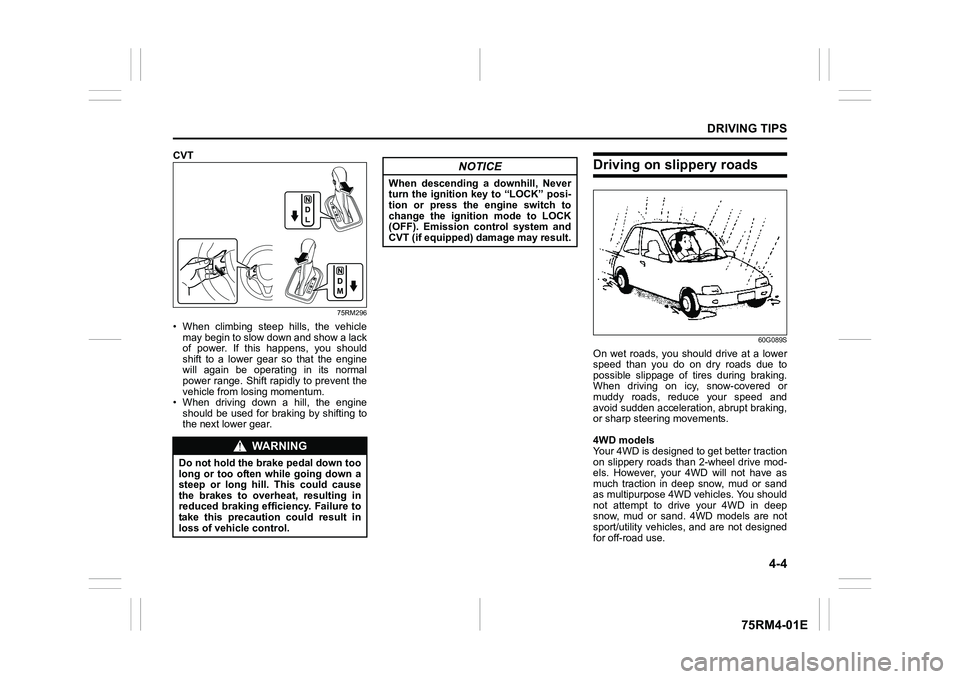
Driving on slippery roads
60G089S
On wet roads, you shou ld drive at a lower
speed than you do on dry roads due to
possible slippage of tires during braking.
When driving on icy, snow-covered or
muddy roads, reduce your speed and
avoid sudden acceleration, abrupt braking,
or sharp steering movements.
4WD models
Your 4WD is designed to get better traction
on slippery roads than 2-wheel drive mod-
els. However, your 4WD will not have as
much traction in deep snow, mud or sand
as multipurpose 4WD vehicles. You should
not attempt to drive your 4WD in deep
snow, mud or sand. 4WD models are not
sport/utility vehicles, and are not designed
for off-road use.
WA R N I N G
Do not hold the brake pedal down too
long or too often while going down a
steep or long hill. This could cause
the brakes to overheat, resulting in
reduced braking efficiency. Failure to
take this precaution could result in
loss of vehicle control.
NOTICE
When descending a downhill, Never
turn the ignition key to “LOCK” posi-
tion or press the engine switch to
change the ignition mode to LOCK
(OFF). Emission control system and
CVT (if equipped) damage may result.
Page 253 of 505
4-6
DRIVING TIPS
75RM4-01E
54G638S
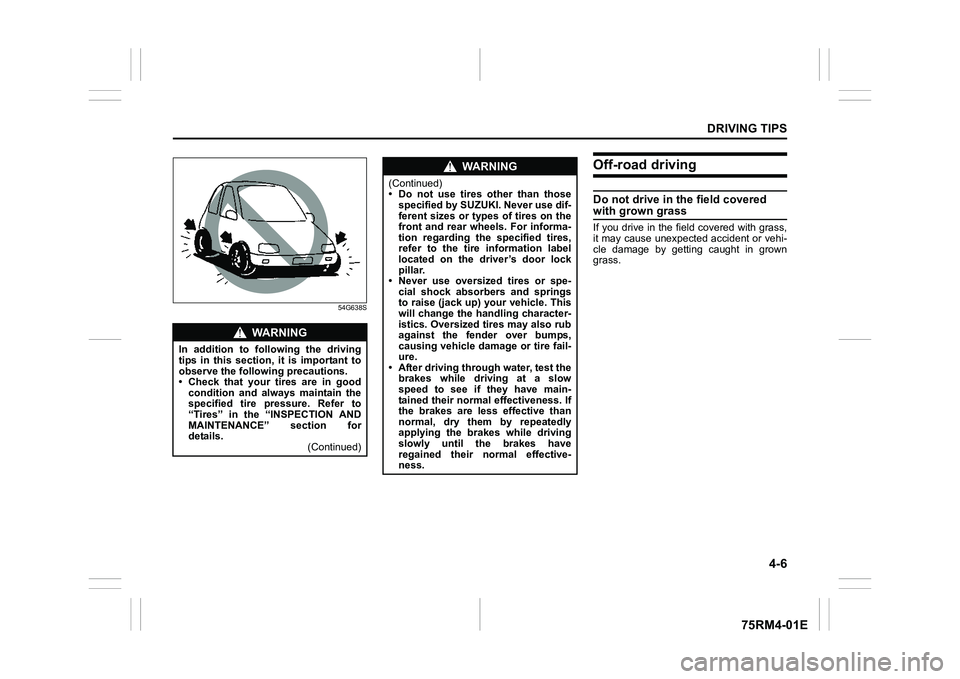
Off-road drivingDo not drive in the field covered with grown grassIf you drive in the field covered with grass,
it may cause unexpected accident or vehi-
cle damage by getting caught in grown
grass.
WA R N I N G
In addition to following the driving
tips in this section, it is important to
observe the following precautions.
• Check that your tires are in good
condition and always maintain the
specified tire pressure. Refer to
“Tires” in the “INSPECTION AND
MAINTENANCE” section for
details. (Continued)
WA R N I N G
(Continued)
• Do not use tires other than those
specified by SUZUKI. Never use dif-
ferent sizes or types of tires on the
front and rear wheels. For informa-
tion regarding the specified tires,
refer to the tire information label
located on the driver’s door lock
pillar.
• Never use oversized tires or spe- cial shock absorbers and springs
to raise (jack up) your vehicle. This
will change the handling character-
istics. Oversized tires may also rub
against the fender over bumps,
causing vehicle damage or tire fail-
ure.
• After driving through water, test the brakes while driving at a slow
speed to see if they have main-
tained their normal effectiveness. If
the brakes are less effective than
normal, dry them by repeatedly
applying the brakes while driving
slowly until the brakes have
regained their normal effective-
ness.
Page 285 of 505
5-30
OTHER CONTROLS AND EQUIPMENT
75RM4-01E
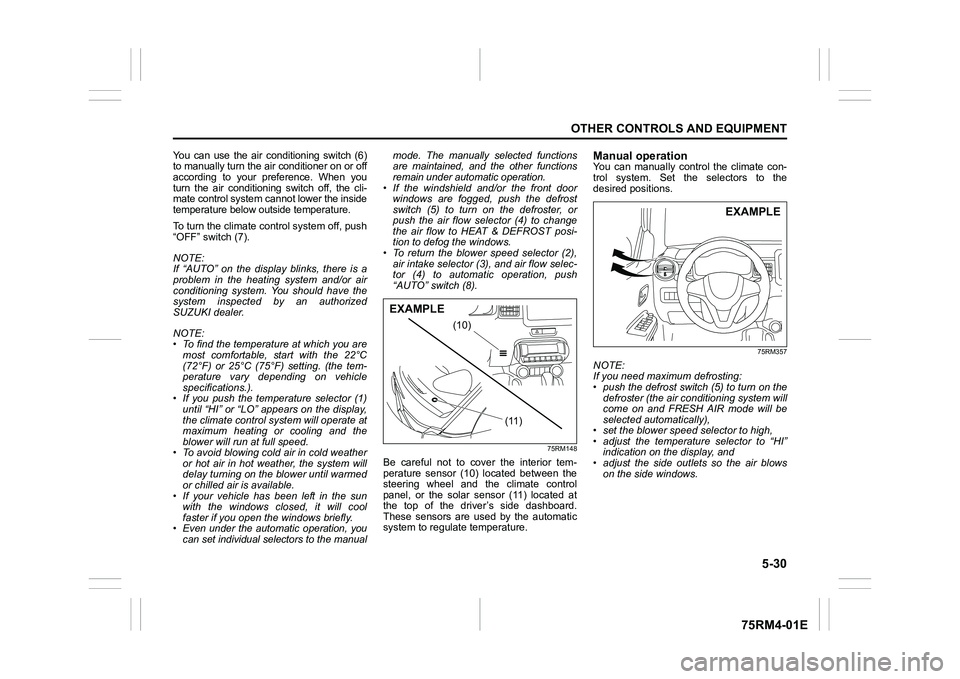
You can use the air conditioning switch (6)
to manually turn the air conditioner on or off
according to your preference. When you
turn the air conditioning switch off, the cli-
mate control system cannot lower the inside
temperature below outside temperature.
To turn the climate control system off, push
“OFF” switch (7).
NOTE:
If “AUTO” on the display blinks, there is a
problem in the heating system and/or air
conditioning system. Yo u should have the
system inspected by an authorized
SUZUKI dealer.
NOTE:
• To find the temperature at which you are
most comfortable, start with the 22°C
(72°F) or 25°C (75°F) setting. (the tem-
perature vary depending on vehicle
specifications.).
• If you push the temperature selector (1) until “HI” or “LO” appears on the display,
the climate control system will operate at
maximum heating or cooling and the
blower will run at full speed.
• To avoid blowing cold air in cold weather or hot air in hot weather, the system will
delay turning on the blower until warmed
or chilled air is available.
• If your vehicle has been left in the sun with the windows closed, it will cool
faster if you open the windows briefly.
• Even under the automat ic operation, you
can set individual selectors to the manual mode. The manually selected functions
are maintained, and the other functions
remain under automatic operation.
• If the windshield and/or the front door windows are fogged, push the defrost
switch (5) to turn on the defroster, or
push the air flow selector (4) to change
the air flow to HEAT & DEFROST posi-
tion to defog the windows.
• To return the blower speed selector (2), air intake selector (3 ), and air flow selec-
tor (4) to automatic operation, push
“AUTO” switch (8).
75RM148
Be careful not to cover the interior tem-
perature sensor (10) located between the
steering wheel and the climate control
panel, or the solar sensor (11) located at
the top of the driver’s side dashboard.
These sensors are used by the automatic
system to regula te temperature.
Manual operationYou can manually control the climate con-
trol system. Set the selectors to the
desired positions.
75RM357
NOTE:
If you need maximum defrosting:
• push the defrost switch (5) to turn on the
defroster (the air conditioning system will
come on and FRESH AIR mode will be
selected automatically),
• set the blower speed selector to high,
• adjust the temperature selector to “HI” indication on the display, and
• adjust the side outlets so the air blows on the side windows.
(10)
(11)
EXAMPLE
EXAMPLE
Page 332 of 505

5-77OTHER CONTROLS AND EQUIPMENT
75RM4-01E
Deletion of audio device information
(Delete Audio)
Follow the instructions below to delete the
registered audio device information.
1) Press the Bluetooth
® setup button (7)
or (8).
The Bluetooth
® setup menu will be dis-
played.
2) Turn “TUNE/FLD PUSH SOUND” knob
(2) to select “Setup Bluetooth”, and
press the knob (2) to determine the
selection.
3) Turn “TUNE/FLD PUSH SOUND” knob (2) to select “List Audio”, and press the
knob (2) to determine the selection.
4) Turn “TUNE/FLD PUSH SOUND” knob (2) to select an audio device to be
deleted, and press the knob (2) to
determine the selection.
5) Turn “TUNE/FLD PUSH SOUND” knob
(2) to select “Delete”, and press the
knob (2) to determine the selection.
6) Turn “TUNE/FLD PUSH SOUND” knob
(2) to select “Delete?”, and press the
knob (2) to determine the selection.
7) Turn “TUNE/FLD PUSH SOUND” knob
(2) to select “Confirm”, and press the
knob (2) to complete the deletion.
NOTE:
When selecting “Go Back” or pressing
BACK button (6), the previous menu will
be displayed.
Disclaimer for Bluetooth
® function
• Depending on compatibility of mobile phone models, no Bluetooth
® function
can be used, or some Bluetooth® func-
tions may be restricted.
• Connectivity or voice quality may get
affected depending on circumstances.
• After the ignition switch is turned to “ON” position or the engine switch is pressed
to change the ignition mode to ON, the
audio system takes few seconds to
detect and connect to the Bluetooth
®
device (if already paired).
Remote audio controls (if equipped)Controlling basic functions of the audio
system is available us ing the switches on
the steering wheel.
75RM063
(4) (4)
(2)
(1) (3)
Page 360 of 505
7-11INSPECTION AND MAINTENANCE
75RM4-01E
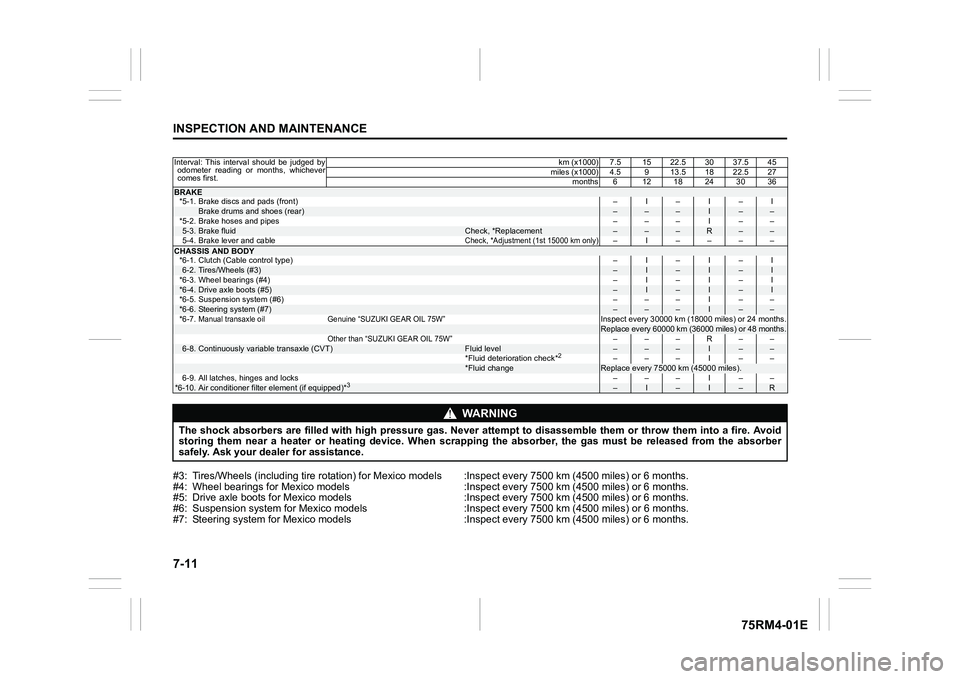
#3: Tires/Wheels (including tire rotation) for Mexico models :Inspect every 7500 km (4500 miles) or 6 months.
#4: Wheel bearings for Mexico models :Inspect every 7500 km (4500 miles) or 6 months.
#5: Drive axle boots for Mexico models :Inspect every 7500 km (45 00 miles) or 6 months.
#6: Suspension system for Mexico models :Inspect every 7500 km (4 500 miles) or 6 months.
#7: Steering system for Mexico m odels :Inspect every 7500 km (450 0 miles) or 6 months.Interval: This interval should be judged by
odometer reading or months, whichever
comes first. km (x1000) 7.5 15 22.5 30 37.5 45
miles (x1000) 4.5 9 13.5 18 22.5 27 months6 1218243036BRAKE*5-1. Brake discs and pads (front) –I–I–I
Brake drums and shoes (rear)
–
–
–
I
–
–
*5-2. Brake hoses and pipes ––– I ––
5-3.
Brake fluid
Check, *Replacement
–
–
–
R
–
–
5-4. Brake lever and cable
Check, *Adjustment (1st 15000 km only)
– I ––––
CHASSIS AND BODY *6-1. Clutch (Cable control type) –I–I–I6-2.
Tires/Wheels (#3)
–
I
–
I
–
I
*6-3. Wheel bearings (#4) –I–I–I
*6-4.
Drive axle boots (#5)
–
I
–
I
–
I
*6-5. Suspension system (#6) ––– I ––
*6-6.
Steering system (#7)
–
–
–
I
–
–
*6-7.
Manual transaxle oil Genuine “SUZUKI GEAR OIL 75W”
Inspect every 30000 km (18000 miles) or 24 months.Replace every 60000 km (36000 miles) or 48 months.
Other than “SUZUKI GEAR OIL 75W”
–––R––
6-8.
Continuously variable transaxle (CVT)
Fluid level
–
–
–
I
–
–
*Fluid deterioration check*
2 –––I––
*Fluid change
Replace every 75000 km (45000 miles).
6-9. All latches, hinges and locks ––– I ––
*6-10.
Air conditioner filter element (if equipped)*
3
–
I
–
I
–
R
WA R N I N G
The shock absorbers are filled with high pressure gas. Never attempt to disassemble them or throw them into a fire. Avoid
storing them near a heater or heating device. When scrapping th e absorber, the gas must be released from the absorber
safely. Ask your deal er for assistance.
Page 361 of 505
7-12
INSPECTION AND MAINTENANCE
75RM4-01E
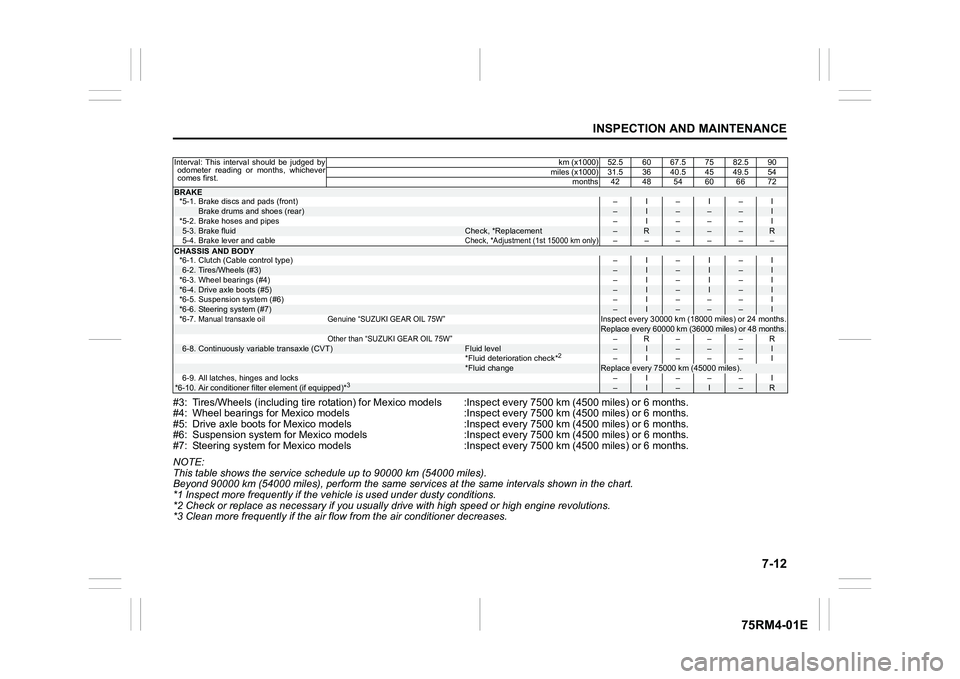
#3: Tires/Wheels (including tire rotation) for Mexico models :Inspect every 7500 km (4500 miles) or 6 months.
#4: Wheel bearings for Mexico models :Inspect every 7500 km (4500 miles) or 6 months.
#5: Drive axle boots for Mexico models :Inspect every 7500 km (45 00 miles) or 6 months.
#6: Suspension system for Mexico models :Inspect every 7500 km (4 500 miles) or 6 months.
#7: Steering system for Mexico m odels :Inspect every 7500 km (450 0 miles) or 6 months.
NOTE:
This table shows the service schedule up to 90000 km (54000 miles).
Beyond 90000 km (54000 miles), perform the same serv ices at the same intervals shown in the chart.
*1 Inspect more frequently if the v ehicle is used under dusty conditions.
*2 Check or replace as necessary if you usually drive with high speed or high engine revolutions.
*3 Clean more frequently if the air flow from the air conditioner decreases.Interval: This interval should be judged by odometer reading or months, whichever
comes first. km (x1000) 52.5 60 67.5 75 82.5 90
miles (x1000) 31.5 36 40.5 45 49.5 54 months 42 48 54 60 66 72BRAKE*5-1. Brake discs and pads (front) –I–I–I
Brake drums and shoes (rear)
–
I
–
–
–
I
*5-2. Brake hoses and pipes –I–––I
5-3.
Brake fluid
Check, *Replacement
–
R
–
–
–
R
5-4. Brake lever and cable
Check, *Adjustment (1st 15000 km only)
––––––
CHASSIS AND BODY *6-1. Clutch (Cable control type) –I–I–I6-2.
Tires/Wheels (#3)
–
I
–
I
–
I
*6-3. Wheel bearings (#4) –I–I–I
*6-4.
Drive axle boots (#5)
–
I
–
I
–
I
*6-5. Suspension system (#6) –I–––I
*6-6.
Steering system (#7)
–
I
–
–
–
I
*6-7.
Manual transaxle oil Genuine “SUZUKI GEAR OIL 75W”
Inspect every 30000 km (18000 miles) or 24 months.Replace every 60000 km (36000 miles) or 48 months.
Other than “SUZUKI GEAR OIL 75W”
–R– – –R
6-8.
Continuously variable transaxle (CVT)
Fluid level
–
I
–
–
–
I
*Fluid deterioration check*
2
–I–––I
*Fluid change
Replace every 75000 km (45000 miles).
6-9. All latches, hinges and locks –I–––I
*6-10.
Air conditioner filter element (if equipped)*
3
–
I
–
I
–
R
Page 370 of 505
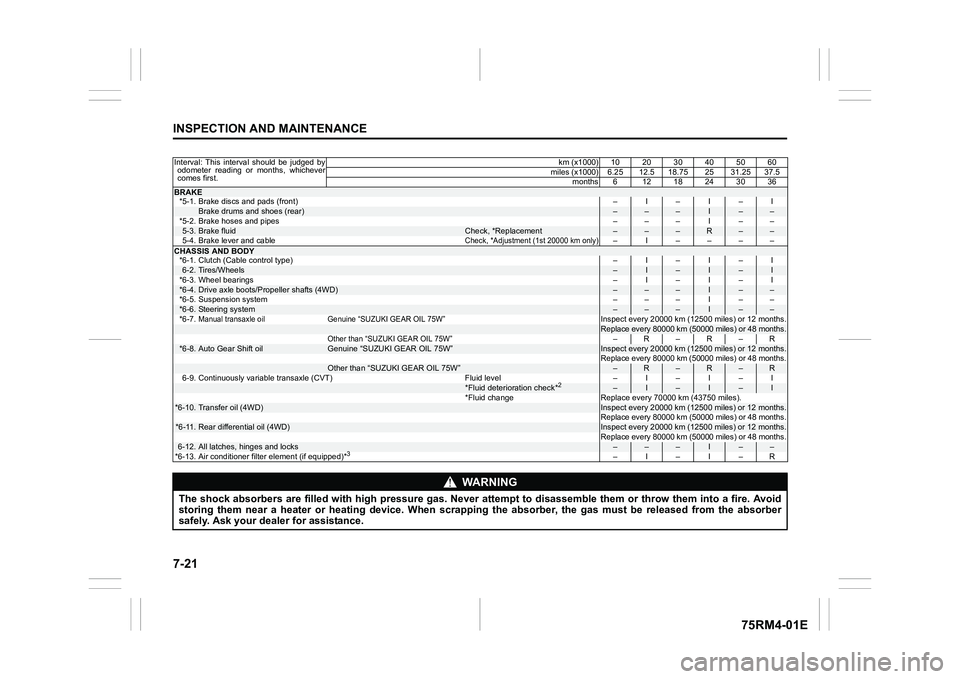
7-21INSPECTION AND MAINTENANCE
75RM4-01E
Interval: This interval should be judged byodometer reading or months, whichever
comes first. km (x1000) 10 20 30 40 50 60
miles (x1000) 6.25 12.5 18.75 25 31.25 37.5 months6 1218243036BRAKE*5-1. Brake discs and pads (front) –I–I–I
Brake drums and shoes (rear)
–
–
–
I
–
–
*5-2. Brake hoses and pipes ––– I ––
5-3.
Brake fluid
Check, *Replacement
–
–
–
R
–
–
5-4. Brake lever and cable
Check, *Adjustment (1st 20000 km only)
– I ––––
CHASSIS AND BODY *6-1. Clutch (Cable control type) –I–I–I6-2.
Tires/Wheels
–
I
–
I
–
I
*6-3. Wheel bearings –I–I–I
*6-4.
Drive axle boots/Propeller shafts (4WD)
–
–
–
I
–
–
*6-5. Suspension system ––– I ––
*6-6.
Steering system
–
–
–
I
–
–
*6-7.
Manual transaxle oil Genuine “SUZUKI GEAR OIL 75W”
Inspect every 20000 km (12500 miles) or 12 months.Replace every 80000 km (50000 miles) or 48 months.
Other than “SUZUKI GEAR OIL 75W”
–R–R–R
*6-8.
Auto Gear Shift oil
Genuine “SUZUKI GEAR OIL 75W”
Inspect every 20000 km (12500 miles) or 12 months.Replace every 80000 km (50000 miles) or 48 months.
Other than “SUZUKI GEAR OIL 75W”
–
R
–
R
–
R
6-9. Continuously variable transaxle (CVT) Fluid level – I – I – I
*Fluid deterioration check*
2
–
I
–
I
–
I
*Fluid change Replace every 70000 km (43750 miles).
*6-10.
Transfer oil (4WD)
Inspect every 20000 km (12500 miles) or 12 months.
Replace every 80000 km (50000 miles) or 48 months.
*6-11.
Rear differential oil (4WD)
Inspect every 20000 km (12500 miles) or 12 months.
Replace every 80000 km (50000 miles) or 48 months.
6-12.
All latches, hinges and locks
–
–
–
I
–
–
*6-13. Air conditioner filter element (if equipped)*
3
–I–I–R
WA R N I N G
The shock absorbers are filled with high pressure gas. Never at tempt to disassemble them or throw them into a fire. Avoid
storing them near a heater or heating device. When scrapping th e absorber, the gas must be released from the absorber
safely. Ask your deal er for assistance.