oil SUZUKI IGNIS 2017 Workshop Manual
[x] Cancel search | Manufacturer: SUZUKI, Model Year: 2017, Model line: IGNIS, Model: SUZUKI IGNIS 2017Pages: 505, PDF Size: 8.36 MB
Page 398 of 505
7-49INSPECTION AND MAINTENANCE
75RM4-01E
Bulb replacement
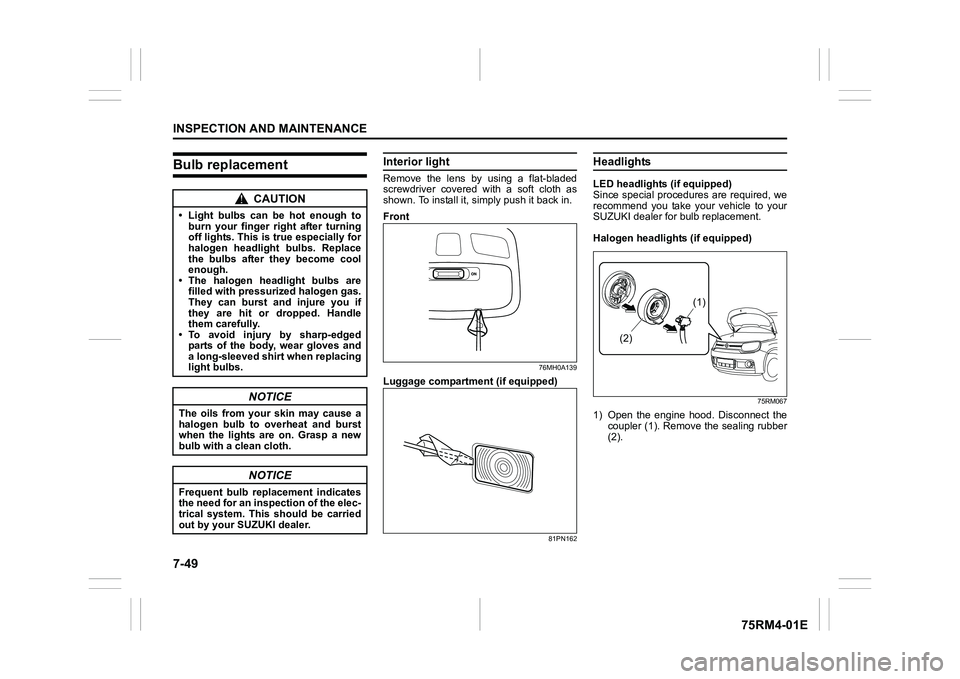
Interior lightRemove the lens by using a flat-bladed
screwdriver covered with a soft cloth as
shown. To install it, simply push it back in.
Front
76MH0A139
Luggage compartmen t (if equipped)
81PN162
HeadlightsLED headlights (if equipped)
Since special procedures are required, we
recommend you take your vehicle to your
SUZUKI dealer for bulb replacement.
Halogen headlights (if equipped)
75RM067
1) Open the engine hood. Disconnect the
coupler (1). Remove the sealing rubber
(2).
CAUTION
• Light bulbs can be hot enough to burn your finger right after turning
off lights. This is true especially for
halogen headlight bulbs. Replace
the bulbs after they become cool
enough.
• The halogen headlight bulbs are filled with pressurized halogen gas.
They can burst and injure you if
they are hit or dropped. Handle
them carefully.
• To avoid injury by sharp-edged
parts of the body, wear gloves and
a long-sleeved shirt when replacing
light bulbs.
NOTICE
The oils from your skin may cause a
halogen bulb to overheat and burst
when the lights are on. Grasp a new
bulb with a clean cloth.
NOTICE
Frequent bulb replacement indicates
the need for an inspection of the elec-
trical system. This should be carried
out by your SUZUKI dealer.
(1)
(2)
Page 407 of 505
7-58
INSPECTION AND MAINTENANCE
75RM4-01E
54G135
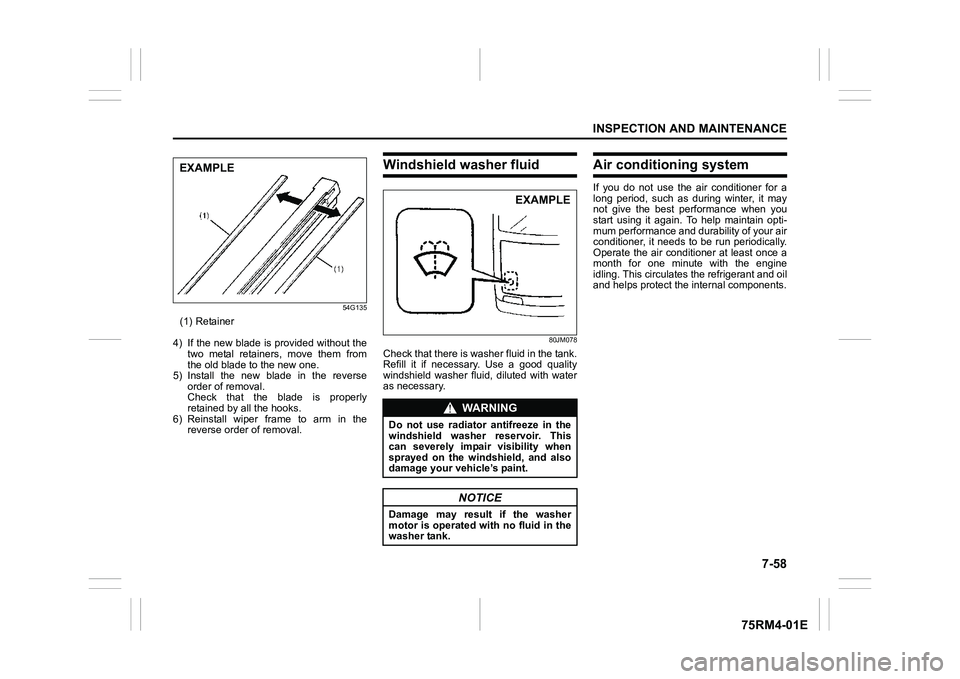
(1) Retainer
4) If the new blade is provided without the two metal retainers, move them from
the old blade to the new one.
5) Install the new blade in the reverse order of removal.
Check that the blade is properly
retained by all the hooks.
6) Reinstall wiper frame to arm in the reverse order of removal.
Windshield washer fluid
80JM078
Check that there is washer fluid in the tank.
Refill it if necessary. Use a good quality
windshield washer fluid, diluted with water
as necessary.
Air conditioning systemIf you do not use the air conditioner for a
long period, such as during winter, it may
not give the best performance when you
start using it again. To help maintain opti-
mum performance and durability of your air
conditioner, it needs to be run periodically.
Operate the air conditioner at least once a
month for one minute with the engine
idling. This circulates the refrigerant and oil
and helps protect the internal components.
EXAMPLE
WA R N I N G
Do not use radiator antifreeze in the
windshield washer reservoir. This
can severely impair visibility when
sprayed on the windshield, and also
damage your vehicle’s paint.
NOTICE
Damage may result if the washer
motor is operated with no fluid in the
washer tank.
EXAMPLE
Page 422 of 505
8-13EMERGENCY SERVICE
75RM4-01E
Engine trouble: Starter does not operate1) Try turning the ignition switch to“START” position or try pressing the
engine switch to change the ignition
mode to START with the headlights
turned on to determine the lead-acid
battery condition. If the headlights go
excessively dim or go off, it usually
means that either the lead-acid battery
is flat or the battery terminal contact is
poor. Recharge the lead-acid battery or
correct battery terminal contact as nec-
essary.
2) If the headlights remain bright, check the fuses. If the reas on for failure of the
starter is not obvious, there may be a
major electrical problem. Have the vehi-
cle inspected by your authorized
SUZUKI dealer.
Engine trouble: Flooded engine(Vehicle without keyless push start sys-
tem)
If the engine is flooded with gasoline, it
may be hard to start. If this happens, press
the accelerator pedal all the way to the
floor and hold it there while cranking the
engine.
• Do not operate the starter motor for more than 12 seconds.
(Vehicle with keyless push start system)
If the engine is flooded with gasoline, it
may be hard to start. If this happens, press
the accelerator pedal all the way to the
floor and hold it there while cranking the
engine.
• Do not operate the starter motor for more than 12 seconds.
NOTE:
If the engine refuses to start, the starter
motor automatically stops after a certain
period of time. After the starter motor has
automatically stopped or if there is any-
thing abnormal in the engine starting sys-
tem, the starter motor runs only while the
engine switch is held pressed.
Engine trouble: OverheatingThe engine could overheat temporarily
under severe driving conditions. If the high
engine coolant temperature warning light
comes on as overheating during driving:
1) Turn off the air conditioner, if equipped.
2) Take the vehicle to a safe place and park.
3) Let the engine run at the normal idle speed for a few minutes until the high
engine coolant temperature warning
light goes off.
WA R N I N G
If you see or hear escaping steam,
stop the vehicle in a safe place and
immediately turn off the engine to
cool it. Do not open the hood when
steam is present. When the steam
can no longer be seen or heard, open
the hood to see if the coolant is still
boiling. If it is, you must wait until it
stops boiling before you proceed.
Page 426 of 505
9-1APPEARANCE CARE
75RM4-01E
Corrosion preventionIt is important to take good care of your
vehicle to protect it from corrosion. Listed
below are instructions for how to maintain
your vehicle to prevent corrosion. Please
read and follow these instructions carefully.Important information about corro-sionCommon causes of corrosion
1) Accumulation of road salt, dirt, moisture or chemicals in hard-to-reach areas of
the vehicle und erbody or frame.
2) Chipping, scratches and any damage to treated or painted metal surfaces
resulting from minor accidents or abra-
sion by stones and gravel.
Environmental conditions which accel-
erate corrosion
1) Road salt, dust control chemicals, sea air or industrial pollution will all acceler-
ate the corrosion of metal.
2) High humidity will increase the rate of
corrosion particularly when the tem-
perature range is just above the freez-
ing point.
3) Moisture in certain areas of a vehicle for an extended period of time may pro-
mote corrosion even though other body
sections may be completely dry. 4) High temperatures will cause an accel-
erated rate of corrosion to parts of the
vehicle which are not well-ventilated to
permit quick drying.
This information illustrates the necessity of
keeping your vehicle (particularly the
underbody) as clean and dry as possible. It
is equally important to repair any damage
to the paint or protective coatings as soon
as possible.
How to help prevent corrosionWash your vehicle frequently
The best way to preserve the finish on your
vehicle and to help avoid corrosion is to
keep it clean with frequent washing.
Wash your vehicle at least once during the
winter and once immediately after the win-
ter. Keep your vehicle, particularly the
underside, as clean and dry as possible.
If you frequently drive on salted roads,
your vehicle should be washed at least
once a month during the winter. If you live
near the ocean, your vehicle should be
washed at least once a month throughout
the year.
For washing instructi ons, refer to “Vehicle
cleaning” section. Remove foreign ma
terial deposits
Foreign material such as salts, chemicals,
road oil or tar, tree sap, bird droppings and
industrial fall-out may damage the finish of
your vehicle if it is left on painted surfaces.
Remove these types of deposits as quickly
as possible. If these deposits are difficult to
wash off, an additional cleaner may be
required. Check that any cleaner you use
is not harmful to painted surfaces and is
specifically intended for your purposes.
Follow the manufacturer’s directions when
using these special cleaners.
Repair finish damage
Carefully examine your vehicle for damage
to the painted surfaces. Should you find
any chips or scratches in the paint, touch
them up immediately to prevent corrosion
from starting. If the chips or scratches have
gone through to the bare metal, have a
qualified body shop make the repair.
Keep passenger and luggage compart-
ments clean
Moisture, dirt or mud can accumulate
under the floor mats and may cause corro-
sion. Occasionally, check under these
mats to ensure that this area is clean and
dry. More frequent checks are necessary if
the vehicle is used for off-road driving or in
wet weather.
Certain cargos such as chemicals, fertiliz-
ers, cleaners, salts, etc. are extremely cor-
rosive by nature. These products should
be transported in sealed containers. If they
Page 428 of 505
9-3APPEARANCE CARE
75RM4-01E
Leather upholstery
Remove loose dirt with a vacuum cleaner.
Using a mild soap or saddle soap solution,
wipe dirt off with a clean damp soft cloth.
To remove soap, wipe the areas again with
a soft cloth dampened with water. Wipe the
areas dry with a soft dry cloth. Repeat this
until the dirt or stain is removed, or use a
commercial leather cleaner for tougher dirt
or stains. If you use a leather cleaner,
carefully follow the manufacturer’s instruc-
tions and precautions. Do not use solvent
type cleaners or abrasive cleaners.
NOTE:
• In order to keep leather upholstery look-ing good, it should be cleaned at least
twice a year.
• If leather upholstery becomes wet, immediately wipe it dry with tissue paper
or a soft cloth. Water may cause leather
to harden and shrink if it is not wiped off.
• When parking on sunny days, select a
shady place or use a sunshade. If
leather upholstery is exposed to direct
sunlight for a long time, it may discolor
and shrink.
• As is common with natural materials, leather is inherently irregular in grain and
cowhide has spots in its natural state.
These do not affect the performance of
the leather in any way. Seat belts
Clean seat belts with a mild soap and
water. Do not use bleach or dye on the
belts. They may weaken the fabric in the
belts.
Vinyl floor mats
Ordinary dirt can be removed from vinyl
with water or mild soap. Use a brush to
help loosen dirt. After the dirt is loosened,
rinse the mat thoroughly with water and
dry it in the shade.
Carpets
Remove dirt and soil as much as possible
with a vacuum cleaner. Using a mild soap
solution, rub stained areas with a clean
damp cloth. To remove soap, rub the areas
again with a cloth dampened with water.
Repeat this until the stain is removed, or
use a commercial carpet cleaner for
tougher stains. If you use a carpet cleaner,
carefully follow the manufacturer’s instruc-
tions and precautions.
Instrument panel and console
Remove loose dirt with a vacuum cleaner.
Gently wipe dirt off with a tightly squeezed
damp clean cloth. Repeat this until the dirt
is removed.
NOTICE
Do not use chemical products that
contain silicon to wipe electrical
components such as the air condi-
tioning system, audio, navigation
system, or other switches. These will
cause damage to the components.
NOTICE
• Liquid such as liquid aromatics,
soft drinks or juice may cause dis-
coloration, wrinkles, and cracking
to resin-based parts and textiles.
Immediately wipe it dry with tissue
paper or a soft cloth.
• Do not leave leather products with color, fur or vinyl products, etc. in
your vehicle for long periods. It
may cause discoloration or deterio-
ration of interior.
Page 430 of 505
9-5APPEARANCE CARE
75RM4-01E
3) Wash the entire exterior with a milddetergent or car wash soap using a
sponge or soft cloth. The sponge or
cloth should be frequently soaked in the
soap solution.
4) Once the dirt has been completely removed, rinse off the detergent with
running water.
5) Wipe off the vehicle body with a wet chamois or cloth and allow it to dry in
the shade.
6) Check carefully for damage to painted surfaces. If there is any damage, touch
up the damage following the procedure
below:
1. Clean all damaged spots and allow
them to dry.
2. Stir the paint and touch up the dam- aged spots lightly using a small
brush.
3. Allow the paint to dry completely. Washing by an automatic car wash
Washing by a high-pressure cleaner
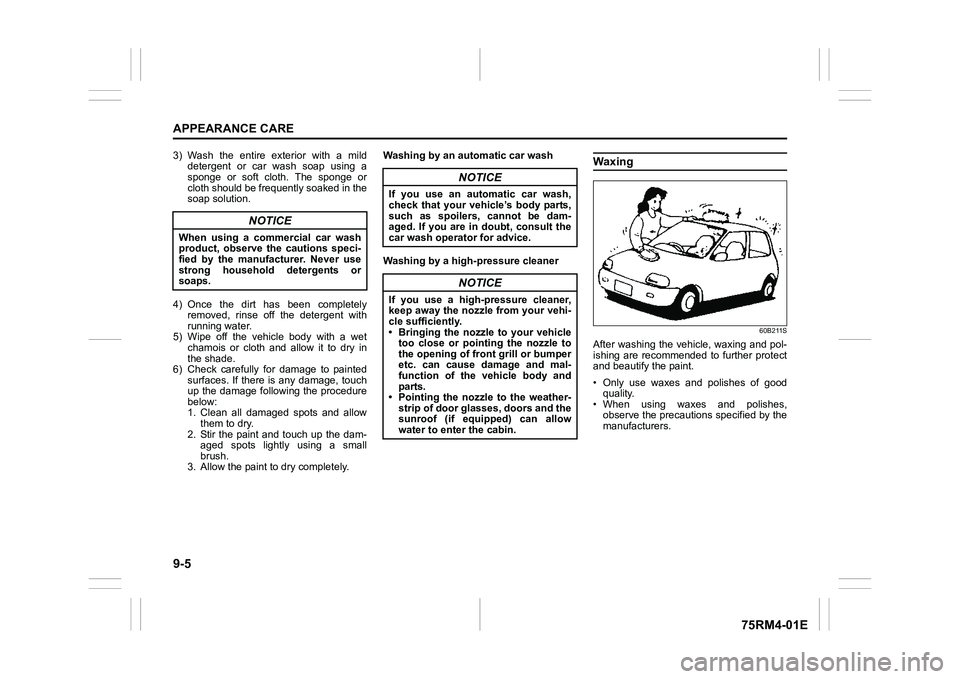
Waxing
60B211S
After washing the vehicle, waxing and pol-
ishing are recommended to further protect
and beautify the paint.
• Only use waxes and polishes of good
quality.
• When using waxes and polishes, observe the precautions specified by the
manufacturers.
NOTICE
When using a commercial car wash
product, observe the cautions speci-
fied by the manufacturer. Never use
strong household detergents or
soaps.
NOTICE
If you use an automatic car wash,
check that your vehicle’s body parts,
such as spoilers, cannot be dam-
aged. If you are in doubt, consult the
car wash operator for advice.
NOTICE
If you use a high-pressure cleaner,
keep away the nozzle from your vehi-
cle sufficiently.
• Bringing the nozzle to your vehicle
too close or pointing the nozzle to
the opening of front grill or bumper
etc. can cause damage and mal-
function of the vehicle body and
parts.
• Pointing the nozzle to the weather-
strip of door glasses, doors and the
sunroof (if equi pped) can allow
water to enter the cabin.
Page 437 of 505
11-5
SPECIFICATIONS
75RM4-01E
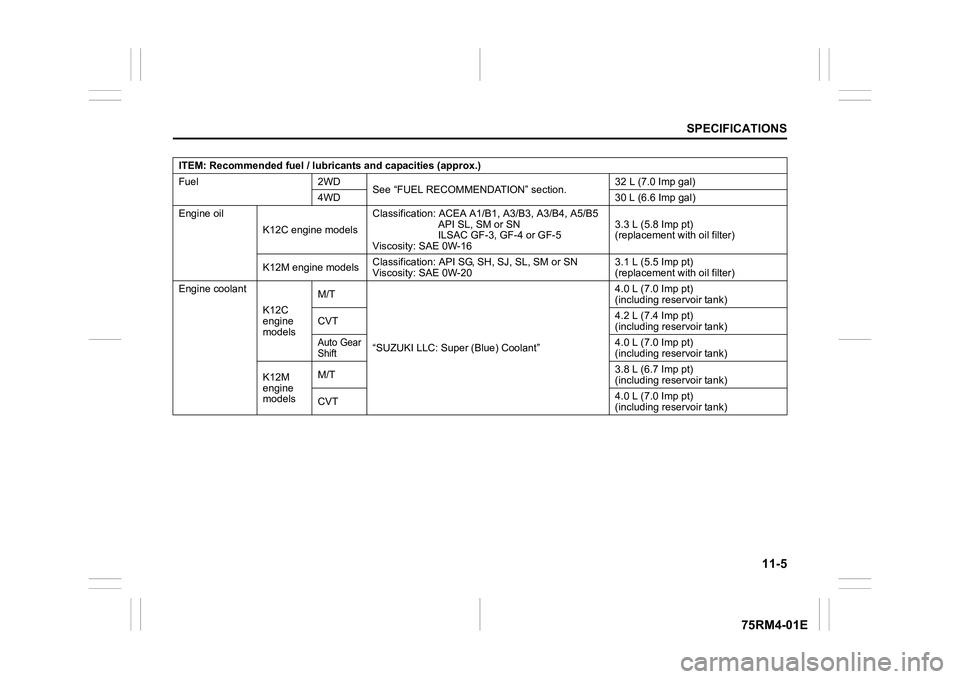
ITEM: Recommended fuel / lubricants and capacities (approx.)
Fuel 2WD See “FUEL RECOMMENDATION” section. 32 L (7.0 Imp gal)
4WD 30 L (6.6 Imp gal)
Engine oil
K12C engine models Classification: ACEA A1/B
1, A3/B3, A3/B4, A5/B5
API SL, SM or SN
ILSAC GF-3, GF-4 or GF-5
Viscosity: SAE 0W-16 3.3 L (5.8 Imp pt)
(replacement with oil filter)
K12M engine models Classification: API SG,
SH, SJ, SL, SM or SN
Viscosity: SAE 0W-20 3.1 L (5.5 Imp pt)
(replacement with oil filter)
Engine coolant
K12C
engine
modelsM/T
“SUZUKI LLC: Super (Blue) Coolant” 4.0 L (7.0 Imp pt)
(including reservoir tank)
CVT 4.2 L (7.4 Imp pt)
(including reservoir tank)
Auto Gear
Shift
4.0 L (7.0 Imp pt)
(including reservoir tank)
K12M
engine
models M/T
3.8 L (6.7 Imp pt)
(including reservoir tank)
CVT 4.0 L (7.0 Imp pt)
(including reservoir tank)
Page 438 of 505
11-6SPECIFICATIONS
75RM4-01E
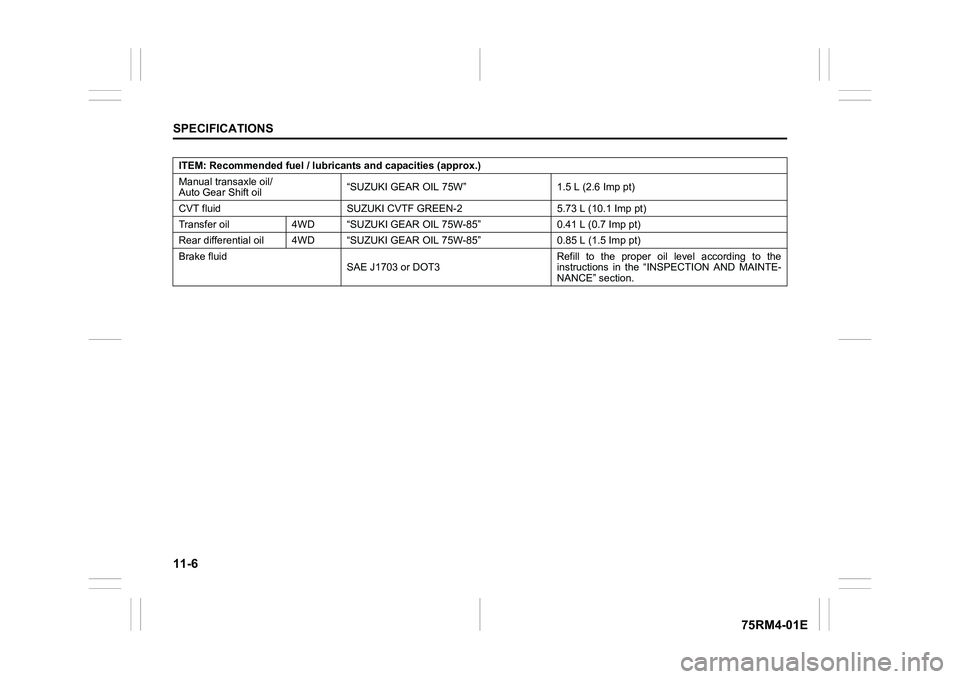
ITEM: Recommended fuel / lubricants and capacities (approx.)
Manual transaxle oil/
Auto Gear Shift oil “SUZUKI GEAR OIL 75W” 1.5 L (2.6 Imp pt)
CVT fluid SUZUKI CVTF GR EEN-2 5.73 L (10.1 Imp pt)
Transfer oil 4WD “SUZUKI GEAR OIL 75W-85” 0.41 L (0.7 Imp pt)
Rear differential oil 4WD “SUZUKI GEAR OIL 75W-85” 0.85 L (1.5 Imp pt)
Brake fluid SAE J1703 or DOT3 Refill to the proper oil level according to the
instructions in the “INSPECTION AND MAINTE-
NANCE” section.
Page 442 of 505
12-3SUPPLEMENT
75RM4-01E
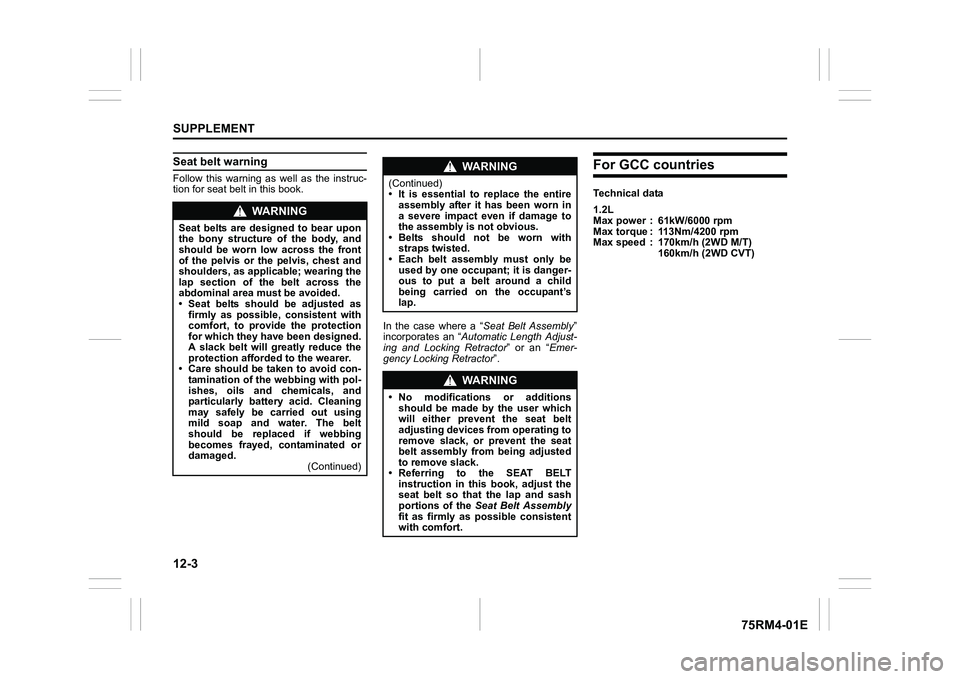
Seat belt warningFollow this warning as well as the instruc-
tion for seat belt in this book.In the case where a “Seat Belt Assembly”
incorporates an “ Automatic Length Adjust-
ing and Locking Retractor ” or an “Emer-
gency Locking Retractor ”.
For GCC countriesTechnical data
1.2L
Max power : 61kW/6000 rpm
Max torque : 113Nm/4200 rpm
Max speed : 170km/h (2WD M/T)
160km/h (2WD CVT)
WA R N I N G
Seat belts are designed to bear upon
the bony structure of the body, and
should be worn low across the front
of the pelvis or the pelvis, chest and
shoulders, as applicable; wearing the
lap section of the belt across the
abdominal area must be avoided.
• Seat belts should be adjusted as
firmly as possible, consistent with
comfort, to provide the protection
for which they have been designed.
A slack belt will greatly reduce the
protection afforded to the wearer.
• Care should be taken to avoid con-
tamination of the webbing with pol-
ishes, oils and chemicals, and
particularly battery acid. Cleaning
may safely be carried out using
mild soap and water. The belt
should be replaced if webbing
becomes frayed, contaminated or
damaged. (Continued)
WA R N I N G
(Continued)
• It is essential to replace the entire
assembly after it has been worn in
a severe impact even if damage to
the assembly is not obvious.
• Belts should not be worn with straps twisted.
• Each belt assembly must only be
used by one occupant; it is danger-
ous to put a belt around a child
being carried on the occupant’s
lap.
WA R N I N G
• No modifications or additionsshould be made by the user which
will either prevent the seat belt
adjusting devices from operating to
remove slack, or prevent the seat
belt assembly from being adjusted
to remove slack.
• Referring to the SEAT BELT instruction in this book, adjust the
seat belt so that the lap and sash
portions of the Seat Belt Assembly
fit as firmly as possible consistent
with comfort.
Page 449 of 505
13-1
INDEX
13
75RM4-01E
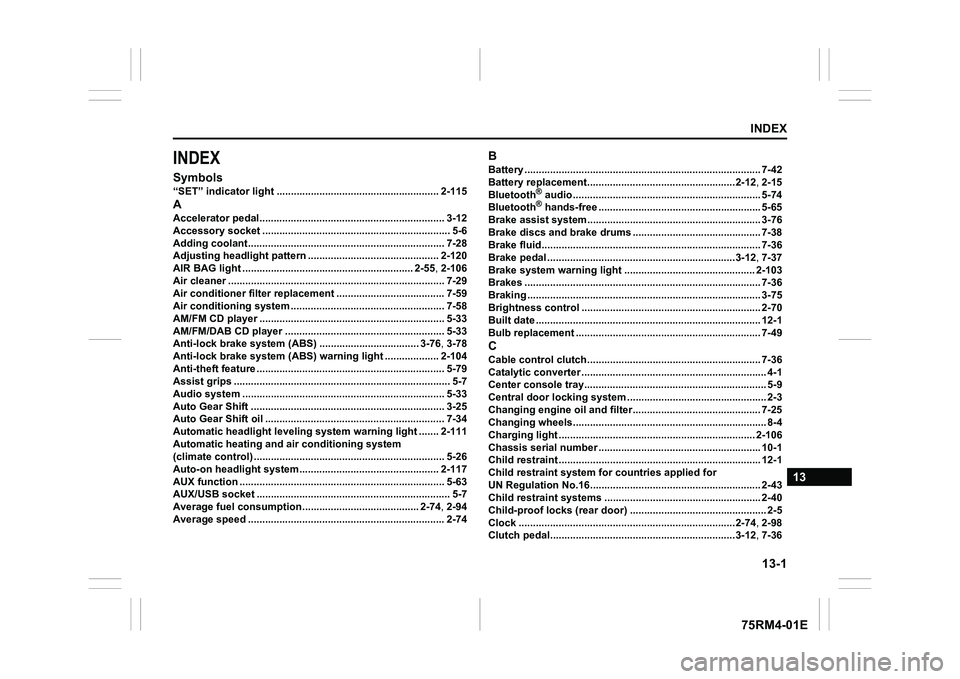
INDEXSymbols“SET” indicator light ......................................................... 2-115AAccelerator pedal................................................................. 3-12
Accessory socket ............. .................................. ................... 5-6
Adding coolant................................................. .................... 7-28
Adjusting headlight pattern .................................... .......... 2-120
AIR BAG light .................................................. .......... 2-55, 2-106
Air cleaner .................................................... ........................ 7-29
Air conditioner filter replacement ............................. ......... 7-59
Air conditioning system ...... ................................................ 7-58
AM/FM CD player ................................................ ................. 5-33
AM/FM/DAB CD player ........... ............................................. 5-33
Anti-lock brake system (ABS) ................................... 3-76, 3-78
Anti-lock brake system (ABS) warning light ................... 2- 104
Anti-theft feature ............................................. ..................... 5-79
Assist grips ................................................... ......................... 5-7
Audio system ................................................... .................... 5-33
Auto Gear Shift ................................................ .................... 3-25
Auto Gear Shift oil ............................................ ................... 7-34
Automatic headlight leveling system warning light ....... 2-111
Automatic heating and air conditioning system
(climate control) .............................................. ..................... 5-26
Auto-on headlight system...... ........................................... 2-117
AUX function ................................................... ..................... 5-63
AUX/USB socket ................................................. ................... 5-7
Average fuel consumption....................................... .. 2-74, 2-94
Average speed .................................................. ................... 2-74
BBattery ................................................................................... 7-42
Battery replacement........... .........................................2-12, 2-15
Bluetooth
® audio......................................................... ......... 5-74
Bluetooth® hands-free .................................................... ..... 5-65
Brake assist system............................................ ................. 3-76
Brake discs and brake drums .................................... ......... 7-38
Brake fluid.................................................... ......................... 7-36
Brake pedal .................................................... ..............3-12, 7-37
Brake system warning light ..................................... ......... 2-103
Brakes ......................................................... .......................... 7-36
Braking ........................................................ .......................... 3-75
Brightness control ............................................. .................. 2-70
Built date ..................................................... .......................... 12-1
Bulb replacement ............................................... .................. 7-49
CCable control clutch........................................... .................. 7-36
Catalytic converter ........ ......................................................... 4-1
Center console tray......... ....................................................... 5-9
Central door locking system .................................... ............. 2-3
Changing engine oil and filter................................. ............ 7-25
Changing wheels................................................ .................... 8-4
Charging light ................................................. .................... 2-106
Chassis serial number ....... .................................................. 10-1
Child restraint ................................................ ....................... 12-1
Child restraint system f or countries applied for
UN Regulation No.16............................................ ................ 2-43
Child restraint systems ........................................ ............... 2-40
Child-proof locks (rear door) .................................. .............. 2-5
Clock .......................................................... ..................2-74, 2-98
Clutch pedal................................................... ..............3-12, 7-36