water coolant SUZUKI IGNIS 2018 Owners Manual
[x] Cancel search | Manufacturer: SUZUKI, Model Year: 2018, Model line: IGNIS, Model: SUZUKI IGNIS 2018Pages: 505, PDF Size: 8.36 MB
Page 155 of 505
3-2
OPERATING YOUR VEHICLE
75RM4-01E
NOTE:
It is normal for water to drip from the air
conditioning system after use.
4) Check that the hood is fully closed andlatched.
5) Check the headlights, turn signal lights, brake lights and horn for proper opera-
tion.
6) Adjust the seat and head restraint.
7) Check the brake pedal and the parking brake lever.
8) Adjust the mirrors.
9) Check that you and all passengers have properly fastened your seat belts.
10)Check that all warning lights come on as the ignition switch is turned to “ON”
position or the engine switch is pressed
to change the ignition mode to ON.
11)Check all gauges.
12)Check that the brake system warning light turns off when the parking brake is
released.
Once a week, or each time you fill your fuel
tank, perform the following under-hood
checks:
1) Engine oil level
2) Coolant level
3) Brake fluid level
4) Lead-acid battery solution level
5) Windshield washer fluid level
6) Hood latch operation Pull the hood release handle inside the
vehicle. Check that you cannot open the hood all the way without releasing
the secondary latch. Close the hood
securely after checking for proper latch
operation. See the item “All latches,
hinges and locks” of “Chassis, body
and others” in “Maintenance schedule”
in the “INSPECTION AND MAINTE-
NANCE” section for lubrication sched-
ule.
Once a month, or each time you fill your
fuel tank, check the tire pressure using a
tire pressure gauge. Also check the tire
pressure of the spare tire.
Engine oil consumptionIt is normal for the engine to consume
some engine oil during normal vehicle
operation.
The amount of engine oil consumption
depends on viscosity and quality of the oil
and your driving conditions.
More oil is consumed during high-speed
driving and when there is frequent acceler-
ation and deceleration. Under high loads,
your engine also will consume more oil.
A new engine also consumes more oil,
since its pistons, piston rings and cylinder
walls have not yet become conditioned.
New engines reach the normal level of oil
consumption only after approximately
5000 km (3000 miles) driving.
Oil consumption:
Max. 1.0 L per 1000 km
(1 Qt. per 600 miles)
When judging the amount of oil consump-
tion, note that the oil may become diluted
and it is difficult to judge the accurate oil
level.
As an example, if a vehicle is used for
repeated short trips, and consumes a nor-
mal amount of oil, the dipstick may not
show any drop in the oil level at all, even
after 1000 km (600 miles) or more of driv-
ing. This is because the oil gradually
becomes diluted with fuel or moisture,
WA R N I N G
Check that the hood is fully closed
and latched before d riving. If it is not,
it can fly up unexpectedly during
driving, obstructing your view and
resulting in an accident.
Page 350 of 505
7-1INSPECTION AND MAINTENANCE
75RM4-01E
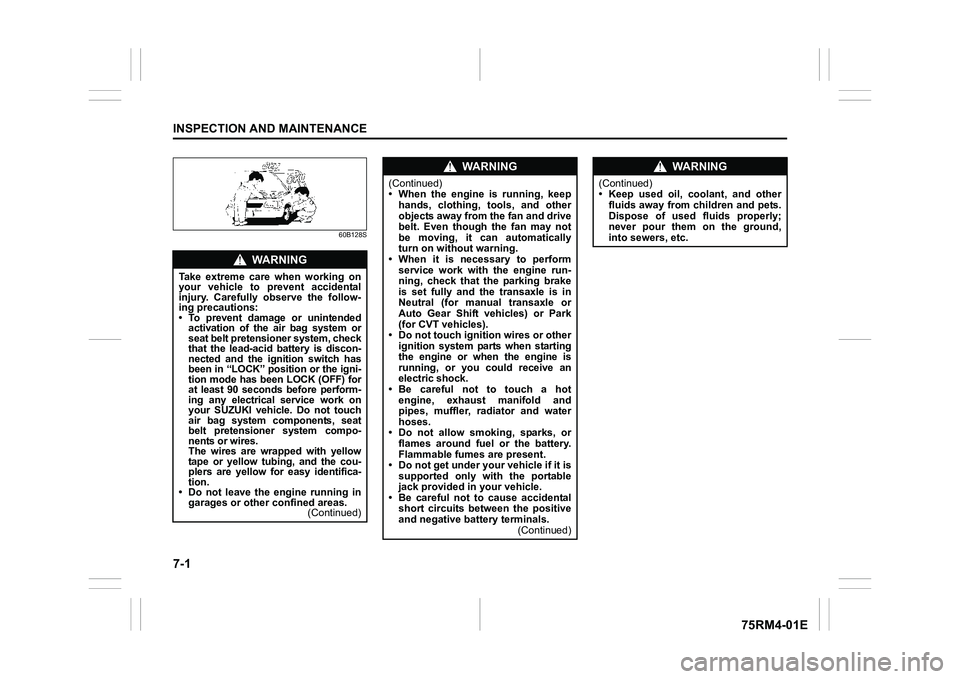
60B128S
WA R N I N G
Take extreme care when working on
your vehicle to prevent accidental
injury. Carefully observe the follow-
ing precautions:
• To prevent damage or unintendedactivation of the air bag system or
seat belt pretensioner system, check
that the lead-acid battery is discon-
nected and the ignition switch has
been in “LOCK” position or the igni-
tion mode has been LOCK (OFF) for
at least 90 seconds before perform-
ing any electrical service work on
your SUZUKI vehicle. Do not touch
air bag system components, seat
belt pretensioner system compo-
nents or wires.
The wires are wrapped with yellow
tape or yellow tubing, and the cou-
plers are yellow for easy identifica-
tion.
• Do not leave the engine running in garages or other confined areas. (Continued)
WA R N I N G
(Continued)
• When the engine is running, keep
hands, clothing, tools, and other
objects away from the fan and drive
belt. Even though the fan may not
be moving, it can automatically
turn on without warning.
• When it is necessary to perform
service work with the engine run-
ning, check that the parking brake
is set fully and the transaxle is in
Neutral (for manual transaxle or
Auto Gear Shift vehicles) or Park
(for CVT vehicles).
• Do not touch ignition wires or other ignition system parts when starting
the engine or when the engine is
running, or you could receive an
electric shock.
•Be careful not to touch a hot engine, exhaust manifold and
pipes, muffler, radiator and water
hoses.
• Do not allow smoking, sparks, or flames around fuel or the battery.
Flammable fumes are present.
• Do not get under your vehicle if it is supported only with the portable
jack provided in your vehicle.
• Be careful not to cause accidental short circuits between the positive
and negative battery terminals. (Continued)
WA R N I N G
(Continued)
• Keep used oil, coolant, and other
fluids away from children and pets.
Dispose of used fluids properly;
never pour them on the ground,
into sewers, etc.
Page 377 of 505
7-28
INSPECTION AND MAINTENANCE
75RM4-01E
Engine coolantSelection of coolantTo maintain optimum performance and
durability of your engine, use SUZUKI gen-
uine coolant or equivalent.
NOTE:
If you use the engine coolant other than
the SUZUKI LLC: Super (Blue) for replace-
ment, follow the schedule of SUZUKI LLC:
Standard (Green). To see the detail of the
maintenance schedule, refer to “Periodic
maintenance schedule” in this section.
This type of coolant is the best for cooling
system for the following reasons:
• The coolant helps maintain properengine temperature.
• It gives proper protection against freez- ing and boiling.
• It gives proper protection against corro- sion and rust. Failure to use the proper coolant can dam-
age your cooling system. Your authorized
SUZUKI dealer can help you select the
proper coolant.
Coolant level checkCheck the coolant le
vel at the reservoir
tank, not at the radiator. With the engine
cool, the coolant level should be between
“FULL” and “LOW” marks.Adding coolant
NOTICE
SUZUKI LLC: Super (Blue) coolant;
This coolant is already diluted to the
proper percentage. Do not dilute with
distilled water additionally. Doing so
may result in the possibility of freez-
ing and/or overheating coolant.
NOTICE
To avoid damaging your cooling sys-
tem:
• Always use a high quality ethylene
glycol base non-silicate type cool-
ant diluted with distilled water at
the correct mixture concentration.
• Check that the proper mix is 50/50
coolant to distill ed water and in no
case higher than 70/30. Concentra-
tions greater than 70/30 coolant to
distilled water will cause overheat-
ing conditions.
• Do not use straight coolant nor plain water (except SUZUKI LLC:
Super (Blue)).
• Do not add extra inhibitors or addi- tives. They may not be compatible
with your cooling system.
• Do not mix different types of base coolants. Doing so may result in
accelerated seal wear and/or the
possibility of severe overheating
and extensive engine or CVT (if
equipped) damage.
WA R N I N G
Swallowing engine coolant can cause
severe injury or death. Inhaling cool-
ant mist or vapors or getting coolant
in your eyes could result in severe
injury.
• Do not drink antifreeze or coolantsolution. If swallowed, do not
induce vomiting. Immediately con-
tact a poison control center or a
physician.
• Avoid inhaling coolant mist or hot
vapors. If inhaled, remove to a
fresh air area.
• If coolant gets in the eyes, flush
with water and seek medical atten-
tion.
• Wash thoroughly after handling
coolant.
• Keep engine coolant out of the
reach of children and pets.
Page 378 of 505
7-29INSPECTION AND MAINTENANCE
75RM4-01E
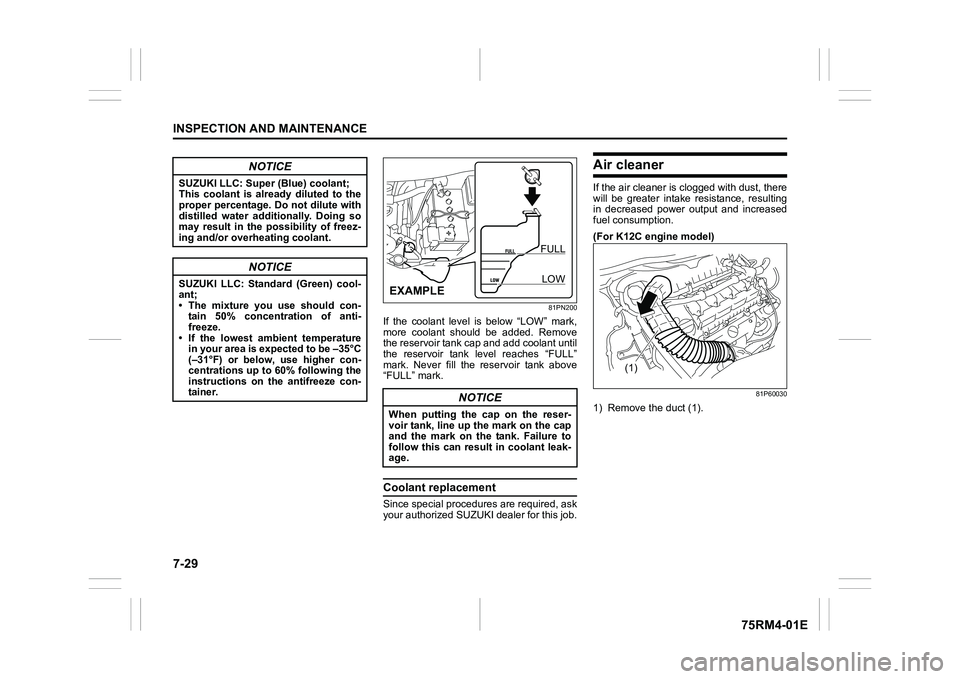
81PN200
If the coolant level is below “LOW” mark,
more coolant should be added. Remove
the reservoir tank cap and add coolant until
the reservoir tank level reaches “FULL”
mark. Never fill the reservoir tank above
“FULL” mark.Coolant replacementSince special procedures are required, ask
your authorized SUZUKI dealer for this job.
Air cleanerIf the air cleaner is clogged with dust, there
will be greater intake resistance, resulting
in decreased power output and increased
fuel consumption.
(For K12C engine model)
81P60030
1) Remove the duct (1).
NOTICE
SUZUKI LLC: Super (Blue) coolant;
This coolant is already diluted to the
proper percentage. Do not dilute with
distilled water additionally. Doing so
may result in the possibility of freez-
ing and/or overheating coolant.
NOTICE
SUZUKI LLC: Standard (Green) cool-
ant;
• The mixture you use should con-tain 50% concentration of anti-
freeze.
• If the lowest ambient temperature in your area is expected to be –35°C
(–31°F) or below, use higher con-
centrations up to 60% following the
instructions on the antifreeze con-
tainer.
NOTICE
When putting the cap on the reser-
voir tank, line up the mark on the cap
and the mark on the tank. Failure to
follow this can result in coolant leak-
age.
FULL
LOW
(ΟΝ03/(
(1)
Page 423 of 505
8-14
EMERGENCY SERVICE
75RM4-01E
If the high engine coolant temperature
warning light does not go off:
1) Turn off the engine and check that thewater pump belt and pulleys are not
damaged or slipping. If any abnormality
is found, correct it.
2) Check the coolant level in the reservoir. If it is found to be lower than “LOW”
line, check radiator, water pump, radia-
tor hoses and heater hoses for leakage.
If leakage that may cause overheating
is found, do not run the engine until
these problems have been corrected.
3) If leakage is not found, carefully add
coolant to the reservoir and then the
radiator, if necessary. (Refer to “Engine
coolant” in the “INSPECTION AND
MAINTENANCE” section.)
NOTE:
If engine overheats and you are not sure
what to do, contact your SUZUKI dealer.
79J007
WA R N I N G
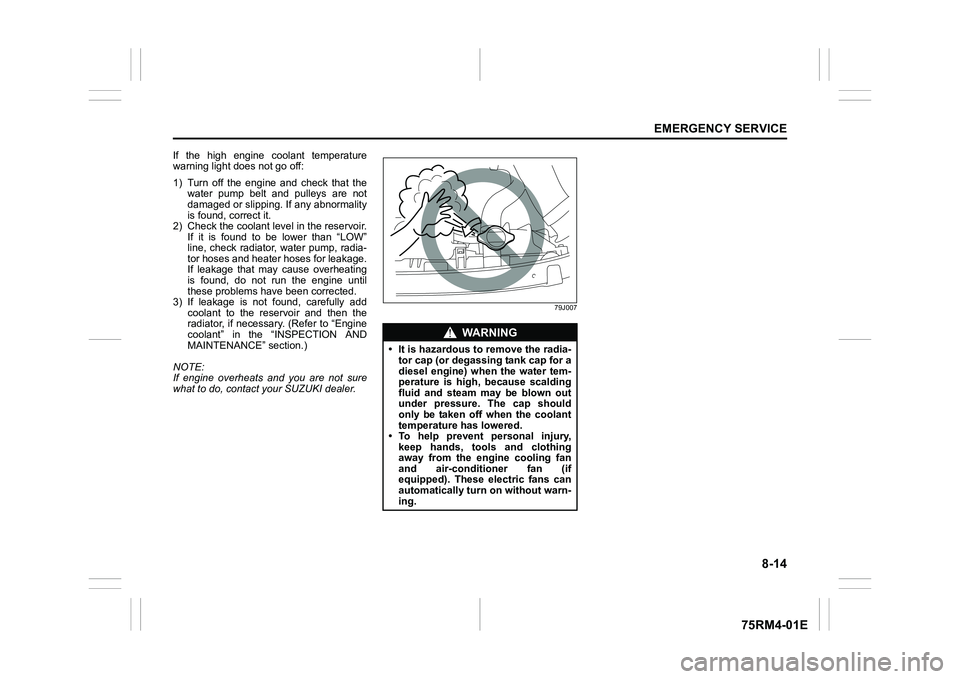
• It is hazardous to remove the radia- tor cap (or degassing tank cap for a
diesel engine) when the water tem-
perature is high, because scalding
fluid and steam may be blown out
under pressure. The cap should
only be taken off when the coolant
temperature has lowered.
• To help prevent personal injury, keep hands, tools and clothing
away from the engine cooling fan
and air-conditioner fan (if
equipped). These electric fans can
automatically turn on without warn-
ing.