5-1 SUZUKI IGNIS 2019 User Guide
[x] Cancel search | Manufacturer: SUZUKI, Model Year: 2019, Model line: IGNIS, Model: SUZUKI IGNIS 2019Pages: 505, PDF Size: 8.36 MB
Page 268 of 505
5-13OTHER CONTROLS AND EQUIPMENT
75RM4-01E
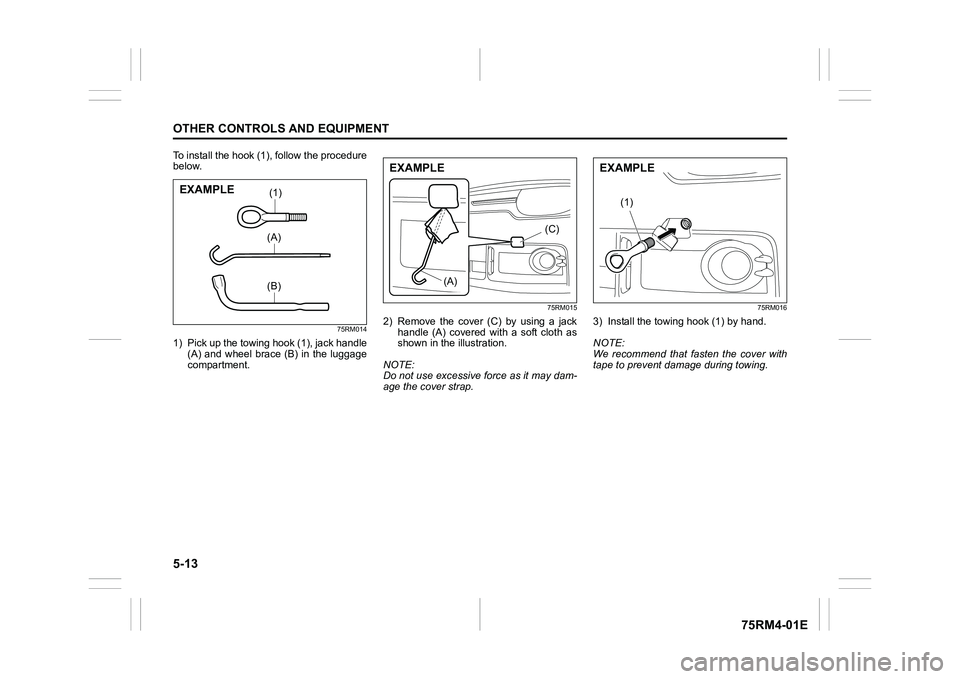
To install the hook (1), follow the procedure
below.
75RM014
1) Pick up the towing hook (1), jack handle(A) and wheel brace (B) in the luggage
compartment.
75RM015
2) Remove the cover (C) by using a jackhandle (A) covered with a soft cloth as
shown in the illustration.
NOTE:
Do not use excessive force as it may dam-
age the cover strap.
75RM016
3) Install the towing hook (1) by hand.
NOTE:
We recommend that fasten the cover with
tape to prevent damage during towing.
(1)(A)(B)
EXAMPLE
(A) (C)
EXAMPLE
(1)
EXAMPLE
Page 269 of 505
5-14
OTHER CONTROLS AND EQUIPMENT
75RM4-01E
75RM017
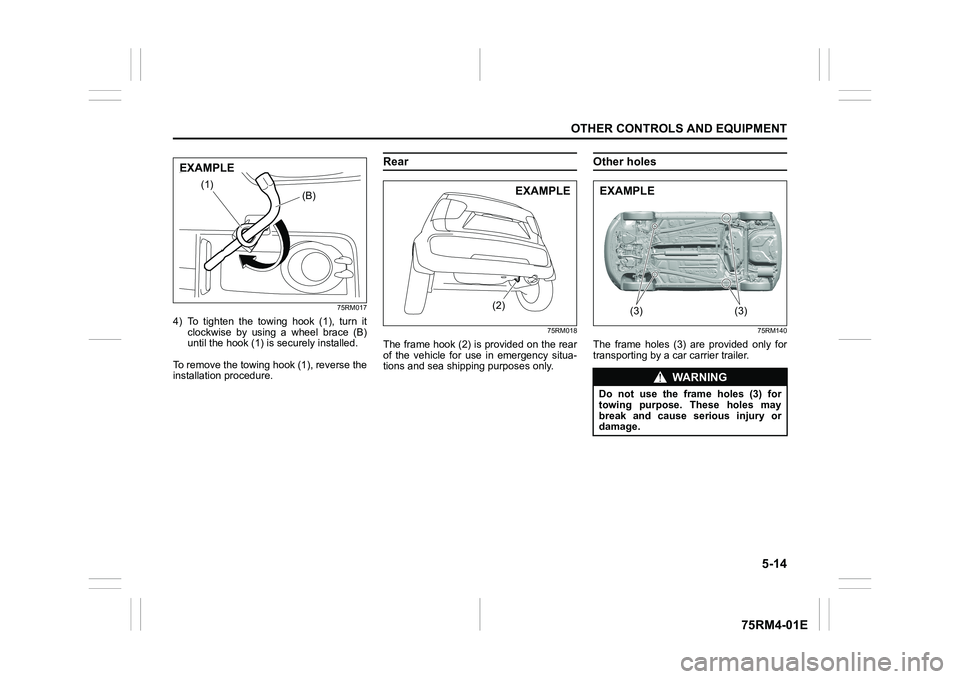
4) To tighten the towing hook (1), turn itclockwise by using a wheel brace (B)
until the hook (1) is securely installed.
To remove the towing hook (1), reverse the
installation procedure.
Rear
75RM018
The frame hook (2) is provided on the rear
of the vehicle for use in emergency situa-
tions and sea shipping purposes only.
Other holes
75RM140
The frame holes (3) are provided only for
transporting by a car carrier trailer.
(B)
(1)
EXAMPLE
(2)
EXAMPLE
WA R N I N G
Do not use the frame holes (3) for
towing purpose. These holes may
break and cause serious injury or
damage.
(3) (3)
(ΟΝ03/(
Page 270 of 505
5-15OTHER CONTROLS AND EQUIPMENT
75RM4-01E
Heating and air conditioning systemThere are three types of heating and air
conditioning syst ems as follows:
• Heating system
• Manual heating and air conditioning sys- tem
• Automatic heating and air conditioning system (climate control)
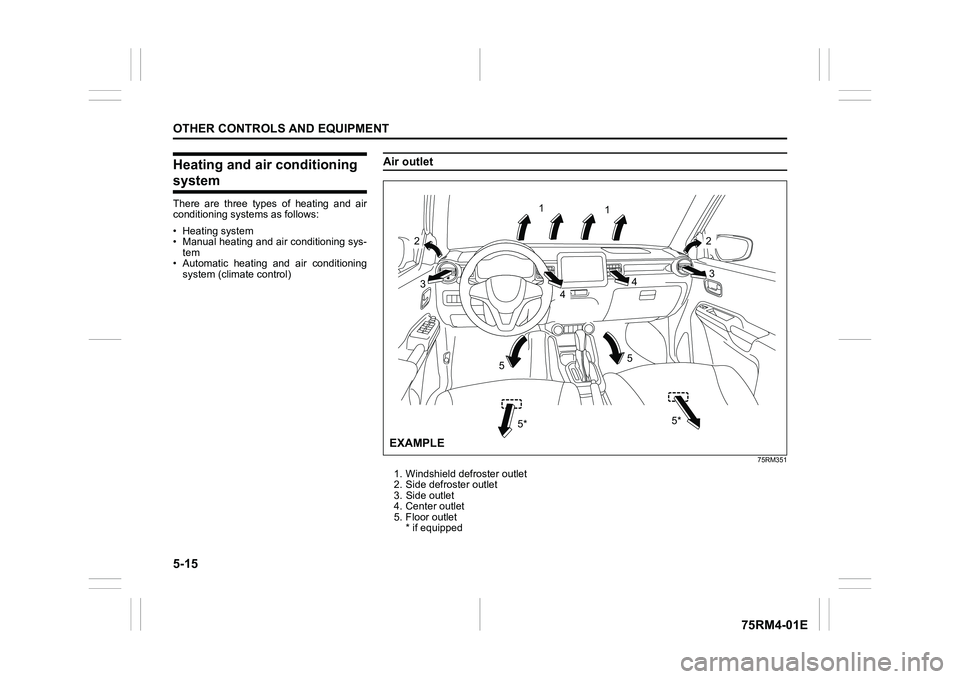
Air outlet
75RM351
1. Windshield defroster outlet
2. Side defroster outlet
3. Side outlet
4. Center outlet
5. Floor outlet * if equipped
1
2 1
2
3 3
4
4
5
5
5*
5*
EXAMPLE
Page 271 of 505
5-16
OTHER CONTROLS AND EQUIPMENT
75RM4-01E
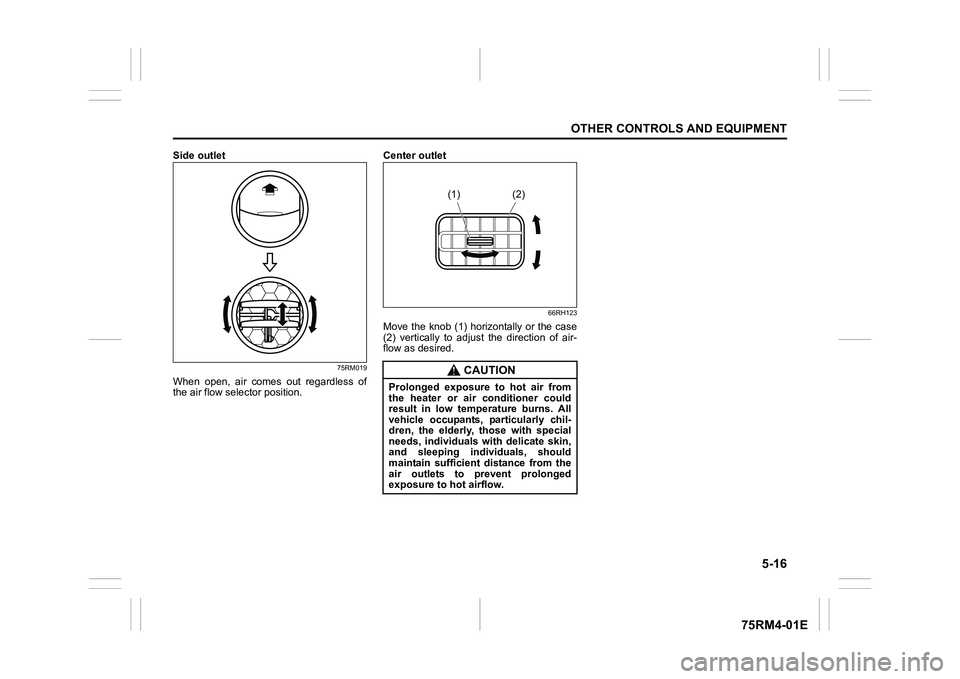
Side outlet
75RM019
When open, air comes out regardless of
the air flow selector position.Center outlet
66RH123
Move the knob (1) horizontally or the case
(2) vertically to adjust the direction of air-
flow as desired.
CAUTION
Prolonged exposure to hot air from
the heater or air conditioner could
result in low temperature burns. All
vehicle occupants, particularly chil-
dren, the elderly, those with special
needs, individuals with delicate skin,
and sleeping individuals, should
maintain sufficient distance from the
air outlets to prevent prolonged
exposure to hot airflow.
(1) (2)
Page 272 of 505
5-17OTHER CONTROLS AND EQUIPMENT
75RM4-01E
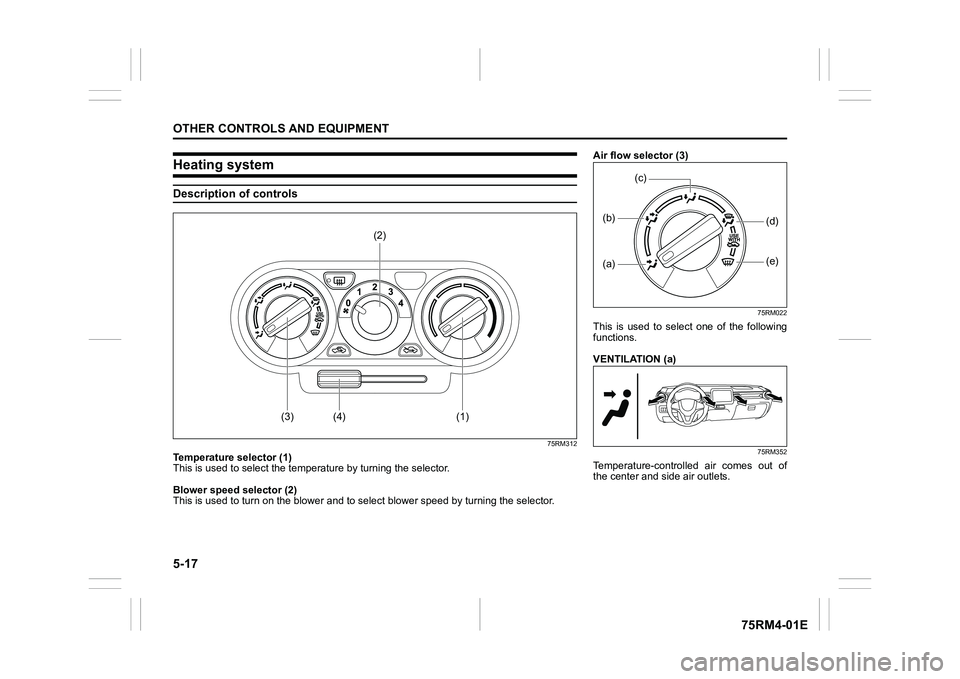
Heating systemDescription of controls
75RM312
Temperature selector (1)
This is used to select the temperature by turning the selector.
Blower speed selector (2)
This is used to turn on the blower and to s elect blower speed by turning the selector.
(3)
(1)
(4)
(2)
Air flow selector (3)
75RM022
This is used to select one of the following
functions.
VENTILATION (a)
75RM352
Temperature-controlled air comes out of
the center and side air outlets.(a)(b)
(e)
(d)
(c)
Page 273 of 505
5-18
OTHER CONTROLS AND EQUIPMENT
75RM4-01E
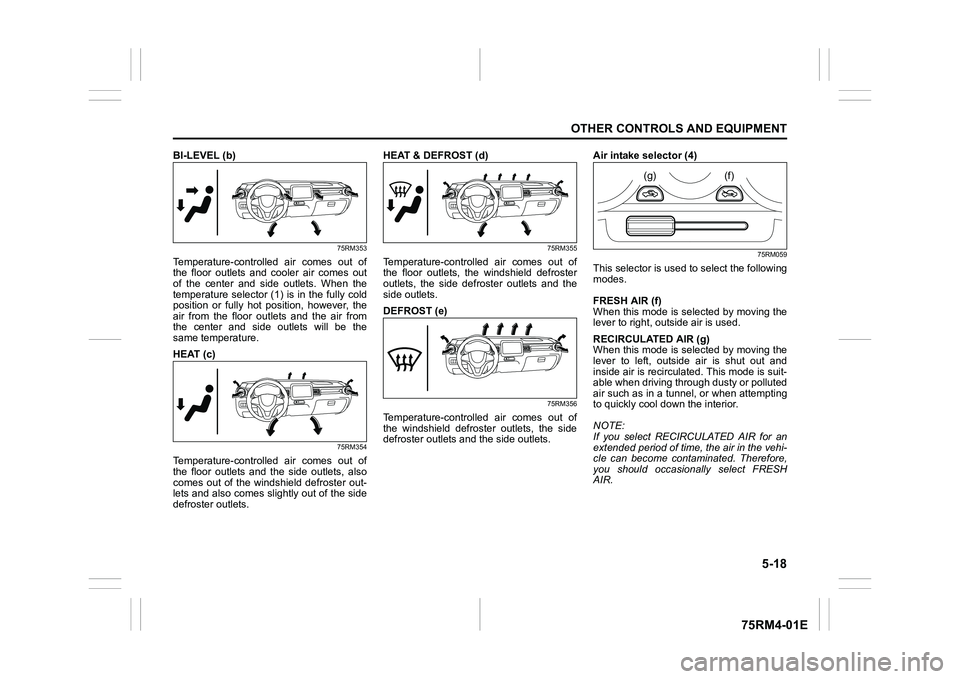
BI-LEVEL (b)
75RM353
Temperature-controlled air comes out of
the floor outlets and cooler air comes out
of the center and side outlets. When the
temperature selector (1) is in the fully cold
position or fully hot position, however, the
air from the floor outlets and the air from
the center and side outlets will be the
same temperature.
HEAT (c)
75RM354
Temperature-controlled air comes out of
the floor outlets and the side outlets, also
comes out of the windshield defroster out-
lets and also comes slightly out of the side
defroster outlets.HEAT & DEFROST (d)
75RM355
Temperature-controlled air comes out of
the floor outlets, the windshield defroster
outlets, the side defroster outlets and the
side outlets.
DEFROST (e)
75RM356
Temperature-controlled air comes out of
the windshield defroster outlets, the side
defroster outlets and the side outlets.
Air intake selector (4)
75RM059
This selector is used to select the following
modes.
FRESH AIR (f)
When this mode is se
lected by moving the
lever to right, outside air is used.
RECIRCULATED AIR (g)
When this mode is se lected by moving the
lever to left, outside air is shut out and
inside air is recirculated. This mode is suit-
able when driving through dusty or polluted
air such as in a tunnel, or when attempting
to quickly cool dow n the interior.
NOTE:
If you select RECIRCULATED AIR for an
extended period of time, the air in the vehi-
cle can become contam inated. Therefore,
you should occasio nally select FRESH
AIR.
(g)
(f)
Page 274 of 505

5-19OTHER CONTROLS AND EQUIPMENT
75RM4-01E
75RM402
NOTE:
The mark of “USE WITH” (5)
To clear fog on the windshield and/or the
side windows quickly, set the air flow
selector (3) to “HEAT & DEFROST” or
“DEFROST” and air intake selector (4) to
“FRESH AIR”. These positioning will clear
the fogged windshield and/or the side win-
dows faster than the “RECIRCULATED
AIR”.
System operating instructionsNatural ventilation
Select VENTILATION and FRESH AIR, the
temperature selector to the desired tem-
perature position, and the blower speed
selector to off. Fresh air will flow through
the vehicle during driving.
Forced ventilation
The control settings are the same as for
natural ventilation except you set the
blower speed selector to a position other
than off.
Normal heating (using outside air)
Select HEAT and FRESH AIR, the tem-
perature selector to the desired tempera-
ture position and the blower speed selector
to the desired blower speed position. Set-
ting the blower speed selector to a higher
blower speed position increases heating
efficiency.
Quick heating (using recirculated air)
The control settings are the same as for
normal heating except you select RECIR-
CULATED AIR. If you use this heating
method for an extended period of time, the
air in the vehicle can become contami-
nated and the windows can become misty.
Therefore, use this method only for quick
heating and change to the normal heating
method as soon as possible. Head cooled/Feet warmed heating
Select BI-LEVEL and FRESH AIR, the
temperature selector to the desired tem-
perature position, and the blower speed
selector to the desired blower speed posi-
tion. Unless the temperature selector is in
the fully cold position or fully hot position,
the air that comes out of the center and
side outlets will be cooler than the air that
comes out of the floor outlets.
Defrosting/Feet warmed heating
Select HEAT & DEFROST and FRESH
AIR, the temperatur
e selector to the
desired temperature position, and the
blower speed selector to high. When the
windshield has become clear, set the
blower speed selector to the desired
blower speed position.
Defrosting
Select DEFROST and FRESH AIR, the
temperature selector to the desired tem-
perature position (higher temperature pro-
vides more efficient defrosting), and the
blower speed selector to high. When the
windshield has become clear, set the
blower speed selector to the desired
blower speed position.
(3)
(5)
Page 355 of 505
7-6
INSPECTION AND MAINTENANCE
75RM4-01E
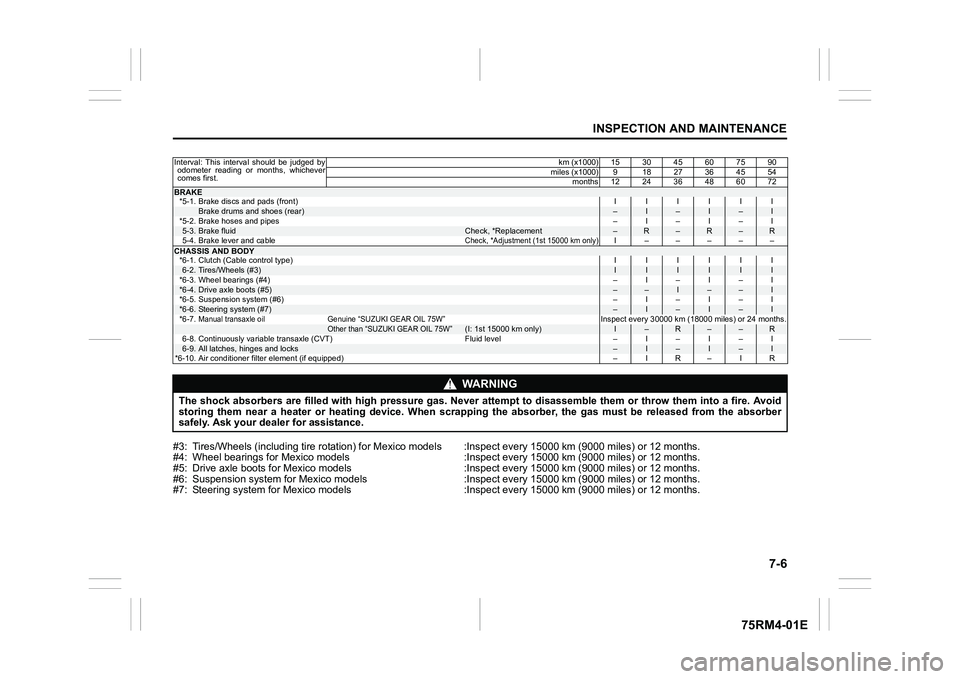
#3: Tires/Wheels (including tire rotation) for Mexico models :Inspect every 15000 km (9000 miles) or 12 months.
#4: Wheel bearings for Mexico models :Inspect every 15000 km (900 0 miles) or 12 months.
#5: Drive axle boots for Mexico models :Inspect every 15000 km (9 000 miles) or 12 months.
#6: Suspension system for Mexico models :Inspect every 15000 km ( 9000 miles) or 12 months.
#7: Steering system for Mexico m odels :Inspect every 15000 km (90 00 miles) or 12 months.Interval: This interval should be judged by
odometer reading or months, whichever
comes first. km (x1000) 15 30 45 60 75 90
miles (x1000) 9 18 27 36 45 54 months 12 24 36 48 60 72BRAKE*5-1. Brake discs and pads (front) IIIIII
Brake drums and shoes (rear)
–
I
–
I
–
I
*5-2. Brake hoses and pipes –I–I–I
5-3.
Brake fluid
Check, *Replacement
–
R
–
R
–
R
5-4. Brake lever and cable
Check, *Adjustment (1st 15000 km only)
I –––––
CHASSIS AND BODY *6-1. Clutch (Cable control type) IIIIII6-2.
Tires/Wheels (#3)
I
I
I
I
I
I
*6-3. Wheel bearings (#4) –I–I–I
*6-4.
Drive axle boots (#5)
–
–
I
–
–
I
*6-5. Suspension system (#6) –I–I–I
*6-6.
Steering system (#7)
–
I
–
I
–
I
*6-7.
Manual transaxle oil Genuine “SUZUKI GEAR OIL 75W”
Inspect every 30000 km (18000 miles) or 24 months.
Other than “SUZUKI GEAR OIL 75W”
(I: 1st 15000 km only)
I
–
R
–
–
R
6-8. Continuously variable transaxle (CVT) Fluid level – I – I – I
6-9.
All latches, hinges and locks
–
I
–
I
–
I
*6-10. Air conditioner filter element (if equipped) –IR–IR
WA R N I N G
The shock absorbers are filled with high pressure gas. Never attempt to disassemble them or throw them into a fire. Avoid
storing them near a heater or heating device. When scrapping th e absorber, the gas must be released from the absorber
safely. Ask your deal er for assistance.
Page 356 of 505
7-7INSPECTION AND MAINTENANCE
75RM4-01E
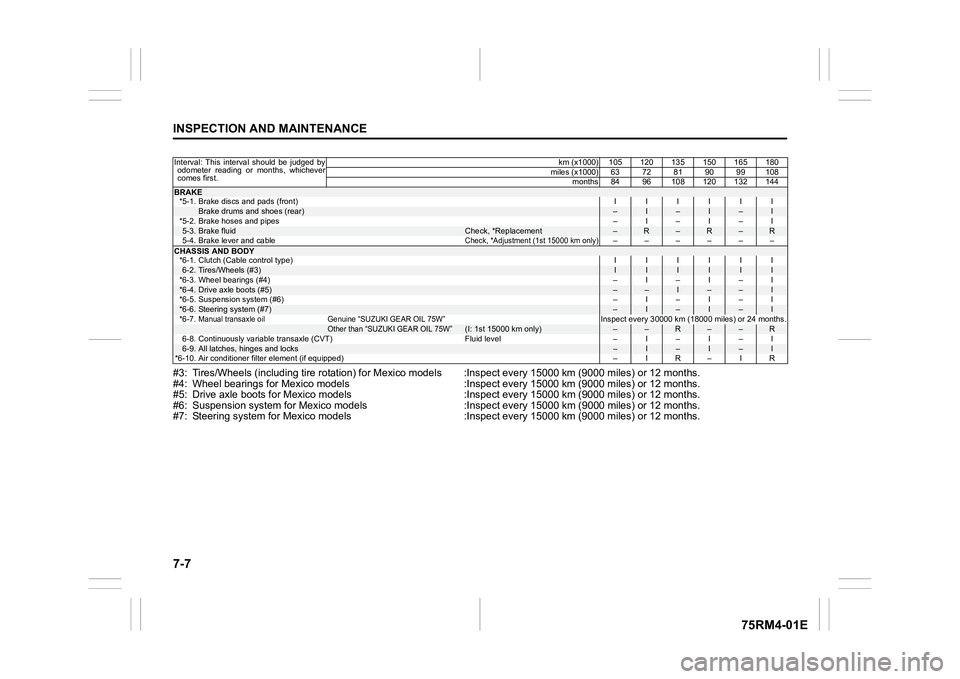
#3: Tires/Wheels (including tire rotation) for Mexico models :Inspect every 15000 km (9000 miles) or 12 months.
#4: Wheel bearings for Mexico models :Inspect every 15000 km (900 0 miles) or 12 months.
#5: Drive axle boots for Mexico models :Inspect every 15000 km (9 000 miles) or 12 months.
#6: Suspension system for Mexico models :Inspect every 15000 km ( 9000 miles) or 12 months.
#7: Steering system for Mexico m odels :Inspect every 15000 km (90 00 miles) or 12 months.Interval: This interval should be judged by
odometer reading or months, whichever
comes first. km (x1000) 105 120 135 150 165 180
miles (x1000) 63 72 81 90 99 108 months 84 96 108 120 132 144BRAKE*5-1. Brake discs and pads (front) IIIIII
Brake drums and shoes (rear)
–
I
–
I
–
I
*5-2. Brake hoses and pipes –I–I–I
5-3.
Brake fluid
Check, *Replacement
–
R
–
R
–
R
5-4. Brake lever and cable
Check, *Adjustment (1st 15000 km only)
––––––
CHASSIS AND BODY *6-1. Clutch (Cable control type) IIIIII6-2.
Tires/Wheels (#3)
I
I
I
I
I
I
*6-3. Wheel bearings (#4) –I–I–I
*6-4.
Drive axle boots (#5)
–
–
I
–
–
I
*6-5. Suspension system (#6) –I–I–I
*6-6.
Steering system (#7)
–
I
–
I
–
I
*6-7.
Manual transaxle oil Genuine “SUZUKI GEAR OIL 75W”
Inspect every 30000 km (18000 miles) or 24 months.
Other than “SUZUKI GEAR OIL 75W”
(I: 1st 15000 km only)
–
–
R
–
–
R
6-8. Continuously variable transaxle (CVT) Fluid level – I – I – I
6-9.
All latches, hinges and locks
–
I
–
I
–
I
*6-10. Air conditioner filter element (if equipped) –IR–IR
Page 360 of 505
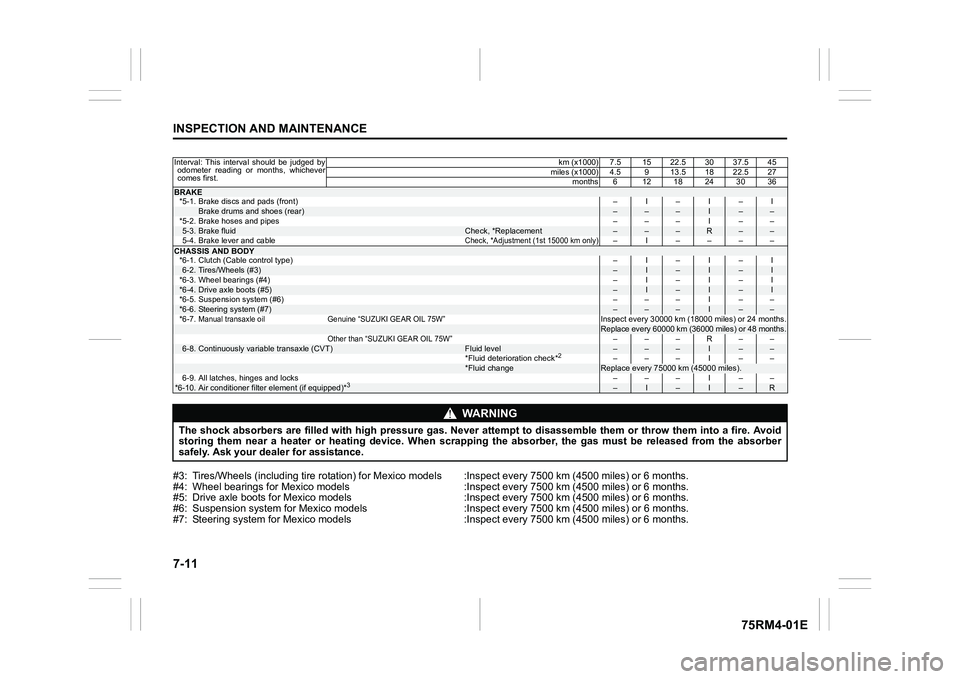
7-11INSPECTION AND MAINTENANCE
75RM4-01E
#3: Tires/Wheels (including tire rotation) for Mexico models :Inspect every 7500 km (4500 miles) or 6 months.
#4: Wheel bearings for Mexico models :Inspect every 7500 km (4500 miles) or 6 months.
#5: Drive axle boots for Mexico models :Inspect every 7500 km (45 00 miles) or 6 months.
#6: Suspension system for Mexico models :Inspect every 7500 km (4 500 miles) or 6 months.
#7: Steering system for Mexico m odels :Inspect every 7500 km (450 0 miles) or 6 months.Interval: This interval should be judged by
odometer reading or months, whichever
comes first. km (x1000) 7.5 15 22.5 30 37.5 45
miles (x1000) 4.5 9 13.5 18 22.5 27 months6 1218243036BRAKE*5-1. Brake discs and pads (front) –I–I–I
Brake drums and shoes (rear)
–
–
–
I
–
–
*5-2. Brake hoses and pipes ––– I ––
5-3.
Brake fluid
Check, *Replacement
–
–
–
R
–
–
5-4. Brake lever and cable
Check, *Adjustment (1st 15000 km only)
– I ––––
CHASSIS AND BODY *6-1. Clutch (Cable control type) –I–I–I6-2.
Tires/Wheels (#3)
–
I
–
I
–
I
*6-3. Wheel bearings (#4) –I–I–I
*6-4.
Drive axle boots (#5)
–
I
–
I
–
I
*6-5. Suspension system (#6) ––– I ––
*6-6.
Steering system (#7)
–
–
–
I
–
–
*6-7.
Manual transaxle oil Genuine “SUZUKI GEAR OIL 75W”
Inspect every 30000 km (18000 miles) or 24 months.Replace every 60000 km (36000 miles) or 48 months.
Other than “SUZUKI GEAR OIL 75W”
–––R––
6-8.
Continuously variable transaxle (CVT)
Fluid level
–
–
–
I
–
–
*Fluid deterioration check*
2 –––I––
*Fluid change
Replace every 75000 km (45000 miles).
6-9. All latches, hinges and locks ––– I ––
*6-10.
Air conditioner filter element (if equipped)*
3
–
I
–
I
–
R
WA R N I N G
The shock absorbers are filled with high pressure gas. Never attempt to disassemble them or throw them into a fire. Avoid
storing them near a heater or heating device. When scrapping th e absorber, the gas must be released from the absorber
safely. Ask your deal er for assistance.