spare tire SUZUKI IGNIS 2021 User Guide
[x] Cancel search | Manufacturer: SUZUKI, Model Year: 2021, Model line: IGNIS, Model: SUZUKI IGNIS 2021Pages: 505, PDF Size: 8.36 MB
Page 388 of 505
7-39INSPECTION AND MAINTENANCE
75RM4-01E
Tires
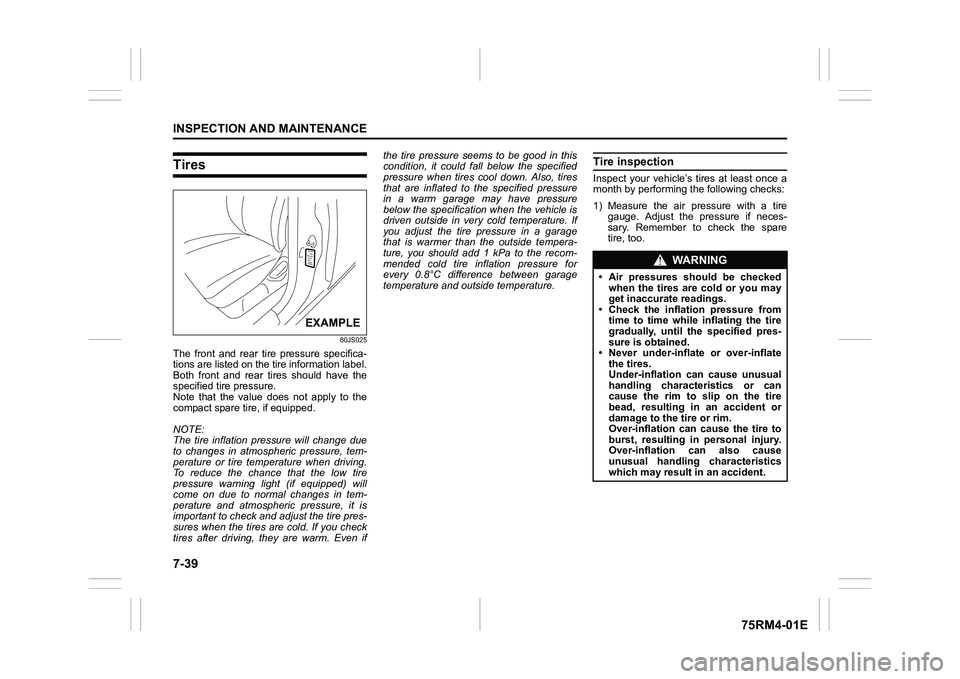
80JS025
The front and rear tire pressure specifica-
tions are listed on the tire information label.
Both front and rear tires should have the
specified tire pressure.
Note that the value does not apply to the
compact spare tire, if equipped.
NOTE:
The tire inflation pressure will change due
to changes in atmospheric pressure, tem-
perature or tire temperature when driving.
To reduce the chance that the low tire
pressure warning light (if equipped) will
come on due to normal changes in tem-
perature and atmospheric pressure, it is
important to check and adjust the tire pres-
sures when the tires are cold. If you check
tires after driving, they are warm. Even ifthe tire pressure seems to be good in this
condition, it could fall below the specified
pressure when tires co
ol down. Also, tires
that are inflated to the specified pressure
in a warm garage may have pressure
below the specification when the vehicle is
driven outside in very cold temperature. If
you adjust the tire pressure in a garage
that is warmer than the outside tempera-
ture, you should add 1 kPa to the recom-
mended cold tire inflation pressure for
every 0.8°C difference between garage
temperature and outside temperature.
Tire inspectionInspect your vehicle’s tires at least once a
month by performing the following checks:
1) Measure the air pressure with a tire gauge. Adjust the pressure if neces-
sary. Remember to check the spare
tire, too.
EXAMPLE
WA R N I N G
• Air pressures should be checkedwhen the tires are cold or you may
get inaccurate readings.
• Check the inflation pressure from time to time while inflating the tire
gradually, until the specified pres-
sure is obtained.
• Never under-inflate or over-inflate the tires.
Under-inflation can cause unusual
handling characteristics or can
cause the rim to slip on the tire
bead, resulting in an accident or
damage to the tire or rim.
Over-inflation can cause the tire to
burst, resulting in personal injury.
Over-inflation c an also cause
unusual handling characteristics
which may result in an accident.
Page 390 of 505
7-41INSPECTION AND MAINTENANCE
75RM4-01E
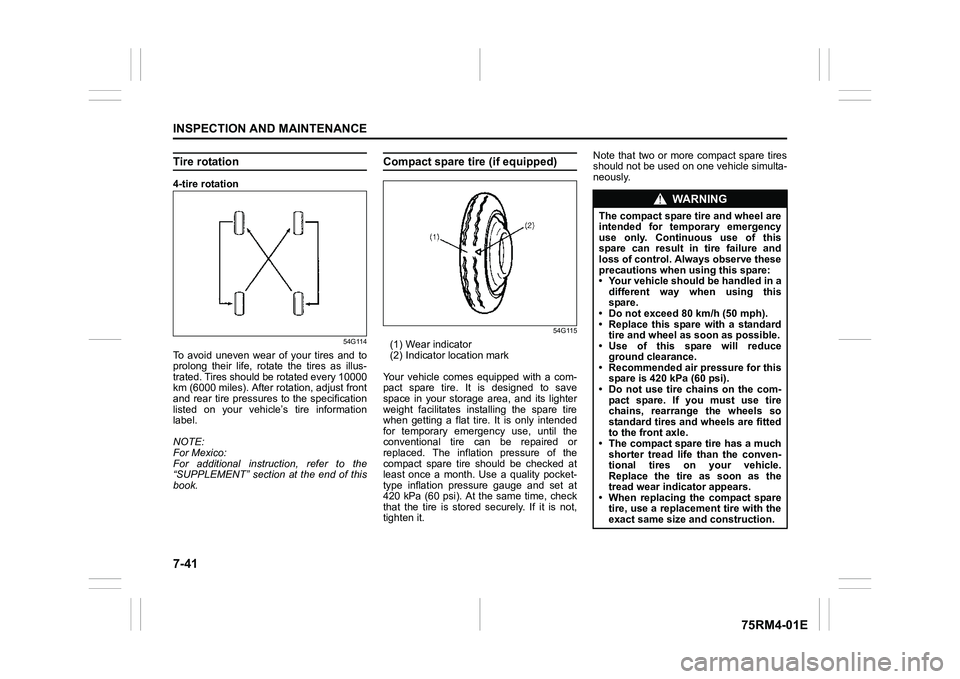
Tire rotation4-tire rotation
54G114
To avoid uneven wear of your tires and to
prolong their life, rotate the tires as illus-
trated. Tires should be rotated every 10000
km (6000 miles). After rotation, adjust front
and rear tire pressures to the specification
listed on your vehicle’s tire information
label.
NOTE:
For Mexico:
For additional instruction, refer to the
“SUPPLEMENT” section at the end of this
book.
Compact spare tire (if equipped)
54G115
(1) Wear indicator
(2) Indicator location mark
Your vehicle comes equipped with a com-
pact spare tire. It is designed to save
space in your storage area, and its lighter
weight facilitates installing the spare tire
when getting a flat tire. It is only intended
for temporary emergency use, until the
conventional tire can be repaired or
replaced. The inflation pressure of the
compact spare tire should be checked at
least once a month. Use a quality pocket-
type inflation pressure gauge and set at
420 kPa (60 psi). At the same time, check
that the tire is stored securely. If it is not,
tighten it. Note that two or more compact spare tires
should not be used on one vehicle simulta-
neously.
WA R N I N G
The compact spare tire and wheel are
intended for temporary emergency
use only. Continuous use of this
spare can result in tire failure and
loss of control. Always observe these
precautions when using this spare:
• Your vehicle should be handled in a
different way when using this
spare.
• Do not exceed 80 km/h (50 mph).
• Replace this spare with a standard tire and wheel as soon as possible.
• Use of this spare will reduce
ground clearance.
• Recommended air pressure for this spare is 420 kPa (60 psi).
• Do not use tire chains on the com- pact spare. If you must use tire
chains, rearrange the wheels so
standard tires and wheels are fitted
to the front axle.
• The compact spare tire has a much
shorter tread life than the conven-
tional tires on your vehicle.
Replace the tire as soon as the
tread wear indicator appears.
• When replacing the compact spare tire, use a replacement tire with the
exact same size and construction.
Page 410 of 505
8-1EMERGENCY SERVICE
75RM4-01E
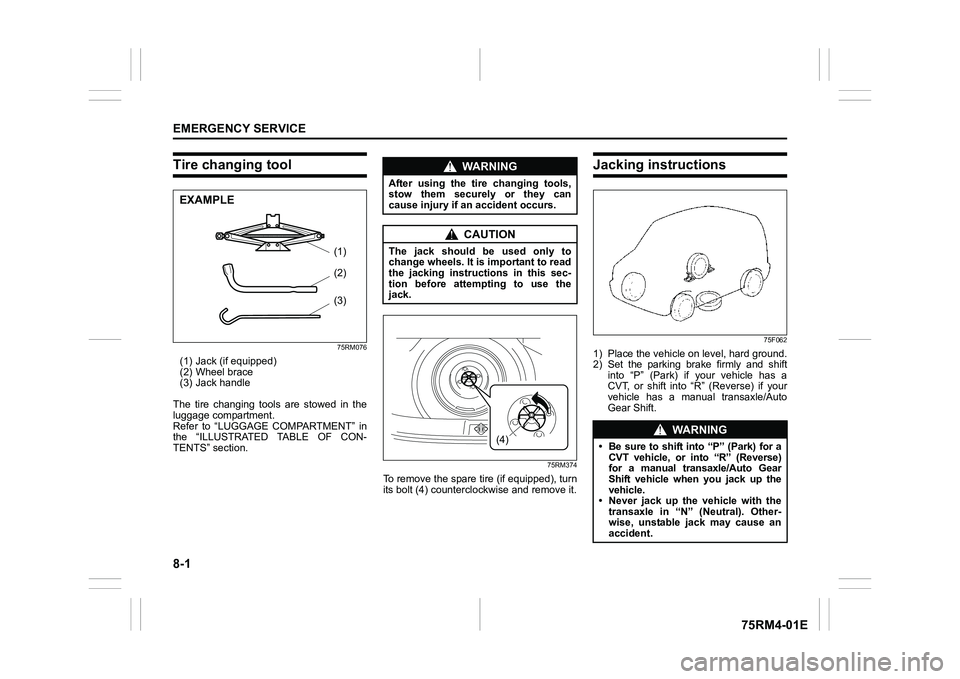
Tire changing tool
75RM076
(1) Jack (if equipped)
(2) Wheel brace
(3) Jack handle
The tire changing tools are stowed in the
luggage compartment.
Refer to “LUGGAGE COMPARTMENT” in
the “ILLUSTRATED TABLE OF CON-
TENTS” section.
75RM374
To remove the spare tire (if equipped), turn
its bolt (4) countercl ockwise and remove it.
Jacking instructions
75F062
1) Place the vehicle on level, hard ground.
2) Set the parking brake firmly and shift into “P” (Park) if your vehicle has a
CVT, or shift into “R” (Reverse) if your
vehicle has a manual transaxle/Auto
Gear Shift.
(3)(2)
(1)
EXAMPLE
WA R N I N G
After using the tire changing tools,
stow them securely or they can
cause injury if an accident occurs.
CAUTION
The jack should be used only to
change wheels. It is important to read
the jacking instructions in this sec-
tion before attempting to use the
jack.
(4)
:Ν 5 1 , 1 *
Page 411 of 505
8-2
EMERGENCY SERVICE
75RM4-01E
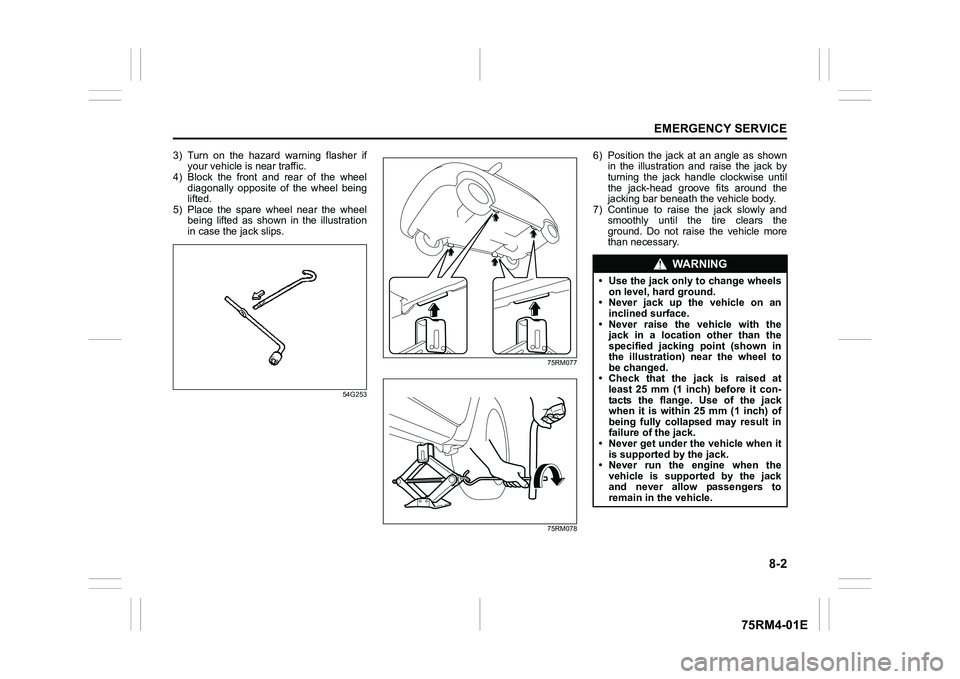
3) Turn on the hazard warning flasher ifyour vehicle is near traffic.
4) Block the front and rear of the wheel
diagonally opposite of the wheel being
lifted.
5) Place the spare wheel near the wheel
being lifted as shown in the illustration
in case the jack slips.
54G253 75RM077
75RM078
6) Position the jack at an angle as shown
in the illustration and raise the jack by
turning the jack handle clockwise until
the jack-head groove fits around the
jacking bar beneath the vehicle body.
7) Continue to raise the jack slowly and
smoothly until the tire clears the
ground. Do not raise the vehicle more
than necessary.
WA R N I N G
• Use the jack only to change wheelson level, hard ground.
• Never jack up the vehicle on an inclined surface.
• Never raise the vehicle with the jack in a location other than the
specified jacking point (shown in
the illustration) near the wheel to
be changed.
• Check that the jack is raised at
least 25 mm (1 inch) before it con-
tacts the flange. Use of the jack
when it is within 25 mm (1 inch) of
being fully collapsed may result in
failure of the jack.
• Never get under the vehicle when it
is supported by the jack.
• Never run the engine when the vehicle is supported by the jack
and never allow passengers to
remain in the vehicle.
Page 415 of 505
8-6
EMERGENCY SERVICE
75RM4-01E
IMPORTANT
The flat tire repair kit cannot be used in
the following cases. Consult a SUZUKI
dealer or a roadside assistance service.
• Cuts or piercing in the tire treadlarger than approx. 4 mm.
• Cuts in the tire side wall.
• Tire damage caused by driving with considerably reduced tire pressure or
even with deflated tire.
• The tire bead completely unseated outside of the rim.
• The rim damaged.
Small punctures in the tire tread,
caused by a nail or a screw, can be
sealed with the flat tire repair kit.
Do not remove nails or screws from the
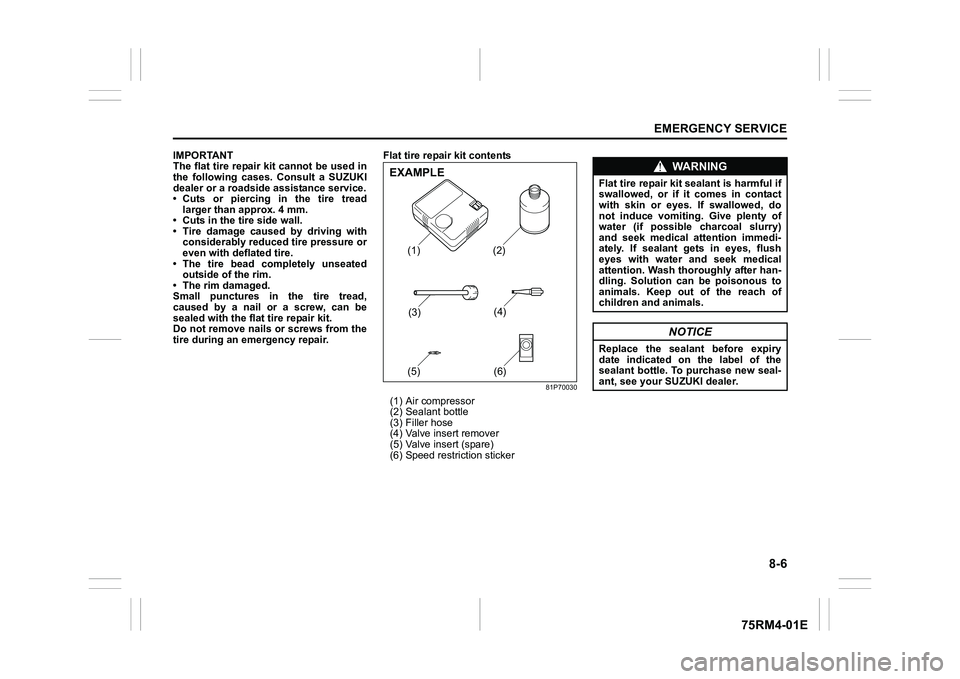
tire during an e mergency repair. Flat tire repair kit contents
81P70030
(1) Air compressor
(2) Sealant bottle
(3) Filler hose
(4) Valve insert remover
(5) Valve insert (spare)
(6) Speed restriction sticker
(1)(3)
(4)
(5)
(6)(2)
EXAMPLE
WA R N I N G
Flat tire repair kit sealant is harmful if
swallowed, or if it comes in contact
with skin or eyes. If swallowed, do
not induce vomiting. Give plenty of
water (if possible charcoal slurry)
and seek medical attention immedi-
ately. If sealant gets in eyes, flush
eyes with water and seek medical
attention. Wash thoroughly after han-
dling. Solution can be poisonous to
animals. Keep out of the reach of
children and animals.
NOTICE
Replace the sealant before expiry
date indicated on the label of the
sealant bottle. To purchase new seal-
ant, see your SUZUKI dealer.
Page 417 of 505
8-8
EMERGENCY SERVICE
75RM4-01E
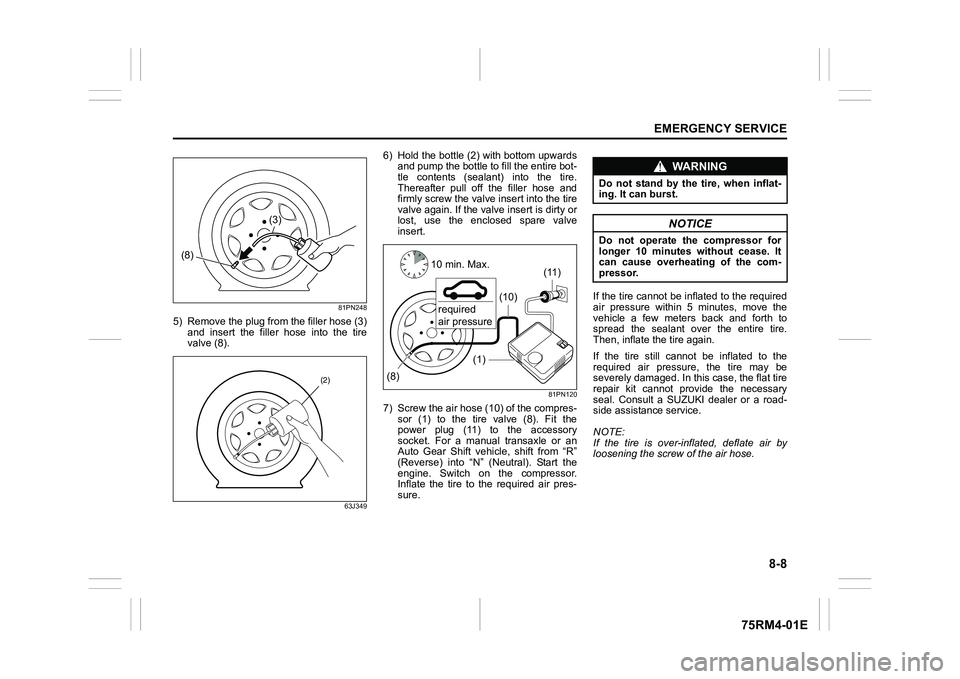
81PN248
5) Remove the plug from the filler hose (3)and insert the filler hose into the tire
valve (8).
63J349
6) Hold the bottle (2) with bottom upwardsand pump the bottle to fill the entire bot-
tle contents (sealant) into the tire.
Thereafter pull off the filler hose and
firmly screw the valve insert into the tire
valve again. If the valve insert is dirty or
lost, use the enclosed spare valve
insert.
81PN120
7) Screw the air hose (10) of the compres- sor (1) to the tire valve (8). Fit the
power plug (11) to the accessory
socket. For a manual transaxle or an
Auto Gear Shift vehicle, shift from “R”
(Reverse) into “N” (Neutral). Start the
engine. Switch on the compressor.
Inflate the tire to the required air pres-
sure. If the tire cannot be inflated to the required
air pressure within 5 minutes, move the
vehicle a few meters back and forth to
spread the sealant over the entire tire.
Then, inflate the tire again.
If the tire still cannot be inflated to the
required air pressure, the tire may be
severely damaged. In this case, the flat tire
repair kit cannot provide the necessary
seal. Consult a SUZUKI dealer or a road-
side assistance service.
NOTE:
If the tire is over-inflated, deflate air by
loosening the screw of the air hose.
(3)
(8)
(2)
(1)
(8) (11)
(10)
10 min. Max.required
air pressure
WA R N I N G
Do not stand by the tire, when inflat-
ing. It can burst.
NOTICE
Do not operate the compressor for
longer 10 minutes without cease. It
can cause overheating of the com-
pressor.
Page 440 of 505
12-1SUPPLEMENT
75RM4-01E
For AustraliaBuilt dateBuilt date is located on Vehicle Identifica-
tion plate.
“Built date” means – the calendar month
and the year in which the body shell and
power train sub-assemblies are conjoined
and the vehicle is driven or moved from the
production line.Temporary-use spare tire (compact spare tire)Temporary Spare Tires fitted to this vehicle
must have a maximum load rating of not
less than 775 kg, or a load index of “99”
and a speed category symbol of not less
than “M” (130 km/h).
Drive with caution when the Temporary-
Use Spare Unit is fitted. Reinstall standard
unit as soon as possible.
Child restraint
Child restraint top tether anchorage brackets
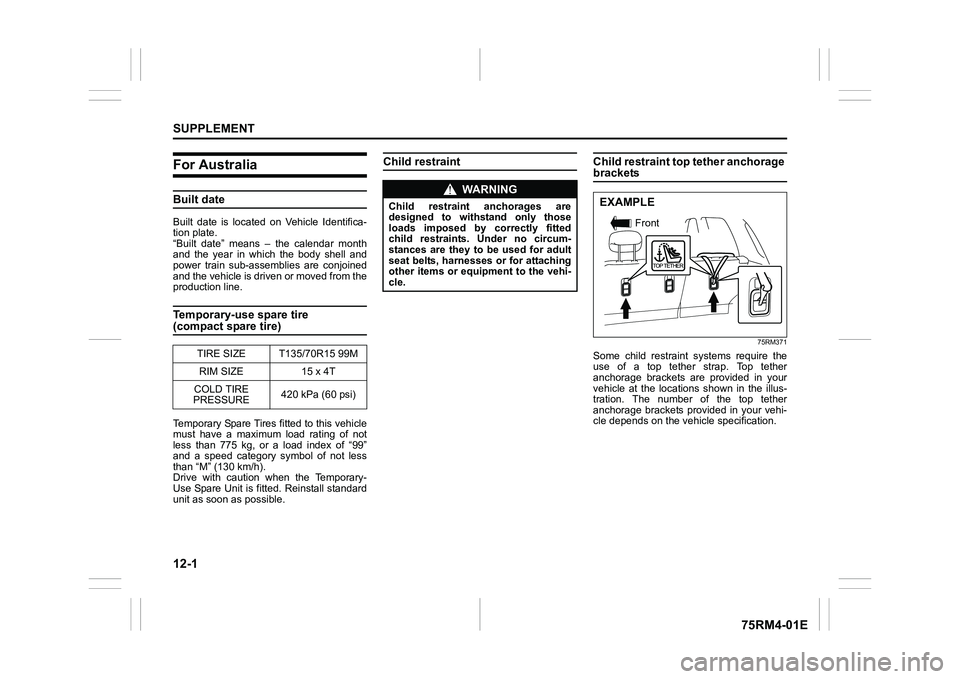
75RM371
Some child restraint systems require the
use of a top tether strap. Top tether
anchorage brackets are provided in your
vehicle at the locations shown in the illus-
tration. The number of the top tether
anchorage brackets provided in your vehi-
cle depends on the v ehicle specification.
TIRE SIZE T135/70R15 99M
RIM SIZE 15 x 4T
COLD TIRE
PRESSURE 420 kPa (60 psi)
WA R N I N G
Child restraint anchorages are
designed to withstand only those
loads imposed by correctly fitted
child restraints. Under no circum-
stances are they to be used for adult
seat belts, harnesses or for attaching
other items or equipment to the vehi-
cle.
EXAMPLE
Front
Page 450 of 505
13-2INDEX
75RM4-01E
Compact spare tire .............................................................. 7-41
Continuously variable transaxle (CVT) .......................... .... 3-19
Continuously variable transaxle (CVT) fluid .................... .7-32
Coolant level check ............................................ ................. 7-28
Coolant replacement ............................................ ............... 7-29
Corrosion prevention .......... .................................................. 9-1
Cruise control ................................................. ..................... 3-48
Cruise indicator light ......................................... ................ 2-115
Cup holder and storage area . ............................................... 5-8DDaily inspection checklist ..................................... ................ 3-1
Daytime running light .......................................... ................ 7-51
Daytime running light (D.R.L.) system.......................... ... 2-118
Dead lock system ............................................... ................... 2-4
Deceleration energy regeneratin g indicator light ........... 2-114
Depress brake pedal indicator .................................. ....... 2-115
Door locks ..................................................... ......................... 2-2
Drive belt ..................................................... ......................... 7-23
Drive mode indicator ........................................... ................ 2-78
Driver’s seat belt reminder light /
Front passenger’s seat belt remi nder light .....................2-106
Driving on hills ............................................... ........................ 4-3
Driving on slippery roads ...................................... ............... 4-4
Driving range.................................................. ............. 2-74, 2-94
Driving time ................................................... ....................... 2-74
Dual camera brake support ...................................... .......... 3-53
Dual camera brake support indicator light...................... 2-110
Dual camera brake support OFF indicator light ............. 2-110
Dual camera brake support OFF switch ........................... .3-61
Dual camera brake support warn ing light ....................... 2-116
EEco-Cool ....................................................... ........................ 3-48
Eco-driving display ............................................ .................. 2-79
Electric mirrors............................................... ...................... 2-24
Electric power steering ligh t ............................................. 2-109
Electric window controls ... .................................................. 2-20
Electronic stabi lity program (ESP
®) ................................... 3-78
Emergency locking retractor ( ELR) .................................... 2-35
Emergency stop signal (ESS) . ............................................ 3-71
Energy flow indicator.......................................... ........2-74, 3-46
ENG A-STOP indicator light ..................................... ......... 2-114
ENG A-STOP OFF light ........................................... ........... 2-114
ENG A-STOP OFF switch .......................................... .......... 3-45
ENG A-STOP system (e ngine auto stop start system) ..... 3-35
Engine coolant ................................................. .................... 7-28
Engine hood .................................................... ....................... 5-2
Engine oil and filter .......................................... .................... 7-23
Engine oil consumption ......................................... ............... 3-2
Engine serial number........................................... ................ 10-1
Engine switch .................................................. ....................... 3-5
Engine switch illumination ..................................... ............... 3-7
Engine trouble: Flooded engine ................................. ........ 8-13
Engine trouble: Overheating .................................... ........... 8-13
Engine trouble: Starter does not operate ....................... ... 8-13
ESP
® OFF indicator light ..........................................2 -105, 3-79
ESP® OFF switch .................................................... ............. 3-80
ESP® warning light ................................................. ..2-104, 3-79
Exhaust gas warning ............................................ ................. 3-1
FFlat tire repair kit .................................................................... 8-5
Floor mats ..................................................... ........................ 5-10
Page 454 of 505
13-6INDEX
75RM4-01E
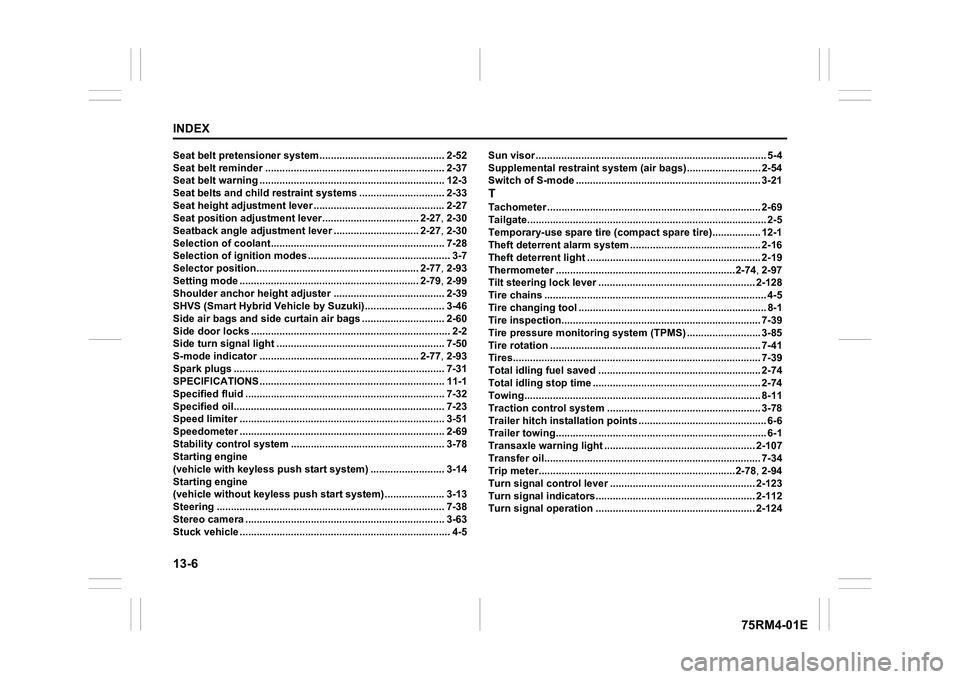
Seat belt pretensioner system............................................ 2-52
Seat belt reminder ............................................. .................. 2-37
Seat belt warning .............................................. ................... 12-3
Seat belts and child restraint systems .............................. 2-33
Seat height adjustment lever ................................... ........... 2-27
Seat position adjustment lever................................. .2-27, 2-30
Seatback angle adjustment lever .............................. 2- 27, 2-30
Selection of coolant........................................... .................. 7-28
Selection of ignition modes .................................... .............. 3-7
Selector position.............................................. ........... 2-77, 2-93
Setting mode ................................................... ............ 2-79, 2-99
Shoulder anchor height adjuster ................................ ....... 2-39
SHVS (Smart Hybrid Ve hicle by Suzuki).......................... .. 3-46
Side air bags and side curtain air bags ............................. 2-60
Side door locks ................................................ ...................... 2-2
Side turn signal light ......................................... .................. 7-50
S-mode indicator ............................................... ......... 2-77, 2-93
Spark plugs .................................................... ...................... 7-31
SPECIFICATIONS...... ........................................................... 11-1
Specified fluid ................................................ ...................... 7-32
Specified oil.................................................. ........................ 7-23
Speed limiter .................................................. ...................... 3-51
Speedometer .................................................... .................... 2-69
Stability control system ....................................... ............... 3-78
Starting engine
(vehicle with keyless push sta rt system) ....................... ... 3-14
Starting engine
(vehicle without keyless push s tart system).....................3-13
Steering ....................................................... ......................... 7-38
Stereo camera .................................................. .................... 3-63
Stuck vehicle .................................................. ........................ 4-5Sun visor ......................................................
........................... 5-4
Supplemental restraint system (air bags)....................... ... 2-54
Switch of S-mode ............................................... .................. 3-21
TTachometer ........................................................................... 2-69
Tailgate....................................................... ............................. 2-5
Temporary-use spare tire (comp act spare tire)................. 12-1
Theft deterrent alarm system ................................... ........... 2-16
Theft deterrent light .......................................... ................... 2-19
Thermometer .................................................... ...........2-74, 2-97
Tilt steering lock lever .... ................................................... 2-128
Tire chains .................................................... .......................... 4-5
Tire changing tool ............................................. ..................... 8-1
Tire inspection................................................ ...................... 7-39
Tire pressure monitoring syst em (TPMS) ..........................3-85
Tire rotation .................................................. ........................ 7-41
Tires.......................................................... ............................. 7-39
Total idling fuel saved .... ..................................................... 2-74
Total idling stop time ......................................... .................. 2-74
Towing......................................................... .......................... 8-11
Traction control system ........................................ .............. 3-78
Trailer hitch installation points .............................. ............... 6-6
Trailer towing................................................. ......................... 6-1
Transaxle warning light ........................................ ............. 2-107
Transfer oil................................................... ......................... 7-34
Trip meter..................................................... ................2-78, 2-94
Turn signal control lever ...................................... ............. 2-123
Turn signal indicators......................................... ............... 2-112
Turn signal operation .......................................... .............. 2-124