towing SUZUKI IGNIS 2021 User Guide
[x] Cancel search | Manufacturer: SUZUKI, Model Year: 2021, Model line: IGNIS, Model: SUZUKI IGNIS 2021Pages: 505, PDF Size: 8.36 MB
Page 344 of 505
6-3VEHICLE LOADING AND TOWING
75RM4-01E
TiresMirrorsCheck if your vehicle’s mirrors meet local
requirements for mirrors used on towing
vehicles. If they do not, you must install the
required mirrors before you tow.Vehicle/trailer loadingTo load your vehicle and trailer properly,
you must know how to measure gross
trailer weight and trailer nose weight.
Gross trailer weight is the weight of the
trailer plus all the cargo in it. You can mea-
sure gross trailer weight by putting the fully
loaded trailer on a vehicle scale.
Nose weight is the downward force
exerted on the tow bar by the trailer cou- pler, with the trailer fully loaded and the
coupler at its normal towing height. This
weight can be measured using a bathroom
scale.
The weight of your loaded trailer (gross
trailer weight) should never exceed towing
capacity.
Distribute cargo in your trailer so that nose
weight is about 10% of gross trailer weight,
but does not exceed “Maximum vertical
load” of 50 kg (110 lbs), and does not fall
below 25 kg (55 lbs) or 4%, whichever is
heavier, on trailer hitch point. You should
measure gross trailer weight and nose
weight before towing to check that your
load is properly distributed.
NOTE:
For 4WD model in Europe, in the Member
States where the road traffic legislation
allows it, as it is also stated in COMMIS-
SION REGULATION (EU) 1230/2012, the
technically permissi
ble maximum laden
mass (GVWR) of the vehicle may be
exceeded by not more than 40 kg (88 lbs)
in case of towing a trailer.
WA R N I N G
When towing a trailer, it is very
important for your vehicle and trailer
to have properly inflated tires. Your
vehicle’s tires should be inflated to
the pressures listed on your vehicles
tire information label. If laden pres-
sures are listed on the label, the tires
should be inflated to the laden pres-
sures. Inflate trailer tires according to
the specifications provided by the
trailer manufacturer.
WA R N I N G
Improper weight distribution of your
trailer may result in poor vehicle han-
dling and swaying of the trailer.
Always check that trailer nose weight
is about 10% of gross trailer weight,
but does not exceed “Maximum verti-
cal load” of 50 kg (110 lbs), and does
not fall below 25 kg (55 lbs) or 4%,
whichever is heavier, on trailer hitch
point. Also check that the cargo is
properly secured. Failure to observe
this requirement may result in an
accident.
WA R N I N G
Never overload cargo on your trailer
or your vehicle. Gross trailer weight
must never exceed towing capacity.
Gross vehicle weight (sum of the
weights of the vehicle, all the occu-
pants, accessories including tow
bars and a trailer hitch, cargo and
trailer nose weight) must never
exceed the Gross Vehicle Weight Rat-
ing (GVWR) listed in the “SPECIFICA-
TIONS” section.
Page 345 of 505
6-4
VEHICLE LOADING AND TOWING
75RM4-01E
Additional trailer towing warnings
WA R N I N G
Connect trailer lights and hook up
safety chains every time you tow.
NOTICE
Because towing a trailer puts addi-
tional stress on your vehicle, more
frequent maintenance will be
required than under normal driving
conditions. Follow the schedule in
“Maintenance recommended under
severe driving conditions”.
WA R N I N G
Your vehicle should be handled in a
different way when towing a trailer.
For the safety of yourself and others,
observe the following precautions:
• Practice turning, stopping, andreversing before you begin towing
a trailer in traffi c. Do not tow a
trailer in traffic until you are confi-
dent that you can handle the vehi-
cle and trailer safely.
• Never exceed towing speed limits
or 80 km/h (50 mph), whichever is
lower.
• Never drive at a speed that causes shaking or swaying of the trailer. If
you notice even the slightest sign
of shaking or sw aying, slow down.
• When roads are wet, slippery or rough, drive at a slower speed than
you would on dry or smooth roads.
Failure to slow down when road
conditions are bad can result in
loss of control.
• Always have someone guide you when reversing.
(Continued)
WA R N I N G
(Continued)
• Allow adequate stopping distance.Stopping distance is increased
when you tow a trailer. For each 16
km/h (10 mph) of speed, allow at
least one vehicle and trailer length
between you and the vehicle
ahead. Allow a greater stopping
distance if roads are wet or slip-
pery.
• If the trailer has over-run brakes,
apply the brakes gradually to avoid
snatching caused by the trailer
wheels locking.
• Slow down before corners and maintain a steady speed while cor-
nering. Deceleration or accelera-
tion while cornering can result in
loss of control. Remember that a
larger than normal turning radius is
needed because the trailer wheels
will be closer than vehicle wheels
to the inside of the turn.
• Avoid sudden acceleration and stopping of the vehicle. Do not
make quick maneuvers unless they
are necessary.
• Slow down in cross winds and be
prepared for gusts of wind from
large passing vehicles. (Continued)
Page 346 of 505
6-5VEHICLE LOADING AND TOWING
75RM4-01E
60A186
WA R N I N G
(Continued)
• Be careful when overtaking othervehicles. Allow enough room for
your trailer before changing lanes,
and use turn signal lights properly
in advance.
• Slow down and shift into a lower gear before you reach long or steep
downhill grades. It is hazardous to
attempt downshifting while you are
descending a hill.
• Do not step on the brake pedal strongly. This could cause the
brakes to over-heat resulting in
reduced braking efficiency. Use
engine braking as much as possi-
ble.
• Because of the added trailer weight, your engine may overheat
on hot days when going up long or
steep hills. Pay attention to your
engine temperature. If the high
engine coolant temperature warn-
ing light (red color) indicates over-
heating, pull off the road and stop
the vehicle in a safe place. Refer to
“Engine trouble: Overheating” in
the “EMERGENCY SERVICE” sec-
tion.
WA R N I N G
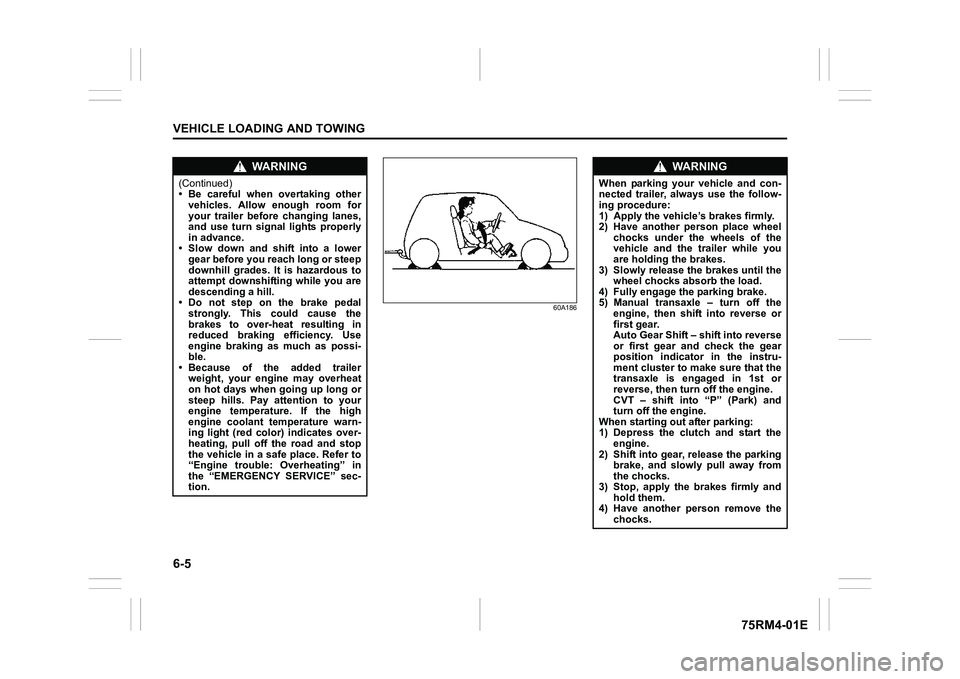
When parking your vehicle and con-
nected trailer, always use the follow-
ing procedure:
1) Apply the vehicle’s brakes firmly.
2) Have another person place wheel
chocks under the wheels of the
vehicle and the trailer while you
are holding the brakes.
3) Slowly release the brakes until the wheel chocks absorb the load.
4) Fully engage the parking brake.
5) Manual transaxle – turn off the engine, then shift into reverse or
first gear.
Auto Gear Shift – shift into reverse
or first gear and check the gear
position indicator in the instru-
ment cluster to make sure that the
transaxle is engaged in 1st or
reverse, then turn off the engine.
CVT – shift into “P” (Park) and
turn off the engine.
When starting out after parking:
1) Depress the clutch and start the engine.
2) Shift into gear, release the parking brake, and slowly pull away from
the chocks.
3) Stop, apply the brakes firmly and hold them.
4) Have another person remove the
chocks.
Page 347 of 505
6-6
VEHICLE LOADING AND TOWING
75RM4-01E
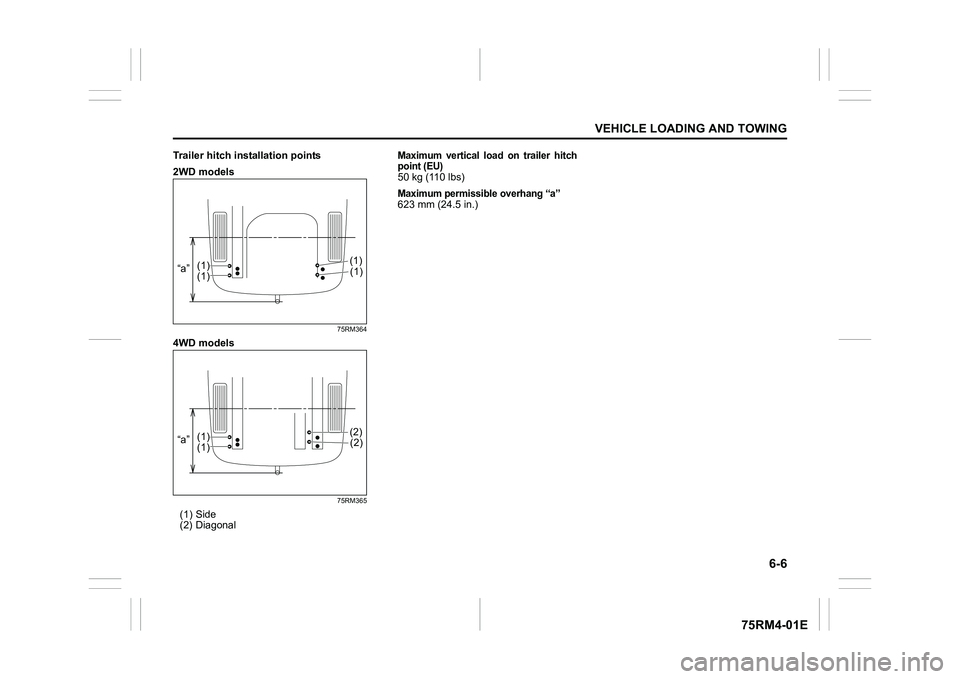
Trailer hitch installation points
2WD models
75RM364
4WD models
75RM365
(1) Side
(2) Diagonal
Maximum vertical load on trailer hitch
point (EU)50 kg (110 lbs)Maximum permissible overhang “a”623 mm (24.5 in.)
“a”
(1)(1)
(1)(1)
“a”
(1)(1)
(2)(2)
Page 348 of 505
6-7VEHICLE LOADING AND TOWING
75RM4-01E
MEMO
Page 357 of 505
7-8
INSPECTION AND MAINTENANCE
75RM4-01E
Maintenance recommended under severe driving conditions (except for EU countries and Israel)Follow this schedule if your vehicle is mainly operated under o ne or more of the following conditions:
• When most trips are le ss than 6 km (4 miles).
• When most trips are less than 16 km (10 miles) and outside temperature remains below freezing.
• Idling and/or low-speed operat ion in stop-and-go traffic.
• Operating in extremely cold we ather and/or on salted roads.
• Operating in rough and/or muddy areas.
• Operating in dusty areas.
• Repeated high speed drive or high engine revolutions.
• Towing a trailer, if admitted.
Schedule should also be followed if the vehicle is used for del ivery service, police, taxi or other commercial applications.
NOTE:
• Class 1: K12C engine
• Class 2: K12M engine
Page 367 of 505
7-18
INSPECTION AND MAINTENANCE
75RM4-01E
Maintenance recommended under severe driving conditions (for EU countries and Israel)Follow this schedule if your vehicle is mainly operated under o ne or more of the following conditions:
• When most trips are le ss than 6 km (4 miles).
• When most trips are less than 16 km (10 miles) and outside temperature remains below freezing.
• Idling and/or low-speed operat ion in stop-and-go traffic.
• Operating in extremely cold we ather and/or on salted roads.
• Operating in rough and/or muddy areas.
• Operating in dusty areas.
• Repeated high speed drive or high engine revolutions.
• Towing a trailer, if admitted.
Schedule should also be followed if the vehicle is used for del ivery service, police, taxi or other commercial applications.
Page 409 of 505
EMERGENCY SERVICE
8
75RM4-01E
60G411
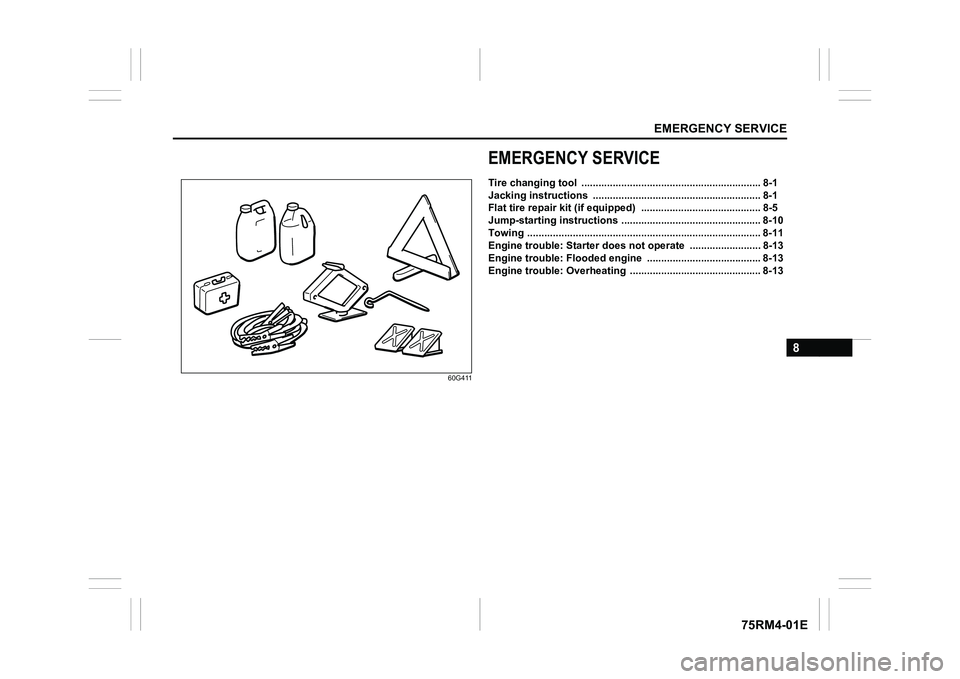
EMERGENCY SERVICETire changing tool ............................................................... 8-1
Jacking instructions .......................................... ................. 8-1
Flat tire repair kit (if equ ipped) .......................................... 8-5
Jump-starting instructions .................................... ............. 8-10
Towing ........................................................ .......................... 8-11
Engine trouble: Starter does not operate ...................... ... 8-13
Engine trouble: Flooded engine ................................ ........ 8-13
Engine trouble: Overheating ................................... ........... 8-13
Page 419 of 505
8-10
EMERGENCY SERVICE
75RM4-01E
Using compressor to inflate a tire1) Place the vehicle on level, hard ground.
Set the parking brake firmly and shift
into “P” (Park) if your vehicle has a
CVT, or shift into “R” (Reverse) if your
vehicle has a manual transaxle or Auto
Gear Shift.
2) Take out the compressor.
3) Unscrew the valve cap from the tire valve.
4) Connect the air ho se of the compressor
to the tire valve.
5) Connect the power plug of the com- pressor to the accessory socket. For a
manual transaxle or an Auto Gear Shift
vehicle, shift from “R” (Reverse) into “N”
(Neutral). Start the engine. Switch on
the compressor. Inflate the tire to the
required air pressure.
Jump-starting instructions
1) Use only a 12-volt lead-acid battery to
jump-start your vehicle. Position the
good 12-volt lead-acid battery close to
your vehicle so that the jump leads will
reach both batteries. When using a bat-
tery installed on another vehicle, check
that two vehicles do not touch each
other. Set the parking brakes fully on
both vehicles.
2) Turn off all vehicle accessories, except those necessary for safety reasons (for
example, headlights or hazard lights).
NOTICE
Do not operate the compressor for
longer than 10 minutes. It can cause
overheating of the compressor.
WA R N I N G
• Never attempt to jump-start your
vehicle if the lead-acid battery
appears to be frozen. Batteries in
this condition may explode.
• When making jump lead connec- tions, check that your hands and
the jump leads remain clear from
pulleys, belts or fans.
• Lead-acid batteries produce flam-
mable hydrogen gas. Keep flames
and sparks away from the battery
or an explosion may occur. Never
smoke when working near the bat-
tery.
• If the booster ba ttery you use for
jump-starting is installed in another
vehicle, check that the two vehicles
are not touching each other.
• If your lead-acid battery discharges repeatedly, for no apparent reason,
have your vehicle inspected by an
authorized SUZUKI dealer.
• To avoid harm to yourself or dam- age to your vehicle or battery, fol-
low the jump-starting instructions
below.
If you are in doubt, call for qualified
road service.
NOTICE
Your vehicle should not be started by
pushing or towing. This starting
method could result in permanent
damage to the catalytic converter.
Use jump leads to start a vehicle with
a weak or flat battery.
Page 420 of 505
8-11EMERGENCY SERVICE
75RM4-01E
54P000804
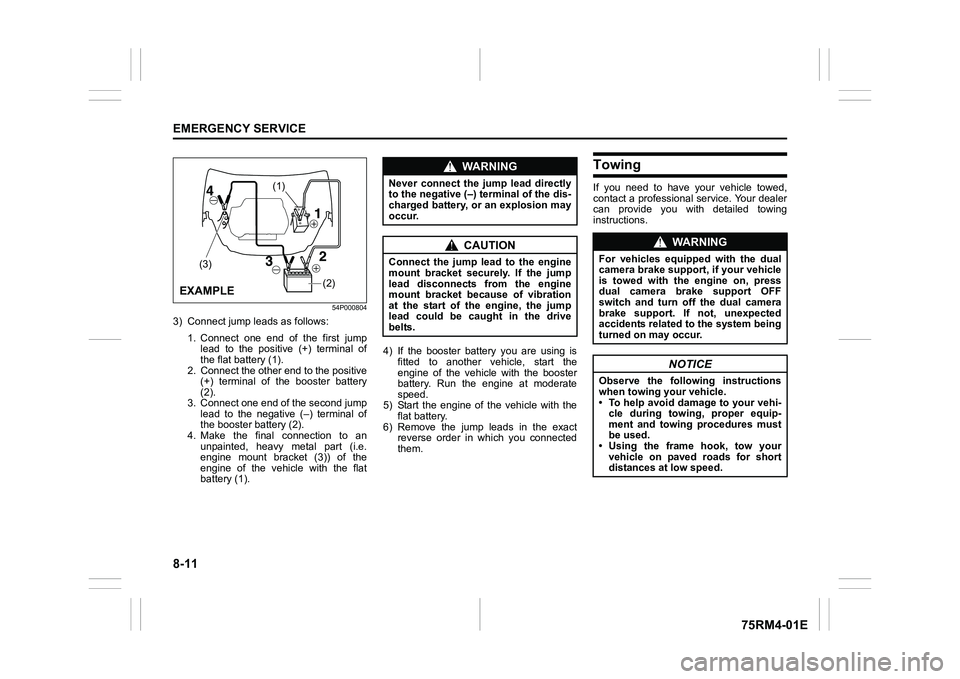
3) Connect jump leads as follows:1. Connect one end of the first jumplead to the positive (+) terminal of
the flat battery (1).
2. Connect the other end to the positive (+) terminal of the booster battery
(2).
3. Connect one end of the second jump lead to the negative (–) terminal of
the booster battery (2).
4. Make the final connection to an unpainted, heavy metal part (i.e.
engine mount bracket (3)) of the
engine of the vehicle with the flat
battery (1). 4) If the booster battery you are using is
fitted to another vehicle, start the
engine of the vehicle with the booster
battery. Run the engine at moderate
speed.
5) Start the engine of the vehicle with the flat battery.
6) Remove the jump leads in the exact reverse order in which you connected
them.
TowingIf you need to have your vehicle towed,
contact a professional service. Your dealer
can provide you with detailed towing
instructions.
(2)
(1)
(3)
EXAMPLE
WA R N I N G
Never connect the jump lead directly
to the negative (–) terminal of the dis-
charged battery, or an explosion may
occur.
CAUTION
Connect the jump l ead to the engine
mount bracket securely. If the jump
lead disconnects from the engine
mount bracket because of vibration
at the start of the engine, the jump
lead could be caught in the drive
belts.
WA R N I N G
For vehicles equipped with the dual
camera brake support, if your vehicle
is towed with the engine on, press
dual camera brake support OFF
switch and turn off the dual camera
brake support. If not, unexpected
accidents related to the system being
turned on may occur.
NOTICE
Observe the following instructions
when towing your vehicle.
• To help avoid damage to your vehi- cle during towing, proper equip-
ment and towing procedures must
be used.
• Using the frame hook, tow your
vehicle on paved roads for short
distances at low speed.