child restraint SUZUKI IGNIS 2021 Owner's Manual
[x] Cancel search | Manufacturer: SUZUKI, Model Year: 2021, Model line: IGNIS, Model: SUZUKI IGNIS 2021Pages: 505, PDF Size: 8.36 MB
Page 80 of 505
2-57BEFORE DRIVING
75RM4-01E
Refer to “Seat belts and child restraint sys-
tems” section for details on securing your
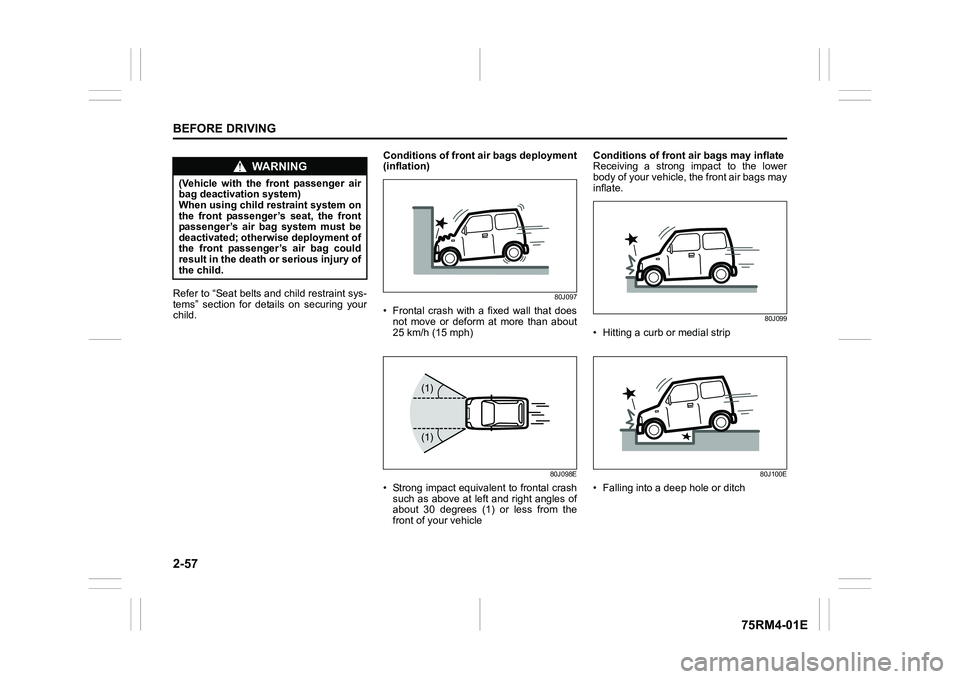
child. Conditions of front
air bags deployment
(inflation)
80J097
• Frontal crash with a fixed wall that does not move or deform at more than about
25 km/h (15 mph)
80J098E
• Strong impact equivalent to frontal crashsuch as above at left and right angles of
about 30 degrees (1) or less from the
front of your vehicle Conditions of front air bags may inflate
Receiving a strong impact to the lower
body of your vehicle, the front air bags may
inflate.
80J099
• Hitting a curb or medial strip
80J100E
• Falling into a deep hole or ditch
WA R N I N G
(Vehicle with the front passenger air
bag deactivation system)
When using child restraint system on
the front passenger’s seat, the front
passenger’s air bag system must be
deactivated; otherwise deployment of
the front passenger’s air bag could
result in the death or serious injury of
the child.
(1)
(1)
Page 86 of 505
2-63BEFORE DRIVING
75RM4-01E
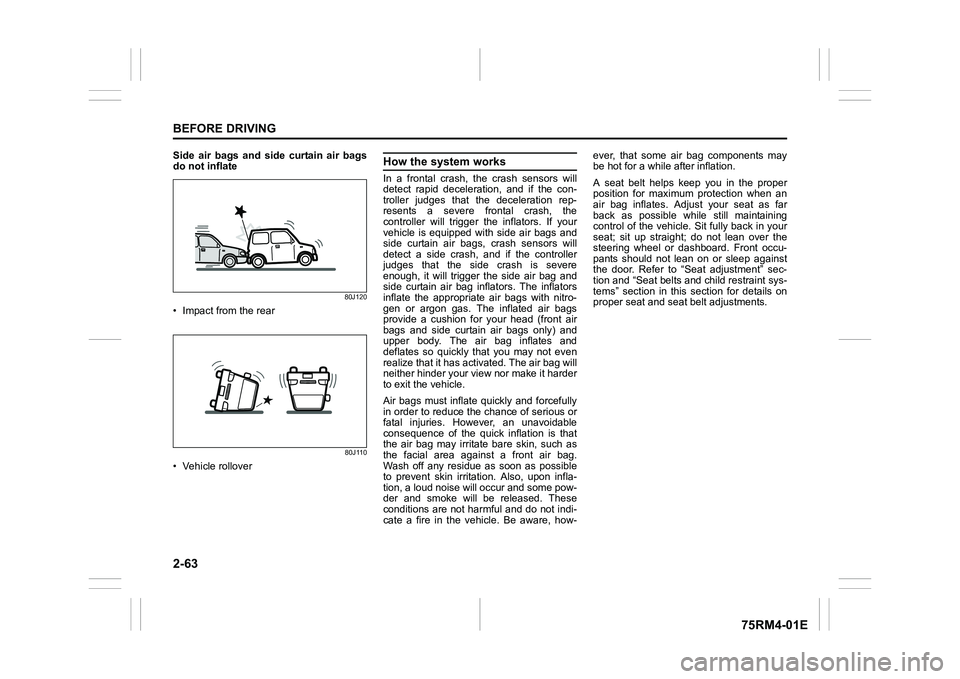
Side air bags and side curtain air bags
do not inflate
80J120
• Impact from the rear
80J110
• Vehicle rollover
How the system worksIn a frontal crash, the crash sensors will
detect rapid deceleration, and if the con-
troller judges that the deceleration rep-
resents a severe frontal crash, the
controller will trigger the inflators. If your
vehicle is equipped with side air bags and
side curtain air bags, crash sensors will
detect a side crash, and if the controller
judges that the side crash is severe
enough, it will trigger the side air bag and
side curtain air bag inflators. The inflators
inflate the appropriate air bags with nitro-
gen or argon gas. The inflated air bags
provide a cushion for your head (front air
bags and side curtain air bags only) and
upper body. The air bag inflates and
deflates so quickly that you may not even
realize that it has activated. The air bag will
neither hinder your view nor make it harder
to exit the vehicle.
Air bags must inflate quickly and forcefully
in order to reduce the chance of serious or
fatal injuries. However, an unavoidable
consequence of the quick inflation is that
the air bag may irritate bare skin, such as
the facial area against a front air bag.
Wash off any residue as soon as possible
to prevent skin irritation. Also, upon infla-
tion, a loud noise will occur and some pow-
der and smoke will be released. These
conditions are not harmful and do not indi-
cate a fire in the vehicle. Be aware, how-ever, that some air bag components may
be hot for a while after inflation.
A seat belt helps keep you in the proper
position for maximum protection when an
air bag inflates. Adjust your seat as far
back as possible while still maintaining
control of the vehicle. Sit fully back in your
seat; sit up straight; do not lean over the
steering wheel or dashboard. Front occu-
pants should not lean on or sleep against
the door. Refer to “Seat adjustment” sec-
tion and “Seat belts and child restraint sys-
tems” section in this
section for details on
proper seat and seat belt adjustments.
Page 88 of 505
2-65BEFORE DRIVING
75RM4-01E
Your vehicle is equipped with a diagnostic
module which records information about
the air bag system if the air bags deploy in
a crash. The module records information
about overall system status, and which
sensors activated the deployment.
Servicing the air bag system
If the air bags inflate, have the air bags
and related components replaced by an
authorized SUZUKI dealer as soon as pos-
sible.
If your vehicle ever gets in deep water and
the driver’s floor is submerged, the air bag
controller could be damaged. If this hap-
pens, ask your SUZUKI dealer to check
the air bag system as soon as possible.
Special procedures are required for servic-
ing or replacing an air bag. For that rea-
son, only an authorized SUZUKI dealer
should be allowed to service or replace
your air bags. Remind anyone who ser-
vices your SUZUKI vehicle that it has air
bags.
Service on or around air bag components
or wiring must be performed only by an
authorized SUZUKI dealer. Improper ser-
vice could result in unintended air bag
deployment or could render the air bag
inoperative. Either of these two conditions
may result in severe injury. To prevent damage or unintended inflation
of the air bag system, check that the lead-
acid battery is disconnected and the igni-
tion switch has been in “LOCK” position or
the ignition mode has been LOCK (OFF)
for at least 90 seconds before performing
any electrical service work on your
SUZUKI vehicle. Do not touch air bag sys-
tem components or wires. The wires are
wrapped with yellow tape or yellow tubing,
and the couplers are yellow for easy identi-
fication.
Scrapping a vehicle that has an uninflated
air bag can be hazardous. Ask your dealer,
body repair shop or scrap yard for help
with disposal.
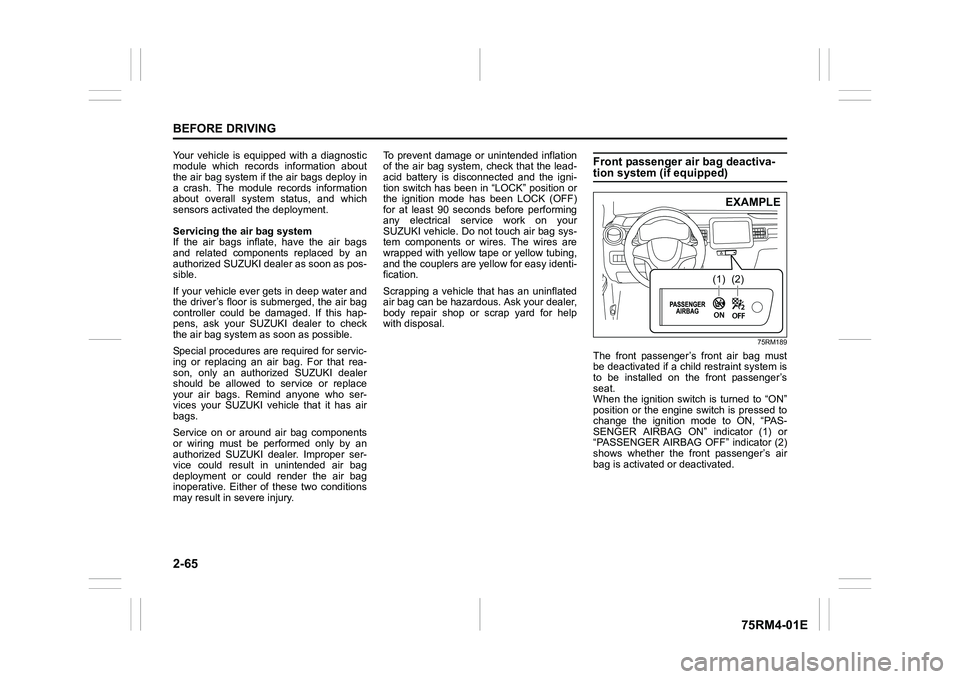
Front passenger air bag deactiva-tion system (if equipped)
75RM189
The front passenger’s front air bag must
be deactivated if a child restraint system is
to be installed on the front passenger’s
seat.
When the ignition switch is turned to “ON”
position or the engine switch is pressed to
change the ignition mode to ON, “PAS-
SENGER AIRBAG ON” indicator (1) or
“PASSENGER AIRBAG OFF” indicator (2)
shows whether the front passenger’s air
bag is activated or deactivated.
(1)
(2)EXAMPLE
Page 89 of 505
2-66
BEFORE DRIVING
75RM4-01E
When the front passenger’s air bag is acti-
vated, both “PASSENGER AIRBAG ON”
indicator (1) and “PASSENGER AIRBAG
OFF” indicator (2) come on for a few sec-
onds and then go out.
After that, only “PASSENGER AIRBAG
ON” indicator (1) comes on for about 1
minute and then goes out.
When the front passenger’s air bag is
deactivated, both “PASSENGER AIRBAG
ON” indicator (1) and “PASSENGER AIR-
BAG OFF” indicator (2 ) come on for a few
seconds and t hen go out.
After that, only “PASSENGER AIRBAG
OFF” indicator (2) comes on.
When you activate or deactivate the front
passenger’s air bag, check which indicator
is on before starting the engine.
Side air bags, side curtain air bags and
seat belt pretensioners are not connected
to the air bag deactivation system. Even if
the front passenger’s air bag is deacti-
vated, side air bags, side curtain air bags
and seat belt pretensioners are still acti-
vated.
58MS030
According to accident s tatistics, children
are safer when properly restrained in rear
seating positions than front seating posi-
tions. Whenever possible, SUZUKI recom-
mends that child restraint systems be
installed on the rear seat.
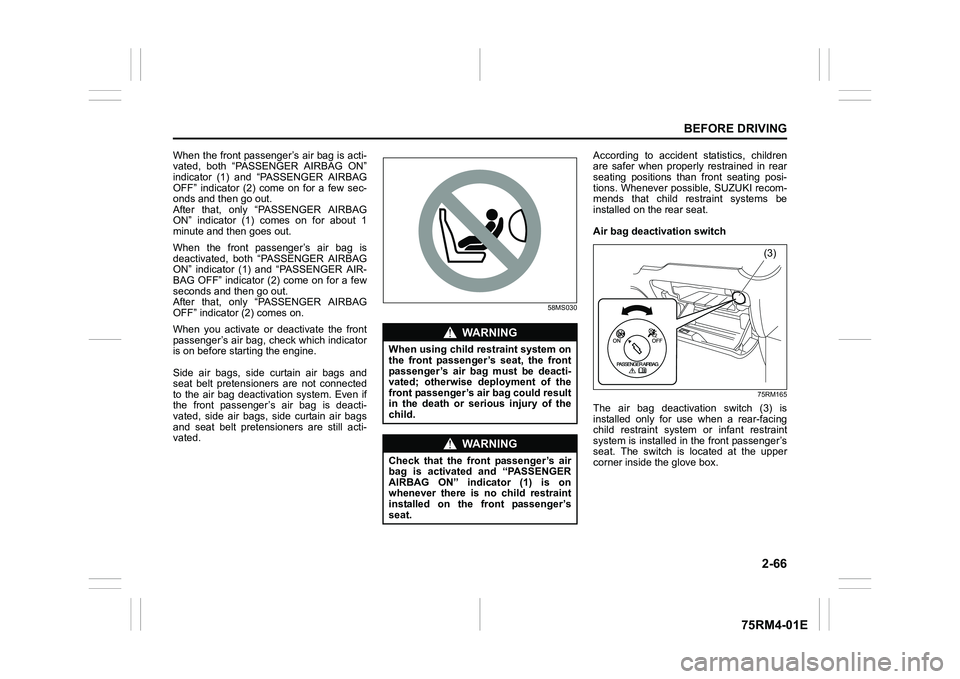
Air bag deactivation switch
75RM165
The air bag deactivation switch (3) is
installed only for use when a rear-facing
child restraint system or infant restraint
system is installed in the front passenger’s
seat. The switch is located at the upper
corner inside the glove box.
WA R N I N G
When using child restraint system on
the front passenger’s seat, the front
passenger’s air bag must be deacti-
vated; otherwise deployment of the
front passenger’s air bag could result
in the death or serious injury of the
child.
WA R N I N G
Check that the front passenger’s air
bag is activated and “PASSENGER
AIRBAG ON” indicator (1) is on
whenever there is no child restraint
installed on the front passenger’s
seat.
(3)
Page 129 of 505
2-106
BEFORE DRIVING
75RM4-01E
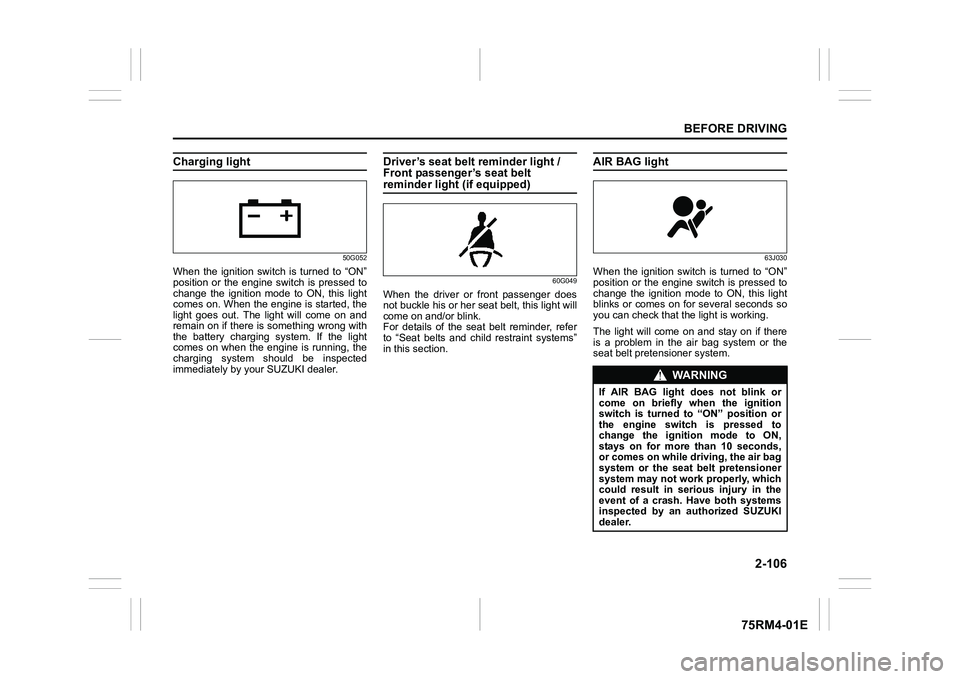
Charging light
50G052
When the ignition switch is turned to “ON”
position or the engine switch is pressed to
change the ignition mode to ON, this light
comes on. When the engine is started, the
light goes out. The light will come on and
remain on if there is something wrong with
the battery charging system. If the light
comes on when the engine is running, the
charging system should be inspected
immediately by your SUZUKI dealer.
Driver’s seat belt reminder light /
Front passenger’s seat belt reminder light (if equipped)
60G049
When the driver or front passenger does
not buckle his or her seat belt, this light will
come on and/or blink.
For details of the seat belt reminder, refer
to “Seat belts and child restraint systems”
in this section.
AIR BAG light
63J030
When the ignition switch is turned to “ON”
position or the engine switch is pressed to
change the ignition mode to ON, this light
blinks or comes on for several seconds so
you can check that t he light is working.
The light will come on and stay on if there
is a problem in the air bag system or the
seat belt pretensioner system.
WA R N I N G
If AIR BAG light does not blink or
come on briefly when the ignition
switch is turned to “ON” position or
the engine switch is pressed to
change the ignition mode to ON,
stays on for more than 10 seconds,
or comes on while driving, the air bag
system or the seat belt pretensioner
system may not work properly, which
could result in serious injury in the
event of a crash. Have both systems
inspected by an authorized SUZUKI
dealer.
Page 248 of 505
4-1DRIVING TIPS
75RM4-01E
52D078S
Running-in
Catalytic converter
80G106
The purpose of the catalytic converter is to
minimize the amount of harmful pollutants
in your vehicle’s exhaust. Use of leaded
fuel in vehicles equipped with catalytic
converters is prohibited, because lead
deactivates the pollutant-reducing compo-
nents of the catalyst system.
The converter is designed to last the life of
the vehicle under normal usage and when
unleaded fuel is used. No special mainte-
nance is required on the converter. How-
ever, it is very important to keep the engine
properly tuned. Engine misfiring, which can
result from an improperly tuned engine,
may cause overheating of the catalytic
converter. This may result in permanent
WA R N I N G
• Fasten your seat belts at all times.Even though air bags are equipped
at the front seating positions, the
driver and all passengers should
be properly restrained at all times,
using the seat belts provided. Refer
to “Seat belts and child restraint
systems” section for instructions
on proper use of the seat belts.
• Never drive under the influence of
alcohol or other drugs. Alcohol and
drugs can seriously impair your
ability to drive safely, greatly
increasing the risk of injury to
yourself and others. You should
also avoid driving when you are
tired, sick, irritated or under stress.
NOTICE
The future performance and reliabil-
ity of the engine depends on the care
and restraint exercised during its
early life. It is especially important to
observe the following precautions
during the first 960 km (600 miles) of
vehicle operation.
•After starting, do not race theengine. Warm it up gradually.
• Avoid prolonged vehicle operation at a constant speed. Moving parts
will break in better if you vary your
speed.
• Start off from a stop slowly. Avoid full throttle starts.
• Avoid hard braking, especially during the first 320 km (200 miles)
of driving.
• Do not drive slowly with the trans- axle in a high gear.
• Drive the vehicle at moderate
engine speeds.
• Do not tow a trailer during the first 960 km (600 miles) of vehicle oper-
ation.
Page 440 of 505
12-1SUPPLEMENT
75RM4-01E
For AustraliaBuilt dateBuilt date is located on Vehicle Identifica-
tion plate.
“Built date” means – the calendar month
and the year in which the body shell and
power train sub-assemblies are conjoined
and the vehicle is driven or moved from the
production line.Temporary-use spare tire (compact spare tire)Temporary Spare Tires fitted to this vehicle
must have a maximum load rating of not
less than 775 kg, or a load index of “99”
and a speed category symbol of not less
than “M” (130 km/h).
Drive with caution when the Temporary-
Use Spare Unit is fitted. Reinstall standard
unit as soon as possible.
Child restraint
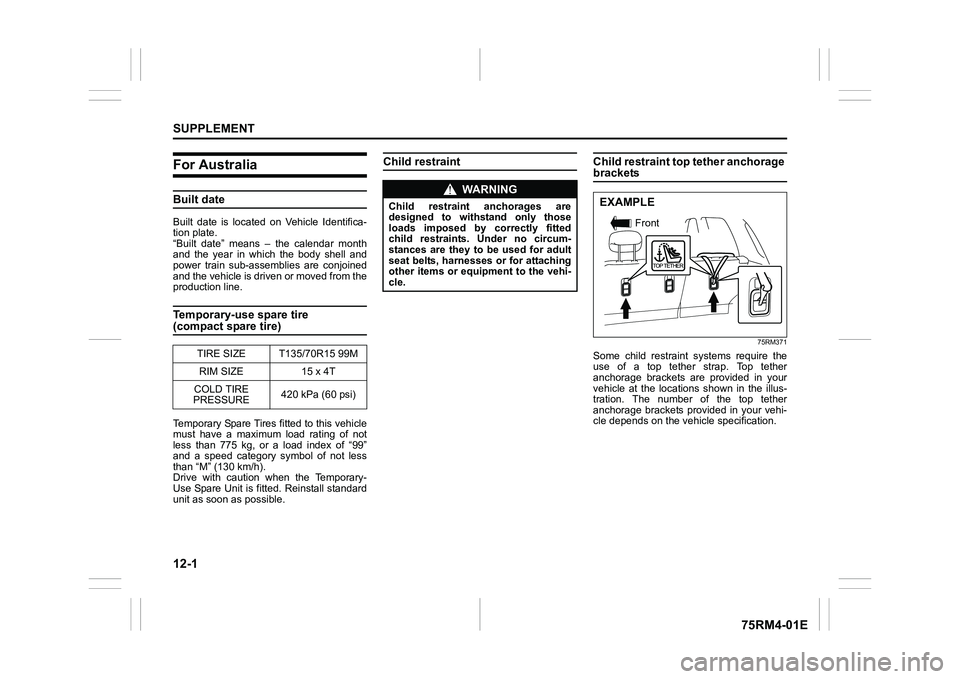
Child restraint top tether anchorage brackets
75RM371
Some child restraint systems require the
use of a top tether strap. Top tether
anchorage brackets are provided in your
vehicle at the locations shown in the illus-
tration. The number of the top tether
anchorage brackets provided in your vehi-
cle depends on the v ehicle specification.
TIRE SIZE T135/70R15 99M
RIM SIZE 15 x 4T
COLD TIRE
PRESSURE 420 kPa (60 psi)
WA R N I N G
Child restraint anchorages are
designed to withstand only those
loads imposed by correctly fitted
child restraints. Under no circum-
stances are they to be used for adult
seat belts, harnesses or for attaching
other items or equipment to the vehi-
cle.
EXAMPLE
Front
Page 441 of 505
12-2
SUPPLEMENT
75RM4-01E
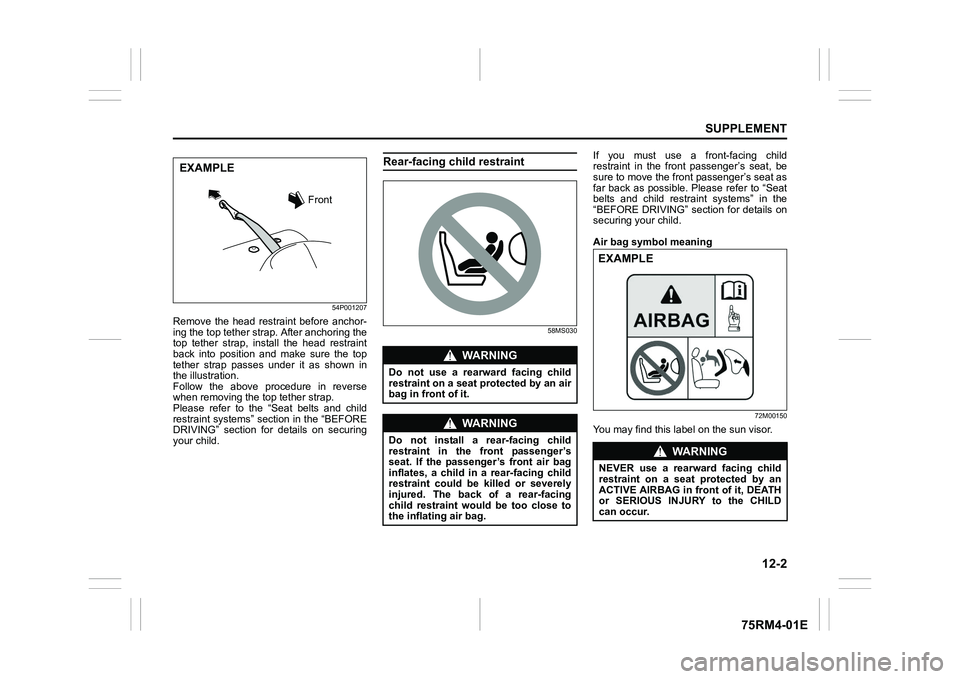
54P001207
Remove the head restraint before anchor-
ing the top tether strap. After anchoring the
top tether strap, install the head restraint
back into position and make sure the top
tether strap passes under it as shown in
the illustration.
Follow the above procedure in reverse
when removing the top tether strap.
Please refer to the “Seat belts and child
restraint systems” section in the “BEFORE
DRIVING” section for details on securing
your child.
Rear-facing child restraint
58MS030
If you must use a front-facing child
restraint in the front passenger’s seat, be
sure to move the front passenger’s seat as
far back as possible. Please refer to “Seat
belts and child restraint systems” in the
“BEFORE DRIVING” section for details on
securing your child.
Air bag symbol meaning
72M00150
You may find this label on the sun visor.
Front
EXAMPLE
WA R N I N G
Do not use a rearward facing child
restraint on a seat protected by an air
bag in front of it.
WA R N I N G
Do not install a rear-facing child
restraint in the front passenger’s
seat. If the passenger’s front air bag
inflates, a child in a rear-facing child
restraint could be killed or severely
injured. The back of a rear-facing
child restraint would be too close to
the inflating air bag.
WA R N I N G
NEVER use a rearward facing child
restraint on a seat protected by an
ACTIVE AIRBAG in front of it, DEATH
or SERIOUS INJURY to the CHILD
can occur.EXAMPLE
Page 446 of 505
12-7SUPPLEMENT
75RM4-01E
Tire rotation4-tire rotation
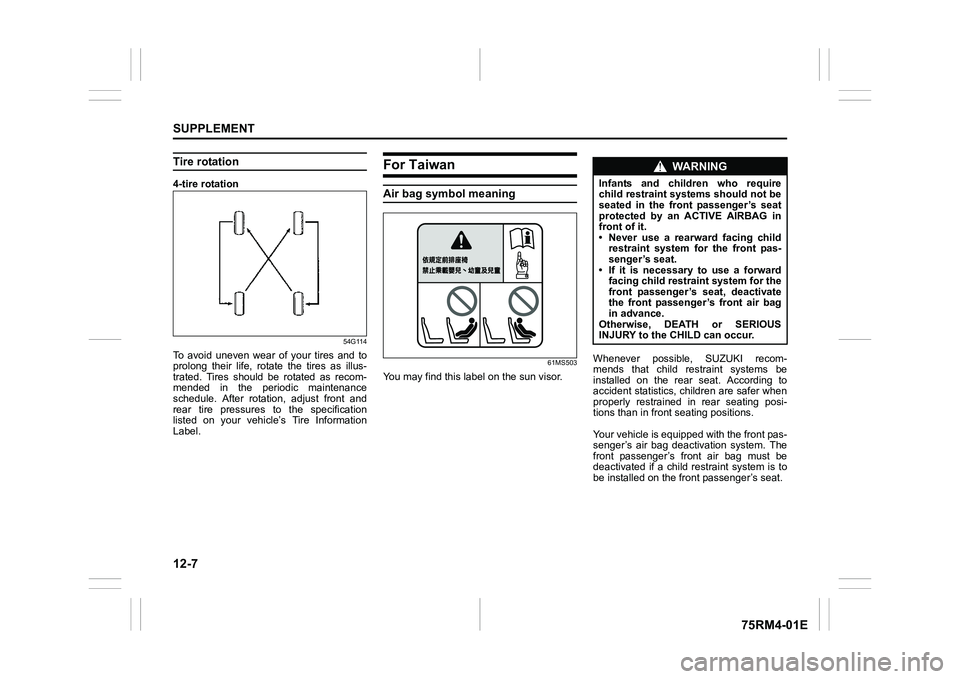
54G114
To avoid uneven wear of your tires and to
prolong their life, rotate the tires as illus-
trated. Tires should be rotated as recom-
mended in the periodic maintenance
schedule. After rotation, adjust front and
rear tire pressures to the specification
listed on your vehicle’s Tire Information
Label.
For TaiwanAir bag symbol meaning
61MS503
You may find this label on the sun visor.Whenever possible, SUZUKI recom-
mends that child restraint systems be
installed on the rear seat. According to
accident statistics, children are safer when
properly restrained in rear seating posi-
tions than in front seating positions.
Your vehicle is equipped with the front pas-
senger’s air bag deactivation system. The
front passenger’s front air bag must be
deactivated if a child restraint system is to
be installed on the fr
ont passenger’s seat.
WA R N I N G
Infants and children who require
child restraint systems should not be
seated in the front passenger’s seat
protected by an ACTIVE AIRBAG in
front of it.
• Never use a rearward facing child
restraint system for the front pas-
senger’s seat.
• If it is necessary to use a forward facing child restraint system for the
front passenger’s seat, deactivate
the front passenger’s front air bag
in advance.
Otherwise, DEATH or SERIOUS
INJURY to the CHILD can occur.
Page 447 of 505
12-8
SUPPLEMENT
75RM4-01E
Refer to the “Seat belts and child restraint
systems”, “Installation with lap-shoulder
seat belts” and “Front passenger air bag
deactivation system” in the “BEFORE
DRIVING” section for details on securing
your child.
For ArgentinaFuel recommendation
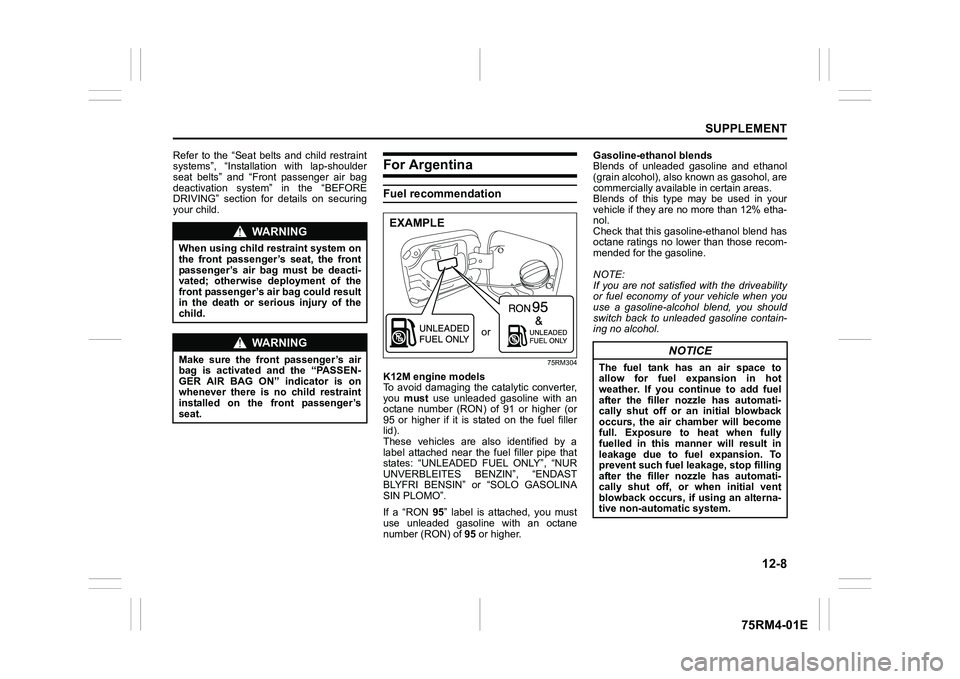
75RM304
K12M engine models
To avoid damaging the catalytic converter,
you must use unleaded gasoline with an
octane number (RON) of 91 or higher (or
95 or higher if it is stated on the fuel filler
lid).
These vehicles are also identified by a
label attached near the fuel filler pipe that
states: “UNLEADED FUEL ONLY”, “NUR
UNVERBLEITES BENZIN”, “ENDAST
BLYFRI BENSIN” or “SOLO GASOLINA
SIN PLOMO”.
If a “RON 95” label is attached, you must
use unleaded gasoline with an octane
number (RON) of 95 or higher. Gasoline-ethanol blends
Blends of unleaded gasoline and ethanol
(grain alcohol), also known as gasohol, are
commercially available in certain areas.
Blends of this type may be used in your
vehicle if they are no more than 12% etha-
nol.
Check that this gasoline-ethanol blend has
octane ratings no lower than those recom-
mended for the gasoline.
NOTE:
If you are not satisfied with the driveability
or fuel economy of your vehicle when you
use a gasoline-alcohol blend, you should
switch back to unleaded gasoline contain-
ing no alcohol.
WA R N I N G
When using child restraint system on
the front passenger’s seat, the front
passenger’s air bag must be deacti-
vated; otherwise deployment of the
front passenger’s air bag could result
in the death or serious injury of the
child.
WA R N I N G
Make sure the front passenger’s air
bag is activated and the “PASSEN-
GER AIR BAG ON” indicator is on
whenever there is no child restraint
installed on the front passenger’s
seat.
or
EXAMPLE
NOTICE
The fuel tank has an air space to
allow for fuel expansion in hot
weather. If you continue to add fuel
after the filler nozzle has automati-
cally shut off or an initial blowback
occurs, the air chamber will become
full. Exposure to heat when fully
fuelled in this manner will result in
leakage due to fuel expansion. To
prevent such fuel leakage, stop filling
after the filler nozzle has automati-
cally shut off, or when initial vent
blowback occurs, if using an alterna-
tive non-autom
atic system.