tire pressure SUZUKI IGNIS 2021 Owner's Manual
[x] Cancel search | Manufacturer: SUZUKI, Model Year: 2021, Model line: IGNIS, Model: SUZUKI IGNIS 2021Pages: 505, PDF Size: 8.36 MB
Page 243 of 505
3-90
OPERATING YOUR VEHICLE
75RM4-01E
TPMS setting• For the instrument cluster with tachome-
ter, you can check the current tire infla-
tion pressure on the information display.
• You can set one of the initial value of tire pressure below that is indicated on the
tire information label.
– Comfort Mode (Unladen Mode)
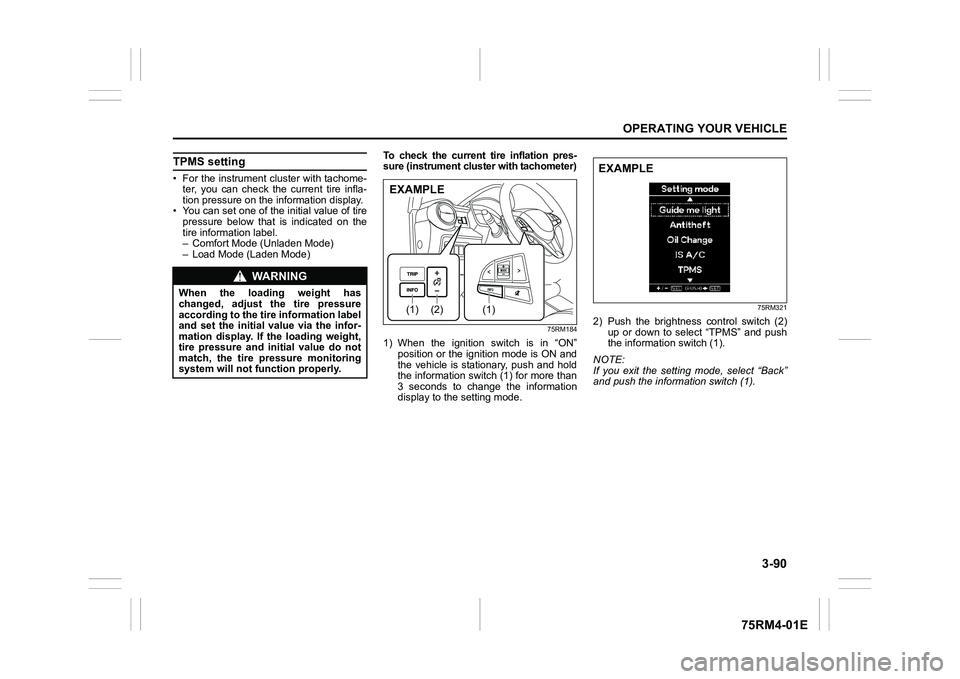
– Load Mode (Laden Mode) To check the current tire inflation pres-
sure (instrument cluster with tachometer)
75RM184
1) When the ignition switch is in “ON”
position or the ignition mode is ON and
the vehicle is stationary, push and hold
the information switch (1) for more than
3 seconds to change the information
display to the setting mode.
75RM321
2) Push the brightness control switch (2)
up or down to select “TPMS” and push
the information switch (1).
NOTE:
If you exit the setting mode, select “Back”
and push the information switch (1).
WA R N I N G
When the loading weight has
changed, adjust the tire pressure
according to the tire information label
and set the initial value via the infor-
mation display. If the loading weight,
tire pressure and initial value do not
match, the tire pressure monitoring
system will not function properly.
(2)
(1)
(1)
EXAMPLE
EXAMPLE
Page 244 of 505
3-91OPERATING YOUR VEHICLE
75RM4-01E
75RM332
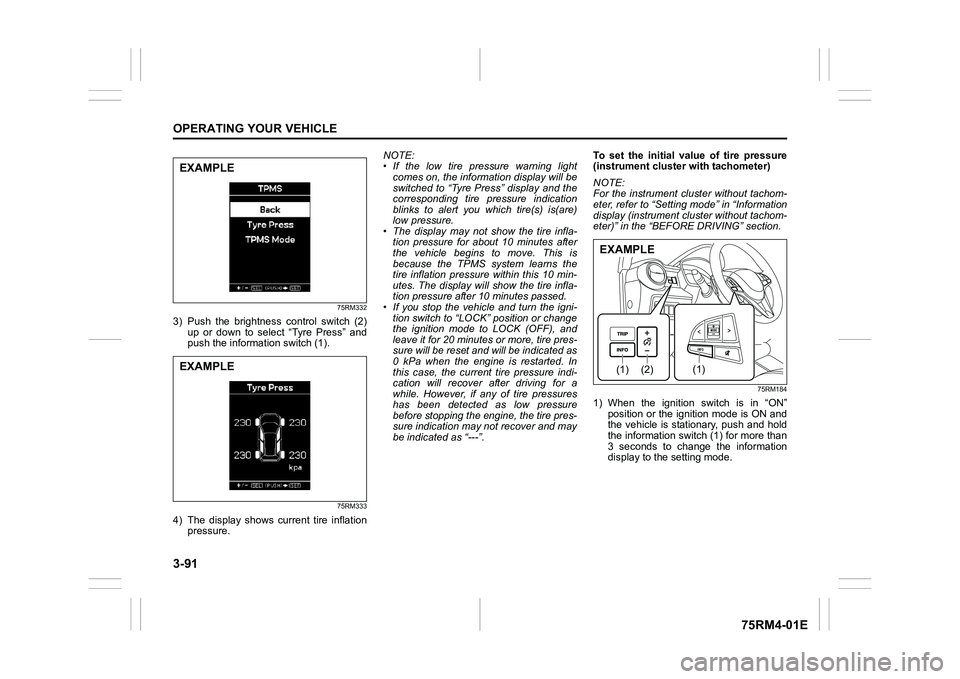
3) Push the brightness control switch (2)
up or down to select “Tyre Press” and
push the information switch (1).
75RM333
4) The display shows current tire inflation pressure. NOTE:
• If the low tire pressure warning light
comes on, the information display will be
switched to “Tyre Press” display and the
corresponding tire pressure indication
blinks to alert you which tire(s) is(are)
low pressure.
• The display may not show the tire infla- tion pressure for about 10 minutes after
the vehicle begins to move. This is
because the TPMS system learns the
tire inflation pressure within this 10 min-
utes. The display will show the tire infla-
tion pressure after 10 minutes passed.
• If you stop the vehicle and turn the igni-
tion switch to “LOCK” position or change
the ignition mode to LOCK (OFF), and
leave it for 20 minutes or more, tire pres-
sure will be reset and will be indicated as
0 kPa when the engine is restarted. In
this case, the current tire pressure indi-
cation will recover after driving for a
while. However, if any of tire pressures
has been detected as low pressure
before stopping the engine, the tire pres-
sure indication may not recover and may
be indicated as “---”. To set the initial value of tire pressure
(instrument
cluster with tachometer)
NOTE:
For the instrument cl uster without tachom-
eter, refer to “Setting mode” in “Information
display (instrument cluster without tachom-
eter)” in the “BEFORE DRIVING” section.
75RM184
1) When the ignition switch is in “ON” position or the ignition mode is ON and
the vehicle is stationary, push and hold
the information switch (1) for more than
3 seconds to change the information
display to the setting mode.
EXAMPLEEXAMPLE
(2)
(1)
(1)
EXAMPLE
Page 250 of 505
4-3DRIVING TIPS
75RM4-01E
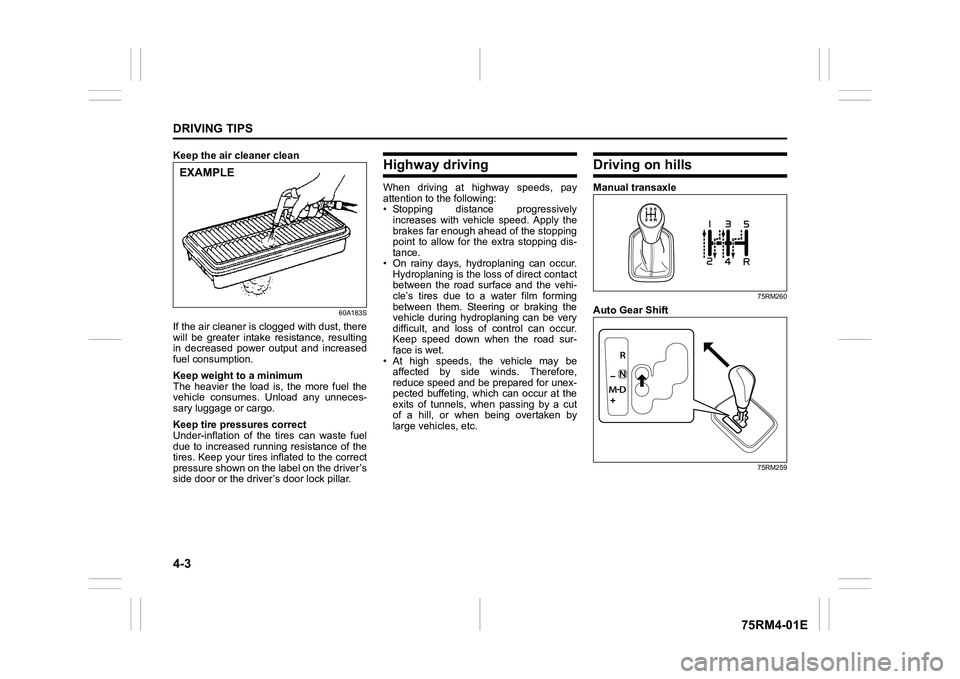
Keep the air cleaner clean
60A183S
If the air cleaner is clogged with dust, there
will be greater intake resistance, resulting
in decreased power output and increased
fuel consumption.
Keep weight to a minimum
The heavier the load is, the more fuel the
vehicle consumes. Unload any unneces-
sary luggage or cargo.
Keep tire pressures correct
Under-inflation of the tires can waste fuel
due to increased running resistance of the
tires. Keep your tires inflated to the correct
pressure shown on the label on the driver’s
side door or the driver’s door lock pillar.
Highway drivingWhen driving at highway speeds, pay
attention to the following:
• Stopping distance progressivelyincreases with vehicle speed. Apply the
brakes far enough ahead of the stopping
point to allow for the extra stopping dis-
tance.
• On rainy days, hydroplaning can occur. Hydroplaning is the loss of direct contact
between the road surface and the vehi-
cle’s tires due to a water film forming
between them. Steering or braking the
vehicle during hydroplaning can be very
difficult, and loss of control can occur.
Keep speed down when the road sur-
face is wet.
• At high speeds, the vehicle may be affected by side winds. Therefore,
reduce speed and be prepared for unex-
pected buffeting, which can occur at the
exits of tunnels, when passing by a cut
of a hill, or when being overtaken by
large vehicles, etc.
Driving on hillsManual transaxle
75RM260
Auto Gear Shift
75RM259
EXAMPLE
Page 253 of 505
4-6
DRIVING TIPS
75RM4-01E
54G638S
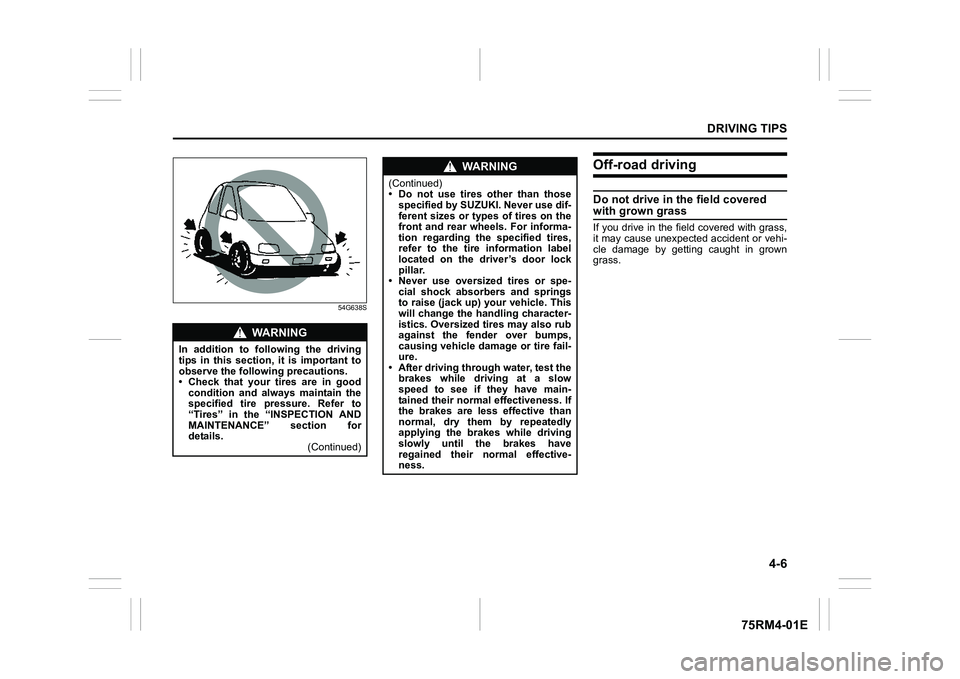
Off-road drivingDo not drive in the field covered with grown grassIf you drive in the field covered with grass,
it may cause unexpected accident or vehi-
cle damage by getting caught in grown
grass.
WA R N I N G
In addition to following the driving
tips in this section, it is important to
observe the following precautions.
• Check that your tires are in good
condition and always maintain the
specified tire pressure. Refer to
“Tires” in the “INSPECTION AND
MAINTENANCE” section for
details. (Continued)
WA R N I N G
(Continued)
• Do not use tires other than those
specified by SUZUKI. Never use dif-
ferent sizes or types of tires on the
front and rear wheels. For informa-
tion regarding the specified tires,
refer to the tire information label
located on the driver’s door lock
pillar.
• Never use oversized tires or spe- cial shock absorbers and springs
to raise (jack up) your vehicle. This
will change the handling character-
istics. Oversized tires may also rub
against the fender over bumps,
causing vehicle damage or tire fail-
ure.
• After driving through water, test the brakes while driving at a slow
speed to see if they have main-
tained their normal effectiveness. If
the brakes are less effective than
normal, dry them by repeatedly
applying the brakes while driving
slowly until the brakes have
regained their normal effective-
ness.
Page 344 of 505
6-3VEHICLE LOADING AND TOWING
75RM4-01E
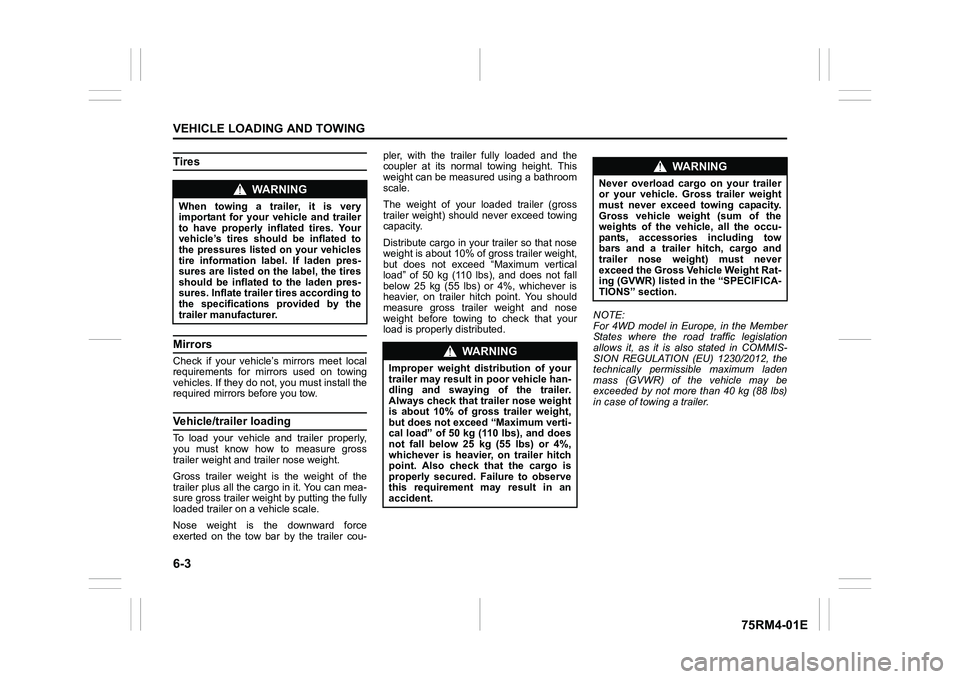
TiresMirrorsCheck if your vehicle’s mirrors meet local
requirements for mirrors used on towing
vehicles. If they do not, you must install the
required mirrors before you tow.Vehicle/trailer loadingTo load your vehicle and trailer properly,
you must know how to measure gross
trailer weight and trailer nose weight.
Gross trailer weight is the weight of the
trailer plus all the cargo in it. You can mea-
sure gross trailer weight by putting the fully
loaded trailer on a vehicle scale.
Nose weight is the downward force
exerted on the tow bar by the trailer cou- pler, with the trailer fully loaded and the
coupler at its normal towing height. This
weight can be measured using a bathroom
scale.
The weight of your loaded trailer (gross
trailer weight) should never exceed towing
capacity.
Distribute cargo in your trailer so that nose
weight is about 10% of gross trailer weight,
but does not exceed “Maximum vertical
load” of 50 kg (110 lbs), and does not fall
below 25 kg (55 lbs) or 4%, whichever is
heavier, on trailer hitch point. You should
measure gross trailer weight and nose
weight before towing to check that your
load is properly distributed.
NOTE:
For 4WD model in Europe, in the Member
States where the road traffic legislation
allows it, as it is also stated in COMMIS-
SION REGULATION (EU) 1230/2012, the
technically permissi
ble maximum laden
mass (GVWR) of the vehicle may be
exceeded by not more than 40 kg (88 lbs)
in case of towing a trailer.
WA R N I N G
When towing a trailer, it is very
important for your vehicle and trailer
to have properly inflated tires. Your
vehicle’s tires should be inflated to
the pressures listed on your vehicles
tire information label. If laden pres-
sures are listed on the label, the tires
should be inflated to the laden pres-
sures. Inflate trailer tires according to
the specifications provided by the
trailer manufacturer.
WA R N I N G
Improper weight distribution of your
trailer may result in poor vehicle han-
dling and swaying of the trailer.
Always check that trailer nose weight
is about 10% of gross trailer weight,
but does not exceed “Maximum verti-
cal load” of 50 kg (110 lbs), and does
not fall below 25 kg (55 lbs) or 4%,
whichever is heavier, on trailer hitch
point. Also check that the cargo is
properly secured. Failure to observe
this requirement may result in an
accident.
WA R N I N G
Never overload cargo on your trailer
or your vehicle. Gross trailer weight
must never exceed towing capacity.
Gross vehicle weight (sum of the
weights of the vehicle, all the occu-
pants, accessories including tow
bars and a trailer hitch, cargo and
trailer nose weight) must never
exceed the Gross Vehicle Weight Rat-
ing (GVWR) listed in the “SPECIFICA-
TIONS” section.
Page 355 of 505
7-6
INSPECTION AND MAINTENANCE
75RM4-01E
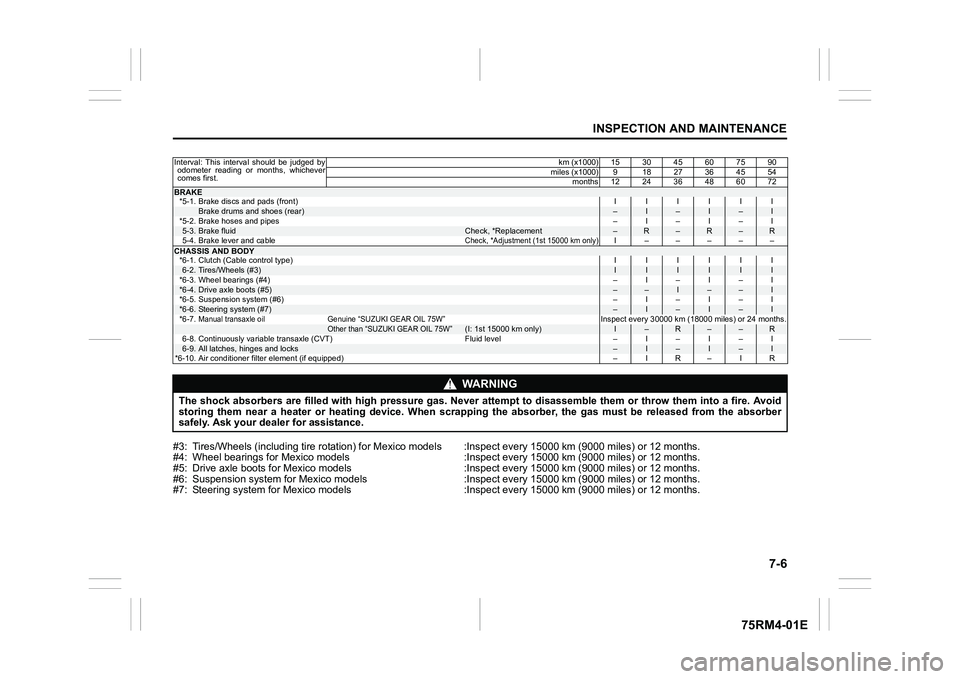
#3: Tires/Wheels (including tire rotation) for Mexico models :Inspect every 15000 km (9000 miles) or 12 months.
#4: Wheel bearings for Mexico models :Inspect every 15000 km (900 0 miles) or 12 months.
#5: Drive axle boots for Mexico models :Inspect every 15000 km (9 000 miles) or 12 months.
#6: Suspension system for Mexico models :Inspect every 15000 km ( 9000 miles) or 12 months.
#7: Steering system for Mexico m odels :Inspect every 15000 km (90 00 miles) or 12 months.Interval: This interval should be judged by
odometer reading or months, whichever
comes first. km (x1000) 15 30 45 60 75 90
miles (x1000) 9 18 27 36 45 54 months 12 24 36 48 60 72BRAKE*5-1. Brake discs and pads (front) IIIIII
Brake drums and shoes (rear)
–
I
–
I
–
I
*5-2. Brake hoses and pipes –I–I–I
5-3.
Brake fluid
Check, *Replacement
–
R
–
R
–
R
5-4. Brake lever and cable
Check, *Adjustment (1st 15000 km only)
I –––––
CHASSIS AND BODY *6-1. Clutch (Cable control type) IIIIII6-2.
Tires/Wheels (#3)
I
I
I
I
I
I
*6-3. Wheel bearings (#4) –I–I–I
*6-4.
Drive axle boots (#5)
–
–
I
–
–
I
*6-5. Suspension system (#6) –I–I–I
*6-6.
Steering system (#7)
–
I
–
I
–
I
*6-7.
Manual transaxle oil Genuine “SUZUKI GEAR OIL 75W”
Inspect every 30000 km (18000 miles) or 24 months.
Other than “SUZUKI GEAR OIL 75W”
(I: 1st 15000 km only)
I
–
R
–
–
R
6-8. Continuously variable transaxle (CVT) Fluid level – I – I – I
6-9.
All latches, hinges and locks
–
I
–
I
–
I
*6-10. Air conditioner filter element (if equipped) –IR–IR
WA R N I N G
The shock absorbers are filled with high pressure gas. Never attempt to disassemble them or throw them into a fire. Avoid
storing them near a heater or heating device. When scrapping th e absorber, the gas must be released from the absorber
safely. Ask your deal er for assistance.
Page 360 of 505
7-11INSPECTION AND MAINTENANCE
75RM4-01E
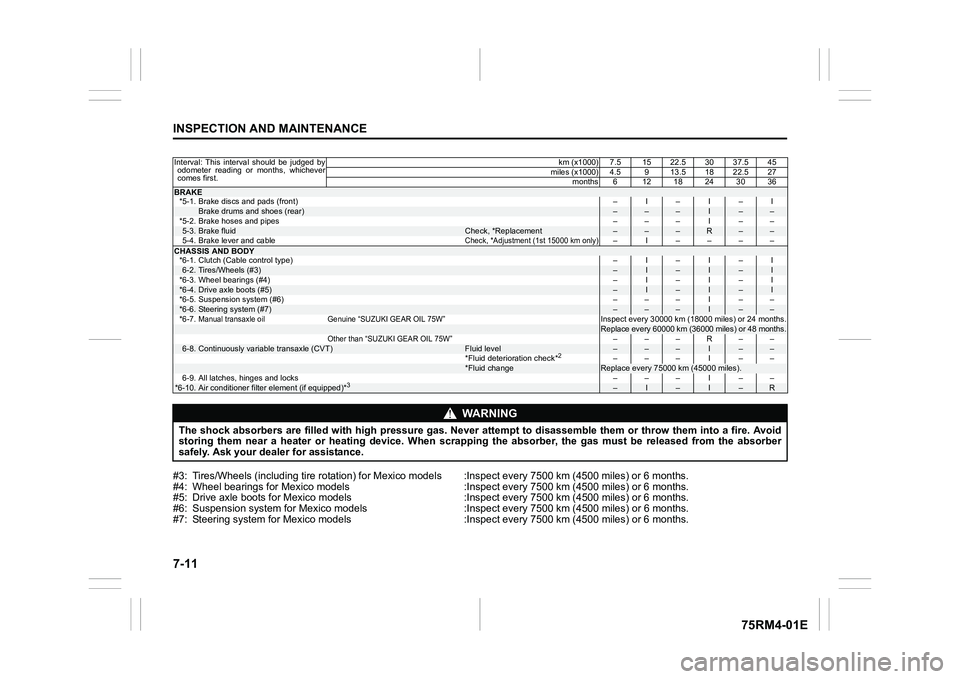
#3: Tires/Wheels (including tire rotation) for Mexico models :Inspect every 7500 km (4500 miles) or 6 months.
#4: Wheel bearings for Mexico models :Inspect every 7500 km (4500 miles) or 6 months.
#5: Drive axle boots for Mexico models :Inspect every 7500 km (45 00 miles) or 6 months.
#6: Suspension system for Mexico models :Inspect every 7500 km (4 500 miles) or 6 months.
#7: Steering system for Mexico m odels :Inspect every 7500 km (450 0 miles) or 6 months.Interval: This interval should be judged by
odometer reading or months, whichever
comes first. km (x1000) 7.5 15 22.5 30 37.5 45
miles (x1000) 4.5 9 13.5 18 22.5 27 months6 1218243036BRAKE*5-1. Brake discs and pads (front) –I–I–I
Brake drums and shoes (rear)
–
–
–
I
–
–
*5-2. Brake hoses and pipes ––– I ––
5-3.
Brake fluid
Check, *Replacement
–
–
–
R
–
–
5-4. Brake lever and cable
Check, *Adjustment (1st 15000 km only)
– I ––––
CHASSIS AND BODY *6-1. Clutch (Cable control type) –I–I–I6-2.
Tires/Wheels (#3)
–
I
–
I
–
I
*6-3. Wheel bearings (#4) –I–I–I
*6-4.
Drive axle boots (#5)
–
I
–
I
–
I
*6-5. Suspension system (#6) ––– I ––
*6-6.
Steering system (#7)
–
–
–
I
–
–
*6-7.
Manual transaxle oil Genuine “SUZUKI GEAR OIL 75W”
Inspect every 30000 km (18000 miles) or 24 months.Replace every 60000 km (36000 miles) or 48 months.
Other than “SUZUKI GEAR OIL 75W”
–––R––
6-8.
Continuously variable transaxle (CVT)
Fluid level
–
–
–
I
–
–
*Fluid deterioration check*
2 –––I––
*Fluid change
Replace every 75000 km (45000 miles).
6-9. All latches, hinges and locks ––– I ––
*6-10.
Air conditioner filter element (if equipped)*
3
–
I
–
I
–
R
WA R N I N G
The shock absorbers are filled with high pressure gas. Never attempt to disassemble them or throw them into a fire. Avoid
storing them near a heater or heating device. When scrapping th e absorber, the gas must be released from the absorber
safely. Ask your deal er for assistance.
Page 365 of 505
7-16
INSPECTION AND MAINTENANCE
75RM4-01E
Interval: This interval should be judged byodometer reading or months, whichever
comes first. km (x1000) 20 40 60 80 100 120
miles (x1000) 12.5 25 37.5 50 62.5 75 months 12 24 36 48 60 72EMISSION CONTROL SYSTEM*4-1. PCV valve ––– I ––*4-2.
Fuel evaporative emission control system
–
–
–
–
–
I
BRAKE
*5-1.
Brake discs and pads (front)
I
I
I
I
I
I
Brake drums and shoes (rear) –I–I–I
*5-2.
Brake hoses and pipes
–
I
–
I
–
I
5-3. Brake fluid Check, *Replacement – R – R – R
5-4.
Brake lever and cable
Check, *Adjustment (1st 20000 km only)
I
–
–
–
–
–
CHASSIS AND BODY
*6-1.
Clutch (Cable control type)
I
I
I
I
I
I
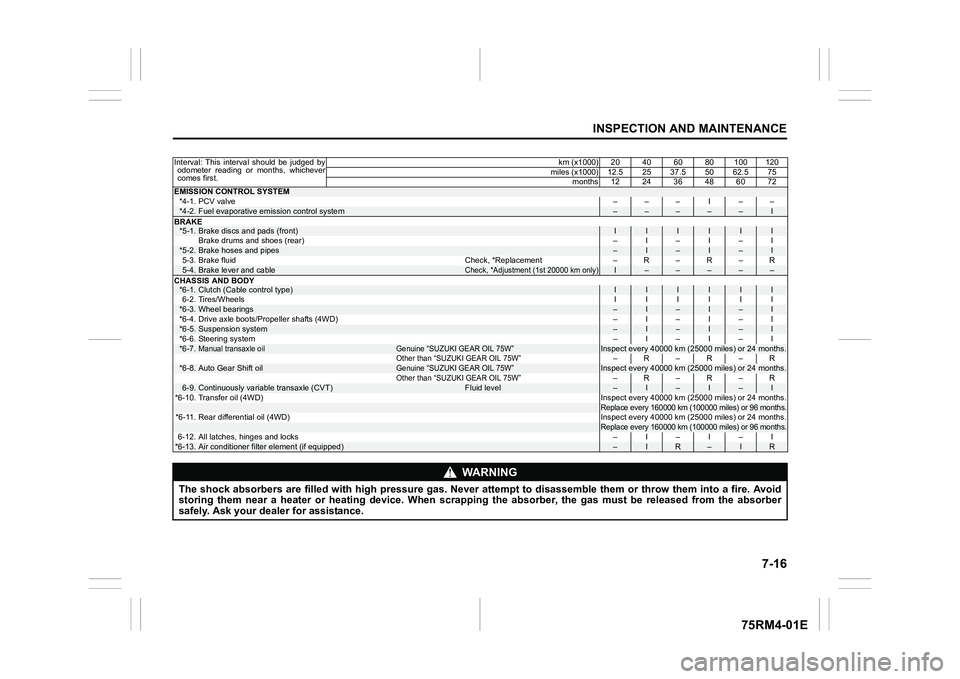
6-2. Tires/Wheels IIIIII
*6-3.
Wheel bearings
–
I
–
I
–
I
*6-4. Drive axle boots/Propeller shafts (4WD) –I–I–I
*6-5.
Suspension system
–
I
–
I
–
I
*6-6. Steering system –I–I–I
*6-7.
Manual transaxle oil
Genuine “SUZUKI GEAR OIL 75W”
Inspect every 40000 km (25000 miles) or 24 months.
Other than “SUZUKI GEAR OIL 75W”
–R–R–R
*6-8.
Auto Gear Shift oil
Genuine “SUZUKI GEAR OIL 75W”
Inspect every 40000 km (25000 miles) or 24 months.
Other than “SUZUKI GEAR OIL 75W”
–R–R–R
6-9.
Continuously variable transaxle (CVT)
Fluid level
–
I
–
I
–
I
*6-10. Transfer oil (4WD) Inspect every 40000 km (25000 miles) or 24 months.
Replace every 160000 km (100000 miles) or 96 months.
*6-11. Rear differential oil (4WD) Inspect every 40000 km (25000 miles) or 24 months.
Replace every 160000 km (100000 miles) or 96 months.
6-12. All latches, hinges and locks –I–I–I*6-13.
Air conditioner filter element (if equipped)
–
I
R
–
I
R
WA R N I N G
The shock absorbers are filled with high pressure gas. Never attempt to disassemble them or throw them into a fire. Avoid
storing them near a heater or heating device. When scrapping th e absorber, the gas must be released from the absorber
safely. Ask your deal er for assistance.
Page 370 of 505
7-21INSPECTION AND MAINTENANCE
75RM4-01E
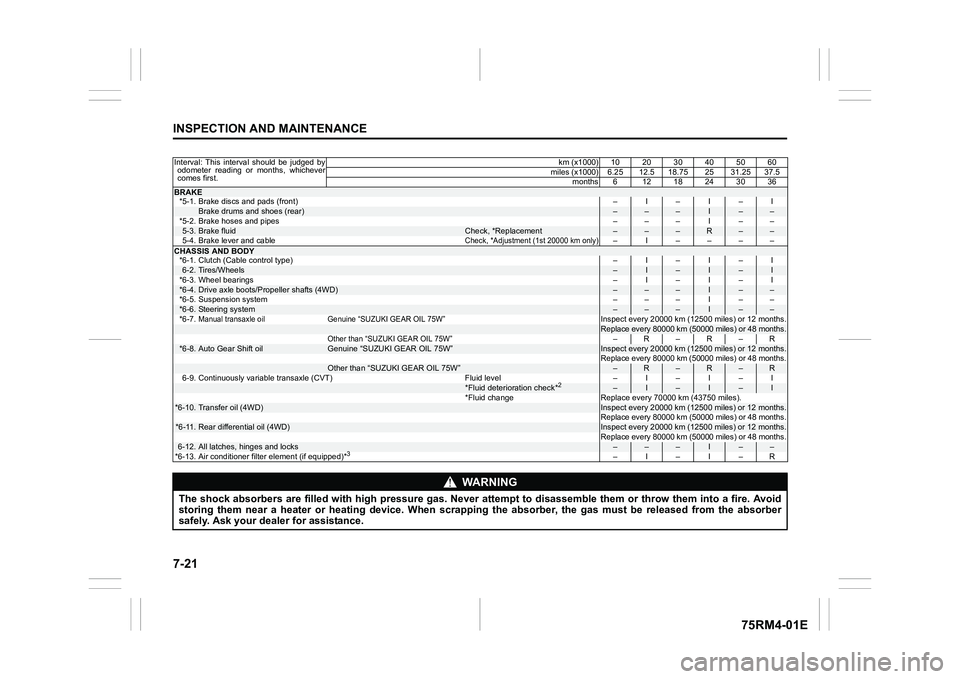
Interval: This interval should be judged byodometer reading or months, whichever
comes first. km (x1000) 10 20 30 40 50 60
miles (x1000) 6.25 12.5 18.75 25 31.25 37.5 months6 1218243036BRAKE*5-1. Brake discs and pads (front) –I–I–I
Brake drums and shoes (rear)
–
–
–
I
–
–
*5-2. Brake hoses and pipes ––– I ––
5-3.
Brake fluid
Check, *Replacement
–
–
–
R
–
–
5-4. Brake lever and cable
Check, *Adjustment (1st 20000 km only)
– I ––––
CHASSIS AND BODY *6-1. Clutch (Cable control type) –I–I–I6-2.
Tires/Wheels
–
I
–
I
–
I
*6-3. Wheel bearings –I–I–I
*6-4.
Drive axle boots/Propeller shafts (4WD)
–
–
–
I
–
–
*6-5. Suspension system ––– I ––
*6-6.
Steering system
–
–
–
I
–
–
*6-7.
Manual transaxle oil Genuine “SUZUKI GEAR OIL 75W”
Inspect every 20000 km (12500 miles) or 12 months.Replace every 80000 km (50000 miles) or 48 months.
Other than “SUZUKI GEAR OIL 75W”
–R–R–R
*6-8.
Auto Gear Shift oil
Genuine “SUZUKI GEAR OIL 75W”
Inspect every 20000 km (12500 miles) or 12 months.Replace every 80000 km (50000 miles) or 48 months.
Other than “SUZUKI GEAR OIL 75W”
–
R
–
R
–
R
6-9. Continuously variable transaxle (CVT) Fluid level – I – I – I
*Fluid deterioration check*
2
–
I
–
I
–
I
*Fluid change Replace every 70000 km (43750 miles).
*6-10.
Transfer oil (4WD)
Inspect every 20000 km (12500 miles) or 12 months.
Replace every 80000 km (50000 miles) or 48 months.
*6-11.
Rear differential oil (4WD)
Inspect every 20000 km (12500 miles) or 12 months.
Replace every 80000 km (50000 miles) or 48 months.
6-12.
All latches, hinges and locks
–
–
–
I
–
–
*6-13. Air conditioner filter element (if equipped)*
3
–I–I–R
WA R N I N G
The shock absorbers are filled with high pressure gas. Never at tempt to disassemble them or throw them into a fire. Avoid
storing them near a heater or heating device. When scrapping th e absorber, the gas must be released from the absorber
safely. Ask your deal er for assistance.
Page 388 of 505
7-39INSPECTION AND MAINTENANCE
75RM4-01E
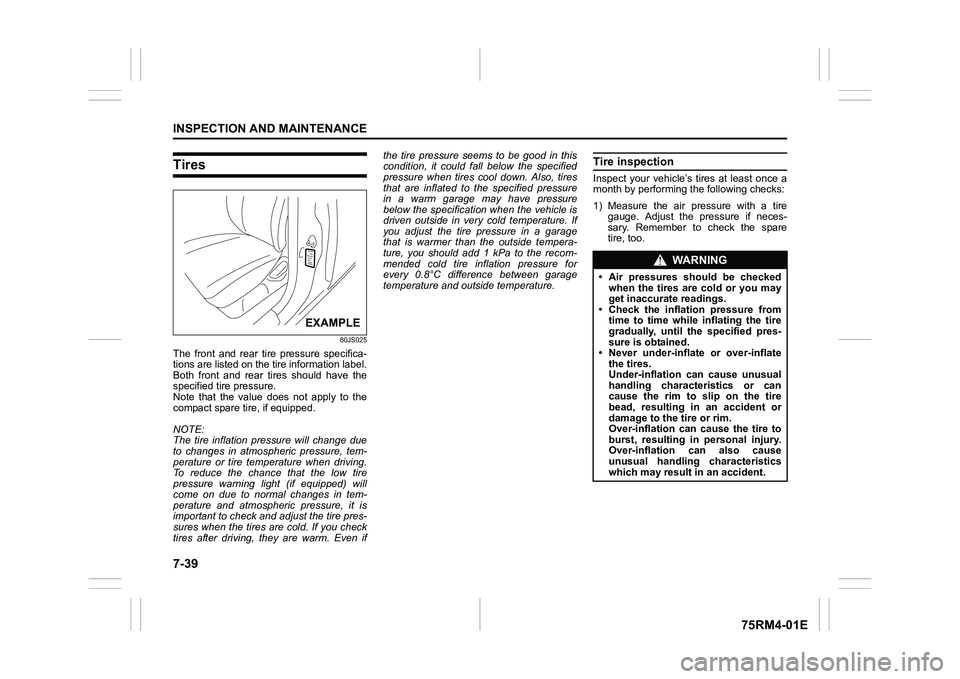
Tires
80JS025
The front and rear tire pressure specifica-
tions are listed on the tire information label.
Both front and rear tires should have the
specified tire pressure.
Note that the value does not apply to the
compact spare tire, if equipped.
NOTE:
The tire inflation pressure will change due
to changes in atmospheric pressure, tem-
perature or tire temperature when driving.
To reduce the chance that the low tire
pressure warning light (if equipped) will
come on due to normal changes in tem-
perature and atmospheric pressure, it is
important to check and adjust the tire pres-
sures when the tires are cold. If you check
tires after driving, they are warm. Even ifthe tire pressure seems to be good in this
condition, it could fall below the specified
pressure when tires co
ol down. Also, tires
that are inflated to the specified pressure
in a warm garage may have pressure
below the specification when the vehicle is
driven outside in very cold temperature. If
you adjust the tire pressure in a garage
that is warmer than the outside tempera-
ture, you should add 1 kPa to the recom-
mended cold tire inflation pressure for
every 0.8°C difference between garage
temperature and outside temperature.
Tire inspectionInspect your vehicle’s tires at least once a
month by performing the following checks:
1) Measure the air pressure with a tire gauge. Adjust the pressure if neces-
sary. Remember to check the spare
tire, too.
EXAMPLE
WA R N I N G
• Air pressures should be checkedwhen the tires are cold or you may
get inaccurate readings.
• Check the inflation pressure from time to time while inflating the tire
gradually, until the specified pres-
sure is obtained.
• Never under-inflate or over-inflate the tires.
Under-inflation can cause unusual
handling characteristics or can
cause the rim to slip on the tire
bead, resulting in an accident or
damage to the tire or rim.
Over-inflation can cause the tire to
burst, resulting in personal injury.
Over-inflation c an also cause
unusual handling characteristics
which may result in an accident.