Gas SUZUKI IGNIS 2022 User Guide
[x] Cancel search | Manufacturer: SUZUKI, Model Year: 2022, Model line: IGNIS, Model: SUZUKI IGNIS 2022Pages: 505, PDF Size: 8.36 MB
Page 375 of 505
7-26
INSPECTION AND MAINTENANCE
75RM4-01E
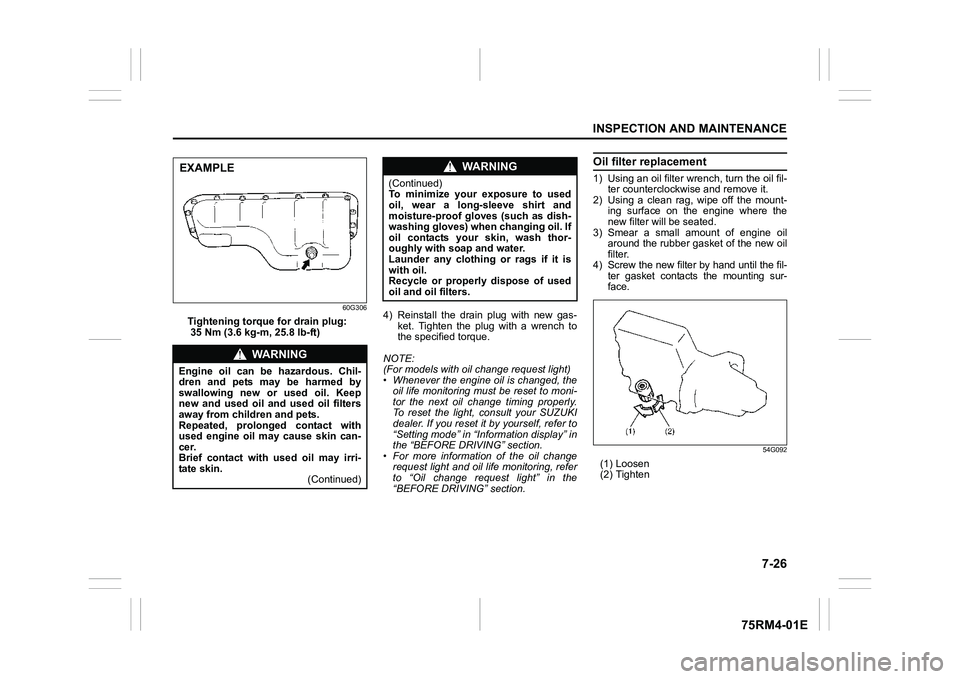
60G306
Tightening torque for drain plug:
35 Nm (3.6 kg-m, 25.8 lb-ft)4) Reinstall the drain plug with new gas-
ket. Tighten the plug with a wrench to
the specif ied torque.
NOTE:
(For models with oil change request light)
• Whenever the engine oil is changed, the oil life monitoring must be reset to moni-
tor the next oil change timing properly.
To reset the light, consult your SUZUKI
dealer. If you reset it by yourself, refer to
“Setting mode” in “Inf ormation display” in
the “BEFORE DRIVING” section.
• For more information of the oil change request light and oil life monitoring, refer
to “Oil change request light” in the
“BEFORE DRIVING” section.
Oil filter replacement1) Using an oil filter wr ench, turn the oil fil-
ter counterclockwise and remove it.
2) Using a clean rag, wipe off the mount- ing surface on the engine where the
new filter will be seated.
3) Smear a small amount of engine oil around the rubber gasket of the new oil
filter.
4) Screw the new filter by hand until the fil- ter gasket contacts the mounting sur-
face.
54G092
(1) Loosen
(2) Tighten
WA R N I N G
Engine oil can be hazardous. Chil-
dren and pets may be harmed by
swallowing new or used oil. Keep
new and used oil and used oil filters
away from children and pets.
Repeated, prolonged contact with
used engine oil may cause skin can-
cer.
Brief contact with used oil may irri-
tate skin. (Continued)EXAMPLE
WA R N I N G
(Continued)
To minimize your exposure to used
oil, wear a long-sleeve shirt and
moisture-proof gloves (such as dish-
washing gloves) when changing oil. If
oil contacts your skin, wash thor-
oughly with soap and water.
Launder any clothing or rags if it is
with oil.
Recycle or properly dispose of used
oil and oil filters.
Page 376 of 505
7-27INSPECTION AND MAINTENANCE
75RM4-01E
Tightening (viewed from filter top)
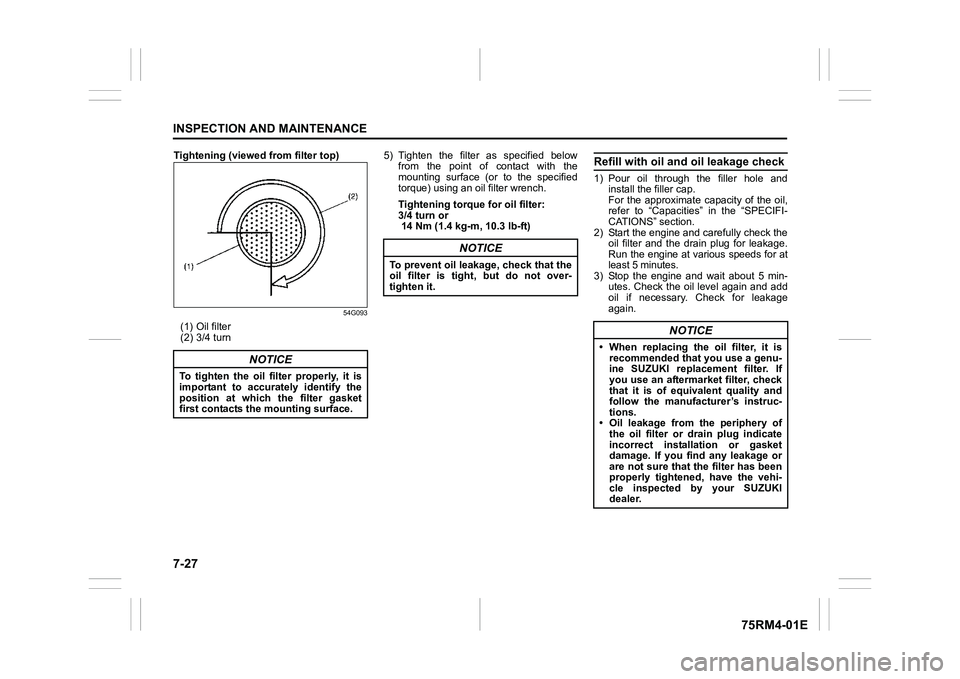
54G093
(1) Oil filter
(2) 3/4 turn5) Tighten the filter as specified below
from the point of contact with the
mounting surface (or to the specified
torque) using an oil filter wrench.
Tightening torque for oil filter:
3/4 turn or
14 Nm (1.4 kg -m, 10.3 lb-ft)
Refill with oil and oil leakage check1) Pour oil through the filler hole and
install the filler cap.
For the approximate capacity of the oil,
refer to “Capacities” in the “SPECIFI-
CATIONS” section.
2) Start the engine and carefully check the oil filter and the drain plug for leakage.
Run the engine at various speeds for at
least 5 minutes.
3) Stop the engine and wait about 5 min- utes. Check the oil level again and add
oil if necessary. Check for leakage
again.
NOTICE
To tighten the oil filter properly, it is
important to accurately identify the
position at which the filter gasket
first contacts the mounting surface.
NOTICE
To prevent oil leakage, check that the
oil filter is tight, but do not over-
tighten it.
NOTICE
• When replacing the oil filter, it is recommended that you use a genu-
ine SUZUKI replacement filter. If
you use an aftermarket filter, check
that it is of equi valent quality and
follow the manufacturer’s instruc-
tions.
• Oil leakage from the periphery of the oil filter or drain plug indicate
incorrect installation or gasket
damage. If you find any leakage or
are not sure that the filter has been
properly tightened, have the vehi-
cle inspected by your SUZUKI
dealer.
Page 398 of 505
7-49INSPECTION AND MAINTENANCE
75RM4-01E
Bulb replacement
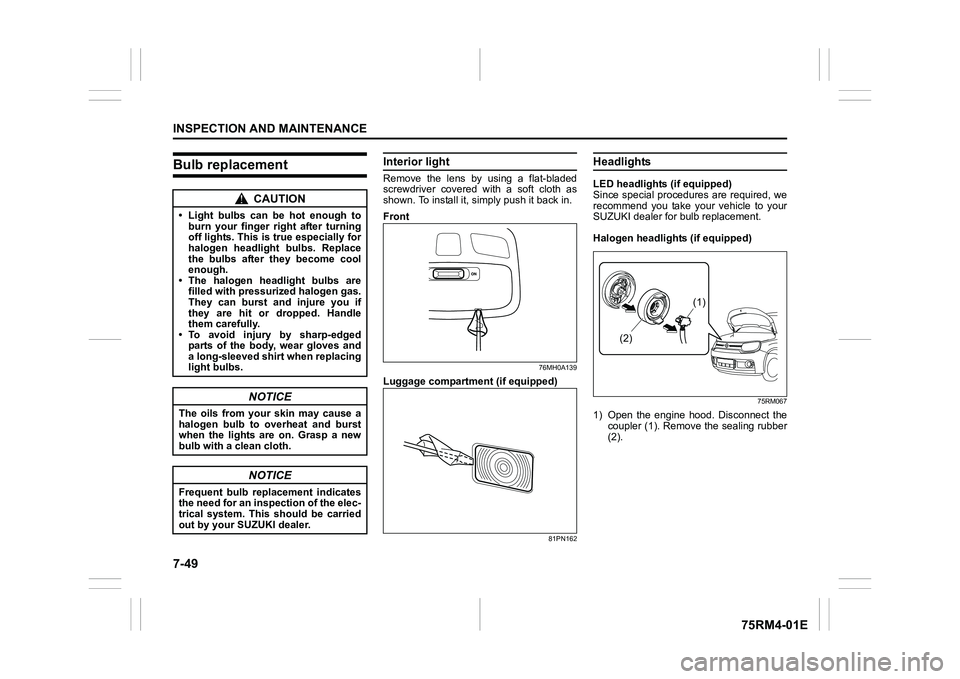
Interior lightRemove the lens by using a flat-bladed
screwdriver covered with a soft cloth as
shown. To install it, simply push it back in.
Front
76MH0A139
Luggage compartmen t (if equipped)
81PN162
HeadlightsLED headlights (if equipped)
Since special procedures are required, we
recommend you take your vehicle to your
SUZUKI dealer for bulb replacement.
Halogen headlights (if equipped)
75RM067
1) Open the engine hood. Disconnect the
coupler (1). Remove the sealing rubber
(2).
CAUTION
• Light bulbs can be hot enough to burn your finger right after turning
off lights. This is true especially for
halogen headlight bulbs. Replace
the bulbs after they become cool
enough.
• The halogen headlight bulbs are filled with pressurized halogen gas.
They can burst and injure you if
they are hit or dropped. Handle
them carefully.
• To avoid injury by sharp-edged
parts of the body, wear gloves and
a long-sleeved shirt when replacing
light bulbs.
NOTICE
The oils from your skin may cause a
halogen bulb to overheat and burst
when the lights are on. Grasp a new
bulb with a clean cloth.
NOTICE
Frequent bulb replacement indicates
the need for an inspection of the elec-
trical system. This should be carried
out by your SUZUKI dealer.
(1)
(2)
Page 419 of 505
8-10
EMERGENCY SERVICE
75RM4-01E
Using compressor to inflate a tire1) Place the vehicle on level, hard ground.
Set the parking brake firmly and shift
into “P” (Park) if your vehicle has a
CVT, or shift into “R” (Reverse) if your
vehicle has a manual transaxle or Auto
Gear Shift.
2) Take out the compressor.
3) Unscrew the valve cap from the tire valve.
4) Connect the air ho se of the compressor
to the tire valve.
5) Connect the power plug of the com- pressor to the accessory socket. For a
manual transaxle or an Auto Gear Shift
vehicle, shift from “R” (Reverse) into “N”
(Neutral). Start the engine. Switch on
the compressor. Inflate the tire to the
required air pressure.
Jump-starting instructions
1) Use only a 12-volt lead-acid battery to
jump-start your vehicle. Position the
good 12-volt lead-acid battery close to
your vehicle so that the jump leads will
reach both batteries. When using a bat-
tery installed on another vehicle, check
that two vehicles do not touch each
other. Set the parking brakes fully on
both vehicles.
2) Turn off all vehicle accessories, except those necessary for safety reasons (for
example, headlights or hazard lights).
NOTICE
Do not operate the compressor for
longer than 10 minutes. It can cause
overheating of the compressor.
WA R N I N G
• Never attempt to jump-start your
vehicle if the lead-acid battery
appears to be frozen. Batteries in
this condition may explode.
• When making jump lead connec- tions, check that your hands and
the jump leads remain clear from
pulleys, belts or fans.
• Lead-acid batteries produce flam-
mable hydrogen gas. Keep flames
and sparks away from the battery
or an explosion may occur. Never
smoke when working near the bat-
tery.
• If the booster ba ttery you use for
jump-starting is installed in another
vehicle, check that the two vehicles
are not touching each other.
• If your lead-acid battery discharges repeatedly, for no apparent reason,
have your vehicle inspected by an
authorized SUZUKI dealer.
• To avoid harm to yourself or dam- age to your vehicle or battery, fol-
low the jump-starting instructions
below.
If you are in doubt, call for qualified
road service.
NOTICE
Your vehicle should not be started by
pushing or towing. This starting
method could result in permanent
damage to the catalytic converter.
Use jump leads to start a vehicle with
a weak or flat battery.
Page 422 of 505
8-13EMERGENCY SERVICE
75RM4-01E
Engine trouble: Starter does not operate1) Try turning the ignition switch to“START” position or try pressing the
engine switch to change the ignition
mode to START with the headlights
turned on to determine the lead-acid
battery condition. If the headlights go
excessively dim or go off, it usually
means that either the lead-acid battery
is flat or the battery terminal contact is
poor. Recharge the lead-acid battery or
correct battery terminal contact as nec-
essary.
2) If the headlights remain bright, check the fuses. If the reas on for failure of the
starter is not obvious, there may be a
major electrical problem. Have the vehi-
cle inspected by your authorized
SUZUKI dealer.
Engine trouble: Flooded engine(Vehicle without keyless push start sys-
tem)
If the engine is flooded with gasoline, it
may be hard to start. If this happens, press
the accelerator pedal all the way to the
floor and hold it there while cranking the
engine.
• Do not operate the starter motor for more than 12 seconds.
(Vehicle with keyless push start system)
If the engine is flooded with gasoline, it
may be hard to start. If this happens, press
the accelerator pedal all the way to the
floor and hold it there while cranking the
engine.
• Do not operate the starter motor for more than 12 seconds.
NOTE:
If the engine refuses to start, the starter
motor automatically stops after a certain
period of time. After the starter motor has
automatically stopped or if there is any-
thing abnormal in the engine starting sys-
tem, the starter motor runs only while the
engine switch is held pressed.
Engine trouble: OverheatingThe engine could overheat temporarily
under severe driving conditions. If the high
engine coolant temperature warning light
comes on as overheating during driving:
1) Turn off the air conditioner, if equipped.
2) Take the vehicle to a safe place and park.
3) Let the engine run at the normal idle speed for a few minutes until the high
engine coolant temperature warning
light goes off.
WA R N I N G
If you see or hear escaping steam,
stop the vehicle in a safe place and
immediately turn off the engine to
cool it. Do not open the hood when
steam is present. When the steam
can no longer be seen or heard, open
the hood to see if the coolant is still
boiling. If it is, you must wait until it
stops boiling before you proceed.
Page 423 of 505
8-14
EMERGENCY SERVICE
75RM4-01E
If the high engine coolant temperature
warning light does not go off:
1) Turn off the engine and check that thewater pump belt and pulleys are not
damaged or slipping. If any abnormality
is found, correct it.
2) Check the coolant level in the reservoir. If it is found to be lower than “LOW”
line, check radiator, water pump, radia-
tor hoses and heater hoses for leakage.
If leakage that may cause overheating
is found, do not run the engine until
these problems have been corrected.
3) If leakage is not found, carefully add
coolant to the reservoir and then the
radiator, if necessary. (Refer to “Engine
coolant” in the “INSPECTION AND
MAINTENANCE” section.)
NOTE:
If engine overheats and you are not sure
what to do, contact your SUZUKI dealer.
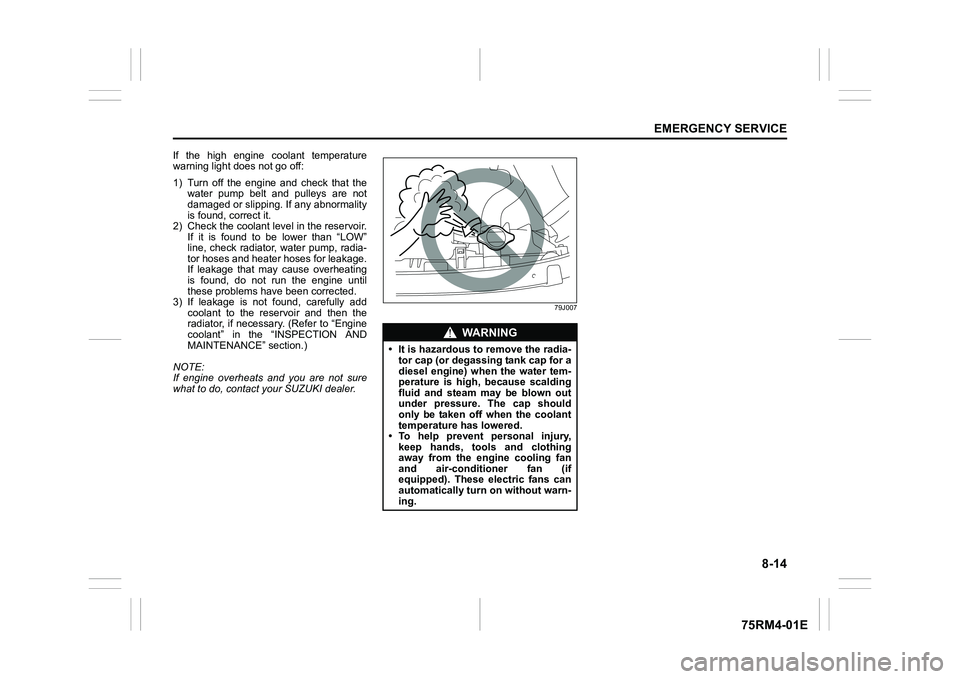
79J007
WA R N I N G
• It is hazardous to remove the radia- tor cap (or degassing tank cap for a
diesel engine) when the water tem-
perature is high, because scalding
fluid and steam may be blown out
under pressure. The cap should
only be taken off when the coolant
temperature has lowered.
• To help prevent personal injury, keep hands, tools and clothing
away from the engine cooling fan
and air-conditioner fan (if
equipped). These electric fans can
automatically turn on without warn-
ing.
Page 427 of 505
9-2
APPEARANCE CARE
75RM4-01E
are spilled or leaked, clean and dry the
area immediately.
Store your vehicle in a dry, well-venti-
lated area
Do not park your vehicle in a damp, poorly-
ventilated area. If you often wash your
vehicle in the garage and place it there in
wet condition, your garage may be damp.
The high humidity in the garage may
cause or accelerate corrosion. A wet vehi-
cle may corrode even in a heated garage if
the ventilation is poor.
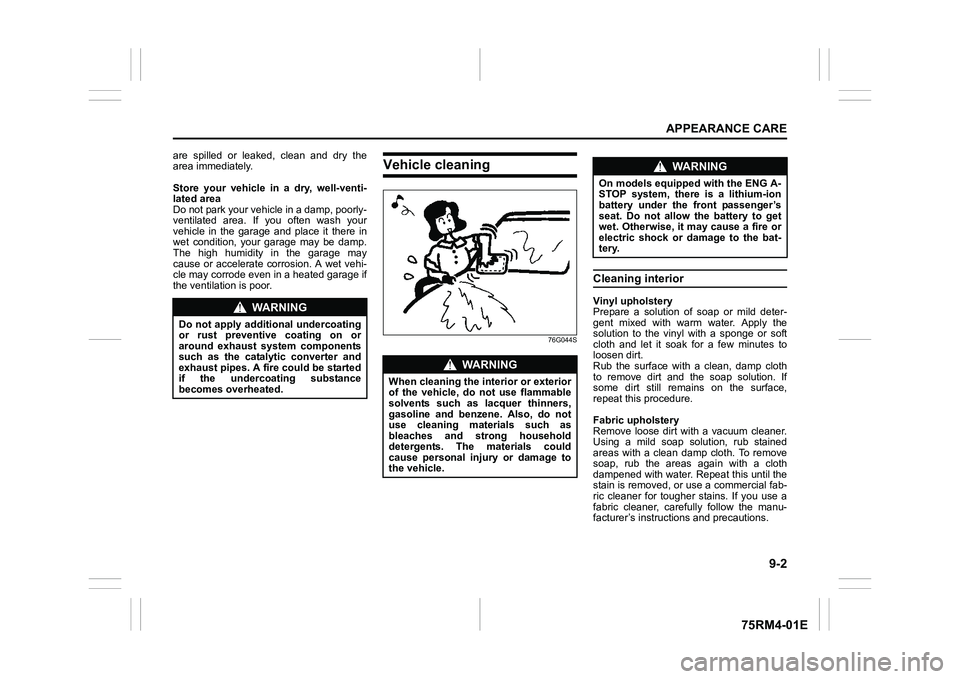
Vehicle cleaning
76G044S
Cleaning interiorVinyl upholstery
Prepare a solution of soap or mild deter-
gent mixed with warm water. Apply the
solution to the vinyl with a sponge or soft
cloth and let it soak for a few minutes to
loosen dirt.
Rub the surface with a clean, damp cloth
to remove dirt and the soap solution. If
some dirt still remains on the surface,
repeat this procedure.
Fabric upholstery
Remove loose dirt with a vacuum cleaner.
Using a mild soap solution, rub stained
areas with a clean damp cloth. To remove
soap, rub the areas again with a cloth
dampened with water. Repeat this until the
stain is removed, or use a commercial fab-
ric cleaner for tougher stains. If you use a
fabric cleaner, carefully follow the manu-
facturer’s instructions and precautions.
WA R N I N G
Do not apply additional undercoating
or rust preventive coating on or
around exhaust system components
such as the catalytic converter and
exhaust pipes. A fire could be started
if the undercoating substance
becomes overheated.
WA R N I N G
When cleaning the interior or exterior
of the vehicle, do not use flammable
solvents such as lacquer thinners,
gasoline and benzene. Also, do not
use cleaning materials such as
bleaches and strong household
detergents. The materials could
cause personal injury or damage to
the vehicle.
WA R N I N G
On models equipped with the ENG A-
STOP system, there is a lithium-ion
battery under the front passenger’s
seat. Do not allow the battery to get
wet. Otherwise, it may cause a fire or
electric shock or damage to the bat-
tery.
Page 444 of 505
12-5SUPPLEMENT
75RM4-01E
For Chile and PanamaFuel recommendation
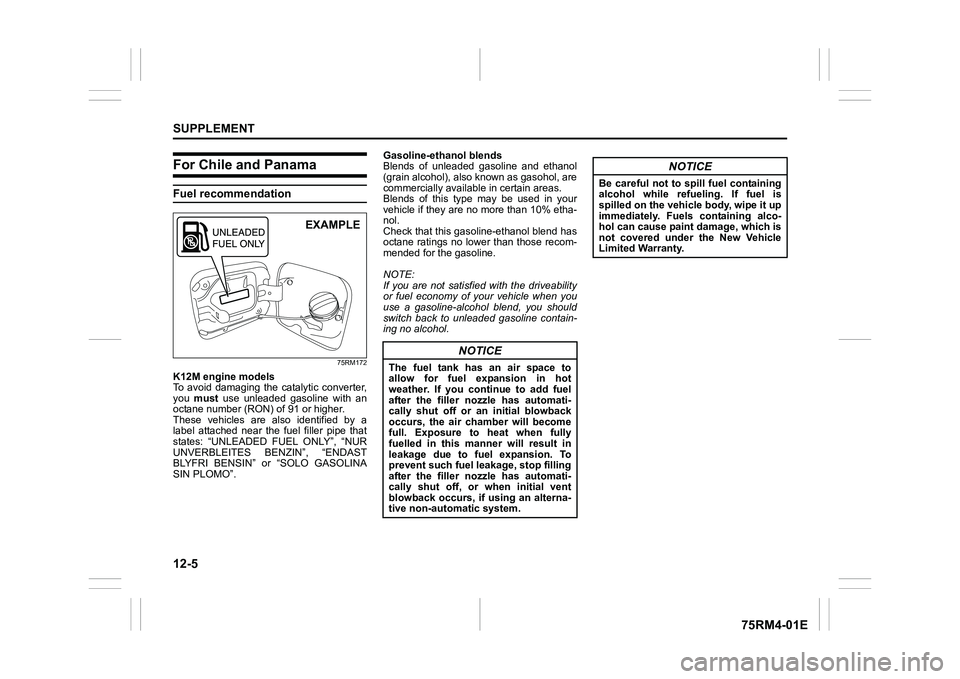
75RM172
K12M engine models
To avoid damaging the catalytic converter,
you must use unleaded gasoline with an
octane number (RON) of 91 or higher.
These vehicles are also identified by a
label attached near the fuel filler pipe that
states: “UNLEADED FUEL ONLY”, “NUR
UNVERBLEITES BENZIN”, “ENDAST
BLYFRI BENSIN” or “SOLO GASOLINA
SIN PLOMO”. Gasoline-ethanol blends
Blends of unleaded gasoline and ethanol
(grain alcohol), also known as gasohol, are
commercially available in certain areas.
Blends of this type may be used in your
vehicle if they are no more than 10% etha-
nol.
Check that this gasoline-ethanol blend has
octane ratings no lower than those recom-
mended for the gasoline.
NOTE:
If you are not satisfied with the driveability
or fuel economy of your vehicle when you
use a gasoline-alcohol blend, you should
switch back to unleaded gasoline contain-
ing no alcohol.
EXAMPLE
NOTICE
The fuel tank has an air space to
allow for fuel expansion in hot
weather. If you continue to add fuel
after the filler nozzle has automati-
cally shut off or an initial blowback
occurs, the air chamber will become
full. Exposure to heat when fully
fuelled in this manner will result in
leakage due to fuel expansion. To
prevent such fuel leakage, stop filling
after the filler nozzle has automati-
cally shut off, or when initial vent
blowback occurs, if using an alterna-
tive non-automatic system.
NOTICE
Be careful not to spill fuel containing
alcohol while refueling. If fuel is
spilled on the vehicle body, wipe it up
immediately. Fuels containing alco-
hol can cause paint damage, which is
not covered under the New Vehicle
Limited Warranty.
Page 445 of 505
12-6
SUPPLEMENT
75RM4-01E
For MexicoFuel recommendation
75RM304
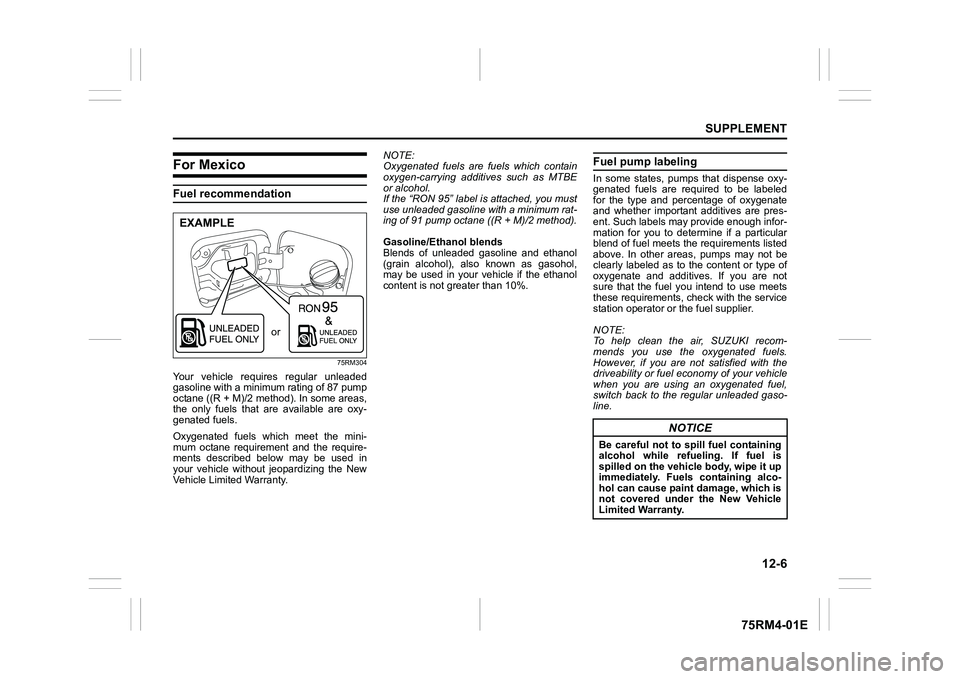
Your vehicle requires regular unleaded
gasoline with a minimum rating of 87 pump
octane ((R + M)/2 method). In some areas,
the only fuels that are available are oxy-
genated fuels.
Oxygenated fuels which meet the mini-
mum octane requirement and the require-
ments described below may be used in
your vehicle without jeopardizing the New
Vehicle Limited Warranty. NOTE:
Oxygenated fuels are fuels which contain
oxygen-carrying additives such as MTBE
or alcohol.
If the “RON 95” label is attached, you must
use unleaded gasoline with a minimum rat-
ing of 91 pump octane ((R + M)/2 method).
Gasoline/Ethanol blends
Blends of unleaded gasoline and ethanol
(grain alcohol), also known as gasohol,
may be used in your vehicle if the ethanol
content is not gr
eater than 10%.
Fuel pump labelingIn some states, pumps that dispense oxy-
genated fuels are required to be labeled
for the type and percentage of oxygenate
and whether important additives are pres-
ent. Such labels may provide enough infor-
mation for you to determine if a particular
blend of fuel meets the requirements listed
above. In other areas, pumps may not be
clearly labeled as to the content or type of
oxygenate and additives. If you are not
sure that the fuel you intend to use meets
these requirements, check with the service
station operator or the fuel supplier.
NOTE:
To help clean the air, SUZUKI recom-
mends you use the oxygenated fuels.
However, if you are not satisfied with the
driveability or fuel economy of your vehicle
when you are using an oxygenated fuel,
switch back to the regular unleaded gaso-
line.
or
EXAMPLE
NOTICE
Be careful not to spill fuel containing
alcohol while refueling. If fuel is
spilled on the vehicle body, wipe it up
immediately. Fuels containing alco-
hol can cause paint damage, which is
not covered under the New Vehicle
Limited Warranty.
Page 447 of 505
12-8
SUPPLEMENT
75RM4-01E
Refer to the “Seat belts and child restraint
systems”, “Installation with lap-shoulder
seat belts” and “Front passenger air bag
deactivation system” in the “BEFORE
DRIVING” section for details on securing
your child.
For ArgentinaFuel recommendation
75RM304
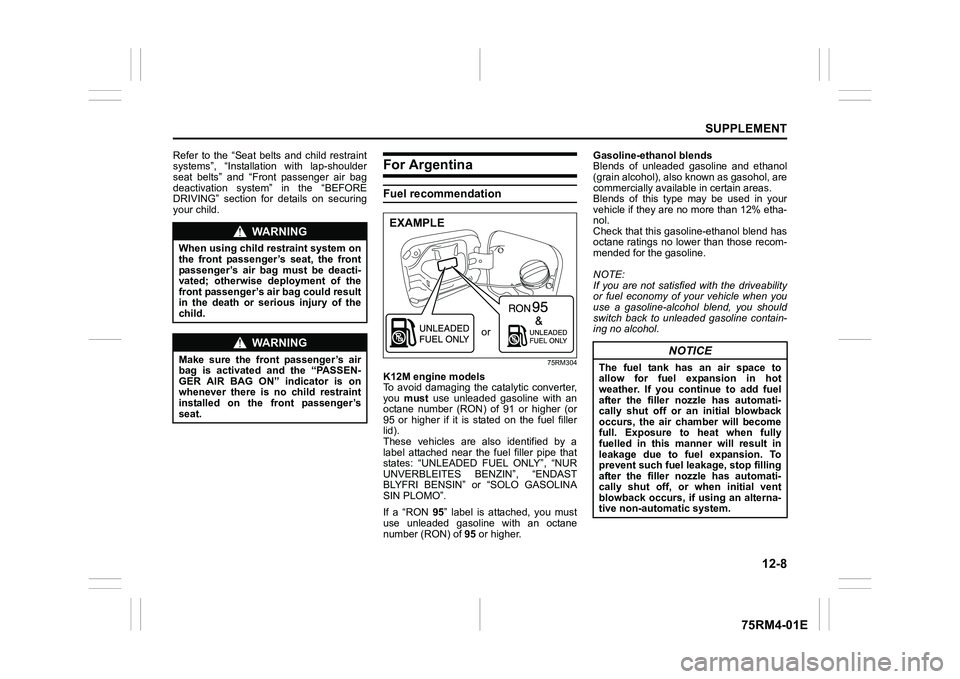
K12M engine models
To avoid damaging the catalytic converter,
you must use unleaded gasoline with an
octane number (RON) of 91 or higher (or
95 or higher if it is stated on the fuel filler
lid).
These vehicles are also identified by a
label attached near the fuel filler pipe that
states: “UNLEADED FUEL ONLY”, “NUR
UNVERBLEITES BENZIN”, “ENDAST
BLYFRI BENSIN” or “SOLO GASOLINA
SIN PLOMO”.
If a “RON 95” label is attached, you must
use unleaded gasoline with an octane
number (RON) of 95 or higher. Gasoline-ethanol blends
Blends of unleaded gasoline and ethanol
(grain alcohol), also known as gasohol, are
commercially available in certain areas.
Blends of this type may be used in your
vehicle if they are no more than 12% etha-
nol.
Check that this gasoline-ethanol blend has
octane ratings no lower than those recom-
mended for the gasoline.
NOTE:
If you are not satisfied with the driveability
or fuel economy of your vehicle when you
use a gasoline-alcohol blend, you should
switch back to unleaded gasoline contain-
ing no alcohol.
WA R N I N G
When using child restraint system on
the front passenger’s seat, the front
passenger’s air bag must be deacti-
vated; otherwise deployment of the
front passenger’s air bag could result
in the death or serious injury of the
child.
WA R N I N G
Make sure the front passenger’s air
bag is activated and the “PASSEN-
GER AIR BAG ON” indicator is on
whenever there is no child restraint
installed on the front passenger’s
seat.
or
EXAMPLE
NOTICE
The fuel tank has an air space to
allow for fuel expansion in hot
weather. If you continue to add fuel
after the filler nozzle has automati-
cally shut off or an initial blowback
occurs, the air chamber will become
full. Exposure to heat when fully
fuelled in this manner will result in
leakage due to fuel expansion. To
prevent such fuel leakage, stop filling
after the filler nozzle has automati-
cally shut off, or when initial vent
blowback occurs, if using an alterna-
tive non-autom
atic system.