Camera SUZUKI IGNIS 2022 Owner's Manual
[x] Cancel search | Manufacturer: SUZUKI, Model Year: 2022, Model line: IGNIS, Model: SUZUKI IGNIS 2022Pages: 505, PDF Size: 8.36 MB
Page 217 of 505
3-64
OPERATING YOUR VEHICLE
75RM4-01E
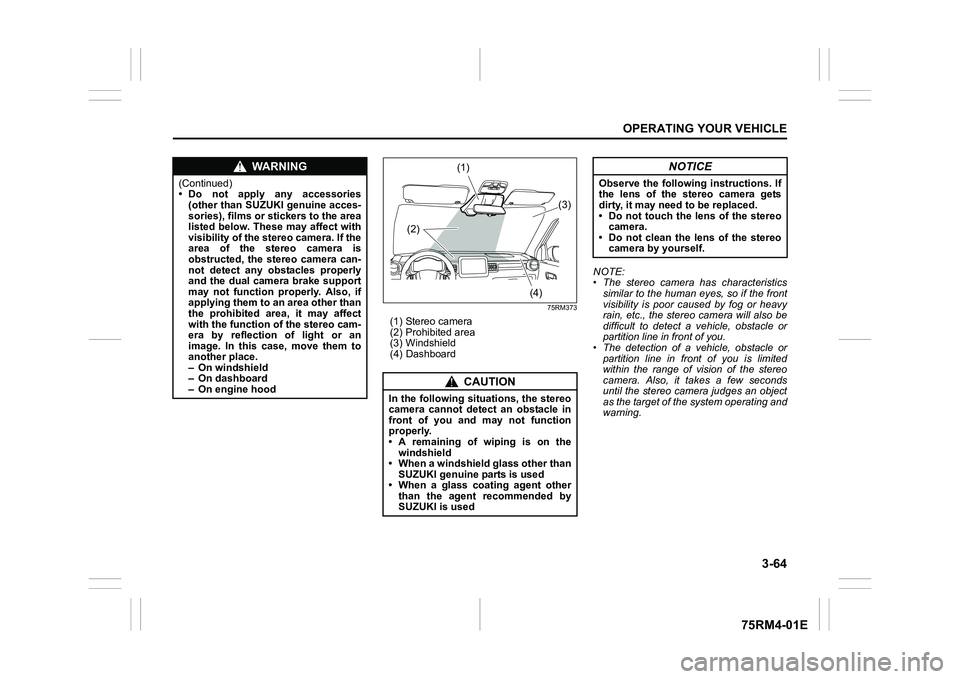
75RM373
(1) Stereo camera
(2) Prohibited area
(3) Windshield
(4) DashboardNOTE:
• The stereo camera has characteristics
similar to the human eyes, so if the front
visibility is poor caused by fog or heavy
rain, etc., the stereo camera will also be
difficult to detect a vehicle, obstacle or
partition line in front of you.
• The detection of a vehicle, obstacle or
partition line in front of you is limited
within the range of vision of the stereo
camera. Also, it takes a few seconds
until the stereo camera judges an object
as the target of the system operating and
warning.
WA R N I N G
(Continued)
• Do not apply any accessories(other than SUZUKI genuine acces-
sories), films or stickers to the area
listed below. These may affect with
visibility of the stereo camera. If the
area of the stereo camera is
obstructed, the stereo camera can-
not detect any obstacles properly
and the dual camera brake support
may not function properly. Also, if
applying them to an area other than
the prohibited area, it may affect
with the function o f the stereo cam-
era by reflection of light or an
image. In this case, move them to
another place.
– On windshield
– On dashboard
– On engine hood
CAUTION
In the following situations, the stereo
camera cannot detect an obstacle in
front of you and may not function
properly.
• A remaining of wiping is on the
windshield
• When a windshield glass other than SUZUKI genuine parts is used
• When a glass coating agent other than the agent recommended by
SUZUKI is used
(1)
(2) (3)
(4)
NOTICE
Observe the following instructions. If
the lens of the stereo camera gets
dirty, it may need to be replaced.
• Do not touch the lens of the stereo camera.
• Do not clean the lens of the stereo camera by yourself.
Page 218 of 505

3-65OPERATING YOUR VEHICLE
75RM4-01E
Temporary stop or failure of the stereo camera
The following chart shows the temporary stop or failure of the stereo camera.
Stereo camera
Temporary Stop Failure
(1) On
(2) On
(3) (#1) On Off
Off On
(4) Blinking
(5) On Off
(1) Dual camera brake support indicator light
(2) Lane departure warning indicator light
(3) Indication of information display (with tachometer)
(4) Master warning indicator light
(if equipped)/
Dual camera brake support warning
light (if equipped)
(5) Indication of information display (without tachometer)
#1: Depending on the cause of the tem- porary stop or failure, the following
message may appear simultaneously.
75RM350
NOTE:
When the function of the stereo camera is
temporarily stopped or malfunctioning, all
of following functions will be turned off.
• Dual camera brake support
• Lane departure warning
• Vehicle swaying warningEXAMPLE
Page 219 of 505
3-66
OPERATING YOUR VEHICLE
75RM4-01E
Temporary stop of the stereo camera
Under the following situations, the function
of the stereo camera stops temporarily.
When the situations are improved, the
temporary stop of the function will be can-
celed.
• When the visibility of the stereo camerais poor
• When the temperature of the body of
stereo camera i s low or high
• When the systems related the dual cam- era brake support stops temporarily
• When the lead-acid battery has a volt- age abnormality
• When the automatic adjustment of the
stereo camera is insufficient
Failure of the stereo camera
When the stereo camera is failure, the
function of the stereo camera stops until
the ignition switch is turned to “LOCK”
position or the engine switch is pressed to
change the ignition mode to LOCK (OFF).
Find a safe place to park and turn the igni-
tion switch to “LOCK” position or change
the ignition mode to LOCK (OFF) by press-
ing the engine switch.
Restart the engine, and check that the dual
camera brake support indicator light and
lane departure warning indicator light go
off.
• If both of the indicators stay on after restarting the engine, there may be a
failure of the stereo camera. Ask your
SUZUKI dealer to have the stereo cam-
era inspected. It is thought that the cause of failure is the
followings.
• When the stereo camera has an abnor-
mality
• When the temperature of the body of stereo camera is t oo low or too high
• When the mounting position of the ste- reo camera is shifted greatly
• When there are communication abnor-
malities among the engine, transaxle
and brake controller
• When the dual camera brake support
OFF switch has an abnormality
• When the steering angle sensor has an abnormality
• When the power supply of the stereo camera is cut
NOTE:
• Under the following situations, the dual camera brake support indicator light and
lane departure warning indicator light
come on after the engine has started, it
does not indicate a malfunction. Once
the ignition switch is turned to “LOCK”
position or the engine switch is pressed
to change the ignition mode to LOCK
(OFF) and then the engine is restarted,
these indicators will go off.
– When the automatic brake system hasbeen operating 3 times
– When the automatic brake system has
been operating for long periods • The function of the stereo camera stops
if the dual camera brake support indica-
tor light and lane departure warning indi-
cator light come on and there may be a
failure of the stereo camera, but it does
not hinder normal driving.
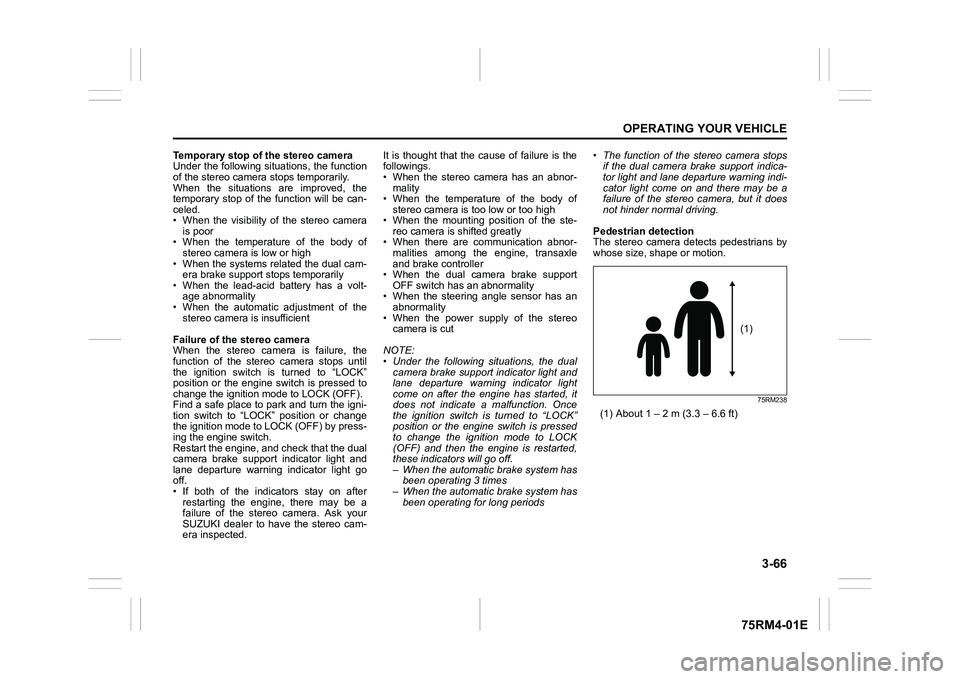
Pedestrian detection
The stereo camera detects pedestrians by
whose size, shape or motion.
75RM238
(1) About 1 – 2 m (3.3 – 6.6 ft)
(1)
Page 220 of 505
3-67OPERATING YOUR VEHICLE
75RM4-01E
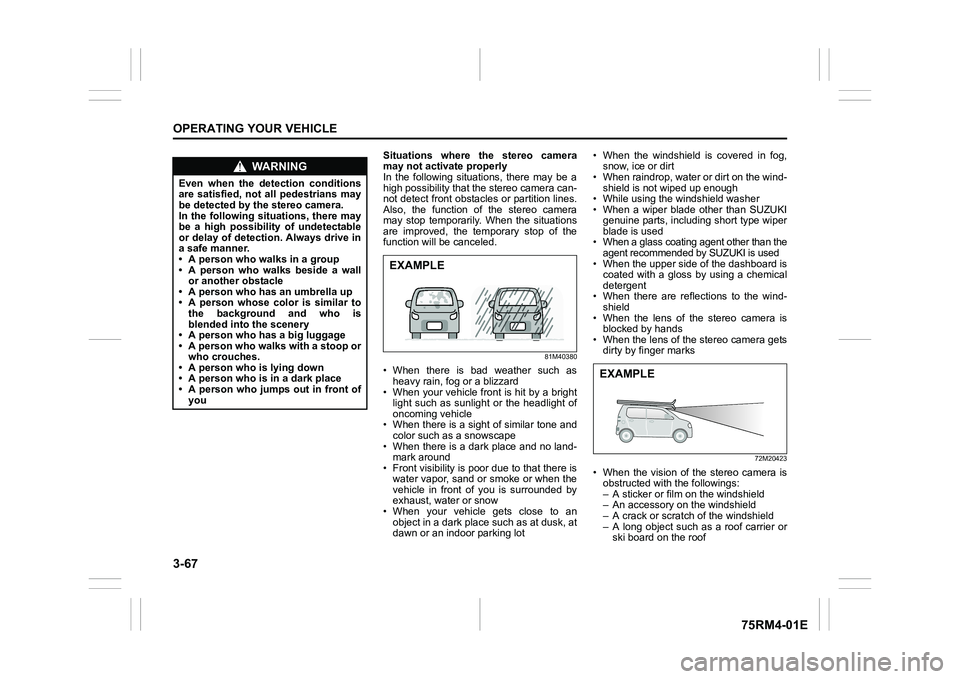
Situations where the stereo camera
may not activate properly
In the following situations, there may be a
high possibility that the stereo camera can-
not detect front obstacles or partition lines.
Also, the function of the stereo camera
may stop temporarily. When the situations
are improved, the temporary stop of the
function will be canceled.
81M40380
• When there is bad weather such as
heavy rain, fo g or a blizzard
• When your vehicle front is hit by a bright light such as sunlight or the headlight of
oncoming vehicle
• When there is a sight of similar tone and color such as a snowscape
• When there is a dark place and no land- mark around
• Front visibility is poor due to that there is
water vapor, sand or smoke or when the
vehicle in front of you is surrounded by
exhaust, water or snow
• When your vehicle gets close to an object in a dark place such as at dusk, at
dawn or an indoor parking lot • When the windshield is covered in fog,
snow, ice or dirt
• When raindrop, water or dirt on the wind-
shield is not wiped up enough
• While using the windshield washer
• When a wiper blade other than SUZUKI
genuine parts, including short type wiper
blade is used
• When a glass coating agent other than the
agent recommended by SUZUKI is used
• When the upper side of the dashboard is coated with a gloss by using a chemical
detergent
• When there are reflections to the wind- shield
• When the lens of the stereo camera is blocked by hands
• When the lens of the stereo camera gets dirty by finger marks
72M20423
• When the vision of the stereo camera isobstructed with the followings:
– A sticker or film on the windshield
– An accessory on the windshield
– A crack or scratch of the windshield
– A long object such as a roof carrier or ski board on the roof
WA R N I N G
Even when the detection conditions
are satisfied, not all pedestrians may
be detected by the stereo camera.
In the following situations, there may
be a high possibility of undetectable
or delay of detection. Always drive in
a safe manner.
• A person who walks in a group
• A person who walks beside a wallor another obstacle
• A person who has an umbrella up
• A person whose color is similar to the background and who is
blended into the scenery
• A person who has a big luggage
• A person who walks with a stoop or
who crouches.
• A person who is lying down
• A person who is in a dark place
• A person who jumps out in front of you
EXAMPLE
EXAMPLE
Page 221 of 505
3-68
OPERATING YOUR VEHICLE
75RM4-01E
72M20405
• When your vehicle is weighed down byheavy items in the luggage compartment
or rear seat
• When the tires are not inflated to the rec- ommended tire inflation pressure or the
tires are worn
• With tire chains or non-specified sized
tires equipped
• When you have a temporarily repaired flat tire
• With a modified suspension equipped
• When passing through the entrance or exit of the tunnel and the brightness is
changed extremely
• When driving without lighting the head- lights at night or in tunnels
• When driving on a steep slope or sharp curves
• When the optical axis of the headlight is
deviated
• With modified headlights and/or front fog lights equipped
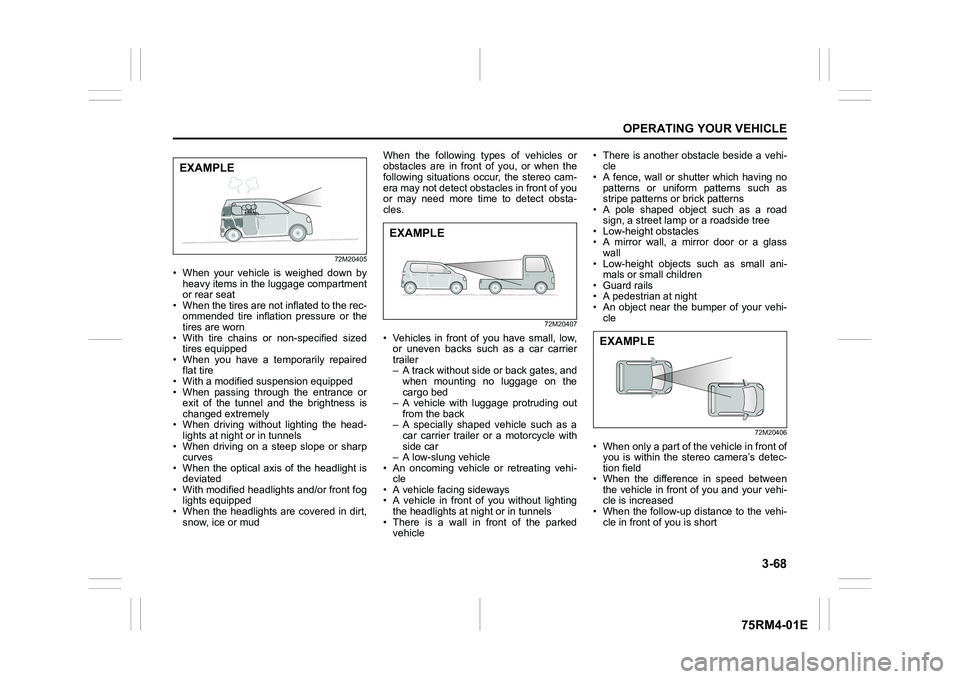
• When the headlights are covered in dirt, snow, ice or mud When the following types of vehicles or
obstacles are in front of you, or when the
following situations occur, the stereo cam-
era may not detect obstacles in front of you
or may need more time to detect obsta-
cles.
72M20407
• Vehicles in front of you have small, low,
or uneven backs such as a car carrier
trailer
– A track without side or back gates, andwhen mounting no luggage on the
cargo bed
– A vehicle with luggage protruding out
from the back
– A specially shaped vehicle such as a car carrier trailer or a motorcycle with
side car
– A low-slung vehicle
• An oncoming vehicle or retreating vehi-
cle
• A vehicle facing sideways
• A vehicle in front of you without lighting
the headlights at n ight or in tunnels
• There is a wall in front of the parked vehicle • There is another obstacle beside a vehi-
cle
• A fence, wall or shutter which having no
patterns or uniform patterns such as
stripe patterns or brick patterns
• A pole shaped object such as a road
sign, a street lamp or a roadside tree
• Low-height obstacles
• A mirror wall, a mirror door or a glass
wall
• Low-height objects such as small ani- mals or small children
• Guard rails
• A pedestrian at night
• An object near the bumper of your vehi- cle
72M20406
• When only a part of the vehicle in front ofyou is within the stereo camera’s detec-
tion field
• When the difference in speed between the vehicle in front of you and your vehi-
cle is increased
• When the follow-up distance to the vehi- cle in front of you is short
EXAMPLE
EXAMPLE
EXAMPLE
Page 222 of 505
3-69OPERATING YOUR VEHICLE
75RM4-01E
• When the vehicle in front of you turns,accelerates or decelerates suddenly
• An object outside of the irradiation range
of the headlights
• An object which jumps out in front of you
• When you change the lane and
approach the preceding vehicle
When the following types of partition lines
are in front of you, or when the following
situations occur, the stereo camera may
not detect the lines o r may need more time
to detect the lines.
• The narrow lane width
• When the lane is difficult to detect – No partition lines, or faded lines
– The Color of partition lines is similar tothe road
– The width of partition lines is narrow
• When the follow-up distance to the vehi-
cle in front of you is short
Page 223 of 505

3-70
OPERATING YOUR VEHICLE
75RM4-01E
Warning and indicator messages (for the instrument cluster with tachometer)The information display shows the warning and indicator message to let you know about certain problems of the dual camera brake sup-
port.
Warning and indicator messages
Warning and indicator message Master warning
indicator Light Sound Cause and remedy
75RM239
Blinks Beep (one time from interior
buzzer) There may be a problem with the stereo
camera.
If the message does not disappear after
restarting the engine, have your vehicle
inspected by an auth
orized SUZUKI dealer.
75RM240
Blinks Continuous beep (from inte-
rior buzzer) The vehicle swaying warning is working.
Operate the steering wheel to move the
vehicle to the cen
ter of the lane.
75RM241
Blinks Off The lane departure warning is working.
Operate the steering wheel to move the
vehicle to the center of the lane.
Page 225 of 505
3-72
OPERATING YOUR VEHICLE
75RM4-01E
Rearview camera (if equipped)When the gearshift lever is shifted to “R”
position while the ignition switch is in “ON”
position or the ignition mode is ON, the
rearview camera system automatically
shows the view behind the vehicle on the
display.
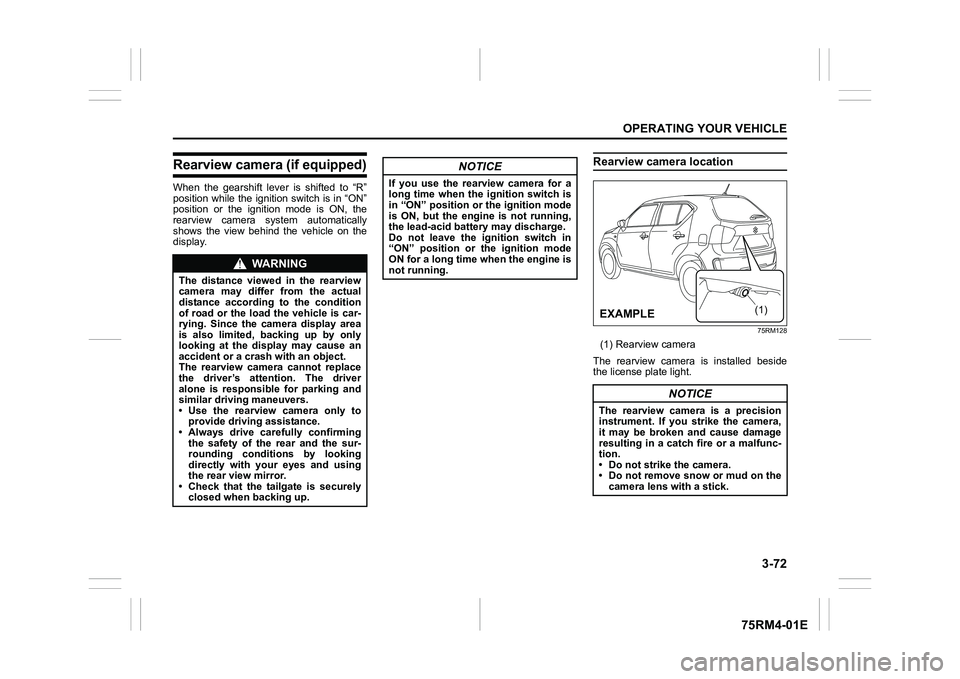
Rearview camera location
75RM128
(1) Rearview camera
The rearview camera is installed beside
the license plate light.
WA R N I N G
The distance viewed in the rearview
camera may differ from the actual
distance according to the condition
of road or the load the vehicle is car-
rying. Since the camera display area
is also limited, backing up by only
looking at the display may cause an
accident or a crash with an object.
The rearview camera cannot replace
the driver’s attention. The driver
alone is responsible for parking and
similar driving maneuvers.
• Use the rearview camera only to provide driving assistance.
• Always drive carefully confirming
the safety of the rear and the sur-
rounding conditions by looking
directly with your eyes and using
the rear view mirror.
• Check that the tailgate is securely closed when backing up.
NOTICE
If you use the rearview camera for a
long time when the ignition switch is
in “ON” position or the ignition mode
is ON, but the engine is not running,
the lead-acid battery may discharge.
Do not leave the ignition switch in
“ON” position or the ignition mode
ON for a long time when the engine is
not running.
NOTICE
The rearview camera is a precision
instrument. If you strike the camera,
it may be broken and cause damage
resulting in a catch fire or a malfunc-
tion.
• Do not strike the camera.
• Do not remove snow or mud on thecamera lens with a stick.
(1)
(ΟΝ03/(
Page 226 of 505

3-73OPERATING YOUR VEHICLE
75RM4-01E
NOTE:
If body wax gets on the camera lens, wipe
off the wax with a clean cloth dampened
with mild detergent diluted with water, and
then wipe the lens with a dry cloth.
How to use rearview camera1) Turn the ignition switch to “ON” positionor press the engine switch to change
the ignition mode to ON.
2) Shift the gearshift lever in “R” position. • The display automatically shows the
view behind the vehicle.
• When the gearshift lever is shifted from “R” to another gearshift lever
position, the display returns to the
previous display.
NOTE:
The rearview camera display has first pri-
ority in any display mode. However, the
rearview camera display does not show
the rear view while the system is initializ-
ing.Display range of rearview cameraThe rearview camera display shows the
area behind the rear end of the tailgate.
The display cannot show objects which are
close to the bumper o r under the bumper.
The rearview camera display cannot show
obstacles which are higher than the cam-
era. Upper parts of tall objects such as
road signs cannot be viewed on the dis-
play. Display range of rearview camera
75RM293
54P000370
(1) Display range
NOTICE
If water enters the rearview camera, it
may cause a malfunction or catch
fire.
Do not use high pressure water
around the camera.
NOTICE
This lens is hard coated to prevent
damage or discoloration. Damage or
discoloration of lens may obscure
the image.
• Do not use a brush to clean lens.
• Do not use alcohol, benzene or thinner to clean the lens.
• Do not use wax on the camera lens.
(1)
EXAMPLE
(1)
EXAMPLE
Page 227 of 505

3-74
OPERATING YOUR VEHICLE
75RM4-01E
NOTE:
• Images shown on the display from therearview camera are reversed images
(mirror images).
• The colors of objects on the rearview camera may differ from the actual object
colors.
• The rearview camera display may be dif- ficult to see under the following condi-
tions, but this is not a system
malfunction.
– In dark areas, on a rainy day or at
night.
– When the temperature around the lens is too high/low, or the camera is wet
such as on a rainy day or during peri-
ods of high humidity (dew condensa-
tion may occur on the camera lens).
– When a foreign object such as mud or a drop of water is stuck around the
camera lens.
– When strong light directly enters the camera (vertical lines may be seen on
the display).
– Under fluorescent light. (The display may flicker.)
– When the outside temperature is low (the image on the display may be
darkened).
Rearview camera screen indication
The distance viewed in the rearview cam-
era may differ from the actual distance
according to the condition of the road or
the load the vehicle is carrying. Uphill incline behind the vehicle
75RM294
(1) Object
(2) Actual distance
(3) Distance on the display
When there is an uphill incline behind the
vehicle, the object shown on the display
appears farther away than the actual dis-
tance. Downhill incline behind the vehicle
75RM295
(1) Object
(2) Actual distance
(3) Distance on the display
When there is a downhill incline behind the
vehicle, the object shown on the display
appears closer than the actual distance.
(1)
(2)
(3)
EXAMPLE
(1)
(3)
(2)
EXAMPLE