size SUZUKI JIMNY 2018 Owner's Manual
[x] Cancel search | Manufacturer: SUZUKI, Model Year: 2018, Model line: JIMNY, Model: SUZUKI JIMNY 2018Pages: 421, PDF Size: 6.35 MB
Page 207 of 421
The ESP® has the following three systems:
Stability control system
The vehicle stability control system helps provide integrated control of systems such as anti-lock brakes, traction control, engine control, etc. This system automatically controls the brakes and engine to help prevent the vehicle from skidding when cornering on a slippery road surface or when turning the steering wheel abruptly.
Traction control system
The traction control system automatically helps prevent the spinning of wheels when the vehicle is started or accelerated on slippery road surfaces. The system operates only if it senses that some of the wheels are spinning or beginning to lose traction. When this happens, the system operates the front or rear brakes and reduces engine power to l1m1t wheel spin.
NOTE: You may hear an operation sound when you start the engine or after the vehicle begins to move. This means that the above systems are in the self-check mode. This sound does not indicate a malfunction.
Anti-lock brake system (ABS)
ABS will help you avoid skidding by electronically controlling braking pressure. It will also help you maintain steering control when braking on slippery surfaces or when braking hard. The ABS works automatically, so you do not have to use any special braking technique. Just push the brak_e pedal down without pumping. The ABS will operate whenever it senses that wheels are locking up. You may feel the brake pedal pulsate while the ABS is operating. (For more information on ABS, see "Braking" in this section.)
NOTE: The ABS will not work if vehicle speed is under about 9 km/h (6 mph).
A WARNING
The ESP® may not work properly if tyres or wheels other than those specified in the owner's manual are used. When replacing tyres or wheels, use only the size and type specified in this owner's manual. • The ESP® may not work properly if ·tyres are not inflated to the recom
mended ~re pressure. The ESP" may not work properly if tyres are fitted with snow chains. (Continued)
OPERATING YOUR VEHICLE
A WARNING
(Continued) • The ESP® may not work properly if the tyres are excessively worn. Replace tyres when the tread wear indicators in the grooves appear on the tread surface. • The ESP® is not a substitute for winter tyres or snow chains on a snowMcovered road.
A WARNING
• The ESP® may not work properly if engine related parts such as the muffler are not equivalent to standard equipment or are extremely deteriorated. Do not modify the vehicle's suspension since the ESP® may not work properly.
NOTE: • If the Espi!) system is activated, you may hear a clunking noise and/or feel pulsating in the brake pedal. This is. normal and indicates that the brake flwd pressure is being controlled properly. You may hear an operation sound when you start the engine or after the vehicle begins to move. This means that the above systems are in the self-check mode. This sound does not indicate a malfunction.
3-56
Page 215 of 421
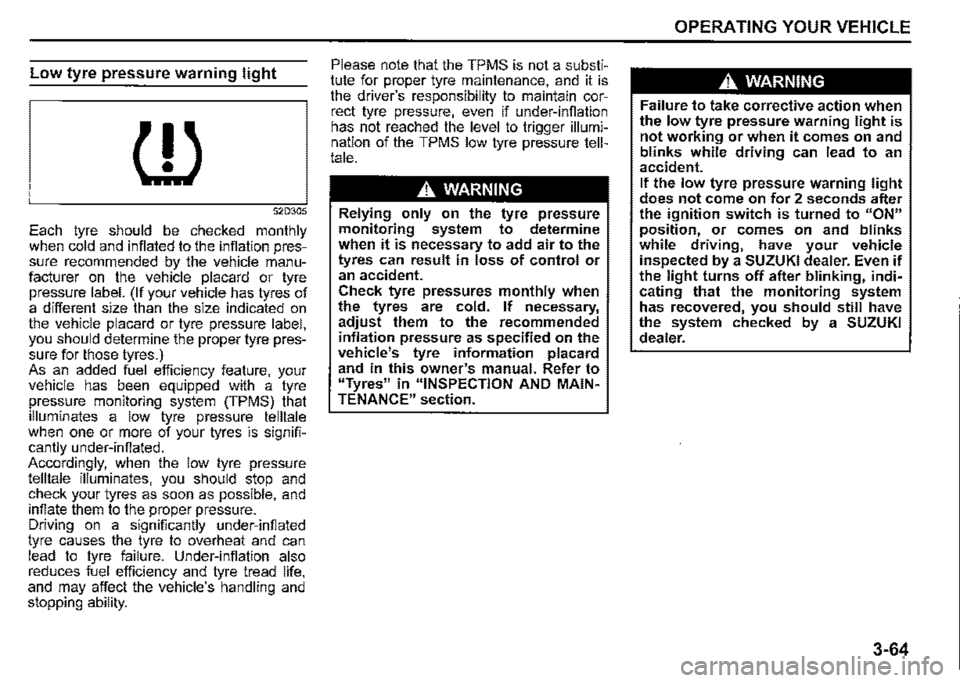
Low tyre pressure warning light
(!)
52D305
Each tyre should be checked monthly when cold and infiated to the infiation pressure recommended by the vehicle manufacturer on the vehicle placard or tyre pressure label. (If your vehicle has tyres of a different size than the size indicated on the vehicle placard or tyre pressure label, you should determine the proper tyre pressure for those tyres.) As an added fuel efficiency feature, your vehicle has been equipped with a tyre pressure monitoring system (TPMS) that illuminates a low tyre pressure telltale when one or more of your tyres is significantly under-infiated. Accordingly, when the low tyre pressure telltale illuminates, you should stop and check your tyres as soon as possible, and infiate them to the proper pressure. Driving on a significantly under-infiated tyre causes the tyre to overheat and can lead to tyre failure. Under-infiation also reduces fuel efficiency and tyre tread life, and may affect the vehicle's handling and stopping ability.
Please note that the TPMS is not a substitute for proper tyre maintenance, and it is the driver's responsibility to maintain correct tyre pressure, even if under-infiation has not reached the level to trigger illumination of the TPMS low tyre pressure telltale.
A WARNING
Relying only on the tyre pressure monitoring system to determine when it is necessary to add air to the tyres can result in loss of control or an accident. Check tyre pressures monthly when the tyres are cold. If necessary, adjust them to the recommended inflation pressure as specified on the vehicle's tyre information placard and in this owner's manual. Refer to "Tyres" in "INSPECTION AND MAINTENANCE" section.
OPERATING YOUR VEHICLE
A WARNING
Failure to take corrective action when the low tyre pressure warning light is not working or when it comes on and blinks while driving can lead to an accident. If the low tyre pressure warning light does not come on for 2 seconds after the ignition switch is turned to "ON" position, or comes on and blinks while driving, have your vehicle inspected by a SUZUKI dealer. Even if the light turns off after blinking, indicating that the monitoring system has recovered, you should still have the system checked by a SUZUKI dealer.
3-64
Page 228 of 421
DRIVING TIPS
Snow chains
Snow chains should only be used if they are needed to increase traction or are required by law. Check that the chains you use are the correct size for your vehicle's tyres. Also check that there is enough clearance between the fenders and the chains as installed on the tyres. Install the chains on the rear tyres tightly, according to the chain manufacturer's instructions. Retighten the chains after driving about 1.0 km (1/2 mile) if necessary. With the chains installed, drive slowly.
NOTICE
If you hear the chains hitting against the vehicle body while driving, stop and tighten them.
4-5
Do not drive in the field covered
with grown grass
If you drive in the field covered with grass, it may cause accident or vehicle damage by getting caught in grown grass.
If Your Vehicle Gets Stuck
If your vehicle gets stuck in snow, mud, or sand, follow the directions below:
1) Shift the transfer shift lever into the "4L"
position. 2) Shift the transmission back and forth between a forward range (or first gear for manual transmission) and reverse. This will create a rocking motion which may give you enough momentum to free the vehicle. Press gently on the accelerator to keep wheel spin to a minimum. Remove your foot from the accelerator while shifting. Do not race the engine. Excessive wheel spin will cause the tyres to dig deeper, making it more difficult to free the vehicle. 3) If your vehicle remains stuck after a few minutes of rocking, get another vehicle to pull you out.
A WARNING
Do not allow anyone to stand near the vehicle when you are rocking it, and do not spin the wheels faster than an indicated 40 km/h (25 mph) on the speedometer. Personal injury and/or vehicle damage may result from spinning the wheels too fast.
NOTICE
• Release the accelerator pedal when operating the gearshift lever or the transfer lever. Operating the gearshift lever or the transfer lever with the engine racing can damage the gears and the free axle mechanism. • Do not continue rocking the vehicle for more than a few minutes. Prolonged rocking can cause engine overheating, transmission, transfer case, axles, propeller shaft or differential damage, or tyre damage.
Page 229 of 421
A WARNING
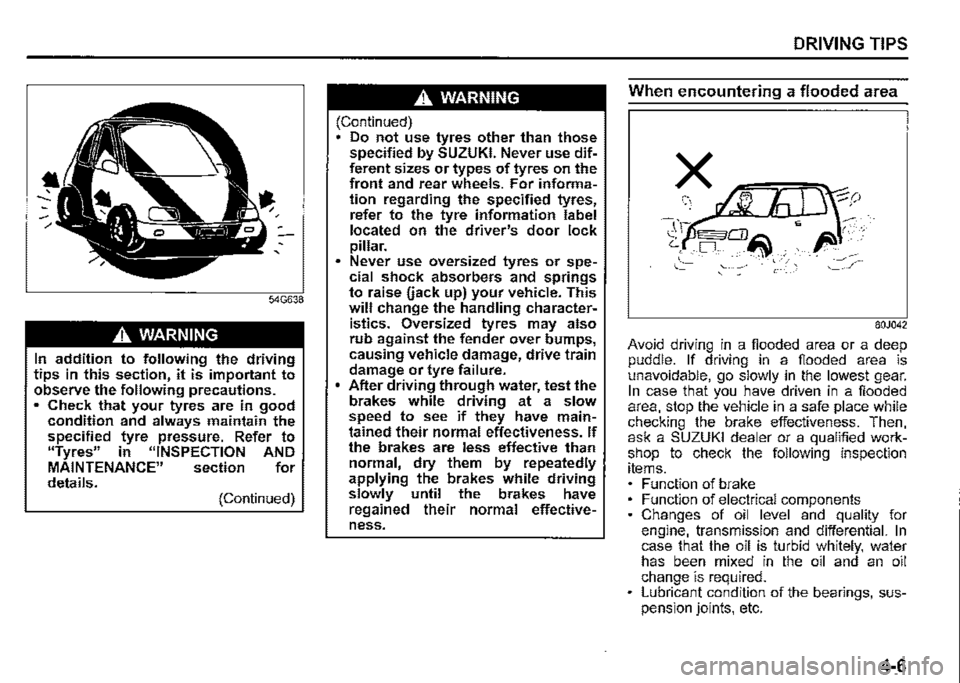
In addition to following the driving tips in this section, it is important to observe the following precautions. • Check that your tyres are in good condition and always maintain the specified tyre pressure. Refer to "Tyres" in "INSPECTION AND MAINTENANCE" section for details. (Continued)
A WARNING
(Continued) Do not use tyres other than those specified by SUZUKI. Never use different sizes or types of tyres on the front and rear wheels. For information regarding the specified tyres, refer to the tyre information label located on the driver's door lock pillar. Never use oversized tyres or spe~ cial shock absorbers and springs to raise uack up) your vehicle. This will change the handling characteristics. Oversized tyres may also rub against the fender over bumps, causing vehicle damage, drive train damage or tyre failure. After driving through water, test the brakes while driving at a slow speed to see if they have maintained their normal effectiveness. If the brakes are less effective than normal, dry them by repeatedly applying the brakes while driving slowly until the brakes have regained their normal effectiveness.
DRIVING TIPS
When encountering a flooded area
80J042
Avoid driving in a flooded area or a deep puddle. If driving in a flooded area is unavoidable, go slowly in the lowest gear. In case that you have driven in a flooded area, stop the vehicle in a safe place while checking the brake effectiveness. Then, ask a SUZUKI dealer or a qualified workshop to check the following inspection items. Function of brake Function of electrical components Changes of oil level and quality for engine, transmission and differential. In case that the oil is turbid whitely, water has been mixed in the oil and an oil change is required. Lubricant condition of the bearings, suspension joints, etc.
4-6
Page 231 of 421

A WARNING
In addition to following the driving tips in this section, it is important to observe the following precautions for on-road and off-road driving. Driver and passengers should wear seat belts at all times. Do not let anyone else drive your vehicle unless they are also aware of the vehicle characteristics and handling differences described in this section. Avoid loaning your vehicle to any• one unless you accompany them. Make sure your tyres are in good condition and always maintain the specified tyre pressure. Refer to "Tyres" in the "INSPECTION AND MAINTENANCE" section for details. Do not use tyres other than those specified by SUZUKI. Never use dif• ferent sizes or types of tyres on the front and rear wheels. For informa• lion regarding the specified tyres, refer to the "SPECIFICATIONS" section. Never use oversized tyres or special shock absorbers and springs to raise uack up) your vehicle. This will raise the center of gravity of the vehicle and change its handling characteristics. (Continued)
A WARNING
(Continued) After driving through water, mud, or sandy ground, test the brakes while driving at a slow speed to see if they have maintained their nor• mal effectiveness. If the brakes are less effective than normal, dry them by repeatedly applying the brakes while driving slowly until the brakes have regained their nor• mal effectiveness. After extended operation in mud, sand, or water, have the brakes, bearings and joint parts etc. inspected by a SUZUKI dealer as soon as possible.
DRIVING TIPS
Running-in
NOTICE
The future performance and reliabil• ity of the engine depends on the care and restraint exercised during its early life. It is especially important to observe the following precautions during the first 960 km (600 miles) of vehicle operation. • After starting, do not race the engine. Warm ii up gradually. • Avoid prolonged vehicle operation at a constant speed. Moving parts will break in better if you vary your speed. Start off from a stop slowly. Avoid full throttle starts. Avoid hard braking, especially during the first 320 km (200 miles) of driving. Do not drive slowly with the !rans• mission in a high gear. Drive the vehicle at moderate engine speeds. Do not tow a trailer during the first 960 km (600 miles) of vehicle oper• ation.
4-8
Page 348 of 421

INSPECTION AND MAINTENANCE
60G160
NOTICE
When installing the spark plugs, screw them in with your fingers to avoid stripping the threads. Tighten the spark plugs with a torque wrench to 17.5 Nm (1.7 kgm, 12.9 lb-ft). Do not allow contaminants to enter the engine through the spark plug holes when the plugs are removed. Never use spark plugs with the wrong thread size.
6-31
Spark plug gap "a":
ZXU20PR11 1.0-1.1 mm (0.039-0.043 in.) KR6A-10 0.95-1.0Smm (0.037-0.041 in.)
NOTICE
54G106
When replacing spark plugs, you ".hould use the ~rand and type specified for your vehicle. For the specified plugs, refer to "SPECIFICATIONS" section in the end of this book. If you wish to use a brand of spark plug other than the specified plugs, consult a SUZUKI dealer.
Gear oil
Manual transmission oil / transfer
oil/ rear differential oil
When adding gear oil, use gear oil with the appropriate viscosity and grade as shown in the chart below.
We highly recommend you use "SUZUKI GEAR OIL 75W" for manual transmission oil and transfer oil.
Manual transmission oil Transfer oil
<: ==:llil:::======> 75W
°C-30 -20 -10 0 10 20 30 40 °F-22 -4 14 32 50 68 86 104
54P120706
We highly recommend you use "SUZUKI SUPER GEAR OIL 75W-85 SYNTHETIC" for front/rear differential oil.
Front/rear differential oil
<~==~7[fil5Wtfi-B~5====>
'C-30 -~0 -10 Of.22 4 14 0 ' 32
20 ' 68 83,60 4p 104
78RB07007
Page 355 of 421

A CAUTION
Hitting curbs and running over rocks can damage tyres and affect wheel alignment. Have tyres and wheel alignment checked periodically by a SUZUKI dealer.
4) Check for loose wheel nuts. 5) Check that there are no nails, stones or other objects sticking into the tyres.
A WARNING
• Your SUZUKI vehicle is equipped with tyres which are all the same type and size. This is important to ensure proper steering and handling of the vehicle. Never mix tyres of different size or type on the four wheels of your vehicle. The size and type of tyres used should be only those approved by SUZUKI as standard or optional equipment for your vehicle. Replacing the wheels and tyres equipped on your vehicle with certain combinations of aftermarket wheels and tyres can significantly change the steering and handling characteristics of your vehicle. Therefore, use only those wheel and tyre combinations approved by SUZUKI as standard or optional equipment for your vehicle.
NOTICE
Replacing the original tyres with tyres of a different size may result in false speedometer or odometer readings. Check with a SUZUKI dealer before purchasing replacement tyres that differ in size from the original tyres. Replacing a tyre with one of a different size, or using different brands among the four tyres can result in damage to the drive train.
INSPECTION AND MAINTENANCE
Tyre rotation
5-tyre rotation
L A
65D445
L: Left hand drive R: Right hand drive
NOTE: If your vehicle is equipped with the tyre pressure monitoring system, the spare tyre TPMS sensor must be recognized when you include the spare tyre during a tyre rotation. For details, refer to "Replacing Tyres and/or Wheels" in "Tyre Pressure Monitoring System (TPMS)" in the "OPERATING YOUR VEHICLE" section.
6-38
Page 391 of 421

are spilled or leaked, clean and dry the
area immediately.
Park your vehicle in a dry, well-venti
lated area Do not park your vehicle in a damp, poorlyventilated area. If you often wash your vehicle in the garage and place it there in wet condition, your garage may be damp. The high humidity in the garage may cause or accelerate corrosion. A wet vehicle may corrode even in a heated garage if the ventilation is poor.
Use mud and gravel shields The use of mud and gravel shields will help protect your vehicle, especially if you frequently drive on gravel or salted roads. Full-size shields, which extend as close to the road as is practical, are the best. The fittings for such shields should also be corrosion resistant. Please check with your SUZUKI dealer for information on these
shields.
A WARNING
Do not apply additional undercoating or rust preventive coating on or around exhaust system components such as the catalytic converter and exhaust pipes. A fire could be started if the undercoating substance
becomes overheated.
APPEARANCE CARE
Vehicle cleaning
A WARNING
When cleaning the interior or exterior of the vehicle, do not use flammable solvents such as lacquer thinners, gasoline and benzene. Also, do not use cleaning materials such as bleaches and strong household detergents. The materials could cause personal injury or damage to
the vehicle.
8-2
Page 403 of 421

SPECIFICATION
ITEM: Wheels and tyres
Tyre size, front and rear 195/80R15 955•1
Rim size with steel wheels 15X5 1/2JJ
with aluminum wheels 15X5 1/2J
Tyre pressures For the specified tyre pressure, see the tyre information label located
on the driver's door lock pillar.
Recommended snow chain (for Europe) Radial thickness: 20 mm, axial thickness: 20mm
Recommended snow tyre 195/80R15.2
•1 If you cannot prepare tyres with the specified load index rate and speed symbol, prepare tyres with higher load index rate and speed
symbol. •2 If you prepare snow tyres; • Check that they are tyres of the same size, structure and load capacity as the originally installed tyres.
• Mount the snow tyres on all four wheels. • Understand that the maximum permissible speed of snow tyres is generally less than the originally installed tyres.
Consult a SUZUKI dealer or supplier for further information.
9-6