tyre SUZUKI JIMNY 2018 Owner's Guide
[x] Cancel search | Manufacturer: SUZUKI, Model Year: 2018, Model line: JIMNY, Model: SUZUKI JIMNY 2018Pages: 421, PDF Size: 6.35 MB
Page 226 of 421

DRIVING TIPS
Know Your Vehicle
Take time to familiarize yourself with the unique handling characteristics of your vehicle by first driving around in an area away from traffic. Practice turning the vehicle at a variety of speeds and in different directions. Get a feel for the greater steering response that your vehicle has over a conventional car.
Wear Your Seat Belts at All Times
The driver and all passengers should be properly restrained at all times, using the seat belts provided. Refer to the "SEAT BELTS" section for instructions on proper use of the seat belts.
Don't Make Sharp Turns
As mentioned before, small multipurpose vehicles have specific design characteristics that allow them to perform in a wide variety of applications. These characteristics also change the cornering behavior relative to conventional passenger cars. Remember, small multipurpose vehicles have more responsive steering and a higher center of gravity than conventional passenger cars. If at all possible, avoid making sharp turns in your vehicle.
4-3
Slow Down on Curves
Learn to approach curves cautiously and at a conservative speed. Do not attempt to take curves at the same speeds that you would in a vehicle with a lower center of gravity. Just as you would not drive a sports car on a trail, you should not attempt to drive your vehicle around curves like a sports car.
Slow Down and Use Caution on
Slippery Roads
60G089A
Under wet road conditions you should drive at a lower speed than on dry roads due to possible slippage of tyres during braking. When driving on icy, snow-covered, or muddy roads, reduce your speed and avoid sudden acceleration, abrupt braking, or sharp steering movements. Use 4-wheel drive high range (4H) for better traction.
Page 227 of 421
NOTICE
Never operate your vehicle in 114H" or 114L11 on dry pavement and, as much as possible, avoid using 114H" or 114L" on wet pavement, as this puts severe stress on the drive train, especially during tight cornering, and can d~mage it. Also, you may have some d1ff1~ culty in steering.
Off-Road Driving
Your vehicle has specific design characteristics for off-road driving. When you leave the paved road, you will encounter driving surfaces of all kinds which may change continually as you drive. In most cases, offroad driving requires the use of 4-wheel drive.
Use Caution on Steep Inclines
Always inspect hills before you attempt to drive up them. Know what is on the other side and how you will get back down. If you have any doubt that it. is safe, do not attempt to drive over a hill. Nev".r d_nve your vehicle up an extremely steep incline. Coming down a steep hill can be trickier than getting up one. Keep the vehicle heading straight down the hill and use low gear. Do not lock the brake~. If the vehicle begins to slide, accelerate slightly to regain steering control.
DRIVING TIPS
Do not Drive Across the Side of
Hills
Driving across the side of a hill can be extremely hazardous. Most of the vehicle'.s weight will be transferred to the downhill tyres, which could result in the vehicle rolling sideways. Whenever possible, avoid this potential hazard. Also, 1f you have to exit your vehicle on a side-hill, always get out on the uphill side.
Wear Your Seat Belts at All Times
You and your passengers should use the seat belts at all times when driving offroad. For proper seat belt use, refer to the "Seat Belts" section in this manual.
Avoid Sudden Reactions in Mud,
Ice, or Snow
Be careful when off-road conditions are slippery. Reduce your speed and avoid sudden movements of the vehicle. Be aware that driving in deep snow or mud can cause a loss of traction and an increase in the resistance to the vehicle's forward motion. Use 4WD low gear (4L) and maintain a steady but moderate speed with a light touch on the steering wheel and brakes.
4-4
Page 228 of 421
DRIVING TIPS
Snow chains
Snow chains should only be used if they are needed to increase traction or are required by law. Check that the chains you use are the correct size for your vehicle's tyres. Also check that there is enough clearance between the fenders and the chains as installed on the tyres. Install the chains on the rear tyres tightly, according to the chain manufacturer's instructions. Retighten the chains after driving about 1.0 km (1/2 mile) if necessary. With the chains installed, drive slowly.
NOTICE
If you hear the chains hitting against the vehicle body while driving, stop and tighten them.
4-5
Do not drive in the field covered
with grown grass
If you drive in the field covered with grass, it may cause accident or vehicle damage by getting caught in grown grass.
If Your Vehicle Gets Stuck
If your vehicle gets stuck in snow, mud, or sand, follow the directions below:
1) Shift the transfer shift lever into the "4L"
position. 2) Shift the transmission back and forth between a forward range (or first gear for manual transmission) and reverse. This will create a rocking motion which may give you enough momentum to free the vehicle. Press gently on the accelerator to keep wheel spin to a minimum. Remove your foot from the accelerator while shifting. Do not race the engine. Excessive wheel spin will cause the tyres to dig deeper, making it more difficult to free the vehicle. 3) If your vehicle remains stuck after a few minutes of rocking, get another vehicle to pull you out.
A WARNING
Do not allow anyone to stand near the vehicle when you are rocking it, and do not spin the wheels faster than an indicated 40 km/h (25 mph) on the speedometer. Personal injury and/or vehicle damage may result from spinning the wheels too fast.
NOTICE
• Release the accelerator pedal when operating the gearshift lever or the transfer lever. Operating the gearshift lever or the transfer lever with the engine racing can damage the gears and the free axle mechanism. • Do not continue rocking the vehicle for more than a few minutes. Prolonged rocking can cause engine overheating, transmission, transfer case, axles, propeller shaft or differential damage, or tyre damage.
Page 229 of 421
A WARNING
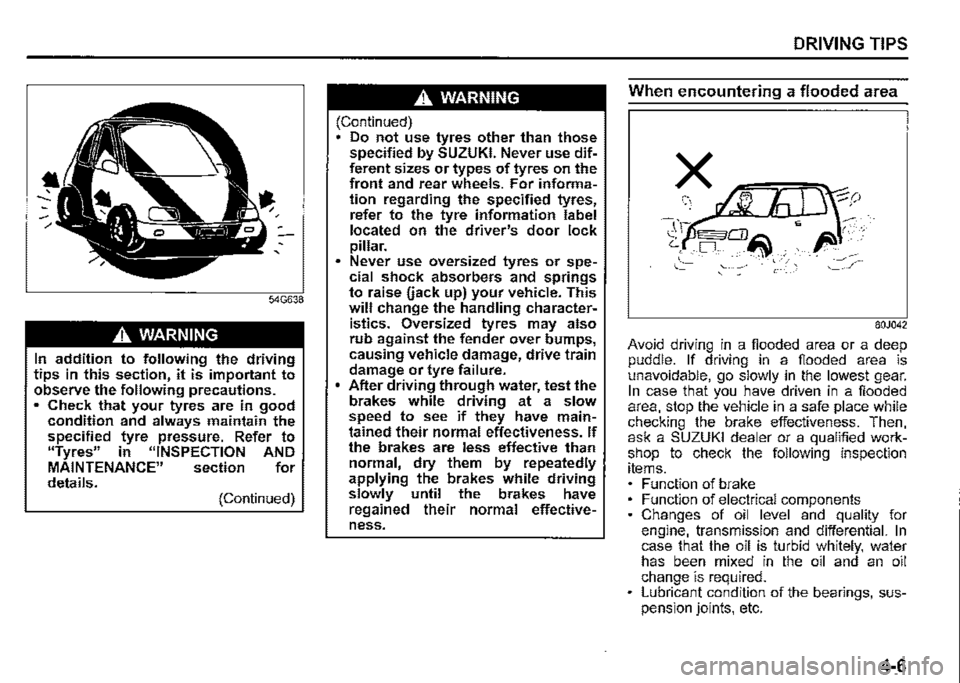
In addition to following the driving tips in this section, it is important to observe the following precautions. • Check that your tyres are in good condition and always maintain the specified tyre pressure. Refer to "Tyres" in "INSPECTION AND MAINTENANCE" section for details. (Continued)
A WARNING
(Continued) Do not use tyres other than those specified by SUZUKI. Never use different sizes or types of tyres on the front and rear wheels. For information regarding the specified tyres, refer to the tyre information label located on the driver's door lock pillar. Never use oversized tyres or spe~ cial shock absorbers and springs to raise uack up) your vehicle. This will change the handling characteristics. Oversized tyres may also rub against the fender over bumps, causing vehicle damage, drive train damage or tyre failure. After driving through water, test the brakes while driving at a slow speed to see if they have maintained their normal effectiveness. If the brakes are less effective than normal, dry them by repeatedly applying the brakes while driving slowly until the brakes have regained their normal effectiveness.
DRIVING TIPS
When encountering a flooded area
80J042
Avoid driving in a flooded area or a deep puddle. If driving in a flooded area is unavoidable, go slowly in the lowest gear. In case that you have driven in a flooded area, stop the vehicle in a safe place while checking the brake effectiveness. Then, ask a SUZUKI dealer or a qualified workshop to check the following inspection items. Function of brake Function of electrical components Changes of oil level and quality for engine, transmission and differential. In case that the oil is turbid whitely, water has been mixed in the oil and an oil change is required. Lubricant condition of the bearings, suspension joints, etc.
4-6
Page 231 of 421

A WARNING
In addition to following the driving tips in this section, it is important to observe the following precautions for on-road and off-road driving. Driver and passengers should wear seat belts at all times. Do not let anyone else drive your vehicle unless they are also aware of the vehicle characteristics and handling differences described in this section. Avoid loaning your vehicle to any• one unless you accompany them. Make sure your tyres are in good condition and always maintain the specified tyre pressure. Refer to "Tyres" in the "INSPECTION AND MAINTENANCE" section for details. Do not use tyres other than those specified by SUZUKI. Never use dif• ferent sizes or types of tyres on the front and rear wheels. For informa• lion regarding the specified tyres, refer to the "SPECIFICATIONS" section. Never use oversized tyres or special shock absorbers and springs to raise uack up) your vehicle. This will raise the center of gravity of the vehicle and change its handling characteristics. (Continued)
A WARNING
(Continued) After driving through water, mud, or sandy ground, test the brakes while driving at a slow speed to see if they have maintained their nor• mal effectiveness. If the brakes are less effective than normal, dry them by repeatedly applying the brakes while driving slowly until the brakes have regained their nor• mal effectiveness. After extended operation in mud, sand, or water, have the brakes, bearings and joint parts etc. inspected by a SUZUKI dealer as soon as possible.
DRIVING TIPS
Running-in
NOTICE
The future performance and reliabil• ity of the engine depends on the care and restraint exercised during its early life. It is especially important to observe the following precautions during the first 960 km (600 miles) of vehicle operation. • After starting, do not race the engine. Warm ii up gradually. • Avoid prolonged vehicle operation at a constant speed. Moving parts will break in better if you vary your speed. Start off from a stop slowly. Avoid full throttle starts. Avoid hard braking, especially during the first 320 km (200 miles) of driving. Do not drive slowly with the !rans• mission in a high gear. Drive the vehicle at moderate engine speeds. Do not tow a trailer during the first 960 km (600 miles) of vehicle oper• ation.
4-8
Page 233 of 421
Improving fuel economy
The following instructions will help you improve fuel economy.
Avoid excessive idling If you park your vehicle for more than one minute, stop the engine and start it again later. When warming up a cold engine, do not allow the engine to idle or apply full throttle until the engine has reached operating temperature. Allow the engine to warm up by driving.
Avoid fast starts F~st starts away from lights or stop signs will consume fuel unnecessarily and shorten engine life. Start off slowly.
Avoid unnecessary stops Avoid unnecessary deceleration and stopping. Try to maintain a moderate, steady speed whenever possible. Slowing down and then accelerating again uses more fuel.
Keep a steady cruising speed Drive at a constant speed that road and traffic conditions will permit.
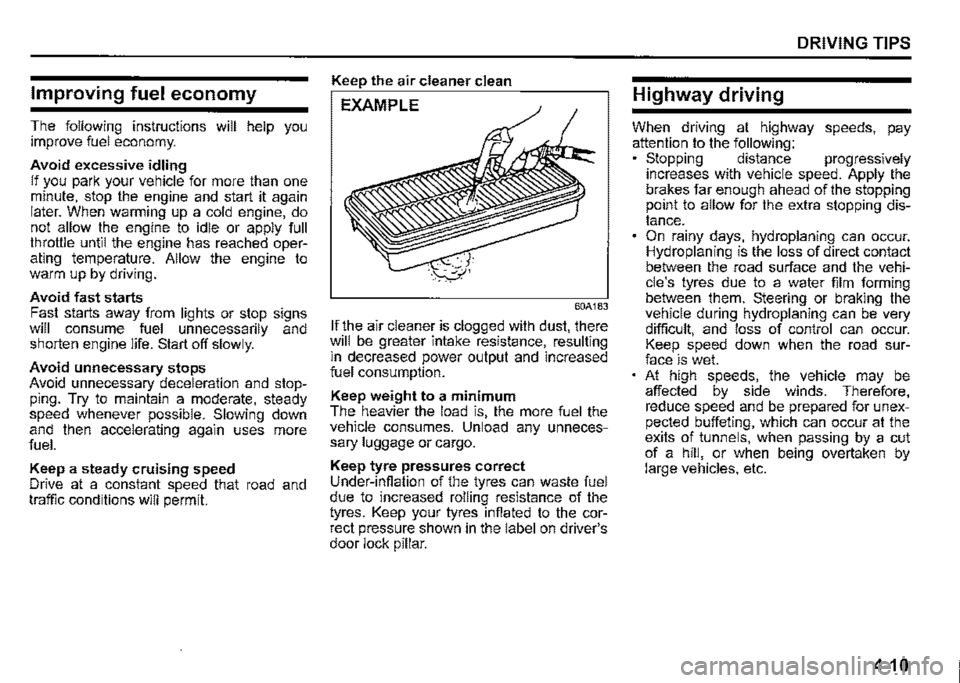
Keep the air cleaner clean
EXAMPLE
60A183
If the air cleaner is clogged with dust, there will be greater intake resistance, resulting m decreased power output and increased fuel consumption.
Keep weight to a minimum The heavier the load is, the more fuel the vehicle consumes. Unload any unnecessary luggage or cargo.
Keep tyre pressures correct Under-infiation of the tyres can waste fuel due to increased rolling resistance of the tyres. Keep your tyres infiated to the correct pressure shown in the label on driver's door lock pillar.
DRIVING TIPS
Highway driving
When driving at highway speeds, pay attention to the following: • Stopping distance progressively increases with vehicle speed. Apply the brakes far enough ahead of the stopping prnnt to allow for the extra stopping distance. On rainy days, hydroplaning can occur. Hydroplaning is the loss of direct contact between the road surface and the vehicle's tyres due to a water film forming between them. Steering or braking the vehicle during hydroplaning can be very difficult, and loss of control can occur. Keep speed down when the road surface is wet. At high speeds, the vehicle may be affected by side winds. Therefore, reduce speed and be prepared for unexpected buffeting, which can occur at the exits of tunnels, when passing by a cut of a hill, or when being overtaken by large vehicles, etc.
4-10
Page 317 of 421
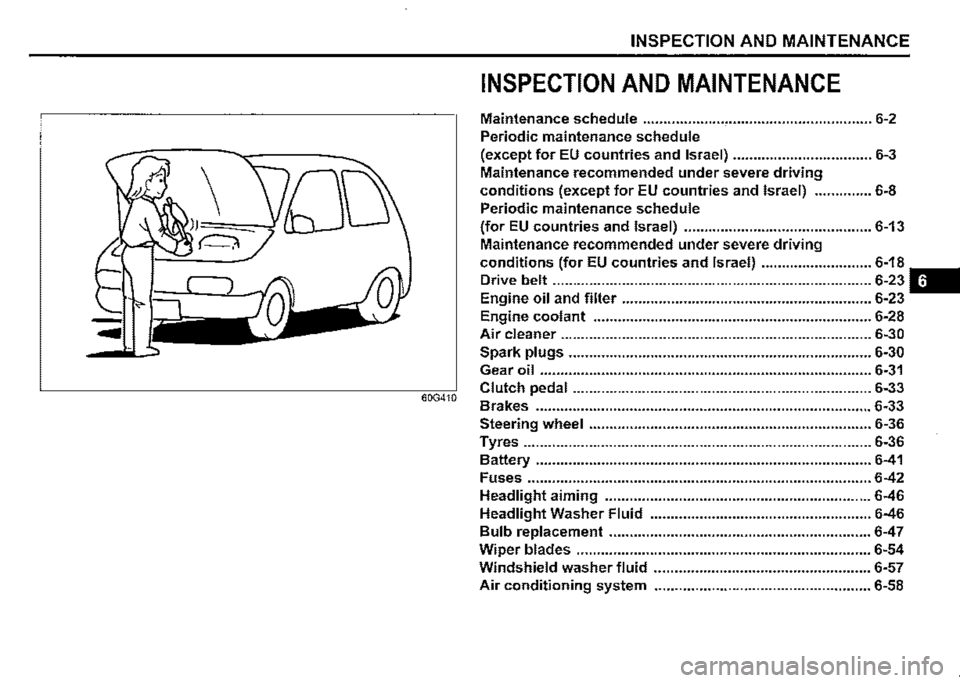
INSPECTION AND MAINTENANCE
INSPECTION AND MAINTENANCE
Maintenance schedule ........................................................ 6-2
Periodic maintenance schedule
(except for EU countries and Israel) .................................. 6-3
Maintenance recommended under severe driving
conditions (except for EU countries and Israel) .............. 6-8
Periodic maintenance schedule
(for EU countries and Israel) .............................................. 6-13
Maintenance recommended under severe driving
conditions (for EU countries and Israel) ........................... 6-18
Drive belt .............................................................................. 6-23 -
Engine oil and filter ............................................................. 6-23
Engine coolant .................................................................... 6-28
Air cleaner ............................................................................ 6-30
Spark plugs .......................................................................... 6-30
Gear oil ................................................................................. 6-31
60G410 Clutch pedal ......................................................................... 6-33
Brakes .................................................................................. 6-33
Steering wheel ..................................................................... 6-36
Tyres ..................................................................................... 6-36
Battery .................................................................................. 6-41
Fuses .................................................................................... 6-42
Headlight aiming ................................................................. 6-46
Headlight Washer Fluid ...................................................... 6-46
Bulb replacement ................................................................ 6-47
Wiper blades ........................................................................ 6-54
Windshield washer fluid ..................................................... 6-57
Air conditioning system ..................................................... 6-58
Page 323 of 421
INSPECTION AND MAINTENANCE
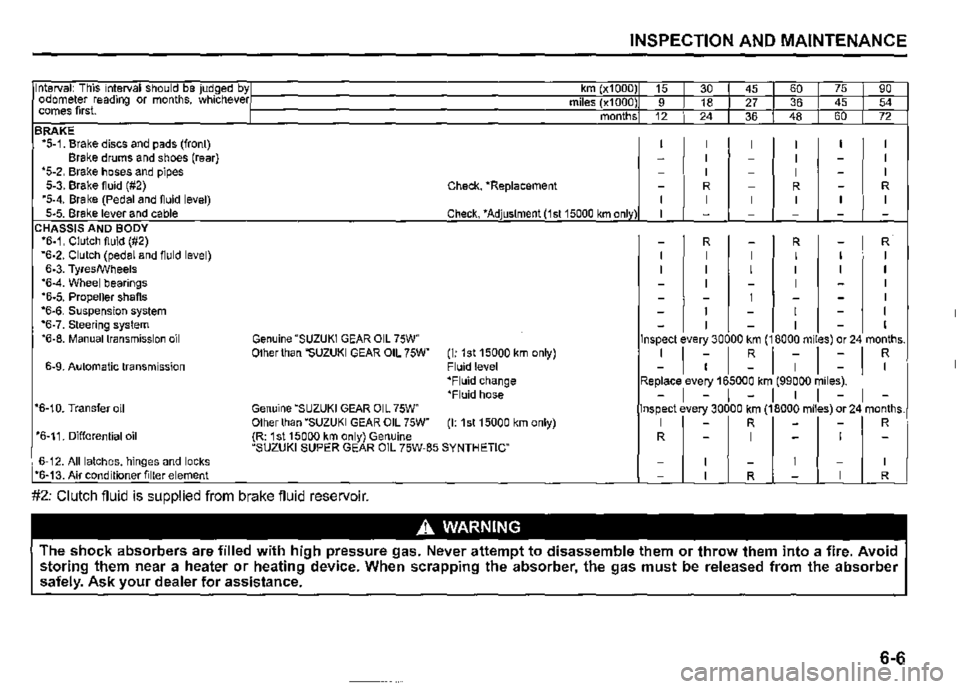
Interval: This interval should be judged byI km (x1000)I 15 I 30 I 45 I 60 I 75 90 odometer reading or months, whichever, miles (x1000)I 9 I 18 I 27 I 36 I 45 54 comes first. 1 monthsI 12 I 24 I 36 I 48 I 60 I 72 BRAKE *5-1. Brake discs and pads (front) I I I I I I Brake drums and shoes (rear) -I -I -I *5-2. Brake hoses and pipes -I -I -I 5-3. Brake fluid (#2) Check, *Replacement -R -R -R *5-4. Brake (Pedal and fluid level) I I I I I I 5-5. Brake lever and cable Check, *Adjustment (1st 15000 km only) I -----CHASSIS AND BODY *6-1. Clutch fluid (#2) -R -R -R *6-2. Clutch (pedal and fluid level) I I I I I I 6-3. Tyres/Wheels I I I I I I *6-4. Wheel bearings -I -I -I *6-5. Propeller shafts --I --I *6-6. Suspension system -I -I -I "6-7. Steering system -I -I -I *6-8. Manual transmission oil Genuine "SUZUKI GEAR OIL 75W" Inspect every 30000 km (18000 miles) or 24 months. Other than "SUZUKI GEAR OIL 75W" (1: 1st 15000 km only) I
I -I
R
I
-
I
-
I
R 6-9. Automatic transmission Fluid level -I -I -I *Fluid change Replace every 165000 km (99000 miles). *Fluid hose -I -I -I I I -I -*6-10. Transfer oil Genuine "SUZUKI GEAR OIL 75W" Inspect every 30000 km (18000 miles) or 24 months. Other than "SUZUKI GEAR OIL 75W" (I: 1st 15000 km only) I -R --R *6-11. Differential oil (R: 1 st 15000 km only) Genuine "SUZUKI SUPER GEAR OIL 75W-85 SYNTHETIC" R -I -I -
6-12. All latches, hinges and locks -I -I -I *6-13. Air conditioner filter element -I R -I R
#2: Clutch fluid is supplied from brake fluid reservoir.
A WARNING
The shock absorbers are filled with high pressure gas. Never attempt to disassemble them or throw them into a fire. Avoid storing them near a heater or heating device. When scrapping the absorber, the gas must be released from the absorber safely. Ask your dealer for assistance.
6-6
Page 324 of 421
INSPECTION AND MAINTENANCE
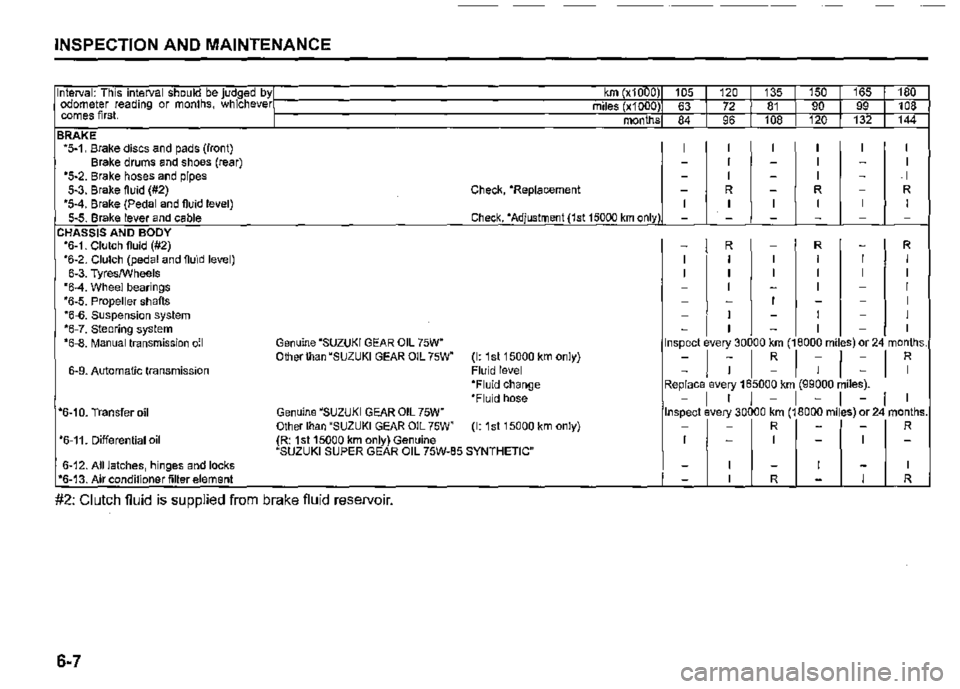
Interval: This interval should be Judged byll---------------------=cc'c-tci.i;#----,i,c---t-----,ai--t----.sci odometer reading or months, whicheveq km (x1000) 105 120 135 150 165 I 180 miles (x1000) 63 72 81 90 I 99 I 108 comes first. 1>----------------------~=.c..,,-4-___,,.c...--1-___,,c----1----c~ months 84 96 108 120 I 132 I 144 BRAKE *5-1, Brake discs and pads (front) Brake drums and shoes (rear) *5-2. Brake hoses and pipes 5-3. Brake fluid (#2) *5-4. Brake (Pedal and fluid level) 5-5. Brake lever and cable CHASSIS AND BODY *6-1. Clutch fluid (#2) *6-2. Clutch (pedal and fluid level) 6-3. Tyres/Wheels *6-4. Wheel bearings *6-5. Propeller shafts *6-6. Suspension system *6-7. Steering system *6-8. Manual transmission oil
6-9. Automatic transmission
*6-10. Transfer oil
*6-11. Differential oil
6-12. All latches, hinges and locks *6-13. Air conditioner filter element
Genuine "SUZUKI GEAR OIL 75W" Otllerthan "SUZUKI GEAR OIL 75W"
Genuine "SUZUKI GEAR OIL 75W"
Check, *Replacement
Check, *Adjustment (1st 15000 km only
(I: 1st 15000 km only) Fluid lever *Fluid change *Fluid hose
Other than "SUZUKI GEAR OIL 75W" (I: 1st 15000 km only) (R: 1st 15000 km only) Genuine "SUZUKI SUPER GEAR OIL 75W-85 SYNTHETIC"
#2: Clutch fluid is supplied from brake fluid reseNoir.
6-7
I I I I I I -I -I -I -I -I -I -R -R -R I I I I I I ------
-R -R -R I I I I I I I I I I I I -I -I -I --I --I -I -I -I -I -I -I Inspect every 30000 km (18000 miles) or 24 months.
= I ~ I ~ I ~ I = I 7 Replace every 165000 km (99000 miles). -I I I -I -I -I I Inspect every 30000 km (18000 m!les) or 24 months. --R --R I -I -I -
R I R
Page 328 of 421
INSPECTION AND MAINTENANCE
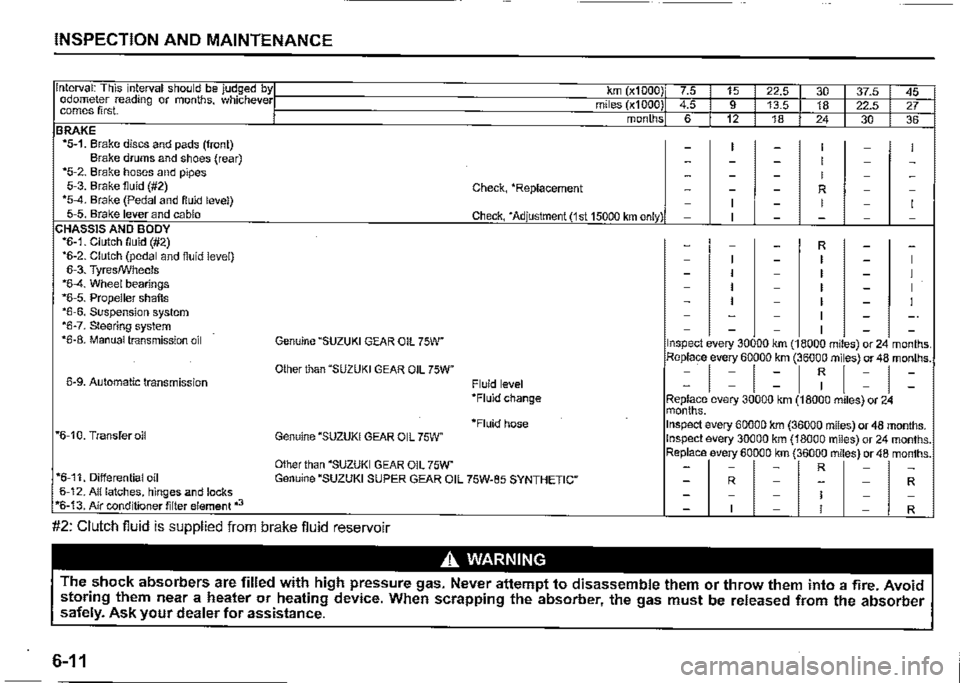
Interval: This interval should be judged by1l--------------------=cic-c+T.C~~,'-,--+----,i'--+ odometer reading or months, whicheverI km (x1000) 7.5 I 15 I 22.5 I 30 I 37.5 45 miles (x1000) 4.5 I 9 I 13.5 I 18 I 22.5 27 comes first. 11-------------------~='---'c=cc=l-";c--+----.,,-+ months 6 I 12 I 18 I 24 I 30 36 BRAKE *5-1. Brake discs and pads (front) Brake drums and shoes (rear) *5-2. Brake hoses and pipes 5-3. Brake fluid (#2) *5-4. Brake (Pedal and fluid level) 5-5. Brake lever and cable CHASSIS AND BODY "6-1. Clutch fluid (#2) *6-2. Clutch (pedal and fluid level) 6-3. Tyres/Wheels *6-4. Wheel bearings *6-5. Propeller shafts *6-6. Suspension system *6-7. Steering system *6-8. Manual transmission oil
6-9. Automatic transmission
*6-10. Transfer oil
*6-11. Differential oil 6-12. All latches, hinges and locks *6-13. Air conditioner filter element •3
Genuine "SUZUKI GEAR OIL 75W"
Other than "SUZUKI GEAR OIL 75W"
Genuine "SUZUKI GEAR OIL 75W"
Other than "SUZUKI GEAR OIL 75W"
Check, *Replacement
Check, *Adjustment (1st 15000 km only)
Flu!d level *Fluid change
*Fluid hose
Genuine "SUZUKI SUPER GEAR OIL 75W-85 SYNTHETIC"
#2: Clutch fiuid is supplied from brake fiuid reservoir
A WARNING
-I -I -I ---I -----I -----R ---I -I -I -I ----
---R ---I -I -I -I -I -I -I -I -I -I -I -I ---I --· ---I --Inspect every 30000 km (18000 miles) or 24 months. Replace every 60000 km (36000 miles) or 48 months.
= I = I = I 7 I = I = Replace every 30000 km (18000 miles) or 24 months. Inspect every 60000 km (36000 miles) or 48 months. Inspect every 30000 km (18000 miles) or 24 months. Replace every 60000 km (36000 m!les) or 48 months. ---R --R R
R
The shock absorbers are filled with high pressure gas. Never attempt to disassemble them or throw them into a fire. Avoid storing them near a heater or heating device. When scrapping the absorber, the gas must be released from the absorber safely. Ask your dealer for assistance.
6-11