back seat SUZUKI JIMNY 2019 User Guide
[x] Cancel search | Manufacturer: SUZUKI, Model Year: 2019, Model line: JIMNY, Model: SUZUKI JIMNY 2019Pages: 421, PDF Size: 6.35 MB
Page 40 of 421

FOR SAFE DRIVING
58MS030
A WARNING
(Vehicle without the front passenger airbag deactivation system) Do not install a rear-facing child restraint in the front passenger's seat. If the passenger's front airbag inflates, a child in a rear-facing child restraint could be killed or severely injured. The back of a rear-facing child restraint would be too close to the inflating airbag.
1-19
A WARNING
(Vehicle with the front passenger airbag deactivation system) When using a child restraint system on the front passenger's seat, the front passenger's airbag system must be deactivated; otherwise deployment of the front passenger's airbag could result in the death or serious injury of the child.
A WARNING
If you install a child restraint system in the rear seat, slide the front seat far enough forward so that the child's feet do not touch the front seatback. This will help avoid injury to the child in the event of an accident.
65D609
A WARNING
Children could be endangered in a collision if their child restraint systems are not properly secured in the vehicle. When installing a child restraint system, follow the instructions below. Secure the child in the restraint system according to the manufacturer's instructions.
Page 41 of 421
Child restraint system for
countries applied for UN
Regulation No.16
.A. CAUTION
Adjust the height of the head restraint or remove it for fitting the child restraint, as necessary. However, if a booster cushion not equipped with the head restraint is fitted, the head restraint should not be removed. If the head restraint is removed for fitting the child restraint, you need to install it again after removing the child restraint. If the child restraint is fitted improperly, a child sitting in it could be injured in a collision. (Refer to "Installation with lap-shoulder seat belts" section, 11lnstallation with ISOFIX type anchorages" section and "Installation of child restraint with top tether11 section in this section for details.)
Child restraint
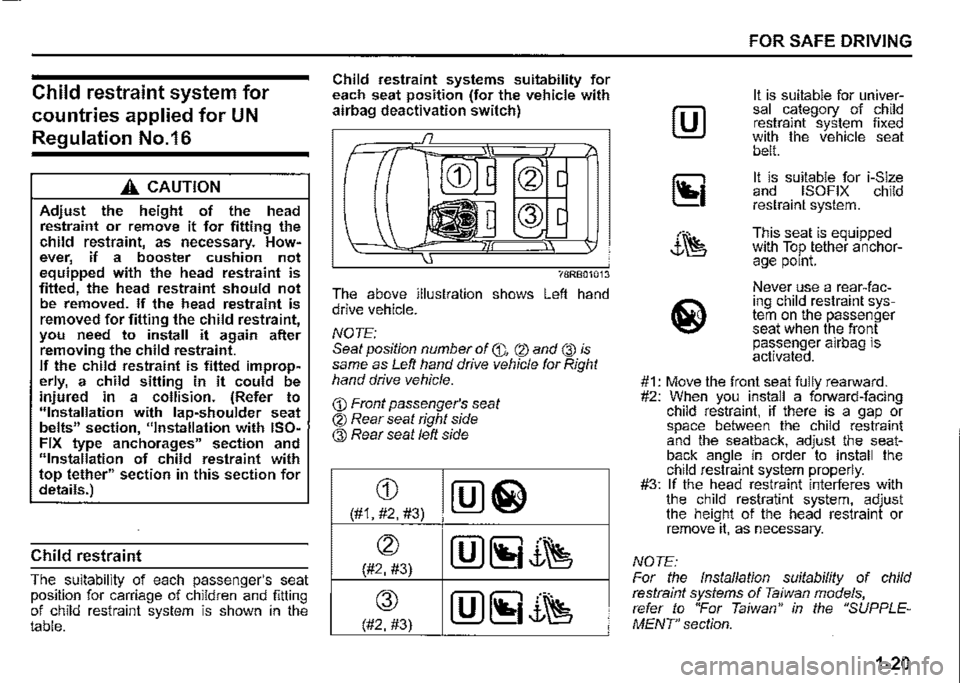
The suitability of each passenger's seat position for carriage of children and fitting of child restraint system is shown in the table.
Child restraint systems suitability for each seat position (for the vehicle with airbag deactivation switch)
The above illustration shows Left hand drive vehicle.
NOTE: Seat position number of G), @ and @ is same as Left hand drive vehicle for Right hand drive vehicle.
G) Front passenger's seat @ Rear seat right side @ Rear seat left side
G) (ID@ (#1. #2. #3)
(2) (ID~J,~ (#2, #3)
® (ID~J,~ (#2. #3)
FOR SAFE DRIVING
It is suitable for universal category of child restraint system fixed with the vehicle seat belt.
It is suitable for i-Size and ISOFIX child restraint system.
This seat is equipped with Top tether anchorage point.
Never use a rear-facing child restraint system on the passenger seat when the front passenger airbag is activated.
#1: Move the front seat fully rearward. #2: When you install a forward-facing child restraint, if there is a gap or space between the child restraint and the seatback, adjust the seatback angle in order to install the child restraint system properly. #3: If the head restraint interferes with the child restratint system, adjust the height of the head restraint or remove it, as necessary.
NOTE: For the Installation suitability of child restraint systems of Taiwan models, refer to "For Taiwan" in the "SUPPLEMENT" section.
1-20
Page 45 of 421
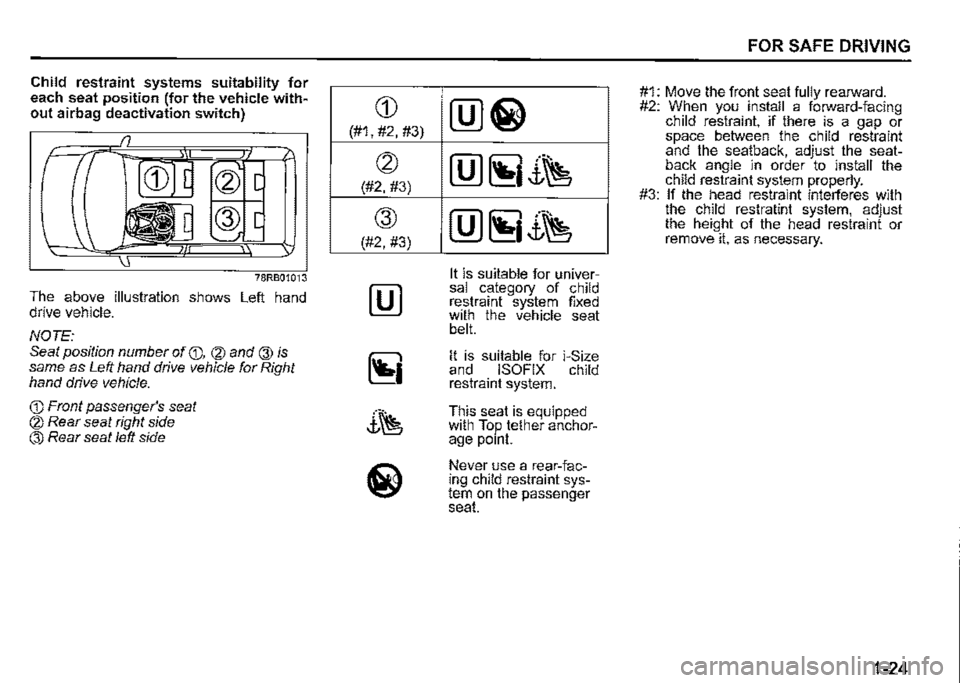
Child restraint systems suitability for each seat position (for the vehicle without airbag deactivation switch)
The above illustration shows Left hand drive vehicle.
NOTE: Seat position number of G), @ and @ is same as Left hand drive vehicle for Right hand drive vehicle.
G) Front passenger's seat @ Rear seat right side @ Rear seat left side
G)
(#1, #2, #3)
~
(#2, #3)
@
(#2, #3)
(gJ
(g)@
[g)~l~
[g)~l~
It is suitable for universal category of child restraint system fixed with the vehicle seat belt.
It is suitable for i-Size and ISOFIX child restraint system.
This seat is equipped with Top tether anchorage point.
Never use a rear-facing child restraint system on the passenger seat.
FOR SAFE DRIVING
#1: Move the front seat fully rearward. #2: When you install a forward-facing child restraint, if there is a gap or space between the child restraint and the seatback, adjust the seatback angle in order to install the child restraint system properly. #3: If the head restraint interferes with the child restratint system, adjust the height of the head restraint or remove it, as necessary.
1-24
Page 50 of 421
FOR SAFE DRIVING
ELR type belt
80JC021
1-29
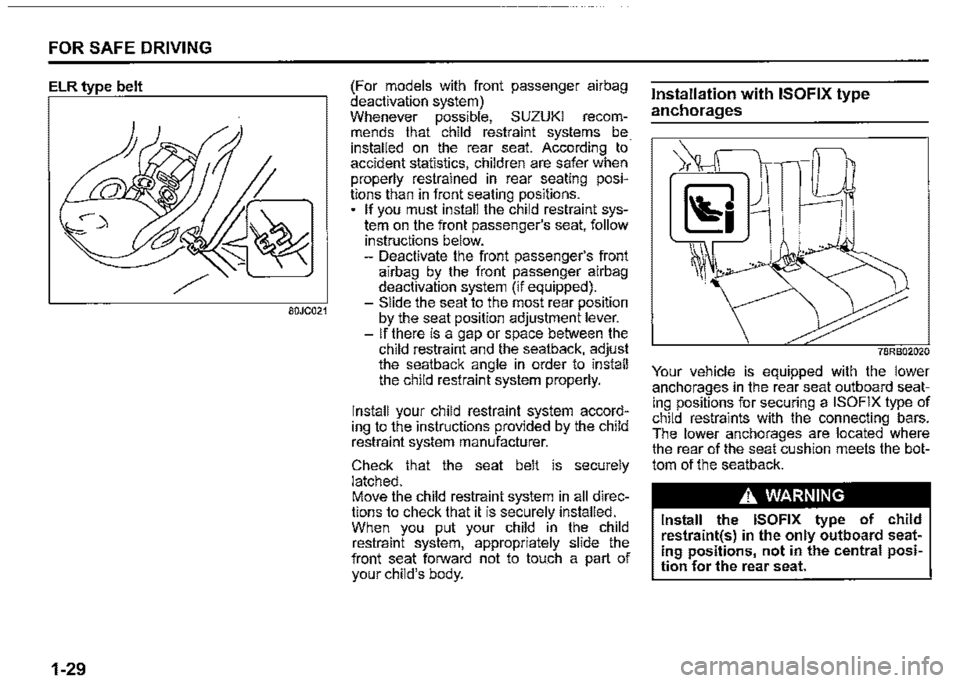
(For models with front passenger airbag deactivation system) Whenever possible, SUZUKI recommends that child restraint systems be installed on . th_e rear seat. According to· accident stat1st1cs, children are safer when ~roperly restrained in rear seating positions than in front seating positions. • If you must install the child restraint system on the front passenger's seat follow instructions below. ' -D_eactivate the front passenger's front airbag by the front passenger airbag d~activation system (if equipped). -Slide the seat to the most rear position by the seat position adjustment lever. -If there is a gap or space between the child restraint and the seatback, adjust the seatback angle in order to install the child restraint system properly.
Install your child restraint system according to the instructions provided by the child restraint system manufacturer.
Check that the seat belt is securely latched. Move the child restraint system in all directions to check that it is securely installed. When you put your child in the child restraint system, appropriately slide the front seat forward not to touch a part of your child's body.
Installation with ISOFIX type
anchorages
78RB02020
Your vehicle is equipped with the lower anchorages in the rear seat outboard seating positions for securing a ISOFIX type of child restraints with the connecting bars. The lower anchorages are located where the rear of the seat cushion meets the bottom of the seatback.
A WARNING
Install the ISOFIX type of child restraint(s) in the only outboard seating positions, not in the central position for the rear seat.
Page 51 of 421
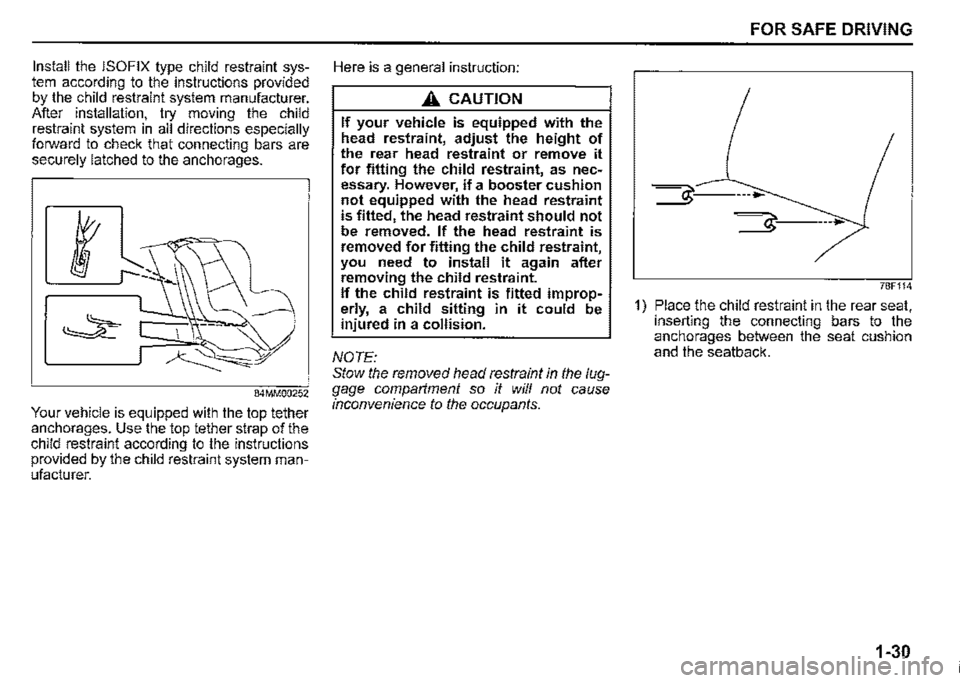
Install the ISOFIX type child restraint system according to the instructions provided by the child restraint system manufacturer. After installation, try moving the child restraint system in all directions especially forward to check that connecting bars are securely latched to the anchorages.
84MM00252
Your vehicle is equipped with the top tether anchorages. Use the top tether strap of the child restraint according to the instructions provided by the child restraint system manufacturer.
Here is a general instruction:
A CAUTION
If your vehicle is equipped with the head restraint, adjust the height of the rear head restraint or remove it for fitting the child restraint, as necessary. However, if a booster cushion not equipped with the head restraint is fitted, the head restraint should not be removed. If the head restraint is removed for fitting the child restraint, you need to install it again after removing the child restraint. If the child restraint is fitted improperly, a child sitting in it could be injured in a collision.
NOTE: Stow the removed head restraint in the luggage comparlment so it will not cause inconvenience to the occupants.
FOR SAFE DRIVING
it'---►
78F114
1) Place the child restraint in the rear seat, inserting the connecting bars to the anchorages between the seat cushion and the seatback.
1-30
Page 55 of 421
The pretensioner is located in each front seat belt retractor and each rear seat belt retractor in outboard seating position. The pretensioner tightens the seat belt so the belt fits the occupant's body more snugly in the event of a frontal or side collision. The retractors will remain locked after the pretensioners are activated. Upon activation, some noise will occur and some smoke may be released. These conditions are not harmful and do not indicate a fire in the vehicle.
The driver and all passengers must be properly restrained by fastening seat belts at all times, whether or not a pretensioner is equipped at their seating position, to minimize the risk of severe injury or death in the event of a collision.
Sit fully back in the seat; sit up straight; do not lean forward or sideways. Adjust the belt so the lap portion of the belt is worn low across the pelvis, not across the waist. Please refer to "Seat adjustment" section and the instructions and precautions about the seat belts in this "Seat belts and child restraint systems" section for details on proper seat and seat belt adjustments.
Please note that the pretensioners along with the airbags will activate in severe frontal or side collisions. They are not designed to activate in rear impacts, rollovers, or minor frontal side collisions. The pretensioners can be activated only once. If the pretensioners are activated (that is, if the airbags are activated), have the pretensioner system serviced by a SUZUKI dealer as soon as possible.
FOR SAFE DRIVING
If AIRBAG light on the instrument cluster does not blink or come on briefiy when the ignition switch is turned to "ON" position, stays on for more than 1 O seconds, or comes on while driving, the pretensioner system or the airbag system may not work properly. Have both systems inspected by a SUZUKI dealer as soon as possible.
Service on or around the pretensioner system components or wiring must be performed only by a SUZUKI dealer who is specially trained. Improper service could result in unintended activation of pretensioners or could render the pretensioner inoperative. Either of these two conditions may result in personal injury.
To prevent damage or unintended activation of the pretensioners, check that the lead-acid battery is disconnected and the ignition switch has been in "LOCK" position for at least 90 seconds before performing any electrical service work on your SUZUKI vehicle.
Do not touch pretensioner system components or wiring. The wires are wrapped with yellow tape or yellow tubing, and the couplers are yellow. When scrapping your SUZUKI vehicle, ask a SUZUKI dealer, body repair shop, or scrap yard for assistance.
1-34
Page 59 of 421

58MS030
.A WARNING
(Vehicle without the front passenger airbag deactivation system) Do not install a rear-facing child restraint in the front passenger's seat. If the passenger's front airbag inflates, a child in a rear-facing child restraint could be killed or severely injured. The back of a rear-facing child restraint would be too close to the inflating airbag.
Conditions of front airbags may inflate
.A WARNING
(Vehicle with the front passenger airbag deactivation system) When using child restraint system on the front passenger's seat, the front passenger's airbag system must be deactivated; otherwise deployment of the front passenger's airbag could result in the death or serious injury of the child.
Refer to "Seat belts and child restraint systems" section for details on securing your child .
FOR SAFE DRIVING
Conditions of front airbags deployment (inflation)
80J097
Frontal collision with a fixed wall that does not move or deform at more than about 25 km/h (15 mph)
80J098E
Strong impact equivalent to frontal collision such as above at left and right angles of about 30 degrees (1) or less from the front of your vehicle
1-38
Page 62 of 421

FOR SAFE DRIVING
80J110
• Vehicle rollover
NOTE: For vehicle equipped with the "Emergency
road assistance -global navigation satellite system (ERA-GLONASS)", refer to "Emergency Road Assistance -Global Navigation Satellite System (ERA-GLONASS)" in "For Russia and other countries adopting ERA-GLONASS" in the "SUPPLEMENT" section for further information.
1-41
Side airbags and side curtain air
bags
68KM090
Side airbags and side curtain airbags are designed to inflate in severe side impact collisions when the ignition switch is in "ON" position.
Side airbags and side curtain airbags are not designed to inflate in frontal or rear collisions, rollovers or minor side collisions, since they would offer no protection in those types of accidents. Only the side airbag and side curtain airbag on the side of the vehicle that is struck will inflate. However, in a frontal angle collision, the side airbags and side curtain airbags may inflate. Since an airbag deploys only one time during an accident, seat belts are needed to restrain occupants from further movements during the accident.
Therefore, an airbag is not a substitute for seat belts. To maximize your protection, always fasten your seat belts. Be aware that no system can prevent all possible injuries that may occur in an accident.
Side airbags
78RB02025
Side airbags are located in the part of the front seatbacks closest to the doors. The "SRS AIRBAG" labels are attached to the seatbacks to identify the location of the side airbags.
Page 66 of 421
FOR SAFE DRIVING
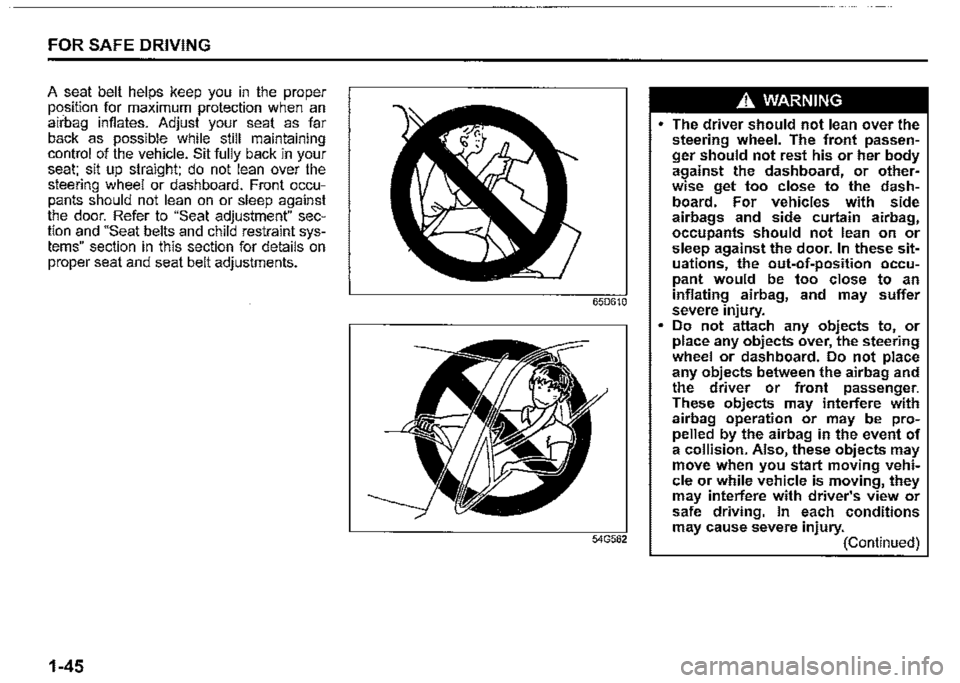
A seat belt helps keep you in the proper po_sition for maximum protection when an airbag infiates. Adjust your seat as far back as possible while still maintaining control of the vehicle. Sit fully back in your seat; sit up straight; do not lean over the steering wheel or dashboard. Front occupants should not lean on or sleep against the door. Refer to "Seat adjustment" section and "Seat belts and child restraint systems" section in this section for details on proper seat and seat belt adjustments.
1-45
A WARNING
• The driver should not lean over the steering wheel. The front passenger should not rest his or her body against the dashboard, or otherwise get too close to the dashboard. For vehicles with side airbags and side curtain airbag, occupants should not lean on or sleep against the door. In these situations, the out-of-position occupant would be too close to an inflating airbag, and may suffer severe injury. • Do not attach any objects to, or place any objects over, the steering wheel or dashboard. Do not place any objects between the airbag and the driver or front passenger. These objects may interfere with airbag operation or may be propelled by the airbag in the event of a collision. Also, these objects may move when you start moving vehicle or while vehicle is moving, they may interfere with driver's view or safe driving. In each conditions may cause severe injury. (Continued)
Page 143 of 421
Vehicle loading
Your vehicle is designed for specific weight capacities. The weight capacities of your vehicle are indicated by the Gross Vehicle Weight Rating (GVWR) and the Permissible maximum Axle Weight (PAW, front and rear). The GVWR and PAW (front and_ rear) are listed in "SPECIFICATIONS" section.
GVWR -Maximum permissible overall weight of the fully loaded vehicle (including all the occupants, accessories and cargo plus the trailer nose weight if towing a trailer). PAW (front and rear) -Maximum permissible weight on an individual axle.
Actual weight of the loaded vehicle and actual loads at the front and rear axles can only be determined by weighing the vehicle. Compare these weights to the GVWR and PAW (front and rear). If the g_ross vehicle weight or the load on either axle exceeds these ratings, you must remove enough weight to bring the load down to the rated capacity.
A_ WARNING
Never overload your vehicle. The gross vehicle weight (sum of the weights of the vehicle, all the occupants, accessories, cargo p~us trailer nose weight if towing a trailer) must never exceed the Gross Vehicle Weight Rating (GVWR). In addition, never distribute a load so that the weight on either the front or rear axle exceeds the Permissible maximum Axle Weight (PAW).
A_ WARNING
Always distribute cargo evenly. To avoid personal injury or damage to
your vehicle, always_ se~ure carg'? to prevent it from sh1ftmg 1f the vehicle moves suddenly. Place heavier objects on the floor and as far _forward in the cargo area as possible. Never pile cargo higher than the top of the seat backs.
BEFORE DRIVING
Trailer towing
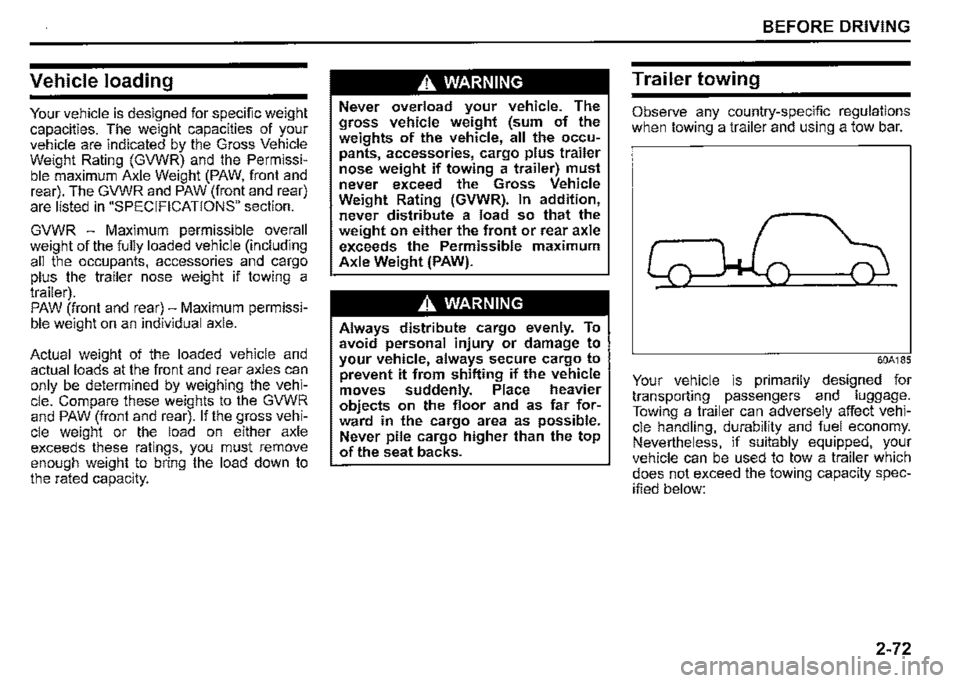
Observe any country-specific regulations when towing a trailer and using a tow bar.
60A185
Your vehicle is primarily designed for transporting passengers and luggage. Towing a trailer can adversely affect vehicle handling, durability and fuel economy. Nevertheless, if suitably equipped, your vehicle can be used to tow a trailer which does not exceed the towing capacity specified below:
2-72