lock SUZUKI JIMNY 2019 Repair Manual
[x] Cancel search | Manufacturer: SUZUKI, Model Year: 2019, Model line: JIMNY, Model: SUZUKI JIMNY 2019Pages: 421, PDF Size: 6.35 MB
Page 230 of 421
DRIVING TIPS
NOTICE
Avoid driving in a flooded area or a deep puddle. It may cause an engine stall, short in electrical components, engine and transmission damages, etc.
4-7
Do not drive through deep or rush
ing water
Driving in deep or rushing water can be hazardous. You could lose control of the vehicle and the occupants could drown. Also, your vehicle could be seriously damaged. To avoid these risks, observe the following instructions and precautions. Do not drive through deep or rushing water. Deep or rushing water, such as fast-moving streams or fioodwaters, could carry your vehicle away from your intended path. The water is too deep if it covers your wheel hubs, axles, or exhaust tailpipe. Know the depth of the water before you attempt to drive through it.
If the vehicle goes across the river unavoidably, follow the instructions below before going across the river. 1) Confirm the depth of the river and the terrain. 2) Select the place which is less than 30cm (11.8 inch) in depth of water. Go across the river to a right angle for the river or lower part of the river 3) Drive slowly at less than 5 km/h (3.1 mph) not to raise the wave and go across the river immediately to avoid operating the gearshift lever.
If the vehicle goes across the river that is more than 30 cm (11.8 inch) in depth of water unavoidably, stop the vehicle in a safe place while checking the brake effectiveness. Then, ask a SUZUKI dealer or a qualified workshop to check the following
inspection items. Function of brake Function of electrical components Changes of oil level and quality for engine, transmission and differential. In case that the oil is turbid whitely, water has been mixed in the oil and an oil change is required. Lubricant condition of the bearings, suspension joints, etc. If water blocks the tailpipe, the engine may not start or run. If the water is deep enough to get drawn into the engine intake system, the engine will be badly damaged. Submerged brakes will have poor braking performance. Drive slowly and carefully. Driving slowly will also help avoid water splashing onto the ignition system, which could cause the engine to stall. Even when driving through shallow or still waters, drive carefully since the water may be hiding ground hazards such as holes, ditches, or bumps.
Page 233 of 421
Improving fuel economy
The following instructions will help you improve fuel economy.
Avoid excessive idling If you park your vehicle for more than one minute, stop the engine and start it again later. When warming up a cold engine, do not allow the engine to idle or apply full throttle until the engine has reached operating temperature. Allow the engine to warm up by driving.
Avoid fast starts F~st starts away from lights or stop signs will consume fuel unnecessarily and shorten engine life. Start off slowly.
Avoid unnecessary stops Avoid unnecessary deceleration and stopping. Try to maintain a moderate, steady speed whenever possible. Slowing down and then accelerating again uses more fuel.
Keep a steady cruising speed Drive at a constant speed that road and traffic conditions will permit.
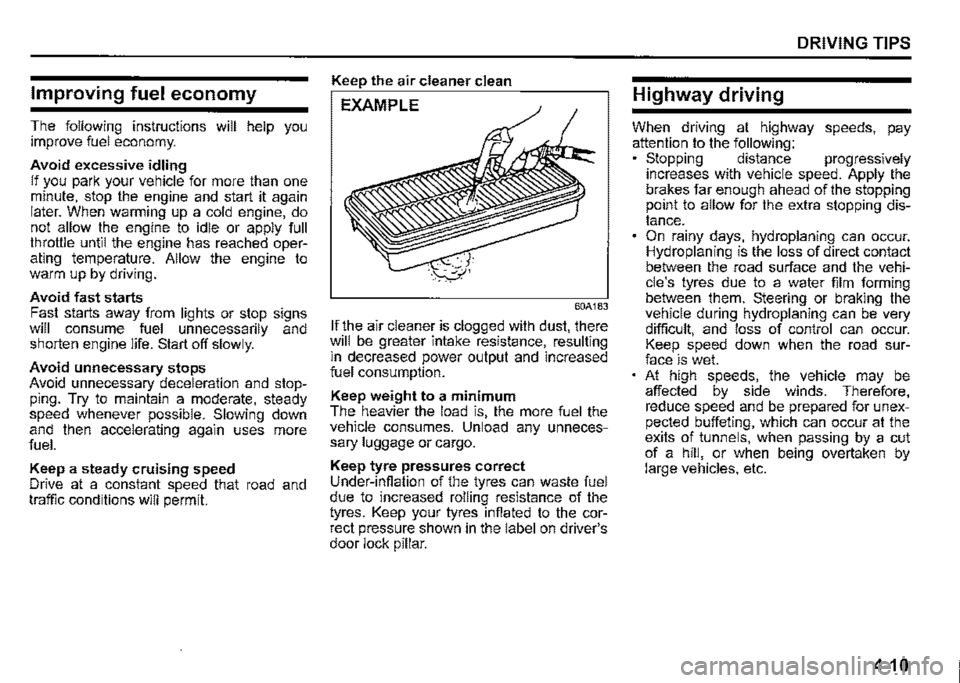
Keep the air cleaner clean
EXAMPLE
60A183
If the air cleaner is clogged with dust, there will be greater intake resistance, resulting m decreased power output and increased fuel consumption.
Keep weight to a minimum The heavier the load is, the more fuel the vehicle consumes. Unload any unnecessary luggage or cargo.
Keep tyre pressures correct Under-infiation of the tyres can waste fuel due to increased rolling resistance of the tyres. Keep your tyres infiated to the correct pressure shown in the label on driver's door lock pillar.
DRIVING TIPS
Highway driving
When driving at highway speeds, pay attention to the following: • Stopping distance progressively increases with vehicle speed. Apply the brakes far enough ahead of the stopping prnnt to allow for the extra stopping distance. On rainy days, hydroplaning can occur. Hydroplaning is the loss of direct contact between the road surface and the vehicle's tyres due to a water film forming between them. Steering or braking the vehicle during hydroplaning can be very difficult, and loss of control can occur. Keep speed down when the road surface is wet. At high speeds, the vehicle may be affected by side winds. Therefore, reduce speed and be prepared for unexpected buffeting, which can occur at the exits of tunnels, when passing by a cut of a hill, or when being overtaken by large vehicles, etc.
4-10
Page 234 of 421
DRIVING TIPS
Driving on hills
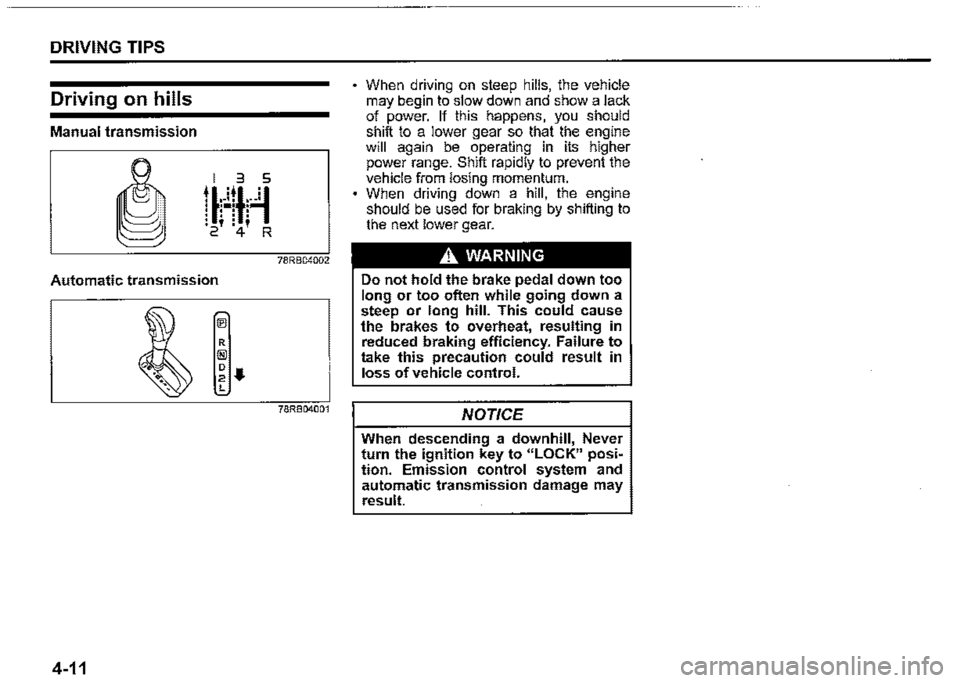
Manual transmission
78RB04002
Automatic transmission
78RB04001
4-11
When driving on steep hills, the vehicle may begin to slow down and show a lack of power. If this happens, you should shift to a lower gear so that the engine will again be operating in its higher power range. Shift rapidly to prevent the vehicle from losing momentum. When driving down a hill, the engine should be used for braking by shifting to the next lower gear.
A WARNING
Do not hold the brake pedal down too long or too often while going down a steep or long hill. This could cause the brakes to overheat, resulting in reduced braking efficiency. Failure to take this precaution could result in loss of vehicle control.
NOTICE
When descending a downhill, Never turn the ignition key to "LOCK" posiM lion. Emission control system and automatic transmission damage may result.
Page 236 of 421
OTHER CONTROLS AND EQUIPMENT
Fuel filler cap
78RB05001
5-1
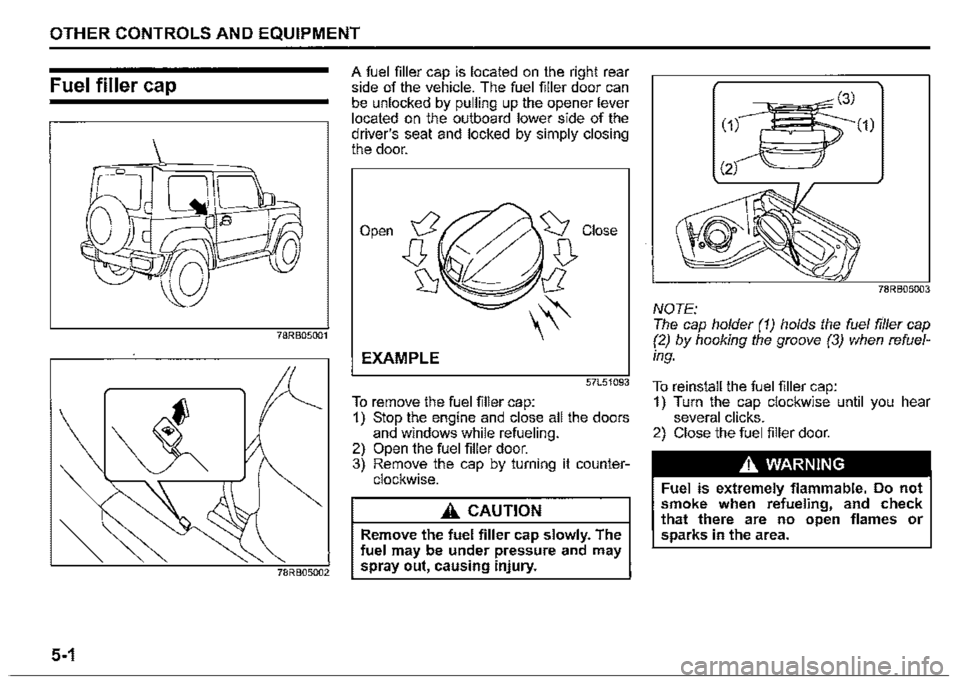
A fuel filler cap is located on the right rear side of the vehicle. The fuel filler door can be unlocked by pulling up the opener lever located on the outboard lower side of the driver's seat and locked by simply closing the door.
Open
EXAMPLE
57L51093
To remove the fuel filler cap: 1) Stop the engine and close all the doors and windows while refueling. 2) Open the fuel filler door. 3) Remove the cap by turning it counterclockwise.
A CAUTION
Remove the fuel filler cap slowly. The fuel may be under pressure and may spray out, causing injury.
78RB05003
NOTE: The cap holder (1) holds the fuel filler cap (2) by hooking the groove (3) when refuel
ing.
To reinstall the fuel filler cap: 1) Turn the cap clockwise until you hear several clicks. 2) Close the fuel filler door.
A WARNING
Fuel is extremely flammable. Do not smoke when refueling, and check that there are no open flames or sparks in the area.
Page 237 of 421
A WARNING
If you need to replace the fuel cap, use a genuine SUZUKI cap. Use of an improper cap can result in a malfunction of the fuel system or emission control system. It may also result in fuel leakage while driving and in the event of an accident.
OTHER CONTROLS AND EQUIPMENT
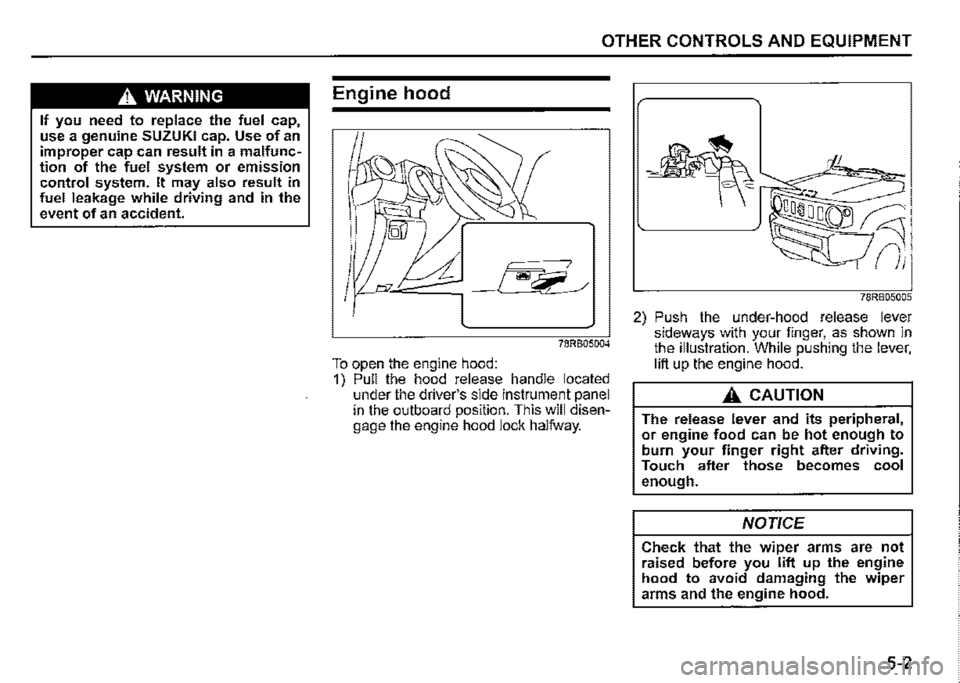
Engine hood
78RB05004
To open the engine hood: 1) Pull the hood release handle located under the driver's side instrument panel in the outboard position. This will disengage the engine hood lock halfway.
78RB05005
2) Push the under-hood release lever sideways with your finger, as shown in the illustration. While pushing the lever, lift up the engine hood.
A CAUTION
The release lever and its peripheral, or engine food can be hot enough to burn your finger right after driving. Touch after those becomes cool enough.
NOTICE
Check that the wiper arms are not raised before you lift up the engine hood to avoid damaging the wiper arms and the engine hood.
5-2
Page 239 of 421

Sun visor
79J161
The sun visors can be pulled down to block glare coming through the windshield, or they can be unhooked and turned to the side to block glare coming through the side window.
NOTICE
When unhooking and hooking a sun visor, handle it by the hard plastic parts or the sun visor can be dam
aged.
OTHER CONTROLS AND EQUIPMENT
Card holder (if equipped)
(1)
(2)
78RB05008
(1) Mirror cover (2) Card holder
You can put a card in the card holder (2) on the back of the sun visor.
NOTICE
When you park your vehicle outdoors in direct sunlight or in hot weather, do not leave plastic cards in the holder. The heat may distort them.
Vanity mirror (if equipped)
(3)
78RB05009
(3) Vanity mirror
To use the vanity mirror (3) on the back of the sun visor, pull up the mirror cover (1).
A WARNING
• Do not use the mirror while driving your vehicle or you lose control of the vehicle. • When using the vanity mirror, do not move too close to a front airbag location or lean against it. If the front airbag is accidentally inflated it could hit you hard. '
5-4
Page 240 of 421

OTHER CONTROLS AND EQUIPMENT
Interior light
Front
52RM50070
This light switch has three positions which function as described below:
ON (1) The light comes on and stays on regardless of whether the door is open or closed.
NOTE: The light will automatically be turned off to prevent the lead-acid battery from discharging when the following conditions are simultaneously met: The ignition switch is in "LOCK" position. The hazard warning lights, the position lights and the headlights are off.
5-5
• After 15 minutes from the light on.
DOOR (2) The light comes on when the door is opened. After closing all doors, the light will remain on for about 15 seconds and then fade out. If you insert the key to change the ignition mode to "ACC" or "ON" during this time, the light will start to fade out immediately. After removing the key from the ignition switch, the light will turn on for about 15 seconds and then fade out.
NOTE: The light will automatically be turned off to prevent the lead-acid battery from discharging when the following conditions are simultaneously met: • The ignition switch is in "LOCK" position. • After about 15 minutes of the light on.
OFF (3) The light remains off even when the door is opened.
Luggage compartment
(if equipped)
ON @l) o @i OFF
(1) (2)
78RB05010
This light switch has three positions which function as described below:
ON (1) The light comes on and stays on regardless of whether the tailgate is open or closed.
NOTE: The light will automatically be turned off to prevent the lead-acid battery from discharging when the following conditions are simultaneously met: The ignition switch is in "LOCK" position. The hazard warning lights, the position lights and the headlights are off. After 15 minutes from the light on.
Page 241 of 421

DOOR (2) The light comes on when the tailgate is opened. After closing the tailgate, the light will remain on for about 15 seconds and then fade out. If you insert the key to change the ignition mode to "ACC" or "ON" during this time, the light will start to fade out immediately. After removing the key from the ignition switch, the light will turn on for about 15 seconds and then fade out.
NOTE: The light will automatically be turned off to prevent the lead-acid battery from discharging when the following conditions are
simultaneously met: • The ignition switch is in "LOCK" position. • After about 15 minutes of the light on.
OFF (3) The light remains off even when the tailgate is opened.
NOTICE
Do not leave the tailgate open with the luggage · compartment light switch in ON position for a long time, or the lead-acid battery will discharge.
OTHER CONTROLS AND EQUIPMENT
NOTE: The light will automatically be turned off to prevent the lead-acid battery from discharging when after 15 minutes of the tail
gate open.
78RB05011
NOTE: The number of doors involved in the lighting operation of the interior light depends on the vehicle specification. If there is a switch (rubber protrusion) at the door opening as shown, the door is involved in the lighting operation. The tailgate is also involved in this operation even without the rubber protrusion.
Accessory socket
Luggage compartment (if equipped)
5-6
Page 242 of 421
OTHER CONTROLS AND EQUIPMENT
The accessory socket will work when the ignition switch is in "ACC" or "ON" position. This socket can be used to provide 12 volt/ 120 watt/1 O ampere power for electrical accessories. Check that the rubber cap remains on the socket when the socket is not in use.
5-7
NOTICE
To prevent the fuse from being blown, when using sockets at the same time, do not exceed the total combined power capacity of 12 volt/120 waW10 ampere. • Use of inappropriate electrical accessories can cause damage to your vehicle's electrical system. Check that any electrical accessories you use are designed to plug into this type of socket. • Check that the cap remains on the socket when the socket is not in use. When the ignition switch is in 11LOCK11 position during using the accessory socket, the following accidents may occur; -the audio or navigation system does not turn off. -the keyless entry system does not work, etc. If they occur, disconnect the item from the accessory socket and check whether the electrical equipments work properly. If the problem persists, ask a SUZUKI dealer to have the system inspected.
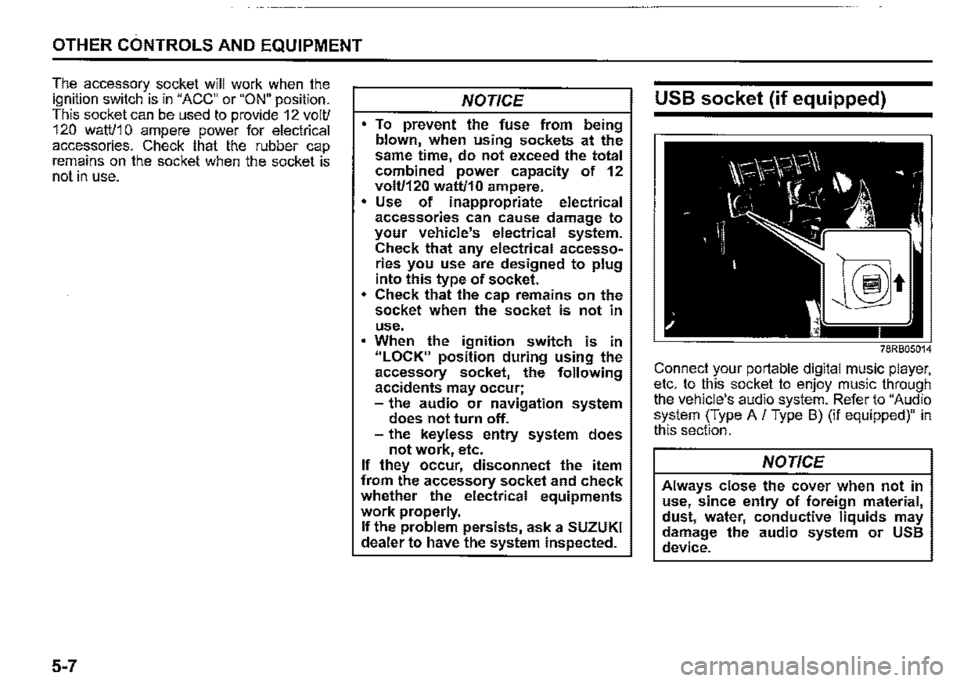
USB socket (if equipped)
78RB05014
Connect your portable digital music player, etc. to this socket to enjoy music through the vehicle's audio system. Refer to "Audio system (Type A I Type 8) (if equipped)" in this section.
NOTICE
Always close the cover when not in use, since entry of foreign material, dust, water, conductive liquids may damage the audio system or USS device.
Page 265 of 421

Radio antenna
Type A
63J055
Type B
61MMOA113
OTHER CONTROLS AND EQUIPMENT
The radio antenna on the roof is removable. To remove the antenna, turn it counterclockwise. To reinstall the antenna, turn it clockwise firmly by hand.
NOTICE
To avoid damage to the radio antenna: Remove the antenna when using an automatic car wash. • Remove the antenna when the antenna hits anything such as a low ceiling in a parking garage or putting a car cover over your vehicle.
Installation of radio frequency
transmitters
NOTE: When you intend to use Radio Frequency (RF) transmitting equipment in your vehicle, refer to "Installation of Radio Frequency (RF) Transmitting Equipment" in the end of this book.
NOTICE
Improper installation of mobile communication equipment such as cellular telephones, CB (Citizen's Band) radios or any other wireless transmitters may cause electronic interference with your vehicle's ignition system or any other electrical systems resulting in vehicle performance problems. Consult a SUZUKI dealer or qualified service technician for advice.
5-30