Cool SUZUKI JIMNY 2020 Owner's Manual
[x] Cancel search | Manufacturer: SUZUKI, Model Year: 2020, Model line: JIMNY, Model: SUZUKI JIMNY 2020Pages: 421, PDF Size: 6.35 MB
Page 332 of 421
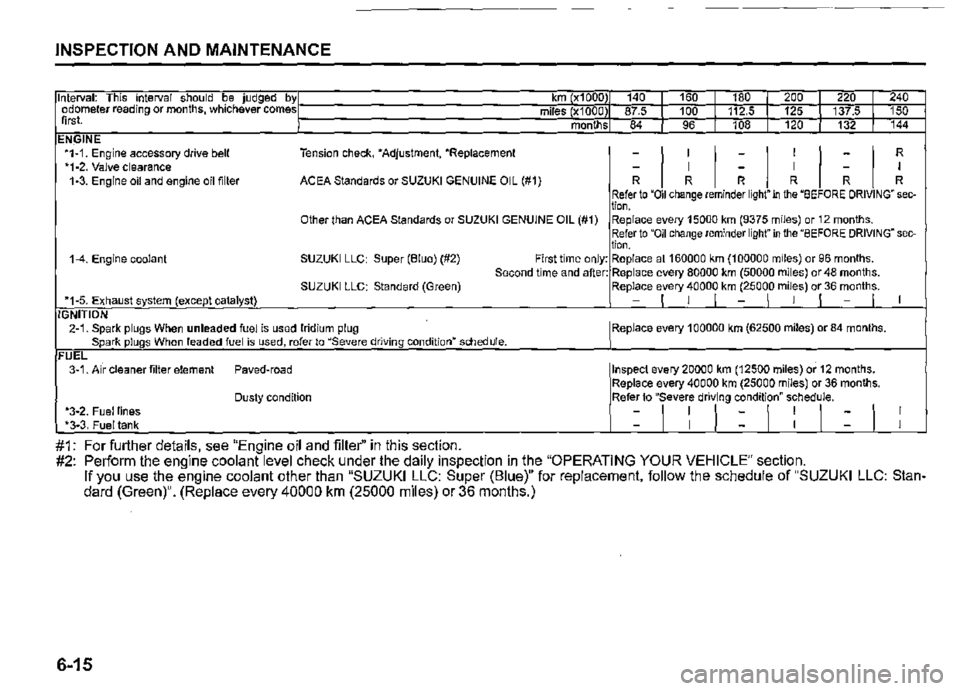
INSPECTION AND MAINTENANCE
Interval: This interval should be judged byl km (x1000)I 140 I 160 I 180 I 200 I 220 I 240 odometer reading or months, whichever comesI miles (x1000)I 87.5 I 100 I 112.5 I 125 I 137.5 ! 150 first. 1 monthsI 84 I 96 I 108 I 120 I 132 I 144 ENGINE •1-1. Engine accessory drive belt Tension check, *Adjustment, *Replacement -
I
I
I
-
I
I
I
-
I
R *1-2. Valve clearance -I -I -I 1-3. Engine oil and engine oil filter ACEA Standards or SUZUKI GENUINE OIL (#1) R R R R R R Refer to "Oil change reminder light" in the "BEFORE DRIVING" sec-lion. Other than ACEA Standards or SUZUKI GENUINE OIL (#1) Replace every 15000 km (9375 miles) or 12 months. Refer to "Oil change reminder light" in the "BEFORE DRIVING" sec-lion. 1-4. Engine coolant SUZUKI LLC: Super (Blue) (#2) First time only: Replace at 160000 km (100000 miles) or 96 months. Second time and after: Replace every 80000 km (50000 miles) or 48 months. SUZUKI LLC: Standard (Green) Replace every 40000 km (25000 miles) or 36 months. *1-5. Exhaust system (except catalyst) -I I I -I I I -I I IGNITION 2-1. Spark plugs When unleaded fuel is used Iridium plug !Replace every 100000 km (62500 miles) or 84 months. Spark plugs When leaded fuel is used, refer to ~severe driving condition~ schedule. FUEL 3-1. Air cleaner filter element Paved-road Inspect every 20000 km (12500 miles) or 12 months. Replace every 40000 km (25000 miles) or 36 months. Dusty condition Refer to "Severe driving condition~ schedule. *3-2. Fuel lines
= I : I = I : I -I I *3-3. Fuel tank -I
#1: For further details, see "Engine oil and filter" in this section. #2: Perform the engine coolant level check under the daily inspection in the "OPERATING YOUR VEHICLE" section. If you use the engine coolant other than "SUZUKI LLC: Super (Blue)" for replacement, follow the schedule of "SUZUKI LLC: Standard (Green)". (Replace every 40000 km (25000 miles) or 36 months.)
6-15
Page 336 of 421
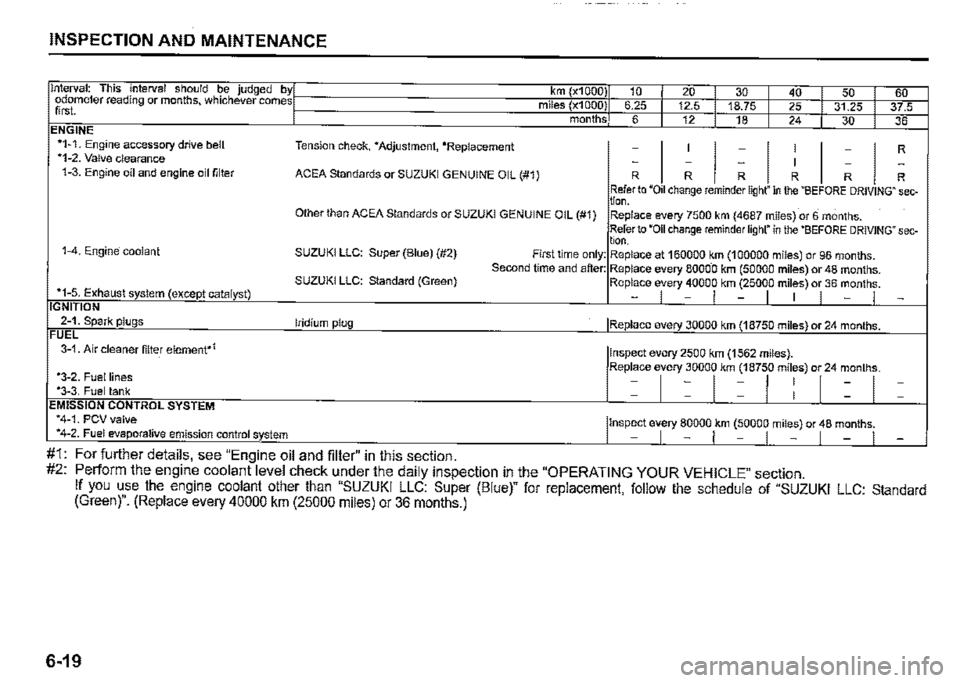
INSPECTION AND MAINTENANCE
Interval: This interval should be judged byl km (x1000)I 10 I 20 I 30 I 40 I 50 I 60 odometer reading or months, whichever comesI miles (x1000)I 6.25 I 12.5 I 18.75 I 25 I 31.25 I 37.5 ft~ I months! 6 I 12 I 18 I 24 I 30 I 36 ENGINE *1-1. Engine accessory drive belt Tension check, *Adjustment, *Replacement -
I
I
I
-
I
I
I
-
I
R *1-2. Valve clearance ---I --1-3. Engine oil and engine oil filter ACEA Standards or SUZUKI GENUINE OIL (#1) R R R R R R Refer to "Oil change reminder light" In the "BEFORE DRIVING" sec-Uon. Other than ACEA Standards or SUZUKI GENUINE OIL (#1) Replace every 7500 km (4687 miles) or 6 months. Refer to "011 change reminder light" in the "BEFORE DRIVING" sec-tion. 1-4. Engine· coolant SUZUKI LLC: Super (Blue) (#2) First time only: Replace at 160000 km (100000 miles) or 96 months. Second time and after: Replace every 80000 km (50000 miles) or 48 months. SUZUKI LLC: Standard (Green) Replace every 40000 km (25000 miles) or 36 months. *1-5. Exhaust system (except catalyst) -I -I -I I I -I -IGNITION 2-1. Spark plugs Iridium plug !Replace every 30000 km (18750 miles) or 24 months. FUEL 3-1. Air cleaner filter element"1 Inspect every 2500 km (1562 miles). Replace every 30000 km (18750 miles) ol 24 months. *3-2. Fuel lines -I -I -I I -I -*3-3. Fuel tank ---I --EMISSION CONTROL SYSTEM *4-1. PCV valve !Inspect every 80000 km (50000 miles) or fB monthsi *4-2. Fuel evaporative emission control system -1-1-1---#1: For further details, see "Engine oil and filter" in this section.
#2: Perform the engine coolant level check under the daily inspection in the "OPERATING YOUR VEHICLE" section. If you use the engine coolant other than "SUZUKI LLC: Super (Blue)" for replacement, follow the schedule of "SUZUKI LLC: Standard (Green)". (Replace every 40000 km (25000 miles) or 36 months.)
6-19
Page 337 of 421
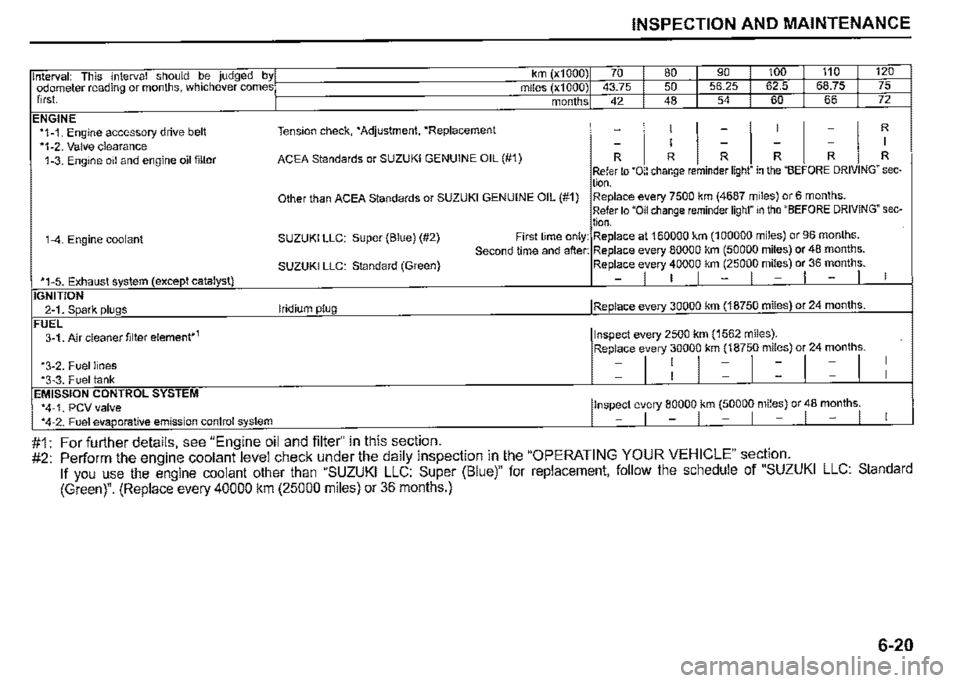
INSPECTION AND MAINTENANCE
Interval: This interval should be judged byl km (x1000) 70 I 80 I 90 I 100 I 110 I 120 odometer reading or months, whichever comesi miles (x1000) 43.75 I 50 I 56.25 I 62.5 I 68.75 I 75 first. I months 42 I 48 I 54 I 60 I 66 I 72
ENGINE *1-1. Engine accessory drive bell Tension check, *Adjustment, *Replacement -
I
I
I
-
I
I
I
-
I
R
*1-2. Valve clearance -I ---I
1-3. Engine oil and engine oil filter ACEA Standards or SUZUKI GENUINE OIL (#1) R R R R R R Refer to "Oil change reminder light" in the "BEFORE DRIVING" sec-tion. Other than ACEA Standards or SUZUKI GENUINE OIL (#1) Replace every 7500 km (4687 miles) or 6 months. Refer to "Oil change reminder light" in the "BEFORE DRIVING" sec-lion.
1-4. Engine coolant SUZUKI LLC: Super (Blue) (#2) First time only: Replace at 160000 km (100000 miles) or96 months. Second time and after: Replace every 80000 km (50000 miles) or 48 months.
SUZUKI LLC: Standard (Green) Replace erery 4000~ km (250010 miles) 0136 months.
*1-5. Exhaust system (except catalyst) -I ---I I
IGNITION 2-1. Spark plugs Iridium plug !Replace every 30000 km (18750 miles) or 24 months.
FUEL 3-1. Air cleaner filter element*1 Inspect every 2500 km (1562 miles). Replace every 30000 km (18750 miles) or 24 months.
*3-2. Fuel lines = I : I = I = I = I
I
*3-3. Fuel tank I
EMISSION CONTROL SYSTEM *4-1. PCV valve *4-2. Fuel evaporative emission control system
!Inspect every 80000 km (50000 miles) or 48 months. I -I I I -I I
#1: For further details, see "Engine oil and filter" in this section. #2: Perform the engine coolant level check under the daily inspection in the "OPERATING YOUR VEHICLE" section. If you use the engine coolant other than "SUZUKI LLC: Super (Blue)" for replacement, follow the schedule of "SUZUKI LLC: Standard
(Green)". (Replace every 40000 km (25000 miles) or 36 months.)
6-20
Page 343 of 421
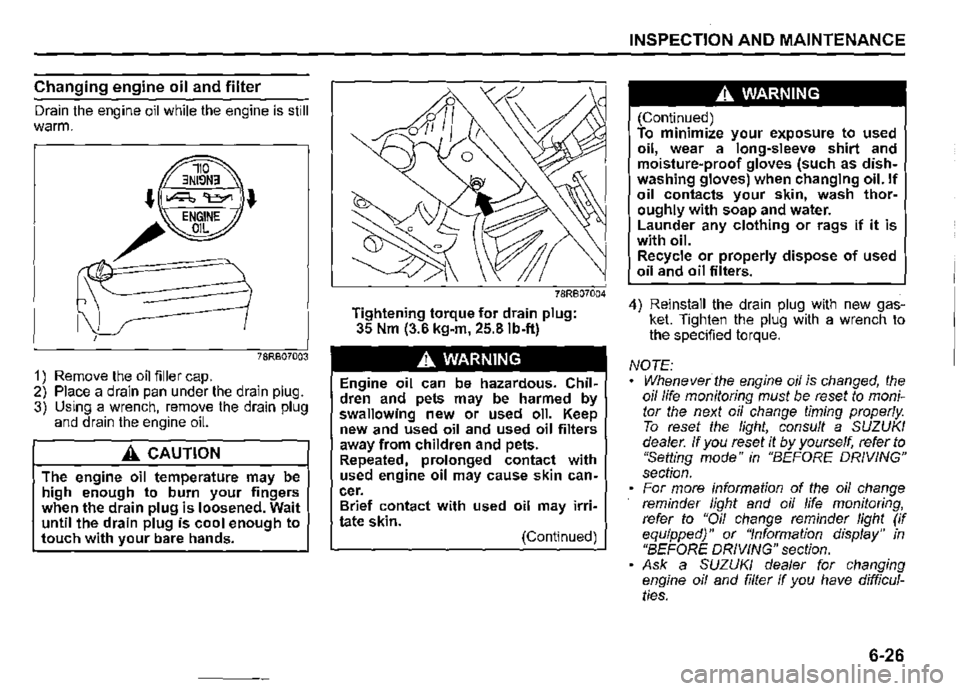
Changing engine oil and filter
Drain the engine oil while the engine is still warm.
78RB07003
1) Remove the oil filler cap. 2) Place a drain pan under the drain plug. 3) Using a wrench, remove the drain plug and drain the engine oil.
A CAUTION
The engine oil temperature may be high enough to burn your fingers when the drain plug is loosened. Wait until the drain plug is cool enough to touch with your bare hands.
Tightening torque for drain plug: 35 Nm (3.6 kg-m, 25.8 lb-ft)
A WARNING
Engine oil can be hazardous. Children and pets may be harmed by swallowing new or used oil. Keep new and used oil and used oil filters away from children and pets. Repeated, prolonged contact with used engine oil may cause skin cancer. Brief contact with used oil may irritate skin. (Continued)
INSPECTION AND MAINTENANCE
A WARNING
(Continued) To minimize your exposure to used oil, wear a long-sleeve shirt and moisture-proof gloves (such as dishwashing gloves) when changing oil. If oil contacts your skin, wash thoroughly with soap and water. Launder any clothing or rags if it is with oil. Recycle or properly dispose of used oil and oil filters.
4) Reinstall the drain plug with new gasket. Tighten the plug with a wrench to the specified torque.
NOTE: • Whenever the engine oil is changed, the oil life monitoring must be reset to monitor the next oil change timing properly To reset the light, consult a SUZUKI dealer. If you reset it by yourself, refer to "Setting mode" in "BEFORE DRIVING" section. For more information of the oil change reminder light and oil life monitoring, refer to "Oil change reminder light (if equipped)" or "Information display" in "BEFORE DRIVING" section. Ask a SUZUKI dealer for changing engine oil and filter If you have difficulties.
6-26
Page 345 of 421
Refill with oil and oil leakage check
1) Pour oil through the filler hole and install the filler cap. For the approximate capacity of the oil, refer to "Recommended fuel / lubricants and capacities (approx.)" in "SPECIFICATIONS" section. 2) Start the engine and carefully check the oil filter and the drain plug for leakage. Run the engine at various speeds for at least 5 minutes. 3) Stop the engine and wait about 5 minutes. Check the oil level again and add oil if necessary. Check for leakage again.
NOTICE
When replacing the oil filter, it is recommended that you use a genuine SUZUKI replacement filter. If you use an aftermarket filter, check that it is of equivalent quality and follow the manufacturer's instructions. • Oil leakage from the periphery of the oil filter or drain plug indicate incorrect installation or gasket damage. If you find any leakage or are not sure that the filter has been properly tightened, have the vehicle inspected by a SUZUKI dealer.
Engine coolant
Selection of coolant
NOTICE
SUZUKI LLC: Super (Blue) coolant; This coolant is already diluted to the proper percentage. Do not dilute with distilled water additionally. Doing so may result in the possibility of freezing and/or overheating coolant.
To maintain optimum performance and durability of your engine, use SUZUKI genuine coolant or equivalent.
NOTE: If you use the engine coolant other than the SUZUKI LLC: Super (Blue) for replacement, follow the schedule of SUZUKI LLC: Standard (Green). To see the detail of the maintenance schedule, refer to "Periodic maintenance schedule" in this section.
This type of coolant is the best for cooling system for the following reasons: • The coolant helps maintain proper engine temperature. It gives proper protection against freezing and boiling. It gives proper protection against corrosion and rust.
INSPECTION AND MAINTENANCE
Failure to use the proper coolant can damage your cooling system. Your SUZUKI dealer can help you select the proper coolant.
NOTICE
To avoid damaging your cooling system: Always use a high quality ethylene glycol base non-silicate type coolant diluted with distilled water at the correct mixture concentration. Check that the proper mix is 50/50 coolant to distilled water and in no case higher than 70/30. Concentrations greater than 70/30 coolant to distilled water will cause overheating conditions. Do not use straight coolant nor plain water (except "SUZUKI LLC: Super {Blue)"). . • Do not add extra inhibitors or additives. They may not be compatible with your cooling system. Do not mix different types of base coolants. Doing so may result in accelerated seal wear and/or the possibility of severe overheating and extensive engine/automatic transmission damage.
6-28
Page 346 of 421
INSPECTION AND MAINTENANCE
NOTE: SUZUKI highly recommends the use of ECSTAR brand coolant. ECSTAR has been specially formulated for your SUZUKI product and contributes to the desired vehicle performance and ideal driving experience.
Coolant level check
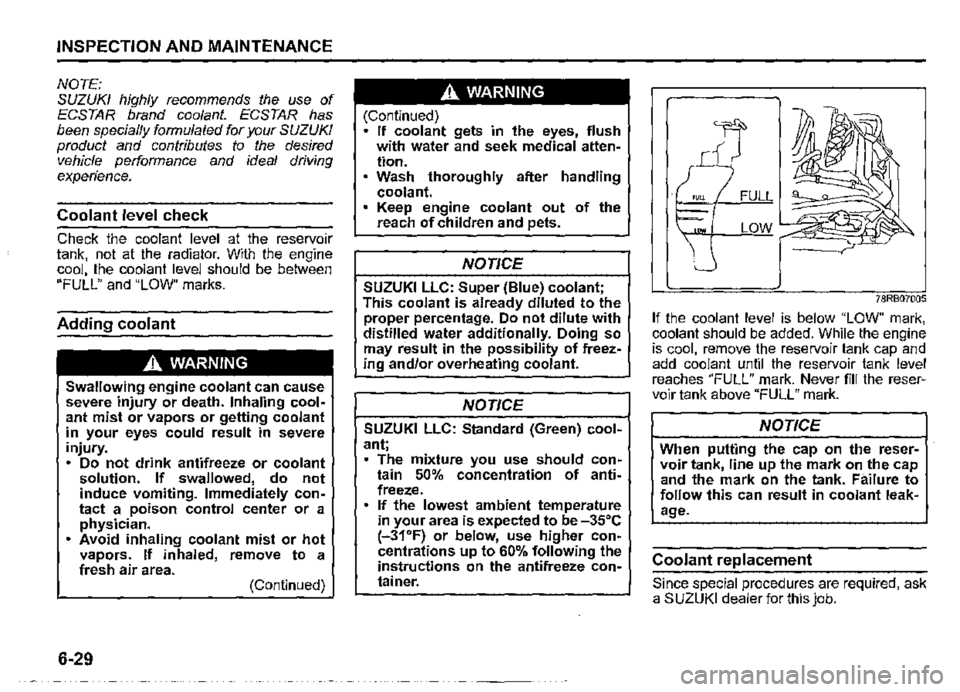
Check the coolant level at the reservoir tank, not at the radiator. With the engine cool, the coolant level should be between "FULL" and "LOW" marks.
Adding coolant
,A WARNING
Swallowing engine coolant can cause severe injury or death. Inhaling coolant mist or vapors or getting coolant in your eyes could result in severe injury. • Do not drink antifreeze or coolant solution. If swallowed, do not induce vomiting. Immediately contact a poison control center or a physician. • Avoid inhaling coolant mist or hot vapors. If inhaled, remove to a fresh air area. (Continued)
6-29
,A WARNING
(Continued) • If coolant gets in the eyes, flush with water and seek medical attention. Wash thoroughly after handling coolant. Keep engine coolant out of the reach of children and pets.
NOTICE
SUZUKI LLC: Super (Blue) coolant; This coolant is already diluted to the proper percentage. Do not dilute with distilled water additionally. Doing so may result in the possibility of freezing and/or overheating coolant.
NOTICE
SUZUKI LLC: Standard (Green) coolant; • The mixture you use should contain 50% concentration of antifreeze. If the lowest ambient temperature in your area is expected lo be -35°C (-31'F) or below, use higher concentrations up to 60% following the instructions on the antifreeze container.
78RB07005
If the coolant level is below "LOW" mark, coolant should be added. While the engine is cool, remove the reservoir tank cap and add coolant until the reservoir tank level reaches "FULL" mark. Never fill the reservoir tank above "FULL" mark.
NOTICE
When putting the cap on the reservoir tank, line up the mark on the cap and the mark on the tank. Failure to follow this can result in coolant leakage.
Coolant replacement
Since special procedures are required, ask a SUZUKI dealer for this job.
Page 350 of 421
· INSPECTION AND MAINTENANCE
A CAUTION
After driving the vehicle, the gear oil temperature may be high enough to burn you. Wait until the oil filler and level plug are cool enough to touch with your bare hands before inspecting gear oil level.
NOTICE
Be sure to use new plug with new gasket to avoid loose·ness of the plug and oil leakage.
Gear oil change
Since special procedures, materials and tools are required, ask a SUZUKI dealer for this job.
6-33
Clutch pedal
Fluid control clutch
78RB07011
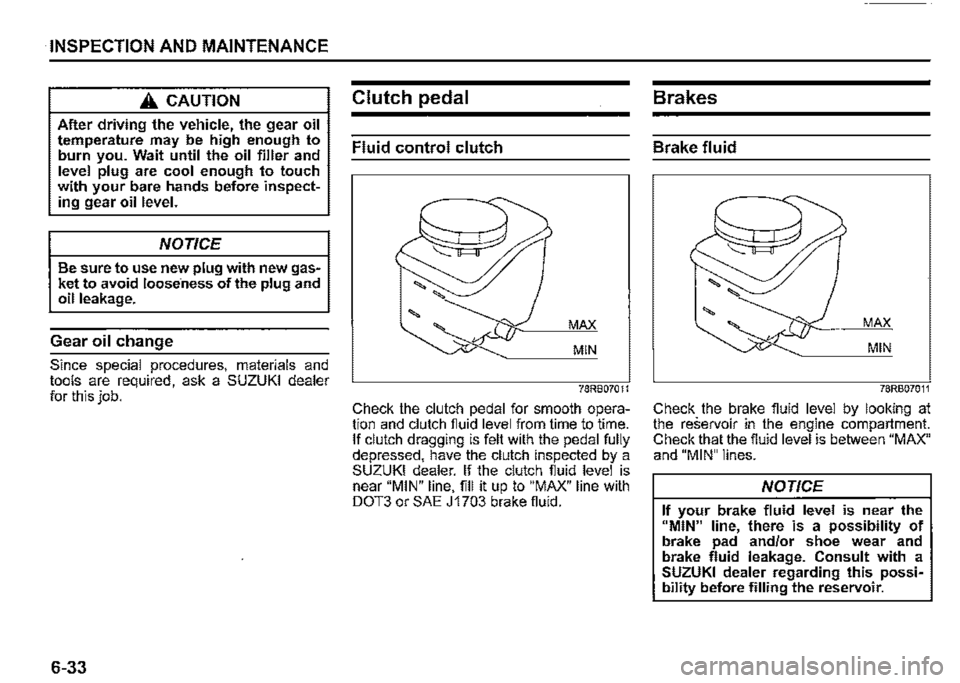
Check the clutch pedal for smooth operation and clutch fiuid level from time to time. If clutch dragging is felt with the pedal fully depressed, have the clutch inspected by a SUZUKI dealer. If the clutch fiuid level is near "MIN" line, fill it up to "MAX" line with DOT3 or SAE J1703 brake fiuid.
Brakes
Brake fluid
MAX
MIN
78RB07011
Check the brake fluid level by looking at the reservoir in the engine compartment. Check that the fiuid level is between "MAX" and "MIN" lines.
NOTICE
If your brake fluid level is near the 11MIN" line, there is a possibility of brake pad and/or shoe wear and brake fluid leakage. Consult with a SUZUKI dealer regarding this possibility before filling the reservoir.
Page 354 of 421

INSPECTION AND MAINTENANCE
specified pressure when tyres cool down. Also, tyres that are inflated to the specified pressure in a warm garage may have pressure below the specification when the vehicle is driven outside in very cold temperature. If you adjust the tyre pressure in a garage that is warmer than the outside temperature, you should add 1 kPa to the recommended cold tyre pressure for every O.B'C difference between garage temperature and outside temperature.
6-37
Tyre inspection
Inspect your vehicle's tyres at least once a month or before long trip by performing the following checks:
1) Measure the air pressure with a tyre gauge. Adjust the pressure if necessary. Remember to check the spare tyre, too.
A WARNING
• Air pressures should be checked when the tyres are cold or you may get inaccurate readings. Check the inflation pressure from time to time while inflating the tyre gradually, until the specified pressure is obtained. Never under-inflate or over-inflate the tyres. Under-inflation can cause unusual handling characteristics or can cause the rim to slip on the tyre bead, resulting in an accident or damage to the tyre or rim. Over-inflation can cause the lyre to burst, resulting in personal injury. Over-inflation can also cause unusual handling characteristics which may result in an accident.
(1)
~ (2)
78RB07048
(1) Tread wear indicator (2) Indicator location mark
2) Check that the depth of the tread groove is more than 1.6 mm (0.06 in.). To help you check this, the tyres have molded-in tread wear indicators in the grooves. When the indicators appear on the tread surface, the remaining depth of the tread is 1.6 mm (0.06 in.) or less and the tyre should be replaced. 3) Check for abnormal wear, cracks and damage. Any tyres with cracks or other damage should be replaced. If any tyres show abnormal wear, have them inspected by a SUZUKI dealer.
Page 364 of 421
INSPECTION AND MAINTENANCE
Bulb replacement
_A CAUTION
Light bulbs can be hot enough to burn your finger right after turning off lights. This is true especially for halogen headlight bulbs. Replace the bulbs after they become cool enough.
The headlight bulbs are filled with pressurized halogen gas. They can burst and injure you if they are hit or dropped. Handle them carefully. To avoid injury by sharp-edged parts of the body, wear gloves and a long-sleeved shirt when replacing light bulbs.
NOTICE
The oils from your skin may cause a halogen bulb to overheat and burst when the lights are on. Grasp a new bulb with a clean cloth.
NOTICE
Frequent bulb replacement indicates the need for an inspection of the electrical system. This should be carried out by a SUZUKI dealer.
6-47
Headlights
LED type
Since special procedures are required, it is recommended that you take your vehicle to a SUZUKI dealer for light replacement.
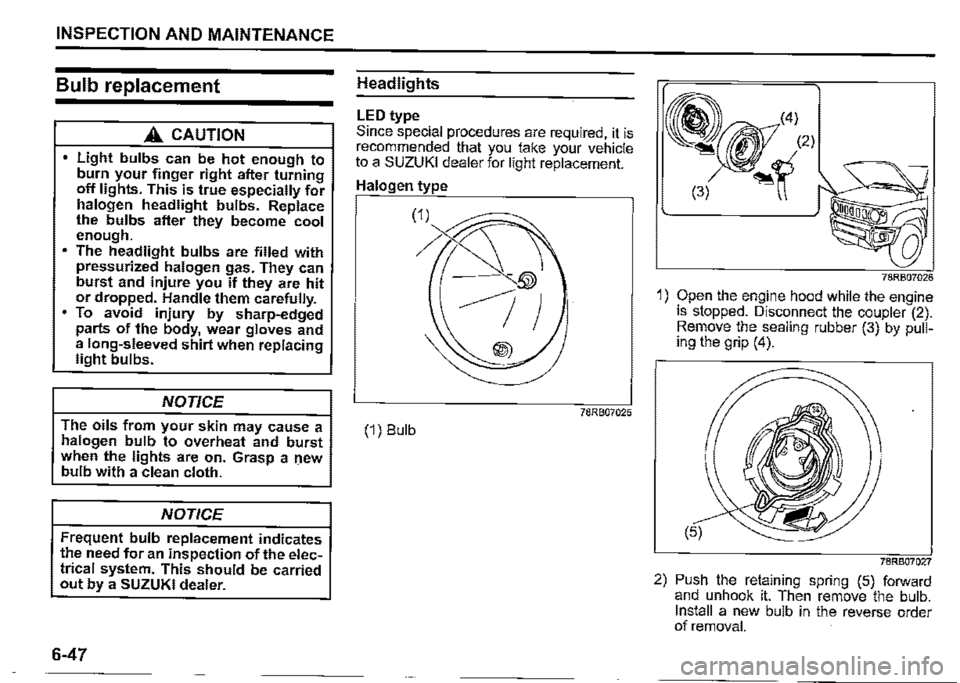
Halogen type
78RB07025
(1) Bulb
8~'",,,
""
'\:~
(3) ~f I r-,.t:: l'1
Jlilt10or\01 ~o
"-" [l!l ,Q
78RB07026
1) Open the engine hood while the engine is stopped. Disconnect the coupler (2). Remove the sealing rubber (3) by pulling the grip (4).
78RB07027
2) Push the retaining spring (5) forward and unhook it. Then remove the bulb. Install a new bulb in the reverse order of removal.
Page 387 of 421
Engine trouble: Starter does
not operate
1) Try turning the ignition switch to "START" position with the headlights turned on to determine the lead-acid battery condition. If the headlights go excessively dim or go off, it usually means that either the lead-acid battery is discharged or the battery terminal contact is poor. Recharge the lead-acid battery or correct battery terminal contact as necessary. 2) If the headlights remain bright, check the fuses. If the reason for failure of the starter is not obvious, there may be a major electrical problem. Have the vehicle inspected by a SUZUKI dealer.
Engine trouble: Does not start
Make sure that your vehicle has enough · fuel and battery. If the engine does not start under very cold condition, press the accelerator pedal all the way to the fioor and hold it while cranking the engine. Refer to "Starting engine" in operating your vehicle section. If the engine still does not start have your vehicle inspected at a SUZUKI dealer. Do not operate the starter motor for more than 12 seconds.
EMERGENCY SERVICE
Engine trouble: Overheating
The engine could overheat temporarily under severe driving conditions. If the high engine coolant temperature warning light comes on as overheating or the engine coolant temperature gauge indicates overheating during driving:
1) Turn off the air conditioner. 2) Take the vehicle to a safe place and park. 3) Run the engine at a normal idle speed for a few minutes until the high engine coolant temperature warning light goes off or the indicator is within the normal, acceptable temperature range between "H" and "C".
A WARNING
If you see or hear escaping steam, stop the vehicle in a safe place and immediately turn off the engine to cool it. Do not open the hood when steam is present. When the steam can no longer be seen or heard, open the hood to see if the coolant is still boiling. If it is, you must wait until it stops boiling before you proceed.
7-10