brake SUZUKI JIMNY 2020 Owner's Manual
[x] Cancel search | Manufacturer: SUZUKI, Model Year: 2020, Model line: JIMNY, Model: SUZUKI JIMNY 2020Pages: 421, PDF Size: 6.35 MB
Page 158 of 421
OPERATING YOUR VEHICLE
Clutch pedal (1)
A clutch pedal is used to disengage the driving force to the wheels when starting the engine, stopping, or shifting the gearshift lever. Depressing the pedal disengages the clutch.
A WARNING
Do not drive with your foot resting on the clutch pedal. It could result in excessive clutch wear, clutch damage, or unexpected loss of engine braking.
Brake pedal (2)
Your vehicle is equipped with either front and rear disc brakes or front disc brakes and rear drum brakes. Depressing a brake pedal applies both sets of brakes.
You may hear occasional brake squeal when you apply the brakes. This is a normal condition caused by environmental factors such as temperature, humidity or dust, etc.
A WARNING
If brake squeal is excessive and occurs each time the brakes are applied, you should have the brakes checked by a SUZUKI dealer.
3-7
A WARNING
Do not apply brakes continuously or rest your foot on the brake pedal. This will result in overheating of the brakes which could cause unpredictable braking action, longer stopping distances, or permanent brake dam
age.
Accelerator pedal (3)
An accelerator pedal controls the speed of the engine. Depressing the accelerator pedal increases power output and speed.
Starting engine
Before starting engine
~ 2 4 R
AT
NOTE: Your vehicle is equipped with Brake Over-fl..l""'"-i ® ride System. If you depress both the accelerator pedal and the brake pedal simultaneously, the engine power output may be suppressed.
78RB03001
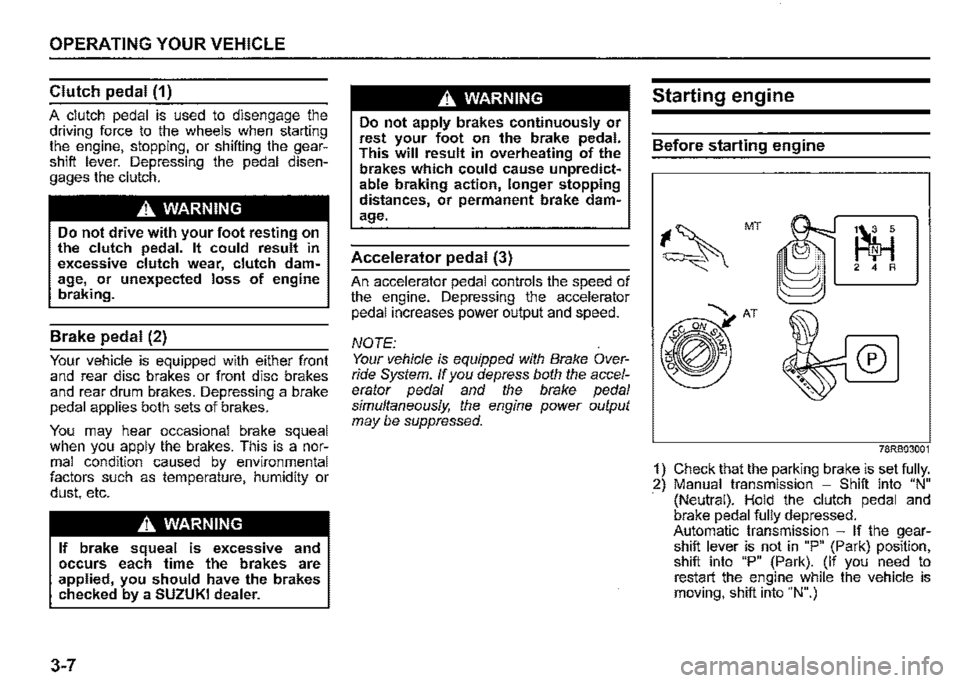
1) Check that the parking brake is set fully. 2) Manual transmission -Shift into "N" (Neutral). Hold the clutch pedal and brake pedal fully depressed. Automatic transmission -If the gearshift lever is not in "P" (Park) position, shift into "P" (Park). (If you need to restart the engine while the vehicle is moving, shift into "N".)
Page 159 of 421

NOTE: Automatic transmission vehicles have a starter interlock device which is designed to keep the starter from operating if the transmission is in any of the drive positions.
A WARNING
Check that the parking brake is set fully and the transmission is in Neutral (or Park for vehicles with an automatic transmission) before attempting to start the engine.
Starting a cold and warm engine
With your foot taken off the accelerator pedal, crank the engine by turning the ignition key to "START". Release the key when the engine starts.
NOTICE
• Stop turning the starter immediately after the engine has started or the starter system can be damaged. For protection of a lead-acid battery and a starter motor, do not use the starter motor by turning the key to "START" for more than 12 seconds at a time. If the engine dose not start, turn the key to 11LOCK" position and wait for more than 30 seconds before trying again. If the engine does not start after several attempts, consult a SUZUKI dealer or a qualified workshop.
If the engine does not start after 12 seconds of cranking, wait about 30 seconds, and then press down the accelerator pedal to 1/3 of its stroke and try cranking the engine again. Release the key and accelerator pedal when the engine starts.
If the engine still does not start, depress the accelerator pedal all the way to the fioor while cranking.
OPERATING YOUR VEHICLE
Using transmission
A WARNING
Do not hang any items on the gearshift lever and do not use the gearshift lever as a handrest. Otherwise, it could prevent proper operation of the gearshift lever and cause its malfunction, resulting in an accident.
Manual transmission
3 5
1-$=1
2 4 R
78RB03002
3-8
Page 160 of 421
OPERATING YOUR VEHICLE
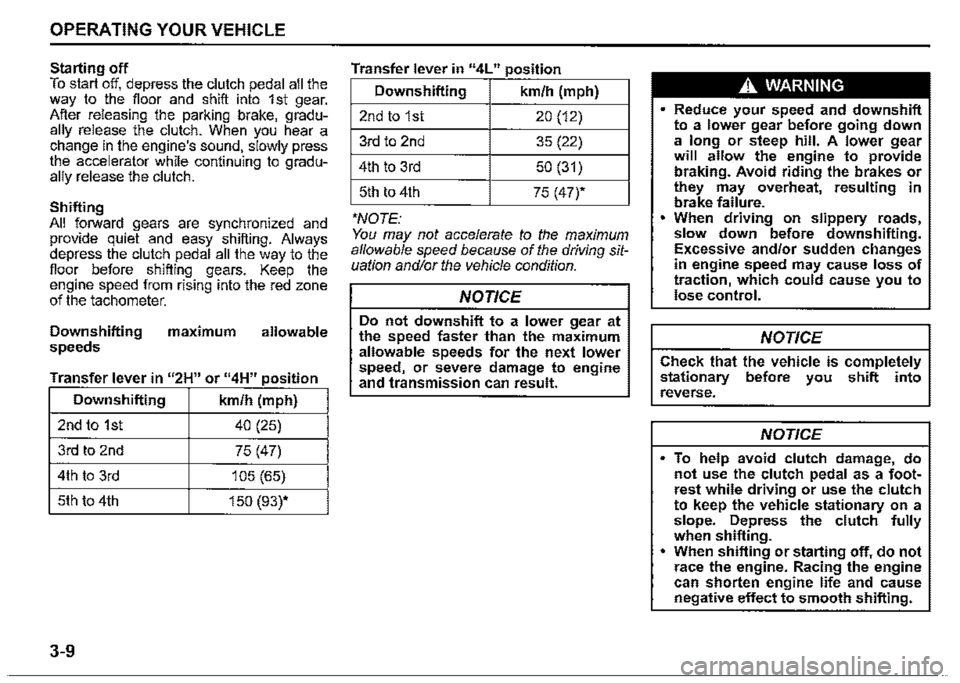
Starting off To start off, depress the clutch pedal all the way to the floor and shift into 1 st gear. After releasing the parking brake, gradually release the clutch. When you hear a change in the engine's sound, slowly press the accelerator while continuing to gradually release the clutch.
Shifting All forward gears are synchronized and provide quiet and easy shifting. Always depress the clutch pedal all the way to the floor before shifting gears. Keep the engine speed from rising into the red zone of the tachometer.
Downshifting maximum allowable speeds
Transfer lever in "2H" or "4H" position
Downshifting km/h (mph)
2nd to 1st 40 (25)
3rd to 2nd 75 (47)
4th to 3rd 105 (65)
5th to 4th 150 (93)*
3-9
Transfer lever in "4L" position
Downshifting km/h (mph)
2ndto1st 20 (12)
3rd to 2nd 35 (22)
4th to 3rd 50 (31)
5th to 4th 75 (47)*
*NOTE: You may not accelerate to the maximum allowable speed because of the driving situation and/or the vehicle condition.
NOTICE
Do not downshift to a lower gear at the speed faster than the maximum allowable speeds for the next lower speed) or severe damage to engine and transmission can result.
A WARNING
• Reduce your speed and downshift to a lower gear before going down a long or steep hill. A lower gear will allow the engine to provide braking. Avoid riding the brakes or they may overheat, resulting in brake failure. When driving on slippery roads, slow down before downshifting. Excessive and/or sudden changes in engine speed may cause loss of traction, which could cause you to lose control.
NOTICE
Check that the vehicle is completely stationary before you shift into reverse.
NOTICE
To help avoid clutch damage, do not use the clutch pedal as a footrest while driving or use the clutch to keep the vehicle stationary on a slope. Depress the clutch fully when shifting. • When shifting or starting off, do not race the engine. Racing the engine can shorten engine life and cause negative effect to smooth shifting.
Page 161 of 421
Automatic transmission
Gearshift lever
[eJ
R
[fj)
D
2 L
78RB03003
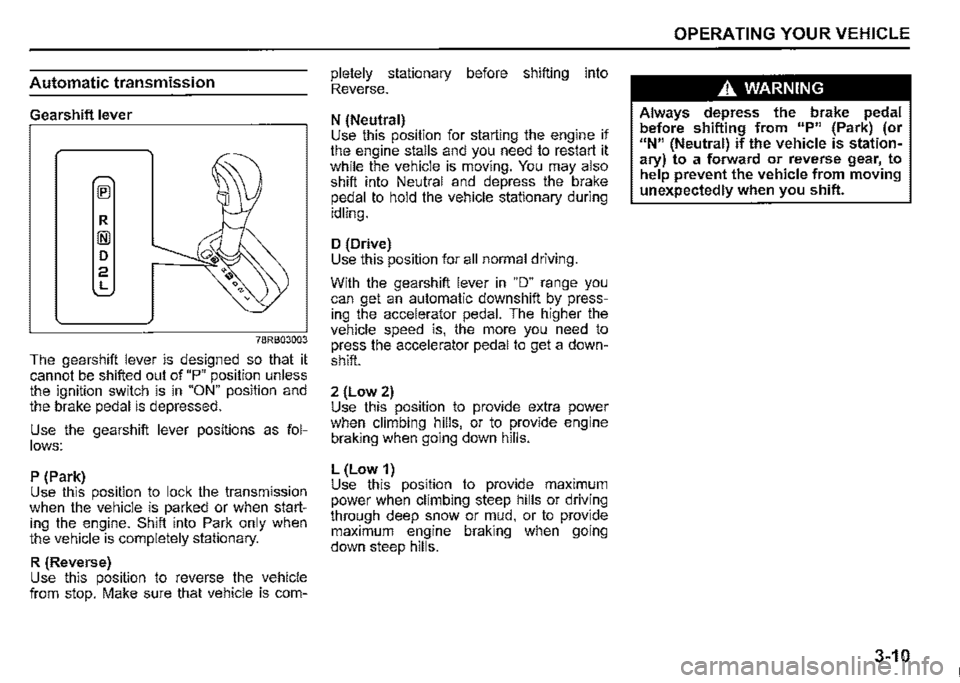
The gearshift lever is designed so that it cannot be shifted out of "P" position unless the ignition switch is in "ON" position and the brake pedal is depressed.
Use the gearshift lever positions as follows:
P (Park) Use this position to lock the transmission when the vehicle is parked or when starting the engine. Shift into Park only when the vehicle is completely stationary.
R (Reverse) Use this position to reverse the vehicle from stop. Make sure that vehicle is corn-
pletely stationary before shifting into Reverse.
N (Neutral) Use this position for starting the engine if the engine stalls and you need to restart it while the vehicle is moving. You may also shift into Neutral and depress the brake pedal to hold the vehicle stationary during
idling.
D (Drive) Use this position for all normal driving.
With the gearshift lever in "D" range you ?an get an automatic downshift by pressing the accelerator pedal. The higher the vehicle speed is, the more you need to press the accelerator pedal to get a downshift.
2 (Low2) Use this position to provide extra power when climbing hills, or to provide engine braking when going down hills.
L (Low 1) Use this position to provide maximum power when climbing steep hills or driving through deep snow or mud, or to provide maximum engine braking when going down steep hills.
OPERATING YOUR VEHICLE
A, WARNING
Always depress the brake pedal before shifting from "P" (Park) (or "N" (Neutral) if the vehicle is stationary) to a forward or reverse gear, to help prevent the vehicle from moving unexpectedly when you shift.
3-10
Page 162 of 421
OPERATING YOUR VEHICLE
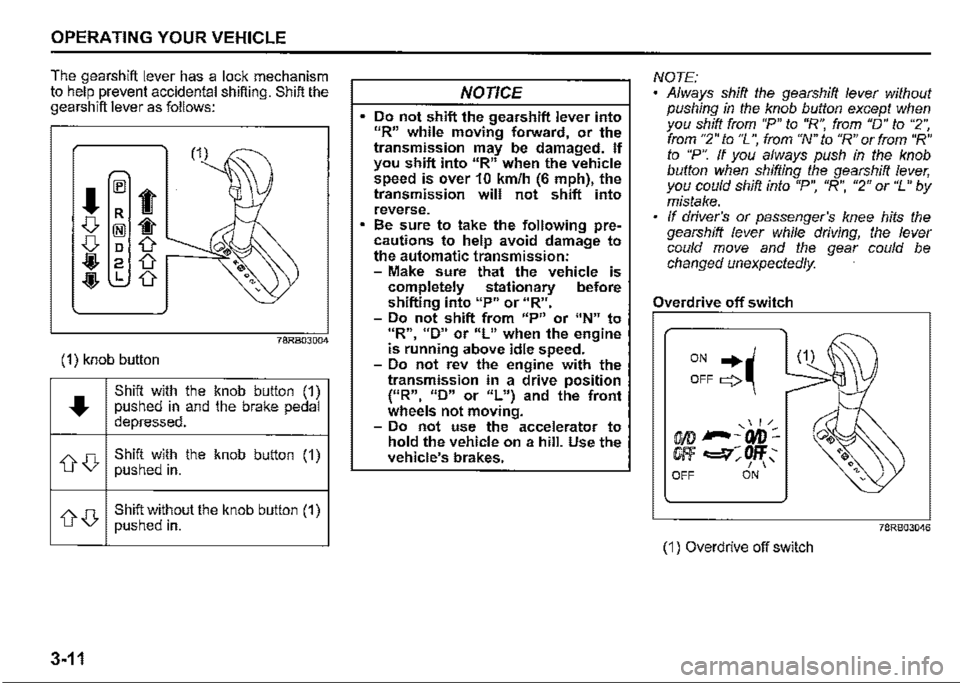
The gearshift lever has a lock mechanism to help prevent accidental shifting. Shift the gearshift lever as follows:
•
®
t R D IN) it
D D D-,@, 2 D-
,@, L D-
78RB03004
( 1 ) knob button
Shift with the knob button (1)
•
pushed in and the brake pedal depressed.
-OD Shift with the knob button (1) pushed in.
D-D Shift without the knob button (1) pushed in.
3-11
NOTICE
• Do not shift the gearshifl lever into 11R" while moving forward, or the transmission may be damaged. If you shift into "R" when the vehicle speed is over 10 km/h (6 mph),_the transmission will not shift mto reverse. Be sure to take the following precautions to help avoid damage to the automatic transmission: -Make sure that the vehicle is completely stationary before shifting into 11P" or "R". -Do not shift from up" or "N" to "R" "D" or "L11 when the engine is r~nning above idle speed. -Do not rev the engine with the transmission in a drive position {uR", 11D" or 11~") and the front wheels not movmg. -Do not use the accelerator to hold the vehicle on a hill. Use the vehicle's brakes.
NOTE: • Always shift the gearshift lever without pushing in the knob button except when ou shift from "P" to "R", from "D" to "2", rrom "2" to "L ", from "N" to "R''. or from "R" to "P". If you always push m the knob button when shifting the gearsh1ft lever. Id h.ft · t "P" "R" "2" or "L" by youcou s1 mo , , mistake. If driver's or passenger's knee hits the gearshift lever while driving, the lever could move and the gear could be changed unexpectedly.
Overdrive off switch
ON ...
OFF c;>~
' / < .. 00---00-@ff ~-ow-,, I \" OFF ON
(1) Overdrive off switch
78RB03046
Page 163 of 421
The transmission is a 4-speed (3-speed plus overdrive) automatic transmission. By operating the overdrive off switch, the transmission can be converted to a 3-speed automatic transmission that will not move to the overdrive position. To convert the transmission to the 3-speed mode, push in the overdrive off switch and release it.
To return the transmission to the 4-speed mode, push in the overdrive off switch again:
When the ignition switch is turned to the "ACC" position, the transmission in the 3-speed mode is converted to the 4-speed mode automatically. The 3-speed mode is suitable for the following driving conditions: Driving on hilly, winding roads -You can drive more smoothly with less frequent gear changing Going down a steep hill -Some engine braking is provided
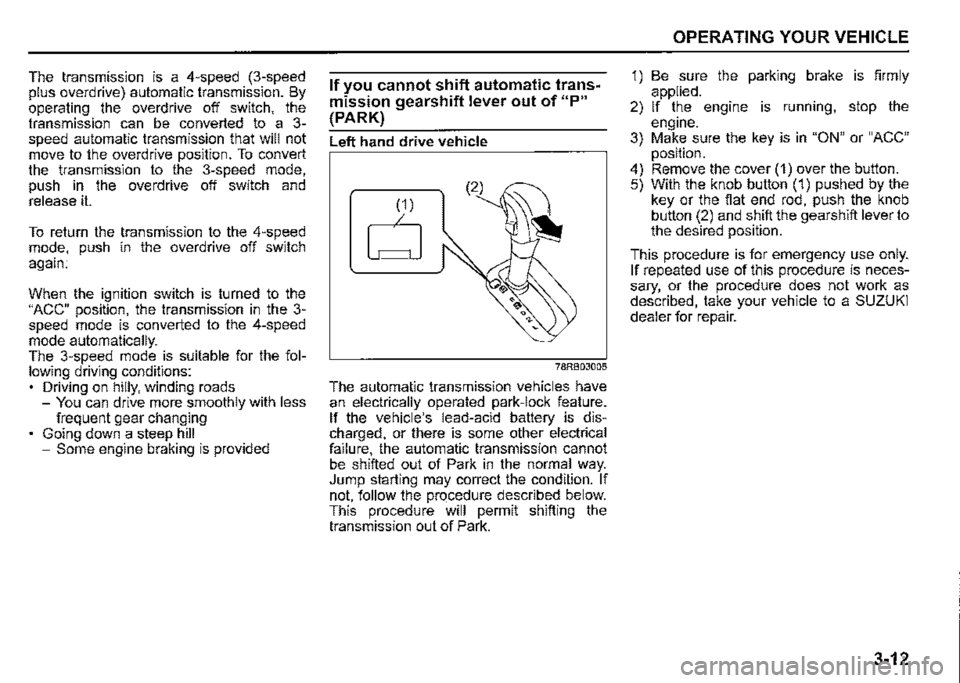
If you cannot shift automatic trans
mission gearshift lever out of "P"
(PARK)
Left hand drive vehicle
(1)
□
78RB03005
The automatic transmission vehicles have an electrically operated park-lock feature. If the vehicle's lead-acid battery is discharged, or there is some other electrical failure, the automatic transmission cannot be shifted out of Park in the normal way. Jump starting may correct the condition. If not, follow the procedure described below. This procedure will permit shifting the transmission out of Park.
OPERATING YOUR VEHICLE
1) Be sure the parking brake is firmly applied. 2) If the engine is running, stop the engine. 3) Make sure the key is in "ON" or "ACC" position. 4) Remove the cover (1) over the button. 5) With the knob button (1) pushed by the key or the flat end rod, push the knob button (2) and shift the gearshift lever to the desired position.
This procedure is for emergency use only. If repeated use of this procedure is necessary, or the procedure does not work as described, take your vehicle to a SUZUKI dealer for repair.
3-12
Page 164 of 421
OPERATING YOUR VEHICLE
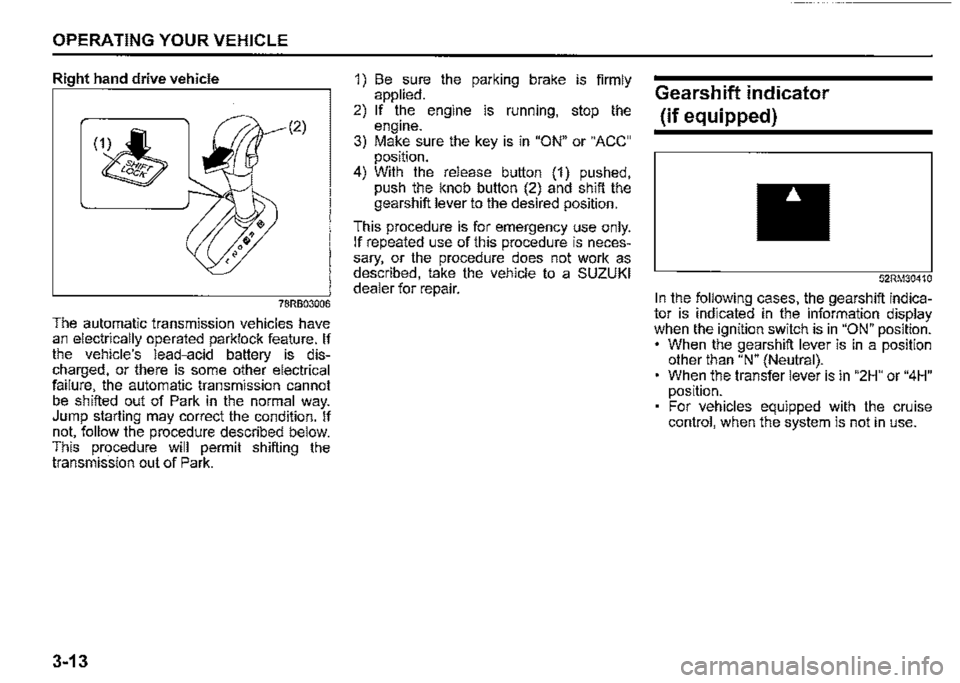
Right hand drive vehicle
(2)
78RB03006
The automatic transmission vehicles have an electrically operated parklock feature. If the vehicle's lead-acid battery is discharged, or there is some other electrical failure, the automatic transmission cannot be shifted out of Park in the normal way. Jump starting may correct the condition. If not, follow the procedure described below. This procedure will permit shifting the transmission out of Park.
3-13
1) Be sure the parking brake is firmly applied. 2) If the engine is running, stop the engine. 3) Make sure the key is in "ON" or "ACC" position. 4) With the release button (1) pushed, push the knob button (2) and shift the gearshift lever to the desired position.
This procedure is for emergency use only. If repeated use of this procedure is necessary, or the procedure does not work as described, take the vehicle to a SUZUKI dealer for repair.
Gearshift indicator
(if equipped)
52RM30410
In the following cases, the gearshift indicator is indicated in the information display when the ignition switch is in "ON" position. • When the gearshift lever is in a position other than "N" (Neutral). When the transfer lever is in "2H" or "4H" position. For vehicles equipped with the cruise control, when the system is not in use.
Page 165 of 421
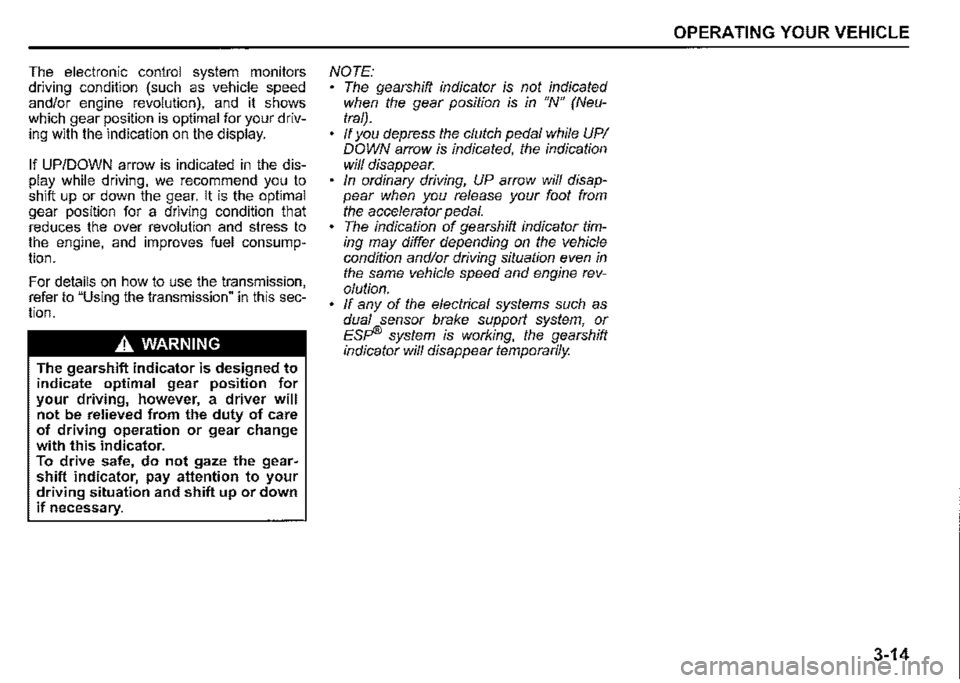
The electronic control system monitors driving condition (such as vehicle speed and/or engine revolution), and it shows which gear position is optimal for your driving with the indication on the display.
If UP/DOWN arrow is indicated in the display while driving, we recommend you to shift up or down the gear. It is the optimal gear position for a driving condition that reduces the over revolution and stress to the engine, and improves fuel consumption.
For details on how to use the transmission, refer to "Using the transmission" in this section.
A WARNING
The gearshift indicator is designed to indicate optimal gear position for your driving, however, a driver will not be relieved from the duty of care of driving operation or gear change with this indicator. To drive safe, do not gaze the gearshift indicator, pay attention to your driving situation and shift up or down if necessary.
NOTE: The gearshift indicator is not indicated when the gear position is in "N" (Neutral). If you depress the clutch pedal while UPI DOWN arrow is indicated, the indication will disappear. In ordinary driving, UP arrow will disappear when you release your foot from the accelerator pedal. The indication of gearshift indicator timing may differ depending on the vehicle condition and/or driving situation even in the same vehicle speed and engine rev
olution. If any of the electrical systems such as dual sensor brake support system, or ESP" system is working, the gearshift indicator will disappear temporarily.
OPERATING YOUR VEHICLE
3-14
Page 169 of 421
OPERATING YOUR VEHICLE
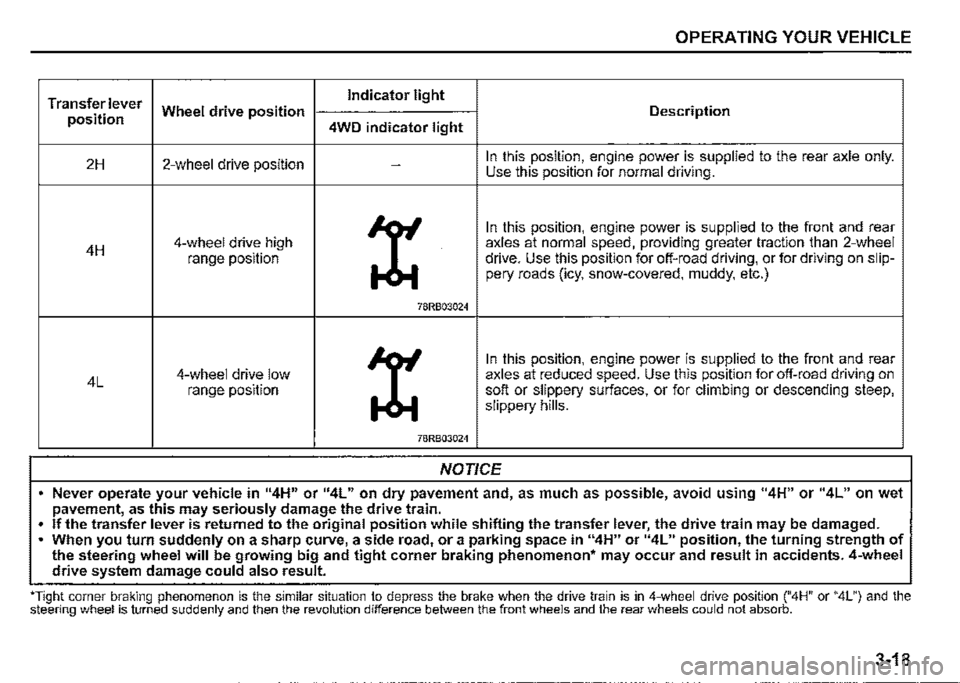
Transfer lever Indicator light
position Wheel drive position Description
4WD indicator light
2H 2-wheel drive position -In this position, engine power is supplied to the rear axle only. Use this position for normal driving.
X
In this position, engine power is supplied to the front and rear
4H 4-wheel drive high axles at normal speed, providing greater traction than 2-wheel
range position drive. Use this position for off-road driving, or for driving on slip-pery roads (icy, snow-covered, muddy, etc.)
78RB03024
X
In this position, engine power is supplied to the front and rear
4L 4-wheel drive low axles at reduced speed. Use this position for off-road driving on range position soft or slippery surfaces, or for climbing or descending steep, slippery hills.
78RB03024
NOTICE
• Never operate your vehicle in 114H" or 114L" on dry pavement and, as much as possible, avoid using "4H" or "4L" on wet pavement, as this may seriously damage the drive train.
• If the transfer lever is returned to the original position while shifting the transfer lever, the drive train may be damaged . . When you turn suddenly on a sharp curve, a side road, or a parking space in "4H" or 114L" position, the turning strength of the steering wheel will be growing big and tight corner braking phenomenon• may occur and result in accidents. 4-wheel drive system damage could also result.
''Tight corner braking phenomenon is the similar situation to depress the brake when the drive train is in 4-wheel drive position ("4H" or "4L") and the steering wheel is turned suddenly and then the revolution difference between the front wheels and the rear wheels could not absorb.
3-18
Page 170 of 421
OPERATING YOUR VEHICLE
NOTE: When you select the "4L" position the ESF'® systems (other than ABS) w/11 be canceled to provide improved vehicle traction, and the ESF'® OFF indicator light, dual sensor brake support OFF indicator light and lane departure warning OFF indicator light will come on. When you select the "4L" position braketraction control can be activated'. Braketraction control brakes the spinning wheel to distribute drive power to the other wheels for increased climbing ability or for better performance on a rolling hill or a slippery surface. If dual sensor brake support OFF indicator light and lane departure warning OFF indicator light come on or go off, the intenor buzzer beeps. This is not a ma/function.
3-19
Transfer lever operation
NOTICE
Unevenly worn tyres can cause problems in the operation of the transfer lever. Be sure to rotate the tyres according to the maintenance schedule. Refer to "Tyres" and "Maintenance Schedule" in the "INSPECTION AND MAINTENANCE" section for proper tyre rotation procedures. If a problem exists during the shifting function, all lights of the 4WD indicator will blink continuously and the transfer lever operation will not work. If the shift function does not work after trying the shifting operation several times, it may be the result of a system failure. Have the system inspected by a SUZUKI dealer.
NOTE: When the temperature of 4-whee/ drive system or the transmission is not warm ':'nder the low temperature, you may feel ,t hard to shift the transfer lever or gear n01se may occur. Unless you can shift the transfer lever drive your vehicle for a while and the/2 shift the transfer lever again.
Operate the transfer lever according to the appropriate procedure described below:
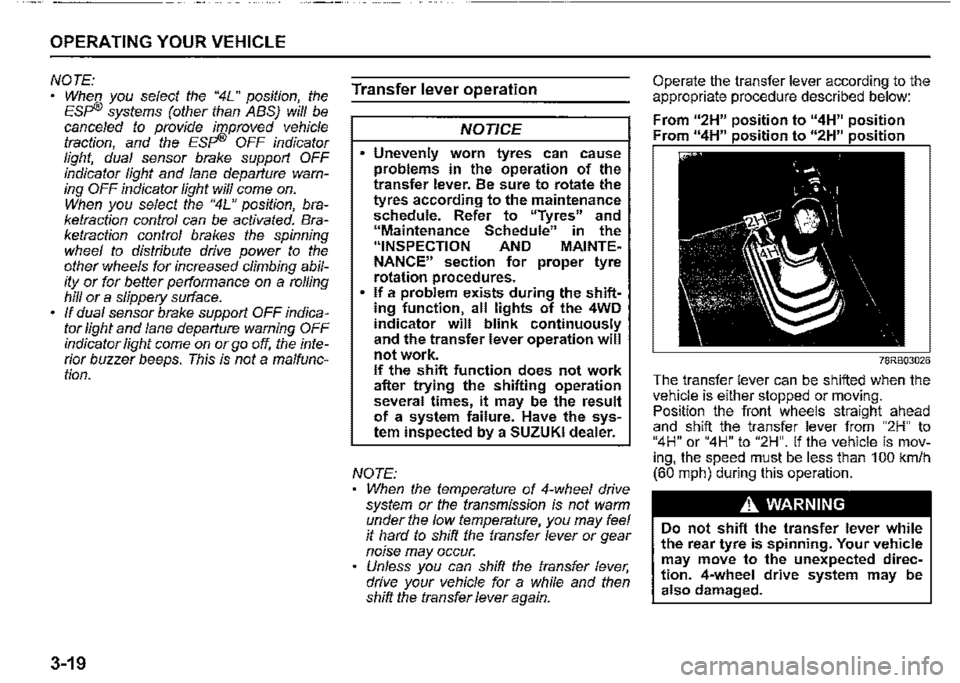
From u2H" position to "4H" position Fr " 11 • • " " • •
78RB03026
The transfer lever can be shifted when the vehi_c_le is either stopped or moving. Pos1t1on the front wheels straight ahead and shift the transfer lever from "2H" to "4H" or "4H" to "2H". If the vehicle is moving, the speed must be less than 100 km/h (60 mph) during this operation.
A WARNING
Do not shift the transfer lever while the rear tyre is spinning. Your vehicle may move to the unexpected direction. 4-wheel drive system may be also damaged.