child seat SUZUKI JIMNY 2021 Owner's Guide
[x] Cancel search | Manufacturer: SUZUKI, Model Year: 2021, Model line: JIMNY, Model: SUZUKI JIMNY 2021Pages: 421, PDF Size: 6.35 MB
Page 116 of 421

BEFORE DRIVING
Rear passenger's seat belt
reminder light (if equipped)
78RB02087
When the rear passenger does not buckle his or her seat belt, this light will come on and/or blink. For details of the seat belt reminder, refer to "Seat belts and child restraint systems" in this section.
2-45
AIRBAG light
63J030
When the ignition switch is turned "ON", this light comes on for several seconds so you can check that the light is working.
The light will come on and stay on if there is a problem in the airbag system or the seat belt pretensioner system.
A WARNING
If AIRBAG light does not blink or come on briefly when the ignition switch is turned "ON", stays on for more than 10 seconds, or comes on while driving, the airbag system or the seat belt pretensioner system may not work properly, which could result in serious injury in the event of a collision. Have both systems inspected by a SUZUKI dealer.
Malfunction indicator light
65D530
Your vehicle has a computer-controlled emission control system. A malfunction indicator light is provided on the instrument cluster to indicate when it is necessary to have the emission control system serviced. When the ignition switch is turned "ON", this light comes on. When the engine is started, the light goes out.
If the malfunction indicator light comes on or blinks when the engine is running, there is a damage in the emission control system. Bring the vehicle to a SUZUKI dealer to have the damage fixed.
Also, if this light comes on when the engine is running, there is a problem with the automatic transmission system. Ask a SUZUKI dealer to have the system inspected.
Page 224 of 421
DRIVING TIPS
52D078
A WARNING
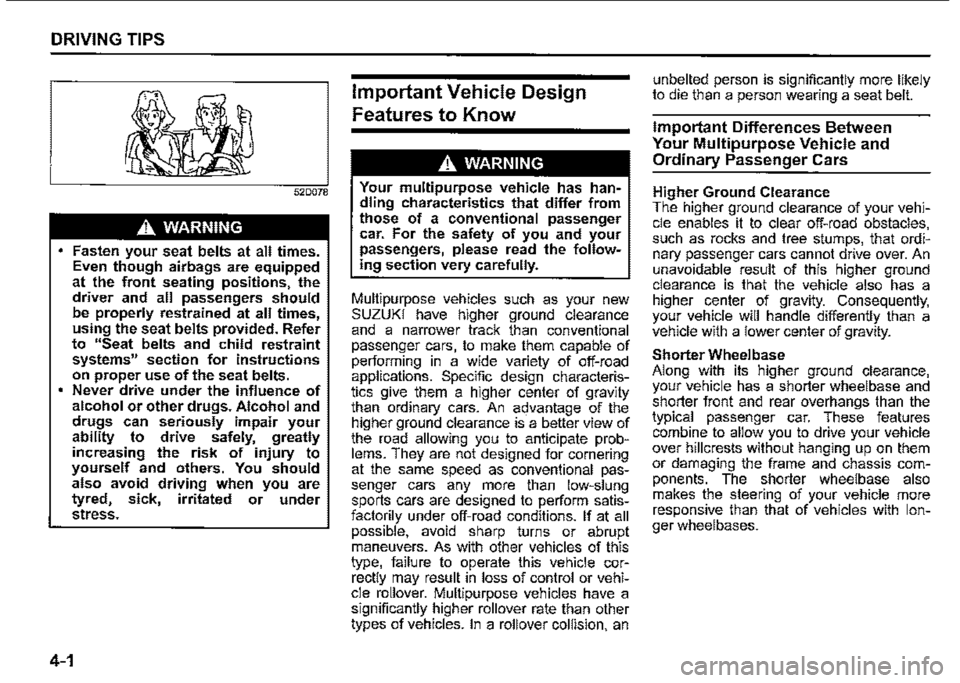
Fasten your seat belts at all times. Even though airbags are equipped at the front seating positions, the driver and all passengers should be properly restrained at all times, using the seat belts provided. Refer to "Seat belts and child restraint systems" section for instructions on proper use of the seat belts. Never drive under the influence of alcohol or other drugs. Alcohol and drugs can seriously impair your ability to drive safely, greatly increasing the risk of injury to yourself and others. You should also avoid driving when you are tyred, sick, irritated or under stress.
4-1
Important Vehicle Design
Features to Know
A WARNING
Your multipurpose vehicle has handling characteristics that differ from those of a conventional passenger car. For the safety of you and your passengers, please read the following section very carefully.
Multipurpose vehicles such as your new SUZUKI have higher ground clearance and a narrower track than conventional passenger cars, to make them capable of performing in a wide variety of off-road applications. Specific design characteristics give them a higher center of gravity than ordinary cars. An advantage of the higher ground clearance is a better view of the road allowing you to anticipate problems. They are not designed for cornering at the same speed as conventional passenger cars any more than low-slung sports cars are designed to perform satisfactorily under off-road conditions. If at all possible, avoid sharp turns or abrupt maneuvers. As with other vehicles of this type, failure to operate this vehicle correctly may result in loss of control or vehicle rollover. Multipurpose vehicles have a significantly higher rollover rate than other types of vehicles. In a rollover collision, an
unbelted person is significantly more likely to die than a person wearing a seat belt.
Important Differences Between
Your Multipurpose Vehicle and
Ordinary Passenger Cars
Higher Ground Clearance The higher ground clearance of your vehicle enables it to clear off-road obstacles, such as rocks and tree stumps, that ordinary passenger cars cannot drive over. An unavoidable result of this higher ground clearance is that the vehicle also has a higher center of gravity. Consequently, your vehicle will handle differently than a vehicle with a lower center of gravity.
Shorter Wheelbase Along with its higher ground clearance, your vehicle has a shorter wheelbase and shorter front and rear overhangs than the typical passenger car. These features combine to allow you to drive your vehicle over hillcrests without hanging up on them or damaging the frame and chassis components. The shorter wheelbase also makes the steering of your vehicle more responsive than that of vehicles with longer wheelbases.
Page 318 of 421
INSPECTION AND MAINTENANCE
60B128S
.A. WARNING
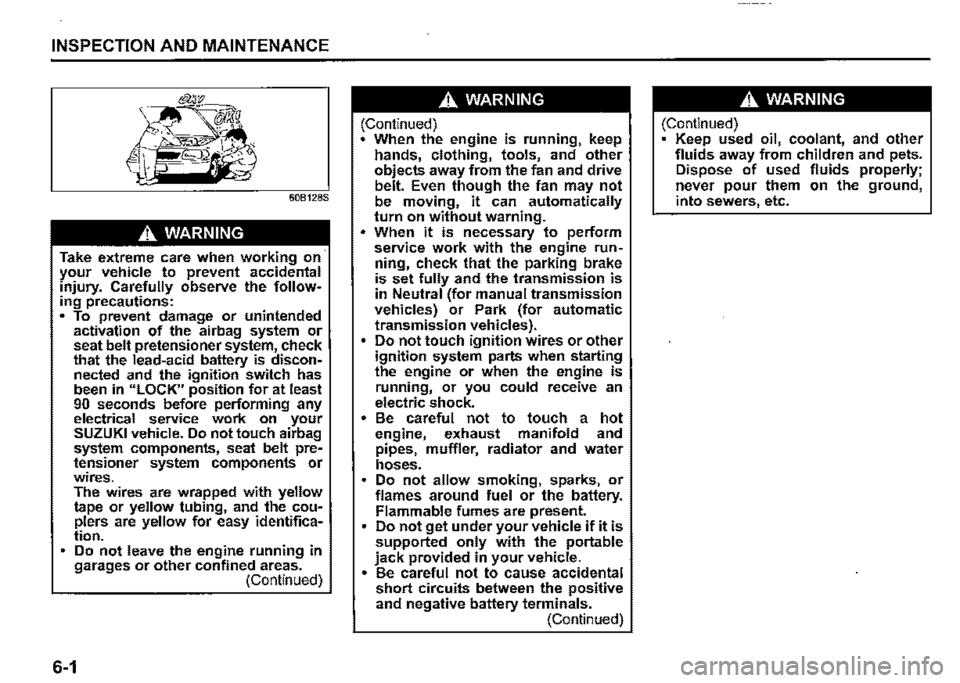
Take extreme care when working on· your vehicle to prevent accidental injury. Carefully observe the following precautions: • To prevent damage or unintended activation of the airbag system or seat belt pretensioner system, check that the lead-acid battery is disconnected and the ignition switch has been in "LOCK" position for at least 90 seconds before performing any electrical service work on your SUZUKI vehicle. Do not touch airbag system components, seat belt pretensioner system components or wires. The wires are wrapped with yellow tape or yellow tubing, and the couplers are yellow for easy identification. Do not leave the engine running in garages or other confined areas. (Continued)
6-1
.A. WARNING
(Continued) When the engine is running, keep hands, clothing, tools, and other objects away from the fan and drive belt. Even though the fan may not be moving, it can automatically turn on without warning . • When it is necessary to perform service work with the engine run~ ning, check that the parking brake is set fully and the transmission is in Neutral (for manual transmission vehicles) or Park (for automatic transmission vehicles). Do not touch ignition wires or other ignition system parts when starting the engine or when the engine is running, or you could receive an electric shock. • Be careful not to touch a hot engine, exhaust manifold and pipes, muffler, radiator and water hoses. Do not allow smoking, sparks, or flames around fuel or the battery. Flammable fumes are present. Do not get under your vehicle if it is supported only with the portable jack provided in your vehicle. • Be careful not to cause accidental short circuits between the positive and negative battery terminals. (Continued)
.A. WARNING
(Continued) Keep used oil, coolant, and other fluids away from children and pets. Dispose of used fluids properly; never pour them on the ground, into sewers, etc.
Page 408 of 421

SUPPLEMENT
For Australia
Built date
Built date is located on Vehicle Identification plate. "Built date" means -the calendar month and the year in which the body shell and power train sub-assemblies are conjoined and the vehicle is driven or moved from the production line.
Child restraint
A WARNING
Child restraint anchorages are designed to withstand only those loads imposed by correctly fitted child restraints. Under no circumstances are they to be used for adult seat belts, harnesses or for attaching other items or equipment to the vehicle.
10-1
Installation of child restraint with
top tether anchorage
Some child restraint systems require the use of a top tether strap. Top tether anchorage brackets are provided in your vehicle at the locations shown in the illustration. The number of the top tether anchorage brackets provided in your vehicle depends on the vehicle specification.
(1)
(1) Anchor fitting
78RB10005
1) Remove the luggage box (1 ). 2) Secure the child restraint on the rear seat using the procedure described above for securing a restraint system that does not require a top tether strap. 3) Hook the top tether strap to the top tether anchorage bracket and tighten the top tether strap according to the instructions provided by the child restraint system manufacturer. Attach 54Gm the top tether strap to the corresponding top tether anchorage bracket located on the floor of the rear cargo area.
Page 409 of 421
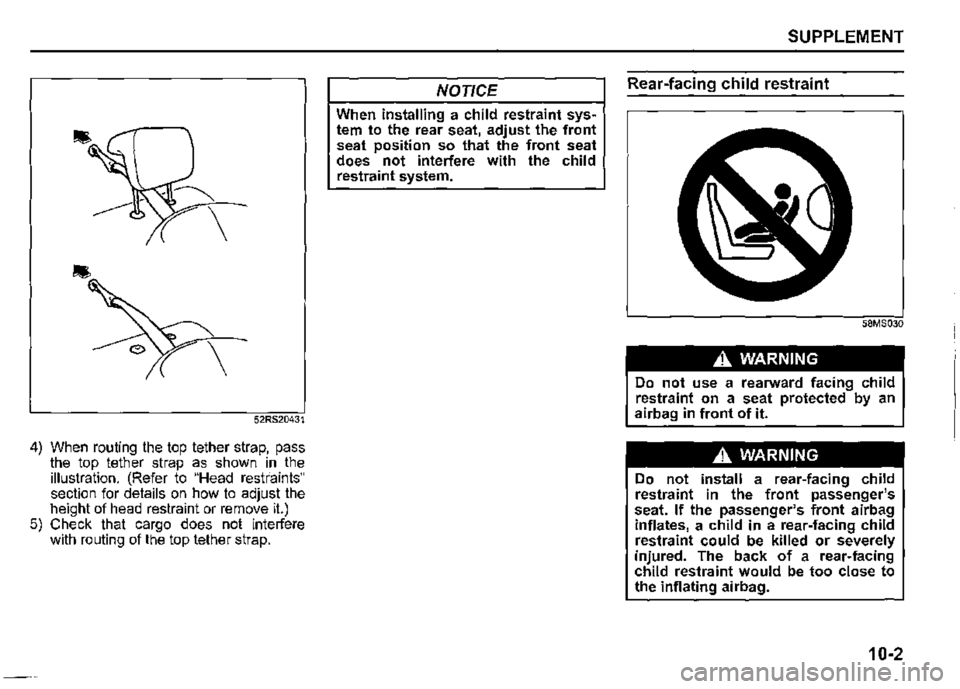
4) When routing the top tether strap, pass the top tether strap as shown in the illustration. (Refer to "Head restraints" section for details on how to adjust the height of head restraint or remove it.) 5) Check that cargo does not interfere with routing of the top tether strap.
NOTICE
When installing a child restraint system to the rear seat, adjust the front seat position so that the front seat does not interfere with the child restraint system.
SUPPLEMENT
Rear-facing child restraint
58MS030
A WARNING
Do not use a rearward facing child restraint on a seat protected by an airbag in front of it.
A WARNING
Do not install a rear-facing child restraint in the front passenger's seat. If the passenger's front airbag inflates, a child in a rear-facing child restraint could be killed or severely injured. The back of a rear-facing child restraint would be too close to the inflating airbag.
10-2
Page 410 of 421

SUPPLEMENT
If you must use a front-facing child restraint in the front passenger's seat, be sure to move the front passenger's seat as far back as possible. Please refer to "Seat belts and child restraint systems" in the "BEFORE DRIVING" section for details on securing your child.
Airbag symbol meaning
A (ill
AIRBAG ~
®
@~
72M00150
You may find this label on the sun visor.
A WARNING
NEVER use a rearward facing child restraint on a seat protected by an ACTIVE AIRBAG in front of it, DEATH or SERIOUS INJURY to the CHILD can occur.
10-3
Seat belt warning
Follow this warning as well as the instruction for seat belt in this book.
A WARNING
Seat belts are designed to bear upon the bony structure of the body, and should be worn low across the front of the pelvis or the pelvis, chest and shoulders, as applicable; wearing the lap section of the belt across the abdominal area must be avoided. • Seat belts should be adjusted as firmly as possible, consistent with comfort, to provide the protection for which they have been designed. A slack belt will greatly reduce the protection afforded to the wearer. • Care should be taken to avoid contamination of the webbing with polishes, oils and chemicals, and particularly battery acid. Cleaning may safely be carried out using mild soap and water. The belt should be replaced if webbing becomes frayed, contaminated or damaged. (Continued)
A WARNING
(Continued) • It is essential to replace the entire assembly after it has been worn in a severe impact even if damage to the assembly is not obvious. Belts should not be worn with straps twisted. Each belt assembly must only be used by one occupant; it is dangerous to put a belt around a child being carried on the occupant's lap,
In the case where a "Seat Belt Assembly'' incorporates an "Automatic Length Adjusting and Locking Retractor' or an "Emergency Locking Retractor'.
A WARNING
No modifications or additions should be made by the user which will either prevent the seat belt adjusting devices from operating to remove slack, or prevent the seat belt assembly from being adjusted to remove slack. Referring to the SEAT BELT instruction in this book, adjust the seat belt so that the lap and sash portions of the Seat Belt Assembly fit as firmly as possible consistent with comfort.
Page 415 of 421
INDEX
Seat belt warning ................................................................. 10-3 Transfer lever ....................................................................... 3-16
Seat belts and child restraint systems ................................ 1-7 Transfer oil.. .......................................................................... 6-31
Seat position adjustment lever ............................................. 1-3 Trip meter ..................................................................... 2-20, 2-32
Seatback angle adjustment lever ......................................... 1-3 Turn signal control lever ..................................................... 2-66
Selection of coolant. ............................................................ 6-28 Turn signal indicators .......................................................... 2-52
Selector position/ Gearshift indicator ............................... 2-19 Turn signal operation .......................................................... 2-66
Setting mode ........................................................................ 2-23 Tyre changing tool ................................................................. 7-1
Side airbags and side curtain airbags ............................... 1-41 Tyre inspection ..................................................................... 6-37
Side door locks ...................................................................... 2-2 Tyre pressure monitoring system (TPMS) ......................... 3-63
Side turn signal light ........................................................... 6-49 Tyre rotation ......................................................................... 6-38
Spark plugs .......................................................................... 6-30 Tyres ...................................................................................... 6-36
Specified oil .......................................................................... 6-23 u Speed limiter ........................................................................ 3-25 USB socket ............................................................................. 5-7 Speedometer ............................................................... 2-16, 2-26 Using transmission ................................................................ 3-8 Stability control system ...................................................... 3-56 V Starting engine ....................................................................... 3-7
Steering wheel ..................................................................... 6-36 Vehicle cleaning ..................................................................... 8-2
Vehicle identification ............................................................. 9-1 Sun visor ................................................................................ 5-4
Supplemental restraint system (airbags) .......................... 1-35
SUZUKI SAFETY SUPPORT ................................................ 3-27
T
Tachometer ................................................................. 2-16, 2-26
Tailgate ................................................................................... 2-3
Theft deterrent alarm system ............................................... 2-8
Vehicle swaying warning ..................................................... 3-34
w
Warning and indicator lights ............................................... 2-39
Warning and indicator messages ....................................... 2-35
Washing .................................................................................. 8-4
Waxing .................................................................................... 8-6
Windows ............................................................................... 2-10 Theft deterrent light ............................................................. 2-10 Windshield washer ............................................................... 2-68 Thermometer ............................................................... 2-19, 2-29 Windshield washer fluid ...................................................... 6-57 Tilt steering lock lever. ........................................................ 2-70
Towing your vehicle (recreational towing) .......................... 7-6
Traction control system ...................................................... 3-56
Traffic sign recognition ....................................................... 3-39
Trailer towing ....................................................................... 2-72
Windshield wiper and washer lever ................................... 2-67
Windshield wipers ................................................................ 2-68
Wiper and washer operation ............................................... 2-68
Wiper blades ......................................................................... 6-54
11-5