body SUZUKI JIMNY 2021 Owners Manual
[x] Cancel search | Manufacturer: SUZUKI, Model Year: 2021, Model line: JIMNY, Model: SUZUKI JIMNY 2021Pages: 421, PDF Size: 6.35 MB
Page 31 of 421
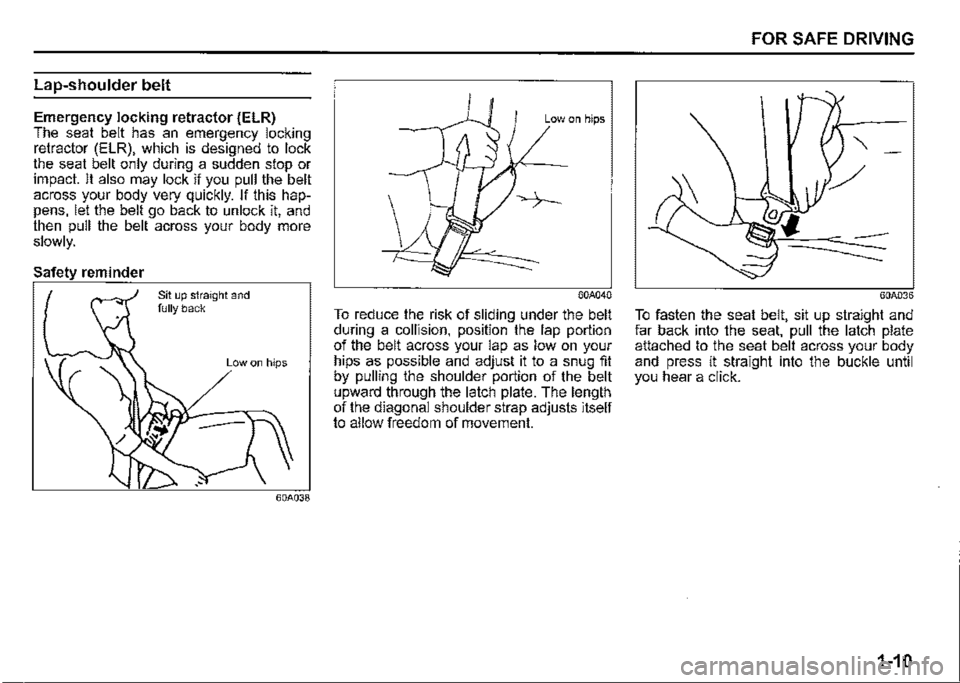
Lap-shoulder belt
Emergency locking retractor {ELR) The seat belt has an emergency locking retractor {ELR), which is designed to lock the seat belt only during a sudden stop or impact. It also may lock if you pull the belt across your body very quickly. If this happens, let the belt go back to unlock it, and then pull the belt across your body more slowly.
Sit up straight and fully back
Low on hips
60A038
60A040
To reduce the risk of sliding under the belt during a collision, position the lap portion of the belt across your lap as low on your hips as possible and adjust it to a snug fit by pulling the shoulder portion of the belt upward through the latch plate. The length of the diagonal shoulder strap adjusts itself to allow freedom of movement.
FOR SAFE DRIVING
60A036
To fasten the seat belt, sit up straight and far back into the seat, pull the latch plate attached to the seat belt across your body and press it straight into the buckle until you hear a click.
1-10
Page 32 of 421
FOR SAFE DRIVING
60A039
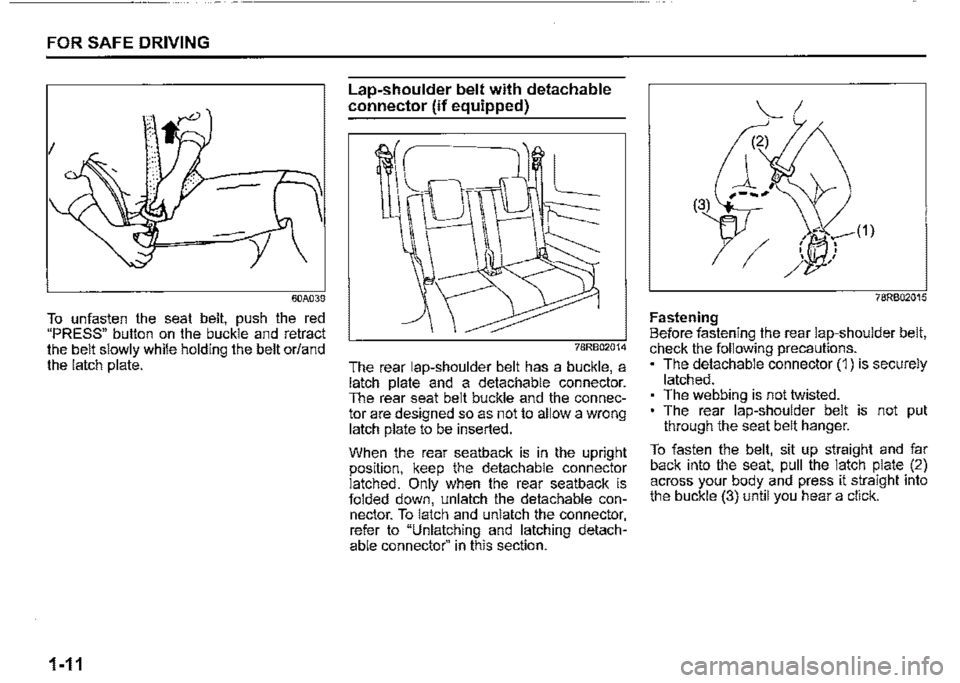
To unfasten the seat belt, push the red "PRESS" button on the buckle and retract the belt slowly while holding the belt or/and the latch plate.
1-11
Lap-shoulder belt with detachable
connector (if equipped)
The rear lap-shoulder belt has a buckle, a latch plate and a detachable connector. The rear seat belt buckle and the connector are designed so as not to allow a wrong latch plate to be inserted.
When the rear seatback is in the upright position, keep the detachable connector latched. Only when the rear seatback is folded down, unlatch the detachable connector. To latch and unlatch the connector, refer to "Unlatching and latching detachable connector" in this section.
78RB02015
Fastening Before fastening the rear lap-shoulder belt, check the following precautions. The detachable connector (1) is securely
latched. The webbing is not twisted. The rear lap-shoulder belt is not put through the seat belt hanger.
To fasten the belt, sit up straight and far back into the seat, pull the latch plate (2) across your body and press it straight into the buckle (3) until you hear a click.
Page 50 of 421
FOR SAFE DRIVING
ELR type belt
80JC021
1-29
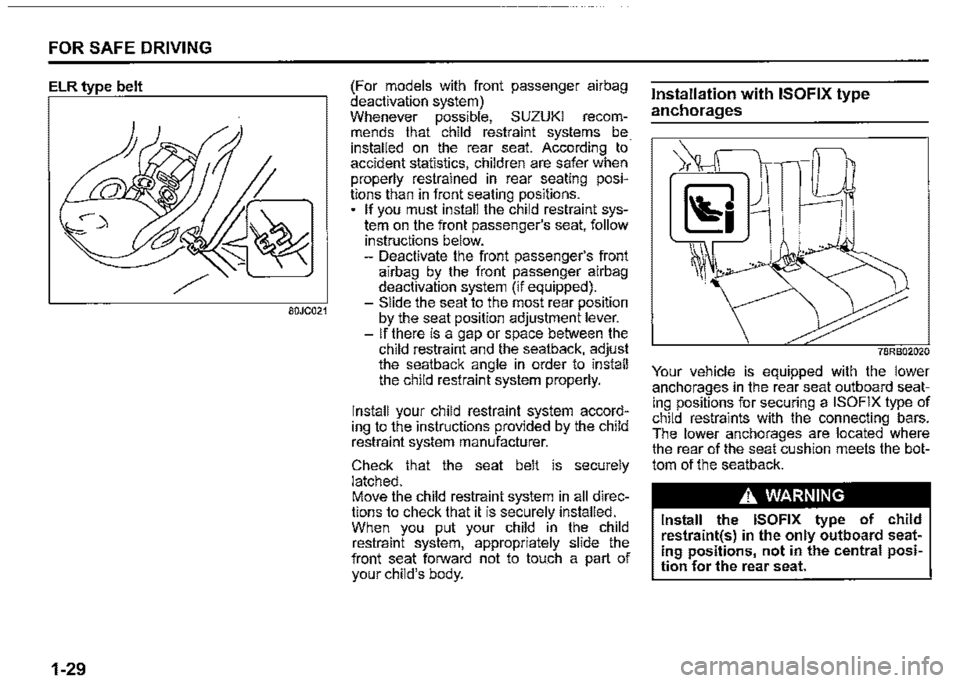
(For models with front passenger airbag deactivation system) Whenever possible, SUZUKI recommends that child restraint systems be installed on . th_e rear seat. According to· accident stat1st1cs, children are safer when ~roperly restrained in rear seating positions than in front seating positions. • If you must install the child restraint system on the front passenger's seat follow instructions below. ' -D_eactivate the front passenger's front airbag by the front passenger airbag d~activation system (if equipped). -Slide the seat to the most rear position by the seat position adjustment lever. -If there is a gap or space between the child restraint and the seatback, adjust the seatback angle in order to install the child restraint system properly.
Install your child restraint system according to the instructions provided by the child restraint system manufacturer.
Check that the seat belt is securely latched. Move the child restraint system in all directions to check that it is securely installed. When you put your child in the child restraint system, appropriately slide the front seat forward not to touch a part of your child's body.
Installation with ISOFIX type
anchorages
78RB02020
Your vehicle is equipped with the lower anchorages in the rear seat outboard seating positions for securing a ISOFIX type of child restraints with the connecting bars. The lower anchorages are located where the rear of the seat cushion meets the bottom of the seatback.
A WARNING
Install the ISOFIX type of child restraint(s) in the only outboard seating positions, not in the central position for the rear seat.
Page 52 of 421
FOR SAFE DRIVING
68LM268
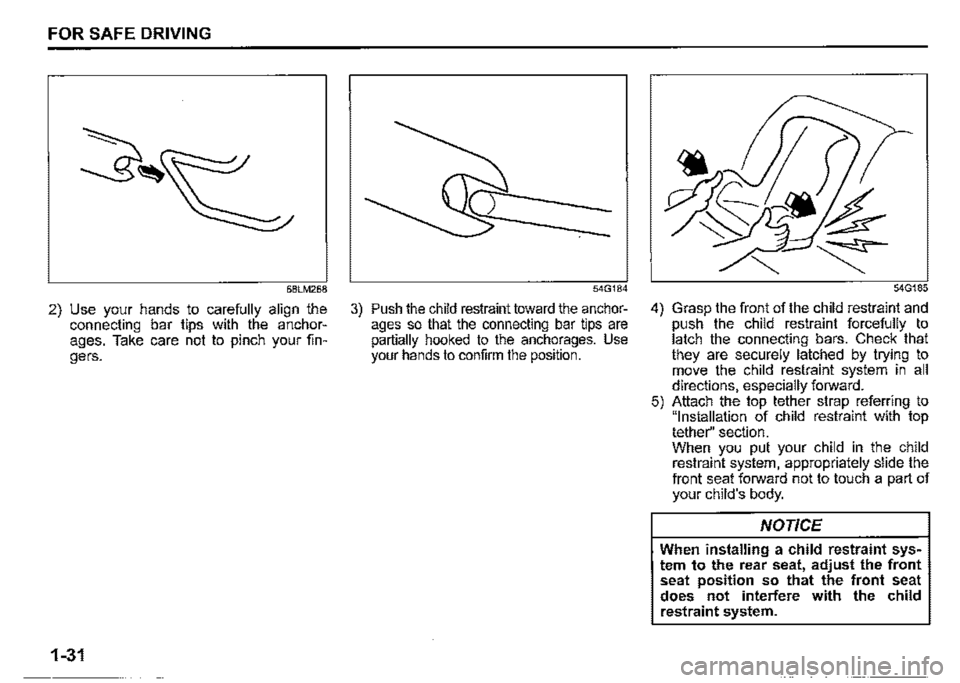
2) Use your hands to carefully align the connecting bar tips with the anchorages. Take care not to pinch your fingers.
1-31
54G184
3) Push the child restraint toward the anchorages so that the connecting bar tips are partially hooked to the anchorages. Use your hands to confirm the position.
54G185
4) Grasp the front of the child restraint and push the child restraint forcefully to latch the connecting bars. Check that they are securely latched by trying to move the child restraint system in all directions, especially forward. 5) Attach the top tether strap referring to "Installation of child restraint with top tether" section. When you put your child in the child restraint system, appropriately slide the front seat forward not to touch a part of your child's body.
NOTICE
When installing a child restraint system to the rear seat, adjust the front seat position so that the front seat does not interfere with the child restraint system.
Page 55 of 421
The pretensioner is located in each front seat belt retractor and each rear seat belt retractor in outboard seating position. The pretensioner tightens the seat belt so the belt fits the occupant's body more snugly in the event of a frontal or side collision. The retractors will remain locked after the pretensioners are activated. Upon activation, some noise will occur and some smoke may be released. These conditions are not harmful and do not indicate a fire in the vehicle.
The driver and all passengers must be properly restrained by fastening seat belts at all times, whether or not a pretensioner is equipped at their seating position, to minimize the risk of severe injury or death in the event of a collision.
Sit fully back in the seat; sit up straight; do not lean forward or sideways. Adjust the belt so the lap portion of the belt is worn low across the pelvis, not across the waist. Please refer to "Seat adjustment" section and the instructions and precautions about the seat belts in this "Seat belts and child restraint systems" section for details on proper seat and seat belt adjustments.
Please note that the pretensioners along with the airbags will activate in severe frontal or side collisions. They are not designed to activate in rear impacts, rollovers, or minor frontal side collisions. The pretensioners can be activated only once. If the pretensioners are activated (that is, if the airbags are activated), have the pretensioner system serviced by a SUZUKI dealer as soon as possible.
FOR SAFE DRIVING
If AIRBAG light on the instrument cluster does not blink or come on briefiy when the ignition switch is turned to "ON" position, stays on for more than 1 O seconds, or comes on while driving, the pretensioner system or the airbag system may not work properly. Have both systems inspected by a SUZUKI dealer as soon as possible.
Service on or around the pretensioner system components or wiring must be performed only by a SUZUKI dealer who is specially trained. Improper service could result in unintended activation of pretensioners or could render the pretensioner inoperative. Either of these two conditions may result in personal injury.
To prevent damage or unintended activation of the pretensioners, check that the lead-acid battery is disconnected and the ignition switch has been in "LOCK" position for at least 90 seconds before performing any electrical service work on your SUZUKI vehicle.
Do not touch pretensioner system components or wiring. The wires are wrapped with yellow tape or yellow tubing, and the couplers are yellow. When scrapping your SUZUKI vehicle, ask a SUZUKI dealer, body repair shop, or scrap yard for assistance.
1-34
Page 60 of 421

FOR SAFE DRIVING
Receiving a strong impact to the lower body of your vehicle, the front airbags may infiate.
80J099
• Hitting a curb or medial strip
80J100E
• Falling into a deep hole or ditch
1-39
80J101
• Landing hard or falling
Front airbags may not inflate The front airbags may not infiate when a strong impact has not occurred since the collision object was easy to be deformed or moved, or the crashed portion of your vehicle was easy to be deformed. Also, front airbags may not inflate in many cases when the collision angle is greater than about 30 degrees at left and right angles from the front of your vehicle.
80J102
Frontal collision to a stopped vehicle at less than about 50 km/h (30 mph)
Page 64 of 421

FOR SAFE DRIVING
80J101
• Landing hard or falling
1-43
Side airbags and side curtain airbags may not inflate
=
80J121
,,
'>
ij = ~ ,
*'4:I
80J122
Impact from the side to the vehicle body other than the passenger compartment
80J123
Impact from the side at an oblique angle
~~,c] fr.
_;,~" 0 1 "1
\
80J124
Impact from the side by a high hood vehicle
Page 65 of 421

80J125
Impact from the side by a motorcycle or
bicycle
80J126
Collision with a utility pole or stumpage
FOR SAFE DRIVING
Side airbags and side curtain airbags do not inflate How the system works
80J120
• Impact from the rear
80J110
• Vehicle rollover
In a frontal collision, the crash sensors will detect rapid deceleration, and if the controller judges that the deceleration represents a severe frontal collision, the controller will trigger the infiators. If your vehicle is equipped with side airbags and side curtain airbags, crash sensors will detect a side collision, and if the controller judges that the side collision is severe enough, it will trigger the side airbag and side curtain airbag infiators. The infiators inflate the appropriate airbags with nitrogen or argon gas. The infiated airbags provide a cushion for your head (front airbags and side curtain airbags only) and upper body. The airbag inflates and defiates so quickly that you may not even realize that it has activated. The airbag will neither hinder your view nor make it harder to exit the vehicle.
Airbags must infiate quickly and forcefully in order to reduce the chance of serious or fatal injuries. However, an unavoidable consequence of the quick infiation is that the airbag may irritate bare skin, such as the facial area against a front airbag. Wash off any residue as soon as possible to prevent skin irritation. Also, upon inflation, a loud noise will occur and some powder and smoke will be released. These conditions are not harmful and do not indicate a fire in the vehicle. Be aware, however, that some airbag components may be hot for a while after infiation.
1-44
Page 66 of 421
FOR SAFE DRIVING
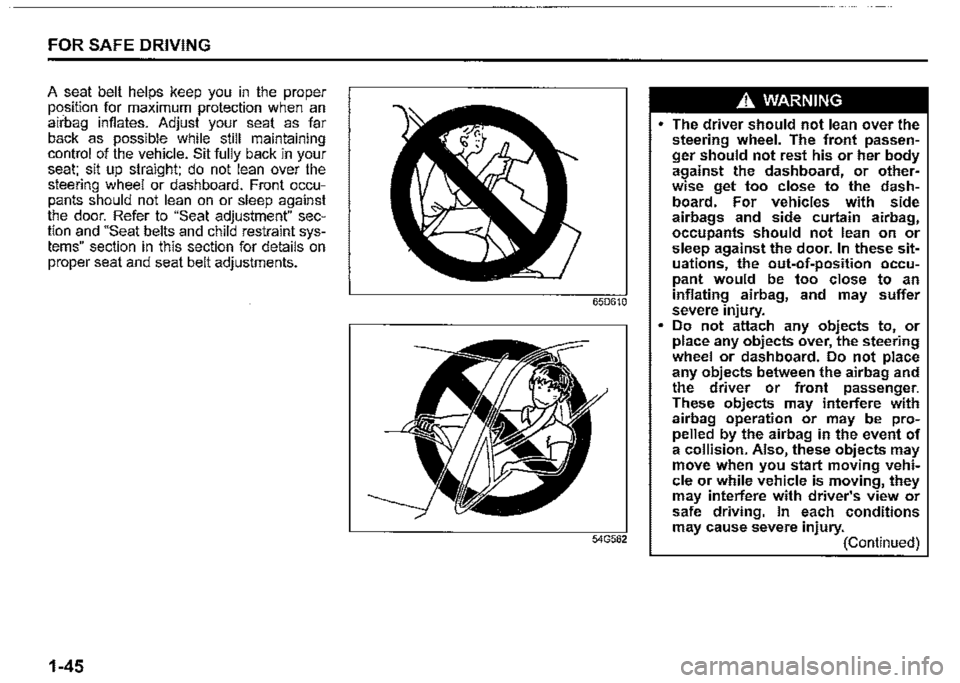
A seat belt helps keep you in the proper po_sition for maximum protection when an airbag infiates. Adjust your seat as far back as possible while still maintaining control of the vehicle. Sit fully back in your seat; sit up straight; do not lean over the steering wheel or dashboard. Front occupants should not lean on or sleep against the door. Refer to "Seat adjustment" section and "Seat belts and child restraint systems" section in this section for details on proper seat and seat belt adjustments.
1-45
A WARNING
• The driver should not lean over the steering wheel. The front passenger should not rest his or her body against the dashboard, or otherwise get too close to the dashboard. For vehicles with side airbags and side curtain airbag, occupants should not lean on or sleep against the door. In these situations, the out-of-position occupant would be too close to an inflating airbag, and may suffer severe injury. • Do not attach any objects to, or place any objects over, the steering wheel or dashboard. Do not place any objects between the airbag and the driver or front passenger. These objects may interfere with airbag operation or may be propelled by the airbag in the event of a collision. Also, these objects may move when you start moving vehicle or while vehicle is moving, they may interfere with driver's view or safe driving. In each conditions may cause severe injury. (Continued)
Page 67 of 421
A WARNING
(Continued) For vehicles with side airbags, do not use non-genuine seat covers on the front seats, because nongenuine seat covers may obstruct the inflation of side airbags. Suzuki highly recommends Suzuki-genuine seat covers to be used when covering the front seats of such vehicles with side airbags. Also, near the door, do not place cup holders, hangers or any other objects and do not lean an umbrella, as these objects could be propelled by the airbag in the event of a collision. Either of these conditions may cause severe injury. Do not strike or apply significant levels of impact to the airbag component areas. It can cause the airbags to malfunction.
Even though your vehicle is moderately damaged by a collision, it may not be severe enough to trigger front, side or side curtain airbags to inflate. If your vehicle sustains any front-end or side damage, have the airbag system inspected by a SUZUKI dealer to ensure that ii works properly.
Your vehicle is equipped with a diagnostic module which records information about the airbag system if the airbags deploy in a collision. The module records information about overall system status, and which sensors activated the deployment, and for a certain vehicle only, whether the driver's seat belt was in use.
Servicing the airbag system If the airbags inflate, have the airbags and related components replaced by a SUZUKI dealer as soon as possible.
If your vehicle ever gets in deep water and the driver's floor is submerged, the airbag controller could be damaged. If this happens, ask a SUZUKI dealer to check the airbag system as soon as possible.
FOR SAFE DRIVING
Special procedures are required for servicing or replacing an airbag. For that reason, only a SUZUKI dealer should be allowed to service or replace your airbags. Remind anyone who services your SUZUKI vehicle that it has airbags.
Service on or around airbag components or wiring must be performed only by a SUZUKI dealer. Improper service could result in unintended airbag deployment or could render the airbag inoperative. Either of these two conditions may result in severe injury.
To prevent damage or unintended inflation of the airbag system, check that the leadacid battery is disconnected and the ignition switch has been in "LOCK" position for at least 90 seconds before performing any electrical service work on your SUZUKI vehicle. Do not touch airbag system components or wires. The wires are wrapped with yellow tape or yellow tubing, and the couplers are yellow for easy identification.
Scrapping a vehicle that has an uninflated airbag can be hazardous. Ask a SUZUKI dealer, body repair shop or scrap yard for help with disposal.
1-46