main SUZUKI JIMNY 2022 Owners Manual
[x] Cancel search | Manufacturer: SUZUKI, Model Year: 2022, Model line: JIMNY, Model: SUZUKI JIMNY 2022Pages: 421, PDF Size: 6.35 MB
Page 372 of 421
INSPECTION AND MAINTENANCE
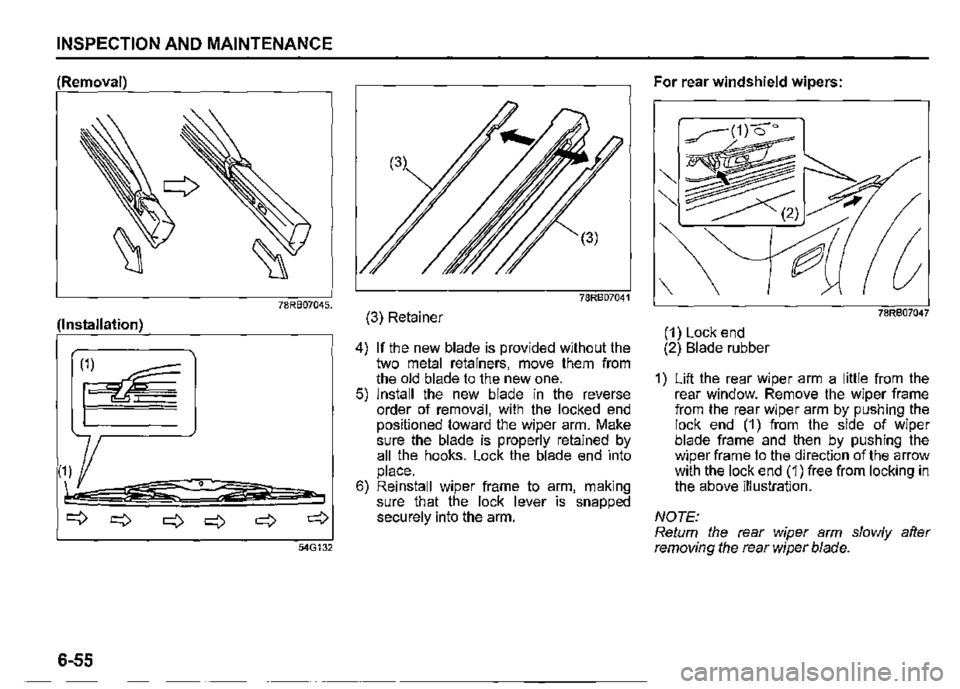
(Removal)
78RB07045.
(Installation)
a
54G132
6-55
(3) Retainer
4) If the new blade is provided without the two metal retainers, move them from the old blade to the new one. 5) Install the new blade in the reverse order of removal, with the locked end positioned toward the wiper arm. Make sure the blade is properly retained by all the hooks. Lock the blade end into place. 6) Reinstall wiper frame to arm, making sure that the lock lever is snapped securely into the arm.
For rear windshield wipers:
78R807047
(1) Lock end (2) Blade rubber
1) Lift the rear wiper arm a little from the rear window. Remove the wiper frame from the rear wiper arm by pushing the lock end (1) from the side of wiper blade frame and then by pushing the wiper frame to the direction of the arrow with the lock end (1) free from locking in the above illustration.
NOTE: Return the rear wiper arm slowly after removing the rear wiper blade.
Page 373 of 421

77R60050
(3) Stopper (4) Hook (5) Retainer
2) Pull and remove the wiper blade rubber from the wiper frame until the stopper (3) of the wiper frame is taken out of the hook (4). Remove the retainers (5) from the wiper blade.
63R60160
3) If the new blade is provided without the two metal retainers, install them from the old blade to the new one.
,.....,
c
77R60030
4) Install the retainers along the direction of camber as shown in the illustration.
INSPECTION AND MAINTENANCE
63R60180
5) Slide the new wiper blade into the wiper frame. When installing the blade rubber, put into the side that has no stopper on the wiper blade.
6-56
Page 374 of 421
INSPECTION AND MAINTENANCE
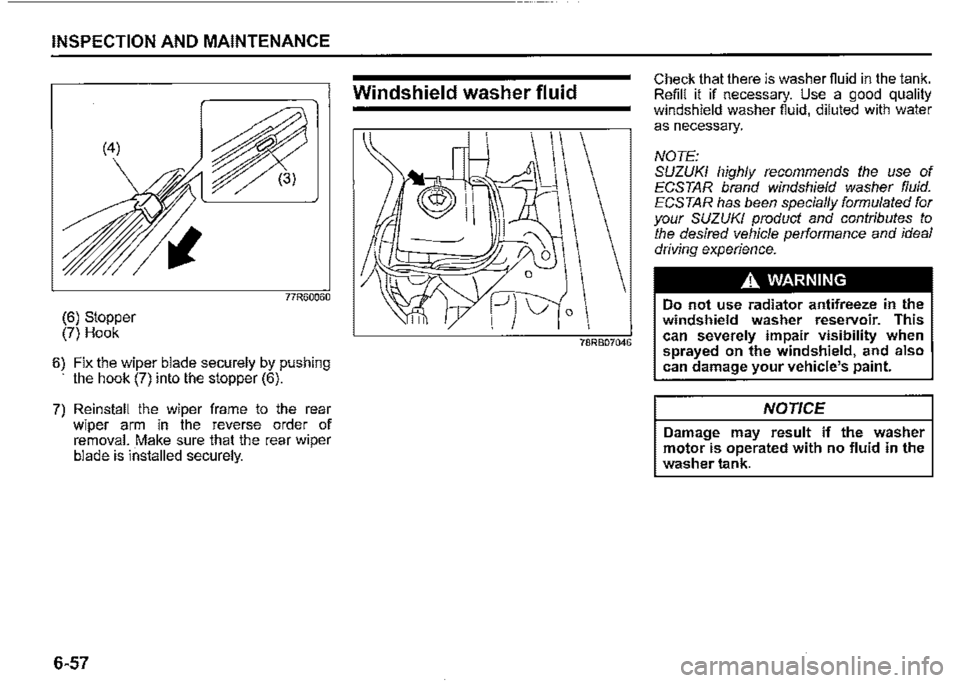
77R60060
(6) Stopper (7) Hook
6) Fix the wiper blade securely by pushing · the hook (7) into the stopper (6).
7) Reinstall the wiper frame to the rear wiper arm in the reverse order of removal. Make sure that the rear wiper blade is installed securely.
6-57
Windshield washer fluid Check that there is washer fiuid in the tank. Refill it if necessary. Use a good quality windshield washer fiuid, diluted with water
as necessary.
NOTE: SUZUKI highly recommends the use of ECSTAR brand windshield washer fluid. ECSTAR has been specially formulated for your SUZUKI product and contributes to the desired vehicle performance and ideal driving experience.
A WARNING
Do not use radiator antifreeze in the windshield washer reservoir. This can severely impair visibility when sprayed on the windshield, and also can damage your vehicle's paint.
NOTICE
Damage may result if the washer motor is operated with no fluid in the washer tank.
Page 375 of 421

Air conditioning system
If you do not use the air conditioner for a long period, such as during winter, it may not give the best performance when you start using it again. To help maintain optimum performance and durability of your air conditioner, it needs to be run periodically. Operate the air conditioner at least once a month for one minute with the engine idling. This circulates the refrigerant and oil and helps protect the internal components.
Air conditioner filter replacement
Since special procedures are required, ask a SUZUKI dealer for this job.
78RB07042
1) To approach the air conditioner filter, remove the glove box by pressing both sides of the glove box inward and pulling it out.
INSPECTION AND MAINTENANCE
(2)
(1)
78RB07043
2) Remove the cover (1) and pull out the air conditioner filter (2).
NOTE: When you install a new filter, check that the UP mark (3) faces upward.
6-58
Page 376 of 421

INSPECTION AND MAINTENANCE
MEMO
------------------------------------------------------
------------------------------------------------------
------------------------------------------------------
------------------------------------------------------
------------------------------------------------------
------------------------------------------------------
------------------------------------------------------
------------------------------------------------------
6-59
Page 379 of 421

Front wheel/Rear wheel
54G277
(1) Boss
6) Position the jack vertically and raise the jack by turning the jack handle clockwise until the jack head hole fits into the boss (1) of the body as the illustration. 7) Continue to raise the jack slowly and smoothly until the tyre clears the ground. Do not raise the vehicle more than necessary.
A WARNING
• Use the jack only to change wheels on level, hard ground. • Never jack up the vehicle on an inclined surface. • Never raise the vehicle with the jack in a location other than between the frame bosses near the wheel to be changed. • Make sure that the jack is raised at least 51 mm (2 inches) before it contacts the boss. Use of the jack when it is within 51 mm (2 inches) of being fully collapsed may result in failure of the jack. No person should place any portion of their body under a vehicle that is supported by a jack. • Never run the engine when the vehicle is supported by the jack and never allow passengers to remain in the vehicle.
EMERGENCY SERVICE
7-2
Page 382 of 421
EMERGENCY SERVICE
A. WARNING
Use genuine wheel nuts and tighten them to the specified torque as soon as possible after changing wheels. Incorrect wheel nuts or improperly tightened wheel nuts may come loose or fall off, which can result in an accident. If you do not have a torque wrench, have the wheel nut torque checked by a SUZUKI dealer.
7-5
Jump-starting instructions
A. WARNING
Never attempt to jump-start your vehicle if the lead-acid battery appears to be frozen. Batteries in this condition may explode. When making jump lead connections, check that your hands and the jump leads remain clear from pulleys, belts or fans. Lead-acid batteries produce flammable hydrogen gas. Keep flames and sparks away from the battery or an explosion may occur. Never smoke when working near the battery. If the booster battery you use for jump-starting is installed in another vehicle, check that the two vehicles are not touching each other. If your lead-acid battery discharges repeatedly, for no apparent reason, have your vehicle inspected by a SUZUKI dealer. • To avoid harm to yourself or damage to your vehicle or battery, follow the jump-starting instructions below. If you are in doubt, call for qualified road service.
NOTICE
Your vehicle should not be started by pushing or towing. This starting method could result in permanent damage to the catalytic converter. Use jump leads to start a vehicle with a weak or flat battery.
1) Use only a 12-volt lead-acid battery to jump-start your vehicle. Position the good 12-volt lead-acid battery close to your vehicle so that the jump leads will reach both batteries. When using a battery installed on another vehicle, check that two vehicles do not touch each other. Set the parking brakes fully on both vehicles. 2) Turn off all vehicle accessories, except those necessary for safety reasons (for example, headlights or hazard lights).
Page 387 of 421
Engine trouble: Starter does
not operate
1) Try turning the ignition switch to "START" position with the headlights turned on to determine the lead-acid battery condition. If the headlights go excessively dim or go off, it usually means that either the lead-acid battery is discharged or the battery terminal contact is poor. Recharge the lead-acid battery or correct battery terminal contact as necessary. 2) If the headlights remain bright, check the fuses. If the reason for failure of the starter is not obvious, there may be a major electrical problem. Have the vehicle inspected by a SUZUKI dealer.
Engine trouble: Does not start
Make sure that your vehicle has enough · fuel and battery. If the engine does not start under very cold condition, press the accelerator pedal all the way to the fioor and hold it while cranking the engine. Refer to "Starting engine" in operating your vehicle section. If the engine still does not start have your vehicle inspected at a SUZUKI dealer. Do not operate the starter motor for more than 12 seconds.
EMERGENCY SERVICE
Engine trouble: Overheating
The engine could overheat temporarily under severe driving conditions. If the high engine coolant temperature warning light comes on as overheating or the engine coolant temperature gauge indicates overheating during driving:
1) Turn off the air conditioner. 2) Take the vehicle to a safe place and park. 3) Run the engine at a normal idle speed for a few minutes until the high engine coolant temperature warning light goes off or the indicator is within the normal, acceptable temperature range between "H" and "C".
A WARNING
If you see or hear escaping steam, stop the vehicle in a safe place and immediately turn off the engine to cool it. Do not open the hood when steam is present. When the steam can no longer be seen or heard, open the hood to see if the coolant is still boiling. If it is, you must wait until it stops boiling before you proceed.
7-10
Page 388 of 421
EMERGENCY SERVICE
If the high engine coolant temperature warning light does not go off or the temperature indication does not come down to within the normal, acceptable range:
1) Turn off the engine and check that the water pump belt and pulleys are not damaged or slipping. If any abnormality is found, correct it. 2) Check the coolant level in the reservoir. If it is found to be lower than "LOW" line, check radiator, water pump, radiator hoses and heater hoses for leakage. If leakage that may cause overheating is found, do not run the engine until these problems have been corrected. 3) If leakage is not found, carefully add coolant to the reservoir and then the radiator, if necessary. (Refer to "Engine coolant" in "INSPECTION AND MAINTENANCE" section.)
NOTE: If engine overheats and you are not sure what to do, contact a SUZUKI dealer.
7-11
650614
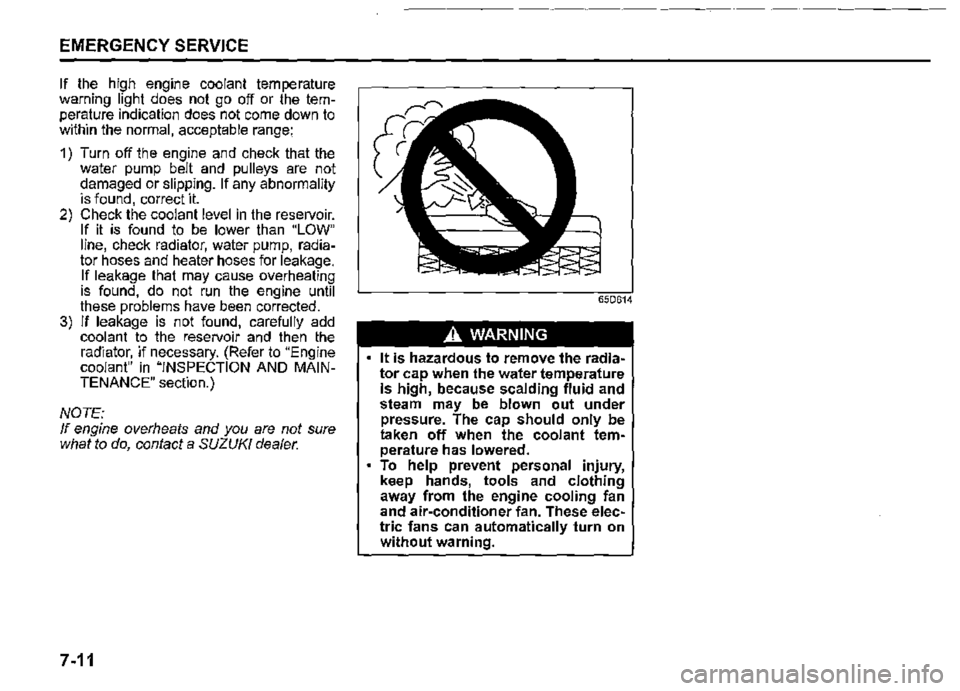
A WARNING
• It is hazardous to remove the radiator cap when the water temperature is high, because scalding fluid and steam may be blown out under pressure. The cap should only be taken off when the coolant temperature has lowered. To help prevent personal injury, keep hands, tools and clothing away from the engine cooling fan and air-conditioner fan. These electric fans can automatically turn on without warning.
Page 390 of 421
APPEARANCE CARE
Corrosion prevention
It is_ important to take good care of your vehicle to protect it from corrosion. Listed below are instructions for how to maintain your vehicle to prevent corrosion. Please read and follow these instructions carefully.
Important information about corro
sion
Common causes of corrosion 1) Accumulation of road salt, dirt moisture or chemicals in hard-to-reach areas of the vehicle underbody or frame. 2) Chipping, scratches and any damage to treated or painted metal surfaces resulting from minor accidents or abrasion by stones and gravel.
Environmental conditions which accelerate corrosion 1) Road salt, dust control chemicals, sea breeze or industrial pollution will all accelerate the corrosion of metal. 2) High humidity will increase the rate of corrosion particularly when the temperature range is just above the freezing point. 3) Moisture in certain areas of a vehicle for an extended period of lime may promote corrosion even though other body sections may be completely dry.
8-1
4) High temperatures will cause an accelerated rate of corrosion to parts of the vehicle which are not well-ventilated to permit quick drying.
This information illustrates the necessity of keeping your vehicle (particularly the ~nderbody) as clean and dry as possible. It Is equally important to repair any damage to the paint or protective coatings as soon as possible.
How to help prevent corrosion
Wash your vehicle frequently The_ best way to preserve the finish on your vehicle and to help avoid corrosion is to keep it clean with frequent washing. Wash your vehicle at least once during the winter and once immediately after the winter. K<:ep your vehicle, particularly the underside, as clean and dry as possible. If you frequently drive on salted roads your vehicle should be washed at least once a month during the winter. If you live near the ocean, your vehicle should be washed at least once a month throughout the year.
For washing instructions, refer to "Vehicle cleaning" section.
Remove foreign material deposits Foreign materials such as salts chemicals road oil or tar, tree sap, bird droppings and industnal fall-out may damage the finish of your vehicle if it is left on painted surfaces. Remove these types of deposits as quickly as possible. If these deposits are difficult to wash off, an additional cleaner may be required. Check that any cleaner you use is not harmful to painted surfaces and is specifically intended for your purposes. Follow the manufacturer's directions when using these special cleaners.
Repair finish damage Carefully examine your vehicle for damage to the painted surfaces. Should you find any chip~ or scratches in the paint, touch them up 1mmed1ately to prevent corrosion from starting. If the chips or scratches have gone through to the bare metal have a qualified body shop make the rep~ir.
Keep passenger and luggage compartments clean Moisture, dirt or mud can accumulate under the floor mats and may cause corrosion. Occasionally, check under these mats to ensure that this area is clean and dry. More fr~quent checks are necessary if the vehicle Is used for off-road driving or in wet weather. Certain cargos such as chemicals, fertilizers, cleaners, salts, etc. are extremely corrosive by nature. These products should be transported in sealed containers. If they