trailer SUZUKI JIMNY 2022 User Guide
[x] Cancel search | Manufacturer: SUZUKI, Model Year: 2022, Model line: JIMNY, Model: SUZUKI JIMNY 2022Pages: 421, PDF Size: 6.35 MB
Page 231 of 421

A WARNING
In addition to following the driving tips in this section, it is important to observe the following precautions for on-road and off-road driving. Driver and passengers should wear seat belts at all times. Do not let anyone else drive your vehicle unless they are also aware of the vehicle characteristics and handling differences described in this section. Avoid loaning your vehicle to any• one unless you accompany them. Make sure your tyres are in good condition and always maintain the specified tyre pressure. Refer to "Tyres" in the "INSPECTION AND MAINTENANCE" section for details. Do not use tyres other than those specified by SUZUKI. Never use dif• ferent sizes or types of tyres on the front and rear wheels. For informa• lion regarding the specified tyres, refer to the "SPECIFICATIONS" section. Never use oversized tyres or special shock absorbers and springs to raise uack up) your vehicle. This will raise the center of gravity of the vehicle and change its handling characteristics. (Continued)
A WARNING
(Continued) After driving through water, mud, or sandy ground, test the brakes while driving at a slow speed to see if they have maintained their nor• mal effectiveness. If the brakes are less effective than normal, dry them by repeatedly applying the brakes while driving slowly until the brakes have regained their nor• mal effectiveness. After extended operation in mud, sand, or water, have the brakes, bearings and joint parts etc. inspected by a SUZUKI dealer as soon as possible.
DRIVING TIPS
Running-in
NOTICE
The future performance and reliabil• ity of the engine depends on the care and restraint exercised during its early life. It is especially important to observe the following precautions during the first 960 km (600 miles) of vehicle operation. • After starting, do not race the engine. Warm ii up gradually. • Avoid prolonged vehicle operation at a constant speed. Moving parts will break in better if you vary your speed. Start off from a stop slowly. Avoid full throttle starts. Avoid hard braking, especially during the first 320 km (200 miles) of driving. Do not drive slowly with the !rans• mission in a high gear. Drive the vehicle at moderate engine speeds. Do not tow a trailer during the first 960 km (600 miles) of vehicle oper• ation.
4-8
Page 249 of 421

Frame hooks
It is not recommended that you use the frame hooks for towing another vehicle. They were originally designed to tow your vehicle in emergency situation. If your vehicle needs to be towed in an emergency, refer to "Towing your vehicle (recreational vehicle)" in "EMERGENCY SERVICE" section.
A WARNING
Observe the following instructions when using frame hooks. The frame hook or vehicle body may break and cause serious injury or damage: • Do not use the frame hooks for towing another vehicle. Avoid pulling the vehicle to get out of severe snowy, muddy or sandy conditions, sudden starts or erratic driving maneuvers which could cause excessive stress on the frame hook.
In such case, we recommend that you contact a professional service.
OTHER CONTROLS AND EQUIPMENT
Front
78RB05023
NOTICE
When you use the frame hook (1), avoid the driving that gives significant physical shock on hook. Such operation can damage the hook, or the vehicle body. Do not sudden accelerate.
78RB05054
The hook (A) is provided for trailer/train/ sea shipping purposes only.
NOTICE
Do not use the hook (A) in emergency situation. If you use this hook (A), the hook or the vehicle may be damaged.
5-14
Page 325 of 421
INSPECTION AND MAINTENANCE
Maintenance recommended under severe driving conditions (except for EU countries and Israel)
Follow this schedule if your vehicle is mainly operated under one or more of the following conditions: • When most trips are less than 6 km (4 miles). • When most trips are less than 16 km (10 miles) and outside temperature remains below freezing. Idling and/or low-speed operation in stop-and-go traffic. Operating in extremely cold weather and/or on salted roads. Operating in rough and/or muddy areas. Operating in dusty areas. Repeated high speed drive or high engine revolutions. Towing a trailer, if admitted. Schedule should also be followed if the vehicle is used for delivery service, police, taxi or other commercial applications.
NdTE: For the Maintenance Recommended under Severe Driving Conditions of Russian models, refer to "For Russia" in the "SUPPLEMENT" section.
6-8
Page 335 of 421
INSPECTION AND MAINTENANCE
Maintenance recommended under severe driving conditions (for EU countries and Israel)
Follow this schedule if your vehicle is mainly operated under one or more of the following conditions:
• When most trips are less than 6 km (4 miles). When most trips are less than 16 km (1 O miles) and outside temperature remains below freezing.
Idling and/or low-speed operation in stop-and-go traffic. Operating in extremely cold weather and/or on salted roads. Operating in rough and/or muddy areas. Operating in dusty areas. Repeated high speed drive or high engine revolutions. Towing a trailer, if admitted. Schedule should also be followed if the vehicle is used for delivery service, police, taxi or other commercial applications.
6-18
Page 383 of 421
78R808004
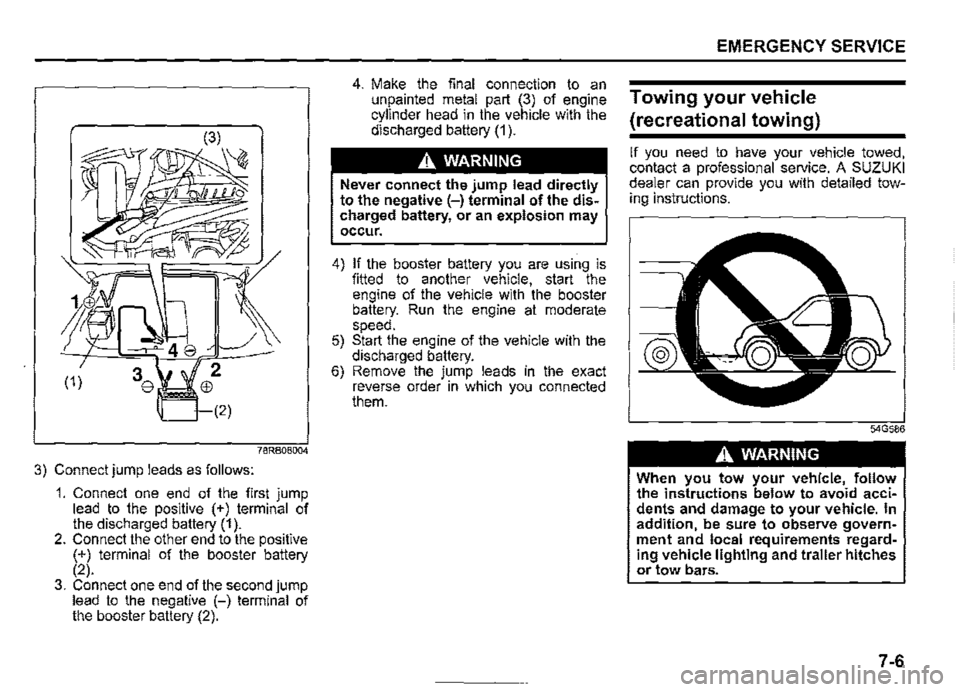
3) Connect jump leads as follows:
1. Connect one end of the first jump lead to the positive (+) terminal of the discharged battery (1 ). 2. Connect the other end to the positive (+) terminal of the booster battery (2). 3. Connect one end of the second jump lead to the negative (-) terminal of the booster battery (2).
4. Make the final connection to an unpainted metal part (3) of engine cylinder head in the vehicle with the discharged battery (1 ).
A WARNING
Never connect the jump lead directly to the negative (-) terminal of the discharged battery, or an explosion may occur.
4) If the booster battery you are using is fitted to another vehicle, start the engine of the vehicle with the booster battery. Run the engine at moderate speed. 5) Start the engine of the vehicle with the discharged battery. 6) Remove the jump leads in the exact reverse order in which you connected them.
EMERGENCY SERVICE
Towing your vehicle
(recreational towing)
If you need to have your vehicle towed, contact a professional service. A SUZUKI dealer can provide you with detailed towing instructions.
A WARNING
When you tow your vehicle, follow the instructions below to avoid accidents and damage to your vehicle. In addition, be sure to observe government and local requirements regarding vehicle lighting and trailer hitches or tow bars.
7-6
Page 415 of 421
INDEX
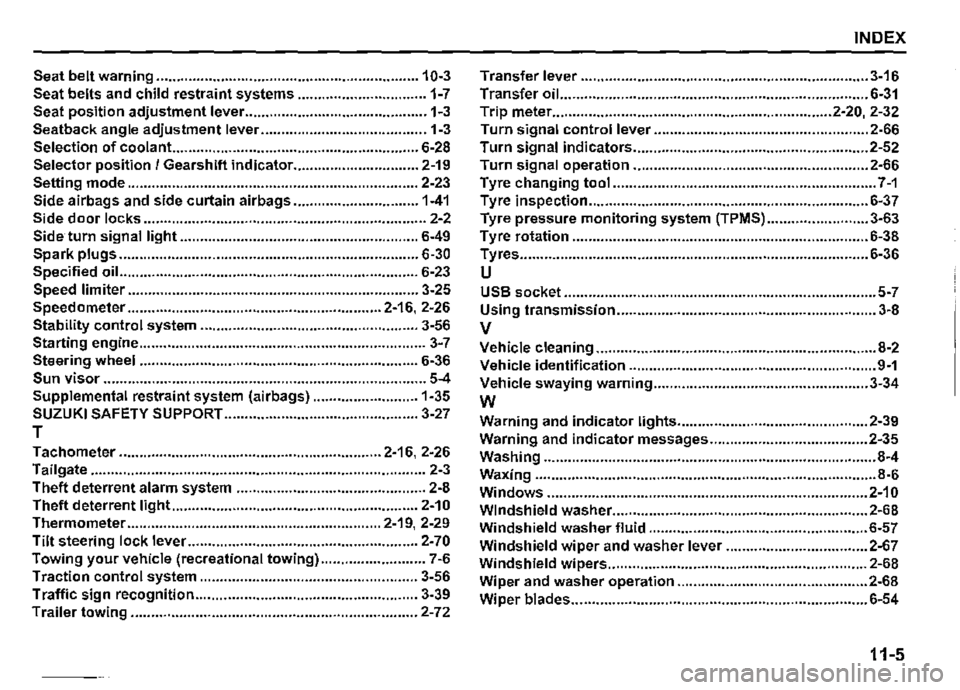
Seat belt warning ................................................................. 10-3 Transfer lever ....................................................................... 3-16
Seat belts and child restraint systems ................................ 1-7 Transfer oil.. .......................................................................... 6-31
Seat position adjustment lever ............................................. 1-3 Trip meter ..................................................................... 2-20, 2-32
Seatback angle adjustment lever ......................................... 1-3 Turn signal control lever ..................................................... 2-66
Selection of coolant. ............................................................ 6-28 Turn signal indicators .......................................................... 2-52
Selector position/ Gearshift indicator ............................... 2-19 Turn signal operation .......................................................... 2-66
Setting mode ........................................................................ 2-23 Tyre changing tool ................................................................. 7-1
Side airbags and side curtain airbags ............................... 1-41 Tyre inspection ..................................................................... 6-37
Side door locks ...................................................................... 2-2 Tyre pressure monitoring system (TPMS) ......................... 3-63
Side turn signal light ........................................................... 6-49 Tyre rotation ......................................................................... 6-38
Spark plugs .......................................................................... 6-30 Tyres ...................................................................................... 6-36
Specified oil .......................................................................... 6-23 u Speed limiter ........................................................................ 3-25 USB socket ............................................................................. 5-7 Speedometer ............................................................... 2-16, 2-26 Using transmission ................................................................ 3-8 Stability control system ...................................................... 3-56 V Starting engine ....................................................................... 3-7
Steering wheel ..................................................................... 6-36 Vehicle cleaning ..................................................................... 8-2
Vehicle identification ............................................................. 9-1 Sun visor ................................................................................ 5-4
Supplemental restraint system (airbags) .......................... 1-35
SUZUKI SAFETY SUPPORT ................................................ 3-27
T
Tachometer ................................................................. 2-16, 2-26
Tailgate ................................................................................... 2-3
Theft deterrent alarm system ............................................... 2-8
Vehicle swaying warning ..................................................... 3-34
w
Warning and indicator lights ............................................... 2-39
Warning and indicator messages ....................................... 2-35
Washing .................................................................................. 8-4
Waxing .................................................................................... 8-6
Windows ............................................................................... 2-10 Theft deterrent light ............................................................. 2-10 Windshield washer ............................................................... 2-68 Thermometer ............................................................... 2-19, 2-29 Windshield washer fluid ...................................................... 6-57 Tilt steering lock lever. ........................................................ 2-70
Towing your vehicle (recreational towing) .......................... 7-6
Traction control system ...................................................... 3-56
Traffic sign recognition ....................................................... 3-39
Trailer towing ....................................................................... 2-72
Windshield wiper and washer lever ................................... 2-67
Windshield wipers ................................................................ 2-68
Wiper and washer operation ............................................... 2-68
Wiper blades ......................................................................... 6-54
11-5