steering SUZUKI JIMNY 2022 Owner's Manual
[x] Cancel search | Manufacturer: SUZUKI, Model Year: 2022, Model line: JIMNY, Model: SUZUKI JIMNY 2022Pages: 421, PDF Size: 6.35 MB
Page 182 of 421
OPERATING YOUR VEHICLE
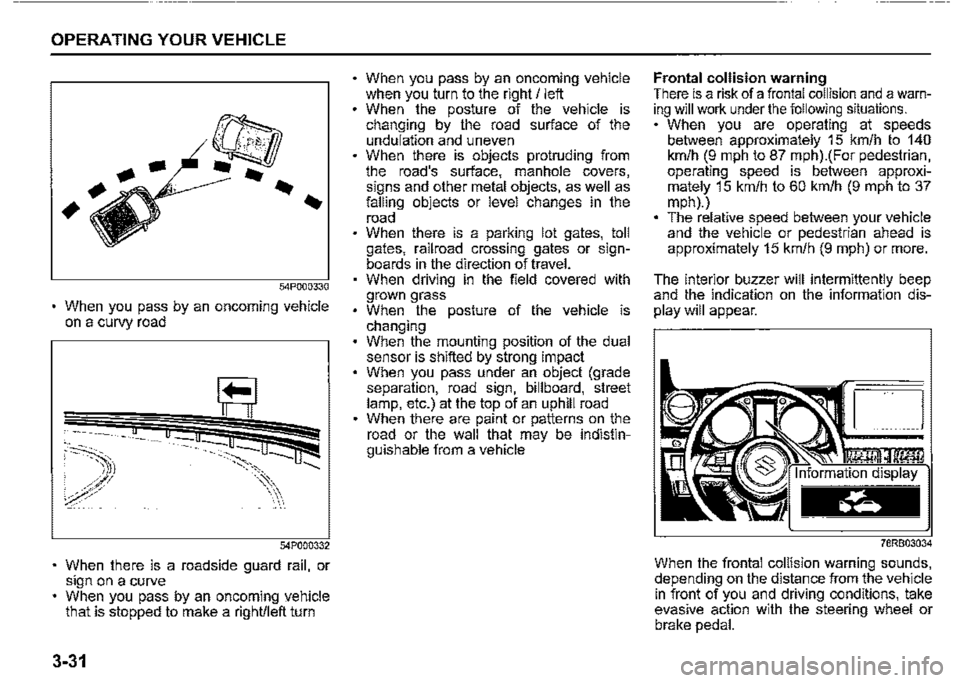
54P000330
When you pass by an oncoming vehicle on a curvy road
54?000332
When there is a roadside guard rail, or sign on a curve When you pass by an oncoming yehicle that is stopped to make a right/left turn
3-31
When you pass by an oncoming vehicle when you turn to the right/ left When the posture of the vehicle is changing by the road surface of the undulation and uneven When there is objects protruding from the road's surface, manhole covers, signs and other metal objects, as well as falling objects or level changes in the road When there is a parking lot gates, toll gates, railroad crossing gates or signboards in the direction of travel. When driving in the field covered with grown grass When the posture of the vehicle is changing When the mounting position of the dual sensor is shifted by strong impact When you pass under an object (grade separation, road sign, billboard, street lamp, etc.) at the top of an uphill road When there are paint or patterns on the road or the wall that may be indistinguishable from a vehicle
Frontal collision warning There is a risk of a frontal collision and a warning will work under the following situations. When you are operating at speeds between approximately 15 km/h to 140 km/h (9 mph to 87 mph).(For pedestrian, operating speed is between approximately 15 km/h to 60 km/h (9 mph to 37 mph).) The relative speed between your vehicle and the vehicle or pedestrian ahead is approximately 15 km/h (9 mph) or more.
The interior buzzer will intermittently beep and the indication on the information dis
play will appear.
78RB03034
When the frontal collision warning sounds, depending on the distance from the vehicle in front of you and driving conditions, take evasive action with the steering wheel or brake pedal.
Page 184 of 421
OPERATING YOUR VEHICLE
Lane departure warning
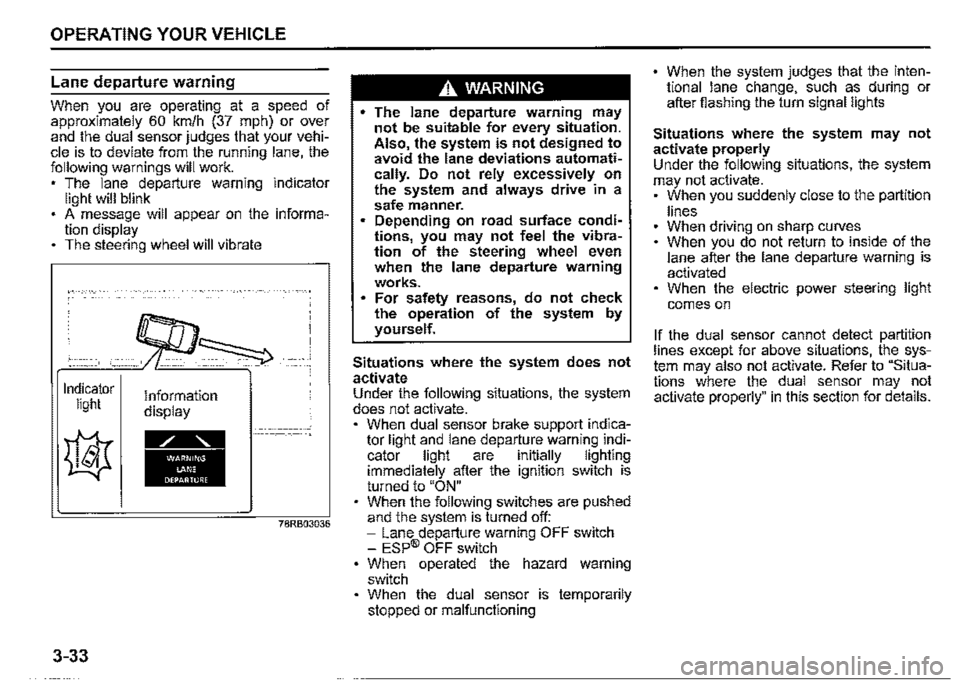
When you are operating at a speed of approximately 60 km/h (37 mph) or ov~r and the dual sensor judges that your vehicle is to deviate from the running lane, the following warnings will work. , The lane departure warning indicator light will blink . A message will appear on the information display The steering wheel will vibrate
Indicator light
3-33
Information display
78RB03036
A WARNING
• The lane departure warning may not be suitable for every situation. Also the system is not designed to avoid the lane deviations automati~ cally. Do not rely excessively on the system and always drive in a safe manner. Depending on road surface conditions, you may n~t feel the vibration of the steering wheel even when the lane departure warning works. For safety reasons, do not check the operation of the system by yourself.
Situations where the system does not activate Under the following situations, the system does not activate. , When dual sensor brake support indicator light and lane departu_re warni~g i~dicator light are 1nitially lighting immediately after the ignition switch is turned to "ON" When the following switches are pushed and the system is turned off: -Lane departure warning OFF switch -ESP® OFF switch When operated the hazard warning switch When the dual sensor is temporarily stopped or malfunctioning
When the system judges that the intentional lane change, such as during or after fiashing the turn signal lights
Situations where the system may not activate properly Under the following situations, the system may not activate. , When you suddenly close to the partition
lines When driving on sharp curves When you do not return to inside of th_e lane after the lane departure warning 1s activated When the electric power steering light
comes on
If the dual sensor cannot detect partition lines except for above situations, t~~ _system may also not activate. Refer to Situations where the dual sensor may not activate properly" in this section for details.
Page 205 of 421
Anti-lock brake system (ABS)
ABS will help you avoid skidding by electronically controlling braking pressure. It will also help you maintain steering control when braking on slippery surfaces or when braking hard. The ABS works automatically, so you do not need any special braking technique. Just push the brake pedal down without pumping. The ABS will operate whenever it senses that the wheels are locking up. You may feel the brake pedal move a little while the ABS is operating.
NOTE: The ABS will not work if vehicle speed is under about 9 km/h (6 mph). ff the ABS system is activated, you may hear a clunking noise and/or feel pulsating in the brake pedal. This is normal and indicates that the brake fluid pressure is being controlled properly. You may hear an operation sound when you start the engine or after the vehicle begins to move. This means that the above systems are in the self-check mode. This sound does not indicate a malfunction.
A WARNING
On some types of loose surfaces (such as gravel, snow-covered roads, etc.), the stopping distance required for a vehicle with ABS may be slightly greater than the one required for a comparable vehicle with a conventional brake system. With a conventional brake system, skidding tyres are able to plow the gravel or snow layer, shortening the stopping distance. ABS minimizes this resistance effect. Allow for extra stopping distance when driving on loose surfaces. On regular paved roads, some drivers may be able to obtain slightly shorter stopping distances with conventional brake systems than with ABS. In both of the above conditions, ABS will still offer the advantage of helping you maintain directional control. However, remember that ABS will not compensate for bad road or weather conditions or poor driver judgment. Use good judgment and do not drive too fast.
OPERATING YOUR VEHICLE
(8) (CD)
(1) (2)
54MN069
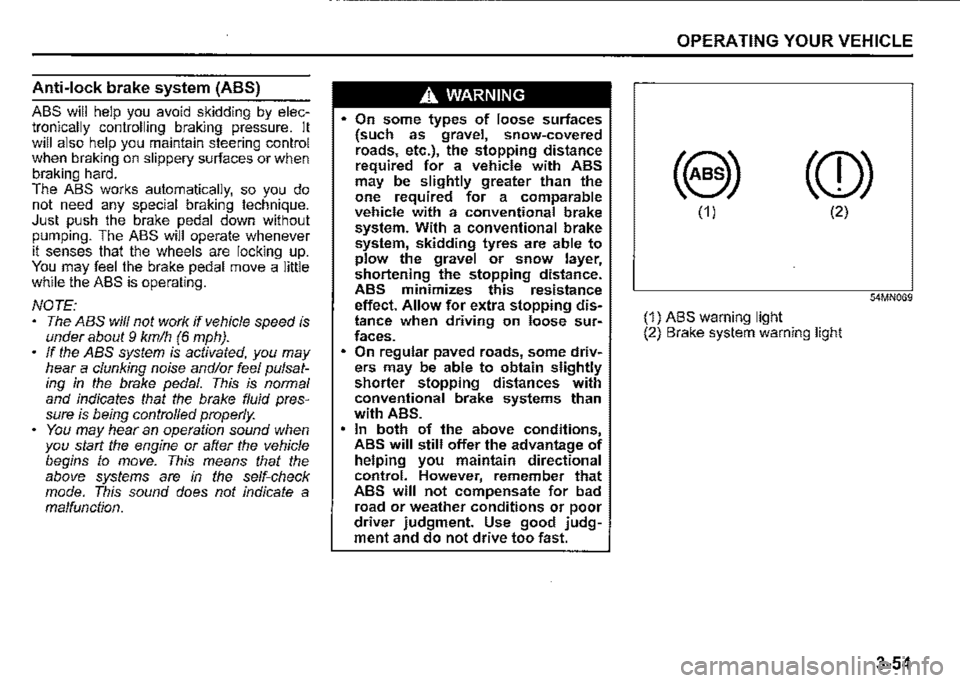
(1) ABS warning light (2) Brake system warning light
3-54
Page 207 of 421
The ESP® has the following three systems:
Stability control system
The vehicle stability control system helps provide integrated control of systems such as anti-lock brakes, traction control, engine control, etc. This system automatically controls the brakes and engine to help prevent the vehicle from skidding when cornering on a slippery road surface or when turning the steering wheel abruptly.
Traction control system
The traction control system automatically helps prevent the spinning of wheels when the vehicle is started or accelerated on slippery road surfaces. The system operates only if it senses that some of the wheels are spinning or beginning to lose traction. When this happens, the system operates the front or rear brakes and reduces engine power to l1m1t wheel spin.
NOTE: You may hear an operation sound when you start the engine or after the vehicle begins to move. This means that the above systems are in the self-check mode. This sound does not indicate a malfunction.
Anti-lock brake system (ABS)
ABS will help you avoid skidding by electronically controlling braking pressure. It will also help you maintain steering control when braking on slippery surfaces or when braking hard. The ABS works automatically, so you do not have to use any special braking technique. Just push the brak_e pedal down without pumping. The ABS will operate whenever it senses that wheels are locking up. You may feel the brake pedal pulsate while the ABS is operating. (For more information on ABS, see "Braking" in this section.)
NOTE: The ABS will not work if vehicle speed is under about 9 km/h (6 mph).
A WARNING
The ESP® may not work properly if tyres or wheels other than those specified in the owner's manual are used. When replacing tyres or wheels, use only the size and type specified in this owner's manual. • The ESP® may not work properly if ·tyres are not inflated to the recom
mended ~re pressure. The ESP" may not work properly if tyres are fitted with snow chains. (Continued)
OPERATING YOUR VEHICLE
A WARNING
(Continued) • The ESP® may not work properly if the tyres are excessively worn. Replace tyres when the tread wear indicators in the grooves appear on the tread surface. • The ESP® is not a substitute for winter tyres or snow chains on a snowMcovered road.
A WARNING
• The ESP® may not work properly if engine related parts such as the muffler are not equivalent to standard equipment or are extremely deteriorated. Do not modify the vehicle's suspension since the ESP® may not work properly.
NOTE: • If the Espi!) system is activated, you may hear a clunking noise and/or feel pulsating in the brake pedal. This is. normal and indicates that the brake flwd pressure is being controlled properly. You may hear an operation sound when you start the engine or after the vehicle begins to move. This means that the above systems are in the self-check mode. This sound does not indicate a malfunction.
3-56
Page 210 of 421
OPERATING YOUR VEHICLE
ABS warning light/ brake system
warning light
See "Braking" in this section.
Hill descent control system
The hill descent control system is designed to reduce the driver's workload when going down steep, rough and/or slippery hills where the vehicle cannot decelerate enough by engine braking alone. The hill descent control system helps to control vehicle speed by automatically engaging the vehicle's brakes, as needed, so you can concentrate on steering the vehicle.
.A. WARNING
Do not rely excessively on the hill descent control system. The hill descent control system may not control the vehicle speed on a hill under all load or road conditions. Always be prepa!ed to control vehicle speed by applying the brakes. Failure to pay attention and control vehicle speed using the brakes when necessary may result in loss of control or an accident.
3-59
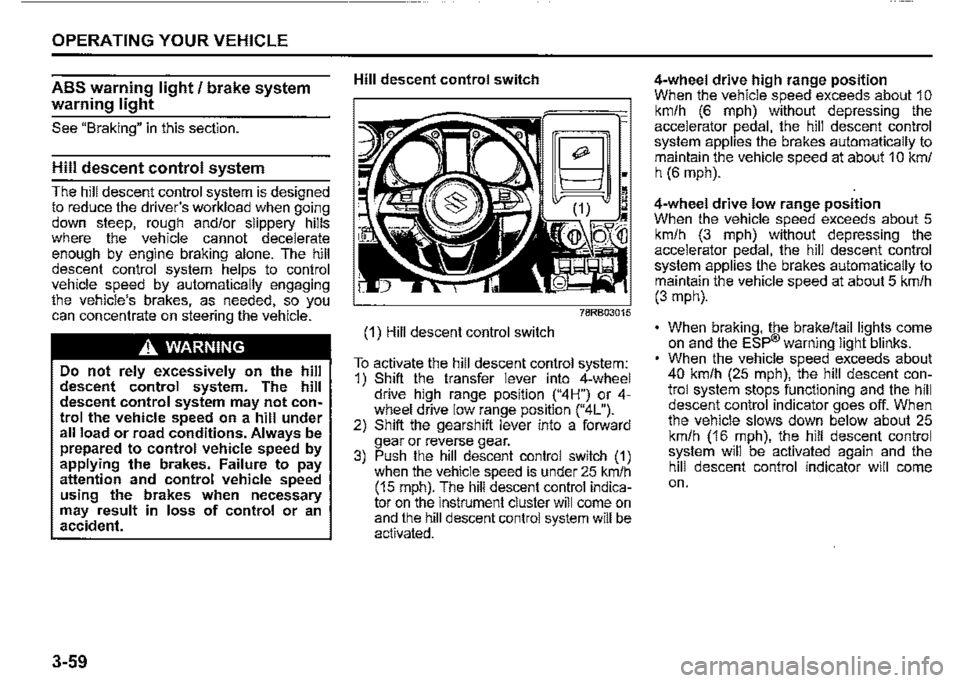
Hill descent control switch
(1) Hill descent control switch
~;
~~~:~M
To activate the hill descent control system: 1) Shift the transfer lever into 4-wheel drive hiQh range position ("4H") or 4-wh!"el drive low '.ange position ("4L"). 2) Shift the gearsh1ft lever into a forward gear or reverse gear. 3) Push the hill descent control switch (1) when the vehicle speed is under 25 km/h (15 mph). The hill descent control indicator on the instrument cluster will come on and the hill descent control system will be activated.
4-wheel drive high range position When the vehicle speed exceeds about 1 o km/h (6 mph) without depressing the accelerator pedal, the hill descent control system applies the brakes automatically to maintain the vehicle speed at about 1 O km/ h (6 mph).
4-wheel drive low range position When the vehicle speed exceeds about 5 km/h (3 mph) without depressing the accelerator pedal, the hill descent control system applies the brakes automatically to maintain the vehicle speed at about 5 km/h (3 mph).
• When braking, the brake/tail lights come on and the ESP® warning light blinks. When the vehicle speed exceeds about 40 km/h (25 mph), the hill descent control system stops functioning and the hill descent control indicator goes off. When the vehicle slows down below about 25 km/h (16 mph), the hill descent control system will be activated again and the hill descent control indicator will come on.
Page 213 of 421
A WARNING
(Continued) After you release your foot from the brake pedal, accelerate the vehicle to move up immediately. If you release your foot from the brake pedal over 2 seconds, the hill hold control system will be canceled. If so, the vehicle may roll downward, which can result in an accident depending on the degree of slope. And, the engine may stall and the power assist for the steering and brakes will not work so steering and braking will be much harder than usual which can result in an accident or vehicle damage. If you drive on the steep slope, the gravel, the sclnow-covered road, or the muddy r I'd and the hill hold control system is activated, there may be a possibility that the wheels will be locked and then the vehicle may lose the control.
The hill hold control system activates for a maximum of about 2 seconds if your foot is moved from the brake pedal when the following conditions are all met.
1) The gearshift lever is in a forward gear or reverse gear. 2) The parking brake is released. 3) The vehicle is on an upward incline.
NOTE: When the hill hold control system is activated, the following conditions may be found, but this is not a malfunction. You may hear a sound from the engine room. As brake pedal becomes heavy, it may be difficult for you to depress it.
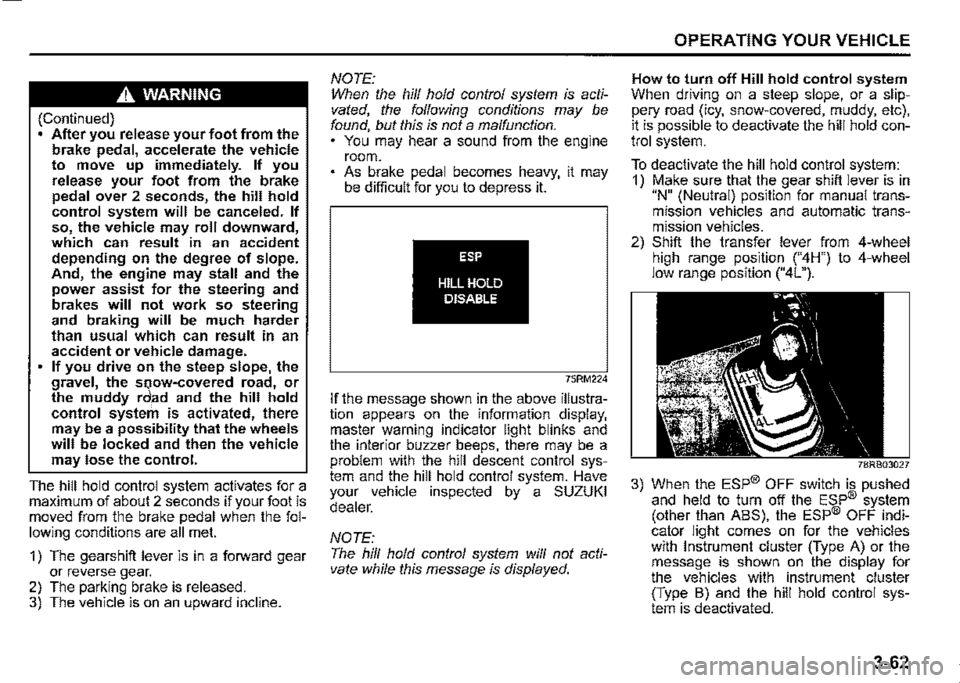
ESP
HILL HOLD DISABLE
75RM224
If the message shown in the above illustration appears on the information display, master warning indicator light blinks and the interior buzzer beeps, there may be a problem with the hill descent control system and the hill hold control system. Have your vehicle inspected by a SUZUKI dealer.
NOTE: The hill hold control system will not activate while this message is displayed.
OPERATING YOUR VEHICLE
How to turn off Hill hold control system When driving on a steep slope, or a slippery road (icy, snow-covered, muddy, etc), it is possible to deactivate the hill hold control system.
To deactivate the hill hold control system: 1) Make sure that the gear shift lever is in "N" (Neutral) position for manual transmission vehicles and automatic transmission vehicles. 2) Shift the transfer lever from 4-wheel high range position ("4H") to 4-wheel low range position ("4L").
78RB03027
3) When the ESP® OFF switch is pushed and held to turn off the ESP® system (other than ABS), the ESP® OFF indicator light comes on for the vehicles with Instrument cluster (Type A) or the message is shown on the display for the vehicles with instrument cluster (Type B) and the hill hold control system is deactivated.
3-62
Page 216 of 421
OPERATING YOUR VEHICLE
A WARNING
The load-carrying capacity of your tyres is reduced at lower inflation pressures. If your tyres are even moderately under-inflated, the load on the tyres may exceed the load-carrying capacity of the tyres, which could lead to tyre failure. The low tyre pressure warning light will not alert you to this condition, because it only comes on when one or more of your tyres becomes significantly underinflated.
Check and adjust your tyre pressure at least once a month. Refer to "Tyres" in "INSPECTION AND MAINTENANCE" section.
3-65
A WARNING
Continuing to drive with the low tyre pressure warning light on can lead to an accident, resulting in severe injury or death. If the low tyre pressure warning light comes on and stays on, reduce your speed and avoid abrupt steering and braking. Be aware that driving on a significantly under-inflated tyre can cause the tyre to overheat and can lead to tyre failure, and may affect steering control and brake effectiveness. Stop in a safe place as soon as possible and check your tyres. If you have a flat tyre, replace it with the spare tyre (if equipped). Refer to "Jacking instructions" in "EMERGENCY SERVICE" section for the tyre replacement method. Also refer to "Replacing tyres and/ or wheels" for instructions on how to restore normal operation of the TPMS after you have had a flat tyre. • If one or more of your tyres is under-inflated, adjust the inflation pressure in all of your tyres to the recommended inflation pressure as soon as possible.
The low tyre pressure warning light can come on due to normal causes such as natural air leakage and pressure changes caused by changes in temperature or atmospheric pressure. Adjusting the air pressure in the tyres to the pressure shown on the tyre information placard should cause the low tyre pressure warning light to turn off.
To make the low tyre pressure warning light go off, adjust the tyre pressures when the tyres are cold, and drive the vehicle for about 10 minutes. When the adjusted tyre pressure is recognized, the low tyre pressure warning light will go off and the information display shows the current tyre pressure (if you select the TPMS monitor (if equipped)).
Page 224 of 421
DRIVING TIPS
52D078
A WARNING
Fasten your seat belts at all times. Even though airbags are equipped at the front seating positions, the driver and all passengers should be properly restrained at all times, using the seat belts provided. Refer to "Seat belts and child restraint systems" section for instructions on proper use of the seat belts. Never drive under the influence of alcohol or other drugs. Alcohol and drugs can seriously impair your ability to drive safely, greatly increasing the risk of injury to yourself and others. You should also avoid driving when you are tyred, sick, irritated or under stress.
4-1
Important Vehicle Design
Features to Know
A WARNING
Your multipurpose vehicle has handling characteristics that differ from those of a conventional passenger car. For the safety of you and your passengers, please read the following section very carefully.
Multipurpose vehicles such as your new SUZUKI have higher ground clearance and a narrower track than conventional passenger cars, to make them capable of performing in a wide variety of off-road applications. Specific design characteristics give them a higher center of gravity than ordinary cars. An advantage of the higher ground clearance is a better view of the road allowing you to anticipate problems. They are not designed for cornering at the same speed as conventional passenger cars any more than low-slung sports cars are designed to perform satisfactorily under off-road conditions. If at all possible, avoid sharp turns or abrupt maneuvers. As with other vehicles of this type, failure to operate this vehicle correctly may result in loss of control or vehicle rollover. Multipurpose vehicles have a significantly higher rollover rate than other types of vehicles. In a rollover collision, an
unbelted person is significantly more likely to die than a person wearing a seat belt.
Important Differences Between
Your Multipurpose Vehicle and
Ordinary Passenger Cars
Higher Ground Clearance The higher ground clearance of your vehicle enables it to clear off-road obstacles, such as rocks and tree stumps, that ordinary passenger cars cannot drive over. An unavoidable result of this higher ground clearance is that the vehicle also has a higher center of gravity. Consequently, your vehicle will handle differently than a vehicle with a lower center of gravity.
Shorter Wheelbase Along with its higher ground clearance, your vehicle has a shorter wheelbase and shorter front and rear overhangs than the typical passenger car. These features combine to allow you to drive your vehicle over hillcrests without hanging up on them or damaging the frame and chassis components. The shorter wheelbase also makes the steering of your vehicle more responsive than that of vehicles with longer wheelbases.
Page 225 of 421
Narrower Body Width and Track Your vehicle is narrower than the average passenger car so that it can pass through tight spaces. Without the essential characteristics described above: higher ground clearance, shorter wheelbase, and narrower body width and track -your vehicle could not provide you with excellent offroad driving performance. However, it is also true that on-road driving, handling, and steering will be different from what drivers experience with a conventional passenger car.
On-Paved Road Driving
The data of accidents show that most rollover accidents for multi-purpose vehicles are caused when a driver loses control of the vehicle and leaves the paved portion of the roadway striking a ditch, curb or other off-road object that causes the vehicle to overturn. The following driving practices may reduce the risk of rollover.
Vehicle Slides Off-Road
You can reduce the risk of this kind of rollover accident by always keeping the vehicle under control. Typically, drivers lose control of vehicles, often resulting in rollover accidents, when the driver is impaired because of alcohol or other drugs, falls asleep at the wheel or is otherwise inattentive, or is driving too fast for the road con
ditions.
DRIVING TIPS
Rollovers On the Roadway
If, for any reason, your vehicle slides sideways or spins out of control at highway speeds, while on the paved portion of the roadway, the risk of rollover is greatly increased. This condition can be created when two or more wheels drop off onto the shoulder and you steer sharply in an attempt to reenter the roadway. To reduce the risk of rollover in these circumstances, if conditions permit, you should hold the steering wheel firmly and slow down before pulling back into the travel lanes with controlled steering movements.
All Types of Rollover Accidents
· As with many kinds of automobile accidents, rollovers can be greatly reduced by doing what all prudent drivers should do, i.e., don't drink and drive, don't drive when tired and don't do anything behind the wheel that could cause a loss of attention to the driving task. Additional guidelines are set out below for your on-road driving.
4-2
Page 226 of 421

DRIVING TIPS
Know Your Vehicle
Take time to familiarize yourself with the unique handling characteristics of your vehicle by first driving around in an area away from traffic. Practice turning the vehicle at a variety of speeds and in different directions. Get a feel for the greater steering response that your vehicle has over a conventional car.
Wear Your Seat Belts at All Times
The driver and all passengers should be properly restrained at all times, using the seat belts provided. Refer to the "SEAT BELTS" section for instructions on proper use of the seat belts.
Don't Make Sharp Turns
As mentioned before, small multipurpose vehicles have specific design characteristics that allow them to perform in a wide variety of applications. These characteristics also change the cornering behavior relative to conventional passenger cars. Remember, small multipurpose vehicles have more responsive steering and a higher center of gravity than conventional passenger cars. If at all possible, avoid making sharp turns in your vehicle.
4-3
Slow Down on Curves
Learn to approach curves cautiously and at a conservative speed. Do not attempt to take curves at the same speeds that you would in a vehicle with a lower center of gravity. Just as you would not drive a sports car on a trail, you should not attempt to drive your vehicle around curves like a sports car.
Slow Down and Use Caution on
Slippery Roads
60G089A
Under wet road conditions you should drive at a lower speed than on dry roads due to possible slippage of tyres during braking. When driving on icy, snow-covered, or muddy roads, reduce your speed and avoid sudden acceleration, abrupt braking, or sharp steering movements. Use 4-wheel drive high range (4H) for better traction.