Starting SUZUKI KIZASHI 2010 1.G Owner's Manual
[x] Cancel search | Manufacturer: SUZUKI, Model Year: 2010, Model line: KIZASHI, Model: SUZUKI KIZASHI 2010 1.GPages: 388, PDF Size: 4.94 MB
Page 286 of 388
7-1INSPECTION AND MAINTENANCE
57L20-03E
60A187S
WARNING
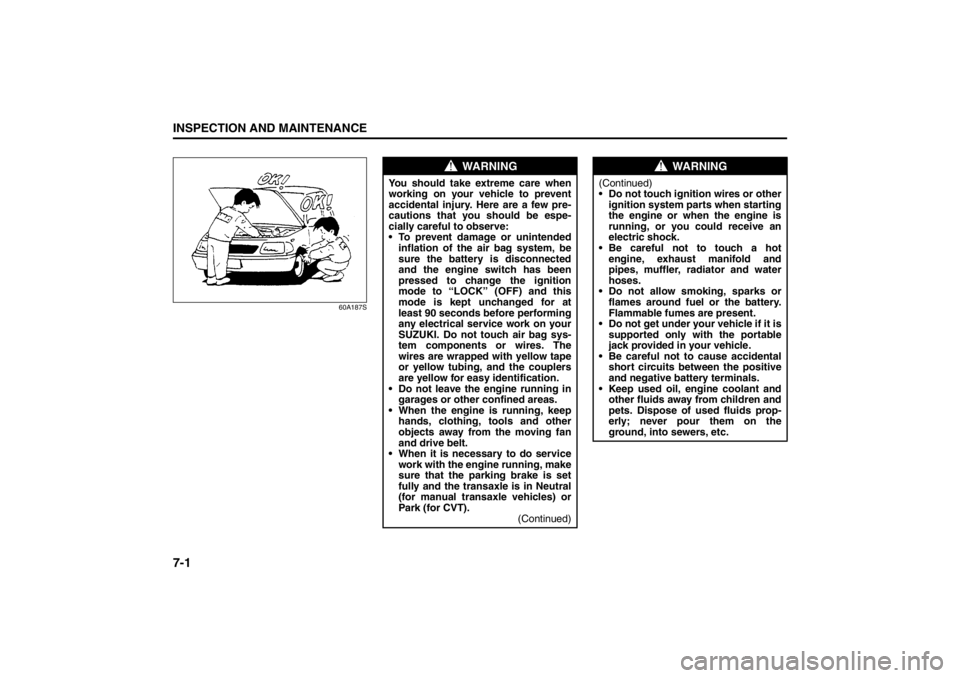
You should take extreme care when
working on your vehicle to prevent
accidental injury. Here are a few pre-
cautions that you should be espe-
cially careful to observe:
To prevent damage or unintended
inflation of the air bag system, be
sure the battery is disconnected
and the engine switch has been
pressed to change the ignition
mode to “LOCK” (OFF) and this
mode is kept unchanged for at
least 90 seconds before performing
any electrical service work on your
SUZUKI. Do not touch air bag sys-
tem components or wires. The
wires are wrapped with yellow tape
or yellow tubing, and the couplers
are yellow for easy identification.
Do not leave the engine running in
garages or other confined areas.
When the engine is running, keep
hands, clothing, tools and other
objects away from the moving fan
and drive belt.
When it is necessary to do service
work with the engine running, make
sure that the parking brake is set
fully and the transaxle is in Neutral
(for manual transaxle vehicles) or
Park (for CVT).
(Continued)
WARNING
(Continued)
Do not touch ignition wires or other
ignition system parts when starting
the engine or when the engine is
running, or you could receive an
electric shock.
Be careful not to touch a hot
engine, exhaust manifold and
pipes, muffler, radiator and water
hoses.
Do not allow smoking, sparks or
flames around fuel or the battery.
Flammable fumes are present.
Do not get under your vehicle if it is
supported only with the portable
jack provided in your vehicle.
Be careful not to cause accidental
short circuits between the positive
and negative battery terminals.
Keep used oil, engine coolant and
other fluids away from children and
pets. Dispose of used fluids prop-
erly; never pour them on the
ground, into sewers, etc.
Highway Driving: NO
Driving on Hills: NO
Page 300 of 388
7-15INSPECTION AND MAINTENANCE
57L20-03E
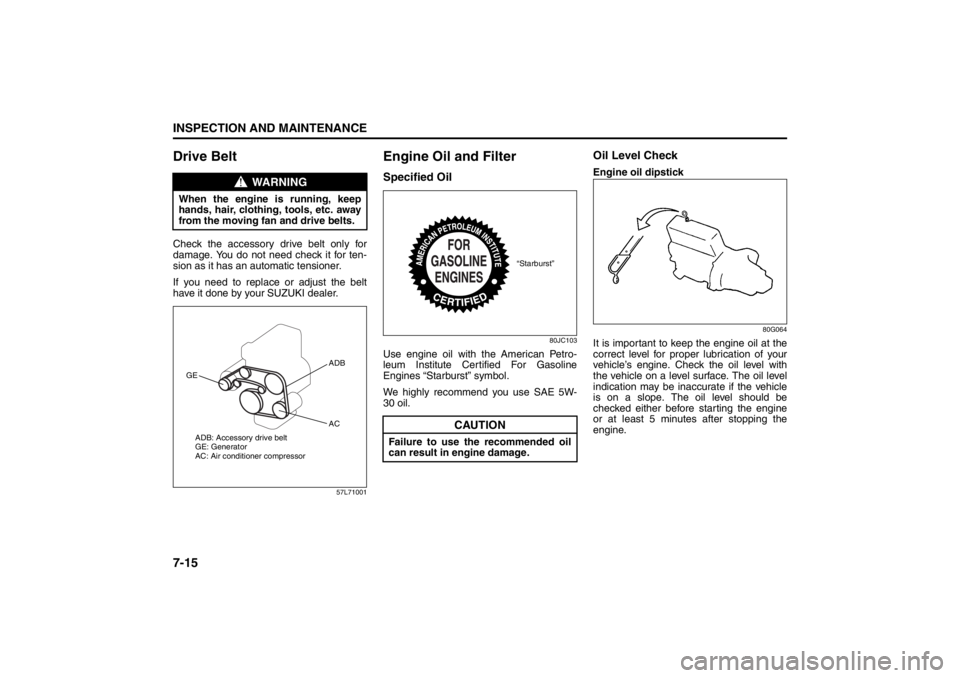
Drive Belt Check the accessory drive belt only for
damage. You do not need check it for ten-
sion as it has an automatic tensioner.
If you need to replace or adjust the belt
have it done by your SUZUKI dealer.
57L71001
Engine Oil and FilterSpecified Oil
80JC103
Use engine oil with the American Petro-
leum Institute Certified For Gasoline
Engines “Starburst” symbol.
We highly recommend you use SAE 5W-
30 oil.
Oil Level CheckEngine oil dipstick
80G064
It is important to keep the engine oil at the
correct level for proper lubrication of your
vehicle’s engine. Check the oil level with
the vehicle on a level surface. The oil level
indication may be inaccurate if the vehicle
is on a slope. The oil level should be
checked either before starting the engine
or at least 5 minutes after stopping the
engine.
WARNING
When the engine is running, keep
hands, hair, clothing, tools, etc. away
from the moving fan and drive belts.
ADB: Accessory drive belt
GE: Generator
AC: Air conditioner compressorGEADB
AC
CAUTION
Failure to use the recommended oil
can result in engine damage.
“Starburst”
Page 324 of 388
7-39INSPECTION AND MAINTENANCE
57L20-03E
Determining Compatibility of Tire
and Vehicle Load Limits
The tires on your vehicle, when they
are inflated to the recommended tire
inflation pressure, have a load-carry-
ing capacity that is greater than the
load that will be on the tires when the
vehicle is at its GVWR or GAWR limit.
Never use replacement tires that have
a load-carrying capacity less than the
original tires on your vehicle. Tire load-
carrying capacity information is
molded into the tire sidewall typically
shown as “Max. Load”. Use of replace-
ment tires with a lower load-carrying
capacity than the original tires, or fail-
ure to keep the tires inflated to recom-
mended tire pressure, may reduce the
GVWR or GAWR limit of your vehicle.
NOTE:
Use of replacement tires with a higher
load-carrying capacity than the origi-
nal tires, or using a tire inflation pres-
sure higher than the recommended
tire inflation pressure, will not increase
the GVWR or GAWR limit of your vehi-
cle.
Battery
60A269
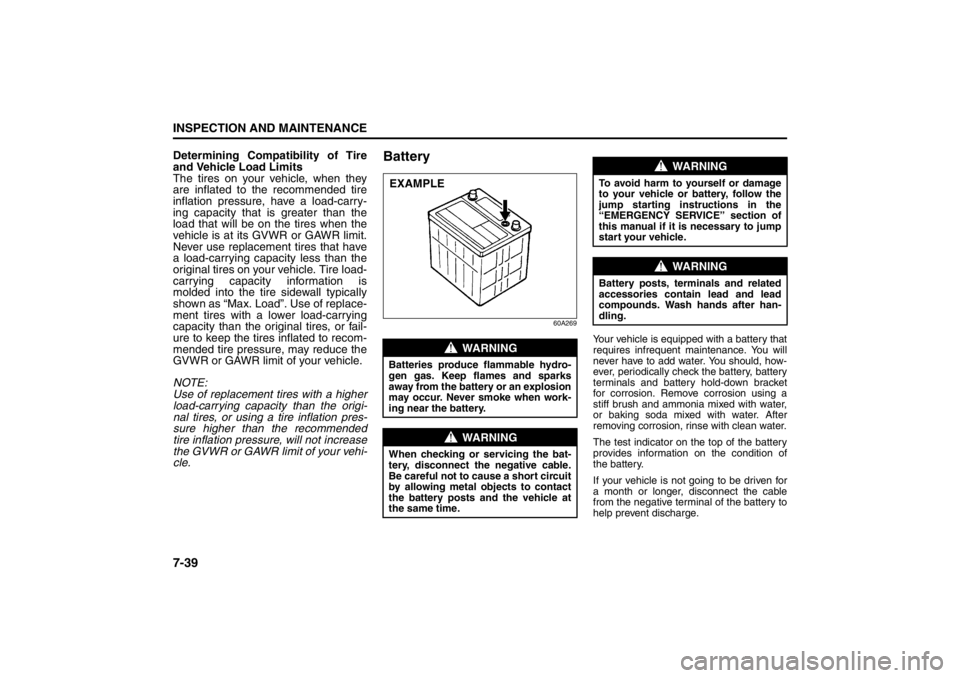
Your vehicle is equipped with a battery that
requires infrequent maintenance. You will
never have to add water. You should, how-
ever, periodically check the battery, battery
terminals and battery hold-down bracket
for corrosion. Remove corrosion using a
stiff brush and ammonia mixed with water,
or baking soda mixed with water. After
removing corrosion, rinse with clean water.
The test indicator on the top of the battery
provides information on the condition of
the battery.
If your vehicle is not going to be driven for
a month or longer, disconnect the cable
from the negative terminal of the battery to
help prevent discharge.
WARNING
Batteries produce flammable hydro-
gen gas. Keep flames and sparks
away from the battery or an explosion
may occur. Never smoke when work-
ing near the battery.
WARNING
When checking or servicing the bat-
tery, disconnect the negative cable.
Be careful not to cause a short circuit
by allowing metal objects to contact
the battery posts and the vehicle at
the same time.EXAMPLE
WARNING
To avoid harm to yourself or damage
to your vehicle or battery, follow the
jump starting instructions in the
“EMERGENCY SERVICE” section of
this manual if it is necessary to jump
start your vehicle.
WARNING
Battery posts, terminals and related
accessories contain lead and lead
compounds. Wash hands after han-
dling.
Page 325 of 388
7-40
INSPECTION AND MAINTENANCE
57L20-03E
FusesYour vehicle has three types of fuses, as
described below:
Main Fuse – The main fuse takes current
directly from the battery.
Primary Fuses – These fuses are between
the main fuse and individual fuses, and are
for electrical load groups.
Individual Fuses – These fuses are for indi-
vidual electrical circuits.
For details on protected circuits, refer to
the “Fuses and Protected Circuits” section
in this manual.
To remove a fuse, use the fuse puller pro-
vided in the fuse box.
57L71011
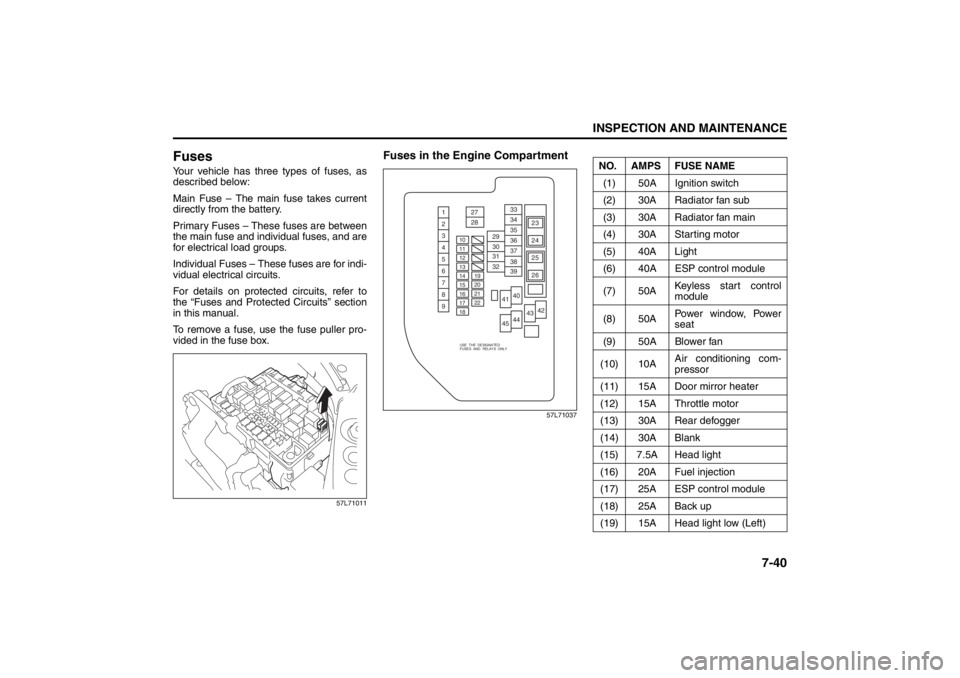
Fuses in the Engine Compartment
57L71037
1
10
11
12
13
14
15
16
1719
20
21
22
23
24
25
26 29
30
31
3233
34 27
28
37
38
39
40
41
444342
4535
36
18
2
3
4
5
6
7
8
9
USE THE DESIGNATED
FUSES AND RELAYS ONLY
NO. AMPS FUSE NAME
(1) 50A Ignition switch
(2) 30A Radiator fan sub
(3) 30A Radiator fan main
(4) 30A Starting motor
(5) 40A Light
(6) 40A ESP control module
(7) 50AKeyless start control
module
(8) 50APowe r w i n d ow, Powe r
seat
(9) 50A Blower fan
(10) 10AAir conditioning com-
pressor
(11) 15A Door mirror heater
(12) 15A Throttle motor
(13) 30A Rear defogger
(14) 30A Blank
(15) 7.5A Head light
(16) 20A Fuel injection
(17) 25A ESP control module
(18) 25A Back up
(19) 15A Head light low (Left)
Page 326 of 388
7-41INSPECTION AND MAINTENANCE
57L20-03E
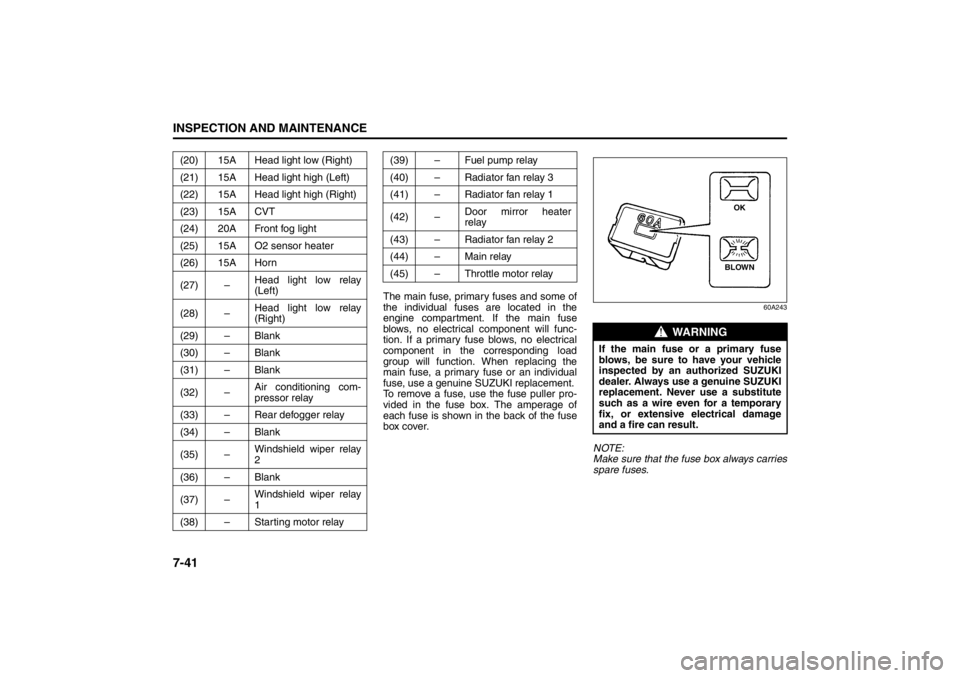
The main fuse, primary fuses and some of
the individual fuses are located in the
engine compartment. If the main fuse
blows, no electrical component will func-
tion. If a primary fuse blows, no electrical
component in the corresponding load
group will function. When replacing the
main fuse, a primary fuse or an individual
fuse, use a genuine SUZUKI replacement.
To remove a fuse, use the fuse puller pro-
vided in the fuse box. The amperage of
each fuse is shown in the back of the fuse
box cover.
60A243
NOTE:
Make sure that the fuse box always carries
spare fuses. (20) 15A Head light low (Right)
(21) 15A Head light high (Left)
(22) 15A Head light high (Right)
(23) 15A CVT
(24) 20A Front fog light
(25) 15A O2 sensor heater
(26) 15A Horn
(27) –Head light low relay
(Left)
(28) –Head light low relay
(Right)
(29) – Blank
(30) – Blank
(31) – Blank
(32) –Air conditioning com-
pressor relay
(33) – Rear defogger relay
(34) – Blank
(35) –Windshield wiper relay
2
(36) – Blank
(37) –Windshield wiper relay
1
(38) – Starting motor relay
(39) – Fuel pump relay
(40) – Radiator fan relay 3
(41) – Radiator fan relay 1
(42) –Door mirror heater
relay
(43) – Radiator fan relay 2
(44) – Main relay
(45) – Throttle motor relay
WARNING
If the main fuse or a primary fuse
blows, be sure to have your vehicle
inspected by an authorized SUZUKI
dealer. Always use a genuine SUZUKI
replacement. Never use a substitute
such as a wire even for a temporary
fix, or extensive electrical damage
and a fire can result.
BLOWNOK
Page 343 of 388
EMERGENCY SERVICE
8
57L20-03E
60G411
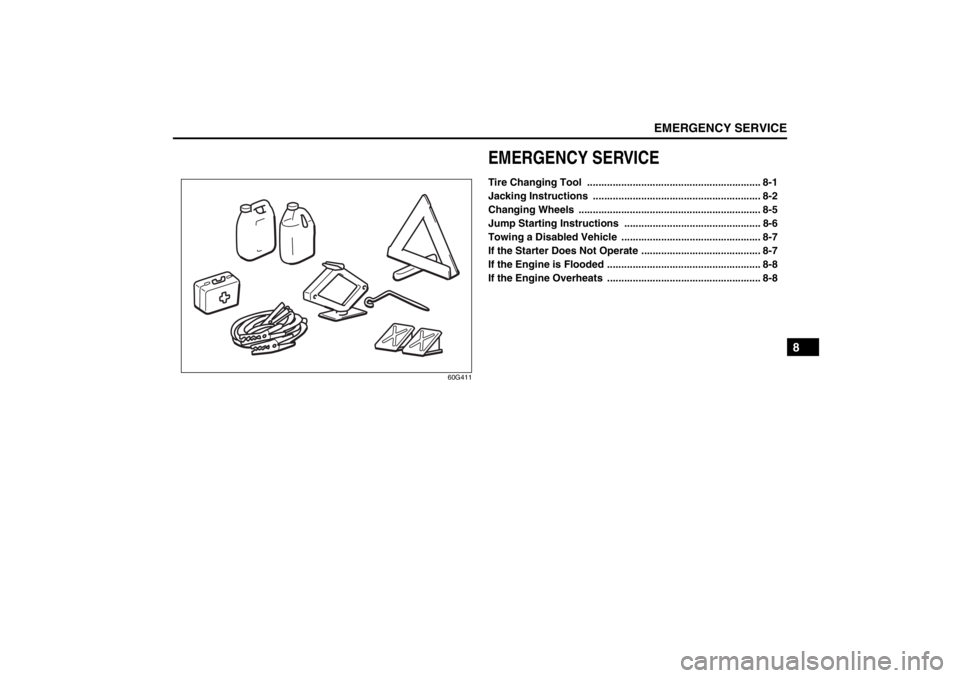
EMERGENCY SERVICETire Changing Tool ............................................................. 8-1
Jacking Instructions ........................................................... 8-2
Changing Wheels ................................................................ 8-5
Jump Starting Instructions ................................................ 8-6
Towing a Disabled Vehicle ................................................. 8-7
If the Starter Does Not Operate .......................................... 8-7
If the Engine is Flooded ...................................................... 8-8
If the Engine Overheats ...................................................... 8-8
Page 349 of 388
8-6
EMERGENCY SERVICE
57L20-03E
Jump Starting Instructions
When jump starting your vehicle, use
the following procedure:
60A269
1) Use only a 12-volt battery to jump startyour vehicle. Position the good 12-volt
battery close to your vehicle so that the
jumper cables will reach both batteries.
When using a battery installed on
another vehicle, DO NOT LET THE
VEHICLES TOUCH. Set the parking
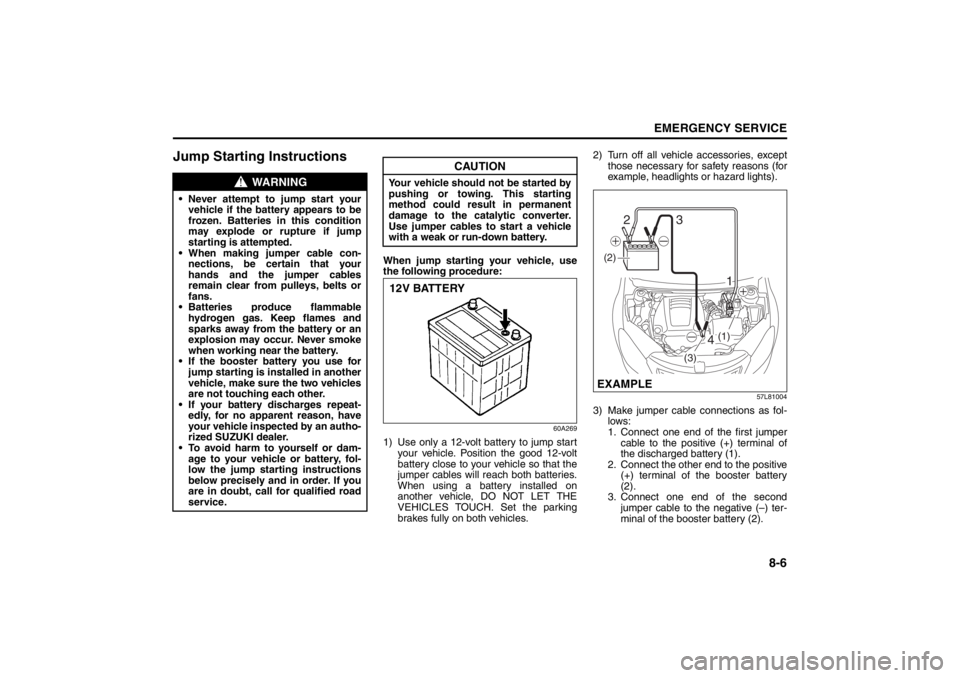
brakes fully on both vehicles. 2) Turn off all vehicle accessories, except
those necessary for safety reasons (for
example, headlights or hazard lights).
57L81004
3) Make jumper cable connections as fol-lows:
1. Connect one end of the first jumper
cable to the positive (+) terminal of
the discharged battery (1).
2. Connect the other end to the positive (+) terminal of the booster battery
(2).
3. Connect one end of the second
jumper cable to the negative (–) ter-
minal of the booster battery (2).
WARNING
• Never attempt to jump start yourvehicle if the battery appears to be
frozen. Batteries in this condition
may explode or rupture if jump
starting is attempted.
When making jumper cable con- nections, be certain that your
hands and the jumper cables
remain clear from pulleys, belts or
fans.
Batteries produce flammable
hydrogen gas. Keep flames and
sparks away from the battery or an
explosion may occur. Never smoke
when working near the battery.
If the booster battery you use for jump starting is installed in another
vehicle, make sure the two vehicles
are not touching each other.
If your battery discharges repeat- edly, for no apparent reason, have
your vehicle inspected by an autho-
rized SUZUKI dealer.
To avoid harm to yourself or dam- age to your vehicle or battery, fol-
low the jump starting instructions
below precisely and in order. If you
are in doubt, call for qualified road
service.
CAUTION
Your vehicle should not be started by
pushing or towing. This starting
method could result in permanent
damage to the catalytic converter.
Use jumper cables to start a vehicle
with a weak or run-down battery.12V BATTERY
(3)
(2)
(1)
1
4
23
EXAMPLE
Page 351 of 388
8-8
EMERGENCY SERVICE
57L20-03E
If the Engine is FloodedIf the engine is flooded with gasoline, it
may be hard to start. If this happens, press
the accelerator pedal all the way to the
floor and hold it there while cranking the
engine. (Do not operate the starter motor
for more than 12 seconds).
NOTE:
If the engine refuses to start, the starter
motor automatically stops after a certain
period of time. After the starter motor has
automatically stopped or there is anything
abnormal in the engine starting system,
the starter motor runs only while the
engine switch is held pressed.
If the Engine OverheatsThe engine could overheat temporarily
under severe driving conditions. If the
engine coolant temperature gauge indi-
cates overheating during driving:
1) Turn off the air conditioner, if equipped.
2) Take the vehicle to a safe place and
park.
3) Let the engine run at normal idle speed
for a few minutes until the indicator is
within the normal, acceptable tempera-
ture range shown by the white band
between “H” and “C”.If the temperature indication does not
come down to within the normal, accept-
able range:
1) Turn off the engine and check that the
water pump belt and pulleys are not
damaged or slipping. If any abnormality
is found, correct it.
2) Check the coolant level in the reservoir.
If it is found to be lower than the “LOW”
line, look for leaks at the radiator, water
pump and radiator and heater hoses. If
you locate any leaks that may have
caused the overheating, do not run the
engine until these problems have been
corrected.
3) If you do not find a leak, carefully add
coolant to the reservoir and then the
radiator, if necessary. (Refer to “Engine
Coolant” in the “INSPECTION AND
MAINTENANCE” section.)
WARNING
If you see or hear escaping steam,
stop the vehicle in a safe place and
immediately turn off the engine to let
it cool. Do not open the hood when
steam is present. When the steam
can no longer be seen or heard, open
the hood to see if the coolant is still
boiling. If it is, you must wait until it
stops boiling before you proceed.
Also, be careful not to touch hot
engine parts (radiator, water hoses,
engine etc.).
Page 354 of 388
9-1APPEARANCE CARE
57L20-03E
Corrosion PreventionIt is important to take good care of your
vehicle to protect it from corrosion.
Listed below are instructions for how to
maintain your vehicle to prevent corrosion.
Please read and follow these instructions
carefully.Important Information About
CorrosionCommon causes of corrosion
1) Accumulation of road salt, dirt, moisture
or chemicals in hard-to-reach areas of
the vehicle underbody or frame.
2) Chipping, scratches and any damage to
treated or painted metal surfaces
resulting from minor accidents or
impact from stones and gravel.
Environmental conditions which accel-
erate corrosion
1) Road salt, dust control chemicals, sea
air or industrial pollution will all acceler-
ate the corrosion of metal.
2) High humidity will increase the rate of
corrosion particularly when the temper-
ature range is just above the freezing
point.
3) Moisture in certain areas of a vehicle
for an extended period of time may pro-
mote corrosion even though other body
sections may be completely dry.
4) High temperatures will cause an accel-
erated rate of corrosion to parts of thevehicle which are not well ventilated to
permit quick drying.
52D151
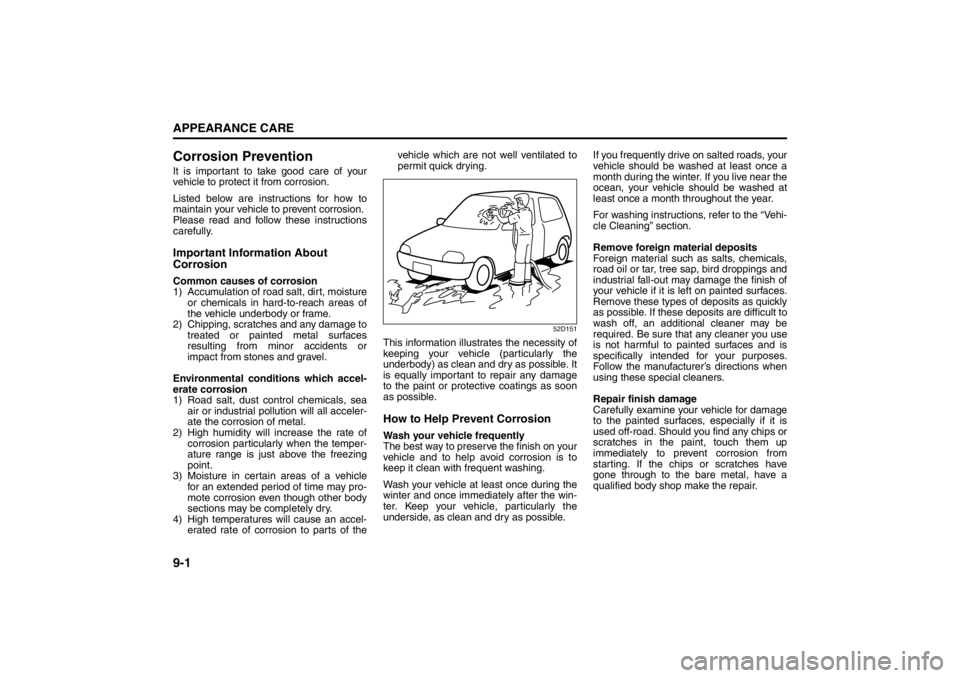
This information illustrates the necessity of
keeping your vehicle (particularly the
underbody) as clean and dry as possible. It
is equally important to repair any damage
to the paint or protective coatings as soon
as possible.How to Help Prevent CorrosionWash your vehicle frequently
The best way to preserve the finish on your
vehicle and to help avoid corrosion is to
keep it clean with frequent washing.
Wash your vehicle at least once during the
winter and once immediately after the win-
ter. Keep your vehicle, particularly the
underside, as clean and dry as possible.If you frequently drive on salted roads, your
vehicle should be washed at least once a
month during the winter. If you live near the
ocean, your vehicle should be washed at
least once a month throughout the year.
For washing instructions, refer to the “Vehi-
cle Cleaning” section.
Remove foreign material deposits
Foreign material such as salts, chemicals,
road oil or tar, tree sap, bird droppings and
industrial fall-out may damage the finish of
your vehicle if it is left on painted surfaces.
Remove these types of deposits as quickly
as possible. If these deposits are difficult to
wash off, an additional cleaner may be
required. Be sure that any cleaner you use
is not harmful to painted surfaces and is
specifically intended for your purposes.
Follow the manufacturer’s directions when
using these special cleaners.
Repair finish damage
Carefully examine your vehicle for damage
to the painted surfaces, especially if it is
used off-road. Should you find any chips or
scratches in the paint, touch them up
immediately to prevent corrosion from
starting. If the chips or scratches have
gone through to the bare metal, have a
qualified body shop make the repair.
Page 365 of 388

10-4
GENERAL INFORMATION
57L20-03E
Reporting Safety DefectsIf you believe that your vehicle has a
defect which could cause a crash or
could cause injury or death, you
should immediately inform the
National Highway Traffic Safety
Administration (NHTSA) in addition to
notifying American Suzuki Motor Corp.
If NHTSA receives similar complaints,
it may open an investigation, and if it
finds that a safety defect exists in a
group of vehicles, it may order a recall
and remedy campaign. However,
NHTSA cannot become involved in
individual problems between you, your
dealer, or American Suzuki Motor
Corp.
To contact NHTSA, you may call the
Vehicle Safety Hotline toll-free at 1-
888-327-4236 (TTY: 1-800-424-9153);
go to http://www.safercar.gov; or write
to: Administrator, NHTSA, 1200 New
Jersey Ave., SE., Washington, D.C.
20590. You can also obtain other infor-
mation about motor vehicle safety
from http://www.safercar.gov.To contact American Suzuki, owners
in the continental United States can
call toll-free 1-800-934-0934, or write
to:
American Suzuki Motor Corporation
Automotive Customer Relations
3251 East Imperial Highway
Brea, CA 92821-6795
For owners outside the continental
United States, please refer to the dis-
tributor’s address listed in your War-
ranty Information booklet.
For vehicles registered for use and
principally operated in Canada please
contact Suzuki Canada Inc. at 1-905-
889-2677 extension 2254 or write to:
Suzuki Canada Inc.
Customer Relations
100 East Beaver Creek Road
Richmond Hill, On
L4B 1J6
Jacking Instructions: 5
Jump Starting Instructions: 7