battery SUZUKI MARUTI 2005 1.G User Guide
[x] Cancel search | Manufacturer: SUZUKI, Model Year: 2005, Model line: MARUTI, Model: SUZUKI MARUTI 2005 1.GPages: 136, PDF Size: 2.93 MB
Page 50 of 136
Downloaded from www.Manualslib.com manuals search engine 5083K
road condition
surrounding traffic condition
driving condition
vehicle condition
when the malfunction indicator light
comes on or blinksUnit indication of fuel consumption
(For “L/100km” or “km/L” setting)You can change the unit indication of fuel
consumption when selecting instantaneous
fuel consumption in the display.
You should operate the display before the
vehicle moves.
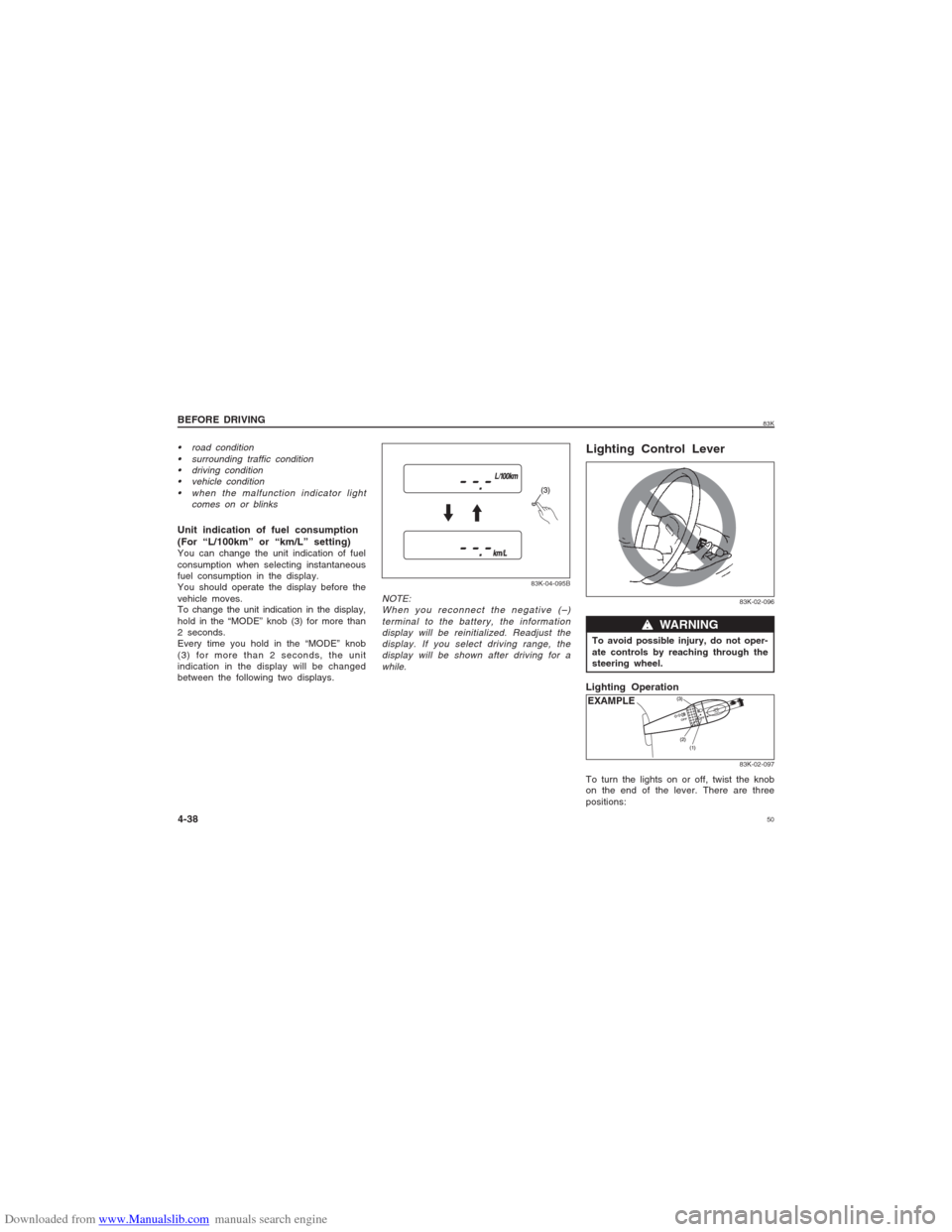
To change the unit indication in the display,
hold in the “MODE” knob (3) for more than
2 seconds.
Every time you hold in the “MODE” knob
(3) for more than 2 seconds, the unit
indication in the display will be changed
between the following two displays.
83K-04-095B
NOTE:
When you reconnect the negative (–)
terminal to the battery, the information
display will be reinitialized. Readjust the
display. If you select driving range, the
display will be shown after driving for a
while.
83K-02-096
w ww w
w WARNING
To avoid possible injury, do not oper-
ate controls by reaching through the
steering wheel.Lighting Control LeverLighting Operation
EXAMPLE
83K-02-097
To turn the lights on or off, twist the knob
on the end of the lever. There are three
positions:
BEFORE DRIVING
4-38
Page 57 of 136
Downloaded from www.Manualslib.com manuals search engine 5783K4) Make sure the bonnet is fully closed and
latched.
5) Check the headlights, turn signal lights,
brake lights and horn for proper opera-
tion.
6) Adjust the seat and adjustable head
restraint (if equipped).
7) Check the brake pedal and the parking
brake lever.
8) Adjust the mirrors.
9) Make sure that you and all passengers
have properly fastened your seat belts.
10)Make sure that all warning lights come
on as the key is turned to the “ON” or
“START” position.
11)Check all gauges.
12)Make sure that the BRAKE SYSTEM
WARNING light turns off when the
parking brake is released.
Once a week, or each time you fill your fuel
tank, perform the following under-hood
checks:
1) Engine oil level
2) Coolant level
3) Brake fluid level
4) Windshield washer fluid level
5) Battery solution level
6) Bonnet latch operation
Pull the Bonnet release handle inside the
vehicle. Make sure that you cannot open
the Bonnet all the way without releasingthe secondary latch. Be sure to close
the Bonnet securely after checking for
proper latch operation. See “All latches,
hinges & locks” of “CHASSIS AND
BODY” in the “Periodic Maintenance
Schedule” in the “INSPECTION AND
MAINTENANCE” section for lubrication
schedule.
w ww w
w WARNING
Make sure the bonnet is fully closed
and latched before driving. If it is not,
it can fly up unexpectedly during
driving, obstructing your view and
resulting in an accident.
Once a month, or each time you fill your
fuel tank, check the tyre pressure using a
tyre pressure gauge. Also check the tyre
pressure of the spare tyre.since its pistons, piston rings and cylinder
walls have not yet become conditioned. New
engines reach the normal level of oil
consumption only after approximately 5000
km (3000 miles) driving.
When judging the amount of oil consump-
tion, note that the oil may become diluted
and make it difficult to accurately judge the
true oil level.
As an example, if a vehicle is used for
repeated short trips, and consumes a nor-
mal amount of oil, the dipstick may not
show any drop in the oil level at all, even
after 1000 km (600 miles) or more of driv-
ing. This is because the oil is gradually
becoming diluted with fuel or moisture,
making it appear that the oil level has not
changed.
You should also be aware that the diluting
ingredients evaporate out when the vehicle
is subsequently driven at high speeds, such
as on an expressway, making it appear that
oil is excessively consumed after high-speed
driving.
OPERATING YOUR VEHICLE
5-2
Engine Oil ConsumptionIt is normal for the engine to consume some
engine oil during normal vehicle operation.
The amount of engine oil consumed
depends on the viscosity of the oil, the
quality of the oil and the conditions the
vehicle is driven under.
More oil is consumed during high-speed
driving and when there is frequent acceler-
ation and deceleration. Under high loads,
your engine also will consume more oil.
A new engine also consumes more oil,
83K-03-003
Ignition SwitchEXAMPLE
Page 58 of 136
Downloaded from www.Manualslib.com manuals search engine 5883K
w ww w
w WARNING
To avoid possible injury, do not oper-
ate controls by reaching through the
steering wheel.
83K-03-004
EXAMPLE OPERATING YOUR VEHICLE
5-3The ignition switch has the following four
positions:LOCKThis is the normal parking position. It is the
only position in which the key can be
removed.
You must push in the key to turn it to the
“LOCK” position. It locks the ignition, and
prevents normal use of the steering wheel
after the key is removed.
To release the steering lock, insert the key
and turn it clockwise to one of the other
positions. If you have trouble turning the keyto unlock the steering, try turning the
steering wheel slightly to the right or left
while turning the key.
ACCAccessories such as the radio can operate,
but the engine is off.ONThis is the normal operating position. All
electrical systems are on.STARTThis is the position for starting the engine
using the starter motor. The key should be
released from this position as soon as the
engine starts.
Ignition key reminder (if equipped)
A buzzer sounds intermittently to remind you
to remove the ignition key if it is in the ignition
switch when the driver’s door is opened.
w ww w
w WARNING
Never remove the ignition key while
the vehicle is moving. The steering
wheel will lock and you will not be
able to steer the vehicle.
Always remove the ignition key
when leaving the vehicle even if a
short time. Also do not leave chil-
dren alone in a parked vehicle.
Unattended children could cause
accidental movement of the vehicle
or could tamper with power win-
dows. They also could suffer from
heat stroke in warm or hot weather.
These could result in severe injury
or even death.
NOTICE
Do not use the starter motor for
more than 15 seconds at a time. If
the engine does not start, wait 15
seconds before trying again. If the
engine does not start after several
attempts, check the fuel and ignition
systems or consult your MARUTI
SUZUKI dealer.
Do not leave the ignition switch in
the “ON” position if the engine is
not running as the battery will dis-
charge.
83K-03-005
Page 63 of 136

Downloaded from www.Manualslib.com manuals search engine 6383K
OPERATING YOUR VEHICLE
5-8
Use the gearshift lever positions as
described below:
P (Park)
Use this position to lock the transaxle when
the vehicle is parked or when starting the
engine. Shift into Park only when the vehicle
is completely stationary.
R (Reverse)
Use this position to reverse the vehicle from
stop. Make sure that vehicle is completely
stationary before shifting into Reverse.
N (Neutral)
Use this position for starting the engine if the
engine stalls and you need to restart it while
the vehicle is moving. You may also shift into
Neutral and depress the brake pedal to hold
the vehicle stationary during idling.
D (Drive)
Use this position for all normal driving. With
the gearshift lever in “D” range you can get
an automatic downshift by pressing the
accelerator pedal. The higher the vehicle
speed is, the more you need to press the
accelerator pedal to get a downshift.
3 (Low 3)
Use this position for driving on moderate
uphill and downhill gradients. The engine
braking effect on moderate downhills can be
used in this position. The transaxle shifts up
only to 3rd gear.2 (Low 2)
Use this position to provide extra power
when climbing hills, or to provide engine
braking when going down hills.
L (Low 1)
Use this position to provide maximum power
when climbing steep hills or driving through
deep snow or mud, or to provide maximum
engine braking when going down steep hills.
NOTE:
If you move the gearshift lever to a lower
gear while driving faster than the maximum
allowable speed for the lower gear, the
transaxle will not actually downshift until
your speed drops below the maximum
speed for the lower gear.
NOTICE
Be sure to take the following
precautions to help avoid damage to
the automatic transaxle:
Make sure that the vehicle is
completely stationary before shifting
into “P” or “R”.
Do not shift from “P” or “N” to “R”,
“D”, “3”, “2”, or “L” when the
engine is running above idle speed.
Do not rev the engine with the
transaxle in a drive position (“R”,
“D”, “3”, “2”, or “L”) and the front
wheels not moving.
If You Cannot Shift Automatic Tran-
saxle Gearshift Lever Out of “P”
(PARK)
83K-03-011C
Vehicles with an automatic transaxle have
an electrically operated park-lock feature. If
the vehicle’s battery is discharged, or there
is some other electrical failure, the
automatic transaxle cannot be shifted out of
Park in the normal way. Jump starting may
correct the condition. If not, follow the
procedure described below. This procedure
will permit shifting the transaxle out of Park.
NOTICE
Do not use the accelerator to hold
the vehicle on a hill. Use the
vehicle’s brakes.
1) Be sure the parking brake is firmly
applied.
2) If the engine is running, stop the engine.
3) Make sure the key is in the “ON” or
“ACC” position.
Page 89 of 136
Downloaded from www.Manualslib.com manuals search engine 8983KINSPECTION AND MAINTENANCE
Maintenance Schedule ....................................................................................................... 9-1
Drive Belt ............................................................................................................................. 9-6
Engine Oil and Filter......................................................................................................... 9-6
Engine Coolant.................................................................................................................... 9-9
Air Cleaner ......................................................................................................................... 9-11
Spark Plugs....................................................................................................................... 9-11
Gear Oil.............................................................................................................................. 9-13
Clutch Pedal...................................................................................................................... 9-14
Fuel Filter (Diesel engine) .............................................................................................. 9-14
Brakes ................................................................................................................................. 9-15
Steering.............................................................................................................................. 9-16
Tyres ................................................................................................................................... 9-17
Battery................................................................................................................................ 9-19
Fuses ................................................................................................................................... 9-20
Bulb Replacement............................................................................................................. 9-23
Wiper Blades..................................................................................................................... 9-26
Windshield Washer Fluid................................................................................................9-28
Air Conditioning System.................................................................................................9-29
INSPECTION AND MAINTENANCE
Page 90 of 136
Downloaded from www.Manualslib.com manuals search engine 9083K
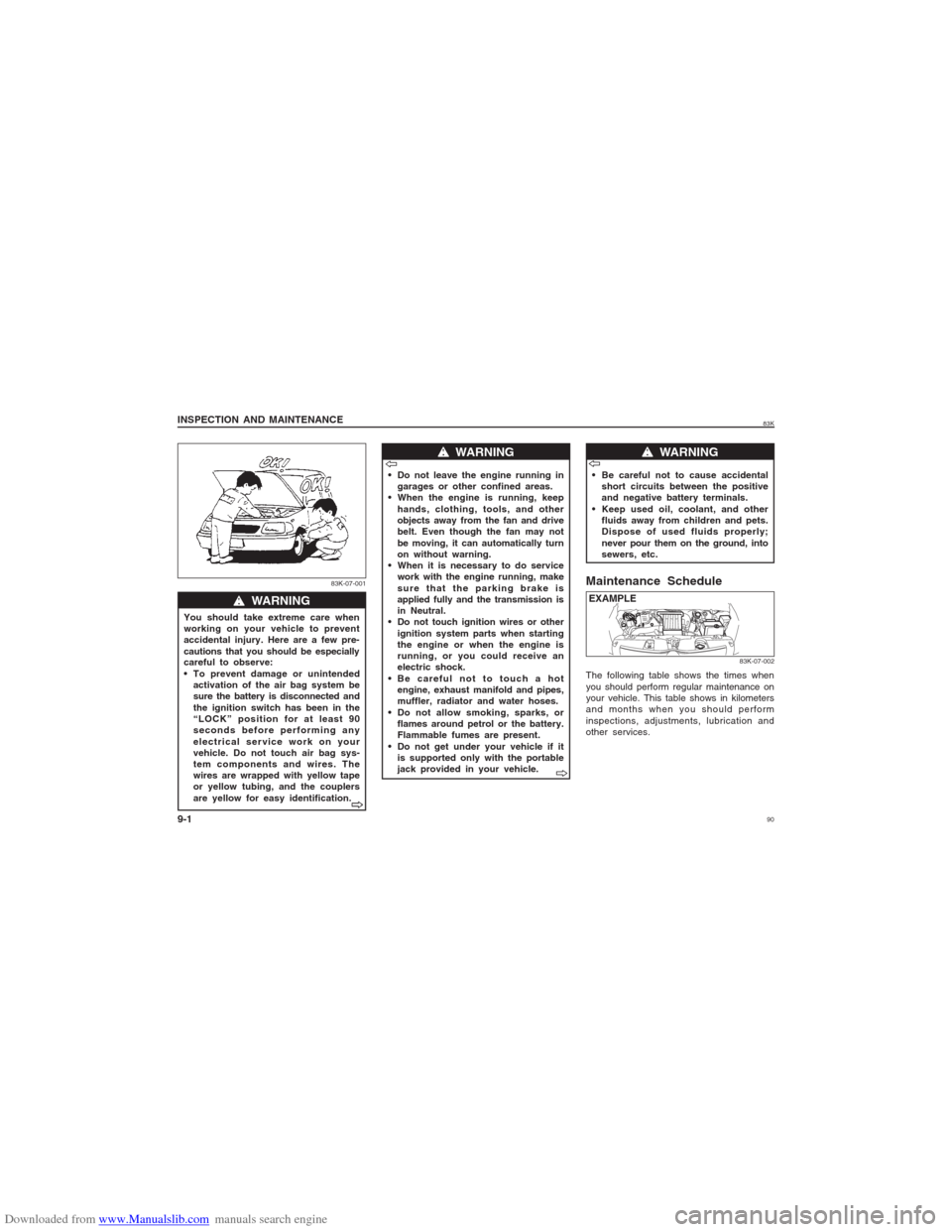
You should take extreme care when
working on your vehicle to prevent
accidental injury. Here are a few pre-
cautions that you should be especially
careful to observe:
To prevent damage or unintended
activation of the air bag system be
sure the battery is disconnected and
the ignition switch has been in the
“LOCK” position for at least 90
seconds before performing any
electrical service work on your
vehicle. Do not touch air bag sys-
tem components and wires. The
wires are wrapped with yellow tape
or yellow tubing, and the couplers
are yellow for easy identification.
w ww w
w WARNING
83K-07-001
w ww w
w WARNING
w ww w
w WARNING
INSPECTION AND MAINTENANCE
9-1
V VV V
V
Do not leave the engine running in
garages or other confined areas.
When the engine is running, keep
hands, clothing, tools, and other
objects away from the fan and drive
belt. Even though the fan may not
be moving, it can automatically turn
on without warning.
When it is necessary to do service
work with the engine running, make
sure that the parking brake is
applied fully and the transmission is
in Neutral.
Do not touch ignition wires or other
ignition system parts when starting
the engine or when the engine is
running, or you could receive an
electric shock.
Be careful not to touch a hot
engine, exhaust manifold and pipes,
muffler, radiator and water hoses.
Do not allow smoking, sparks, or
flames around petrol or the battery.
Flammable fumes are present.
Do not get under your vehicle if it
is supported only with the portable
jack provided in your vehicle.V VV V
V
V VV V
V
Be careful not to cause accidental
short circuits between the positive
and negative battery terminals.
Keep used oil, coolant, and other
fluids away from children and pets.
Dispose of used fluids properly;
never pour them on the ground, into
sewers, etc.V VV V
V
83K-07-002
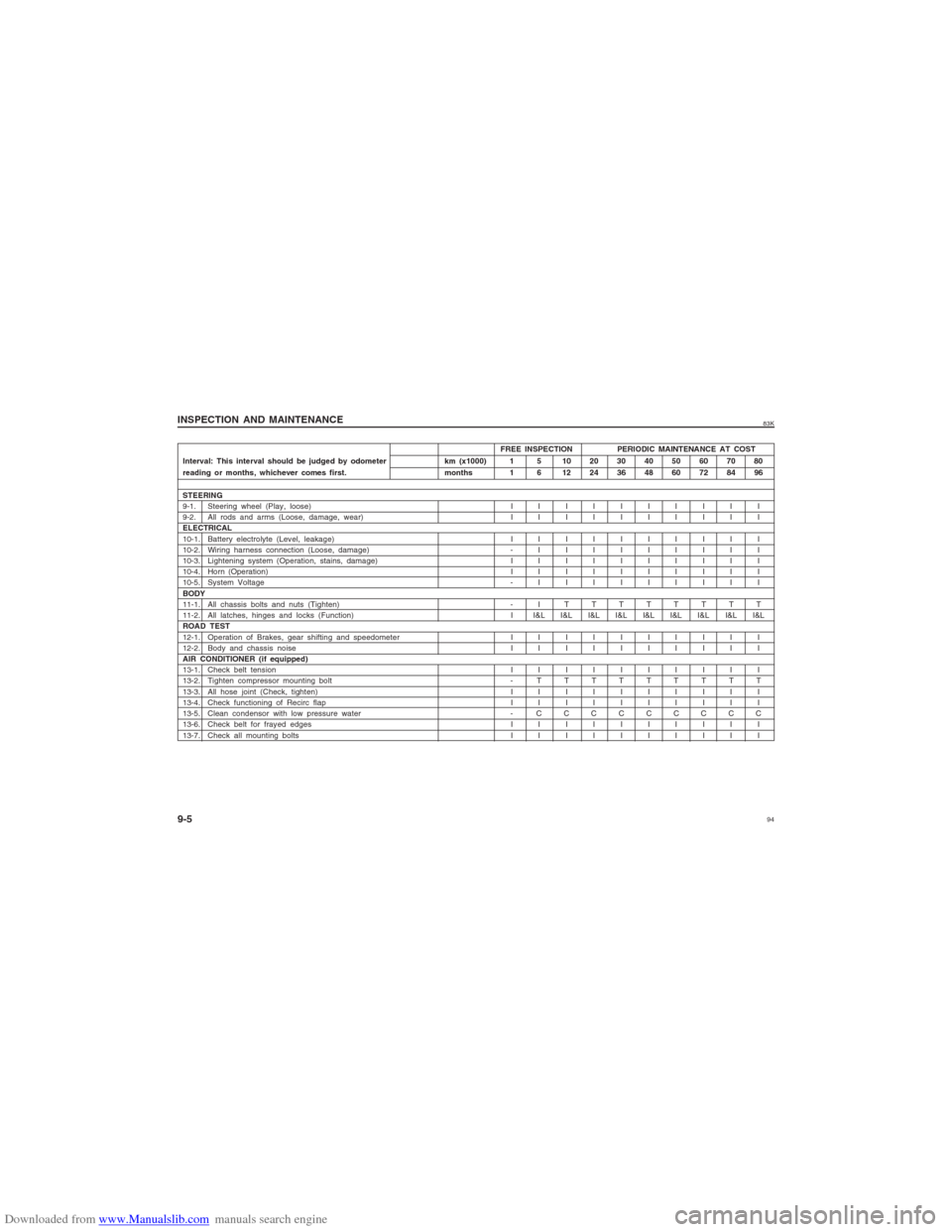
Maintenance ScheduleThe following table shows the times when
you should perform regular maintenance on
your vehicle. This table shows in kilometers
and months when you should perform
inspections, adjustments, lubrication and
other services.EXAMPLE
Page 94 of 136
Downloaded from www.Manualslib.com manuals search engine 9483K
FREE INSPECTION PERIODIC MAINTENANCE AT COST
Interval: This interval should be judged by odometer km (x1000) 1 5 10 20 30 40 50 60 70 80
reading or months, whichever comes first.months 1 6 12 24 36 48 60 72 84 96
STEERING
9-1.Steering wheel (Play, loose)IIIIIIIIII
9-2. All rods and arms (Loose, damage, wear)IIIIIIIIII
ELECTRICAL
10-1.Battery electrolyte (Level, leakage)IIIIIIIIII
10-2. Wiring harness connection (Loose, damage) -IIIIIIIII
10-3. Lightening system (Operation, stains, damage)IIIIIIIIII
10-4.Horn (Operation)IIIIIIIIII
10-5.System Voltage -IIIIIIIII
BODY
11-1.All chassis bolts and nuts (Tighten) - ITTTTTTTT
11-2. All latches, hinges and locks (Function) I I&L I&L I&L I&L I&L I&L I&L I&L I&L
ROAD TEST
12-1.Operation of Brakes, gear shifting and speedometerIIIIIIIIII
12-2.Body and chassis noiseIIIIIIIIII
AIR CONDITIONER (if equipped)
13-1. Check belt tensionIIIIIIIIII
13-2.Tighten compressor mounting bolt -TTTTTTTTT
13-3. All hose joint (Check, tighten)IIIIIIIIII
13-4.Check functioning of Recirc flapIIIIIIIIII
13-5. Clean condensor with low pressure water - C C CCCCCCC
13-6. Check belt for frayed edgesIIIIIIIIII
13-7.Check all mounting boltsIIIIIIIIII
INSPECTION AND MAINTENANCE
9-5
Page 95 of 136
Downloaded from www.Manualslib.com manuals search engine 9583KDrive Belt
w ww w
w WARNING
When the engine is running, keep
hands, hair, clothing, tools, etc. away
from the moving fan and drive belts.
(For Petrol Engine Model)
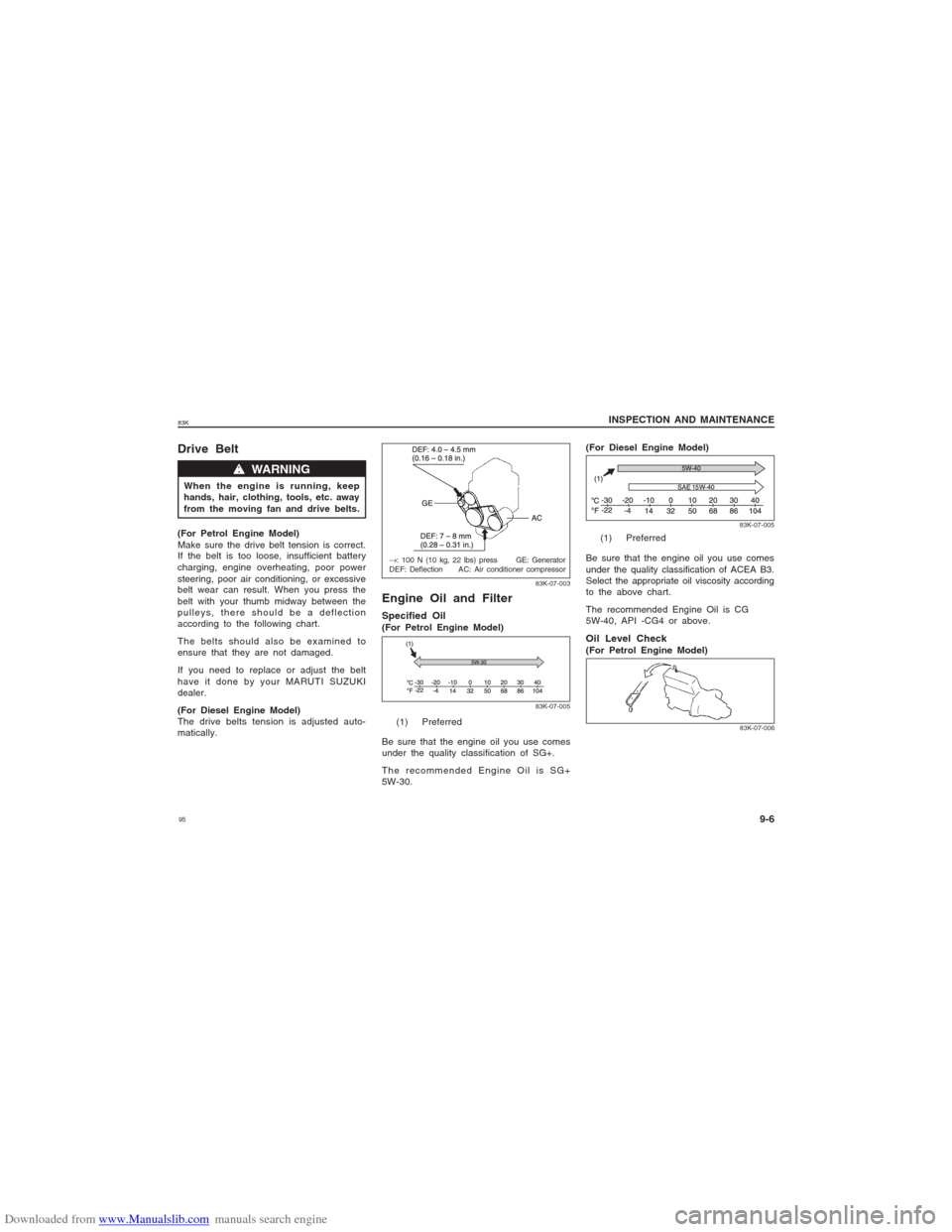
Make sure the drive belt tension is correct.
If the belt is too loose, insufficient battery
charging, engine overheating, poor power
steering, poor air conditioning, or excessive
belt wear can result. When you press the
belt with your thumb midway between the
pulleys, there should be a deflection
according to the following chart.
The belts should also be examined to
ensure that they are not damaged.
If you need to replace or adjust the belt
have it done by your MARUTI SUZUKI
dealer.
(For Diesel Engine Model)
The drive belts tension is adjusted auto-
matically.
Engine Oil and FilterSpecified Oil(For Petrol Engine Model)
(1) Preferred→: 100 N (10 kg, 22 lbs) press GE: Generator
DEF: Deflection AC: Air conditioner compressor
INSPECTION AND MAINTENANCE
9-6
83K-07-003
(For Diesel Engine Model)
83K-07-005
Be sure that the engine oil you use comes
under the quality classification of ACEA B3.
Select the appropriate oil viscosity according
to the above chart.
The recommended Engine Oil is CG
5W-40, API -CG4 or above.Oil Level Check(For Petrol Engine Model)
83K-07-006
(1) Preferred
83K-07-005
Be sure that the engine oil you use comes
under the quality classification of SG+.
The recommended Engine Oil is SG+
5W-30.
Page 110 of 136
Downloaded from www.Manualslib.com manuals search engine 11083K
INSPECTION AND MAINTENANCE
9-21
83K-07-039
8. In case of any problem, please get in
touch with MARUTI SUZUKI authorised
dealer.Full Wheel Cover (if equipped)
w ww w
w WARNING
Batteries produce flammable hydro-
gen gas. Keep flames and sparks
away from the battery or an explosion
may occur. Never smoke when
working in the vicinity of the battery.
When checking or servicing the
battery, disconnect the negative
cable. Be careful not to cause a
V VV V
V
w ww w
w WARNING
short circuit by allowing metal
objects to contact the battery posts
and the vehicle at the same time.
To avoid harm to yourself or dam-
age to your vehicle or battery, fol-
low the jump starting instructions in
the “EMERGENCY SERVICE” section
of this manual if it is necessary to
jump start your vehicle.V VV V
V
Petrol
83K-07-040-41
EXAMPLE
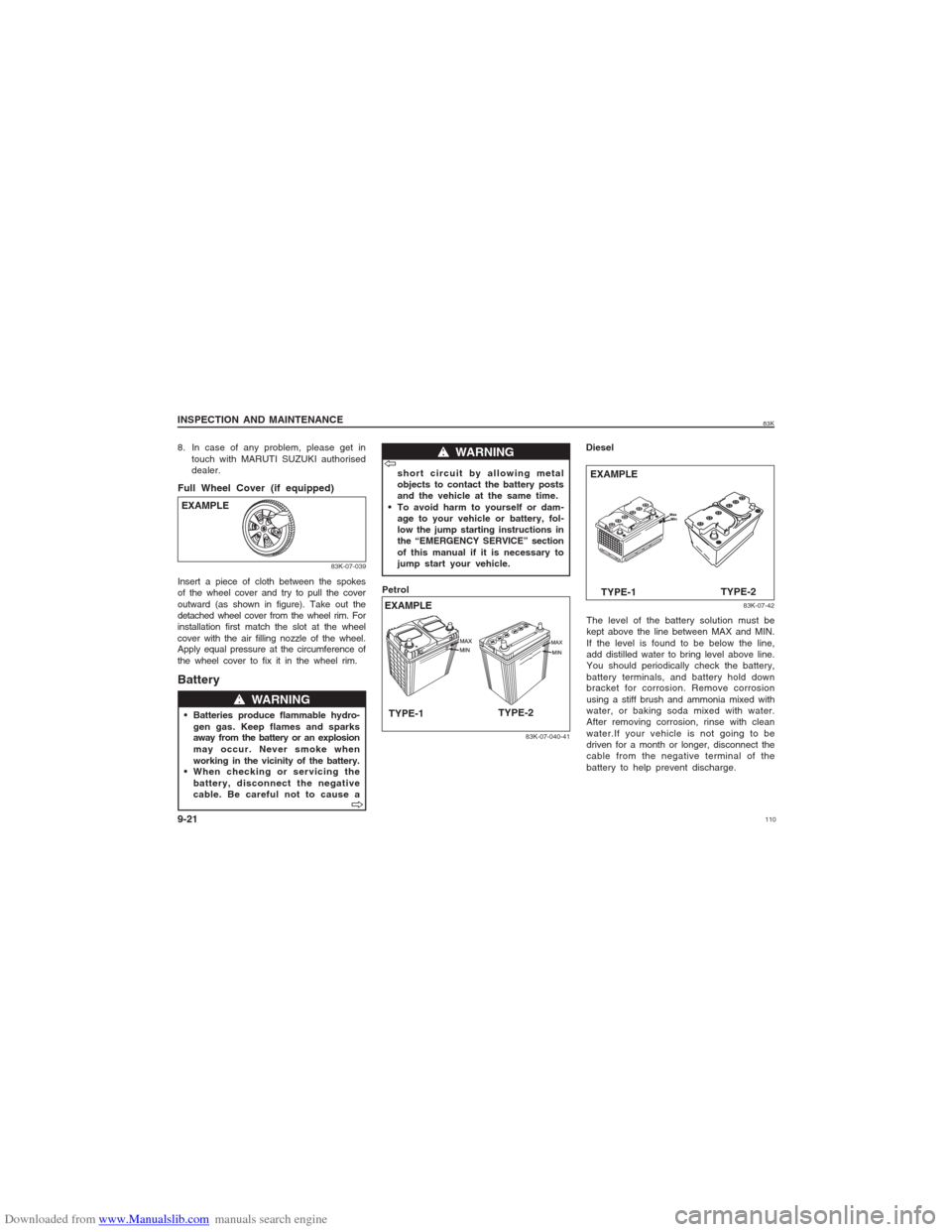
The level of the battery solution must be
kept above the line between MAX and MIN.
If the level is found to be below the line,
add distilled water to bring level above line.
You should periodically check the battery,
battery terminals, and battery hold down
bracket for corrosion. Remove corrosion
using a stiff brush and ammonia mixed with
water, or baking soda mixed with water.
After removing corrosion, rinse with clean
water.If your vehicle is not going to be
driven for a month or longer, disconnect the
cable from the negative terminal of the
battery to help prevent discharge.
EXAMPLE
TYPE-1TYPE-2Insert a piece of cloth between the spokes
of the wheel cover and try to pull the cover
outward (as shown in figure). Take out the
detached wheel cover from the wheel rim. For
installation first match the slot at the wheel
cover with the air filling nozzle of the wheel.
Apply equal pressure at the circumference of
the wheel cover to fix it in the wheel rim.Battery
TYPE-1
83K-07-42
EXAMPLEDiesel
TYPE-2
Page 111 of 136
Downloaded from www.Manualslib.com manuals search engine 11183K
INSPECTION AND MAINTENANCE
9-22
83K-07-043
83K-07-044
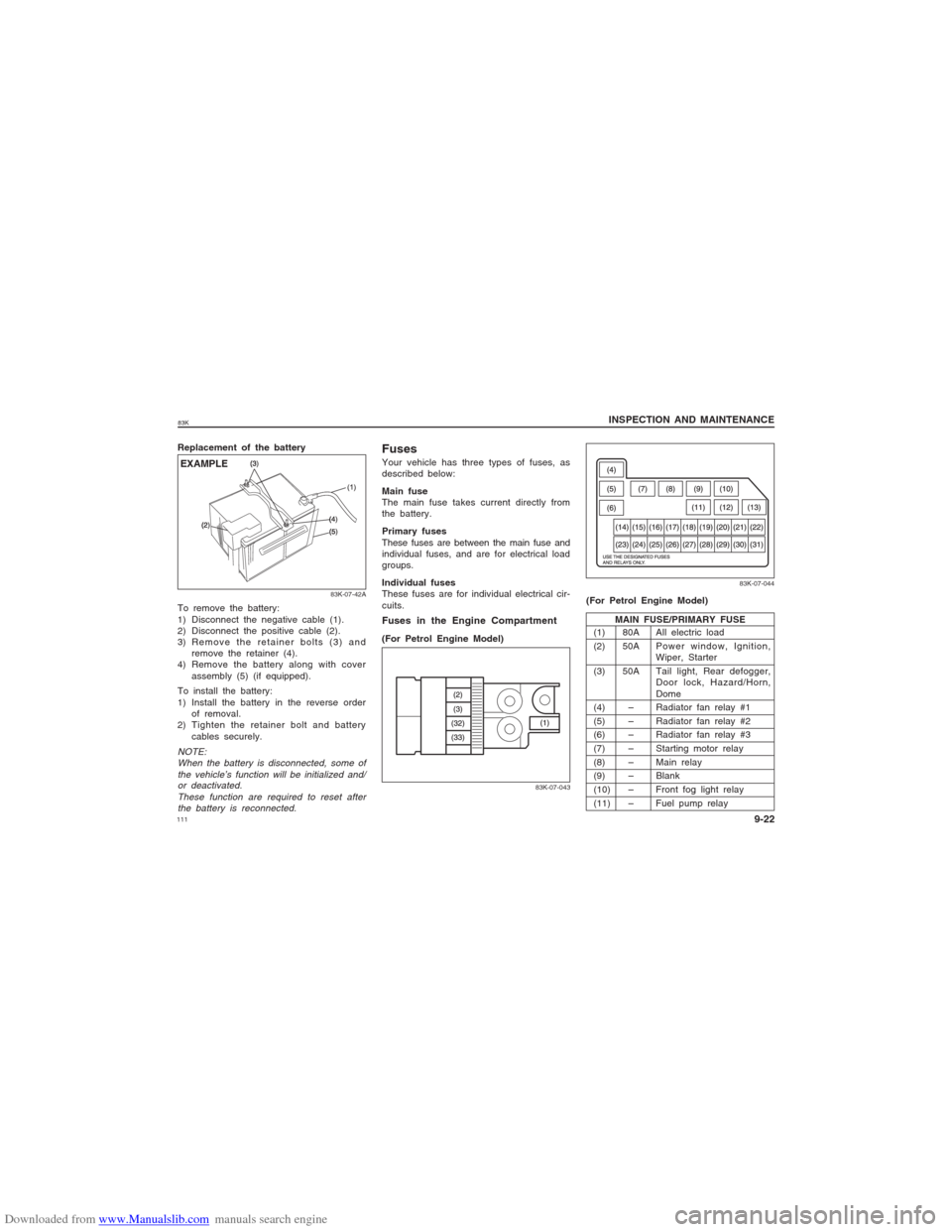
Fuses in the Engine Compartment(For Petrol Engine Model)
Replacement of the battery
83K-07-42A
EXAMPLETo remove the battery:
1) Disconnect the negative cable (1).
2) Disconnect the positive cable (2).
3) Remove the retainer bolts (3) and
remove the retainer (4).
4) Remove the battery along with cover
assembly (5) (if equipped).
To install the battery:
1) Install the battery in the reverse order
of removal.
2) Tighten the retainer bolt and battery
cables securely.NOTE:
When the battery is disconnected, some of
the vehicle’s function will be initialized and/
or deactivated.
These function are required to reset after
the battery is reconnected.
FusesYour vehicle has three types of fuses, as
described below:
Main fuse
The main fuse takes current directly from
the battery.
Primary fuses
These fuses are between the main fuse and
individual fuses, and are for electrical load
groups.
Individual fuses
These fuses are for individual electrical cir-
cuits.
(1) 80A All electric load
(2) 50A Power window, Ignition,
Wiper, Starter
(3) 50A Tail light, Rear defogger,
Door lock, Hazard/Horn,
Dome
(4) – Radiator fan relay #1
(5) – Radiator fan relay #2
(6) – Radiator fan relay #3
(7) – Starting motor relay
(8) – Main relay
(9) – Blank
(10) – Front fog light relay
(11) – Fuel pump relayMAIN FUSE/PRIMARY FUSE(For Petrol Engine Model)