brake SUZUKI MARUTI 2005 1.G User Guide
[x] Cancel search | Manufacturer: SUZUKI, Model Year: 2005, Model line: MARUTI, Model: SUZUKI MARUTI 2005 1.GPages: 136, PDF Size: 2.93 MB
Page 62 of 136
Downloaded from www.Manualslib.com manuals search engine 6283K
OPERATING YOUR VEHICLE
5-7Petrol
83K-03-010
Diesel
83K-03-011
CAUTION
When downshifting to a lower gear,
make sure not to operate with the
speed faster than the maximum
allowable speeds for the next lower
gear, or severe engine damage can
result.
Keep the engine speed so it does not get
into the red zone of tachometer.
w ww w
w WARNINGCAUTION
To help avoid clutch damage, do not
use the clutch pedal as a footrest
while driving or use the clutch to
keep the vehicle stationary on a
slope. Depress the clutch fully when
shifting.
When shifting or starting off, do not
race the engine. Racing the engine
can shorten engine life and affect
smooth operation.
83K-03-011A
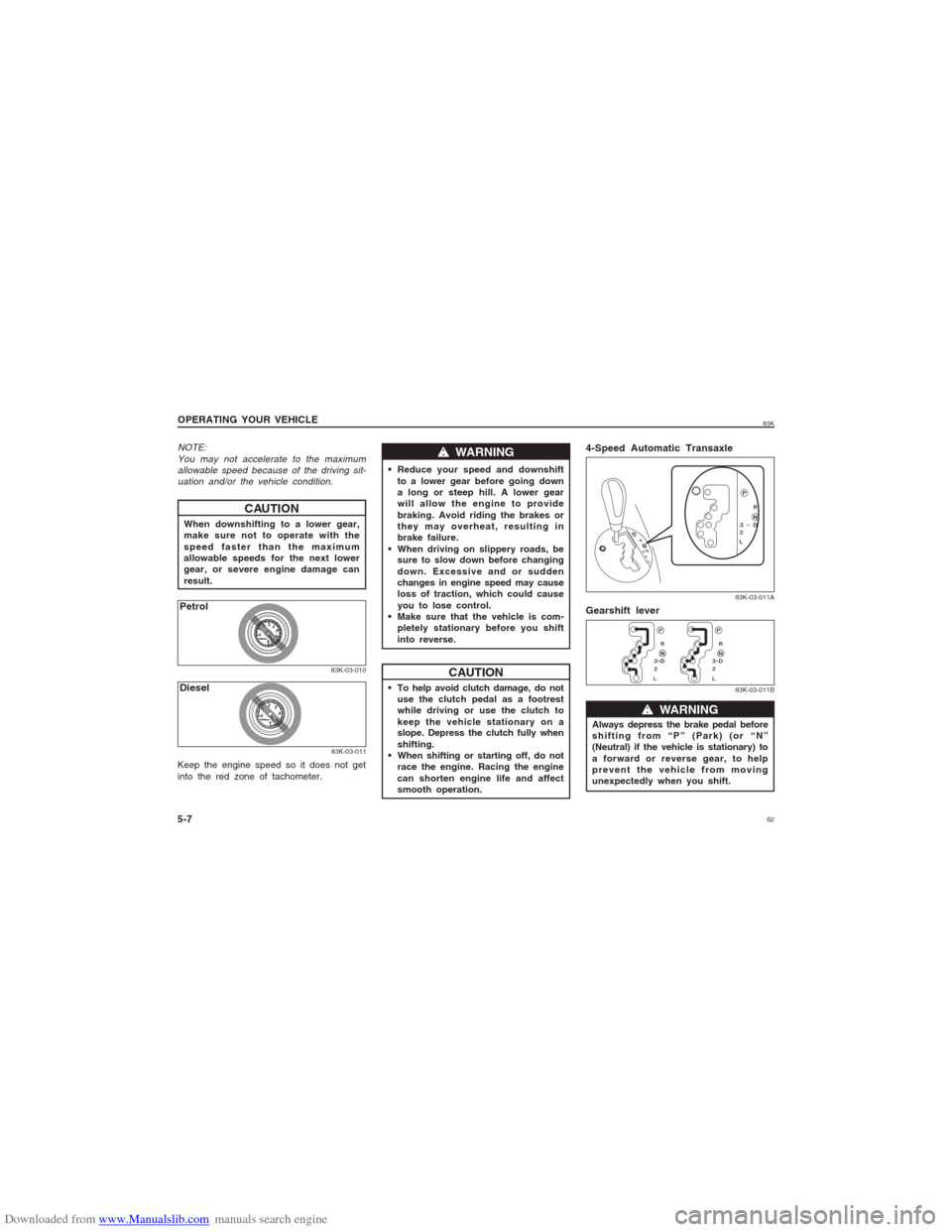
4-Speed Automatic Transaxle
Gearshift lever
83K-03-011B
w ww w
w WARNING
Always depress the brake pedal before
shifting from “P” (Park) (or “N”
(Neutral) if the vehicle is stationary) to
a forward or reverse gear, to help
prevent the vehicle from moving
unexpectedly when you shift.
Reduce your speed and downshift
to a lower gear before going down
a long or steep hill. A lower gear
will allow the engine to provide
braking. Avoid riding the brakes or
they may overheat, resulting in
brake failure.
When driving on slippery roads, be
sure to slow down before changing
down. Excessive and or sudden
changes in engine speed may cause
loss of traction, which could cause
you to lose control.
Make sure that the vehicle is com-
pletely stationary before you shift
into reverse.
NOTE:
You may not accelerate to the maximum
allowable speed because of the driving sit-
uation and/or the vehicle condition.
Page 63 of 136

Downloaded from www.Manualslib.com manuals search engine 6383K
OPERATING YOUR VEHICLE
5-8
Use the gearshift lever positions as
described below:
P (Park)
Use this position to lock the transaxle when
the vehicle is parked or when starting the
engine. Shift into Park only when the vehicle
is completely stationary.
R (Reverse)
Use this position to reverse the vehicle from
stop. Make sure that vehicle is completely
stationary before shifting into Reverse.
N (Neutral)
Use this position for starting the engine if the
engine stalls and you need to restart it while
the vehicle is moving. You may also shift into
Neutral and depress the brake pedal to hold
the vehicle stationary during idling.
D (Drive)
Use this position for all normal driving. With
the gearshift lever in “D” range you can get
an automatic downshift by pressing the
accelerator pedal. The higher the vehicle
speed is, the more you need to press the
accelerator pedal to get a downshift.
3 (Low 3)
Use this position for driving on moderate
uphill and downhill gradients. The engine
braking effect on moderate downhills can be
used in this position. The transaxle shifts up
only to 3rd gear.2 (Low 2)
Use this position to provide extra power
when climbing hills, or to provide engine
braking when going down hills.
L (Low 1)
Use this position to provide maximum power
when climbing steep hills or driving through
deep snow or mud, or to provide maximum
engine braking when going down steep hills.
NOTE:
If you move the gearshift lever to a lower
gear while driving faster than the maximum
allowable speed for the lower gear, the
transaxle will not actually downshift until
your speed drops below the maximum
speed for the lower gear.
NOTICE
Be sure to take the following
precautions to help avoid damage to
the automatic transaxle:
Make sure that the vehicle is
completely stationary before shifting
into “P” or “R”.
Do not shift from “P” or “N” to “R”,
“D”, “3”, “2”, or “L” when the
engine is running above idle speed.
Do not rev the engine with the
transaxle in a drive position (“R”,
“D”, “3”, “2”, or “L”) and the front
wheels not moving.
If You Cannot Shift Automatic Tran-
saxle Gearshift Lever Out of “P”
(PARK)
83K-03-011C
Vehicles with an automatic transaxle have
an electrically operated park-lock feature. If
the vehicle’s battery is discharged, or there
is some other electrical failure, the
automatic transaxle cannot be shifted out of
Park in the normal way. Jump starting may
correct the condition. If not, follow the
procedure described below. This procedure
will permit shifting the transaxle out of Park.
NOTICE
Do not use the accelerator to hold
the vehicle on a hill. Use the
vehicle’s brakes.
1) Be sure the parking brake is firmly
applied.
2) If the engine is running, stop the engine.
3) Make sure the key is in the “ON” or
“ACC” position.
Page 64 of 136
Downloaded from www.Manualslib.com manuals search engine 6483K
w ww w
w WARNING
If water gets into the brake drums,
brake performance may become poor
and unpredictable.
After driving through water or wash-
ing the underside of the vehicle, test
the brakes while driving at a slow
speed to see if they have maintained
their normal effectiveness. If the
brakes are less effective than normal,
dry them by repeatedly applying the
brakes while driving slowly until the
brakes have regained their normal
effectiveness.
w ww w
w WARNING
Even without reserve power in the
brake system, you can still stop the
vehicle by pressing the brake pedal
harder than normally required. How-
ever, the stopping distance may be
longer.
OPERATING YOUR VEHICLE
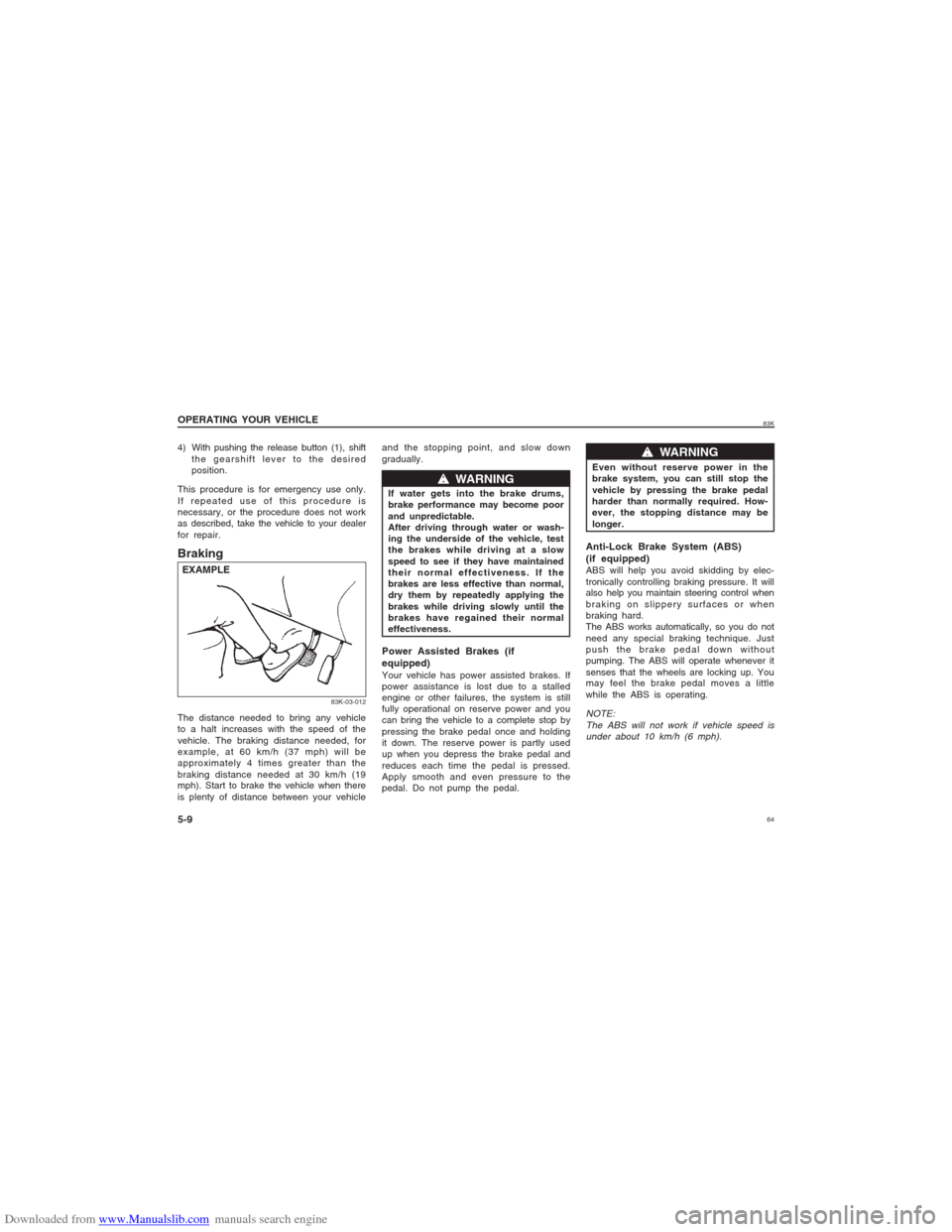
5-9Braking
83K-03-012
EXAMPLE4) With pushing the release button (1), shift
the gearshift lever to the desired
position.
This procedure is for emergency use only.
If repeated use of this procedure is
necessary, or the procedure does not work
as described, take the vehicle to your dealer
for repair.
The distance needed to bring any vehicle
to a halt increases with the speed of the
vehicle. The braking distance needed, for
example, at 60 km/h (37 mph) will be
approximately 4 times greater than the
braking distance needed at 30 km/h (19
mph). Start to brake the vehicle when there
is plenty of distance between your vehicleand the stopping point, and slow down
gradually.
Power Assisted Brakes (if
equipped)Your vehicle has power assisted brakes. If
power assistance is lost due to a stalled
engine or other failures, the system is still
fully operational on reserve power and you
can bring the vehicle to a complete stop by
pressing the brake pedal once and holding
it down. The reserve power is partly used
up when you depress the brake pedal and
reduces each time the pedal is pressed.
Apply smooth and even pressure to the
pedal. Do not pump the pedal.
Anti-Lock Brake System (ABS)
(if equipped)ABS will help you avoid skidding by elec-
tronically controlling braking pressure. It will
also help you maintain steering control when
braking on slippery surfaces or when
braking hard.
The ABS works automatically, so you do not
need any special braking technique. Just
push the brake pedal down without
pumping. The ABS will operate whenever it
senses that the wheels are locking up. You
may feel the brake pedal moves a little
while the ABS is operating.NOTE:
The ABS will not work if vehicle speed is
under about 10 km/h (6 mph).
Page 65 of 136
Downloaded from www.Manualslib.com manuals search engine 6583K
OPERATING YOUR VEHICLE
5-10
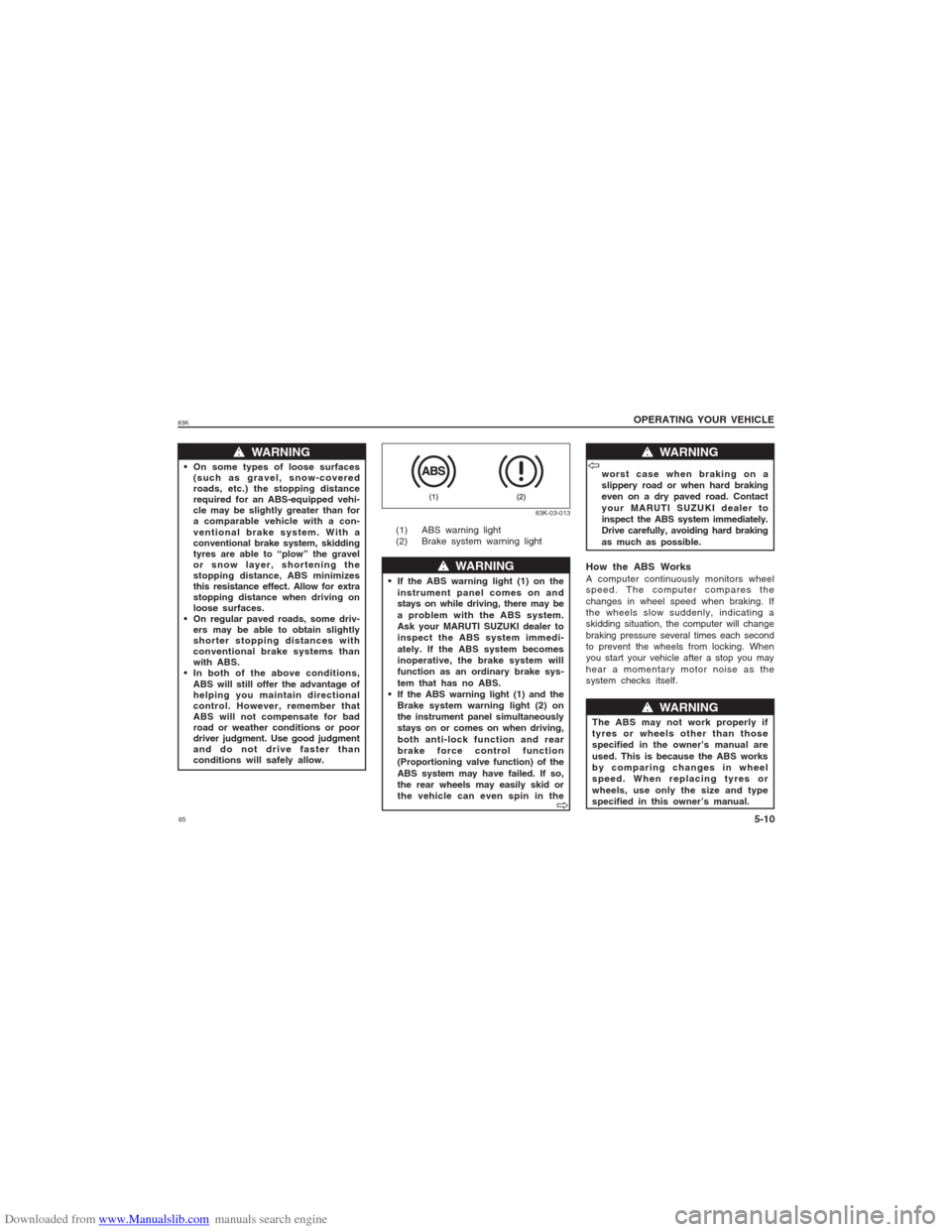
(1) ABS warning light
(2) Brake system warning light
w ww w
w WARNING
If the ABS warning light (1) on the
instrument panel comes on and
stays on while driving, there may be
a problem with the ABS system.
Ask your MARUTI SUZUKI dealer to
inspect the ABS system immedi-
ately. If the ABS system becomes
inoperative, the brake system will
function as an ordinary brake sys-
tem that has no ABS.
If the ABS warning light (1) and the
Brake system warning light (2) on
the instrument panel simultaneously
stays on or comes on when driving,
both anti-lock function and rear
brake force control function
(Proportioning valve function) of the
ABS system may have failed. If so,
the rear wheels may easily skid or
the vehicle can even spin in the
83K-03-013
V VV V
V
w ww w
w WARNING
V VV V
V
w ww w
w WARNING
The ABS may not work properly if
tyres or wheels other than those
specified in the owner’s manual are
used. This is because the ABS works
by comparing changes in wheel
speed. When replacing tyres or
wheels, use only the size and type
specified in this owner’s manual.worst case when braking on a
slippery road or when hard braking
even on a dry paved road. Contact
your MARUTI SUZUKI dealer to
inspect the ABS system immediately.
Drive carefully, avoiding hard braking
as much as possible.How the ABS WorksA computer continuously monitors wheel
speed. The computer compares the
changes in wheel speed when braking. If
the wheels slow suddenly, indicating a
skidding situation, the computer will change
braking pressure several times each second
to prevent the wheels from locking. When
you start your vehicle after a stop you may
hear a momentary motor noise as the
system checks itself.
w ww w
w WARNING
On some types of loose surfaces
(such as gravel, snow-covered
roads, etc.) the stopping distance
required for an ABS-equipped vehi-
cle may be slightly greater than for
a comparable vehicle with a con-
ventional brake system. With a
conventional brake system, skidding
tyres are able to “plow” the gravel
or snow layer, shortening the
stopping distance, ABS minimizes
this resistance effect. Allow for extra
stopping distance when driving on
loose surfaces.
On regular paved roads, some driv-
ers may be able to obtain slightly
shorter stopping distances with
conventional brake systems than
with ABS.
In both of the above conditions,
ABS will still offer the advantage of
helping you maintain directional
control. However, remember that
ABS will not compensate for bad
road or weather conditions or poor
driver judgment. Use good judgment
and do not drive faster than
conditions will safely allow.
Page 69 of 136
Downloaded from www.Manualslib.com manuals search engine 6983K
DRIVING TIPS
6-3
(Diesel engine)
No cleaning is required. Replace as per
periodic maintenance schedule.
Keep weight to a minimum
The heavier the load, the more fuel the
vehicle consumes. Take out any luggage or
cargo when it is not necessary.
Keep tyre pressures correct
Underinflation of the tyres can waste fuel
due to increased running resistance of the
tyres. Keep your tyres inflated to the cor-
rect pressure shown on the label on the
driver’s side door pillar.Highway DrivingWhen driving at high speeds, pay attention
to the following:
Stopping distance progressively increa-
ses with vehicle speed. Apply the brakes
far enough ahead of the stopping point
to allow for the extra stopping distance.
On rainy days, “Aquaplaning” can occur.
“Aquaplaning” is the loss of direct con-
tact between the road surface and the
vehicle’s tyres due to a water film form-
ing between them. Steering or braking
the vehicle while “Aquaplaning” can be
very difficult, and loss of control can
occur. Keep speed down when the road
surface is wet.
At high speeds, the vehicle may be
affected by side winds. Therefore, reducespeed and be prepared for unexpected
buffeting, which can occur at the exits
of tunnels, when passing by a cut of a
hill, or when being overtaken by large
vehicles, etc.
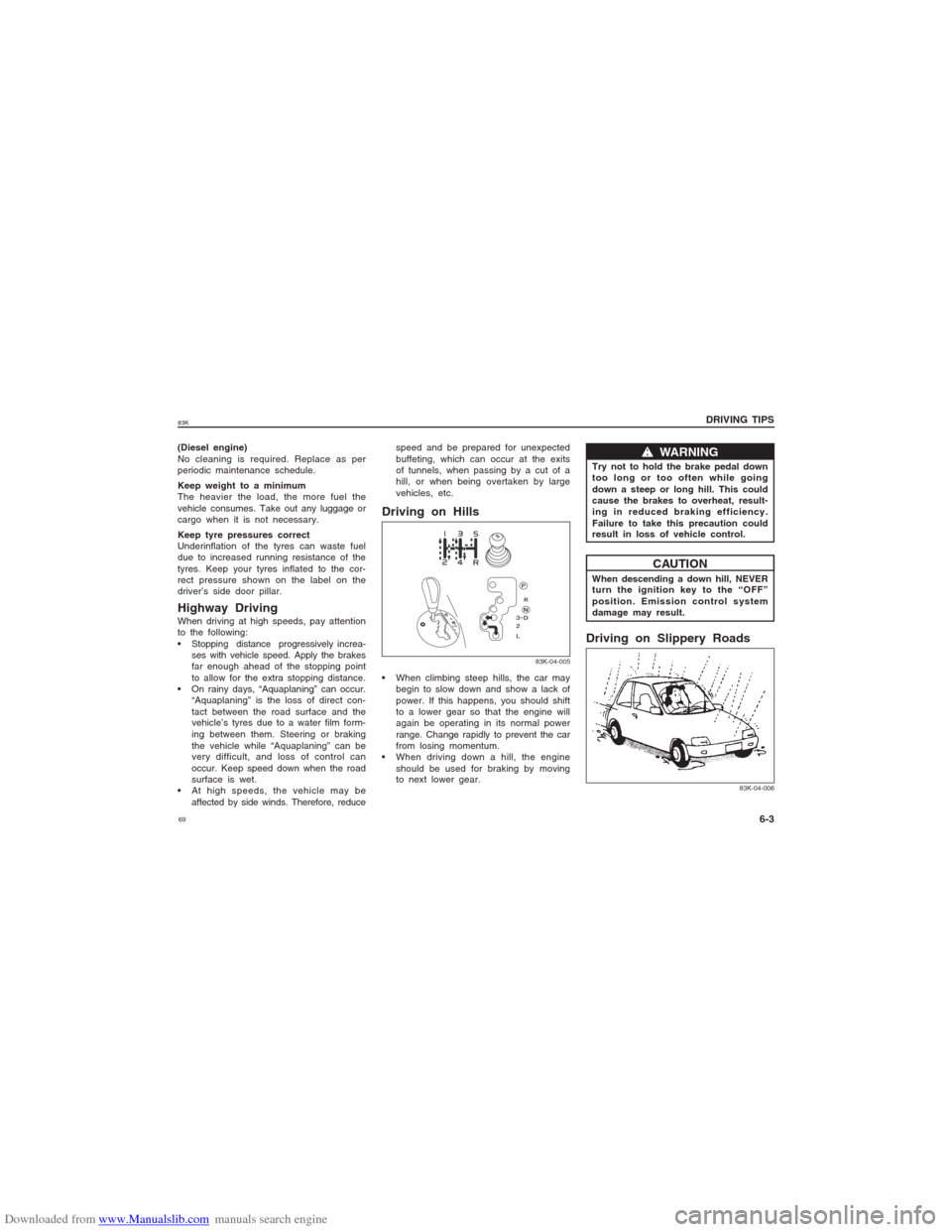
Driving on Hills
w ww w
w WARNING
Try not to hold the brake pedal down
too long or too often while going
down a steep or long hill. This could
cause the brakes to overheat, result-
ing in reduced braking efficiency.
Failure to take this precaution could
result in loss of vehicle control.
CAUTION
When descending a down hill, NEVER
turn the ignition key to the “OFF”
position. Emission control system
damage may result.Driving on Slippery Roads
83K-04-006
83K-04-005
When climbing steep hills, the car may
begin to slow down and show a lack of
power. If this happens, you should shift
to a lower gear so that the engine will
again be operating in its normal power
range. Change rapidly to prevent the car
from losing momentum.
When driving down a hill, the engine
should be used for braking by moving
to next lower gear.
Page 71 of 136
Downloaded from www.Manualslib.com manuals search engine 7183K
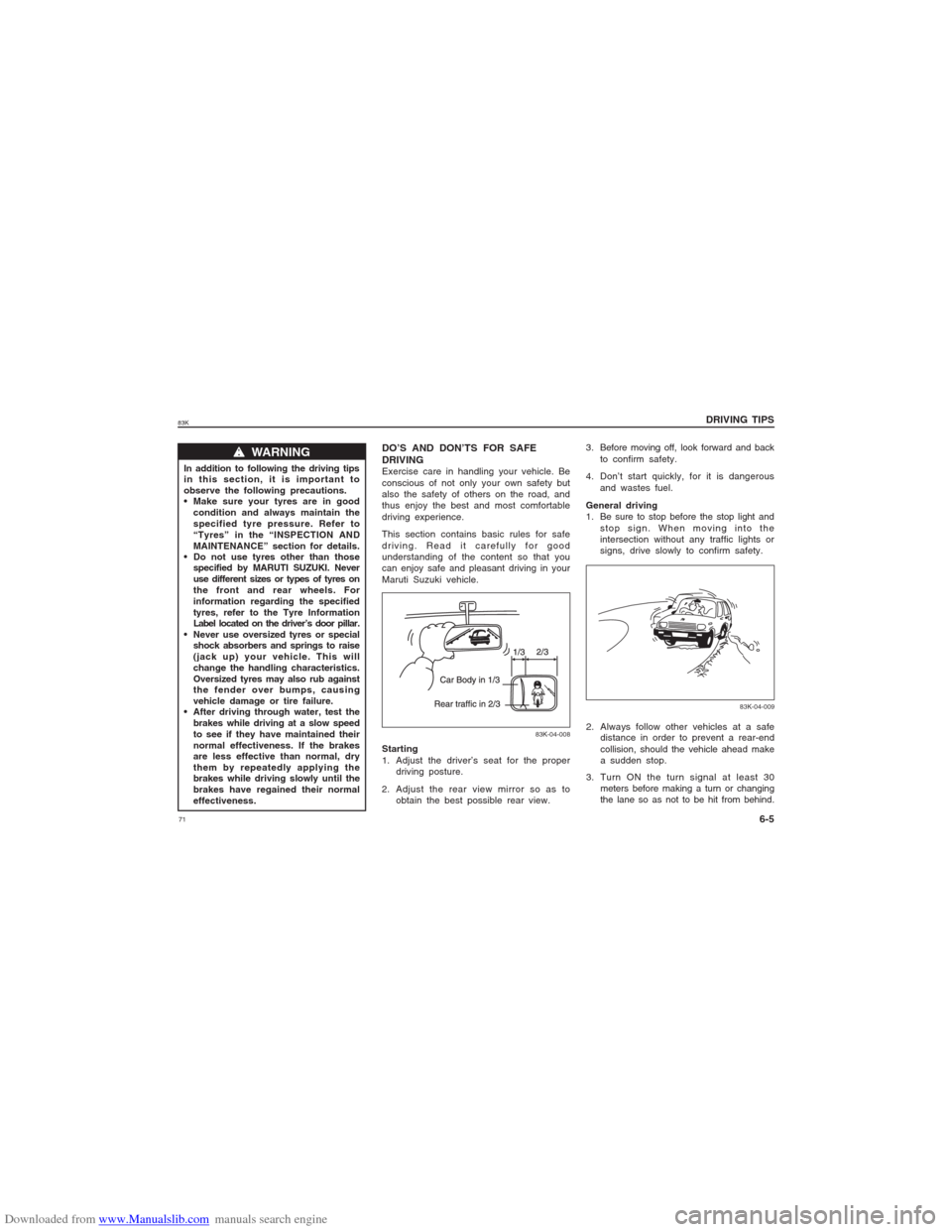
Starting
1. Adjust the driver’s seat for the proper
driving posture.
2. Adjust the rear view mirror so as to
obtain the best possible rear view.
83K-04-008
83K-04-009
2. Always follow other vehicles at a safe
distance in order to prevent a rear-end
collision, should the vehicle ahead make
a sudden stop.
3. Turn ON the turn signal at least 30
meters before making a turn or changing
the lane so as not to be hit from behind.
DRIVING TIPS
6-5
DO’S AND DON’TS FOR SAFE
DRIVINGExercise care in handling your vehicle. Be
conscious of not only your own safety but
also the safety of others on the road, and
thus enjoy the best and most comfortable
driving experience.
This section contains basic rules for safe
driving. Read it carefully for good
understanding of the content so that you
can enjoy safe and pleasant driving in your
Maruti Suzuki vehicle.3. Before moving off, look forward and back
to confirm safety.
4. Don’t start quickly, for it is dangerous
and wastes fuel.
General driving
1. Be sure to stop before the stop light and
stop sign. When moving into the
intersection without any traffic lights or
signs, drive slowly to confirm safety.
w ww w
w WARNING
In addition to following the driving tips
in this section, it is important to
observe the following precautions.
Make sure your tyres are in good
condition and always maintain the
specified tyre pressure. Refer to
“Tyres” in the “INSPECTION AND
MAINTENANCE” section for details.
Do not use tyres other than those
specified by MARUTI SUZUKI. Never
use different sizes or types of tyres on
the front and rear wheels. For
information regarding the specified
tyres, refer to the Tyre Information
Label located on the driver’s door pillar.
Never use oversized tyres or special
shock absorbers and springs to raise
(jack up) your vehicle. This will
change the handling characteristics.
Oversized tyres may also rub against
the fender over bumps, causing
vehicle damage or tire failure.
After driving through water, test the
brakes while driving at a slow speed
to see if they have maintained their
normal effectiveness. If the brakes
are less effective than normal, dry
them by repeatedly applying the
brakes while driving slowly until the
brakes have regained their normal
effectiveness.
Page 72 of 136
Downloaded from www.Manualslib.com manuals search engine 7283K
DRIVING TIPS
6-6
83K-04-010
4. Before entering a corner, decelerate to
a safe speed. Don’t apply brakes during
cornering, or a cornering skid may occur.
5. When overtaking other vehicles, watch
out for the oncoming vehicle and
carefully confirm the safety.
6. Don’t attempt zigzag driving which will
hinder your control over the vehicle and
cause an accident.
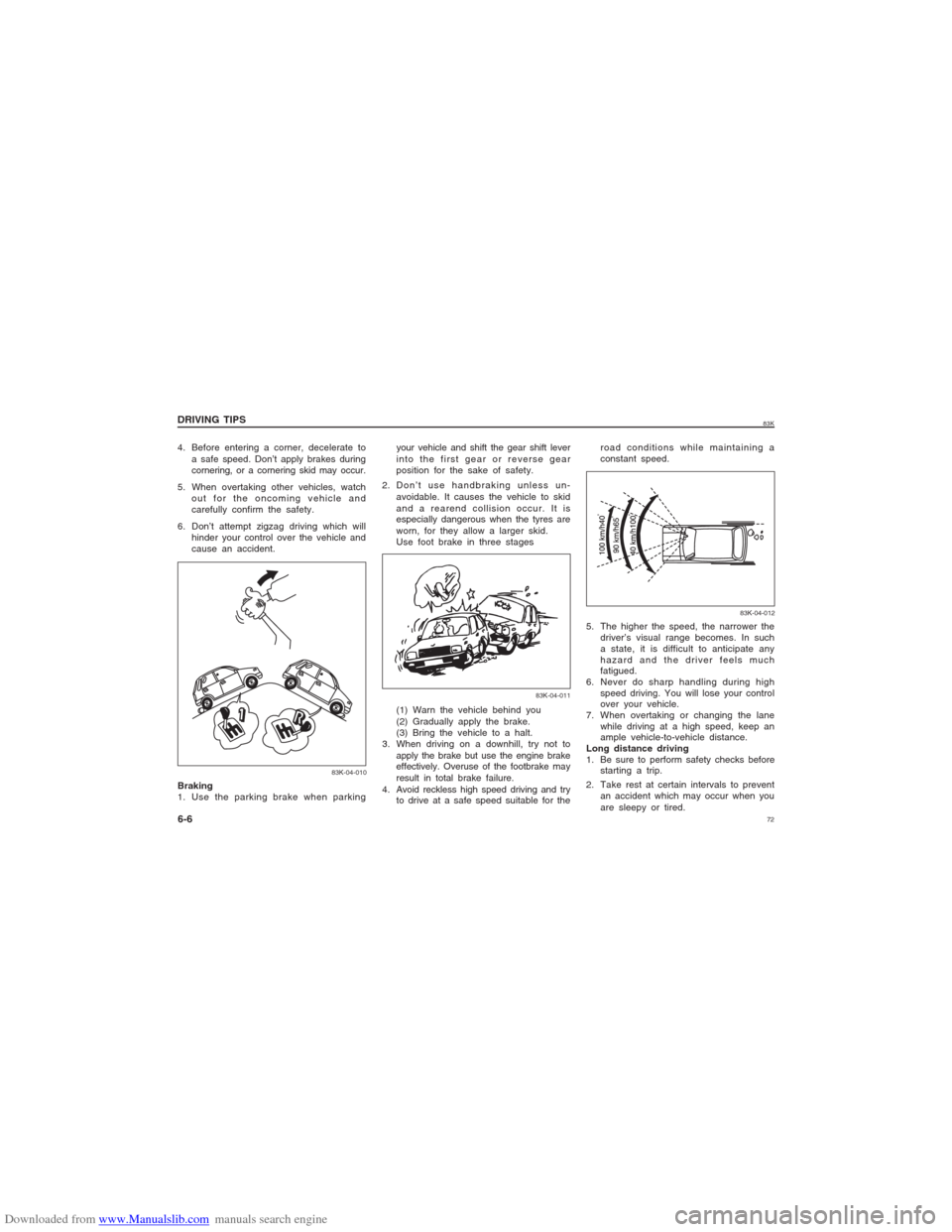
Braking
1. Use the parking brake when parking(1) Warn the vehicle behind you
(2) Gradually apply the brake.
(3) Bring the vehicle to a halt.
3. When driving on a downhill, try not to
apply the brake but use the engine brake
effectively. Overuse of the footbrake may
result in total brake failure.
4. Avoid reckless high speed driving and try
to drive at a safe speed suitable for theroad conditions while maintaining a
constant speed.
83K-04-012
83K-04-011
your vehicle and shift the gear shift lever
into the first gear or reverse gear
position for the sake of safety.
2. Don’t use handbraking unless un-
avoidable. It causes the vehicle to skid
and a rearend collision occur. It is
especially dangerous when the tyres are
worn, for they allow a larger skid.
Use foot brake in three stages
5. The higher the speed, the narrower the
driver’s visual range becomes. In such
a state, it is difficult to anticipate any
hazard and the driver feels much
fatigued.
6. Never do sharp handling during high
speed driving. You will lose your control
over your vehicle.
7. When overtaking or changing the lane
while driving at a high speed, keep an
ample vehicle-to-vehicle distance.
Long distance driving
1. Be sure to perform safety checks before
starting a trip.
2. Take rest at certain intervals to prevent
an accident which may occur when you
are sleepy or tired.
Page 88 of 136
Downloaded from www.Manualslib.com manuals search engine 8883K
VEHICLE LOADING AND TOWING
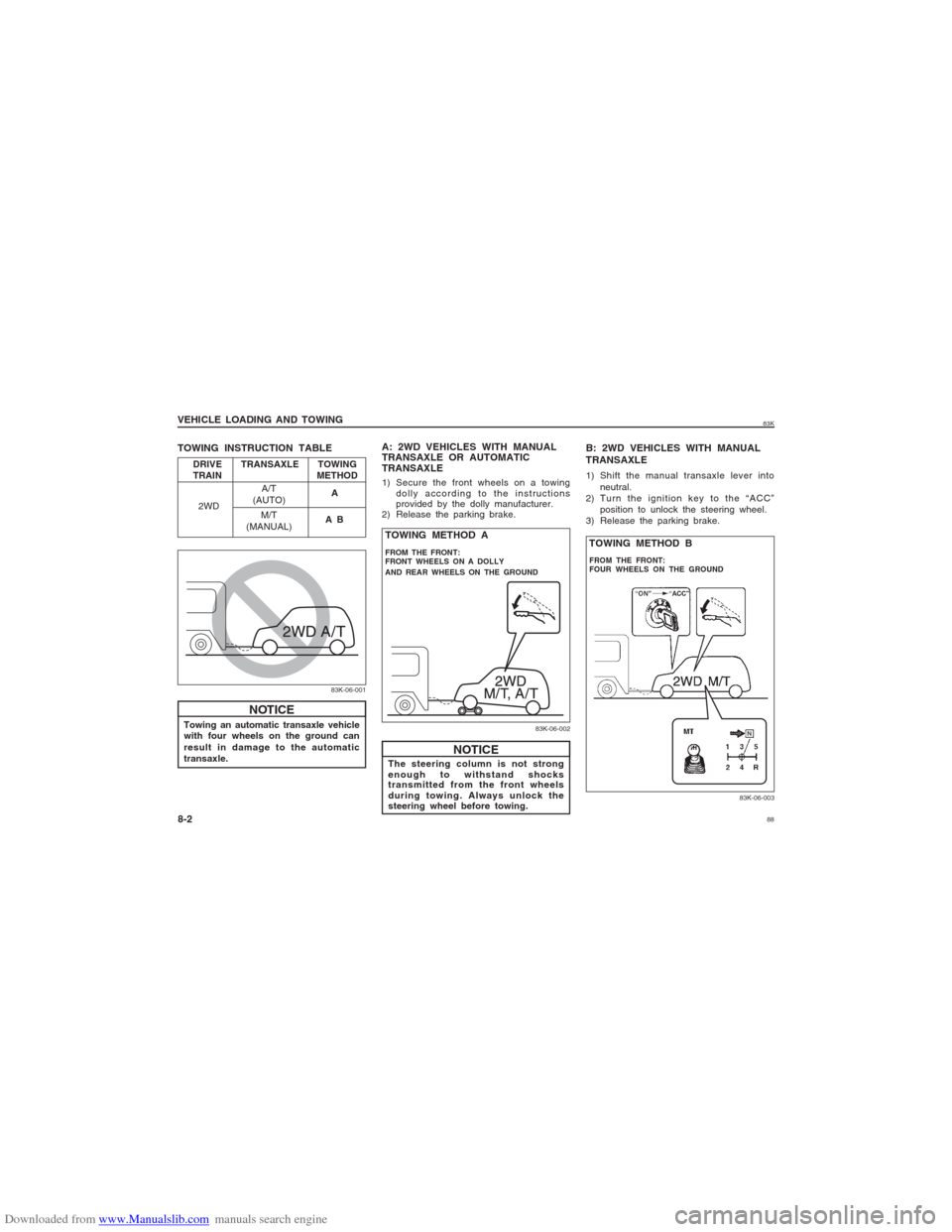
TOWING INSTRUCTION TABLE
DRIVE TRANSAXLE TOWING
TRAIN METHOD2WDA/T
(AUTO)
M/T
(MANUAL)A
A B
Towing an automatic transaxle vehicle
with four wheels on the ground can
result in damage to the automatic
transaxle.
83K-06-001
NOTICE
A: 2WD VEHICLES WITH MANUAL
TRANSAXLE OR AUTOMATIC
TRANSAXLE1) Secure the front wheels on a towing
dolly according to the instructions
provided by the dolly manufacturer.
2) Release the parking brake.
83K-06-002
TOWING METHOD AFROM THE FRONT:
FRONT WHEELS ON A DOLLY
AND REAR WHEELS ON THE GROUND
B: 2WD VEHICLES WITH MANUAL
TRANSAXLE1) Shift the manual transaxle lever into
neutral.
2) Turn the ignition key to the “ACC”
position to unlock the steering wheel.
3) Release the parking brake.
83K-06-003
TOWING METHOD BFROM THE FRONT:
FOUR WHEELS ON THE GROUND
NOTICE
The steering column is not strong
enough to withstand shocks
transmitted from the front wheels
during towing. Always unlock the
steering wheel before towing.
8-2
Page 89 of 136
Downloaded from www.Manualslib.com manuals search engine 8983KINSPECTION AND MAINTENANCE
Maintenance Schedule ....................................................................................................... 9-1
Drive Belt ............................................................................................................................. 9-6
Engine Oil and Filter......................................................................................................... 9-6
Engine Coolant.................................................................................................................... 9-9
Air Cleaner ......................................................................................................................... 9-11
Spark Plugs....................................................................................................................... 9-11
Gear Oil.............................................................................................................................. 9-13
Clutch Pedal...................................................................................................................... 9-14
Fuel Filter (Diesel engine) .............................................................................................. 9-14
Brakes ................................................................................................................................. 9-15
Steering.............................................................................................................................. 9-16
Tyres ................................................................................................................................... 9-17
Battery................................................................................................................................ 9-19
Fuses ................................................................................................................................... 9-20
Bulb Replacement............................................................................................................. 9-23
Wiper Blades..................................................................................................................... 9-26
Windshield Washer Fluid................................................................................................9-28
Air Conditioning System.................................................................................................9-29
INSPECTION AND MAINTENANCE
Page 90 of 136
Downloaded from www.Manualslib.com manuals search engine 9083K
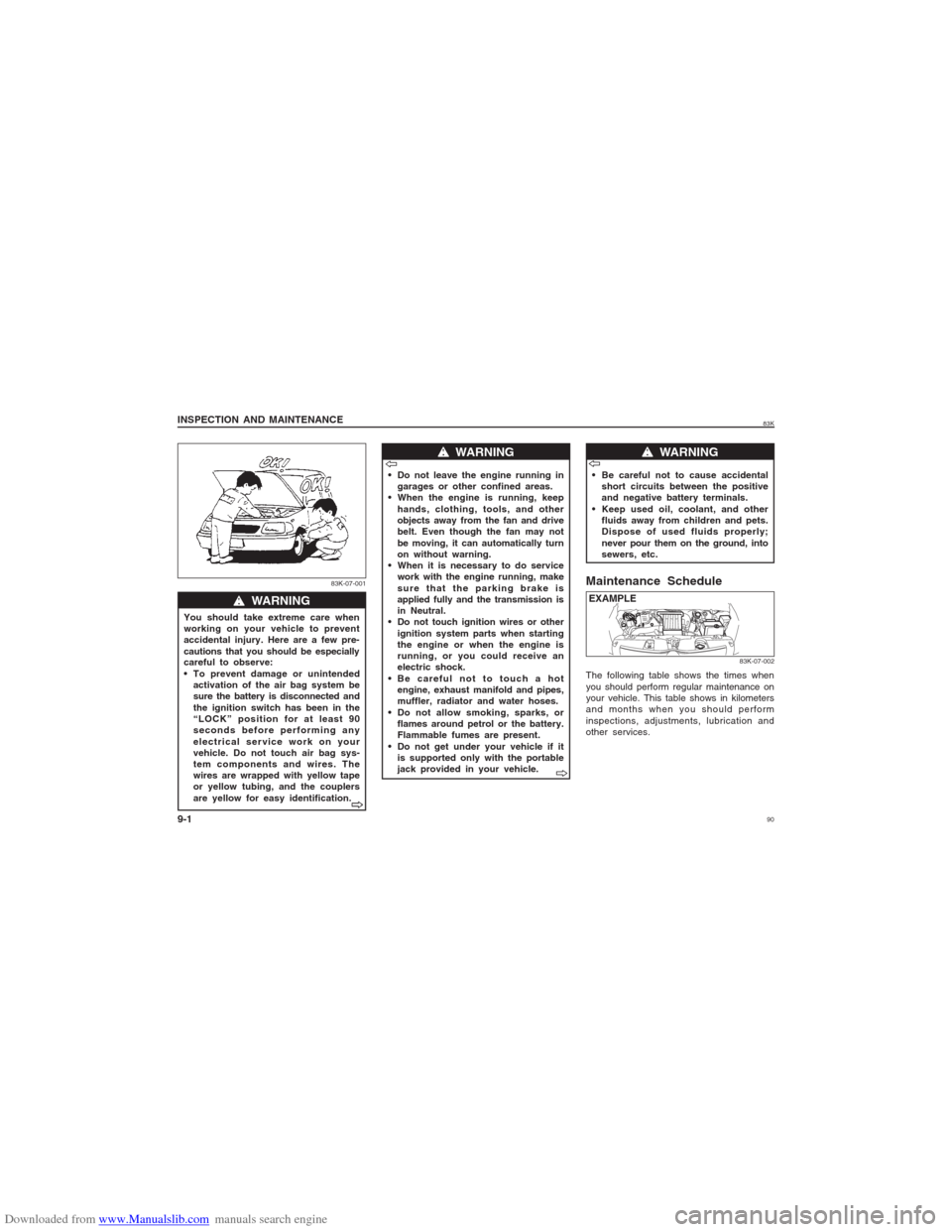
You should take extreme care when
working on your vehicle to prevent
accidental injury. Here are a few pre-
cautions that you should be especially
careful to observe:
To prevent damage or unintended
activation of the air bag system be
sure the battery is disconnected and
the ignition switch has been in the
“LOCK” position for at least 90
seconds before performing any
electrical service work on your
vehicle. Do not touch air bag sys-
tem components and wires. The
wires are wrapped with yellow tape
or yellow tubing, and the couplers
are yellow for easy identification.
w ww w
w WARNING
83K-07-001
w ww w
w WARNING
w ww w
w WARNING
INSPECTION AND MAINTENANCE
9-1
V VV V
V
Do not leave the engine running in
garages or other confined areas.
When the engine is running, keep
hands, clothing, tools, and other
objects away from the fan and drive
belt. Even though the fan may not
be moving, it can automatically turn
on without warning.
When it is necessary to do service
work with the engine running, make
sure that the parking brake is
applied fully and the transmission is
in Neutral.
Do not touch ignition wires or other
ignition system parts when starting
the engine or when the engine is
running, or you could receive an
electric shock.
Be careful not to touch a hot
engine, exhaust manifold and pipes,
muffler, radiator and water hoses.
Do not allow smoking, sparks, or
flames around petrol or the battery.
Flammable fumes are present.
Do not get under your vehicle if it
is supported only with the portable
jack provided in your vehicle.V VV V
V
V VV V
V
Be careful not to cause accidental
short circuits between the positive
and negative battery terminals.
Keep used oil, coolant, and other
fluids away from children and pets.
Dispose of used fluids properly;
never pour them on the ground, into
sewers, etc.V VV V
V
83K-07-002
Maintenance ScheduleThe following table shows the times when
you should perform regular maintenance on
your vehicle. This table shows in kilometers
and months when you should perform
inspections, adjustments, lubrication and
other services.EXAMPLE