steering SUZUKI MARUTI 2005 1.G User Guide
[x] Cancel search | Manufacturer: SUZUKI, Model Year: 2005, Model line: MARUTI, Model: SUZUKI MARUTI 2005 1.GPages: 136, PDF Size: 2.93 MB
Page 70 of 136
Downloaded from www.Manualslib.com manuals search engine 7083K
DRIVING TIPS
6-4
w ww w
w WARNING
Do not allow anyone to stand near the
vehicle when you are rocking it, and
do not spin the wheels faster than an
indicated 40 km/h (25 mph) on the
speedometer. Personal injury and/ or
vehicle damage may result from spin-
ning the wheels too fast.
CAUTION
83K-04-007
Do not continue rocking the vehicle
for more than a few minutes. Pro-
longed rocking can cause engine
overheating or transmission damage.
Under wet road conditions you should drive
at a lower speed than on dry roads due to
possible slippage of tyres during braking.
When driving on icy, snow-covered, or
muddy roads, reduce your speed and avoid
sudden acceleration, abrupt braking, or
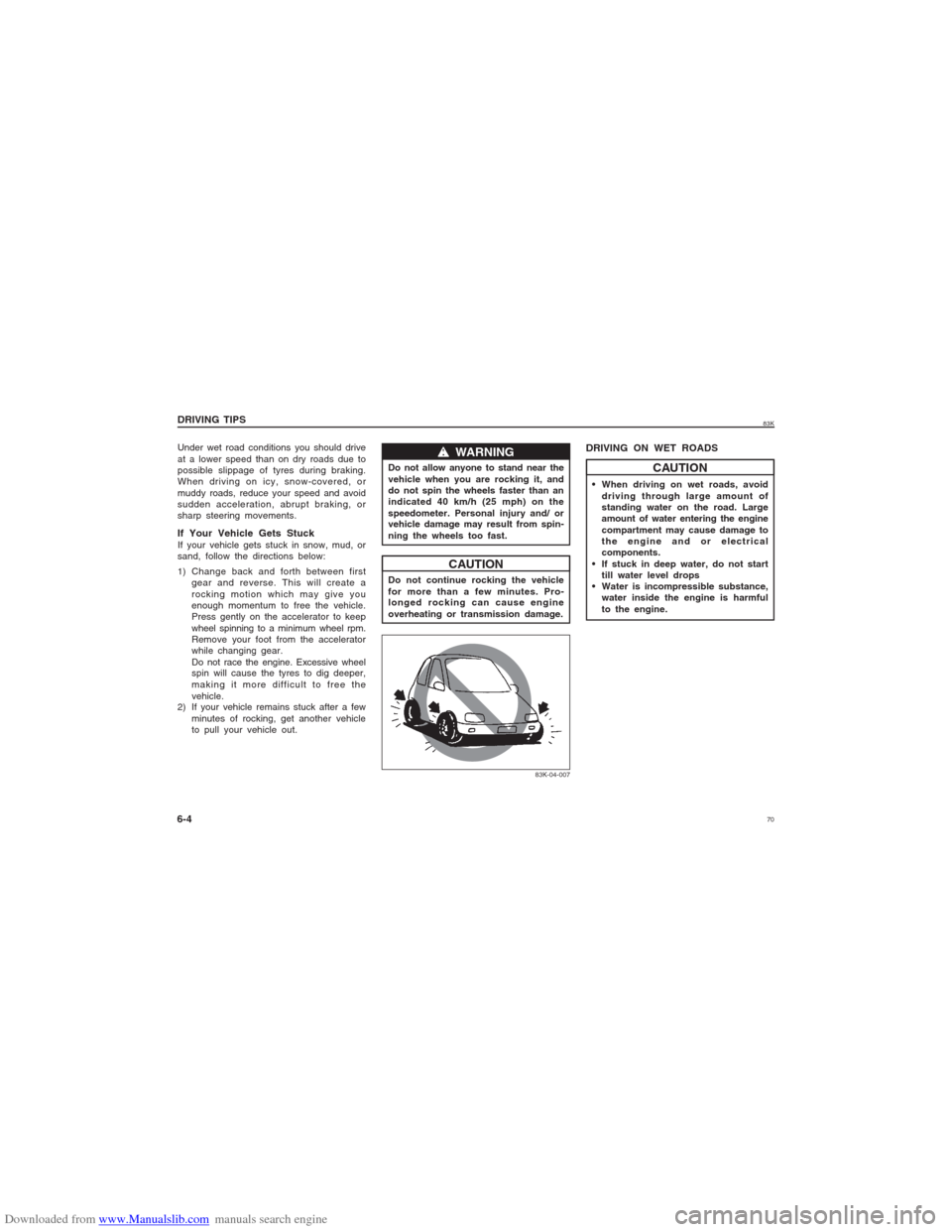
sharp steering movements.If Your Vehicle Gets StuckIf your vehicle gets stuck in snow, mud, or
sand, follow the directions below:
1) Change back and forth between first
gear and reverse. This will create a
rocking motion which may give you
enough momentum to free the vehicle.
Press gently on the accelerator to keep
wheel spinning to a minimum wheel rpm.
Remove your foot from the accelerator
while changing gear.
Do not race the engine. Excessive wheel
spin will cause the tyres to dig deeper,
making it more difficult to free the
vehicle.
2) If your vehicle remains stuck after a few
minutes of rocking, get another vehicle
to pull your vehicle out.
CAUTION
When driving on wet roads, avoid
driving through large amount of
standing water on the road. Large
amount of water entering the engine
compartment may cause damage to
the engine and or electrical
components.
If stuck in deep water, do not start
till water level drops
Water is incompressible substance,
water inside the engine is harmful
to the engine.DRIVING ON WET ROADS
Page 73 of 136
Downloaded from www.Manualslib.com manuals search engine 7383K
83K-04-01483K-04-015
other drivers. For that, observe the
following.
Drive at a safe speed.
Maintain a sufficient distance between
your vehicle and the vehicle ahead.
Don’t force yourself to overtake other
vehicles.
Don’t make quick start, hard steering or
sudden stops.
Allow an ample time in the driving
schedule.
Observe traffic rules and regulations.
CONCLUSION
A perfect driver does not exist. The
endeavour of every motorist should be to
strive for perfection. Safety consciousness
not only ensures your safety and the safety
of other road users, it also helps reduce the
wear and tear on your vehicle, prolongs its
life, gives more mileage and ensures a
comfortable driving experience.
Follow the do’s and don’ts listed, and
driving will never be the same again.
MARGIN FOR SAFETY
It is important to allow yourself a margin for
safety during driving so that you can cope
with erroneous or unexpected driving of
DRIVING TIPS
6-7
83K-04-013
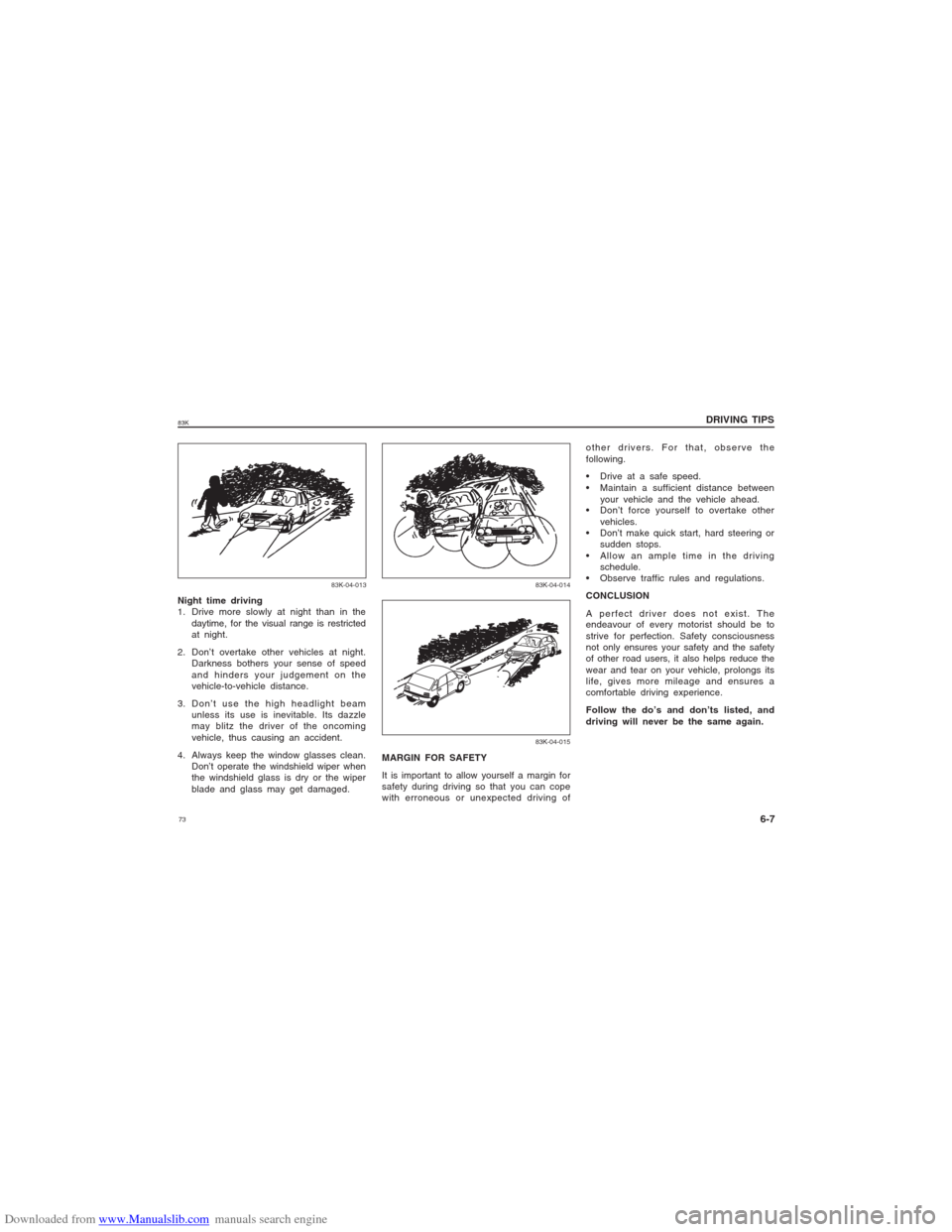
Night time driving
1. Drive more slowly at night than in the
daytime, for the visual range is restricted
at night.
2. Don’t overtake other vehicles at night.
Darkness bothers your sense of speed
and hinders your judgement on the
vehicle-to-vehicle distance.
3. Don’t use the high headlight beam
unless its use is inevitable. Its dazzle
may blitz the driver of the oncoming
vehicle, thus causing an accident.
4. Always keep the window glasses clean.
Don’t operate the windshield wiper when
the windshield glass is dry or the wiper
blade and glass may get damaged.
Page 78 of 136
Downloaded from www.Manualslib.com manuals search engine 7883K
OTHER CONTROLS AND EQUIPMENT
7-4Using the wrong refrigerant may
damage your air conditioning system.
Use R-134a only. Do not mix or replace
the R-134a with other refrigerants.
CAUTION
NOTE:
If you need maximum demisting:
set the air flow selector to “DEMIST”,
set the blower speed selector to HIGH,
adjust the temperature selector to the
HOT end,
turn on the “A/C” switch, and
adjust the side outlets so the air blows
on the side windows.MaintenanceIf you do not use the air conditioner for a
long period, such as during winter, it may
not give the best performance when you
start using it again. To help maintain opti-
mum performance and durability of your air
conditioner, it needs to be run periodically.
Operate the air conditioner at least once a
month for one minute with the engine idling.
This circulates the refrigerant and oil and
helps protect the internal components.NOTE:
Your vehicle uses the air conditioning
refrigerant HFC-134a, commonly called “R-
134a”. Only R-134a should be used in your
vehicle.
Audio System (if equipped)Refer supplementary manual for audio
system (if equipped), provided along with
the vehicle.Radio Antenna
83K-05-013
To avoid damage to the radio antenna:
Remove the antenna when using an
automatic car wash.
Remove the antenna when the
antenna hits anything such as a low
ceiling in a parking garage or
putting a car cover over your car.
CAUTION
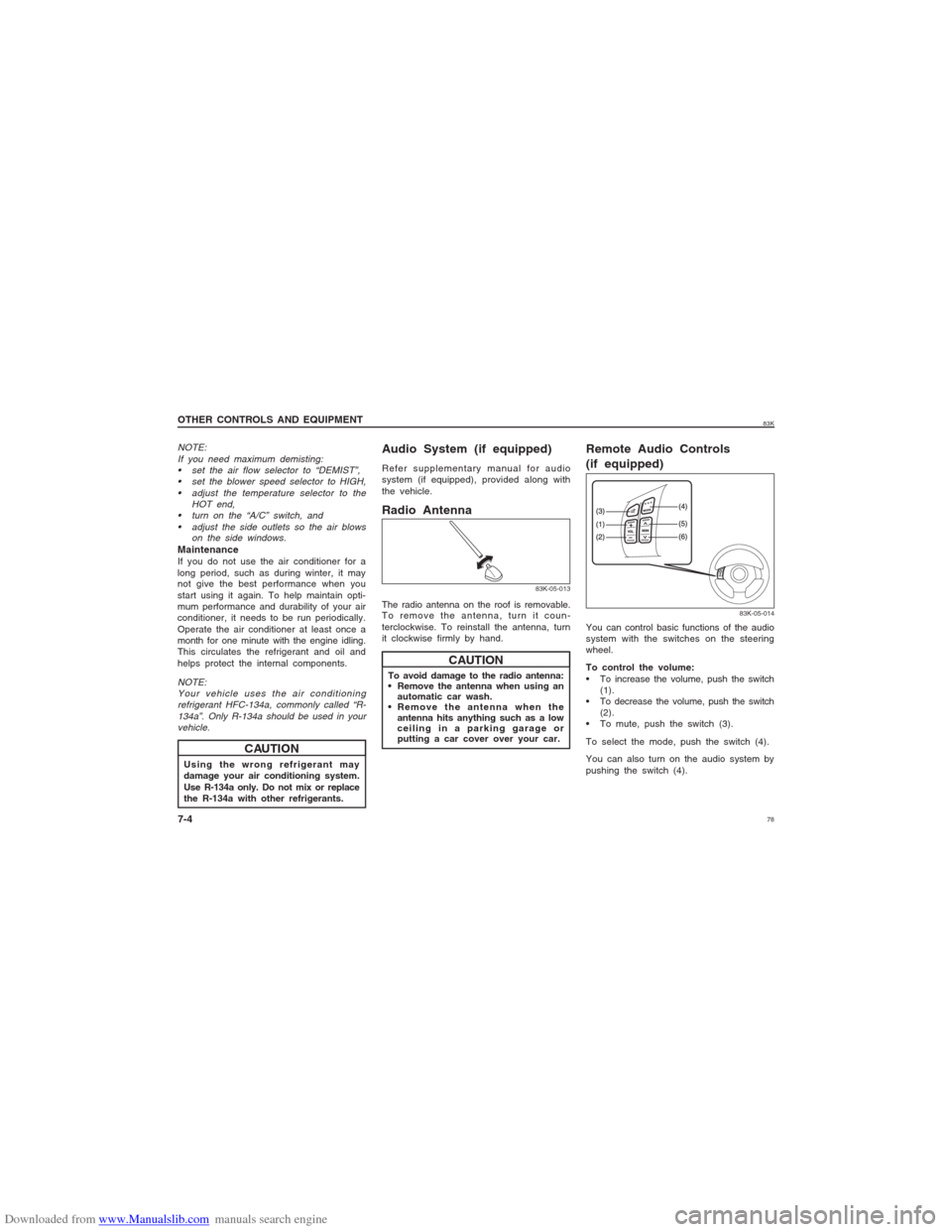
Remote Audio Controls
(if equipped)
83K-05-014
You can control basic functions of the audio
system with the switches on the steering
wheel.
To control the volume:
To increase the volume, push the switch
(1).
To decrease the volume, push the switch
(2).
To mute, push the switch (3).
To select the mode, push the switch (4).
You can also turn on the audio system by
pushing the switch (4). The radio antenna on the roof is removable.
To remove the antenna, turn it coun-
terclockwise. To reinstall the antenna, turn
it clockwise firmly by hand.
Page 88 of 136
Downloaded from www.Manualslib.com manuals search engine 8883K
VEHICLE LOADING AND TOWING
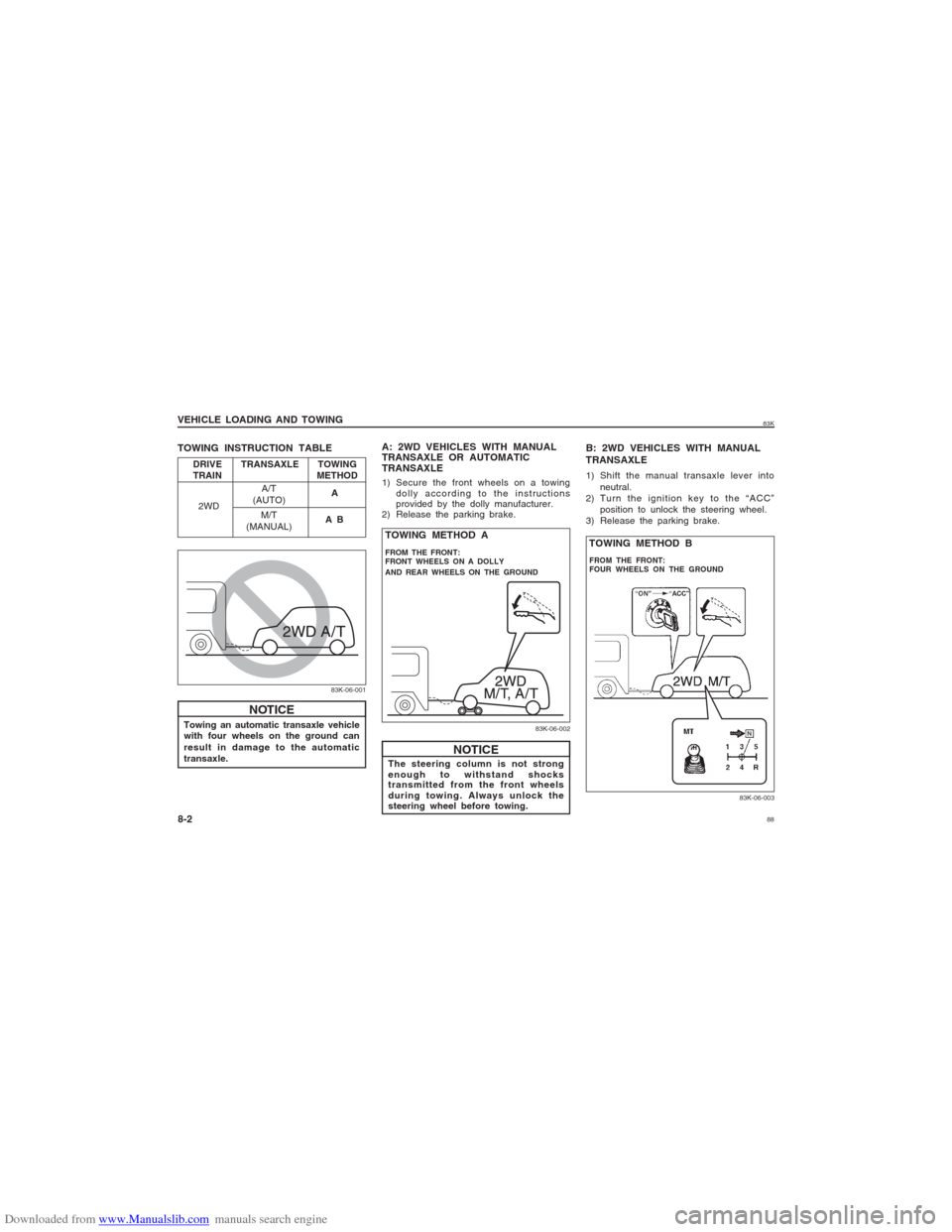
TOWING INSTRUCTION TABLE
DRIVE TRANSAXLE TOWING
TRAIN METHOD2WDA/T
(AUTO)
M/T
(MANUAL)A
A B
Towing an automatic transaxle vehicle
with four wheels on the ground can
result in damage to the automatic
transaxle.
83K-06-001
NOTICE
A: 2WD VEHICLES WITH MANUAL
TRANSAXLE OR AUTOMATIC
TRANSAXLE1) Secure the front wheels on a towing
dolly according to the instructions
provided by the dolly manufacturer.
2) Release the parking brake.
83K-06-002
TOWING METHOD AFROM THE FRONT:
FRONT WHEELS ON A DOLLY
AND REAR WHEELS ON THE GROUND
B: 2WD VEHICLES WITH MANUAL
TRANSAXLE1) Shift the manual transaxle lever into
neutral.
2) Turn the ignition key to the “ACC”
position to unlock the steering wheel.
3) Release the parking brake.
83K-06-003
TOWING METHOD BFROM THE FRONT:
FOUR WHEELS ON THE GROUND
NOTICE
The steering column is not strong
enough to withstand shocks
transmitted from the front wheels
during towing. Always unlock the
steering wheel before towing.
8-2
Page 89 of 136
Downloaded from www.Manualslib.com manuals search engine 8983KINSPECTION AND MAINTENANCE
Maintenance Schedule ....................................................................................................... 9-1
Drive Belt ............................................................................................................................. 9-6
Engine Oil and Filter......................................................................................................... 9-6
Engine Coolant.................................................................................................................... 9-9
Air Cleaner ......................................................................................................................... 9-11
Spark Plugs....................................................................................................................... 9-11
Gear Oil.............................................................................................................................. 9-13
Clutch Pedal...................................................................................................................... 9-14
Fuel Filter (Diesel engine) .............................................................................................. 9-14
Brakes ................................................................................................................................. 9-15
Steering.............................................................................................................................. 9-16
Tyres ................................................................................................................................... 9-17
Battery................................................................................................................................ 9-19
Fuses ................................................................................................................................... 9-20
Bulb Replacement............................................................................................................. 9-23
Wiper Blades..................................................................................................................... 9-26
Windshield Washer Fluid................................................................................................9-28
Air Conditioning System.................................................................................................9-29
INSPECTION AND MAINTENANCE
Page 94 of 136
Downloaded from www.Manualslib.com manuals search engine 9483K
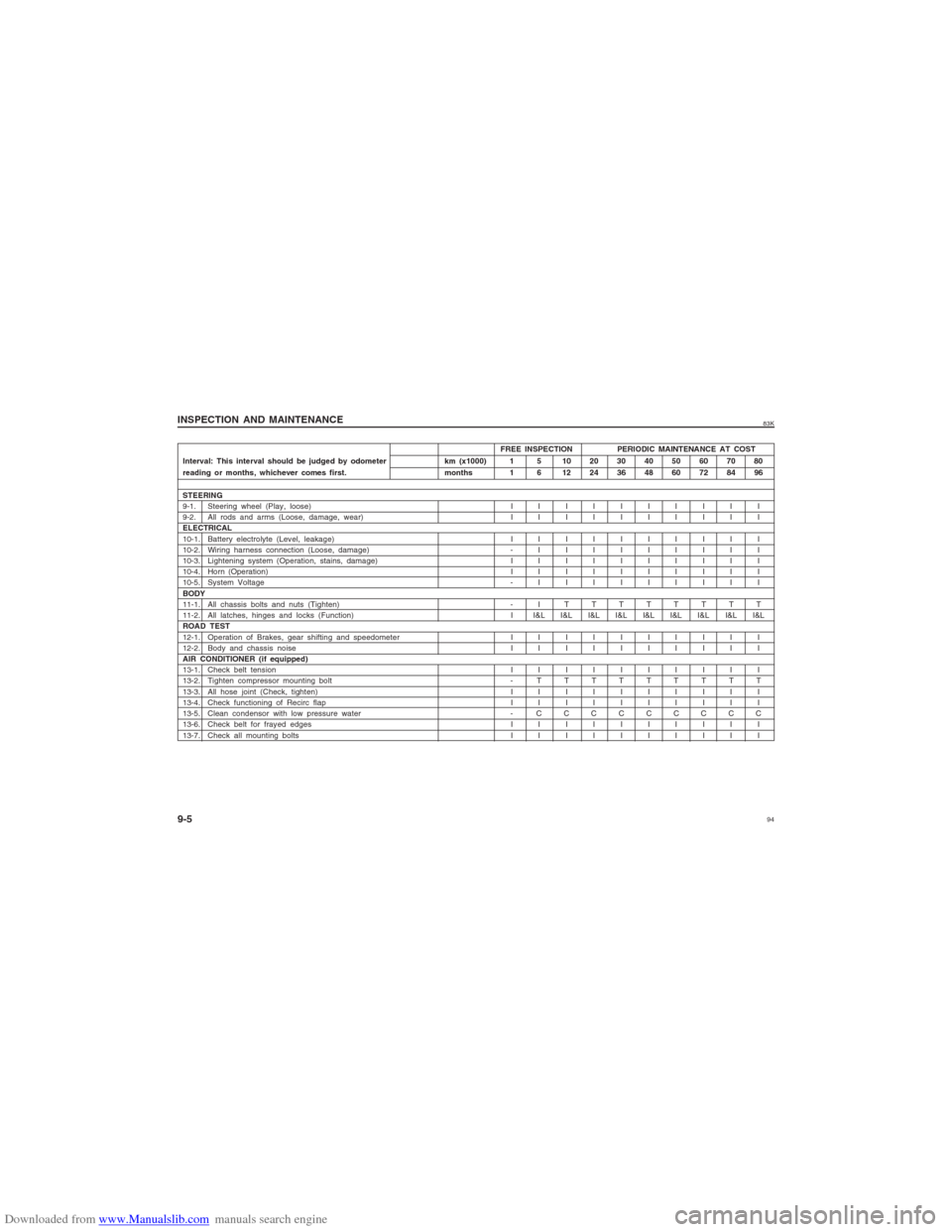
FREE INSPECTION PERIODIC MAINTENANCE AT COST
Interval: This interval should be judged by odometer km (x1000) 1 5 10 20 30 40 50 60 70 80
reading or months, whichever comes first.months 1 6 12 24 36 48 60 72 84 96
STEERING
9-1.Steering wheel (Play, loose)IIIIIIIIII
9-2. All rods and arms (Loose, damage, wear)IIIIIIIIII
ELECTRICAL
10-1.Battery electrolyte (Level, leakage)IIIIIIIIII
10-2. Wiring harness connection (Loose, damage) -IIIIIIIII
10-3. Lightening system (Operation, stains, damage)IIIIIIIIII
10-4.Horn (Operation)IIIIIIIIII
10-5.System Voltage -IIIIIIIII
BODY
11-1.All chassis bolts and nuts (Tighten) - ITTTTTTTT
11-2. All latches, hinges and locks (Function) I I&L I&L I&L I&L I&L I&L I&L I&L I&L
ROAD TEST
12-1.Operation of Brakes, gear shifting and speedometerIIIIIIIIII
12-2.Body and chassis noiseIIIIIIIIII
AIR CONDITIONER (if equipped)
13-1. Check belt tensionIIIIIIIIII
13-2.Tighten compressor mounting bolt -TTTTTTTTT
13-3. All hose joint (Check, tighten)IIIIIIIIII
13-4.Check functioning of Recirc flapIIIIIIIIII
13-5. Clean condensor with low pressure water - C C CCCCCCC
13-6. Check belt for frayed edgesIIIIIIIIII
13-7.Check all mounting boltsIIIIIIIIII
INSPECTION AND MAINTENANCE
9-5
Page 95 of 136
Downloaded from www.Manualslib.com manuals search engine 9583KDrive Belt
w ww w
w WARNING
When the engine is running, keep
hands, hair, clothing, tools, etc. away
from the moving fan and drive belts.
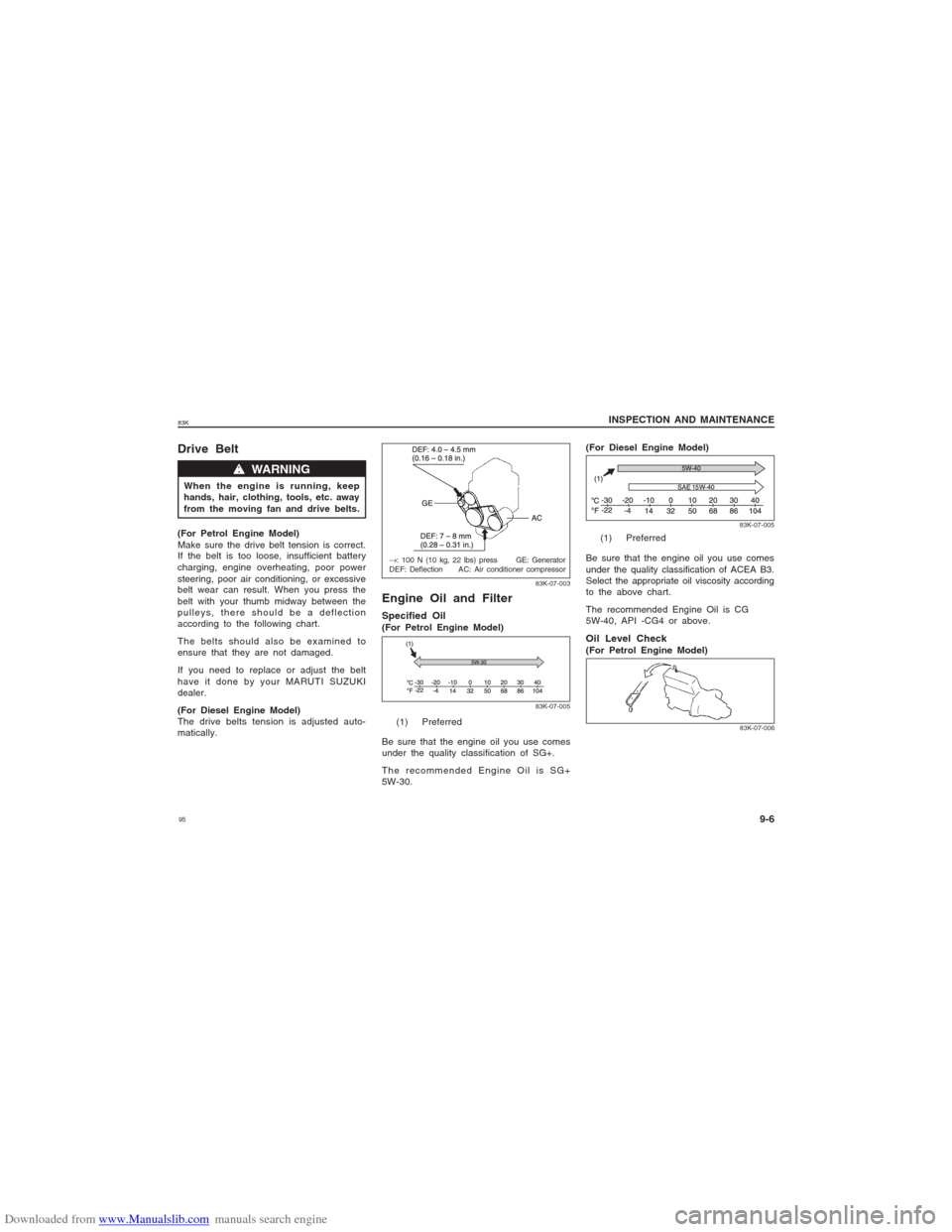
(For Petrol Engine Model)
Make sure the drive belt tension is correct.
If the belt is too loose, insufficient battery
charging, engine overheating, poor power
steering, poor air conditioning, or excessive
belt wear can result. When you press the
belt with your thumb midway between the
pulleys, there should be a deflection
according to the following chart.
The belts should also be examined to
ensure that they are not damaged.
If you need to replace or adjust the belt
have it done by your MARUTI SUZUKI
dealer.
(For Diesel Engine Model)
The drive belts tension is adjusted auto-
matically.
Engine Oil and FilterSpecified Oil(For Petrol Engine Model)
(1) Preferred→: 100 N (10 kg, 22 lbs) press GE: Generator
DEF: Deflection AC: Air conditioner compressor
INSPECTION AND MAINTENANCE
9-6
83K-07-003
(For Diesel Engine Model)
83K-07-005
Be sure that the engine oil you use comes
under the quality classification of ACEA B3.
Select the appropriate oil viscosity according
to the above chart.
The recommended Engine Oil is CG
5W-40, API -CG4 or above.Oil Level Check(For Petrol Engine Model)
83K-07-006
(1) Preferred
83K-07-005
Be sure that the engine oil you use comes
under the quality classification of SG+.
The recommended Engine Oil is SG+
5W-30.
Page 107 of 136
Downloaded from www.Manualslib.com manuals search engine 10783K
INSPECTION AND MAINTENANCE
9-18
With the engine running, measure the dis-
tance between the brake pedal and floor
carpet when the pedal is depressed with
approximately 30 kg (66 lbs) of force. The
minimum distance required is as specified.
Since your vehicle’s brake system is self-
adjusting, there is no need for pedal
adjustment.
If the pedal to floor wall distance as mea-
sured above is less than the minimum dis-
tance required, have your vehicle inspec-ted
by your MARUTI SUZUKI dealer.NOTE:
When measuring the distance between the
brake pedal and floor wall, be sure not to
include the floor mat or rubber on the floor
wall in your measurement.
83K-07-033
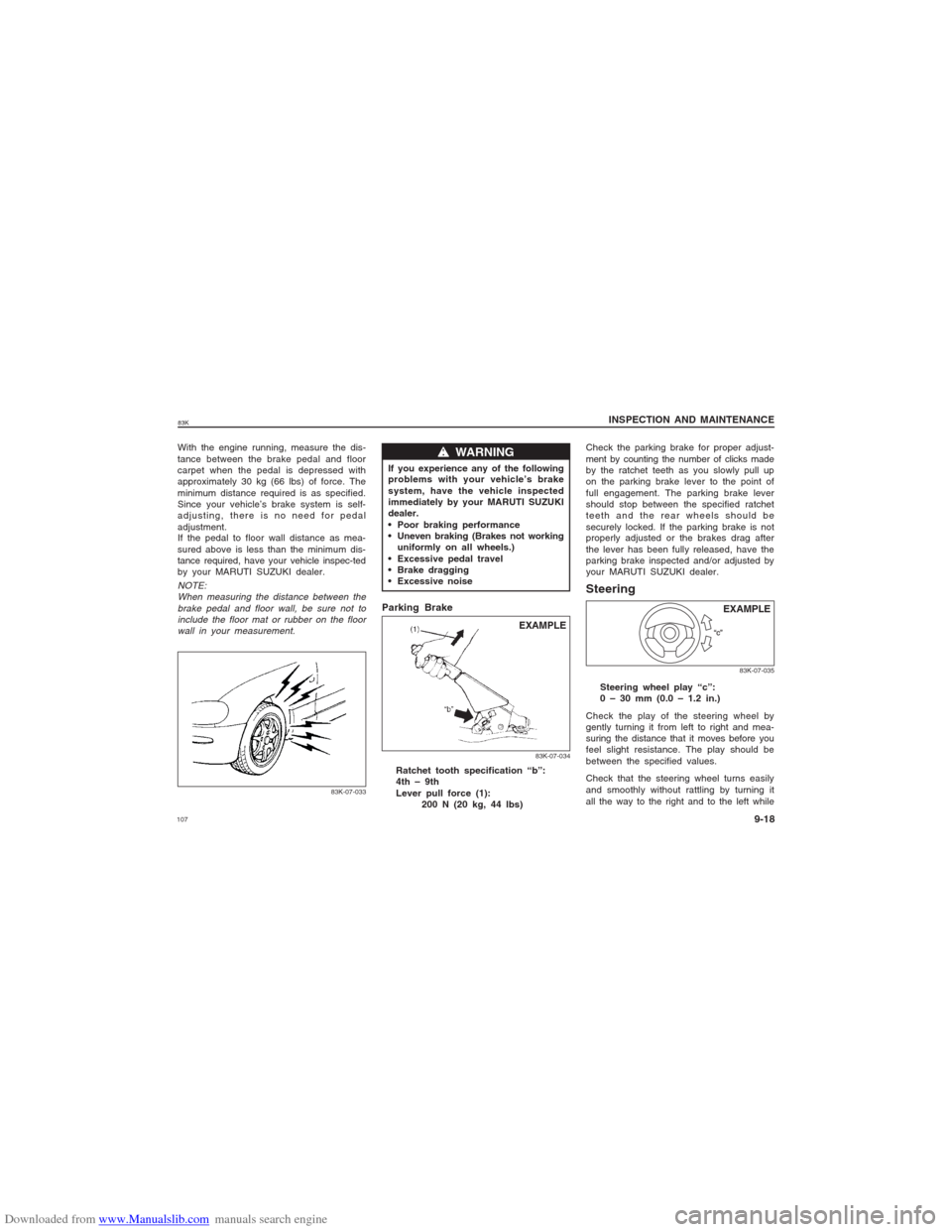
Parking Brake
Ratchet tooth specification “b”:
4th – 9th
Lever pull force (1):
200 N (20 kg, 44 lbs)
w ww w
w WARNING
If you experience any of the following
problems with your vehicle’s brake
system, have the vehicle inspected
immediately by your MARUTI SUZUKI
dealer.
Poor braking performance
Uneven braking (Brakes not working
uniformly on all wheels.)
Excessive pedal travel
Brake dragging
Excessive noise
83K-07-034
EXAMPLE
Check the parking brake for proper adjust-
ment by counting the number of clicks made
by the ratchet teeth as you slowly pull up
on the parking brake lever to the point of
full engagement. The parking brake lever
should stop between the specified ratchet
teeth and the rear wheels should be
securely locked. If the parking brake is not
properly adjusted or the brakes drag after
the lever has been fully released, have the
parking brake inspected and/or adjusted by
your MARUTI SUZUKI dealer.Steering
EXAMPLE
Steering wheel play “c”:
0 – 30 mm (0.0 – 1.2 in.)
Check the play of the steering wheel by
gently turning it from left to right and mea-
suring the distance that it moves before you
feel slight resistance. The play should be
between the specified values.
Check that the steering wheel turns easily
and smoothly without rattling by turning it
all the way to the right and to the left while
83K-07-035
Page 109 of 136
Downloaded from www.Manualslib.com manuals search engine 10983K
INSPECTION AND MAINTENANCE
9-20
ensure proper steering and handling
of the vehicle. Never mix tyres of
different size or type on the four
wheels of your vehicle. The size and
type of tyres used should be only
those approved by MARUTI SUZUKI
as standard or optional equipment
for your vehicle.
Replacing the wheels and tyres
equipped on your vehicle with cer-
tain combinations of aftermarket
wheels and tyres can significantly
change the steering and handling
characteristics of your vehicle.
Therefore, use only those wheel and
tyre combinations which are
approved by MARUTI SUZUKI for
your vehicle.
w ww w
w WARNINGCAUTION
Replacing the original tyres with tyres
of a different size may result in false
speedometer or odometer readings.
Check with your MARUTI SUZUKI
dealer before purchasing replacement
tyres that differ in size from the
original tyres.V VV V
V
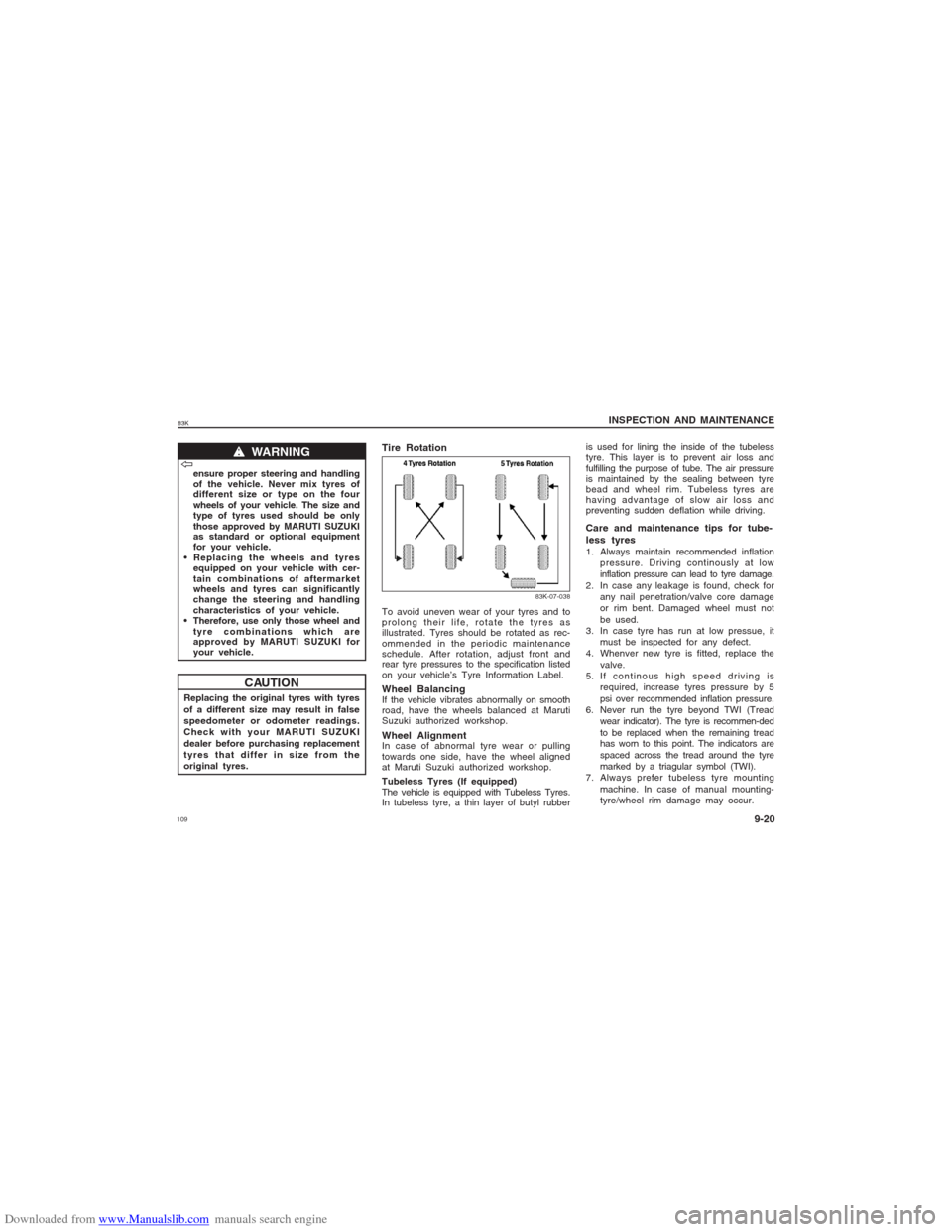
Tire RotationTo avoid uneven wear of your tyres and to
prolong their life, rotate the tyres as
illustrated. Tyres should be rotated as rec-
ommended in the periodic maintenance
schedule. After rotation, adjust front and
rear tyre pressures to the specification listed
on your vehicle’s Tyre Information Label.Wheel BalancingIf the vehicle vibrates abnormally on smooth
road, have the wheels balanced at Maruti
Suzuki authorized workshop.Wheel AlignmentIn case of abnormal tyre wear or pulling
towards one side, have the wheel aligned
at Maruti Suzuki authorized workshop.
Tubeless Tyres (If equipped)
The vehicle is equipped with Tubeless Tyres.
In tubeless tyre, a thin layer of butyl rubber
83K-07-038
is used for lining the inside of the tubeless
tyre. This layer is to prevent air loss and
fulfilling the purpose of tube. The air pressure
is maintained by the sealing between tyre
bead and wheel rim. Tubeless tyres are
having advantage of slow air loss and
preventing sudden deflation while driving.Care and maintenance tips for tube-
less tyres1. Always maintain recommended inflation
pressure. Driving continously at low
inflation pressure can lead to tyre damage.
2. In case any leakage is found, check for
any nail penetration/valve core damage
or rim bent. Damaged wheel must not
be used.
3. In case tyre has run at low pressue, it
must be inspected for any defect.
4. Whenver new tyre is fitted, replace the
valve.
5. If continous high speed driving is
required, increase tyres pressure by 5
psi over recommended inflation pressure.
6. Never run the tyre beyond TWI (Tread
wear indicator). The tyre is recommen-ded
to be replaced when the remaining tread
has worn to this point. The indicators are
spaced across the tread around the tyre
marked by a triagular symbol (TWI).
7. Always prefer tubeless tyre mounting
machine. In case of manual mounting-
tyre/wheel rim damage may occur.
Page 112 of 136
Downloaded from www.Manualslib.com manuals search engine 11283K
INSPECTION AND MAINTENANCE
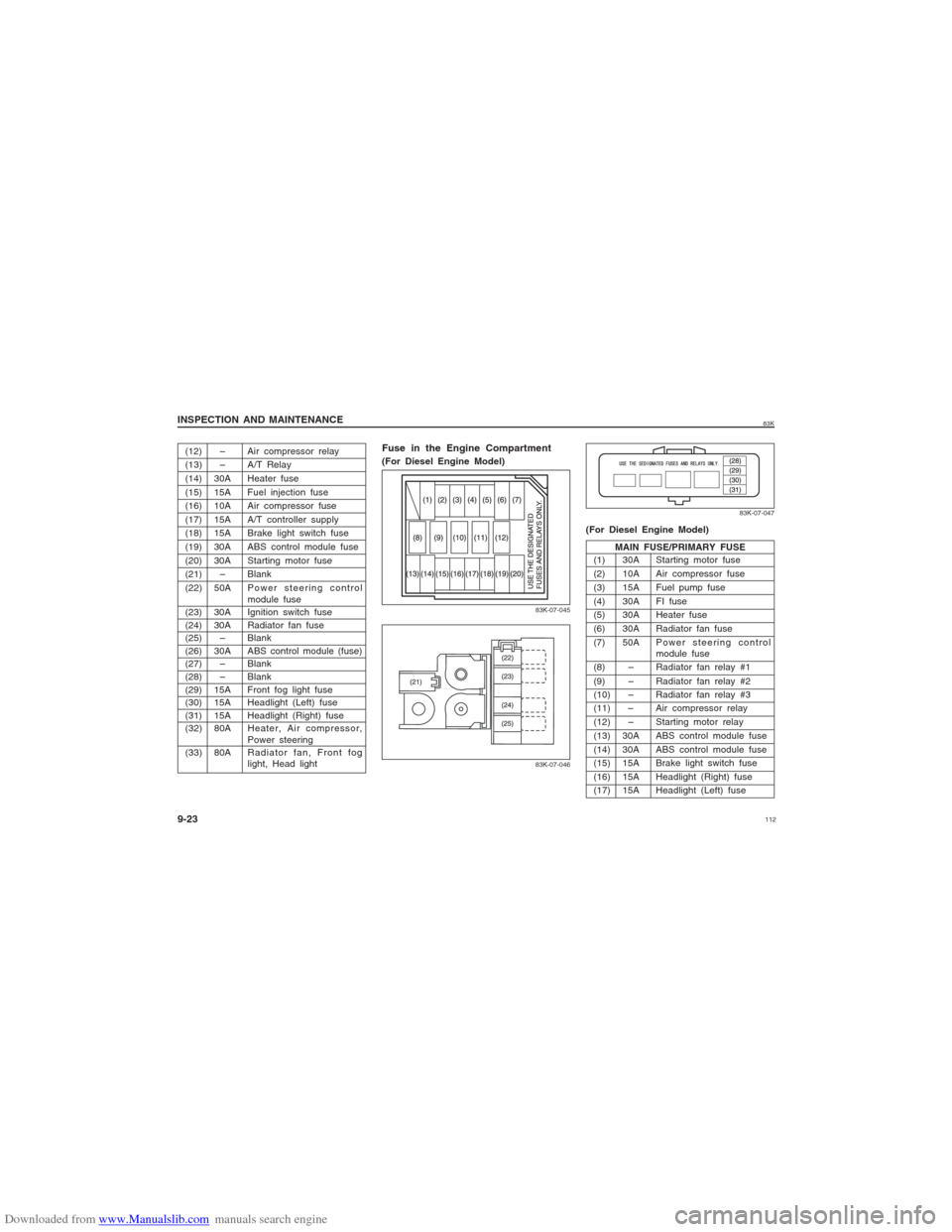
9-23(12) – Air compressor relay
(13) – A/T Relay
(14) 30A Heater fuse
(15) 15A Fuel injection fuse
(16) 10A Air compressor fuse
(17) 15A A/T controller supply
(18) 15A Brake light switch fuse
(19) 30A ABS control module fuse
(20) 30A Starting motor fuse
(21) – Blank
(22) 50A P o w e r steering control
module fuse
(23) 30A Ignition switch fuse
(24) 30A Radiator fan fuse
(25) – Blank
(26) 30AABS control module (fuse)
(27) – Blank
(28) – Blank
(29) 15A Front fog light fuse
(30) 15A Headlight (Left) fuse
(31) 15A Headlight (Right) fuse
(32) 80AHeater, Air compressor,
Power steering
(33) 80ARadiator fan, Front fog
light, Head light
83K-07-046
Fuse in the Engine Compartment(For Diesel Engine Model)
83K-07-045
(For Diesel Engine Model)(1) 30A Starting motor fuse
(2) 10A Air compressor fuse
(3) 15A Fuel pump fuse
(4) 30A FI fuse
(5) 30A Heater fuse
(6) 30A Radiator fan fuse
(7) 50A Power steering control
module fuse
(8) – Radiator fan relay #1
(9) – Radiator fan relay #2
(10) – Radiator fan relay #3
(11) – Air compressor relay
(12) – Starting motor relay
(13) 30A ABS control module fuse
(14) 30A ABS control module fuse
(15) 15A Brake light switch fuse
(16) 15A Headlight (Right) fuse
(17) 15A Headlight (Left) fuseMAIN FUSE/PRIMARY FUSE
83K-07-047