exhaust SUZUKI MARUTI 2005 1.G Owners Manual
[x] Cancel search | Manufacturer: SUZUKI, Model Year: 2005, Model line: MARUTI, Model: SUZUKI MARUTI 2005 1.GPages: 136, PDF Size: 2.93 MB
Page 10 of 136
Downloaded from www.Manualslib.com manuals search engine 1083K
Annexure-A
List of parts covered under Emission Warranty
1. Fuel injection Assembly, Pressure Regulator, Throttle Body Assembly.
2. Electronic Control Module (ECM).
3. Intake Manifold.
4. EGR valve.
5. Distributor and internal parts.
6. Ignitions coil.
7. Canister Assembly.
8. Vapour Liquid Separator.
9. Fuel Tank and Filler Cap.
10. PCV (Positive Crankcase Ventilation) Valve.
11. Oil Filler Cap.
12. Catalytic Convertor.
13. Exhaust manifold.
14. All fuel injection System related SENSORS.
15. High Pressure Fuel Pump.
16. Glow Plug.
17. Glow Plug Controller.
18. ManiverterEMISSION WARRANTY
2-5
Page 16 of 136
Downloaded from www.Manualslib.com manuals search engine 1683K
You can lock and unlock the tailgate by
using the key in the driver’s door lock.
To open the tailgate, pull up and hold the
tailgate unlatch handle (1) and lift the tailgate.
w ww w
w WARNING
Always make sure that the tailgate is
closed and latched securely. Com-
pletely closing the tailgate helps pre-
vent occupants from being thrown
from the vehicle in the event of an
accident. Completely closing it also
helps keep away exhaust gases from
entering the car.BEFORE DRIVING
4-4
83K-02-011
2) Push open the tailgate from inside by
pushing up on the emergency lever (2)
using a flat blade screw driver or the
jack handle. The tailgate will be latched
again by closing the tailgate simply.
If the tailgate can not be unlatched by pull-
ing up the tailgate unlatch switch (1), have
the vehicle inspected by your MARUTI
SUZUKI authorized dealer. If you can not unlatch the tailgate by pulling
up the unlatch handle (1) due to a malfunc-
tion, follow the procedures below to unlatch
the tailgate from inside the vehicle.
1) Fold the rear seat forward for easier
access. Refer to “Folding Rear Seats”
section for details on how to fold the
rear seat forward.
w ww w
w WARNING
To avoid injury, do not use your fin-
ger to push the emergency lever.
Make sure there is no one near the
tailgate when pushing open the tail-
gate from inside the vehicle.
Keyless Entry System Trans-
mitter (if equipped)
83K-02-012
(1) “LOCK” button
(2) “UNLOCK” button
There are two ways to lock or unlock all
doors (including the tailgate) simultaneously
by operating the transmitter near the vehicle.
Central door locking system
To lock all doors, push the “LOCK” but-
ton (1) once.
To unlock all other doors, push the
“UNLOCK” button (2) once.
The turn signal lights will flash once when
the doors are locked.
When the doors are unlocked:
The turn signal lights will flash twice.
If the interior light switch is in the middle
position, the interior light will turn on for
about 15 seconds and then fade out. If
you insert the key into the ignition switch
during this time, the light will start to
fade out immediately.
Page 55 of 136
Downloaded from www.Manualslib.com manuals search engine 5583KOPERATING YOUR VEHICLE
Exhaust Gas Warning........................................................................................................ 5-1
Daily Inspection Checklist................................................................................................ 5-1
Engine Oil Consumption................................................................................................... 5-2
Ignition Switch .................................................................................................................... 5-2
Parking Brake Lever.......................................................................................................... 5-4
Pedal..................................................................................................................................... 5-4
Starting the Engine............................................................................................................5-5
Using the Transmission.................................................................................................... 5-6
Braking .................................................................................................................................. 5-9
OPERATING YOUR VEHICLE
Page 56 of 136
Downloaded from www.Manualslib.com manuals search engine 5683K
Exhaust Gas Warning
83K-03-001
w ww w
w WARNING
Avoid breathing exhaust gases.
Exhaust gases contain carbon mon-
oxide, a potentially lethal gas that is
colorless and odorless. Since carbon
monoxide is difficult to detect by
itself, be sure to take the following
precautions to help prevent carbon
monoxide from entering your vehicle.
Do not leave the engine running in
garages or other confined areas.
w ww w
w WARNING
Do not park with the engine running
for a long period of time, even in an
open area. If it is necessary to sit
for a short time in a parked vehicle
with the engine running, make sure
the air intake selector is set to
“FRESH AIR” and the fan is at high
speed.
Avoid operating the vehicle with the
tailgate open. If it is necessary to
operate the vehicle with the tailgate
open, make sure all windows are
closed, and the blower is at high
speed with the air intake selector
set to “FRESH AIR”.
To allow proper operation of your
vehicle’s ventilation system, keep
the air inlet grille in front of the
windshield clear of snow, leaves, or
other obstructions at all times.
Keep the exhaust tailpipe area clear
of snow and other material to help
reduce the buildup of exhaust gases
under the vehicle. This is
particularly important when parked
in blizzard conditions.
Have the exhaust system inspected
periodically for damage and leaks.
Any damage or leaks should be
repaired immediately.
Daily Inspection ChecklistBefore Driving1) Make sure that windows, mirrors, lights,
and reflectors are clean and unob-
structed.
2) Visually check the tyres for the following
points:
– the depth of the tread groove
– abnormal wear, cracks and damage
– loose wheel bolts
– existence of foreign material such as
nails, stones, etc.
Refer to “Tyres” in “INSPECTION AND
MAINTENANCE” section for details.
3) Look for fluid and oil leaks.NOTE:
It is normal for water to drip from the air
conditioning system after use.
83K-03-002
OPERATING YOUR VEHICLE
5-1
V VV V
V
V VV V
V
Page 67 of 136
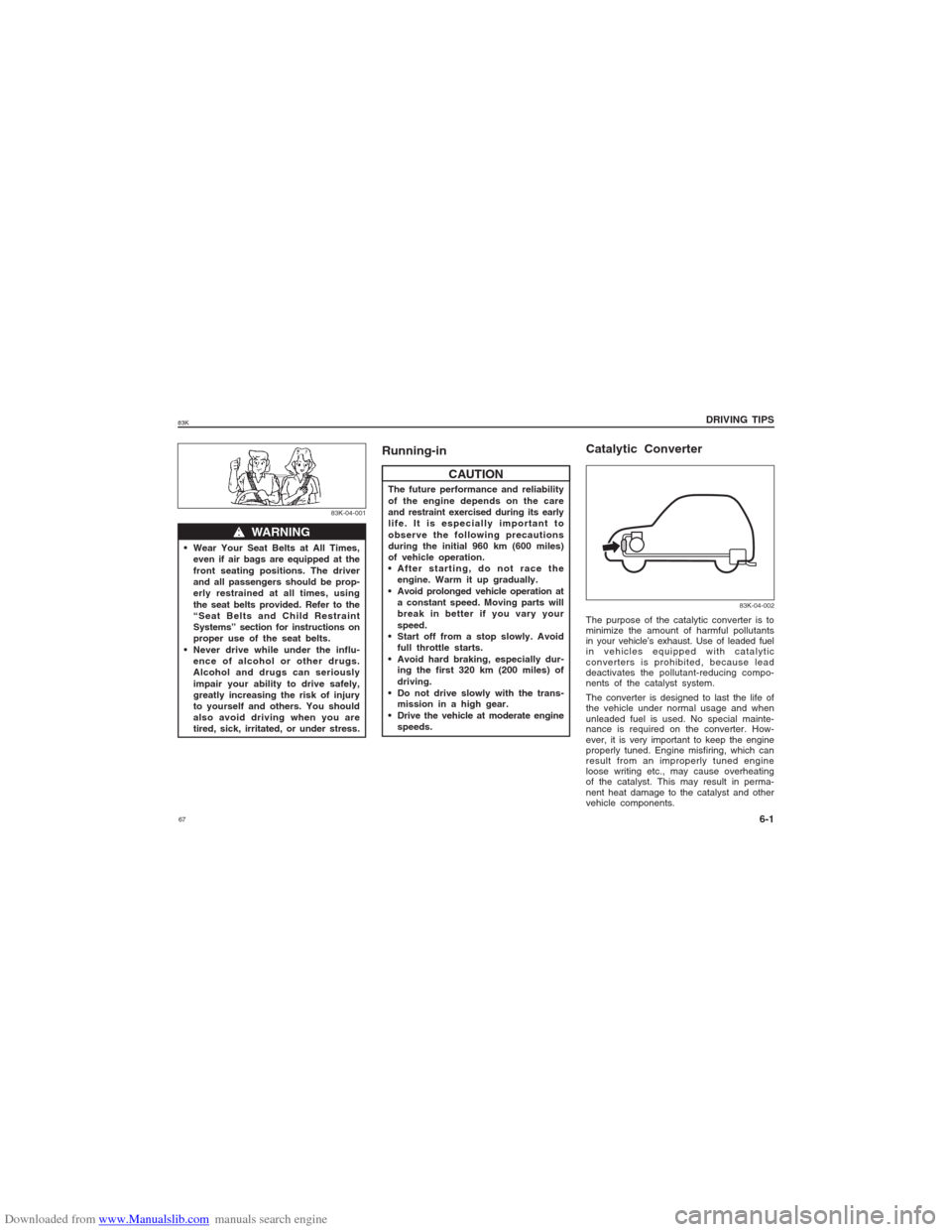
Downloaded from www.Manualslib.com manuals search engine 6783K Wear Your Seat Belts at All Times,
even if air bags are equipped at the
front seating positions. The driver
and all passengers should be prop-
erly restrained at all times, using
the seat belts provided. Refer to the
“Seat Belts and Child Restraint
Systems” section for instructions on
proper use of the seat belts.
Never drive while under the influ-
ence of alcohol or other drugs.
Alcohol and drugs can seriously
impair your ability to drive safely,
greatly increasing the risk of injury
to yourself and others. You should
also avoid driving when you are
tired, sick, irritated, or under stress.The future performance and reliability
of the engine depends on the care
and restraint exercised during its early
life. It is especially important to
observe the following precautions
during the initial 960 km (600 miles)
of vehicle operation.
After starting, do not race the
engine. Warm it up gradually.
Avoid prolonged vehicle operation at
a constant speed. Moving parts will
break in better if you vary your
speed.
Start off from a stop slowly. Avoid
full throttle starts.
Avoid hard braking, especially dur-
ing the first 320 km (200 miles) of
driving.
Do not drive slowly with the trans-
mission in a high gear.
Drive the vehicle at moderate engine
speeds.
83K-04-001
w ww w
w WARNING
Running-in
CAUTION
Catalytic ConverterThe purpose of the catalytic converter is to
minimize the amount of harmful pollutants
in your vehicle’s exhaust. Use of leaded fuel
in vehicles equipped with catalytic
converters is prohibited, because lead
deactivates the pollutant-reducing compo-
nents of the catalyst system.
The converter is designed to last the life of
the vehicle under normal usage and when
unleaded fuel is used. No special mainte-
nance is required on the converter. How-
ever, it is very important to keep the engine
properly tuned. Engine misfiring, which can
result from an improperly tuned engine
loose writing etc., may cause overheating
of the catalyst. This may result in perma-
nent heat damage to the catalyst and other
vehicle components.
83K-04-002
DRIVING TIPS
6-1
Page 68 of 136
Downloaded from www.Manualslib.com manuals search engine 6883K
To minimize the possibility of catalyst
or other vehicle damage:
Maintain the engine in the proper
operating condition.
In the event of an engine malfunc-
tion, particularly one involving
engine misfire or other apparent
loss of performance, have the vehi-
cle serviced promptly.
Do not turn off the engine or inter-
rupt the ignition when the transmis-
sion is in gear and the vehicle is in
motion.
Do not try to start the engine by
pushing or towing the vehicle, or
coasting down a hill.
Do not idle the engine with any
spark plug wires disconnected or
removed, such as during diagnostic
testing.
Do not idle the vehicle for pro-
longed periods if idling seems rough
or there are other malfunctions.
Do not allow the fuel tank to get
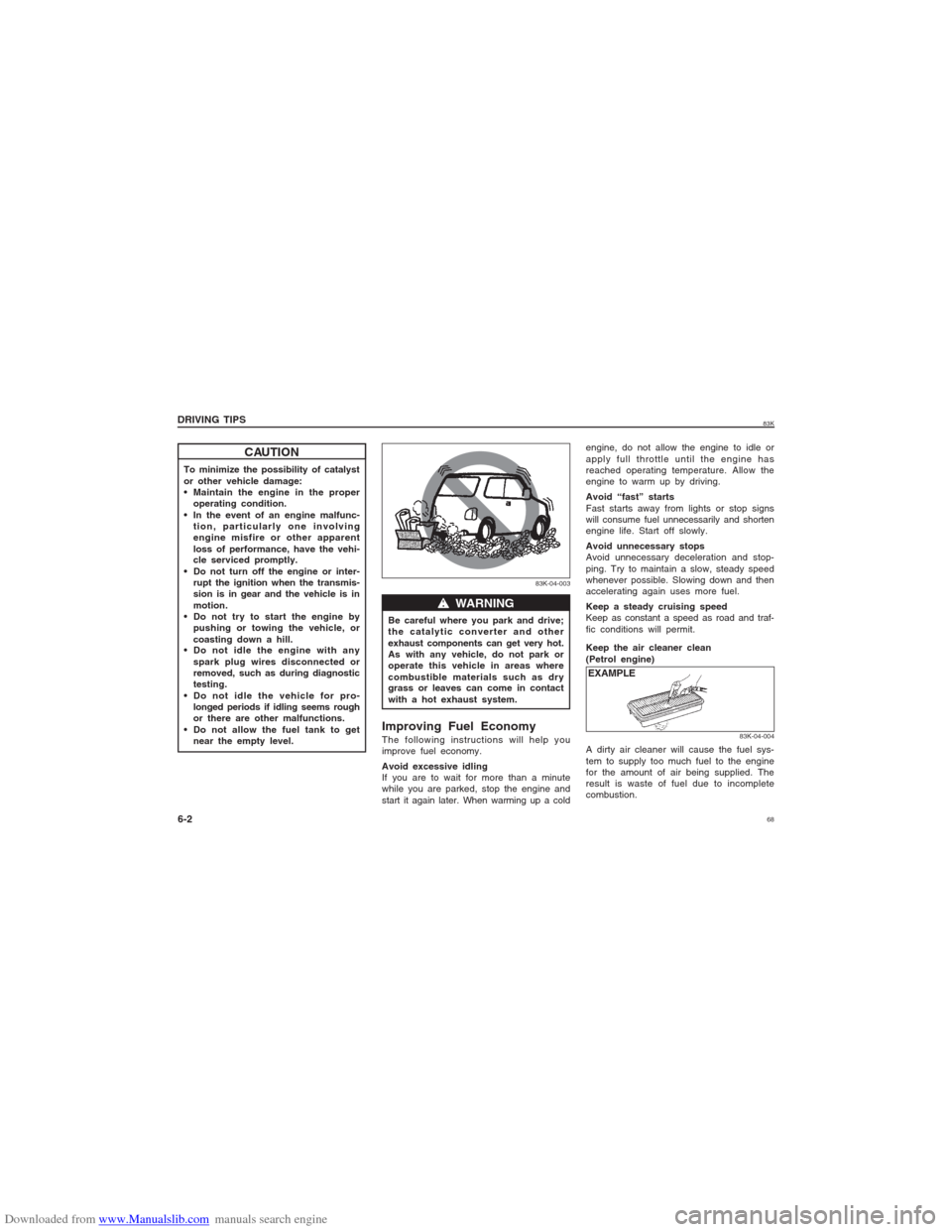
near the empty level.Be careful where you park and drive;
the catalytic converter and other
exhaust components can get very hot.
As with any vehicle, do not park or
operate this vehicle in areas where
combustible materials such as dry
grass or leaves can come in contact
with a hot exhaust system.
w ww w
w WARNING
83K-04-003
engine, do not allow the engine to idle or
apply full throttle until the engine has
reached operating temperature. Allow the
engine to warm up by driving.
Avoid “fast” starts
Fast starts away from lights or stop signs
will consume fuel unnecessarily and shorten
engine life. Start off slowly.
Avoid unnecessary stops
Avoid unnecessary deceleration and stop-
ping. Try to maintain a slow, steady speed
whenever possible. Slowing down and then
accelerating again uses more fuel.
Keep a steady cruising speed
Keep as constant a speed as road and traf-
fic conditions will permit.
DRIVING TIPS
6-2
CAUTION
Improving Fuel EconomyThe following instructions will help you
improve fuel economy.
Avoid excessive idling
If you are to wait for more than a minute
while you are parked, stop the engine and
start it again later. When warming up a coldKeep the air cleaner clean
(Petrol engine)
EXAMPLE
83K-04-004
A dirty air cleaner will cause the fuel sys-
tem to supply too much fuel to the engine
for the amount of air being supplied. The
result is waste of fuel due to incomplete
combustion.
Page 90 of 136
Downloaded from www.Manualslib.com manuals search engine 9083K
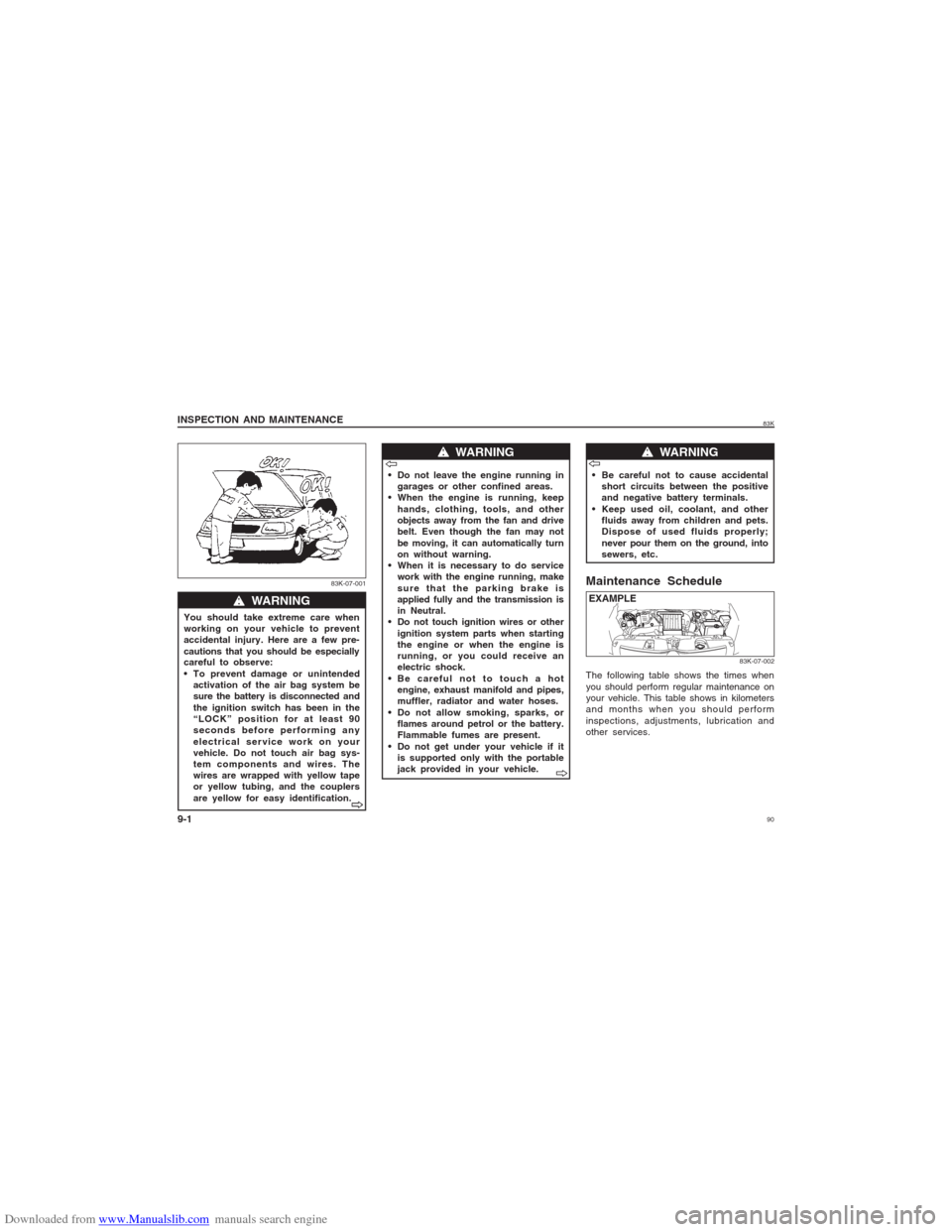
You should take extreme care when
working on your vehicle to prevent
accidental injury. Here are a few pre-
cautions that you should be especially
careful to observe:
To prevent damage or unintended
activation of the air bag system be
sure the battery is disconnected and
the ignition switch has been in the
“LOCK” position for at least 90
seconds before performing any
electrical service work on your
vehicle. Do not touch air bag sys-
tem components and wires. The
wires are wrapped with yellow tape
or yellow tubing, and the couplers
are yellow for easy identification.
w ww w
w WARNING
83K-07-001
w ww w
w WARNING
w ww w
w WARNING
INSPECTION AND MAINTENANCE
9-1
V VV V
V
Do not leave the engine running in
garages or other confined areas.
When the engine is running, keep
hands, clothing, tools, and other
objects away from the fan and drive
belt. Even though the fan may not
be moving, it can automatically turn
on without warning.
When it is necessary to do service
work with the engine running, make
sure that the parking brake is
applied fully and the transmission is
in Neutral.
Do not touch ignition wires or other
ignition system parts when starting
the engine or when the engine is
running, or you could receive an
electric shock.
Be careful not to touch a hot
engine, exhaust manifold and pipes,
muffler, radiator and water hoses.
Do not allow smoking, sparks, or
flames around petrol or the battery.
Flammable fumes are present.
Do not get under your vehicle if it
is supported only with the portable
jack provided in your vehicle.V VV V
V
V VV V
V
Be careful not to cause accidental
short circuits between the positive
and negative battery terminals.
Keep used oil, coolant, and other
fluids away from children and pets.
Dispose of used fluids properly;
never pour them on the ground, into
sewers, etc.V VV V
V
83K-07-002
Maintenance ScheduleThe following table shows the times when
you should perform regular maintenance on
your vehicle. This table shows in kilometers
and months when you should perform
inspections, adjustments, lubrication and
other services.EXAMPLE
Page 92 of 136
Downloaded from www.Manualslib.com manuals search engine 9283K
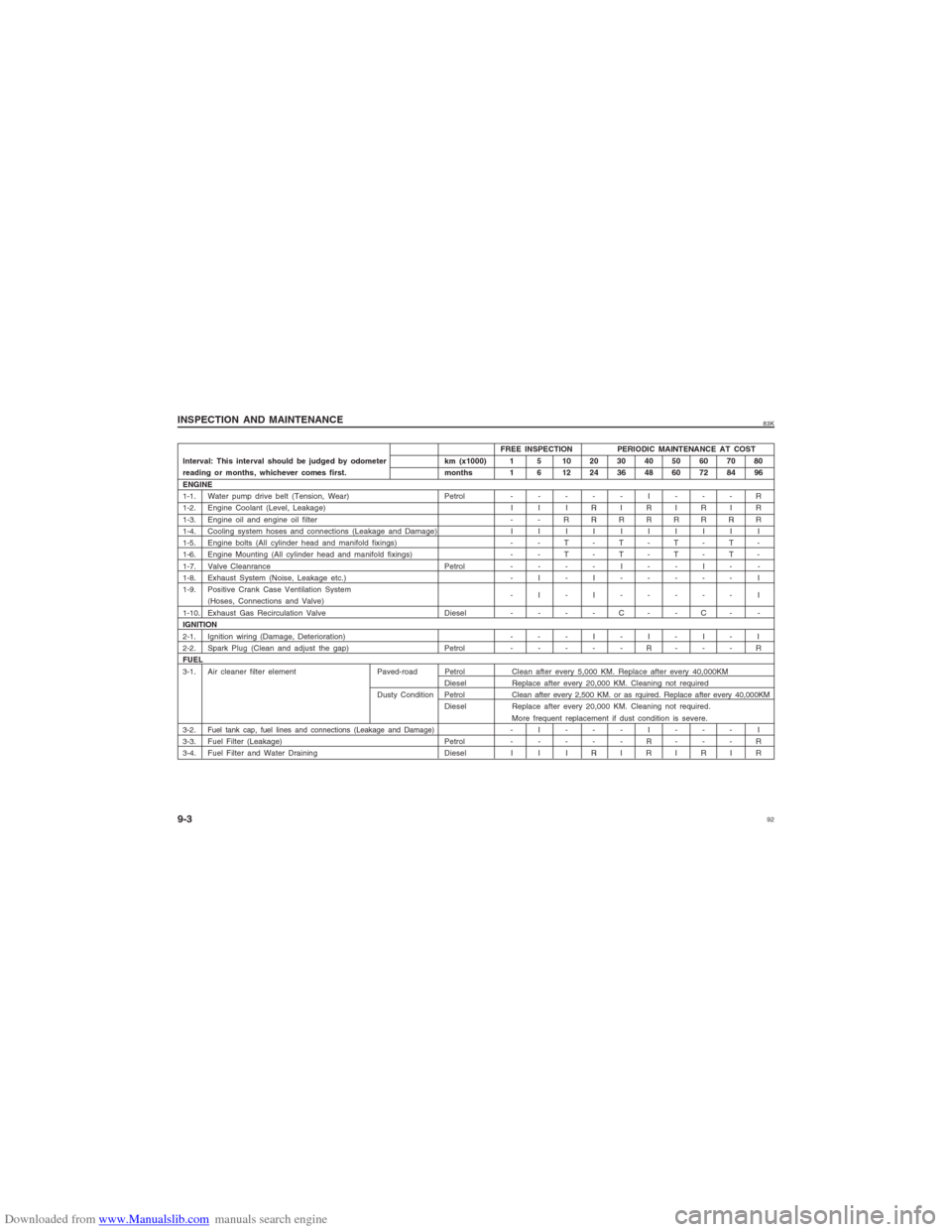
FREE INSPECTION PERIODIC MAINTENANCE AT COST
Interval: This interval should be judged by odometer km (x1000) 1 5 10 20 30 40 50 60 70 80
reading or months, whichever comes first.months 1 6 12 24 36 48 60 72 84 96
ENGINE
1-1. Water pump drive belt (Tension, Wear) Petrol-----I---R
1-2.Engine Coolant (Level, Leakage) I I I R I R I R I R
1-3. Engine oil and engine oil filter - - R RRRRRRR
1-4.Cooling system hoses and connections (Leakage and Damage)IIIIIIIIII
1-5.Engine bolts (All cylinder head and manifold fixings) - - T - T - T - T -
1-6.Engine Mounting (All cylinder head and manifold fixings) - - T - T - T - T -
1-7. Valve Cleanrance Petrol----I--I--
1-8.Exhaust System (Noise, Leakage etc.) - I - I-----I
1-9. Positive Crank Case Ventilation System
(Hoses, Connections and Valve)-I-I-----I
1-10.Exhaust Gas Recirculation Valve Diesel----C--C--
IGNITION
2-1.Ignition wiring (Damage, Deterioration) - - - I - I - I - I
2-2. Spark Plug (Clean and adjust the gap) Petrol-----R---R
FUEL
3-1. Air cleaner filter element Paved-road Petrol Clean after every 5,000 KM. Replace after every 40,000KM
Diesel Replace after every 20,000 KM. Cleaning not required
Dusty Condition Petrol Clean after every 2,500 KM. or as rquired. Replace after every 40,000KM
Diesel Replace after every 20,000 KM. Cleaning not required.
More frequent replacement if dust condition is severe.
3-2.
Fuel tank cap, fuel lines and connections (Leakage and Damage)
-I---I---I
3-3. Fuel Filter (Leakage) Petrol-----R---R
3-4. Fuel Filter and Water Draining Diesel I I I R I R I R I R
INSPECTION AND MAINTENANCE
9-3
Page 128 of 136
Downloaded from www.Manualslib.com manuals search engine 12883K
Certain cargos such as chemicals, fertiliz-
ers, cleaners, salts, etc. are extremely cor-
rosive by nature. These products should be
transported in sealed containers. If a spill
or leak does occur, clean and dry the area
immediately.APPEARANCE CAREStore your vehicle in a dry, well-venti-
lated area
Do not park your vehicle in a damp, poorly
ventilated area. If you often wash your
vehicle in the garage or if you frequently
drive it in when wet, your garage may be
damp. The high humidity in the garage may
cause or accelerate corrosion. A wet vehicle
may corrode even in a heated garage if the
ventilation is poor.
w ww w
w WARNING
Do not apply additional undercoating
or rust preventive coating on or
around exhaust system components
such as the catalytic converter,
exhaust pipes, etc. A fire could be
started if the undercoating substance
becomes overheated.
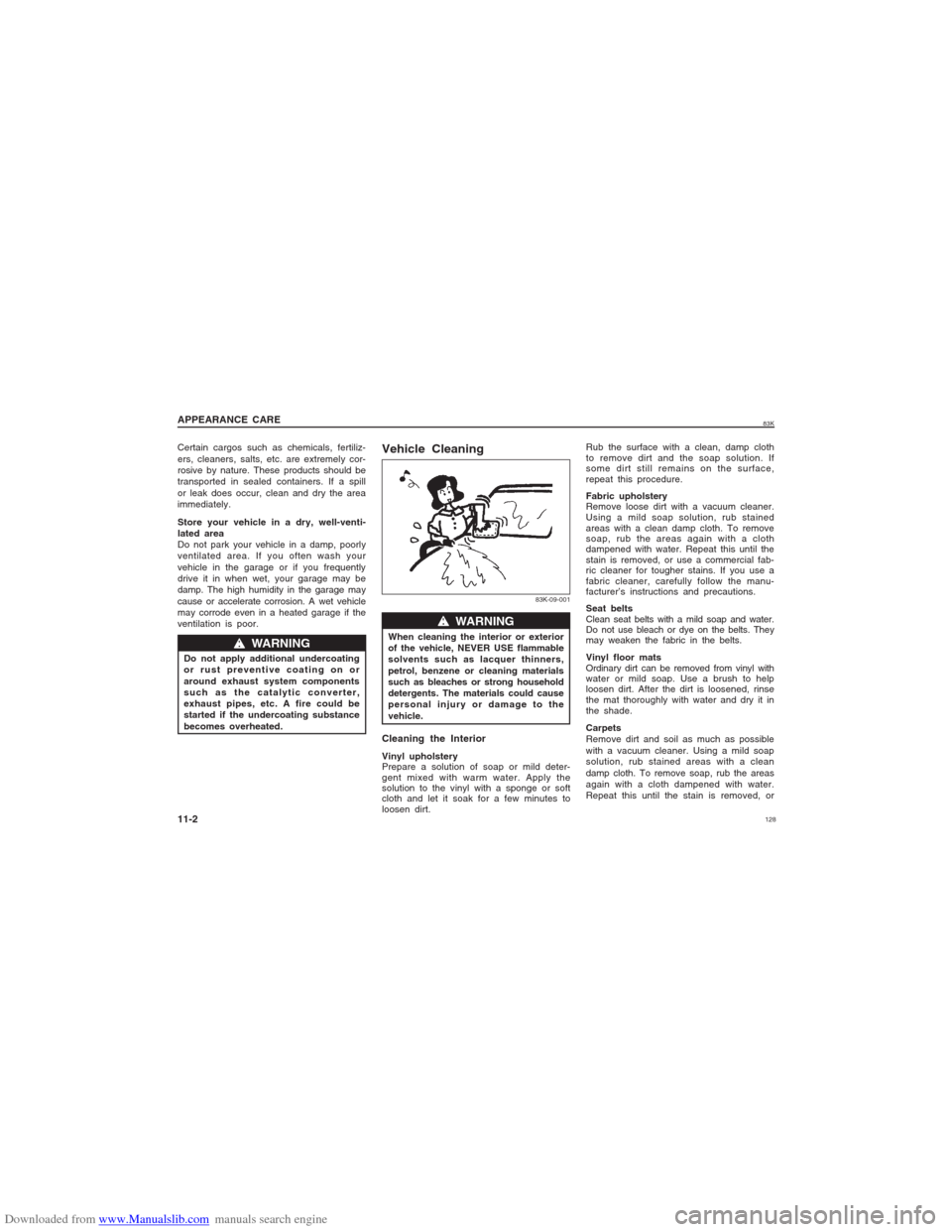
Vehicle Cleaning
83K-09-001
When cleaning the interior or exterior
of the vehicle, NEVER USE flammable
solvents such as lacquer thinners,
petrol, benzene or cleaning materials
such as bleaches or strong household
detergents. The materials could cause
personal injury or damage to the
vehicle.
w ww w
w WARNING
Cleaning the InteriorVinyl upholstery
Prepare a solution of soap or mild deter-
gent mixed with warm water. Apply the
solution to the vinyl with a sponge or soft
cloth and let it soak for a few minutes to
loosen dirt.Rub the surface with a clean, damp cloth
to remove dirt and the soap solution. If
some dirt still remains on the surface,
repeat this procedure.
Fabric upholstery
Remove loose dirt with a vacuum cleaner.
Using a mild soap solution, rub stained
areas with a clean damp cloth. To remove
soap, rub the areas again with a cloth
dampened with water. Repeat this until the
stain is removed, or use a commercial fab-
ric cleaner for tougher stains. If you use a
fabric cleaner, carefully follow the manu-
facturer’s instructions and precautions.
Seat belts
Clean seat belts with a mild soap and water.
Do not use bleach or dye on the belts. They
may weaken the fabric in the belts.
Vinyl floor mats
Ordinary dirt can be removed from vinyl with
water or mild soap. Use a brush to help
loosen dirt. After the dirt is loosened, rinse
the mat thoroughly with water and dry it in
the shade.
Carpets
Remove dirt and soil as much as possible
with a vacuum cleaner. Using a mild soap
solution, rub stained areas with a clean
damp cloth. To remove soap, rub the areas
again with a cloth dampened with water.
Repeat this until the stain is removed, or
11-2