heating SUZUKI MARUTI 2005 1.G Owners Manual
[x] Cancel search | Manufacturer: SUZUKI, Model Year: 2005, Model line: MARUTI, Model: SUZUKI MARUTI 2005 1.GPages: 136, PDF Size: 2.93 MB
Page 11 of 136
Downloaded from www.Manualslib.com manuals search engine 1183KFUEL RECOMMENDATION
FUEL RECOMMENDATION
Petrol Engine
You must use unleaded petrol with an
octane number (RON) of 91 or higher.
Diesel Engine
The diesel fuel should be with cetane num-
ber (CN) higher than 51 and sulphur con-
tent less than 350 ppm (parts per million).
Do not use marine diesel fuel, heating oils
and so forth.
Petrol/Ethanol blends
Blends of unleaded petrol and ethanol (grain
alcohol), also known as gasohol, are
commercially available in some areas.
Blends of this type may be used in your
vehicle if they are no more than 10% etha-
nol. Make sure this petrol-ethanol blend has
octane ratings no lower than those
recommended for petrol.
Petrol/Methanol blends
Blends of unleaded petrol and methanol
(wood alcohol) are also commercially avail-
able in some areas. DO NOT USE fuels
containing more than 5% methanol under any
circumstances. Fuel system damage or
vehicle performance problems resulting from
the use of such fuels are not the
responsibility of MARUTI SUZUKI and may
not be covered under the New Vehicle
Warranty.Fuels containing 5% or less methanol may
be suitable for use in your vehicle if they
contain cosolvents and corrosion inhibitors.
NOTE:
If you are not satisfied with the driveability
or fuel economy of your vehicle when you
are using a petrol/alcohol blend, you should
switch back to unleaded petrol containing no
alcohol.The fuel tank has an air space to
allow for fuel expansion in hot
weather. If you continue to add fuel
after the filler nozzle has automatically
shut off or an initial blowback occurs,
the air chamber will become full.
Exposure to heat when fully fuelled in
this manner will result in leakage due
to fuel expansion. To prevent such
fuel leakage, stop filling after the filler
nozzle has automatically shut off, or
when using an alternative non
automatic system, initial vent
blowback occurs.
CAUTION
CAUTION
Be careful not to spill fuel containing
alcohol while refueling. If fuel is
spilled on the vehicle body, wipe it up
immediately. Fuels containing alcohol
can cause paint damage, which is not
covered under the New Vehicle
Limited Warranty.
3-1
Page 44 of 136
Downloaded from www.Manualslib.com manuals search engine 4483K
BEFORE DRIVING
4-32
CAUTION
Continuing to drive the vehicle when
engine overheating is indicated can
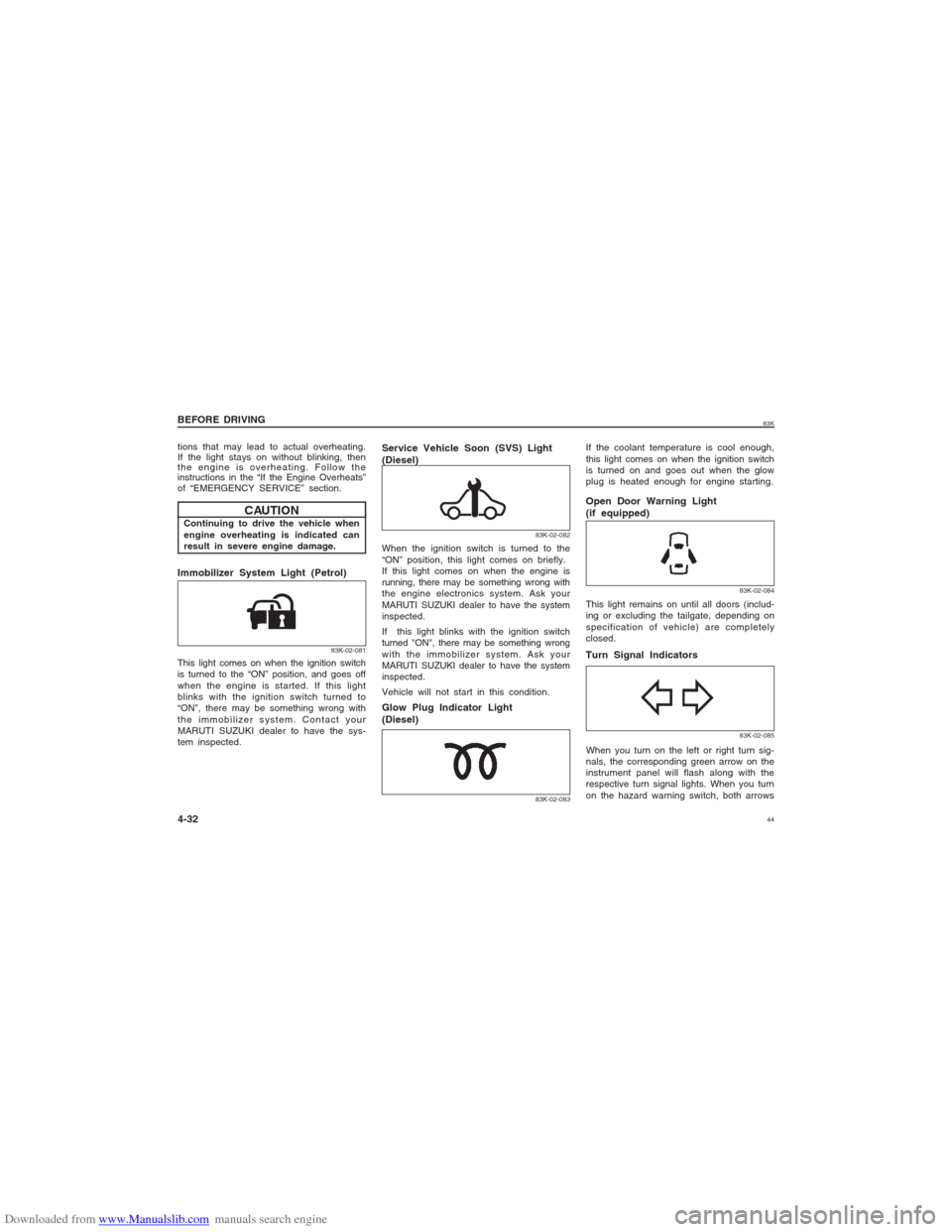
result in severe engine damage.Immobilizer System Light (Petrol)
83K-02-081
tions that may lead to actual overheating.
If the light stays on without blinking, then
the engine is overheating. Follow the
instructions in the “If the Engine Overheats”
of “EMERGENCY SERVICE” section.
83K-02-082
This light comes on when the ignition switch
is turned to the “ON” position, and goes off
when the engine is started. If this light
blinks with the ignition switch turned to
“ON”, there may be something wrong with
the immobilizer system. Contact your
MARUTI SUZUKI dealer to have the sys-
tem inspected.
Service Vehicle Soon (SVS) Light
(Diesel)When the ignition switch is turned to the
“ON” position, this light comes on briefly.
If this light comes on when the engine is
running, there may be something wrong with
the engine electronics system. Ask your
MARUTI SUZUKI dealer to have the system
inspected.
If this light blinks with the ignition switch
turned "ON", there may be something wrong
with the immobilizer system. Ask your
MARUTI SUZUKI dealer to have the system
inspected.
Vehicle will not start in this condition.Glow Plug Indicator Light
(Diesel)
83K-02-083
Open Door Warning Light
(if equipped)
83K-02-084
Turn Signal Indicators
83K-02-085
This light remains on until all doors (includ-
ing or excluding the tailgate, depending on
specification of vehicle) are completely
closed.When you turn on the left or right turn sig-
nals, the corresponding green arrow on the
instrument panel will flash along with the
respective turn signal lights. When you turn
on the hazard warning switch, both arrows If the coolant temperature is cool enough,
this light comes on when the ignition switch
is turned on and goes out when the glow
plug is heated enough for engine starting.
Page 59 of 136
Downloaded from www.Manualslib.com manuals search engine 5983K
OPERATING YOUR VEHICLE
5-4
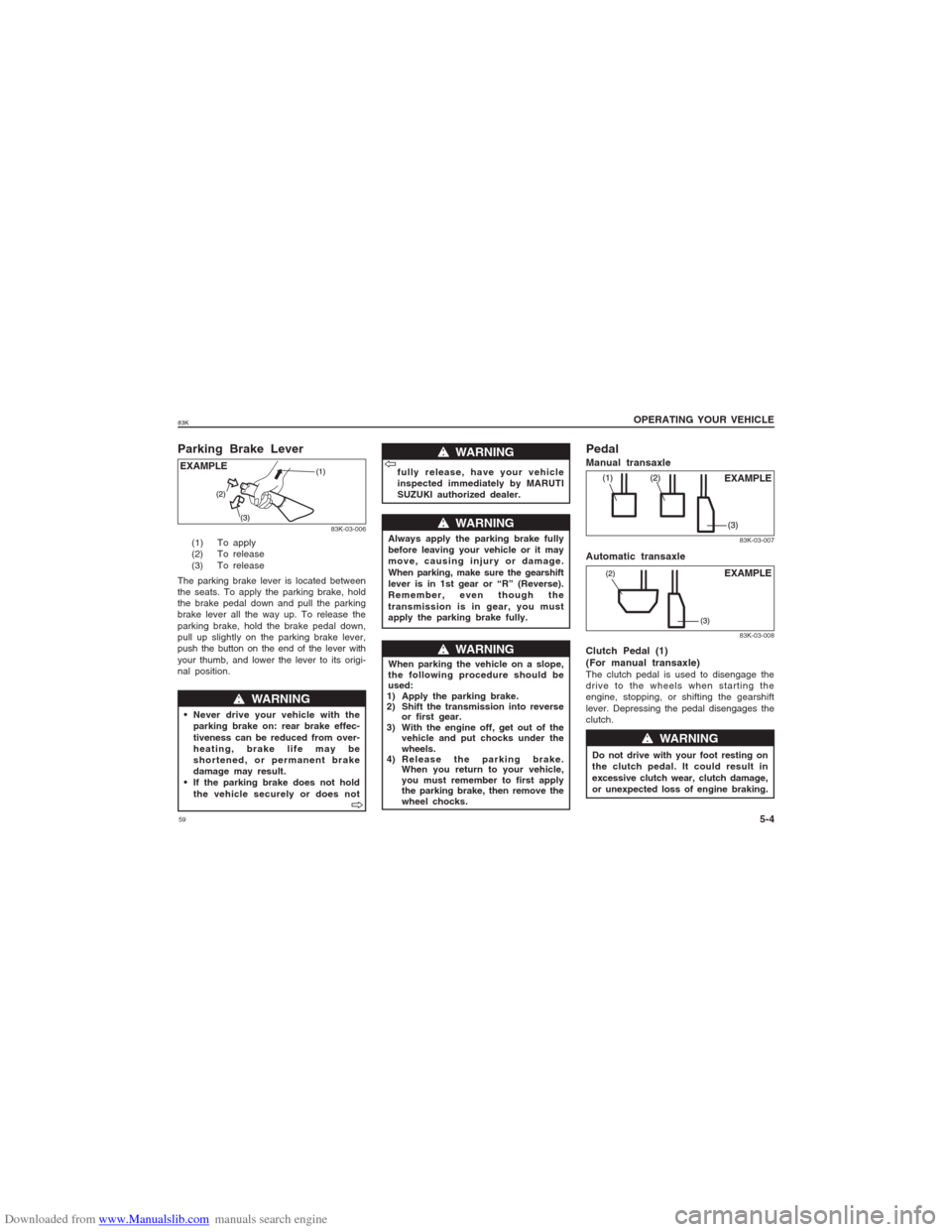
Parking Brake Lever
83K-03-006
w ww w
w WARNING
Never drive your vehicle with the
parking brake on: rear brake effec-
tiveness can be reduced from over-
heating, brake life may be
shortened, or permanent brake
damage may result.
If the parking brake does not hold
the vehicle securely or does not (1) To apply
(2) To release
(3) To release
The parking brake lever is located between
the seats. To apply the parking brake, hold
the brake pedal down and pull the parking
brake lever all the way up. To release the
parking brake, hold the brake pedal down,
pull up slightly on the parking brake lever,
push the button on the end of the lever with
your thumb, and lower the lever to its origi-
nal position.
V VV V
V
w ww w
w WARNING
V VV V
V
w ww w
w WARNING
Always apply the parking brake fully
before leaving your vehicle or it may
move, causing injury or damage.
When parking, make sure the gearshift
lever is in 1st gear or “R” (Reverse).
Remember, even though the
transmission is in gear, you must
apply the parking brake fully.fully release, have your vehicle
inspected immediately by MARUTI
SUZUKI authorized dealer.
w ww w
w WARNING
When parking the vehicle on a slope,
the following procedure should be
used:
1) Apply the parking brake.
2) Shift the transmission into reverse
or first gear.
3) With the engine off, get out of the
vehicle and put chocks under the
wheels.
4) Release the parking brake.
When you return to your vehicle,
you must remember to first apply
the parking brake, then remove the
wheel chocks.
EXAMPLE
PedalManual transaxle
83K-03-007
EXAMPLE
Automatic transaxle
83K-03-008
EXAMPLE
Clutch Pedal (1)
(For manual transaxle)The clutch pedal is used to disengage the
drive to the wheels when starting the
engine, stopping, or shifting the gearshift
lever. Depressing the pedal disengages the
clutch.
w ww w
w WARNING
Do not drive with your foot resting on
the clutch pedal. It could result in
excessive clutch wear, clutch damage,
or unexpected loss of engine braking.
Page 60 of 136
Downloaded from www.Manualslib.com manuals search engine 6083K
OPERATING YOUR VEHICLE
5-5 Brake Pedal (2)Your SUZUKI vehicle is equipped with front
disc brakes and rear drum brakes.
Depressing the brake pedal applies both
sets of brakes.
You may hear occasional brake squeal
when you apply the brakes. This is a
normal condition caused by environmental
factors such as cold, wet, snow, etc.
w ww w
w WARNING
If brake squeal is excessive and
occurs each time the brakes are
applied, you should have the brakes
checked by your SUZUKI dealer.
w ww w
w WARNING
Do not “ride” the brakes by applying
them continuously or resting your foot
on the pedal. This will result in
overheating of the brakes which could
cause unpredictable braking action,
longer stopping distances, or
permanent brake damage.Accelerator Pedal (3)This pedal controls the speed of the engine.
Depressing the accelerator pedal increases
power output and speed.
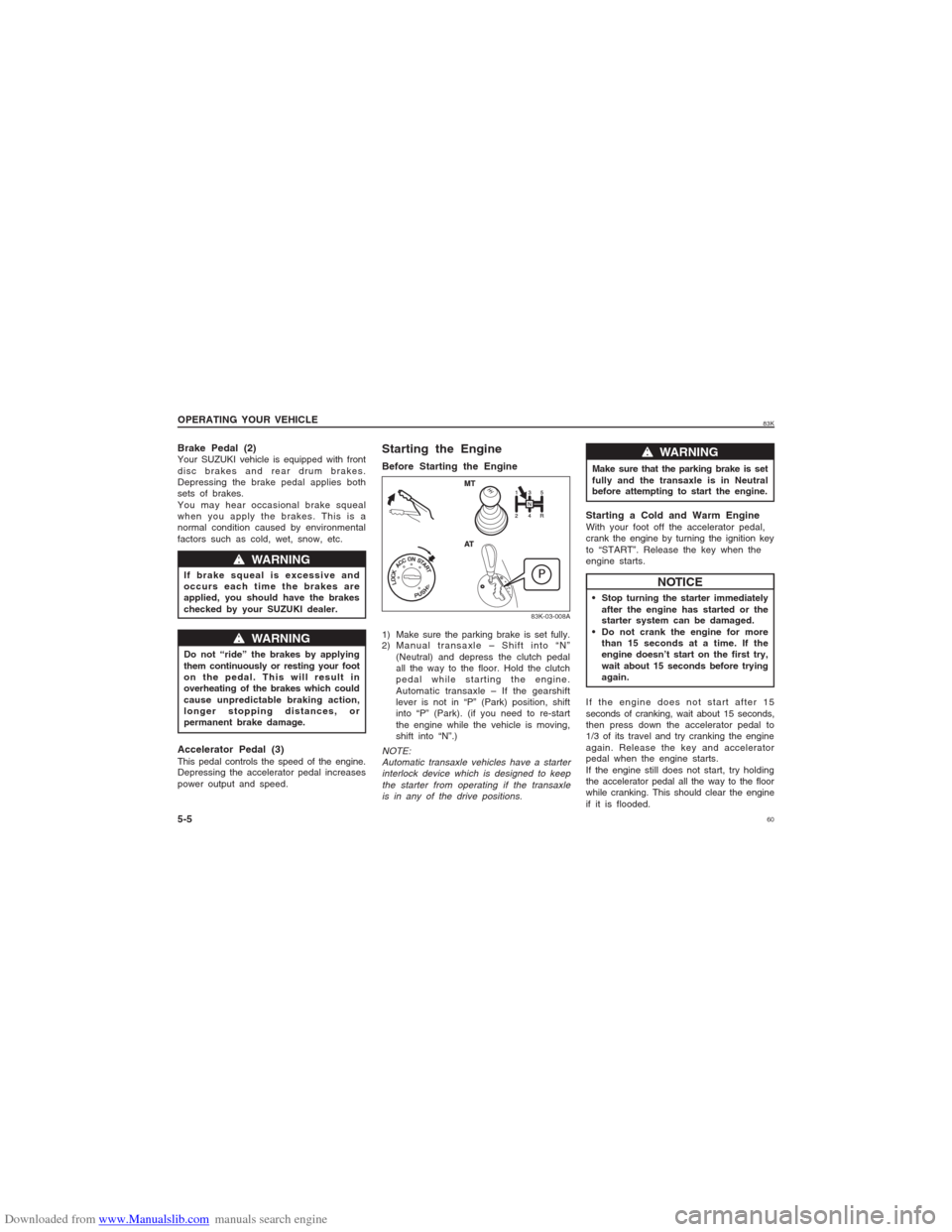
Starting the EngineBefore Starting the Engine
83K-03-008A
1) Make sure the parking brake is set fully.
2) Manual transaxle – Shift into “N”
(Neutral) and depress the clutch pedal
all the way to the floor. Hold the clutch
pedal while starting the engine.
Automatic transaxle – If the gearshift
lever is not in “P” (Park) position, shift
into “P” (Park). (if you need to re-start
the engine while the vehicle is moving,
shift into “N”.)NOTE:
Automatic transaxle vehicles have a starter
interlock device which is designed to keep
the starter from operating if the transaxle
is in any of the drive positions.
Make sure that the parking brake is set
fully and the transaxle is in Neutral
before attempting to start the engine.
w ww w
w WARNING
Starting a Cold and Warm EngineWith your foot off the accelerator pedal,
crank the engine by turning the ignition key
to “START”. Release the key when the
engine starts.
NOTICE
Stop turning the starter immediately
after the engine has started or the
starter system can be damaged.
Do not crank the engine for more
than 15 seconds at a time. If the
engine doesn’t start on the first try,
wait about 15 seconds before trying
again.
If the engine does not start after 15
seconds of cranking, wait about 15 seconds,
then press down the accelerator pedal to
1/3 of its travel and try cranking the engine
again. Release the key and accelerator
pedal when the engine starts.
If the engine still does not start, try holding
the accelerator pedal all the way to the floor
while cranking. This should clear the engine
if it is flooded.
Page 67 of 136
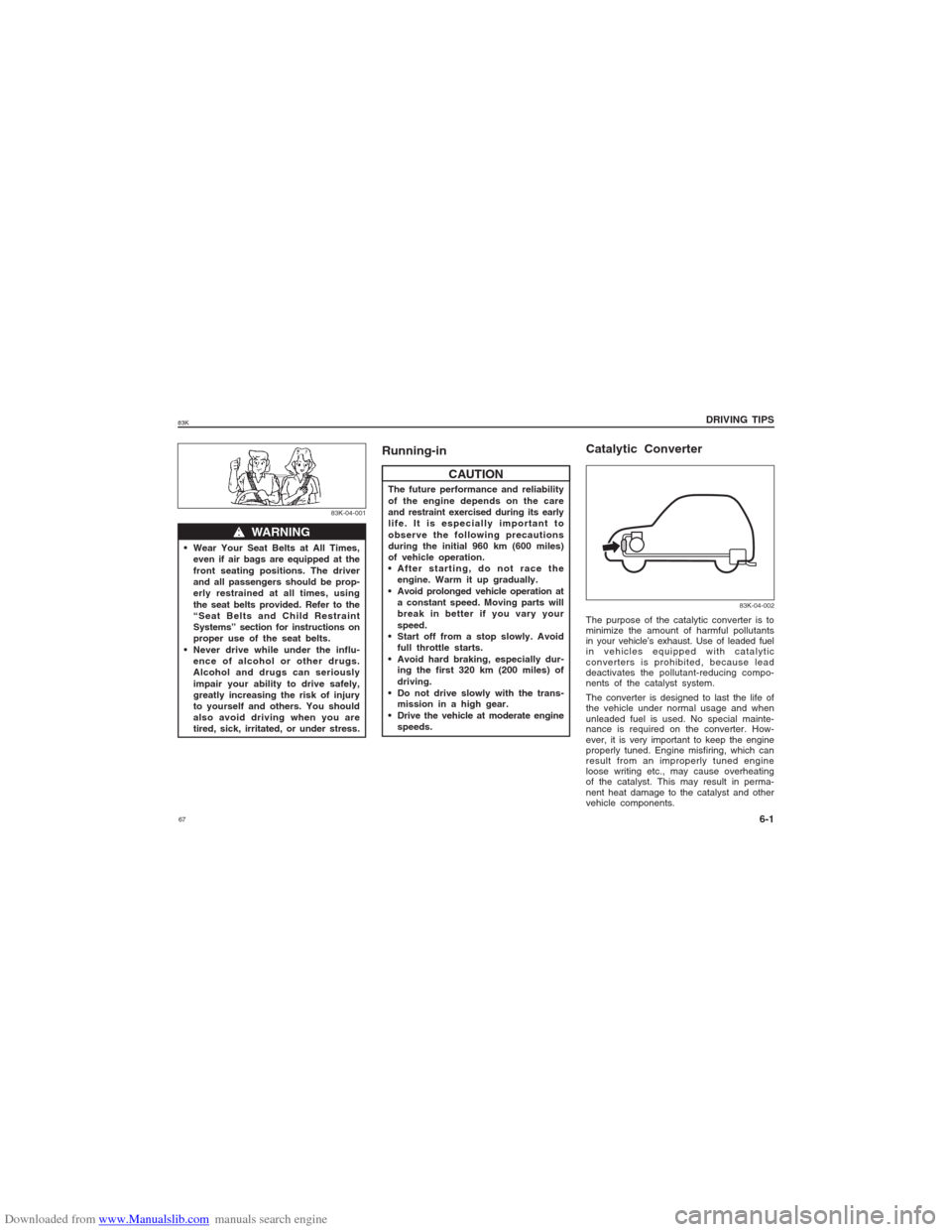
Downloaded from www.Manualslib.com manuals search engine 6783K Wear Your Seat Belts at All Times,
even if air bags are equipped at the
front seating positions. The driver
and all passengers should be prop-
erly restrained at all times, using
the seat belts provided. Refer to the
“Seat Belts and Child Restraint
Systems” section for instructions on
proper use of the seat belts.
Never drive while under the influ-
ence of alcohol or other drugs.
Alcohol and drugs can seriously
impair your ability to drive safely,
greatly increasing the risk of injury
to yourself and others. You should
also avoid driving when you are
tired, sick, irritated, or under stress.The future performance and reliability
of the engine depends on the care
and restraint exercised during its early
life. It is especially important to
observe the following precautions
during the initial 960 km (600 miles)
of vehicle operation.
After starting, do not race the
engine. Warm it up gradually.
Avoid prolonged vehicle operation at
a constant speed. Moving parts will
break in better if you vary your
speed.
Start off from a stop slowly. Avoid
full throttle starts.
Avoid hard braking, especially dur-
ing the first 320 km (200 miles) of
driving.
Do not drive slowly with the trans-
mission in a high gear.
Drive the vehicle at moderate engine
speeds.
83K-04-001
w ww w
w WARNING
Running-in
CAUTION
Catalytic ConverterThe purpose of the catalytic converter is to
minimize the amount of harmful pollutants
in your vehicle’s exhaust. Use of leaded fuel
in vehicles equipped with catalytic
converters is prohibited, because lead
deactivates the pollutant-reducing compo-
nents of the catalyst system.
The converter is designed to last the life of
the vehicle under normal usage and when
unleaded fuel is used. No special mainte-
nance is required on the converter. How-
ever, it is very important to keep the engine
properly tuned. Engine misfiring, which can
result from an improperly tuned engine
loose writing etc., may cause overheating
of the catalyst. This may result in perma-
nent heat damage to the catalyst and other
vehicle components.
83K-04-002
DRIVING TIPS
6-1
Page 70 of 136
Downloaded from www.Manualslib.com manuals search engine 7083K
DRIVING TIPS
6-4
w ww w
w WARNING
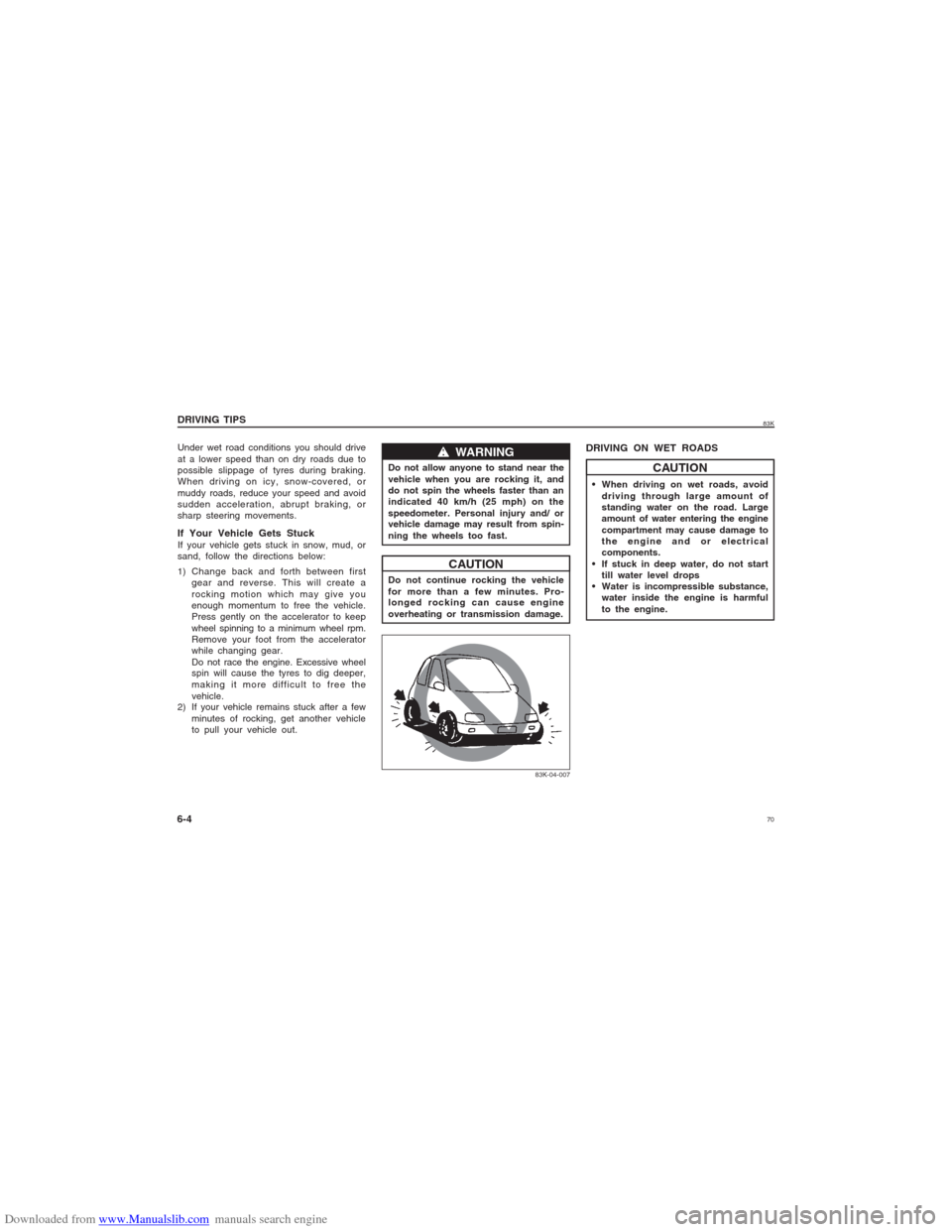
Do not allow anyone to stand near the
vehicle when you are rocking it, and
do not spin the wheels faster than an
indicated 40 km/h (25 mph) on the
speedometer. Personal injury and/ or
vehicle damage may result from spin-
ning the wheels too fast.
CAUTION
83K-04-007
Do not continue rocking the vehicle
for more than a few minutes. Pro-
longed rocking can cause engine
overheating or transmission damage.
Under wet road conditions you should drive
at a lower speed than on dry roads due to
possible slippage of tyres during braking.
When driving on icy, snow-covered, or
muddy roads, reduce your speed and avoid
sudden acceleration, abrupt braking, or
sharp steering movements.If Your Vehicle Gets StuckIf your vehicle gets stuck in snow, mud, or
sand, follow the directions below:
1) Change back and forth between first
gear and reverse. This will create a
rocking motion which may give you
enough momentum to free the vehicle.
Press gently on the accelerator to keep
wheel spinning to a minimum wheel rpm.
Remove your foot from the accelerator
while changing gear.
Do not race the engine. Excessive wheel
spin will cause the tyres to dig deeper,
making it more difficult to free the
vehicle.
2) If your vehicle remains stuck after a few
minutes of rocking, get another vehicle
to pull your vehicle out.
CAUTION
When driving on wet roads, avoid
driving through large amount of
standing water on the road. Large
amount of water entering the engine
compartment may cause damage to
the engine and or electrical
components.
If stuck in deep water, do not start
till water level drops
Water is incompressible substance,
water inside the engine is harmful
to the engine.DRIVING ON WET ROADS
Page 74 of 136
Downloaded from www.Manualslib.com manuals search engine 7483K
OTHER CONTROLS AND EQUIPMENT
Heating and Air Conditioning System........................................................................... 7-1
Manual Heating and Air Conditioning System............................................................. 7-1
Radio Antenna..................................................................................................................... 7-4
Remote Audio Controls (if equipped)............................................................................ 7-4
Fuel Filler Cap.................................................................................................................... 7-5
Engine Bonnet..................................................................................................................... 7-6
Sun Visor............................................................................................................................. 7-6
Interior Light Switch ..........................................................................................................7-7
Accessory Socket (if equipped)...................................................................................... 7-7
Assist Grips (if equipped)................................................................................................ 7-8
Glove Box............................................................................................................................ 7-8
Instrument Panel Upper Tray........................................................................................... 7-8
Cup Holder........................................................................................................................... 7-9
Front Seat Back Pocket (if equipped)........................................................................... 7-9
Underseat Tray (if equipped)........................................................................................... 7-9
Shopping Hook (if equipped).........................................................................................7-10
Luggage Area Cover (if equipped)...............................................................................7-10
Frame Hooks..................................................................................................................... 7-10
OTHER CONTROLS AND EQUIPMENT
Page 75 of 136
Downloaded from www.Manualslib.com manuals search engine 7583KHeating and Air Conditioning
SystemThe type of heating and air conditioning
system is:
Manual Heating and Air Conditioning
SystemAir OutletOTHER CONTROLS AND EQUIPMENT
7-1
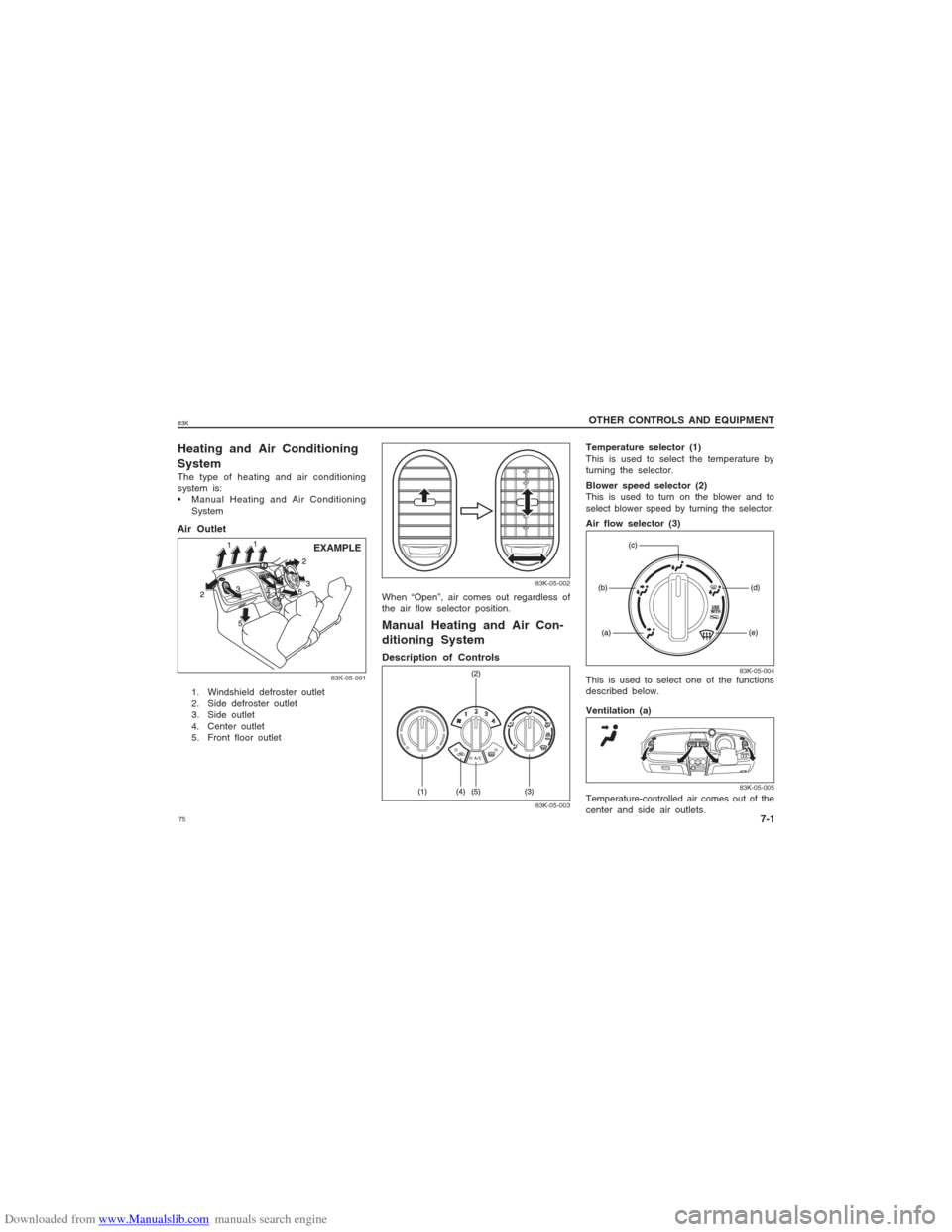
83K-05-001
EXAMPLE
1. Windshield defroster outlet
2. Side defroster outlet
3. Side outlet
4. Center outlet
5. Front floor outlet
83K-05-002
When “Open”, air comes out regardless of
the air flow selector position.Manual Heating and Air Con-
ditioning SystemDescription of Controls
83K-05-003
Temperature selector (1)
This is used to select the temperature by
turning the selector.
Blower speed selector (2)
This is used to turn on the blower and to
select blower speed by turning the selector.
Air flow selector (3)
This is used to select one of the functions
described below.
Ventilation (a)
83K-05-005
Temperature-controlled air comes out of the
center and side air outlets.
83K-05-004
Page 77 of 136
Downloaded from www.Manualslib.com manuals search engine 7783K
OTHER CONTROLS AND EQUIPMENT
7-3
These changes are normal, the system is
designed so that the compressor turns on
or off to maintain the desired temperature.
Less operation of the compressor results in
better fuel economy.System Operating InstructionsNatural ventilation
Select “VENTILATION” and “FRESH AIR”,
the temperature selector to the desired
temperature position, and the blower speed
selector to “OFF”. Fresh air will flow through
the vehicle during driving.
Forced ventilation
The control settings are the same as for
natural ventilation except you set the blower
speed selector to a position other than “OFF”.
Normal heating (using outside air)
Select “HEAT” and “FRESH AIR”, the tem-
perature selector to the desired temperature
position and the blower speed selector to
the desired blower speed position. Setting
the blower speed selector to a higher blower
speed position increases heating efficiency.
Quick heating (using recirculated air)
The control settings are the same as for
normal heating except you select “RECIR-
CULATED AIR”. If you use this heating
method for an extended period of time, the
air in the vehicle can become contaminatedand the windows can become misty.
Therefore, use this method only for quick
heating and change to the normal heating
method as soon as possible.
Cool face / Warm feet
Select “BI-LEVEL” and “FRESH AIR”, the
temperature selector to the desired tem-
perature position, and the blower speed
selector to the desired blower speed posi-
tion. Unless the temperature selector is in
the fully COLD position or fully HOT posi-
tion, the air that comes out of the center
and side outlets will be cooler than the air
that comes out of the floor outlets.
Normal cooling
Turn on the “A/C” switch, set the air flow
selector to “VENTILATION”, the temperature
selector to the desired temperature position
and the blower speed selector to the
desired blower speed position. Setting the
blower speed selector to a higher blower
speed position increases cooling efficiency.
You can switch the air intake selector to
either “FRESH AIR” or “RECIRCULATED
AIR” as you desire. Choosing “RECIRCU-
LATED AIR” increases cooling efficiency.
Quick cooling (using recirculated air)
The control settings are the same as for
normal cooling except you select “RECIR-
CULATED AIR” and the highest blower speed.
NOTE:
If your vehicle has been left in the sun
with the windows closed, it will cool
faster if you open the windows briefly
while you operate the air conditioner with
the air intake selector at “FRESH AIR”
and the blower at high speed.Dehumidifying
Turn on the “A/C” switch, set the air flow
selector to the desired air flow selector
position, and select “FRESH AIR”, the tem-
perature selector to the desired temperature
position, and the blower speed selector to
the desired blower speed position.
83K-05-011
NOTE:
Because the air conditioner dehumidifies the
air, turning it on will help keep the windows
clear, even when blowing heated air using the
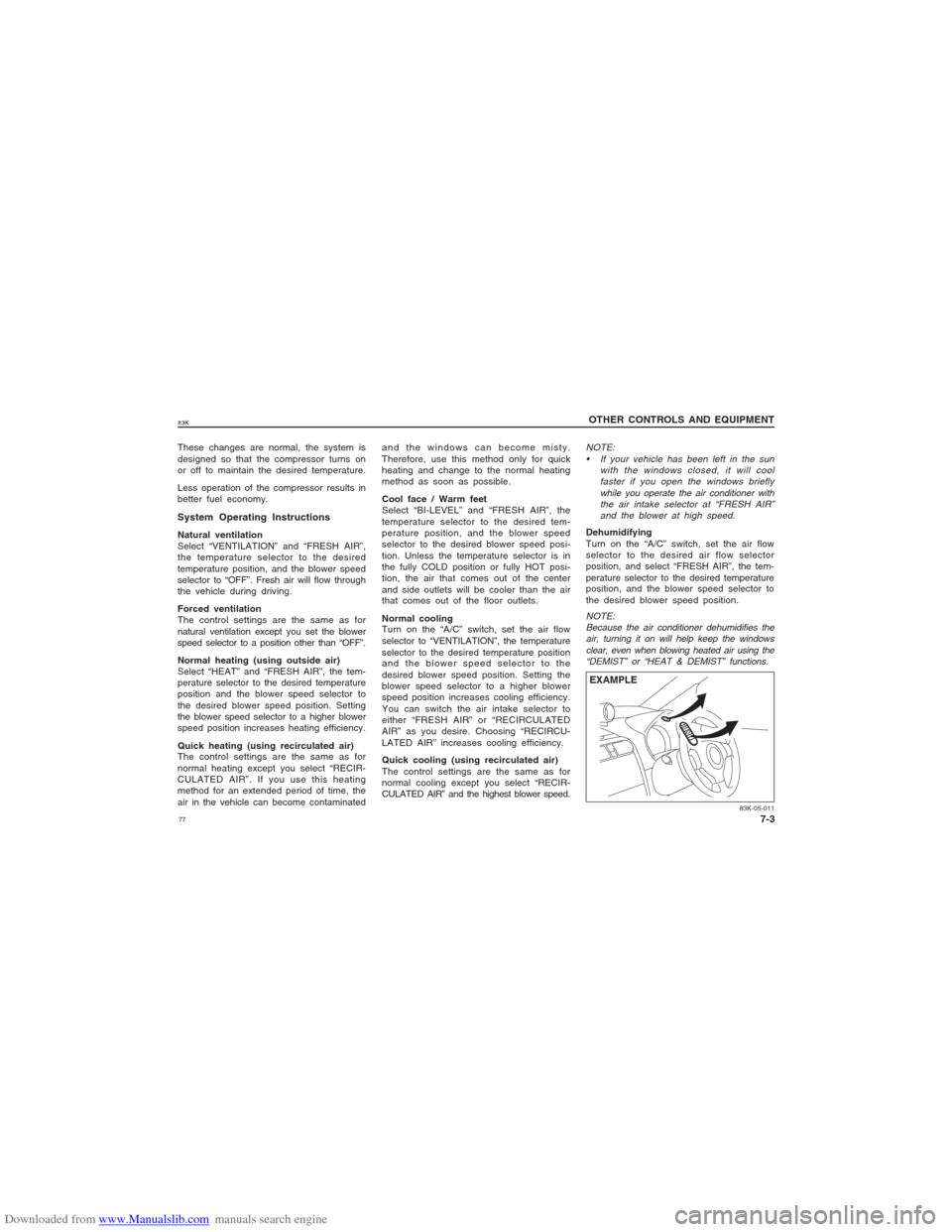
“DEMIST” or “HEAT & DEMIST” functions.EXAMPLE
Page 95 of 136
Downloaded from www.Manualslib.com manuals search engine 9583KDrive Belt
w ww w
w WARNING
When the engine is running, keep
hands, hair, clothing, tools, etc. away
from the moving fan and drive belts.
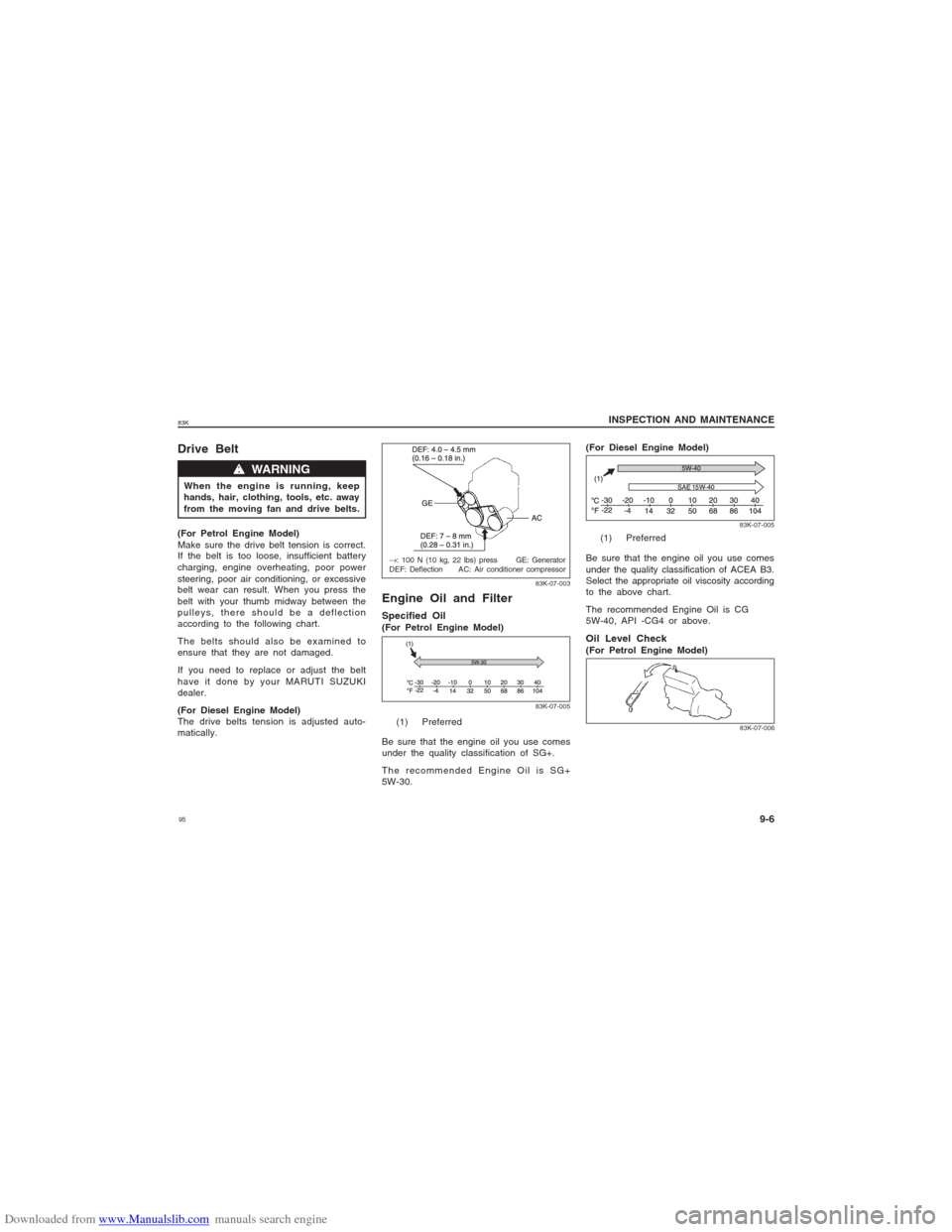
(For Petrol Engine Model)
Make sure the drive belt tension is correct.
If the belt is too loose, insufficient battery
charging, engine overheating, poor power
steering, poor air conditioning, or excessive
belt wear can result. When you press the
belt with your thumb midway between the
pulleys, there should be a deflection
according to the following chart.
The belts should also be examined to
ensure that they are not damaged.
If you need to replace or adjust the belt
have it done by your MARUTI SUZUKI
dealer.
(For Diesel Engine Model)
The drive belts tension is adjusted auto-
matically.
Engine Oil and FilterSpecified Oil(For Petrol Engine Model)
(1) Preferred→: 100 N (10 kg, 22 lbs) press GE: Generator
DEF: Deflection AC: Air conditioner compressor
INSPECTION AND MAINTENANCE
9-6
83K-07-003
(For Diesel Engine Model)
83K-07-005
Be sure that the engine oil you use comes
under the quality classification of ACEA B3.
Select the appropriate oil viscosity according
to the above chart.
The recommended Engine Oil is CG
5W-40, API -CG4 or above.Oil Level Check(For Petrol Engine Model)
83K-07-006
(1) Preferred
83K-07-005
Be sure that the engine oil you use comes
under the quality classification of SG+.
The recommended Engine Oil is SG+
5W-30.