warning SUZUKI RENO 2008 1.G Owners Manual
[x] Cancel search | Manufacturer: SUZUKI, Model Year: 2008, Model line: RENO, Model: SUZUKI RENO 2008 1.GPages: 226, PDF Size: 4.98 MB
Page 159 of 226
5-15SERVICE AND APPEARANCE CARE
85Z14-03E
If the warning continues and you have not
stopped, pull over, stop, and park your
vehicle right away.
If there’s still no sign of steam, you can idle
the engine for three minutes while you’re
parked. If you still have the warning, turn
off the engine and get everyone out of the
vehicle until it cools down.
You may decide not to lift the hood, but to
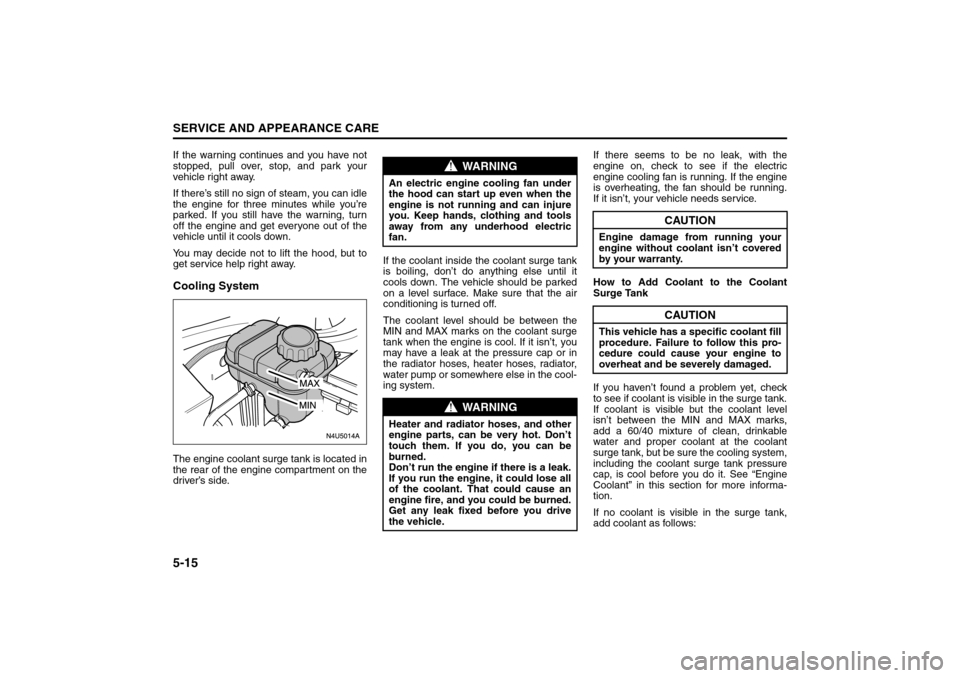
get service help right away.Cooling SystemThe engine coolant surge tank is located in
the rear of the engine compartment on the
driver’s side.If the coolant inside the coolant surge tank
is boiling, don’t do anything else until it
cools down. The vehicle should be parked
on a level surface. Make sure that the air
conditioning is turned off.
The coolant level should be between the
MIN and MAX marks on the coolant surge
tank when the engine is cool. If it isn’t, you
may have a leak at the pressure cap or in
the radiator hoses, heater hoses, radiator,
water pump or somewhere else in the cool-
ing system.If there seems to be no leak, with the
engine on, check to see if the electric
engine cooling fan is running. If the engine
is overheating, the fan should be running.
If it isn’t, your vehicle needs service.
How to Add Coolant to the Coolant
Surge Tank
If you haven’t found a problem yet, check
to see if coolant is visible in the surge tank.
If coolant is visible but the coolant level
isn’t between the MIN and MAX marks,
add a 60/40 mixture of clean, drinkable
water and proper coolant at the coolant
surge tank, but be sure the cooling system,
including the coolant surge tank pressure
cap, is cool before you do it. See “Engine
Coolant” in this section for more informa-
tion.
If no coolant is visible in the surge tank,
add coolant as follows:
WARNING
An electric engine cooling fan under
the hood can start up even when the
engine is not running and can injure
you. Keep hands, clothing and tools
away from any underhood electric
fan.
WARNING
Heater and radiator hoses, and other
engine parts, can be very hot. Don’t
touch them. If you do, you can be
burned.
Don’t run the engine if there is a leak.
If you run the engine, it could lose all
of the coolant. That could cause an
engine fire, and you could be burned.
Get any leak fixed before you drive
the vehicle.
CAUTION
Engine damage from running your
engine without coolant isn’t covered
by your warranty.
CAUTION
This vehicle has a specific coolant fill
procedure. Failure to follow this pro-
cedure could cause your engine to
overheat and be severely damaged.
Checking Things Under the Hood:
Page 160 of 226
5-16
SERVICE AND APPEARANCE CARE
85Z14-03E
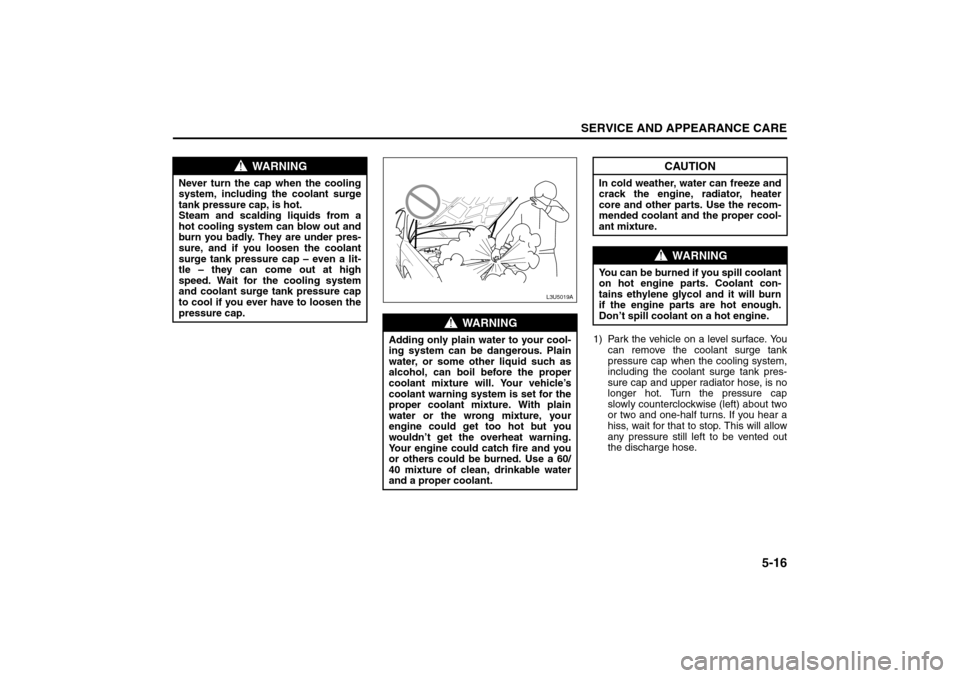
1) Park the vehicle on a level surface. You
can remove the coolant surge tank
pressure cap when the cooling system,
including the coolant surge tank pres-
sure cap and upper radiator hose, is no
longer hot. Turn the pressure cap
slowly counterclockwise (left) about two
or two and one-half turns. If you hear a
hiss, wait for that to stop. This will allow
any pressure still left to be vented out
the discharge hose.
WARNING
Never turn the cap when the cooling
system, including the coolant surge
tank pressure cap, is hot.
Steam and scalding liquids from a
hot cooling system can blow out and
burn you badly. They are under pres-
sure, and if you loosen the coolant
surge tank pressure cap – even a lit-
tle – they can come out at high
speed. Wait for the cooling system
and coolant surge tank pressure cap
to cool if you ever have to loosen the
pressure cap.
WARNING
Adding only plain water to your cool-
ing system can be dangerous. Plain
water, or some other liquid such as
alcohol, can boil before the proper
coolant mixture will. Your vehicle’s
coolant warning system is set for the
proper coolant mixture. With plain
water or the wrong mixture, your
engine could get too hot but you
wouldn’t get the overheat warning.
Your engine could catch fire and you
or others could be burned. Use a 60/
40 mixture of clean, drinkable water
and a proper coolant.
L3U5019A
CAUTION
In cold weather, water can freeze and
crack the engine, radiator, heater
core and other parts. Use the recom-
mended coolant and the proper cool-
ant mixture.
WARNING
You can be burned if you spill coolant
on hot engine parts. Coolant con-
tains ethylene glycol and it will burn
if the engine parts are hot enough.
Don’t spill coolant on a hot engine.
Checking Things Under the Hood:
Page 163 of 226
5-19SERVICE AND APPEARANCE CARE
85Z14-03E
When your brake fluid falls to a low level,
your brake warning light will come on. See
“Brake System Warning Light” in section 3.
What to Add
When you do need brake fluid, use only
DOT-3 brake fluid. Use new brake fluid
from a sealed container only. See “Recom-
mended Fluids and Lubricants” in section
6.
Always clean the brake fluid reservoir cap
and the area around the cap before remov-
ing it. This will help keep dirt from entering
the reservoir.Brake Wear
Your vehicle has front and rear disc brakes.
Disc brake pads have built-in wear indica-
tors that make a high-pitched warning
sound when the brake pads are worn and
new pads are needed. The sound may
come and go or be heard all the time your
vehicle is moving (except when you are
pushing on the brake pedal firmly).Some driving conditions or climates may
cause a brake squeal when the brakes are
first applied or lightly applied. This does
not mean something is wrong with your
brakes.
Properly torqued wheel nuts are necessary
to help prevent brake pulsation. When tires
are rotated, inspect brake pads for wear
and evenly tighten wheel nuts in the proper
sequence to SUZUKI torque specifica-
tions.
Brake linings should always be replaced as
complete axle sets.
See “Brake System Inspection” in section
6.
WARNING
If you have too much brake fluid, it
can spill on the engine. The fluid will
burn if the engine is hot enough. You
or others could be burned, and your
vehicle could be damaged.
WARNING
With the wrong kind of fluid in your
brake system, your brakes may not
work well, or they may not even work
at all. This could cause a crash.
Always use the proper brake fluid.
CAUTION
Using the wrong fluid can badly
damage brake system parts. For
example, just a few drops of min-
eral-based oil, such as engine oil,
in your brake system can damage
brake system parts so badly that
they’ll have to be replaced. Don’t let
someone put in the wrong kind of
fluid.
If you spill brake fluid on your vehi-
cle’s painted surfaces, the paint fin-
ish can be damaged. Be careful not
to spill brake fluid on your vehicle.
If you do, wash it off immediately.
See “Appearance Care” in the
Index.
WARNING
The brake wear warning sound
means that soon your brakes won’t
work well. That could lead to an acci-
dent. When you hear the brake wear
warning sound, have your vehicle
serviced.
CAUTION
Continuing to drive with worn-out
brake pads could result in costly
brake repair.
Checking Things Under the Hood:
Page 164 of 226
5-20
SERVICE AND APPEARANCE CARE
85Z14-03E
Brake Pedal Travel
See your SUZUKI dealer if the brake pedal
does not return to normal height, or if there
is a rapid increase in pedal travel. This
could be a sign of brake trouble.
Brake Adjustment
Every time you make a moderate brake
stop, your disc brakes adjust for wear. If
you rarely make a moderate or heavier
stop, then your brakes might not adjust
correctly. If you drive in that way, then –
very carefully – make a few moderate
brake stops about every 1,000 miles
(1,600 km), so your brakes will adjust prop-
erly.
Replacing Brake System Parts
The braking system on a vehicle is com-
plex. Its many parts have to be of top qual-
ity and work well together if the vehicle is
to have really good braking. When you
replace parts of your braking system – for
example, when your brake linings wear
down and you need new ones put in – be
sure you get new approved SUZUKI
replacement parts. If you don’t, your
brakes may no longer work properly. For
example, if someone puts in brake linings
that are wrong for your vehicle, the balance
between your front and rear brakes can
change – for the worse. The braking per-
formance you’ve come to expect can
change in many other ways if someone
puts in the wrong replacement brake parts.
BatteryYour new vehicle comes with a mainte-
nance free battery. When it’s time for a new
battery, get one that has the replacement
number shown on the original battery’s
label. See “Engine Compartment Over-
view” in this section for battery location.
Vehicle Stor ag e
If you’re not going to drive your vehicle for
25 days or more, remove the black, nega-
tive (–) cable from the battery. This will
help keep your battery from running down.
Contact your SUZUKI dealer to learn how
to prepare your vehicle for longer storage
periods.
Jump StartingIf your battery has run down, you may want
to use another vehicle and some jumper
cables to start your vehicle. Be sure to fol-
low the steps below to do it safely.
1) Check the other vehicle. It must have a
12-volt battery with a negative ground
system.
WARNING
Battery posts, terminals and related
accessories contain lead and lead
compounds, chemicals known to the
State of California to cause cancer
and reproductive harm. Wash hands
after handling.
WARNING
Batteries have acid that can burn you
and gas that can explode. You can be
badly hurt if you aren’t careful. See
the next section, “Jump Starting”, for
tips on working around a battery
without getting hurt.
WARNING
Batteries can hurt you. They can be
dangerous because:
They contain acid that can burn
you.
They contain gas that can explode
or ignite.
They contain enough electricity to
burn you.
If you don’t follow these steps
exactly, some or all of these things
can hurt you.
CAUTION
Ignoring the following steps could
result in costly damage to your vehi-
cle that wouldn’t be covered by your
warranty.
Trying to start your vehicle by push-
ing or pulling it won’t work, and it
could damage your vehicle.
Checking Things Under the Hood:
Page 165 of 226
5-21SERVICE AND APPEARANCE CARE
85Z14-03E
2) Get the vehicles close enough so the
jumper cables can reach, but be sure
the vehicles aren’t touching each other.
If they are, it could cause a ground con-
nection you don’t want. You wouldn’t be
able to start your vehicle, and the bad
grounding could damage the electrical
systems.
To avoid the possibility of the vehicles
rolling, set the parking brake firmly on
both vehicles involved in the jump start
procedure. Put an automatic transmis-
sion in PARK (P) or a manual transmis-
sion in NEUTRAL before setting the
parking brake.3) Turn off the ignition on both vehicles.
Unplug unnecessary accessories
plugged into the cigarette lighter or in
the accessory power outlet. Turn off the
radio and all lamps that aren’t needed.
This will avoid sparks and help save
both batteries. And it could save your
radio!
4) Open the hoods and locate the batter-
ies. Find the positive (+) and negative
(–) terminal locations on each vehicle.
Your vehicle’s positive (+) terminal is
located under a red tethered cap on the
battery. The negative (–) terminal is
located under a black tethered cap on
the battery. See “Engine Compartment
Overview” in this section for more infor-
mation on location. Flip the caps up to
access the positive (+) and negative (–)
terminals.
5) Check that the jumper cables don’t
have loose or missing insulation. If they
do, you could get a shock. The vehicles
could be damaged, too.
Before you connect the cables, here are
some basic things you should know.
Positive (+) will go to positive (+) or to a
remote positive (+) terminal if the vehi-
cle has one. Negative (–) will go to a
heavy, unpainted metal engine part or
to a remote negative (–) terminal if the
vehicle with the dead battery has one.
Don’t connect positive (+) to negative
(–) or you’ll get a short that would dam-
CAUTION
If the other system isn’t a 12-volt sys-
tem with a negative ground, both
vehicles can be damaged. Only use
vehicles with 12-volt systems with
negative grounds to jump start your
vehicle.
CAUTION
If you leave your radio or other acces-
sories on during the jump starting
procedure, they could be damaged.
The repairs wouldn’t be covered by
your warranty. Always turn off your
radio and other accessories when
jump starting your vehicle.
WARNING
An electric fan under the hood can
start up and injure you even when the
engine is not running. Keep hands,
clothing and tools away from any
underhood electric fan.
WARNING
Using a match near a battery can
cause battery gas to explode. People
have been hurt doing this, and some
have been blinded. Use a flashlight if
you need more light.
Be sure the battery has enough
water. You don’t need to add water to
the battery installed in your new vehi-
cle. But if a battery has filler caps, be
sure the right amount of fluid is
there. If it is low, add water to take
care of that first. If you don’t, explo-
sive gas could be present.
Battery fluid contains acid that can
burn you. Don’t get it on you. If you
accidentally get it in your eyes or on
your skin, flush the place with water
and get medical help immediately.
Checking Things Under the Hood:
Page 166 of 226
5-22
SERVICE AND APPEARANCE CARE
85Z14-03E
age the battery and maybe other parts,
too. And don’t connect the negative (–)
cable to the negative (–) terminal on the
dead battery because this can cause
sparks.
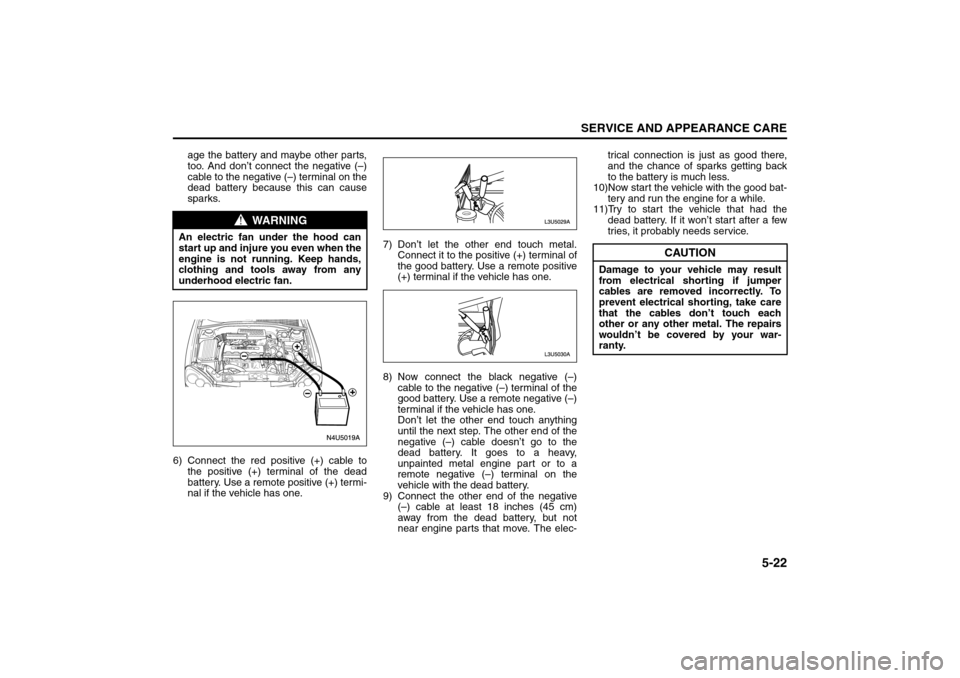
6) Connect the red positive (+) cable to
the positive (+) terminal of the dead
battery. Use a remote positive (+) termi-
nal if the vehicle has one.7) Don’t let the other end touch metal.
Connect it to the positive (+) terminal of
the good battery. Use a remote positive
(+) terminal if the vehicle has one.
8) Now connect the black negative (–)
cable to the negative (–) terminal of the
good battery. Use a remote negative (–)
terminal if the vehicle has one.
Don’t let the other end touch anything
until the next step. The other end of the
negative (–) cable doesn’t go to the
dead battery. It goes to a heavy,
unpainted metal engine part or to a
remote negative (–) terminal on the
vehicle with the dead battery.
9) Connect the other end of the negative
(–) cable at least 18 inches (45 cm)
away from the dead battery, but not
near engine parts that move. The elec-trical connection is just as good there,
and the chance of sparks getting back
to the battery is much less.
10)Now start the vehicle with the good bat-
tery and run the engine for a while.
11)Try to start the vehicle that had the
dead battery. If it won’t start after a few
tries, it probably needs service.
WARNING
An electric fan under the hood can
start up and injure you even when the
engine is not running. Keep hands,
clothing and tools away from any
underhood electric fan.
CAUTION
Damage to your vehicle may result
from electrical shorting if jumper
cables are removed incorrectly. To
prevent electrical shorting, take care
that the cables don’t touch each
other or any other metal. The repairs
wouldn’t be covered by your war-
ranty.
Checking Things Under the Hood:
Page 167 of 226
5-23SERVICE AND APPEARANCE CARE
85Z14-03E
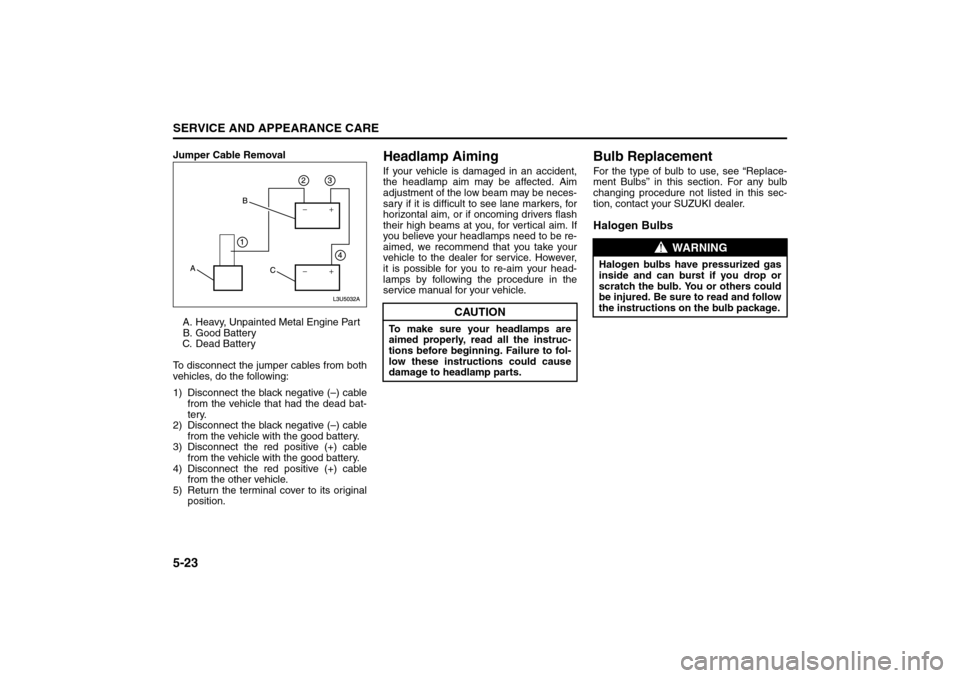
Jumper Cable Removal
A. Heavy, Unpainted Metal Engine Part
B. Good Battery
C. Dead Battery
To disconnect the jumper cables from both
vehicles, do the following:
1) Disconnect the black negative (–) cable
from the vehicle that had the dead bat-
tery.
2) Disconnect the black negative (–) cable
from the vehicle with the good battery.
3) Disconnect the red positive (+) cable
from the vehicle with the good battery.
4) Disconnect the red positive (+) cable
from the other vehicle.
5) Return the terminal cover to its original
position.
Headlamp AimingIf your vehicle is damaged in an accident,
the headlamp aim may be affected. Aim
adjustment of the low beam may be neces-
sary if it is difficult to see lane markers, for
horizontal aim, or if oncoming drivers flash
their high beams at you, for vertical aim. If
you believe your headlamps need to be re-
aimed, we recommend that you take your
vehicle to the dealer for service. However,
it is possible for you to re-aim your head-
lamps by following the procedure in the
service manual for your vehicle.
Bulb ReplacementFor the type of bulb to use, see “Replace-
ment Bulbs” in this section. For any bulb
changing procedure not listed in this sec-
tion, contact your SUZUKI dealer.Halogen Bulbs
CAUTION
To make sure your headlamps are
aimed properly, read all the instruc-
tions before beginning. Failure to fol-
low these instructions could cause
damage to headlamp parts.
WARNING
Halogen bulbs have pressurized gas
inside and can burst if you drop or
scratch the bulb. You or others could
be injured. Be sure to read and follow
the instructions on the bulb package.
Checking Things Under the Hood:
Headlamp Aiming:
Bulb Replacement:
Page 172 of 226
5-28
SERVICE AND APPEARANCE CARE
85Z14-03E
TiresYour new vehicle comes with high-quality
tires made by a leading tire manufacturer.
If you ever have questions about your tire
warranty and where to obtain service, see
your SUZUKI Warranty booklet for details.
For additional information refer to the tire
manufacturer’s booklet included with your
vehicle’s Owner’s Manual.
Tire Sidewall LabelingUseful information about a tire is molded
into its sidewall. The examples below show
a typical passenger car tire and a spare
tire sidewall.
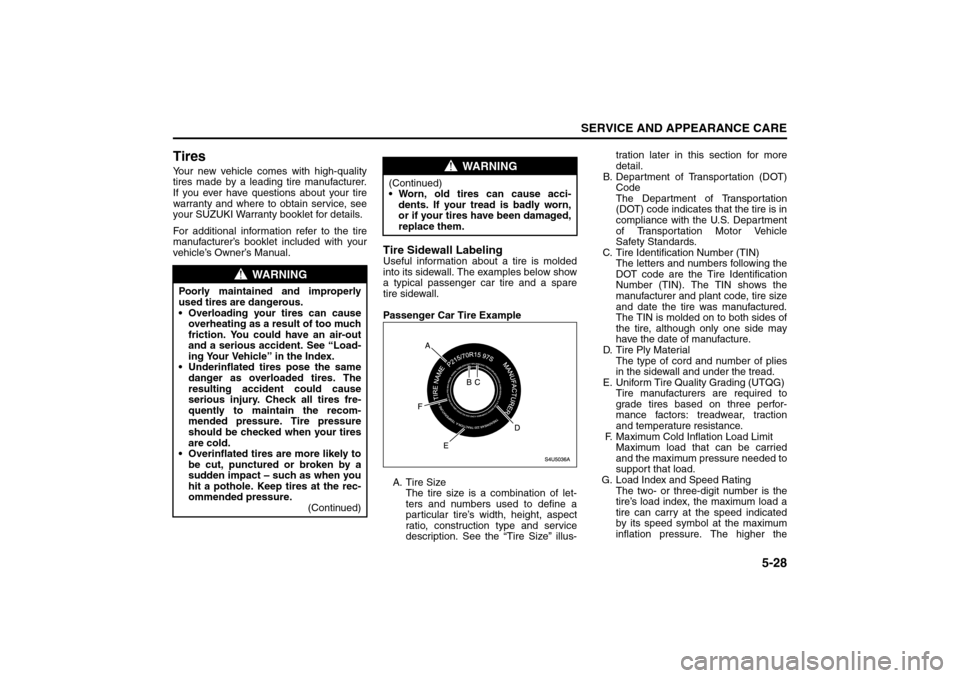
Passenger Car Tire Example
A. Tire Size
The tire size is a combination of let-
ters and numbers used to define a
particular tire’s width, height, aspect
ratio, construction type and service
description. See the “Tire Size” illus-tration later in this section for more
detail.
B. Department of Transportation (DOT)
Code
The Department of Transportation
(DOT) code indicates that the tire is in
compliance with the U.S. Department
of Transportation Motor Vehicle
Safety Standards.
C. Tire Identification Number (TIN)
The letters and numbers following the
DOT code are the Tire Identification
Number (TIN). The TIN shows the
manufacturer and plant code, tire size
and date the tire was manufactured.
The TIN is molded on to both sides of
the tire, although only one side may
have the date of manufacture.
D. Tire Ply Material
The type of cord and number of plies
in the sidewall and under the tread.
E. Uniform Tire Quality Grading (UTQG)
Tire manufacturers are required to
grade tires based on three perfor-
mance factors: treadwear, traction
and temperature resistance.
F. Maximum Cold Inflation Load Limit
Maximum load that can be carried
and the maximum pressure needed to
support that load.
G. Load Index and Speed Rating
The two- or three-digit number is the
tire’s load index, the maximum load a
tire can carry at the speed indicated
by its speed symbol at the maximum
inflation pressure. The higher the
WARNING
Poorly maintained and improperly
used tires are dangerous.
Overloading your tires can cause
overheating as a result of too much
friction. You could have an air-out
and a serious accident. See “Load-
ing Your Vehicle” in the Index.
Underinflated tires pose the same
danger as overloaded tires. The
resulting accident could cause
serious injury. Check all tires fre-
quently to maintain the recom-
mended pressure. Tire pressure
should be checked when your tires
are cold.
Overinflated tires are more likely to
be cut, punctured or broken by a
sudden impact – such as when you
hit a pothole. Keep tires at the rec-
ommended pressure.
(Continued)
WARNING
(Continued)
Worn, old tires can cause acci-
dents. If your tread is badly worn,
or if your tires have been damaged,
replace them.
Tires:
Page 173 of 226
5-29SERVICE AND APPEARANCE CARE
85Z14-03E
number is, the greater the load carry-
ing capacity. The letter symbol
denotes the speed at which a tire is
designed to be driven for extended
periods of time. (Ratings are listed
below.)
*The letters ZR may be used on tires with a
maximum speed capability over 149 mph
and will always be used on tires with a
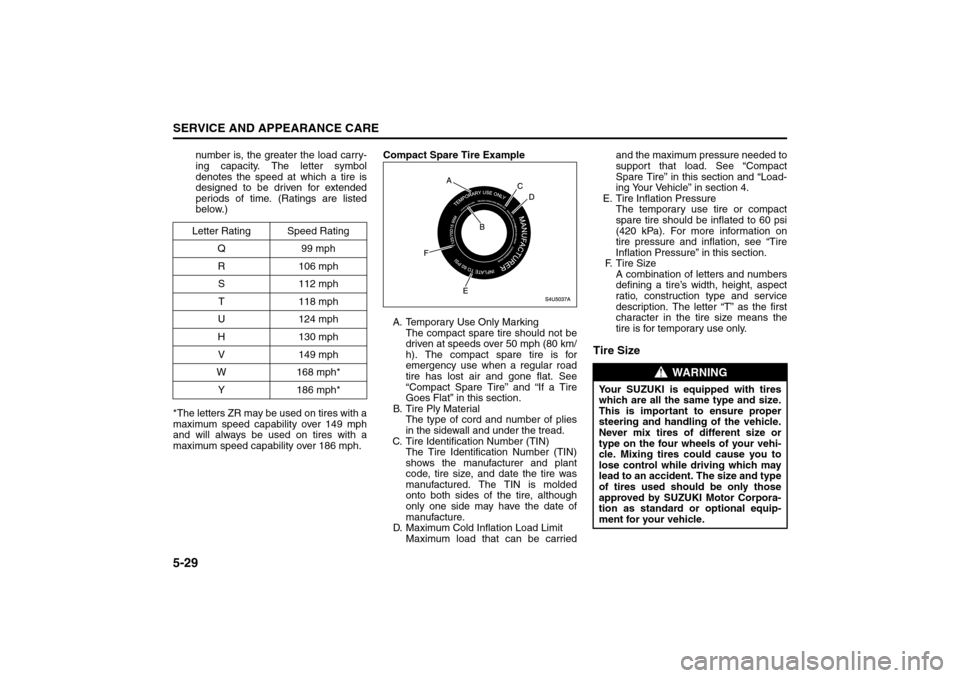
maximum speed capability over 186 mph.Compact Spare Tire Example
A. Temporary Use Only Marking
The compact spare tire should not be
driven at speeds over 50 mph (80 km/
h). The compact spare tire is for
emergency use when a regular road
tire has lost air and gone flat. See
“Compact Spare Tire” and “If a Tire
Goes Flat” in this section.
B. Tire Ply Material
The type of cord and number of plies
in the sidewall and under the tread.
C. Tire Identification Number (TIN)
The Tire Identification Number (TIN)
shows the manufacturer and plant
code, tire size, and date the tire was
manufactured. The TIN is molded
onto both sides of the tire, although
only one side may have the date of
manufacture.
D. Maximum Cold Inflation Load Limit
Maximum load that can be carriedand the maximum pressure needed to
support that load. See “Compact
Spare Tire” in this section and “Load-
ing Your Vehicle” in section 4.
E. Tire Inflation Pressure
The temporary use tire or compact
spare tire should be inflated to 60 psi
(420 kPa). For more information on
tire pressure and inflation, see “Tire
Inflation Pressure” in this section.
F. T i r e S i z e
A combination of letters and numbers
defining a tire’s width, height, aspect
ratio, construction type and service
description. The letter “T” as the first
character in the tire size means the
tire is for temporary use only.
Tire Size
Letter Rating Speed Rating
Q 99 mph
R106 mph
S112 mph
T118 mph
U124 mph
H130 mph
V149 mph
W 168 mph*
Y 186 mph*
WARNING
Your SUZUKI is equipped with tires
which are all the same type and size.
This is important to ensure proper
steering and handling of the vehicle.
Never mix tires of different size or
type on the four wheels of your vehi-
cle. Mixing tires could cause you to
lose control while driving which may
lead to an accident. The size and type
of tires used should be only those
approved by SUZUKI Motor Corpora-
tion as standard or optional equip-
ment for your vehicle.
Tires:
Page 176 of 226
5-32
SERVICE AND APPEARANCE CARE
85Z14-03E
Speed Rating:
An alphanumeric code assigned to a tire
indicating the maximum speed at which a
tire can operate.
Tr a c t i o n :
The friction between the tire and the road
surface. The amount of grip provided.
Tr e a d :
The portion of a tire that comes into con-
tact with the road.
Treadwear Indicators:
Narrow bands, sometimes called “wear
bars,” that show across the tread of a tire
when only 2/32 inch of tread remains.
UTQGS:
Uniform Tire Quality Grading Standards, a
tire information system that provides con-
sumers with ratings for a tire’s traction,
temperature and treadwear. Ratings are
determined by tire manufacturers using
government testing procedures. The rat-
ings are molded into the sidewall of the
tire.
Vehicle Capacity Weight:
The number of designated seating posi-
tions multiplied by 150 lbs (68 kg) plus the
rated cargo load.
Vehicle Maximum Load on the Tire:
The load on an individual tire that is deter-
mined by distributing to each axle its share
of the maximum loaded vehicle weight and
dividing by two.Vehicle Normal Load on the Tire:
The load on an individual tire that is deter-
mined by distributing to each axle its share
of the curb weight, accessory weight, and
normal occupant weight (distributed in
accordance with Table 1 shown below) and
dividing by 2.
TABLE 1 – Occupant Loading and Dis-
tribution For Vehicle Normal Load For
Various Designated Seating Capacities
Vehicle Placard:
A label permanently attached to a vehicle
showing the original equipment tire size
and recommended inflation pressure.
Tire Pressure Monitoring
SystemIf your vehicle is equipped with a tire pres-
sure monitoring system, it uses pressure
sensors containing a unique identification
code to monitor the inflation pressure of
the tires. When the inflation pressure of
one or more tires indicates significant
under-inflation, the tire pressure warning
light comes on. If the warning light blinks,
for approximately one minute and then illu-
minates continuously, the monitoring sys-
tem may not be working. For more
information, see “Tire Pressure Monitoring
System Warning Light” in section 3.
The tire pressure monitoring system does
not replace normal tire maintenance. See
“Inflation – Tire Pressure & Correcting the
Tire Pressure” in this section for more
information.
Designated
seating capac-
ity, number of
occupantsVehicle nor-
mal load, num-
ber of
occupantsOccupant
distribution in
a normally
loaded vehicle
2 through 4 2 2 in front
5 through 10 32 in front, 1 in
second seat
WARNING
If the tire pressure warning light does
not come on when the ignition is
turned to the “ON” position, or
comes on and blinks while driving
there may be a problem with the tire
pressure monitoring system. Have
your vehicle inspected by an autho-
rized dealer.
Tires: