maintenance SUZUKI RENO 2008 1.G User Guide
[x] Cancel search | Manufacturer: SUZUKI, Model Year: 2008, Model line: RENO, Model: SUZUKI RENO 2008 1.GPages: 226, PDF Size: 4.98 MB
Page 153 of 226
5-9SERVICE AND APPEARANCE CARE
85Z14-03E
If you are in an area of extreme cold,
where the temperature falls below –22°F
(–30°C), it is recommended that you use
either an SAE 5W-30 synthetic oil or an
SAE 0W-30 oil. Both will provide easier
cold starting and better protection for your
engine at extremely low temperatures.
Engine Oil Additives
Don’t add anything to your oil. The recom-
mended oils with the starburst symbol are
all you will need for good performance and
engine protection.
When to Change Engine Oil
If any one of these is true for you, use the
short trip/city maintenance schedule:
Most trips are less than 5 miles (8 km).
This is particularly important when out-
side temperatures are below freezing.
Most trips include extensive idling (such
as frequent driving in stop-and-go traf-
fic).
The vehicle is used for delivery service,
police, taxi or other commercial applica-
tion.Driving under these conditions causes
engine oil to break down sooner. If any one
of these is true for your vehicle, then you
need to change your oil and filter every
3,750 miles (6,000 km) or 3 months –
whichever occurs first.
If none of them is true, use the long trip/
highway maintenance schedule. Change
the oil and filter every 7,500 miles (12,000
km) or 6 months – whichever occurs first.
Driving a vehicle with a fully warmed
engine under highway conditions will
cause engine oil to break down slower.
What to Do with Used Oil
Used engine oil contains certain elements
that may be unhealthy for your skin and
could even cause cancer. Don’t let used oil
stay on your skin for very long. Clean your
skin and nails with soap and water, or a
good hand cleaner. Wash or properly dis-
pose of clothing or rags containing used
engine oil. See the manufacturer’s warn-
ings about the use and disposal of oil prod-
ucts.
Used oil can be a threat to the environ-
ment. If you change your own oil, be sure
to drain all the oil from the filter before dis-
posal. Never dispose of oil by putting it in
the trash, pouring it on the ground, into
sewers, or into streams or bodies of water.
Instead, recycle it by taking it to a place
that collects used oil. If you have a problem
properly disposing of your used oil, askyour SUZUKI dealer, a service station or a
local recycling center for help.
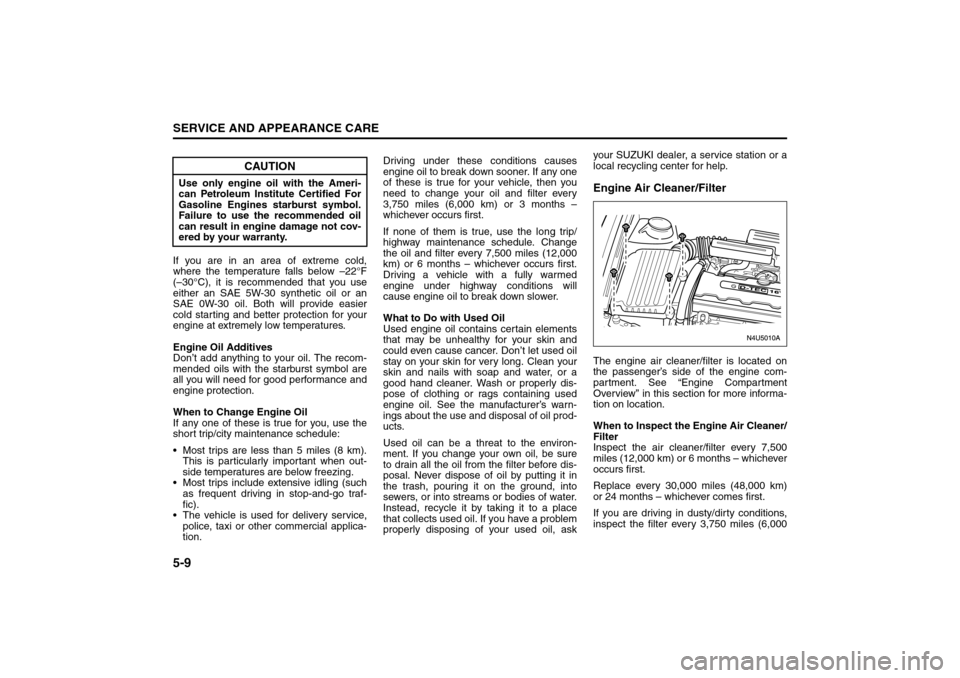
Engine Air Cleaner/FilterThe engine air cleaner/filter is located on
the passenger’s side of the engine com-
partment. See “Engine Compartment
Overview” in this section for more informa-
tion on location.
When to Inspect the Engine Air Cleaner/
Filter
Inspect the air cleaner/filter every 7,500
miles (12,000 km) or 6 months – whichever
occurs first.
Replace every 30,000 miles (48,000 km)
or 24 months – whichever comes first.
If you are driving in dusty/dirty conditions,
inspect the filter every 3,750 miles (6,000
CAUTION
Use only engine oil with the Ameri-
can Petroleum Institute Certified For
Gasoline Engines starburst symbol.
Failure to use the recommended oil
can result in engine damage not cov-
ered by your warranty.
Checking Things Under the Hood:
Page 155 of 226
5-11SERVICE AND APPEARANCE CARE
85Z14-03E
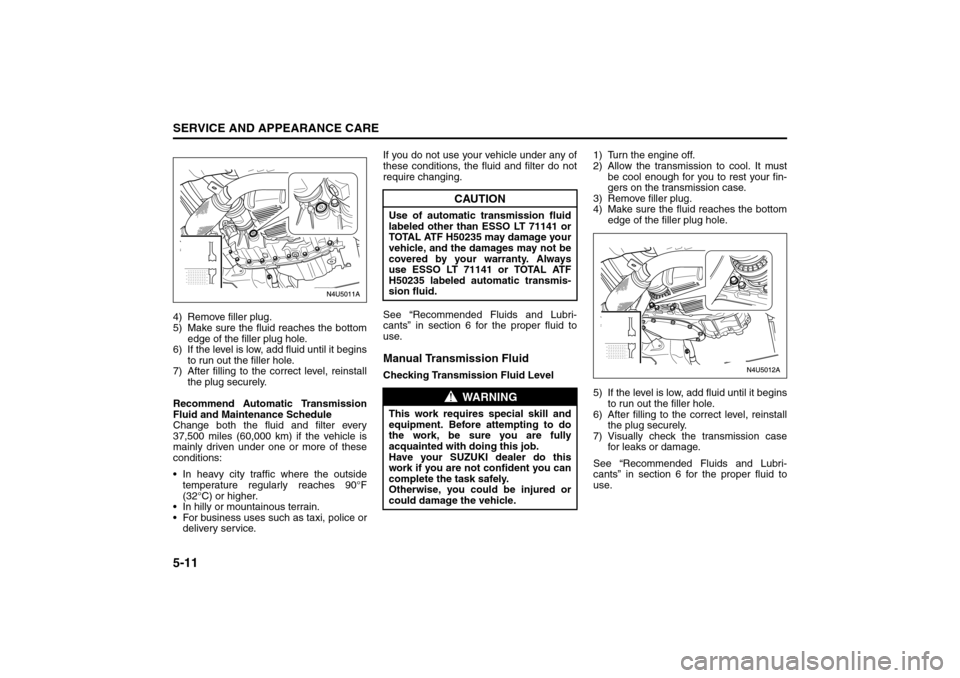
4) Remove filler plug.
5) Make sure the fluid reaches the bottom
edge of the filler plug hole.
6) If the level is low, add fluid until it begins
to run out the filler hole.
7) After filling to the correct level, reinstall
the plug securely.
Recommend Automatic Transmission
Fluid and Maintenance Schedule
Change both the fluid and filter every
37,500 miles (60,000 km) if the vehicle is
mainly driven under one or more of these
conditions:
In heavy city traffic where the outside
temperature regularly reaches 90°F
(32°C) or higher.
In hilly or mountainous terrain.
For business uses such as taxi, police or
delivery service.If you do not use your vehicle under any of
these conditions, the fluid and filter do not
require changing.
See “Recommended Fluids and Lubri-
cants” in section 6 for the proper fluid to
use.
Manual Transmission FluidChecking Transmission Fluid Level1) Turn the engine off.
2) Allow the transmission to cool. It must
be cool enough for you to rest your fin-
gers on the transmission case.
3) Remove filler plug.
4) Make sure the fluid reaches the bottom
edge of the filler plug hole.
5) If the level is low, add fluid until it begins
to run out the filler hole.
6) After filling to the correct level, reinstall
the plug securely.
7) Visually check the transmission case
for leaks or damage.
See “Recommended Fluids and Lubri-
cants” in section 6 for the proper fluid to
use.
CAUTION
Use of automatic transmission fluid
labeled other than ESSO LT 71141 or
TOTAL ATF H50235 may damage your
vehicle, and the damages may not be
covered by your warranty. Always
use ESSO LT 71141 or TOTAL ATF
H50235 labeled automatic transmis-
sion fluid.
WARNING
This work requires special skill and
equipment. Before attempting to do
the work, be sure you are fully
acquainted with doing this job.
Have your SUZUKI dealer do this
work if you are not confident you can
complete the task safely.
Otherwise, you could be injured or
could damage the vehicle.
Checking Things Under the Hood:
Page 156 of 226
5-12
SERVICE AND APPEARANCE CARE
85Z14-03E
Hydraulic ClutchThere is one reservoir for both the brake
and the hydraulic clutch fluid. See “Brakes”
in this section for more information.
The hydraulic clutch linkage in your vehicle
is self-adjusting. The master cylinder res-
ervoir is filled with hydraulic fluid.
A fluid loss in this system could indicate a
problem. Have the system inspected and
repaired.
When to Check and What to Use
Refer to the Maintenance Schedule to
determine how often you should check the
fluid level and for the proper fluid. See sec-
tion 6.
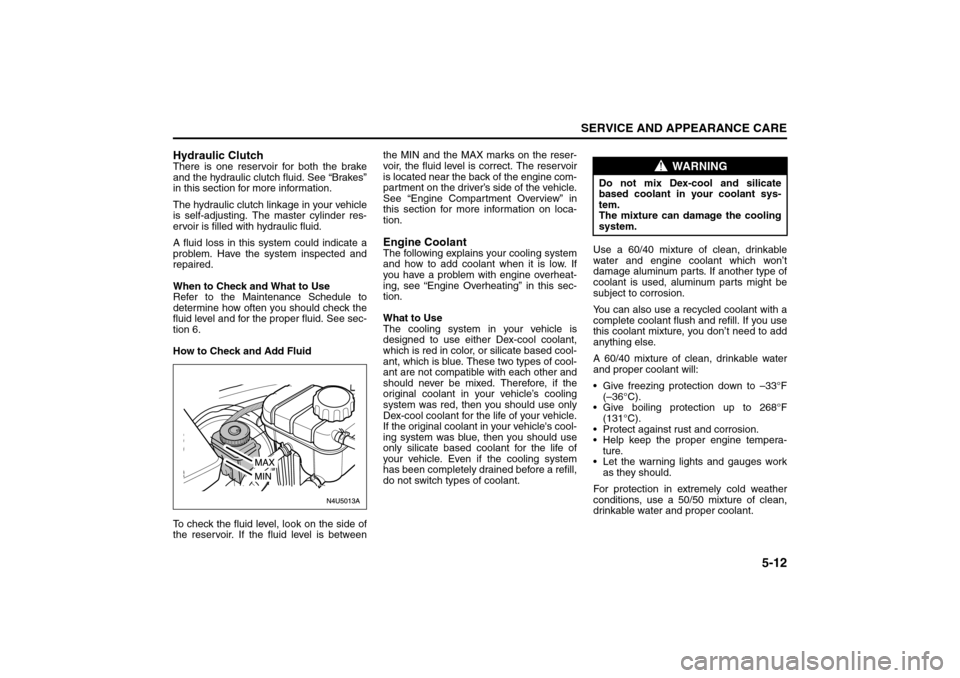
How to Check and Add Fluid
To check the fluid level, look on the side of
the reservoir. If the fluid level is betweenthe MIN and the MAX marks on the reser-
voir, the fluid level is correct. The reservoir
is located near the back of the engine com-
partment on the driver’s side of the vehicle.
See “Engine Compartment Overview” in
this section for more information on loca-
tion.
Engine CoolantThe following explains your cooling system
and how to add coolant when it is low. If
you have a problem with engine overheat-
ing, see “Engine Overheating” in this sec-
tion.
What to Use
The cooling system in your vehicle is
designed to use either Dex-cool coolant,
which is red in color, or silicate based cool-
ant, which is blue. These two types of cool-
ant are not compatible with each other and
should never be mixed. Therefore, if the
original coolant in your vehicle’s cooling
system was red, then you should use only
Dex-cool coolant for the life of your vehicle.
If the original coolant in your vehicle's cool-
ing system was blue, then you should use
only silicate based coolant for the life of
your vehicle. Even if the cooling system
has been completely drained before a refill,
do not switch types of coolant.Use a 60/40 mixture of clean, drinkable
water and engine coolant which won’t
damage aluminum parts. If another type of
coolant is used, aluminum parts might be
subject to corrosion.
You can also use a recycled coolant with a
complete coolant flush and refill. If you use
this coolant mixture, you don’t need to add
anything else.
A 60/40 mixture of clean, drinkable water
and proper coolant will:
Give freezing protection down to –33°F
(–36°C).
Give boiling protection up to 268°F
(131°C).
Protect against rust and corrosion.
Help keep the proper engine tempera-
ture.
Let the warning lights and gauges work
as they should.
For protection in extremely cold weather
conditions, use a 50/50 mixture of clean,
drinkable water and proper coolant.
WARNING
Do not mix Dex-cool and silicate
based coolant in your coolant sys-
tem.
The mixture can damage the cooling
system.
Checking Things Under the Hood:
Page 176 of 226
5-32
SERVICE AND APPEARANCE CARE
85Z14-03E
Speed Rating:
An alphanumeric code assigned to a tire
indicating the maximum speed at which a
tire can operate.
Tr a c t i o n :
The friction between the tire and the road
surface. The amount of grip provided.
Tr e a d :
The portion of a tire that comes into con-
tact with the road.
Treadwear Indicators:
Narrow bands, sometimes called “wear
bars,” that show across the tread of a tire
when only 2/32 inch of tread remains.
UTQGS:
Uniform Tire Quality Grading Standards, a
tire information system that provides con-
sumers with ratings for a tire’s traction,
temperature and treadwear. Ratings are
determined by tire manufacturers using
government testing procedures. The rat-
ings are molded into the sidewall of the
tire.
Vehicle Capacity Weight:
The number of designated seating posi-
tions multiplied by 150 lbs (68 kg) plus the
rated cargo load.
Vehicle Maximum Load on the Tire:
The load on an individual tire that is deter-
mined by distributing to each axle its share
of the maximum loaded vehicle weight and
dividing by two.Vehicle Normal Load on the Tire:
The load on an individual tire that is deter-
mined by distributing to each axle its share
of the curb weight, accessory weight, and
normal occupant weight (distributed in
accordance with Table 1 shown below) and
dividing by 2.
TABLE 1 – Occupant Loading and Dis-
tribution For Vehicle Normal Load For
Various Designated Seating Capacities
Vehicle Placard:
A label permanently attached to a vehicle
showing the original equipment tire size
and recommended inflation pressure.
Tire Pressure Monitoring
SystemIf your vehicle is equipped with a tire pres-
sure monitoring system, it uses pressure
sensors containing a unique identification
code to monitor the inflation pressure of
the tires. When the inflation pressure of
one or more tires indicates significant
under-inflation, the tire pressure warning
light comes on. If the warning light blinks,
for approximately one minute and then illu-
minates continuously, the monitoring sys-
tem may not be working. For more
information, see “Tire Pressure Monitoring
System Warning Light” in section 3.
The tire pressure monitoring system does
not replace normal tire maintenance. See
“Inflation – Tire Pressure & Correcting the
Tire Pressure” in this section for more
information.
Designated
seating capac-
ity, number of
occupantsVehicle nor-
mal load, num-
ber of
occupantsOccupant
distribution in
a normally
loaded vehicle
2 through 4 2 2 in front
5 through 10 32 in front, 1 in
second seat
WARNING
If the tire pressure warning light does
not come on when the ignition is
turned to the “ON” position, or
comes on and blinks while driving
there may be a problem with the tire
pressure monitoring system. Have
your vehicle inspected by an autho-
rized dealer.
Tires:
Page 179 of 226
5-35SERVICE AND APPEARANCE CARE
85Z14-03E
When to Check
Check your tires each time you fill your fuel
tank or at least once a month using a tire
pressure gauge.
Don’t forget your compact spare tire. It
should be at 60 psi (420 kPa).
How to check
Use a good quality pocket-type gauge to
check tire pressure. You can’t tell if your
tires are properly inflated simply by looking
at them. Radial tires may look properly
inflated even when they’re underinflated.
Check the tire’s inflation pressure when the
tires are cold. Cold means your vehicle has
been sitting for at least three hours or
driven no more than 1 mile (1.6 km).
Remove the valve cap from the tire valve
stem. Press the tire gauge firmly onto the
valve to get a pressure measurement. If
the cold tire inflation pressure is low, add
air until you reach the recommended pres-
sure.
If you overfill the tire, release air by push-
ing on the metal stem in the center of the
tire valve. Recheck the tire pressure with
the tire gauge.
Be sure to put the valve caps back on the
valve stems. They help prevent leaks by
keeping out dirt and moisture.
Tire Inspection and RotationInspect your vehicle’s tires at least once a
month.
Tires should be rotated every 7,500 miles
(12,000 km).
Any time you notice unusual wear, rotate
your tires as soon as possible and check
wheel alignment. Also check for damaged
tires or wheels. See “When It Is Time for
New Tires” and “Wheel Replacement” in
this section for more information.
The purpose of regular rotation is to
achieve more uniform wear for all tires on
the vehicle. The first rotation is the most
important. See “Scheduled Maintenance
Services” in section 6, for scheduled rota-
tion intervals.
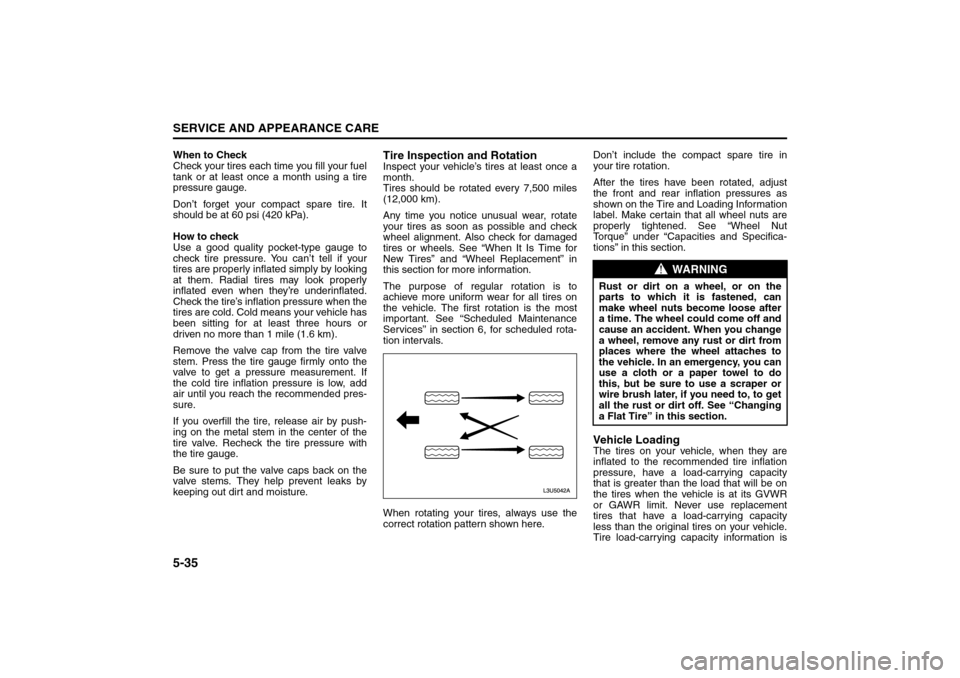
When rotating your tires, always use the
correct rotation pattern shown here.Don’t include the compact spare tire in
your tire rotation.
After the tires have been rotated, adjust
the front and rear inflation pressures as
shown on the Tire and Loading Information
label. Make certain that all wheel nuts are
properly tightened. See “Wheel Nut
Torque” under “Capacities and Specifica-
tions” in this section.
Vehicle LoadingThe tires on your vehicle, when they are
inflated to the recommended tire inflation
pressure, have a load-carrying capacity
that is greater than the load that will be on
the tires when the vehicle is at its GVWR
or GAWR limit. Never use replacement
tires that have a load-carrying capacity
less than the original tires on your vehicle.
Tire load-carrying capacity information is
WARNING
Rust or dirt on a wheel, or on the
parts to which it is fastened, can
make wheel nuts become loose after
a time. The wheel could come off and
cause an accident. When you change
a wheel, remove any rust or dirt from
places where the wheel attaches to
the vehicle. In an emergency, you can
use a cloth or a paper towel to do
this, but be sure to use a scraper or
wire brush later, if you need to, to get
all the rust or dirt off. See “Changing
a Flat Tire” in this section.
Tires:
Page 183 of 226
5-39SERVICE AND APPEARANCE CARE
85Z14-03E
it’s much more likely to leak out slowly. But
if you should ever have a “blowout”, here
are a few tips about what to expect and
what to do:
If a front tire fails, the flat tire will create a
drag that pulls the vehicle toward that side.
Take your foot off the accelerator pedal
and grip the steering wheel firmly. Steer to
maintain lane position, and then gently
brake to a stop well out of the traffic lane.
A rear blowout, particularly on a curve,
acts much like a skid and may require the
same correction you’d use in a skid. In any
rear blowout, remove your foot from the
accelerator pedal. Get the vehicle under
control by steering the way you want the
vehicle to go. It may be very bumpy and
noisy, but you can still steer. Gently brake
to a stop, well off the road if possible.If a tire goes flat, the next part shows how
to use your jacking equipment to change a
flat tire safely.
Changing a Flat TireIf a tire goes flat, avoid further tire and
wheel damage by driving slowly to a level
place. Turn on your hazard warning flash-
ers.
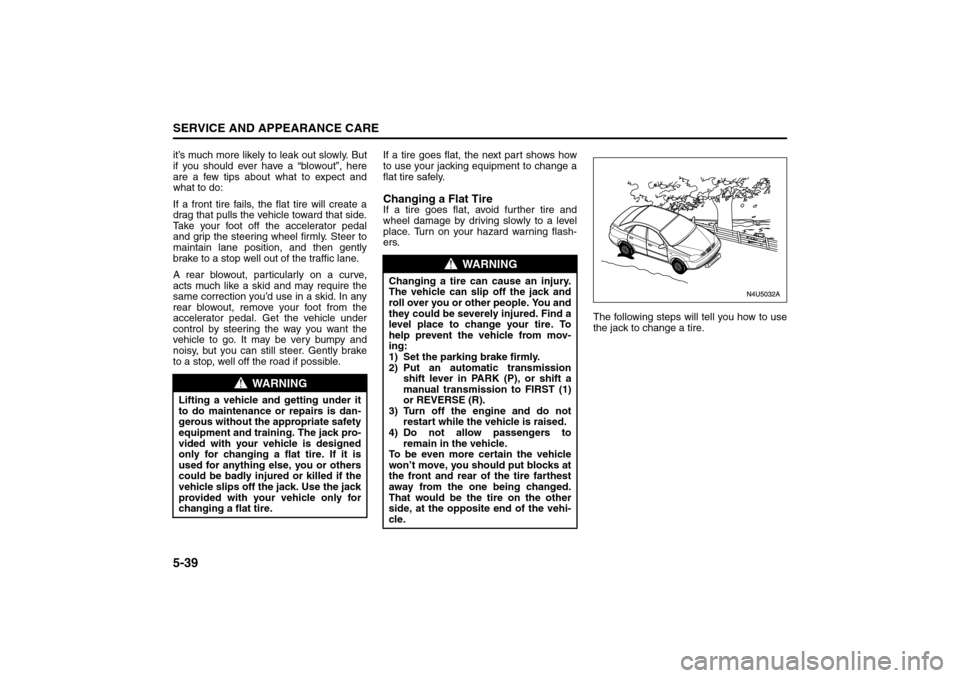
The following steps will tell you how to use
the jack to change a tire.
WARNING
Lifting a vehicle and getting under it
to do maintenance or repairs is dan-
gerous without the appropriate safety
equipment and training. The jack pro-
vided with your vehicle is designed
only for changing a flat tire. If it is
used for anything else, you or others
could be badly injured or killed if the
vehicle slips off the jack. Use the jack
provided with your vehicle only for
changing a flat tire.
WARNING
Changing a tire can cause an injury.
The vehicle can slip off the jack and
roll over you or other people. You and
they could be severely injured. Find a
level place to change your tire. To
help prevent the vehicle from mov-
ing:
1) Set the parking brake firmly.
2) Put an automatic transmission
shift lever in PARK (P), or shift a
manual transmission to FIRST (1)
or REVERSE (R).
3) Turn off the engine and do not
restart while the vehicle is raised.
4) Do not allow passengers to
remain in the vehicle.
To be even more certain the vehicle
won’t move, you should put blocks at
the front and rear of the tire farthest
away from the one being changed.
That would be the tire on the other
side, at the opposite end of the vehi-
cle.
Tires:
Page 191 of 226
5-47SERVICE AND APPEARANCE CARE
85Z14-03E
Sheet Metal DamageIf your vehicle is damaged and requires
sheet metal repair or replacement, make
sure the body repair shop applies anti-cor-
rosion material to parts repaired or
replaced to restore corrosion protection.
Original manufacturer replacement parts
will provide the corrosion protection while
maintaining the warranty.Finish DamageAny stone chips, fractures or deep
scratches in the finish should be repaired
right away. Bare metal will corrode quickly
and may develop into major repair
expense.
Minor chips and scratches can be repaired
with touch-up materials available from your
SUZUKI dealer. Larger areas of finish
damage can be corrected in your SUZUKI
dealer’s body and paint shop.
Underbody MaintenanceChemicals used for ice and snow removal
and dust control can collect on the under-
body. If these are not removed, acceler-
ated corrosion (rust) can occur on the
underbody parts such as fuel lines, frame,
floor pan and exhaust system even though
they have corrosion protection.
At least every spring, flush these materials
from the underbody with plain water. Clean
any areas where mud and debris can col-
lect. Dirt packed in close areas of the
frame should be loosened before being
flushed. Your SUZUKI dealer or an under-
body car washing system can do this for
you.Chemical Paint SpottingSome weather and atmospheric conditions
can create a chemical fallout. Airborne pol-
lutants can fall upon and attack painted
surfaces on your vehicle. This damage can
take two forms: blotchy, ring-shaped discol-
orations, and small, irregular dark spots
etched into the paint surface.Vehicle Care/Appearance MaterialsSee your SUZUKI dealer for more informa-
tion on purchasing the following products.
CAUTION
When applying a tire dressing,
always take care to wipe off any over-
spray or splash from all painted sur-
faces on the body or wheels of the
vehicle. Petroleum-based products
may damage the paint finish and
tires.
Description Usage
Polishing Cloth
Wax-TreatedInterior and exterior
polishing cloth.
Tar and Road
Oil RemoverRemoves tar, road oil
and asphalt.
Chrome
Cleaner and
Po l i s hUse on chrome or
stainless steel.
White Sidewall
Tire CleanerRemoves soil and
black marks from
whitewalls.
Vinyl Cleaner Cleans vinyl tops,
upholstery and con-
ver tible tops.
Glass Cleaner Removes dirt, grime,
smoke and finger-
prints.
Chrome and
Wire Wheel
CleanerRemoves dirt and
grime from chrome
wheels and wire
wheel covers.
Finish
EnhancerRemoves dust, finger-
prints, and surface
contaminants, Spray
on wipe off.
Electrical System:
Page 200 of 226
MAINTENANCE SCHEDULE
6
85Z14-03E
MAINTENANCE SCHEDULEGeneral Information ............................................................ 6-1
Maintenance ........................................................................ 6-2
Page 201 of 226
6-1MAINTENANCE SCHEDULE
85Z14-03E
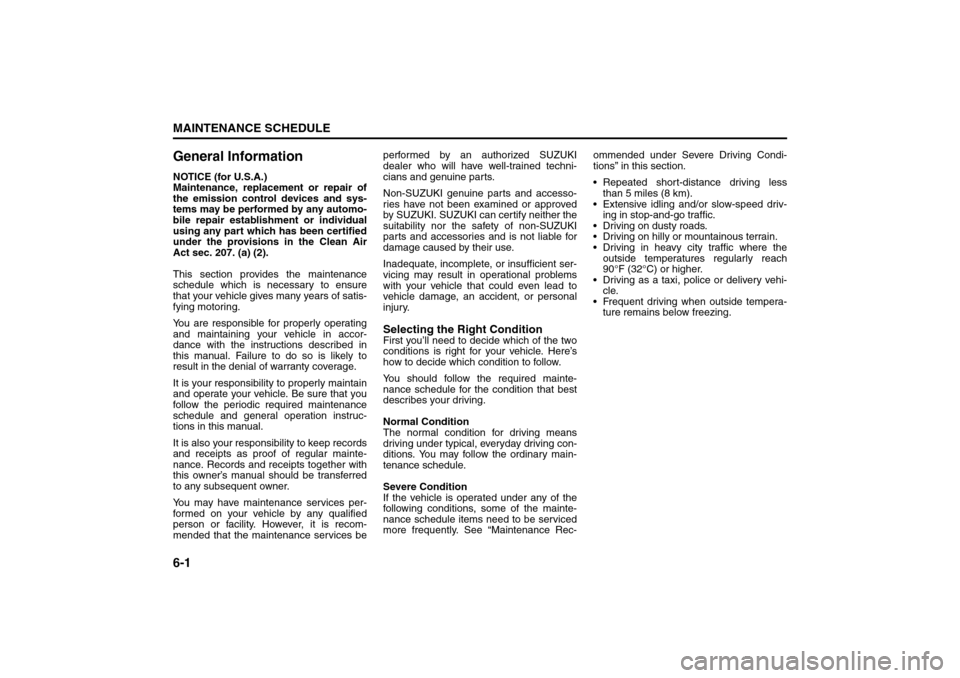
General InformationNOTICE (for U.S.A.)
Maintenance, replacement or repair of
the emission control devices and sys-
tems may be performed by any automo-
bile repair establishment or individual
using any part which has been certified
under the provisions in the Clean Air
Act sec. 207. (a) (2).
This section provides the maintenance
schedule which is necessary to ensure
that your vehicle gives many years of satis-
fying motoring.
You are responsible for properly operating
and maintaining your vehicle in accor-
dance with the instructions described in
this manual. Failure to do so is likely to
result in the denial of warranty coverage.
It is your responsibility to properly maintain
and operate your vehicle. Be sure that you
follow the periodic required maintenance
schedule and general operation instruc-
tions in this manual.
It is also your responsibility to keep records
and receipts as proof of regular mainte-
nance. Records and receipts together with
this owner’s manual should be transferred
to any subsequent owner.
You may have maintenance services per-
formed on your vehicle by any qualified
person or facility. However, it is recom-
mended that the maintenance services beperformed by an authorized SUZUKI
dealer who will have well-trained techni-
cians and genuine parts.
Non-SUZUKI genuine parts and accesso-
ries have not been examined or approved
by SUZUKI. SUZUKI can certify neither the
suitability nor the safety of non-SUZUKI
parts and accessories and is not liable for
damage caused by their use.
Inadequate, incomplete, or insufficient ser-
vicing may result in operational problems
with your vehicle that could even lead to
vehicle damage, an accident, or personal
injury.
Selecting the Right ConditionFirst you’ll need to decide which of the two
conditions is right for your vehicle. Here’s
how to decide which condition to follow.
You should follow the required mainte-
nance schedule for the condition that best
describes your driving.
Normal Condition
The normal condition for driving means
driving under typical, everyday driving con-
ditions. You may follow the ordinary main-
tenance schedule.
Severe Condition
If the vehicle is operated under any of the
following conditions, some of the mainte-
nance schedule items need to be serviced
more frequently. See “Maintenance Rec-ommended under Severe Driving Condi-
tions” in this section.
Repeated short-distance driving less
than 5 miles (8 km).
Extensive idling and/or slow-speed driv-
ing in stop-and-go traffic.
Driving on dusty roads.
Driving on hilly or mountainous terrain.
Driving in heavy city traffic where the
outside temperatures regularly reach
90°F (32°C) or higher.
Driving as a taxi, police or delivery vehi-
cle.
Frequent driving when outside tempera-
ture remains below freezing.
Page 202 of 226
6-2
MAINTENANCE SCHEDULE
85Z14-03E
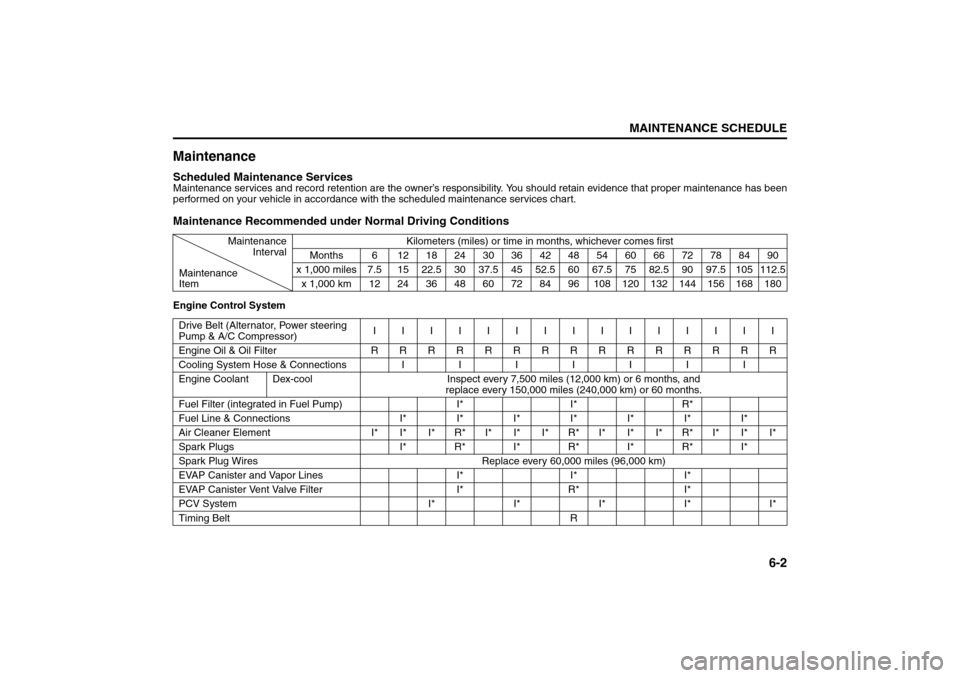
MaintenanceScheduled Maintenance ServicesMaintenance services and record retention are the owner’s responsibility. You should retain evidence that proper maintenance has been
performed on your vehicle in accordance with the scheduled maintenance services chart.Maintenance Recommended under Normal Driving ConditionsEngine Control SystemMaintenance
IntervalKilometers (miles) or time in months, whichever comes first
Months 6 1218243036424854606672788490
Maintenance
Itemx 1,000 miles 7.5 15 22.5 30 37.5 45 52.5 60 67.5 75 82.5 90 97.5 105 112.5
x 1,000 km 12 24 36 48 60 72 84 96 108 120 132 144 156 168 180
Drive Belt (Alternator, Power steering
Pump & A/C Compressor)IIIIIIIIIIIIIII
Engine Oil & Oil Filter RRRRRRRRRRRRRRR
Cooling System Hose & Connections I I I I I I I
Engine Coolant Dex-cool Inspect every 7,500 miles (12,000 km) or 6 months, and
replace every 150,000 miles (240,000 km) or 60 months.
Fuel Filter (integrated in Fuel Pump) I* I* R*
Fuel Line & Connections I* I* I* I* I* I* I*
Air Cleaner Element I* I* I* R* I* I* I* R* I* I* I* R* I* I* I*
Spark Plugs I*R*I*R*I*R*I*
Spark Plug Wires Replace every 60,000 miles (96,000 km)
EVAP Canister and Vapor Lines I* I* I*
EVAP Canister Vent Valve Filter I* R* I*
PCV System I* I* I* I* I*
Timing BeltR