ESP SUZUKI RENO 2008 1.G Owner's Manual
[x] Cancel search | Manufacturer: SUZUKI, Model Year: 2008, Model line: RENO, Model: SUZUKI RENO 2008 1.GPages: 226, PDF Size: 4.98 MB
Page 201 of 226
6-1MAINTENANCE SCHEDULE
85Z14-03E
General InformationNOTICE (for U.S.A.)
Maintenance, replacement or repair of
the emission control devices and sys-
tems may be performed by any automo-
bile repair establishment or individual
using any part which has been certified
under the provisions in the Clean Air
Act sec. 207. (a) (2).
This section provides the maintenance
schedule which is necessary to ensure
that your vehicle gives many years of satis-
fying motoring.
You are responsible for properly operating
and maintaining your vehicle in accor-
dance with the instructions described in
this manual. Failure to do so is likely to
result in the denial of warranty coverage.
It is your responsibility to properly maintain
and operate your vehicle. Be sure that you
follow the periodic required maintenance
schedule and general operation instruc-
tions in this manual.
It is also your responsibility to keep records
and receipts as proof of regular mainte-
nance. Records and receipts together with
this owner’s manual should be transferred
to any subsequent owner.
You may have maintenance services per-
formed on your vehicle by any qualified
person or facility. However, it is recom-
mended that the maintenance services beperformed by an authorized SUZUKI
dealer who will have well-trained techni-
cians and genuine parts.
Non-SUZUKI genuine parts and accesso-
ries have not been examined or approved
by SUZUKI. SUZUKI can certify neither the
suitability nor the safety of non-SUZUKI
parts and accessories and is not liable for
damage caused by their use.
Inadequate, incomplete, or insufficient ser-
vicing may result in operational problems
with your vehicle that could even lead to
vehicle damage, an accident, or personal
injury.
Selecting the Right ConditionFirst you’ll need to decide which of the two
conditions is right for your vehicle. Here’s
how to decide which condition to follow.
You should follow the required mainte-
nance schedule for the condition that best
describes your driving.
Normal Condition
The normal condition for driving means
driving under typical, everyday driving con-
ditions. You may follow the ordinary main-
tenance schedule.
Severe Condition
If the vehicle is operated under any of the
following conditions, some of the mainte-
nance schedule items need to be serviced
more frequently. See “Maintenance Rec-ommended under Severe Driving Condi-
tions” in this section.
Repeated short-distance driving less
than 5 miles (8 km).
Extensive idling and/or slow-speed driv-
ing in stop-and-go traffic.
Driving on dusty roads.
Driving on hilly or mountainous terrain.
Driving in heavy city traffic where the
outside temperatures regularly reach
90°F (32°C) or higher.
Driving as a taxi, police or delivery vehi-
cle.
Frequent driving when outside tempera-
ture remains below freezing.
Page 202 of 226
6-2
MAINTENANCE SCHEDULE
85Z14-03E
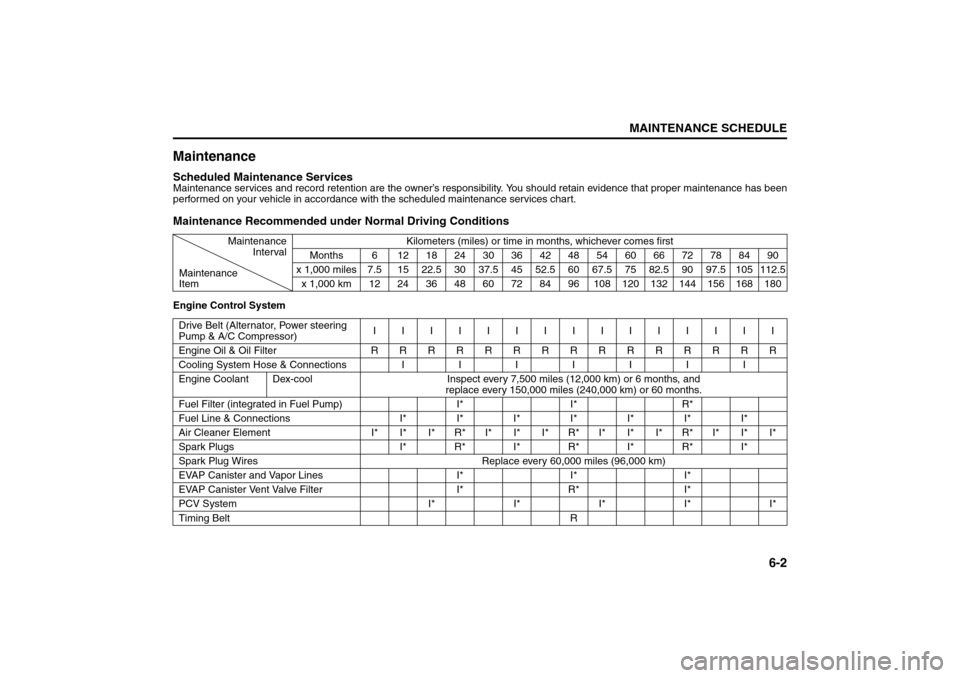
MaintenanceScheduled Maintenance ServicesMaintenance services and record retention are the owner’s responsibility. You should retain evidence that proper maintenance has been
performed on your vehicle in accordance with the scheduled maintenance services chart.Maintenance Recommended under Normal Driving ConditionsEngine Control SystemMaintenance
IntervalKilometers (miles) or time in months, whichever comes first
Months 6 1218243036424854606672788490
Maintenance
Itemx 1,000 miles 7.5 15 22.5 30 37.5 45 52.5 60 67.5 75 82.5 90 97.5 105 112.5
x 1,000 km 12 24 36 48 60 72 84 96 108 120 132 144 156 168 180
Drive Belt (Alternator, Power steering
Pump & A/C Compressor)IIIIIIIIIIIIIII
Engine Oil & Oil Filter RRRRRRRRRRRRRRR
Cooling System Hose & Connections I I I I I I I
Engine Coolant Dex-cool Inspect every 7,500 miles (12,000 km) or 6 months, and
replace every 150,000 miles (240,000 km) or 60 months.
Fuel Filter (integrated in Fuel Pump) I* I* R*
Fuel Line & Connections I* I* I* I* I* I* I*
Air Cleaner Element I* I* I* R* I* I* I* R* I* I* I* R* I* I* I*
Spark Plugs I*R*I*R*I*R*I*
Spark Plug Wires Replace every 60,000 miles (96,000 km)
EVAP Canister and Vapor Lines I* I* I*
EVAP Canister Vent Valve Filter I* R* I*
PCV System I* I* I* I* I*
Timing BeltR
Page 216 of 226
7-2
GENERAL INFORMATION
85Z14-03E
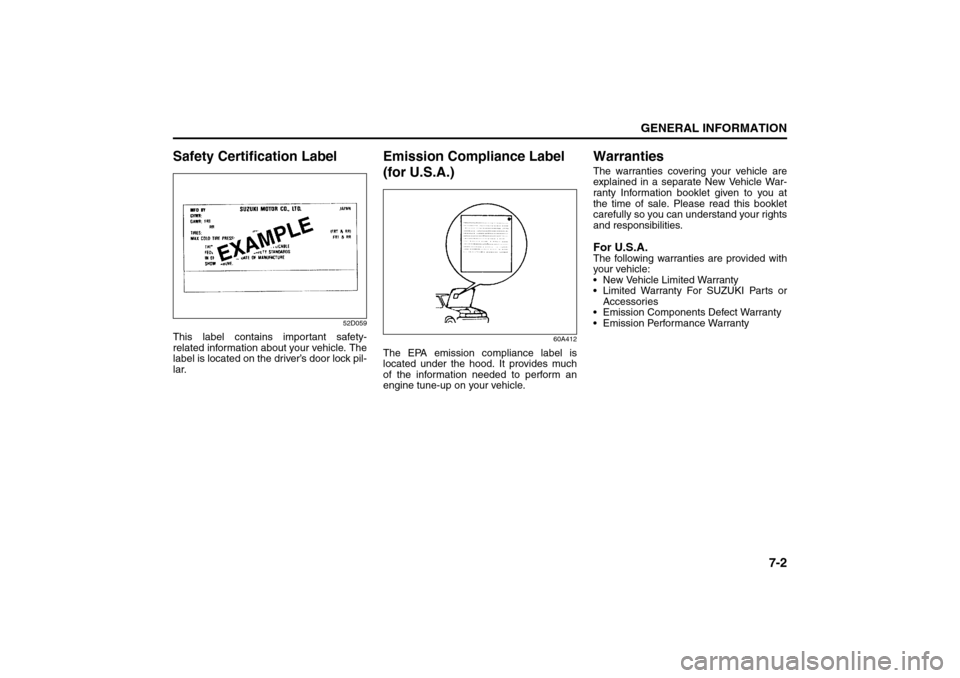
Safety Certification Label
52D059
This label contains important safety-
related information about your vehicle. The
label is located on the driver’s door lock pil-
lar.
Emission Compliance Label
(for U.S.A.)
60A412
The EPA emission compliance label is
located under the hood. It provides much
of the information needed to perform an
engine tune-up on your vehicle.
WarrantiesThe warranties covering your vehicle are
explained in a separate New Vehicle War-
ranty Information booklet given to you at
the time of sale. Please read this booklet
carefully so you can understand your rights
and responsibilities.For U.S.A.The following warranties are provided with
your vehicle:
New Vehicle Limited Warranty
Limited Warranty For SUZUKI Parts or
Accessories
Emission Components Defect Warranty
Emission Performance Warranty
Page 217 of 226
7-3GENERAL INFORMATION
85Z14-03E
On-Board Vehicle Computers
and Event Data RecordersYour vehicle is equipped with on-board
computer systems which monitor and
control several aspects of vehicle per-
formance, including the following:
Emission-related components and
engine parameters such as engine
speed and throttle position are moni-
tored to provide emissions control
and to provide optimum fuel econ-
omy. Your vehicle also has an on-
board diagnostic system which mon-
itors and records information about
emission-related malfunctions.
Signals from various sensors are
monitored to provide air bag deploy-
ment.
If your vehicle is equipped with
antilock brakes, conditions such as
vehicle speed and brake perfor-
mance are monitored, so that the
ABS system can provide effective
antilock braking. If your vehicle has
an Electronic Stability Program
(ESP
®) system, conditions such as
yaw rate, lateral acceleration, and
brake fluid pressure are monitored,
so that the ESP
® system can help
the driver control the vehicle in diffi-
cult driving situations.
Some information may be stored by
the on-board computers during normaloperation of the vehicle. This stored
information can assist technicians in
repairing the vehicle when malfunc-
tions occur. Other information is stored
only in the event of crash, by computer
systems that are commonly called
Event Data Recorders (EDRs).
In a crash event, EDRs such as the
Airbag Sensing and Diagnostic Mod-
ule (SDM) in your vehicle may record
information about the condition of the
vehicle and how it was operated, such
as data related to airbag readiness,
airbag performance, safety belt usage,
and the severity of the collision. These
data can help provide a better under-
standing of the circumstances in which
crashes and injuries occur and lead to
the designing of safer vehicles. The
SDM in your vehicle does not collect
or store personal information.
To read the stored information, special
equipment is needed and access to
the vehicle or storage device is
required. SUZUKI will not access infor-
mation about a crash event or share it
with others other than with the consent
of the vehicle owner or lessee, in
response to an official request from
the police or similar government office,
as part of SUZUKI’s defense of litiga-
tion through the discovery process, or
as required by law.In addition, once SUZUKI collects or
receives data, SUZUKI may use the
data for research conducted by
SUZUKI, make the data available for
outside research if need is shown and
confidentiality is assured, or make
summary data which does not identify
specific vehicles available for outside
research.
Others, such as law enforcement per-
sonnel, may have access to the spe-
cial equipment that can read the
information if they have access to the
vehicle or storage device.