change time SUZUKI RENO 2008 1.G Owner's Manual
[x] Cancel search | Manufacturer: SUZUKI, Model Year: 2008, Model line: RENO, Model: SUZUKI RENO 2008 1.GPages: 226, PDF Size: 4.98 MB
Page 178 of 226
5-34
SERVICE AND APPEARANCE CARE
85Z14-03E
eral Communications Commission (FCC)
Rules and with Industry and Science Can-
ada.
This device complies with Part 15 of the
FCC Rules and with RSS-210 of Industry
and Science Canada. Operation is subject
to the following two conditions: (1) This
device may not cause harmful interfer-
ence, and (2) this device must accept any
interference received including interfer-
ence that may cause undesired operation
of the device.
NOTE:
Changes or modifications not expressly
approved by the party responsible for com-
pliance could void the user’s authority to
operate the equipment.
NOTE:
Only use tire sizes that are recommended
for your vehicle. Use of inappropriate-size
tires can cause a variety of problems which
will not be covered under warranty.
Correcting the Tire PressureTo permanently eliminate the low tire pres-
sure warning light, you must fill the tires
with the correct amount of air. However, at
the next vehicle start-up, the warning light
will reappear if the tire pressure is not cor-
rected. The best time to check your tire
pressure is when the tires are cold. A Tire
and Loading Information label, located on
the driver’s door near the door latch,
shows the correct inflation pressure for the
tires when they are cold. Cold means your
vehicle has been sitting for at least three
hours or driven no more than one mile.
You may notice during cooler conditions
that low tire pressure warning light will
appear when the vehicle is first started and
then turn off as you start to drive the vehi-
cle. This could be an early indicator that
your tire pressures are getting low and
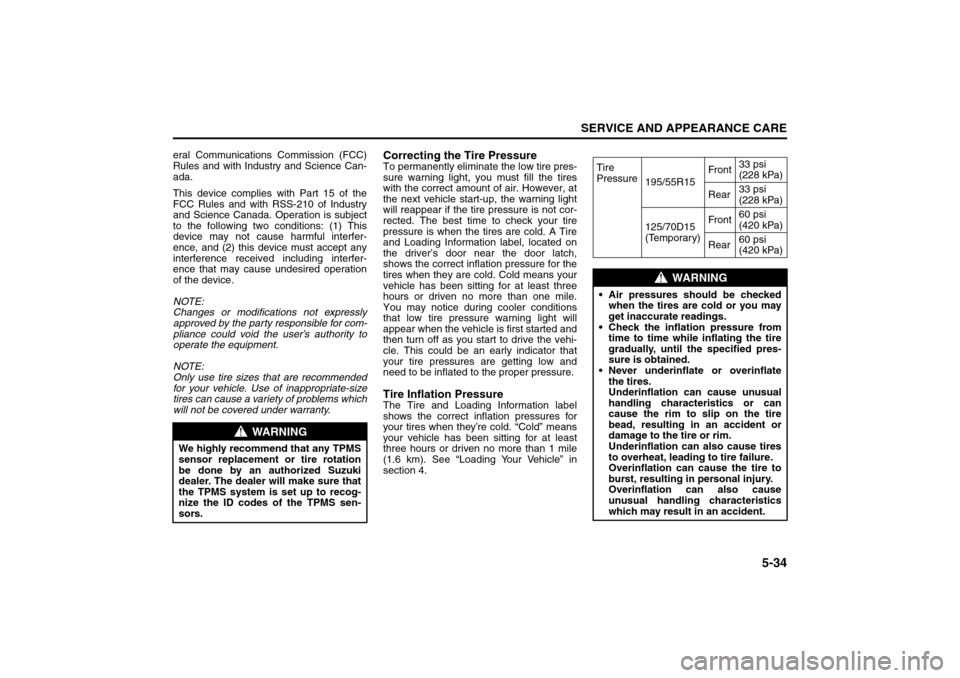
need to be inflated to the proper pressure.Tire Inflation PressureThe Tire and Loading Information label
shows the correct inflation pressures for
your tires when they’re cold. “Cold” means
your vehicle has been sitting for at least
three hours or driven no more than 1 mile
(1.6 km). See “Loading Your Vehicle” in
section 4.
WARNING
We highly recommend that any TPMS
sensor replacement or tire rotation
be done by an authorized Suzuki
dealer. The dealer will make sure that
the TPMS system is set up to recog-
nize the ID codes of the TPMS sen-
sors.
Tire
Pressure
195/55R15Front33 psi
(228 kPa)
Rear33 psi
(228 kPa)
125/70D15
(Temporary)Front60 psi
(420 kPa)
Rear60 psi
(420 kPa)
WARNING
Air pressures should be checked
when the tires are cold or you may
get inaccurate readings.
Check the inflation pressure from
time to time while inflating the tire
gradually, until the specified pres-
sure is obtained.
Never underinflate or overinflate
the tires.
Underinflation can cause unusual
handling characteristics or can
cause the rim to slip on the tire
bead, resulting in an accident or
damage to the tire or rim.
Underinflation can also cause tires
to overheat, leading to tire failure.
Overinflation can cause the tire to
burst, resulting in personal injury.
Overinflation can also cause
unusual handling characteristics
which may result in an accident.
Tires:
Page 179 of 226
5-35SERVICE AND APPEARANCE CARE
85Z14-03E
When to Check
Check your tires each time you fill your fuel
tank or at least once a month using a tire
pressure gauge.
Don’t forget your compact spare tire. It
should be at 60 psi (420 kPa).
How to check
Use a good quality pocket-type gauge to
check tire pressure. You can’t tell if your
tires are properly inflated simply by looking
at them. Radial tires may look properly
inflated even when they’re underinflated.
Check the tire’s inflation pressure when the
tires are cold. Cold means your vehicle has
been sitting for at least three hours or
driven no more than 1 mile (1.6 km).
Remove the valve cap from the tire valve
stem. Press the tire gauge firmly onto the
valve to get a pressure measurement. If
the cold tire inflation pressure is low, add
air until you reach the recommended pres-
sure.
If you overfill the tire, release air by push-
ing on the metal stem in the center of the
tire valve. Recheck the tire pressure with
the tire gauge.
Be sure to put the valve caps back on the
valve stems. They help prevent leaks by
keeping out dirt and moisture.
Tire Inspection and RotationInspect your vehicle’s tires at least once a
month.
Tires should be rotated every 7,500 miles
(12,000 km).
Any time you notice unusual wear, rotate
your tires as soon as possible and check
wheel alignment. Also check for damaged
tires or wheels. See “When It Is Time for
New Tires” and “Wheel Replacement” in
this section for more information.
The purpose of regular rotation is to
achieve more uniform wear for all tires on
the vehicle. The first rotation is the most
important. See “Scheduled Maintenance
Services” in section 6, for scheduled rota-
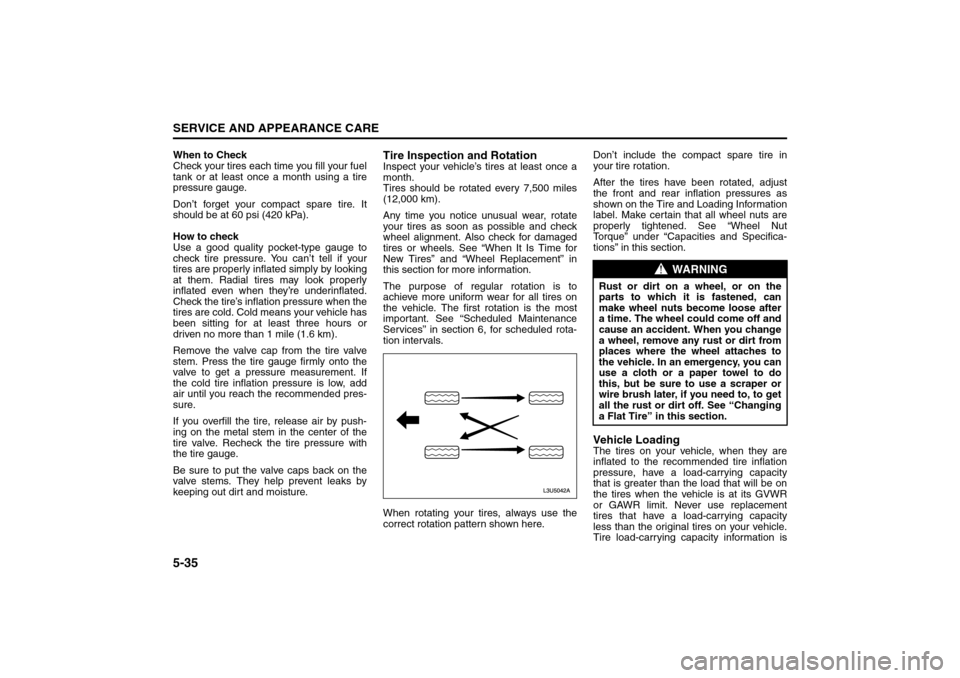
tion intervals.
When rotating your tires, always use the
correct rotation pattern shown here.Don’t include the compact spare tire in
your tire rotation.
After the tires have been rotated, adjust
the front and rear inflation pressures as
shown on the Tire and Loading Information
label. Make certain that all wheel nuts are
properly tightened. See “Wheel Nut
Torque” under “Capacities and Specifica-
tions” in this section.
Vehicle LoadingThe tires on your vehicle, when they are
inflated to the recommended tire inflation
pressure, have a load-carrying capacity
that is greater than the load that will be on
the tires when the vehicle is at its GVWR
or GAWR limit. Never use replacement
tires that have a load-carrying capacity
less than the original tires on your vehicle.
Tire load-carrying capacity information is
WARNING
Rust or dirt on a wheel, or on the
parts to which it is fastened, can
make wheel nuts become loose after
a time. The wheel could come off and
cause an accident. When you change
a wheel, remove any rust or dirt from
places where the wheel attaches to
the vehicle. In an emergency, you can
use a cloth or a paper towel to do
this, but be sure to use a scraper or
wire brush later, if you need to, to get
all the rust or dirt off. See “Changing
a Flat Tire” in this section.
Tires:
Page 180 of 226
5-36
SERVICE AND APPEARANCE CARE
85Z14-03E
molded into the tire sidewall typically
shown as “Max. Load”. Use of replacement
tires with a lower load-carrying capacity
than the original tires, or failure to keep the
tires inflated to the recommended tire pres-
sure, may reduce the GVWR or GAWR
limit of your vehicle.
NOTE:
Use of replacement tires with a higher
load-carrying capacity than the original
tires, or using a tire inflation pressure
higher than the recommended tire inflation
pressure, will not increase the GVWR or
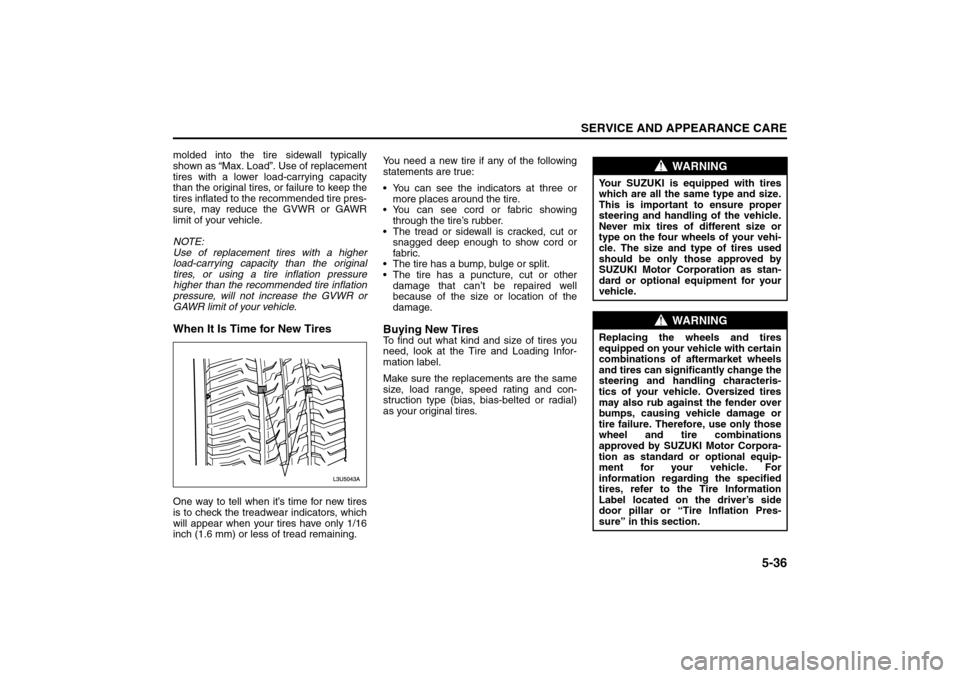
GAWR limit of your vehicle.When It Is Time for New TiresOne way to tell when it’s time for new tires
is to check the treadwear indicators, which
will appear when your tires have only 1/16
inch (1.6 mm) or less of tread remaining.You need a new tire if any of the following
statements are true:
You can see the indicators at three or
more places around the tire.
You can see cord or fabric showing
through the tire’s rubber.
The tread or sidewall is cracked, cut or
snagged deep enough to show cord or
fabric.
The tire has a bump, bulge or split.
The tire has a puncture, cut or other
damage that can’t be repaired well
because of the size or location of the
damage.
Buying New TiresTo find out what kind and size of tires you
need, look at the Tire and Loading Infor-
mation label.
Make sure the replacements are the same
size, load range, speed rating and con-
struction type (bias, bias-belted or radial)
as your original tires.
WARNING
Your SUZUKI is equipped with tires
which are all the same type and size.
This is important to ensure proper
steering and handling of the vehicle.
Never mix tires of different size or
type on the four wheels of your vehi-
cle. The size and type of tires used
should be only those approved by
SUZUKI Motor Corporation as stan-
dard or optional equipment for your
vehicle.
WARNING
Replacing the wheels and tires
equipped on your vehicle with certain
combinations of aftermarket wheels
and tires can significantly change the
steering and handling characteris-
tics of your vehicle. Oversized tires
may also rub against the fender over
bumps, causing vehicle damage or
tire failure. Therefore, use only those
wheel and tire combinations
approved by SUZUKI Motor Corpora-
tion as standard or optional equip-
ment for your vehicle. For
information regarding the specified
tires, refer to the Tire Information
Label located on the driver’s side
door pillar or “Tire Inflation Pres-
sure” in this section.
Tires:
Page 185 of 226
5-41SERVICE AND APPEARANCE CARE
85Z14-03E
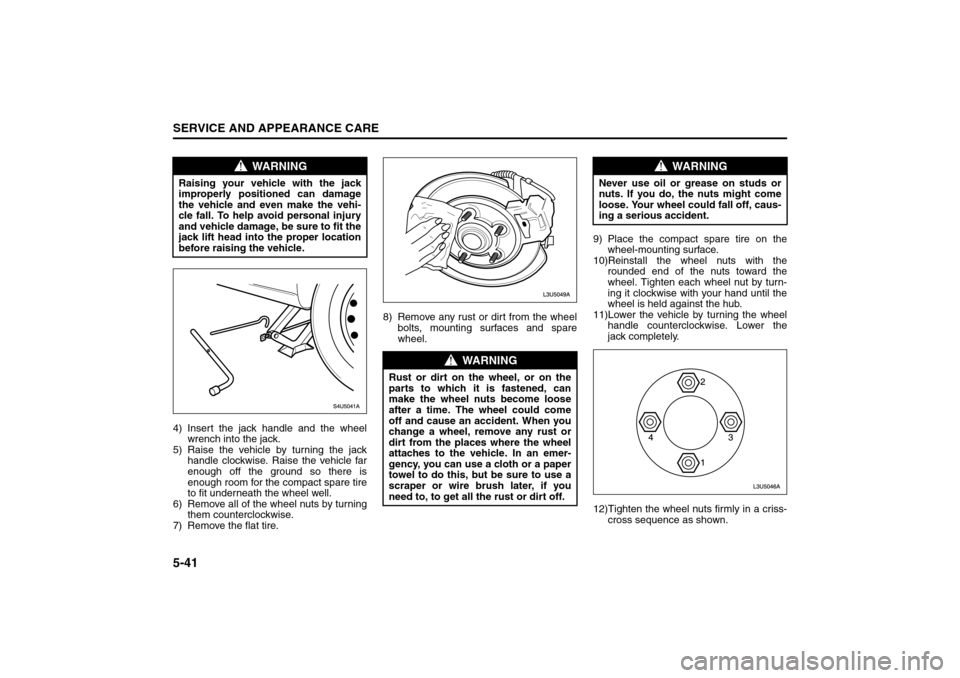
4) Insert the jack handle and the wheel
wrench into the jack.
5) Raise the vehicle by turning the jack
handle clockwise. Raise the vehicle far
enough off the ground so there is
enough room for the compact spare tire
to fit underneath the wheel well.
6) Remove all of the wheel nuts by turning
them counterclockwise.
7) Remove the flat tire.8) Remove any rust or dirt from the wheel
bolts, mounting surfaces and spare
wheel.9) Place the compact spare tire on the
wheel-mounting surface.
10)Reinstall the wheel nuts with the
rounded end of the nuts toward the
wheel. Tighten each wheel nut by turn-
ing it clockwise with your hand until the
wheel is held against the hub.
11)Lower the vehicle by turning the wheel
handle counterclockwise. Lower the
jack completely.
12)Tighten the wheel nuts firmly in a criss-
cross sequence as shown.
WARNING
Raising your vehicle with the jack
improperly positioned can damage
the vehicle and even make the vehi-
cle fall. To help avoid personal injury
and vehicle damage, be sure to fit the
jack lift head into the proper location
before raising the vehicle.
WARNING
Rust or dirt on the wheel, or on the
parts to which it is fastened, can
make the wheel nuts become loose
after a time. The wheel could come
off and cause an accident. When you
change a wheel, remove any rust or
dirt from the places where the wheel
attaches to the vehicle. In an emer-
gency, you can use a cloth or a paper
towel to do this, but be sure to use a
scraper or wire brush later, if you
need to, to get all the rust or dirt off.
WARNING
Never use oil or grease on studs or
nuts. If you do, the nuts might come
loose. Your wheel could fall off, caus-
ing a serious accident.
Tires:
Page 210 of 226
6-10
MAINTENANCE SCHEDULE
85Z14-03E
Chart Symbols
I – Inspect these items and their related
parts. Correct, clean, refill, adjust, lubri-
cate, inflate or replace as required.
R – Replace or Change
NOTE:
Check the engine oil and engine coolant
levels weekly.
*: SUZUKI recommends that this mainte-
nance service be performed at the time/
mileage interval indicated to ensure the
peak performance and long-term reliability
of your vehicle. However, the U.S. Environ-
mental Protection Agency and the Califor-
nia Air Resources Board have determined
that failure to perform this specific mainte-
nance item will not void your emission war-
ranty or limit recall liability.
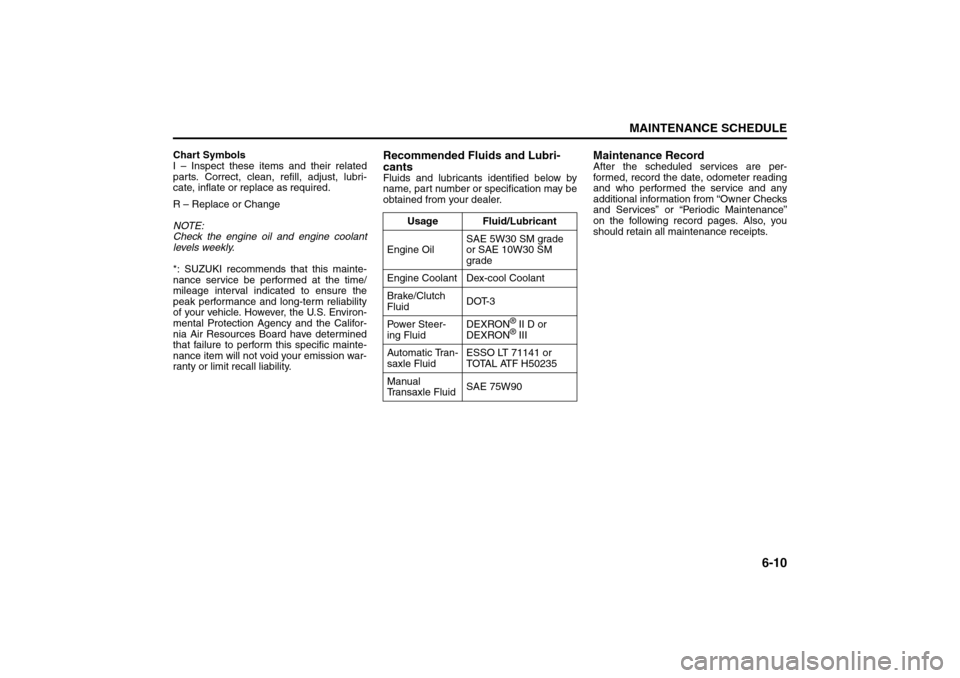
Recommended Fluids and Lubri-
cantsFluids and lubricants identified below by
name, part number or specification may be
obtained from your dealer.
Maintenance RecordAfter the scheduled services are per-
formed, record the date, odometer reading
and who performed the service and any
additional information from “Owner Checks
and Services” or “Periodic Maintenance”
on the following record pages. Also, you
should retain all maintenance receipts. Usage Fluid/Lubricant
Engine OilSAE 5W30 SM grade
or SAE 10W30 SM
grade
Engine Coolant Dex-cool Coolant
Brake/Clutch
FluidDOT-3
Power Steer-
ing FluidDEXRON
® II D or
DEXRON® III
Automatic Tran-
saxle FluidESSO LT 71141 or
TOTAL ATF H50235
Manual
Transaxle FluidSAE 75W90
Page 220 of 226
8-1
INDEX
88
85Z14-03E
INDEXAAccessory Power Outlet
.....................................................3-10
Adding Equipment to the Outside of Your Vehicle
..........5-1
Adding Equipment to Your Air Bag-Equipped Vehicle
....1-31
Additives
..............................................................................5-2
Add-On Electrical Equipment
.............................................5-48
Air Bag Readiness Light
.....................................................3-20
Antenna
................................................................................2-23
Anti-Lock Brake System (ABS)
..........................................4-3
Anti-Lock Brake System Warning Light
............................3-21
Appearance Care
.................................................................5-44
Ashtrays and Cigarette Lighter
..........................................3-11
Audio System
.......................................................................3-29
Automatic Transmission Fluid
...........................................5-10
Automatic Transmission Operation
...................................2-12
BBackup Lamps and Tail/Stop Lamps
.................................5-26
Battery
..................................................................................5-20
Before Driving
......................................................................2-10
Before Leaving on a Long Trip
...........................................4-11
Brake System Warning Light
..............................................3-21
Brakes
...................................................................................5-18
Braking .................................................................................4-3
Bulb Replacement
...............................................................5-23
Buying New Tires ................................................................5-36
CCalifornia Fuel
......................................................................5-1
Capacities
.............................................................................5-53Capacities and Specifications
........................................... 5-53
CD CHANGER OPERATION (Optional)
............................. 3-45
Center High-Mounted Stop Lamp
...................................... 5-25
Central Door Locking System
............................................ 2-5
Changing a Flat Tire
........................................................... 5-39
Charging System Light ....................................................... 3-20
Checking Things Under the Hood
..................................... 5-4
Checking Your Restraint Systems .................................... 1-33
Chemical Paint Spotting
..................................................... 5-47
Child Restraint Systems ..................................................... 1-18
Child Restraints
.................................................................. 1-15
City Driving
.......................................................................... 4-10
Cleaning the Inside of Your Vehicle
.................................. 5-44
Cleaning the Outside of Your Vehicle ............................... 5-45
Climate Control System
..................................................... 3-12
Climate Controls
................................................................. 3-12
Clock
.................................................................................... 3-12
Control of a Vehicle
............................................................ 4-2
Coolant Surge Tank Pressure Cap
.................................... 5-14
Cooling System
................................................................... 5-15
Correcting the Tire Pressure
............................................. 5-34
Cruise Control
..................................................................... 3-6
Cruise Control Light
........................................................... 3-25
Cupholder(s)
........................................................................ 2-21
DDaily Inspection Checklist
................................................. 2-10
Daytime Running Lamps Indicator Light
.......................... 3-26
Defensive Driving
................................................................ 4-1