belt SUZUKI SWIFT 2017 5.G Owner's Manual
[x] Cancel search | Manufacturer: SUZUKI, Model Year: 2017, Model line: SWIFT, Model: SUZUKI SWIFT 2017 5.GPages: 336, PDF Size: 6.24 MB
Page 50 of 336
2-31
BEFORE DRIVING
74LH0-74E
of the diagonal shoulder strap adjusts itself
to allow freedom of movement.
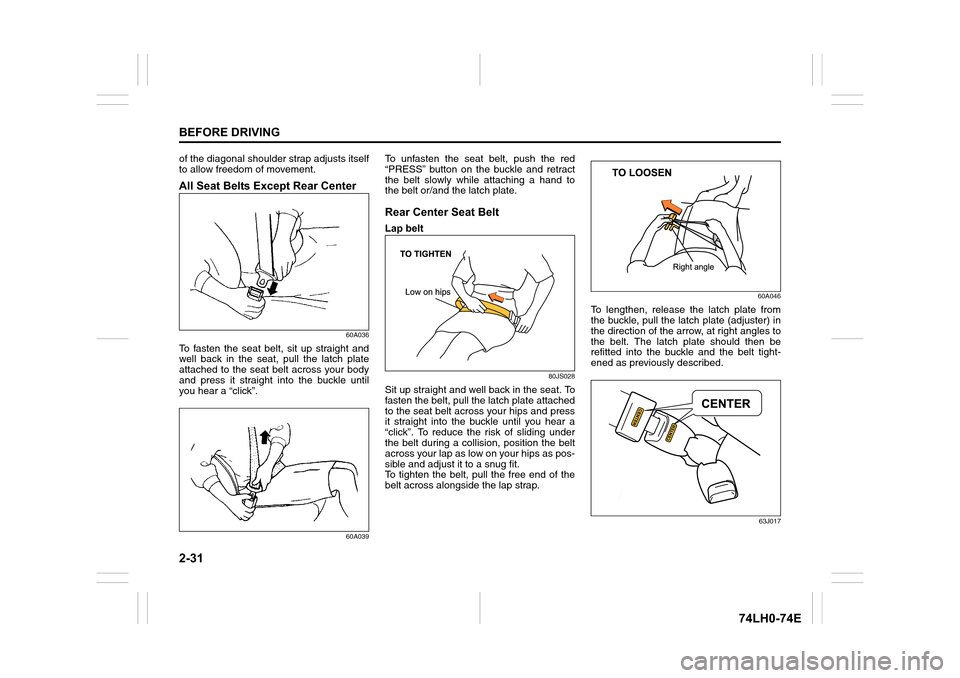
All Seat Belts Except Rear Center
60A036
To fasten the seat belt, sit up straight and
well back in the seat, pull the latch plate
attached to the seat belt across your body
and press it straight into the buckle until
you hear a “click”.
60A039
To unfasten the seat belt, push the red
“PRESS” button on the buckle and retract
the belt slowly while attaching a hand to
the belt or/and the latch plate.
Rear Center Seat Belt
Lap belt
80JS028
Sit up straight and well back in the seat. To
fasten the belt, pull the latch plate attached
to the seat belt across your hips and press
it straight into the buckle until you hear a
“click”. To reduce the risk of sliding under
the belt during a collision, position the belt
across your lap as low on your hips as pos-
sible and adjust it to a snug fit.
To tighten the belt, pull the free end of the
belt across alongside the lap strap.
60A046
To lengthen, release the latch plate from
the buckle, pull the latch plate (adjuster) in
the direction of the arrow, at right angles to
the belt. The latch plate should then be
refitted into the buckle and the belt tight-
ened as previously described.
63J017
Page 51 of 336
2-32
BEFORE DRIVING
74LH0-74E
NOTE:
The word “CENTER” is molded on the
buckle and latch plate of the center lap
belt. The buckles are designed so a latch
plate can not be inserted into the wrong
buckle.
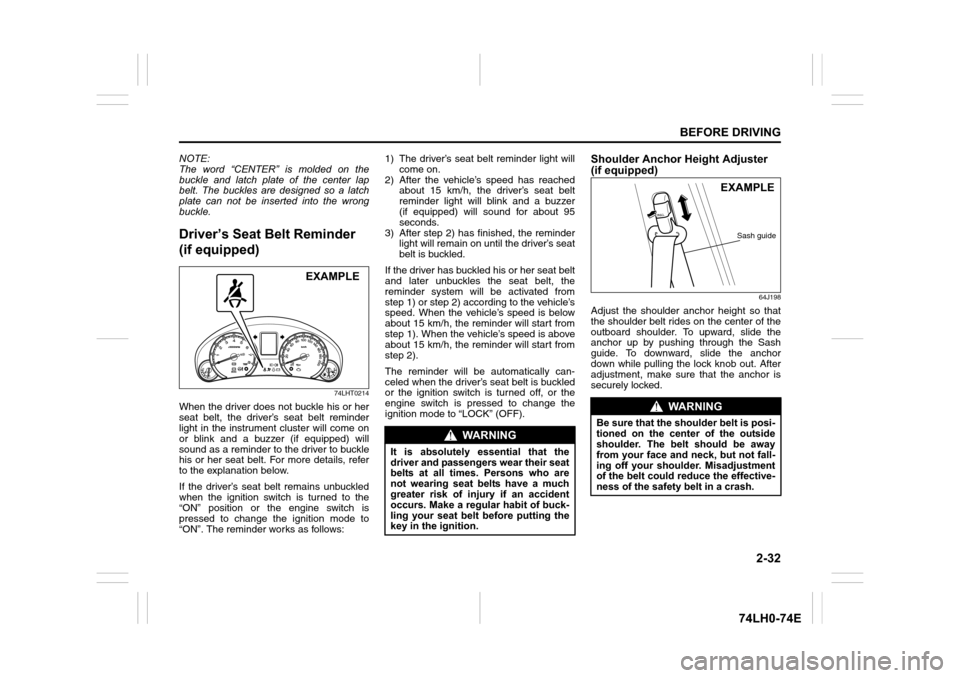
Driver’s Seat Belt Reminder
(if equipped)
74LHT0214
When the driver does not buckle his or her
seat belt, the driver’s seat belt reminder
light in the instrument cluster will come on
or blink and a buzzer (if equipped) will
sound as a reminder to the driver to buckle
his or her seat belt. For more details, refer
to the explanation below.
If the driver’s seat belt remains unbuckled
when the ignition switch is turned to the
“ON” position or the engine switch is
pressed to change the ignition mode to
“ON”. The reminder works as follows:1) The driver’s seat belt reminder light will
come on.
2) After the vehicle’s speed has reached
about 15 km/h, the driver’s seat belt
reminder light will blink and a buzzer
(if equipped) will sound for about 95
seconds.
3) After step 2) has finished, the reminder
light will remain on until the driver’s seat
belt is buckled.
If the driver has buckled his or her seat belt
and later unbuckles the seat belt, the
reminder system will be activated from
step 1) or step 2) according to the vehicle’s
speed. When the vehicle’s speed is below
about 15 km/h, the reminder will start from
step 1). When the vehicle’s speed is above
about 15 km/h, the reminder will start from
step 2).
The reminder will be automatically can-
celed when the driver’s seat belt is buckled
or the ignition switch is turned off, or the
engine switch is pressed to change the
ignition mode to “LOCK” (OFF).
Shoulder Anchor Height Adjuster
(if equipped)
64J198
Adjust the shoulder anchor height so that
the shoulder belt rides on the center of the
outboard shoulder. To upward, slide the
anchor up by pushing through the Sash
guide. To downward, slide the anchor
down while pulling the lock knob out. After
adjustment, make sure that the anchor is
securely locked.
EXAMPLE
WA R N I N G
It is absolutely essential that the
driver and passengers wear their seat
belts at all times. Persons who are
not wearing seat belts have a much
greater risk of injury if an accident
occurs. Make a regular habit of buck-
ling your seat belt before putting the
key in the ignition.
WA R N I N G
Be sure that the shoulder belt is posi-
tioned on the center of the outside
shoulder. The belt should be away
from your face and neck, but not fall-
ing off your shoulder. Misadjustment
of the belt could reduce the effective-
ness of the safety belt in a crash.
EXAMPLE
Sash guide
Page 52 of 336
2-33
BEFORE DRIVING
74LH0-74E
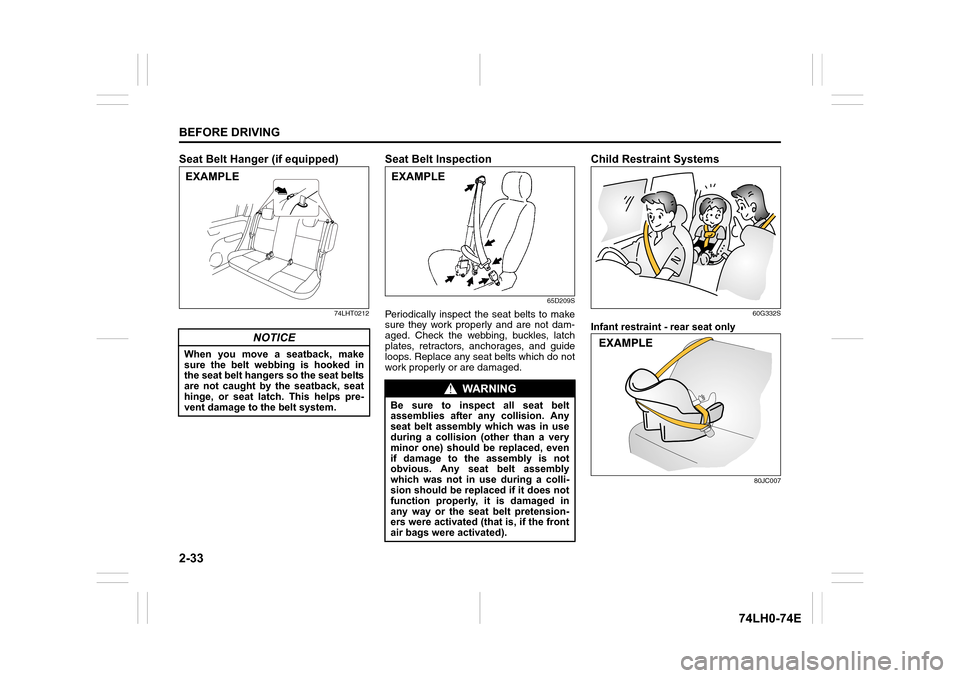
Seat Belt Hanger (if equipped)
74LHT0212
Seat Belt Inspection
65D209S
Periodically inspect the seat belts to make
sure they work properly and are not dam-
aged. Check the webbing, buckles, latch
plates, retractors, anchorages, and guide
loops. Replace any seat belts which do not
work properly or are damaged.
Child Restraint Systems
60G332S
Infant restraint - rear seat only
80JC007
NOTICE
When you move a seatback, make
sure the belt webbing is hooked in
the seat belt hangers so the seat belts
are not caught by the seatback, seat
hinge, or seat latch. This helps pre-
vent damage to the belt system.
EXAMPLE
WA R N I N G
Be sure to inspect all seat belt
assemblies after any collision. Any
seat belt assembly which was in use
during a collision (other than a very
minor one) should be replaced, even
if damage to the assembly is not
obvious. Any seat belt assembly
which was not in use during a colli-
sion should be replaced if it does not
function properly, it is damaged in
any way or the seat belt pretension-
ers were activated (that is, if the front
air bags were activated).
EXAMPLE
Page 53 of 336
2-34
BEFORE DRIVING
74LH0-74E
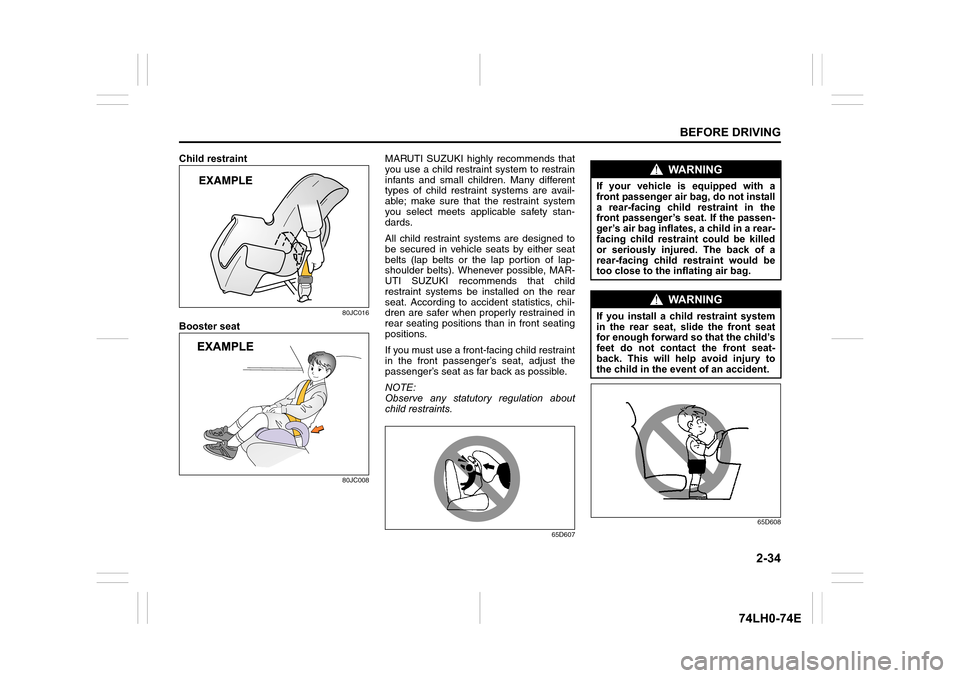
Child restraint
80JC016
Booster seat
80JC008
MARUTI SUZUKI highly recommends that
you use a child restraint system to restrain
infants and small children. Many different
types of child restraint systems are avail-
able; make sure that the restraint system
you select meets applicable safety stan-
dards.
All child restraint systems are designed to
be secured in vehicle seats by either seat
belts (lap belts or the lap portion of lap-
shoulder belts). Whenever possible, MAR-
UTI SUZUKI recommends that child
restraint systems be installed on the rear
seat. According to accident statistics, chil-
dren are safer when properly restrained in
rear seating positions than in front seating
positions.
If you must use a front-facing child restraint
in the front passenger’s seat, adjust the
passenger’s seat as far back as possible.
NOTE:
Observe any statutory regulation about
child restraints.
65D60765D608
WA R N I N G
If your vehicle is equipped with a
front passenger air bag, do not install
a rear-facing child restraint in the
front passenger’s seat. If the passen-
ger’s air bag inflates, a child in a rear-
facing child restraint could be killed
or seriously injured. The back of a
rear-facing child restraint would be
too close to the inflating air bag.
WA R N I N G
If you install a child restraint system
in the rear seat, slide the front seat
for enough forward so that the child’s
feet do not contact the front seat-
back. This will help avoid injury to
the child in the event of an accident.
Page 54 of 336
2-35
BEFORE DRIVING
74LH0-74E
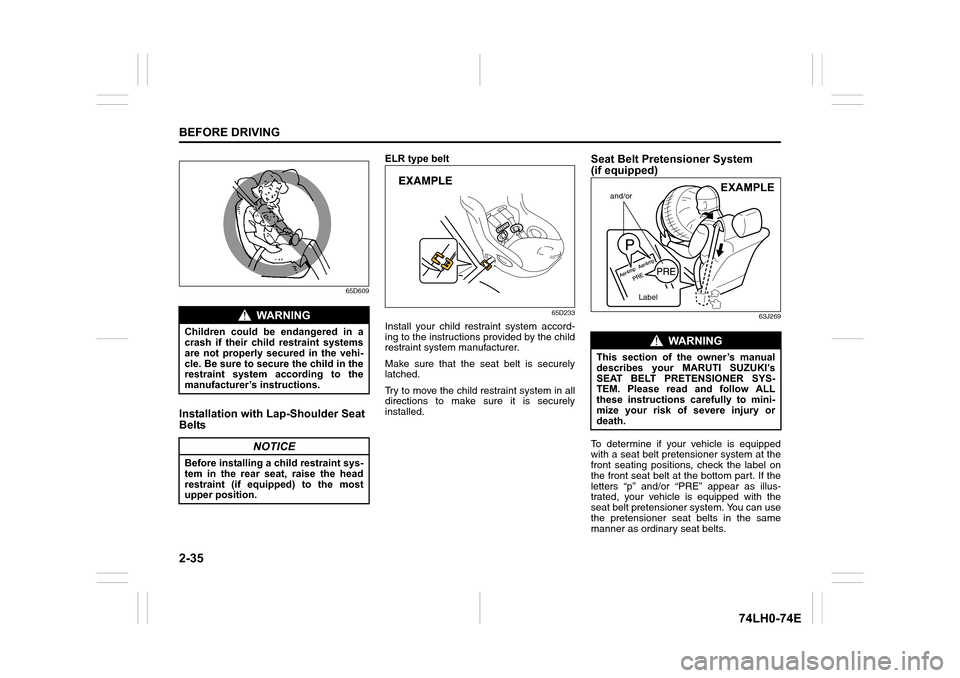
65D609
Installation with Lap-Shoulder Seat
Belts
ELR type belt
65D233
Install your child restraint system accord-
ing to the instructions provided by the child
restraint system manufacturer.
Make sure that the seat belt is securely
latched.
Try to move the child restraint system in all
directions to make sure it is securely
installed.
Seat Belt Pretensioner System
(if equipped)
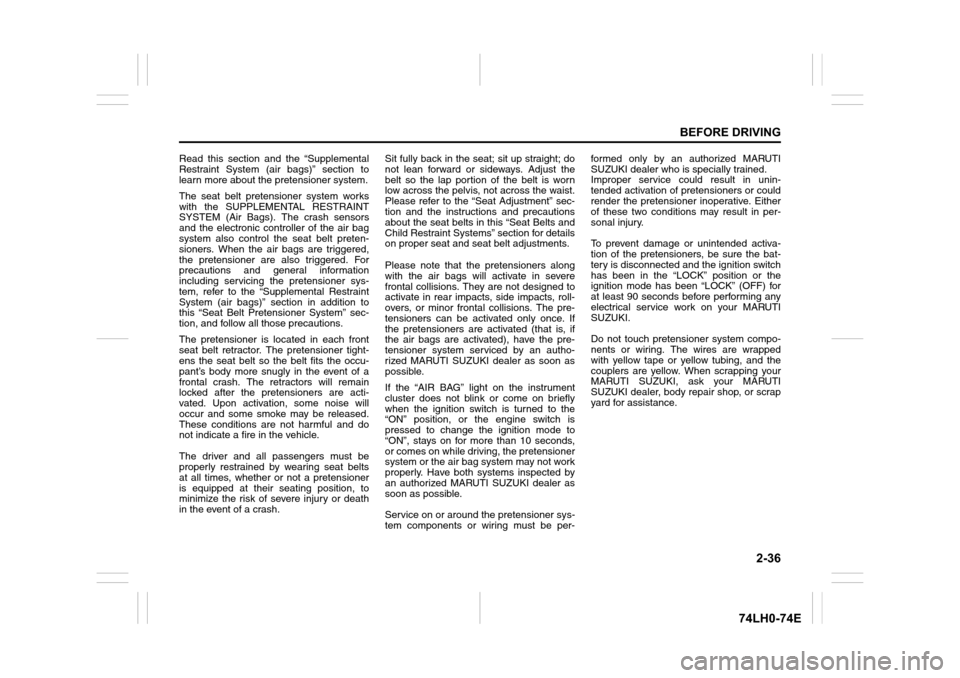
63J269
To determine if your vehicle is equipped
with a seat belt pretensioner system at the
front seating positions, check the label on
the front seat belt at the bottom part. If the
letters “p” and/or “PRE” appear as illus-
trated, your vehicle is equipped with the
seat belt pretensioner system. You can use
the pretensioner seat belts in the same
manner as ordinary seat belts.
WA R N I N G
Children could be endangered in a
crash if their child restraint systems
are not properly secured in the vehi-
cle. Be sure to secure the child in the
restraint system according to the
manufacturer’s instructions.
NOTICE
Before installing a child restraint sys-
tem in the rear seat, raise the head
restraint (if equipped) to the most
upper position.
WA R N I N G
This section of the owner’s manual
describes your MARUTI SUZUKI’s
SEAT BELT PRETENSIONER SYS-
TEM. Please read and follow ALL
these instructions carefully to mini-
mize your risk of severe injury or
death.
and/or
Label
EXAMPLE
Page 55 of 336
2-36
BEFORE DRIVING
74LH0-74E
Read this section and the “Supplemental
Restraint System (air bags)” section to
learn more about the pretensioner system.
The seat belt pretensioner system works
with the SUPPLEMENTAL RESTRAINT
SYSTEM (Air Bags). The crash sensors
and the electronic controller of the air bag
system also control the seat belt preten-
sioners. When the air bags are triggered,
the pretensioner are also triggered. For
precautions and general information
including servicing the pretensioner sys-
tem, refer to the “Supplemental Restraint
System (air bags)” section in addition to
this “Seat Belt Pretensioner System” sec-
tion, and follow all those precautions.
The pretensioner is located in each front
seat belt retractor. The pretensioner tight-
ens the seat belt so the belt fits the occu-
pant’s body more snugly in the event of a
frontal crash. The retractors will remain
locked after the pretensioners are acti-
vated. Upon activation, some noise will
occur and some smoke may be released.
These conditions are not harmful and do
not indicate a fire in the vehicle.
The driver and all passengers must be
properly restrained by wearing seat belts
at all times, whether or not a pretensioner
is equipped at their seating position, to
minimize the risk of severe injury or death
in the event of a crash. Sit fully back in the seat; sit up straight; do
not lean forward or sideways. Adjust the
belt so the lap portion of the belt is worn
low across the pelvis, not across the waist.
Please refer to the “Seat Adjustment” sec-
tion and the instructions and precautions
about the seat belts in this “Seat Belts and
Child Restraint Systems” section for details
on proper seat and seat belt adjustments.
Please note that the pretensioners along
with the air bags will activate in severe
frontal collisions. They are not designed to
activate in rear impacts, side impacts, roll-
overs, or minor frontal collisions. The pre-
tensioners can be activated only once. If
the pretensioners are activated (that is, if
the air bags are activated), have the pre-
tensioner system serviced by an autho-
rized MARUTI SUZUKI dealer as soon as
possible.
If the “AIR BAG” light on the instrument
cluster does not blink or come on briefly
when the ignition switch is turned to the
“ON” position, or the engine switch is
pressed to change the ignition mode to
“ON”, stays on for more than 10 seconds,
or comes on while driving, the pretensioner
system or the air bag system may not work
properly. Have both systems inspected by
an authorized MARUTI SUZUKI dealer as
soon as possible.
Service on or around the pretensioner sys-
tem components or wiring must be per-formed only by an authorized MARUTI
SUZUKI dealer who is specially trained.
Improper service could result in unin-
tended activation of pretensioners or could
render the pretensioner inoperative. Either
of these two conditions may result in per-
sonal injury.
To prevent damage or unintended activa-
tion of the pretensioners, be sure the bat-
tery is disconnected and the ignition switch
has been in the “LOCK” position or the
ignition mode has been “LOCK” (OFF) for
at least 90 seconds before performing any
electrical service work on your MARUTI
SUZUKI.
Do not touch pretensioner system compo-
nents or wiring. The wires are wrapped
with yellow tape or yellow tubing, and the
couplers are yellow. When scrapping your
MARUTI SUZUKI, ask your MARUTI
SUZUKI dealer, body repair shop, or scrap
yard for assistance.
Page 57 of 336
2-38
BEFORE DRIVING
74LH0-74E
Supplemental Restraint
System (air bags)
(if equipped)
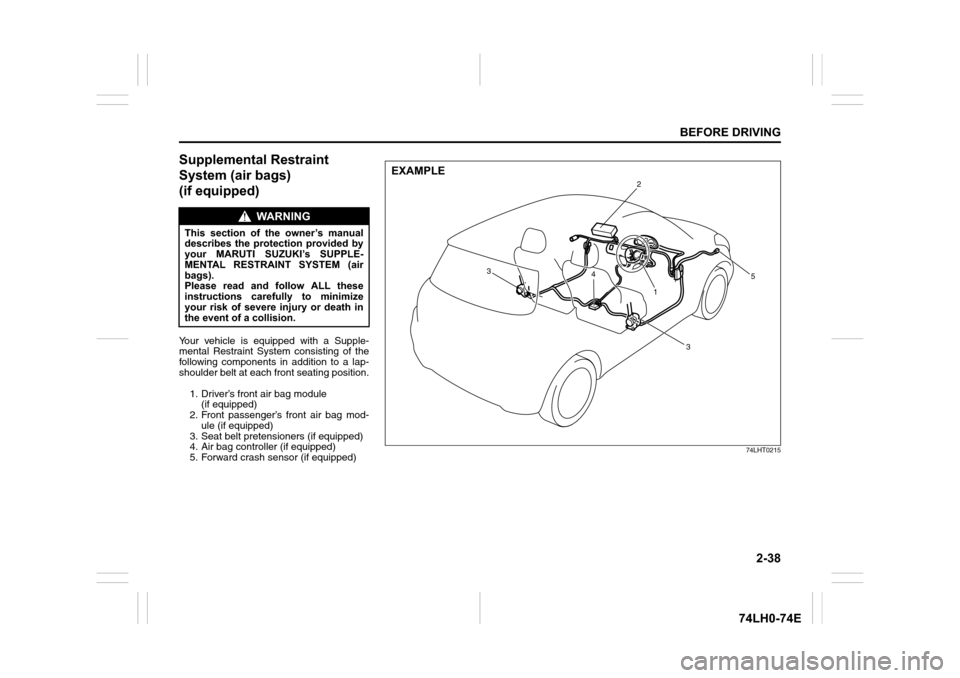
Your vehicle is equipped with a Supple-
mental Restraint System consisting of the
following components in addition to a lap-
shoulder belt at each front seating position.
1. Driver’s front air bag module
(if equipped)
2. Front passenger’s front air bag mod-
ule (if equipped)
3. Seat belt pretensioners (if equipped)
4. Air bag controller (if equipped)
5. Forward crash sensor (if equipped)
WA R N I N G
This section of the owner’s manual
describes the protection provided by
your MARUTI SUZUKI’s SUPPLE-
MENTAL RESTRAINT SYSTEM (air
bags).
Please read and follow ALL these
instructions carefully to minimize
your risk of severe injury or death in
the event of a collision.
74LHT0215
EXAMPLE
1
3 3
42
5
Page 58 of 336
2-39
BEFORE DRIVING
74LH0-74E
“AIR BAG” light (If equipped)
63J030
If the “AIR BAG” light on the instrument
cluster does not blink or come on when the
ignition switch is first turned to the “ON”
position, or the ignition mode is first
changed to “ON” or the “AIR BAG” light
stays on, or comes on while driving, the air
bag system (or the seat belt pretensioner
system) may not work properly. Have the
air bag system inspected by an authorized
MARUTI SUZUKI dealer as soon as possi-
ble.
Front Air Bags
63J113
Front air bags are designed to inflate in
severe frontal collisions when the ignition
switch is in the “ON” position or the ignition
mode is “ON”.
Front air bags are not designed to inflate in
rear impacts, side impacts, rollovers or
minor frontal collisions, since they would
offer no protection in those types of acci-
dents. Remember, since an air bag
deploys only one time during an accident,
seat belts are needed to restrain occu-
pants from further movements during the
accident.
Therefore, an air bag is NOT a substitute
for seat belts. To maximize your protection,
ALWAYS WEAR YOUR SEAT BELTS. Be
aware that no system can prevent all pos-
sible injuries that may occur in an accident.
63J114
The driver’s front air bag is located behind
the center pad of the steering wheel and
the front passenger’s front air bag is
located behind the passenger’s side of the
dashboard. The words “SRS AIRBAG” aremolded into the air bag covers to identity
the location of the air bags.
58MS030
Please refer to the “Seat Belts and Child
Restraint Systems” section in this section
for details on securing your child.
EXAMPLE
WA R N I N G
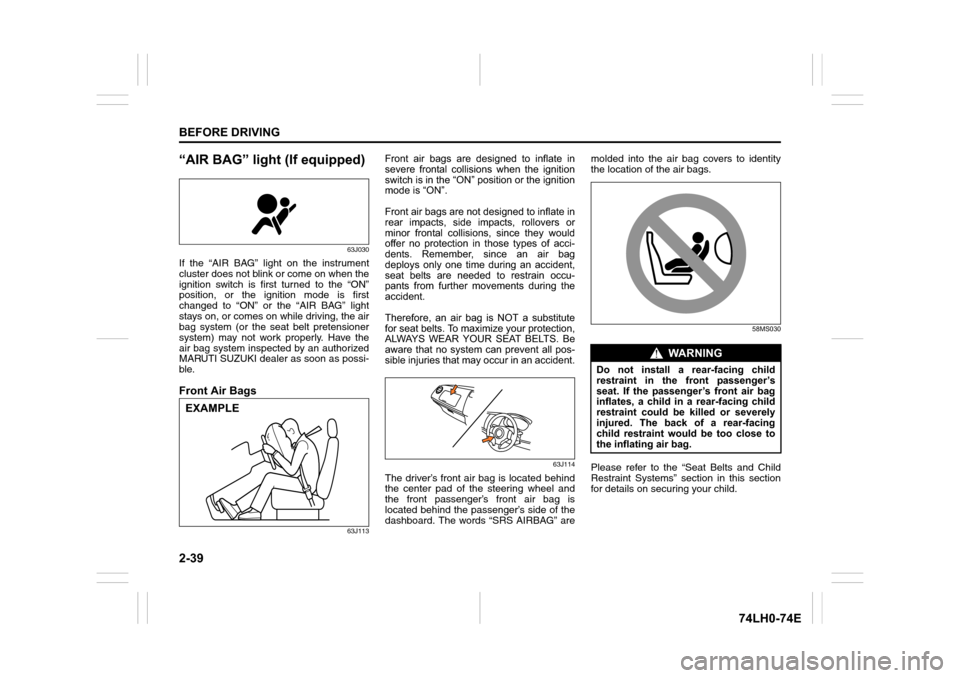
Do not install a rear-facing child
restraint in the front passenger’s
seat. If the passenger’s front air bag
inflates, a child in a rear-facing child
restraint could be killed or severely
injured. The back of a rear-facing
child restraint would be too close to
the inflating air bag.
Page 61 of 336
2-42
BEFORE DRIVING
74LH0-74E
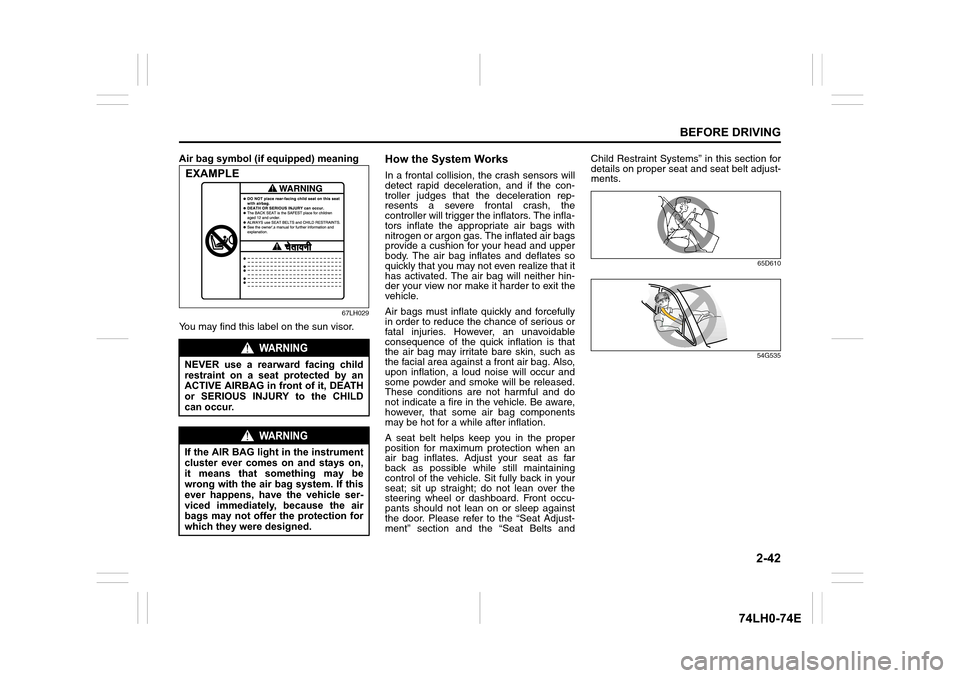
Air bag symbol (if equipped) meaning
67LH029
You may find this label on the sun visor.
How the System Works
In a frontal collision, the crash sensors will
detect rapid deceleration, and if the con-
troller judges that the deceleration rep-
resents a severe frontal crash, the
controller will trigger the inflators. The infla-
tors inflate the appropriate air bags with
nitrogen or argon gas. The inflated air bags
provide a cushion for your head and upper
body. The air bag inflates and deflates so
quickly that you may not even realize that it
has activated. The air bag will neither hin-
der your view nor make it harder to exit the
vehicle.
Air bags must inflate quickly and forcefully
in order to reduce the chance of serious or
fatal injuries. However, an unavoidable
consequence of the quick inflation is that
the air bag may irritate bare skin, such as
the facial area against a front air bag. Also,
upon inflation, a loud noise will occur and
some powder and smoke will be released.
These conditions are not harmful and do
not indicate a fire in the vehicle. Be aware,
however, that some air bag components
may be hot for a while after inflation.
A seat belt helps keep you in the proper
position for maximum protection when an
air bag inflates. Adjust your seat as far
back as possible while still maintaining
control of the vehicle. Sit fully back in your
seat; sit up straight; do not lean over the
steering wheel or dashboard. Front occu-
pants should not lean on or sleep against
the door. Please refer to the “Seat Adjust-
ment” section and the “Seat Belts andChild Restraint Systems” in this section for
details on proper seat and seat belt adjust-
ments.
65D610
54G535
WARNING
NEVER use a rearward facing child
restraint on a seat protected by an
ACTIVE AIRBAG in front of it, DEATH
or SERIOUS INJURY to the CHILD
can occur.
WARNING
If the AIR BAG light in the instrument
cluster ever comes on and stays on,
it means that something may be
wrong with the air bag system. If this
ever happens, have the vehicle ser-
viced immediately, because the air
bags may not offer the protection for
which they were designed.
EXAMPLE
Page 67 of 336
2-48
BEFORE DRIVING
74LH0-74E
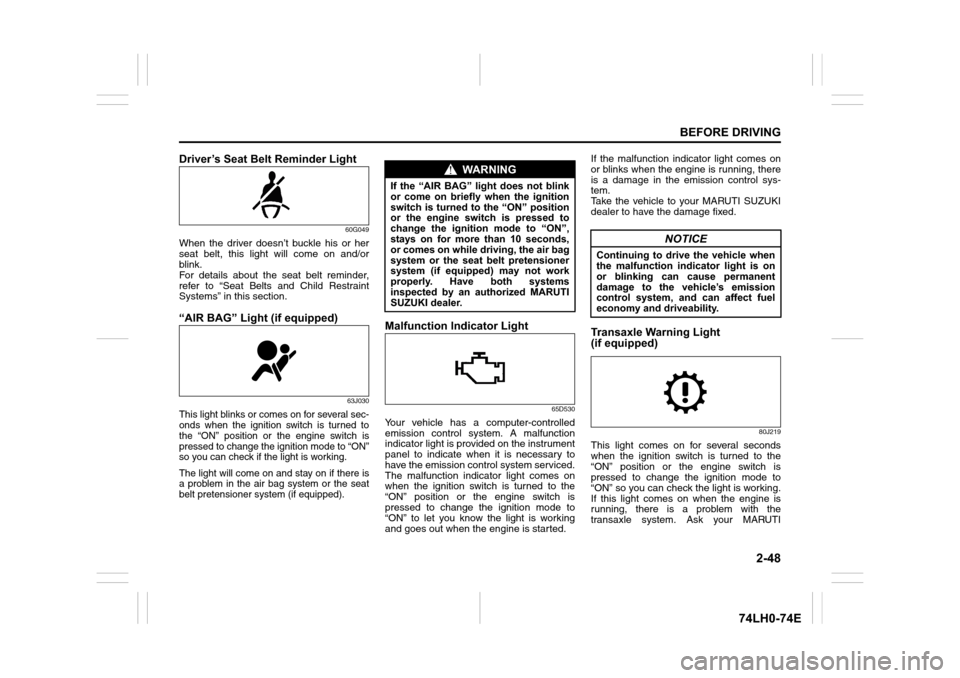
Driver’s Seat Belt Reminder Light
60G049
When the driver doesn’t buckle his or her
seat belt, this light will come on and/or
blink.
For details about the seat belt reminder,
refer to “Seat Belts and Child Restraint
Systems” in this section.
“AIR BAG” Light (if equipped)
63J030
This light blinks or comes on for several sec-
onds when the ignition switch is turned to
the “ON” position or the engine switch is
pressed to change the ignition mode to “ON”
so you can check if the light is working.
The light will come on and stay on if there is
a problem in the air bag system or the seat
belt pretensioner system (if equipped).
Malfunction Indicator Light
65D530
Your vehicle has a computer-controlled
emission control system. A malfunction
indicator light is provided on the instrument
panel to indicate when it is necessary to
have the emission control system serviced.
The malfunction indicator light comes on
when the ignition switch is turned to the
“ON” position or the engine switch is
pressed to change the ignition mode to
“ON” to let you know the light is working
and goes out when the engine is started. If the malfunction indicator light comes on
or blinks when the engine is running, there
is a damage in the emission control sys-
tem.
Take the vehicle to your MARUTI SUZUKI
dealer to have the damage fixed.
Transaxle Warning Light
(if equipped)
80J219
This light comes on for several seconds
when the ignition switch is turned to the
“ON” position or the engine switch is
pressed to change the ignition mode to
“ON” so you can check the light is working.
If this light comes on when the engine is
running, there is a problem with the
transaxle system. Ask your MARUTI
WA R N I N G
If the “AIR BAG” light does not blink
or come on briefly when the ignition
switch is turned to the “ON” position
or the engine switch is pressed to
change the ignition mode to “ON”,
stays on for more than 10 seconds,
or comes on while driving, the air bag
system or the seat belt pretensioner
system (if equipped) may not work
properly. Have both systems
inspected by an authorized MARUTI
SUZUKI dealer.
NOTICE
Continuing to drive the vehicle when
the malfunction indicator light is on
or blinking can cause permanent
damage to the vehicle’s emission
control system, and can affect fuel
economy and driveability.