Throttle SUZUKI SX4 2006 1.G Service Owners Manual
[x] Cancel search | Manufacturer: SUZUKI, Model Year: 2006, Model line: SX4, Model: SUZUKI SX4 2006 1.GPages: 1556, PDF Size: 37.31 MB
Page 651 of 1556
Downloaded from www.Manualslib.com manuals search engine Automatic Transmission/Transaxle: 5A-3
General Description
A/T DescriptionS6RW0D5101001
This automatic transaxle is electronic control full automatic transaxle with forward 3-speed plus overdrive (O/D) and
reverse 1-speed.
The torque converter is a 3-element, 1-step and 2-phase type and is equipped with an automatically controlled lock-up
mechanism.
The gear change device consists of a ravigneau type planetary gear unit, 3 multiple disc type clutches, 3 multiple disc
type brakes and 2 one-way clutches.
The hydraulic pressure control device consists of a valve body assembly, pressure control solenoid valve (linear
solenoid), 2 shift solenoid valves, TCC solenoid valve (TCC pressure control solenoid valve) (linear solenoid) and a
timing solenoid valve. Optimum line pressure complying with engine torque is produced by the pressure control
solenoid valve in dependence upon control signal from transmission control module (TCM). This makes it possible to
control the line pressure with high accuracy in accordance with the engine power and running conditions to achieve
smooth shifting characteristics and high efficiency.
A clutch-to-clutch control system is provided for shifting between 3rd gear and 4th gear. This clutch-to-clutch control
system is made to function optimally, so that hydraulic pressure controls such as shown below are conducted.
• When upshifting from 3rd gear to 4th gear, to adjust the drain hydraulic pressure at releasing the forward clutch, a
timing solenoid valve is used to switch a hydraulic passage with an orifice to another during shifting.
• When downshifting from 4th gear to 3rd gear, to adjust the line pressure applied to the forward clutch at engaging
the forward clutch, a timing solenoid valve is used to switch a hydraulic passage with an orifice to another during
shifting.
• When upshifting from 3rd gear to 4th gear with engine throttle opened, to optimize the line pressure applied to the
forward clutch at releasing the forward clutch, the learning control is processed to compensate the switching timing
of the timing solenoid at every shifting.
• When downshifting from 4th gear to 3rd gear with engine throttle opened, to optimize the line pressure applied to
the forward clutch at engaging the forward clutch, the learning control is processed to compensate the line pressure
at every shifting.
Employing the ravigneau type planetary gear unit and this clutch-to-clutch control system greatly simplifies the
construction to make possible a lightweight and compact transaxle.
A line pressure learning control is conducted to provide optimum shifting time at every upshifting with engine throttle
opened. If long upshifting time is detected, the subsequent line pressure applied during upshifting is intensified. On the
contrary, if short upshifting time is detected, the subsequent line pressure applied during upshifting is weakened.
Page 657 of 1556
Downloaded from www.Manualslib.com manuals search engine Automatic Transmission/Transaxle: 5A-9
CAN Communication System DescriptionS6RW0D5101006
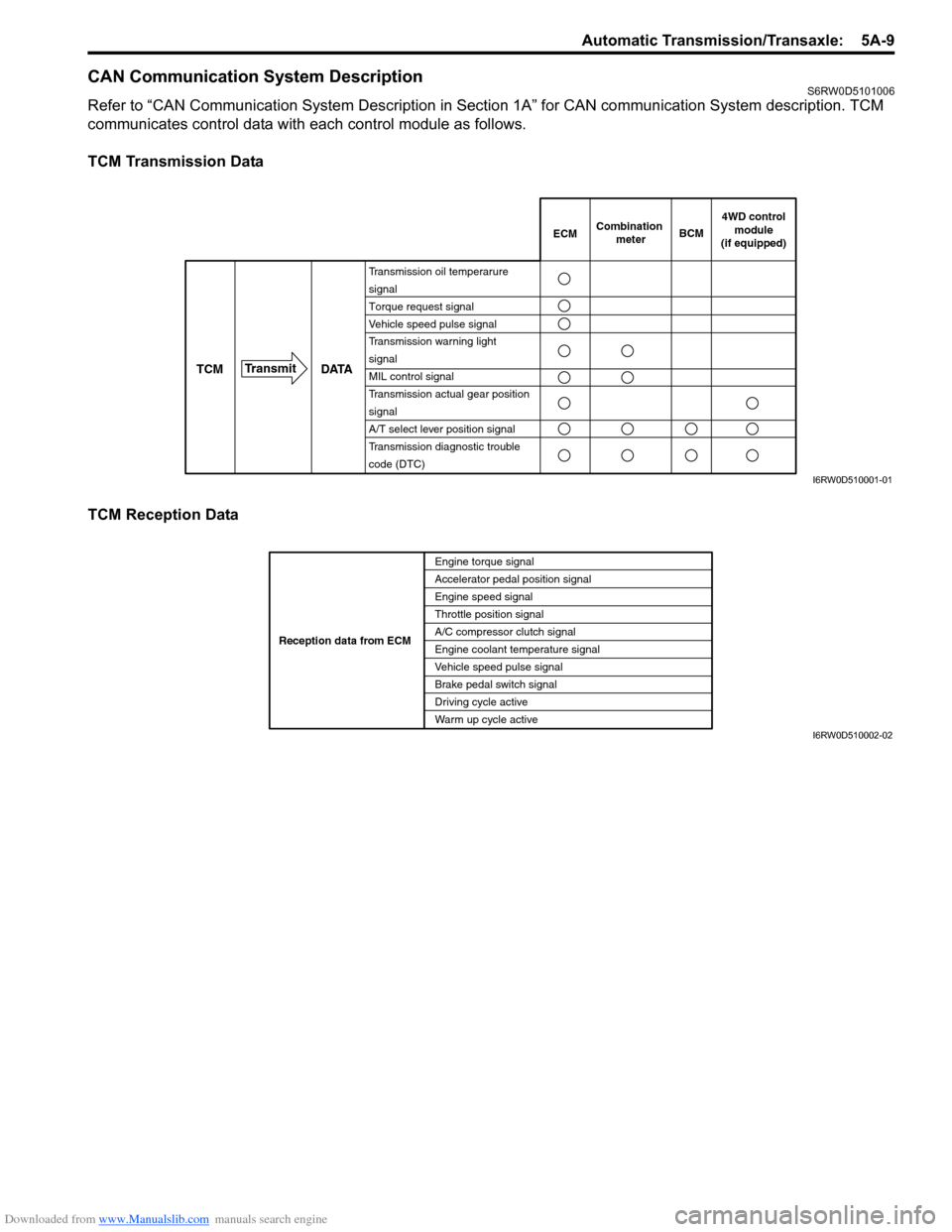
Refer to “CAN Communication System Description in Section 1A” for CAN communication System description. TCM
communicates control data with each control module as follows.
TCM Transmission Data
TCM Reception Data
DATA TCMTransmit
Transmission oil temperarure
signal
Torque request signal
Vehicle speed pulse signal
Transmission warning light
signal
MIL control signal
Transmission actual gear position
signal
A/T select lever position signal
Transmission diagnostic trouble
code (DTC)
ECMCombination
meterBCM
4WD control
module
(if equipped)
I6RW0D510001-01
Engine torque signal
Accelerator pedal position signal
Engine speed signal
Throttle position signal
A/C compressor clutch signal
Engine coolant temperature signal
Vehicle speed pulse signal
Brake pedal switch signal
Driving cycle active
Warm up cycle active Reception data from ECM
I6RW0D510002-02
Page 660 of 1556
Downloaded from www.Manualslib.com manuals search engine 5A-12 Automatic Transmission/Transaxle:
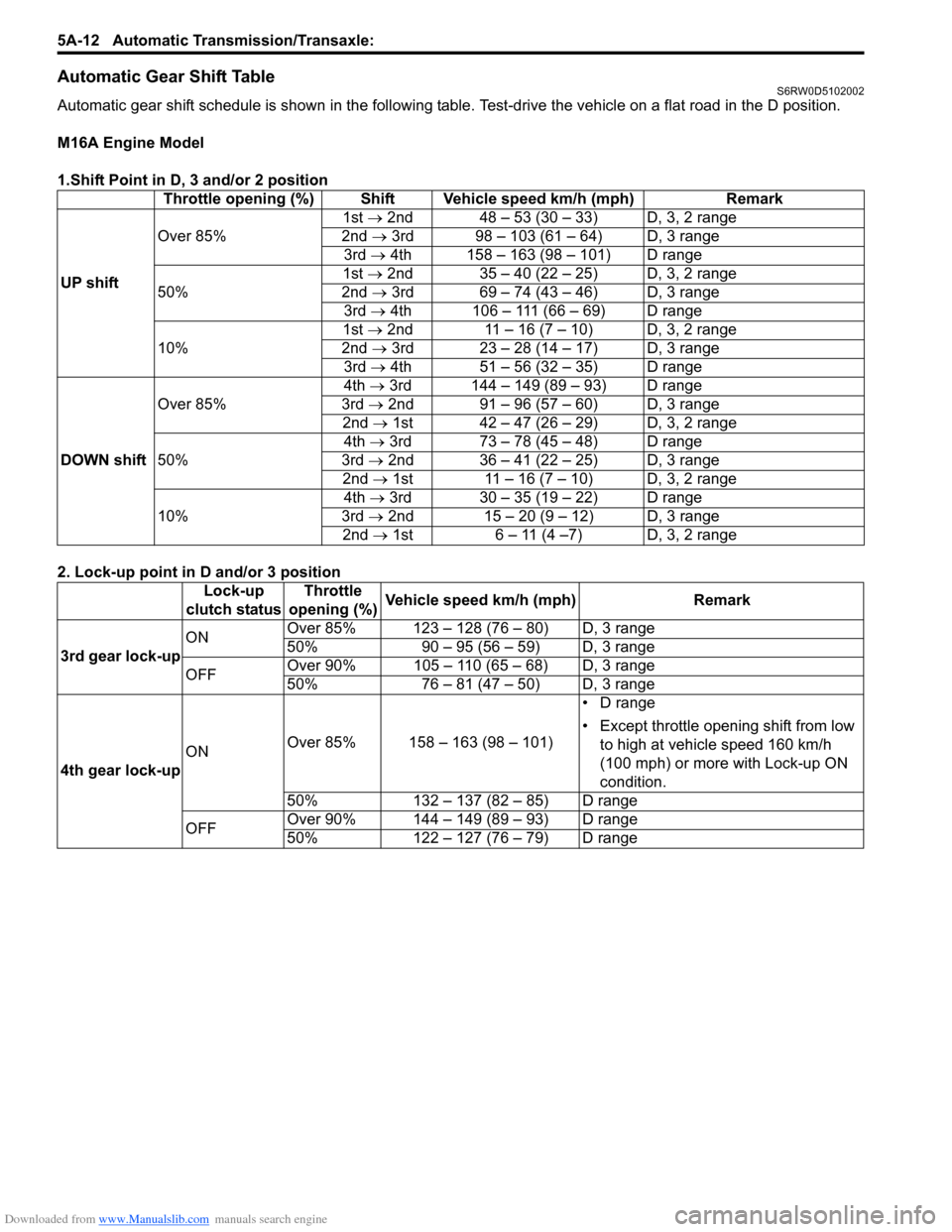
Automatic Gear Shift TableS6RW0D5102002
Automatic gear shift schedule is shown in the following table. Test-drive the vehicle on a flat road in the D position.
M16A Engine Model
1.Shift Point in D, 3 and/or 2 position
2. Lock-up point in D and/or 3 positionThrottle opening (%) Shift Vehicle speed km/h (mph) Remark
UP shiftOver 85%1st → 2nd 48 – 53 (30 – 33) D, 3, 2 range
2nd → 3rd 98 – 103 (61 – 64) D, 3 range
3rd → 4th 158 – 163 (98 – 101) D range
50%1st → 2nd 35 – 40 (22 – 25) D, 3, 2 range
2nd → 3rd 69 – 74 (43 – 46) D, 3 range
3rd → 4th 106 – 111 (66 – 69) D range
10%1st → 2nd 11 – 16 (7 – 10) D, 3, 2 range
2nd → 3rd 23 – 28 (14 – 17) D, 3 range
3rd → 4th 51 – 56 (32 – 35) D range
DOWN shiftOver 85%4th → 3rd 144 – 149 (89 – 93) D range
3rd → 2nd 91 – 96 (57 – 60) D, 3 range
2nd → 1st 42 – 47 (26 – 29) D, 3, 2 range
50%4th → 3rd 73 – 78 (45 – 48) D range
3rd → 2nd 36 – 41 (22 – 25) D, 3 range
2nd → 1st 11 – 16 (7 – 10) D, 3, 2 range
10%4th → 3rd 30 – 35 (19 – 22) D range
3rd → 2nd 15 – 20 (9 – 12) D, 3 range
2nd → 1st 6 – 11 (4 –7) D, 3, 2 range
Lock-up
clutch statusThrottle
opening (%)Vehicle speed km/h (mph) Remark
3rd gear lock-upONOver 85% 123 – 128 (76 – 80) D, 3 range
50% 90 – 95 (56 – 59) D, 3 range
OFFOver 90% 105 – 110 (65 – 68) D, 3 range
50% 76 – 81 (47 – 50) D, 3 range
4th gear lock-upONOver 85% 158 – 163 (98 – 101)•D range
• Except throttle opening shift from low
to high at vehicle speed 160 km/h
(100 mph) or more with Lock-up ON
condition.
50% 132 – 137 (82 – 85) D range
OFFOver 90% 144 – 149 (89 – 93) D range
50% 122 – 127 (76 – 79) D range
Page 661 of 1556
Downloaded from www.Manualslib.com manuals search engine Automatic Transmission/Transaxle: 5A-13
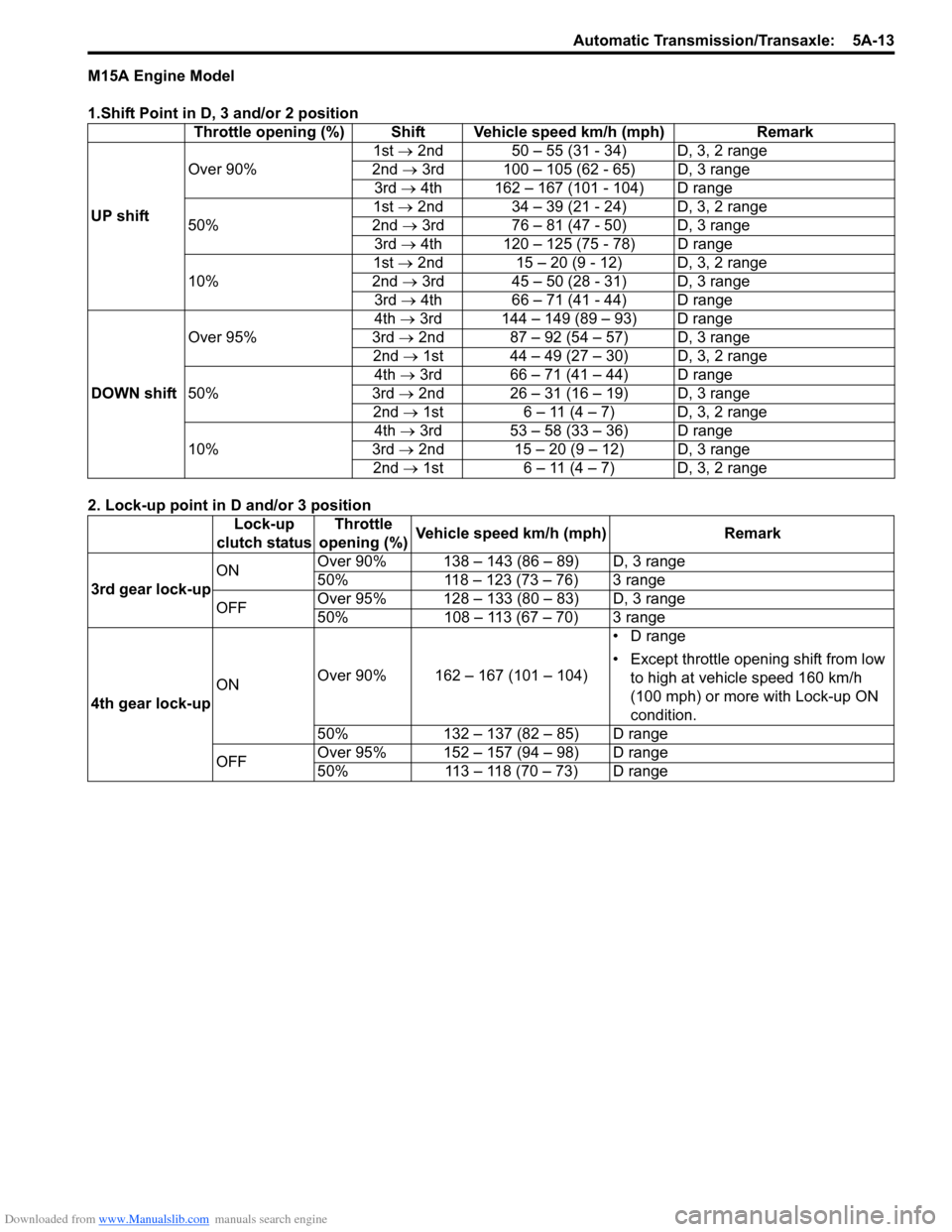
M15A Engine Model
1.Shift Point in D, 3 and/or 2 position
2. Lock-up point in D and/or 3 positionThrottle opening (%) Shift Vehicle speed km/h (mph) Remark
UP shiftOver 90%1st → 2nd 50 – 55 (31 - 34) D, 3, 2 range
2nd → 3rd 100 – 105 (62 - 65) D, 3 range
3rd → 4th 162 – 167 (101 - 104) D range
50%1st → 2nd 34 – 39 (21 - 24) D, 3, 2 range
2nd → 3rd 76 – 81 (47 - 50) D, 3 range
3rd → 4th 120 – 125 (75 - 78) D range
10%1st → 2nd 15 – 20 (9 - 12) D, 3, 2 range
2nd → 3rd 45 – 50 (28 - 31) D, 3 range
3rd → 4th 66 – 71 (41 - 44) D range
DOWN shiftOver 95%4th → 3rd 144 – 149 (89 – 93) D range
3rd → 2nd 87 – 92 (54 – 57) D, 3 range
2nd → 1st 44 – 49 (27 – 30) D, 3, 2 range
50%4th → 3rd 66 – 71 (41 – 44) D range
3rd → 2nd 26 – 31 (16 – 19) D, 3 range
2nd → 1st 6 – 11 (4 – 7) D, 3, 2 range
10%4th → 3rd 53 – 58 (33 – 36) D range
3rd → 2nd 15 – 20 (9 – 12) D, 3 range
2nd → 1st 6 – 11 (4 – 7) D, 3, 2 range
Lock-up
clutch statusThrottle
opening (%)Vehicle speed km/h (mph) Remark
3rd gear lock-upONOver 90% 138 – 143 (86 – 89) D, 3 range
50% 118 – 123 (73 – 76) 3 range
OFFOver 95% 128 – 133 (80 – 83) D, 3 range
50% 108 – 113 (67 – 70) 3 range
4th gear lock-upONOver 90% 162 – 167 (101 – 104)•D range
• Except throttle opening shift from low
to high at vehicle speed 160 km/h
(100 mph) or more with Lock-up ON
condition.
50% 132 – 137 (82 – 85) D range
OFFOver 95% 152 – 157 (94 – 98) D range
50% 113 – 118 (70 – 73) D range
Page 663 of 1556
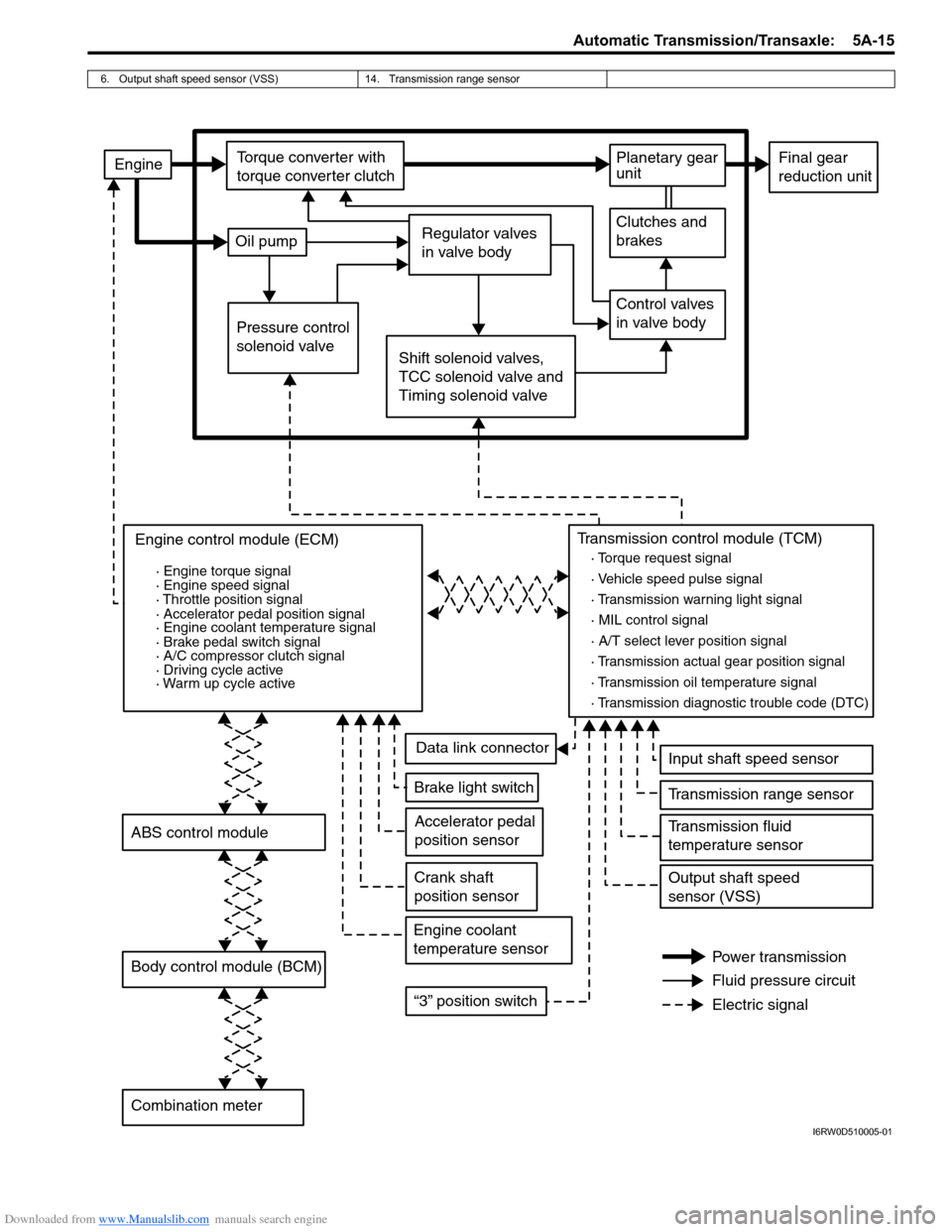
Downloaded from www.Manualslib.com manuals search engine Automatic Transmission/Transaxle: 5A-15
6. Output shaft speed sensor (VSS) 14. Transmission range sensor
EngineTorque converter with
torque converter clutch
Oil pumpRegulator valves
in valve body
Planetary gear
unit
Clutches and
brakes
Control valves
in valve body
Shift solenoid valves,
TCC solenoid valve and
Timing solenoid valve Pressure control
solenoid valve
Final gear
reduction unit
Engine control module (ECM)
Body control module (BCM)
Combination meter
· Engine torque signal
· Engine speed signal
Transmission control module (TCM)
· Torque request signal
· Throttle position signal
· Accelerator pedal position signal
· Engine coolant temperature signal
· Brake pedal switch signal
· Driving cycle active
· Warm up cycle active
Accelerator pedal
position sensor
Crank shaft
position sensor
Engine coolant
temperature sensor
Input shaft speed sensor
Brake light switch
“3” position switch
Transmission range sensor
Transmission fluid
temperature sensor
Output shaft speed
sensor (VSS)
Power transmission
Fluid pressure circuit
Electric signal
Data link connector
· Transmission diagnostic trouble code (DTC) · Vehicle speed pulse signal
· Transmission warning light signal
· A/T select lever position signal
· Transmission actual gear position signal
· Transmission oil temperature signal · MIL control signal
ABS control module
· A/C compressor clutch signal
I6RW0D510005-01
Page 666 of 1556
Downloaded from www.Manualslib.com manuals search engine 5A-18 Automatic Transmission/Transaxle:
Step 2. DTC / Freeze Frame Data Check, Record and
Clearance
First, referring to “DTC Check”, check DTC and pending
DTC. If DTC exists, print or write down DTC and freeze
frame data and then clear malfunction DTC(s) by
referring to “DTC Clearance”. Malfunction DTC indicates
malfunction in the system but it is not possible to know
from it whether the malfunction is occurring now or it
occurred in the past and normal condition has been
restored. In order to know that, check symptom in
question according to Step 5 and then recheck DTC
according to Step 6.
Diagnosing a trouble based on the DTC in this step only
or failure to clear the DTC in this step may result in an
faulty diagnosis, trouble diagnosis of a normal circuit or
difficulty in troubleshooting which is otherwise
unnecessary.
Step 3 and 4. Visual Inspection
As a preliminary step, be sure to perform visual check of
the items that support proper function of the engine and
automatic transaxle referring to “Visual Inspection”.
Step 5. Trouble Symptom Confirmation
Check trouble symptoms based on information obtained
in “Step 1. Customer Complaint Analysis: ” and “Step 2.
DTC / Freeze Frame Data Check, Record and
Clearance: ”.
Also, reconfirm DTC according to “DTC Confirmation
Procedure” described in each DTC flow.
Step 6 and 7. Rechecking and Record of DTC and
Freeze Frame Data
Refer to “DTC Check” for checking procedure.Step 8. A/T Basic Check and A/T Symptom
Diagnosis
Perform basic check of A/T according to “A/T Basic
Check” first. When the end of the flow has been reached,
check the parts of the system suspected as a possible
cause referring to “A/T Symptom Diagnosis” and based
on symptoms appearing on the vehicle (symptoms
obtained through steps of customer complaint analysis,
trouble symptom confirmation and/or A/T basic check)
and repair or replace faulty parts, if any.
Step 9. Troubleshooting for DTC
Based on the DTC indicated in Step 6 / 7 and referring to
“applicable DTC flow”, locate the cause of the trouble,
namely in a sensor, switch, wire harness, connector,
actuator, TCM or other part and repair or replace faulty
parts.
Step 10. Check for Intermittent Problem
Check parts where an intermittent trouble is easy to
occur (e.g. wire harness, connector, etc.), referring to
“Intermittent and Poor Connection Inspection in Section
00” and related circuit of DTC recorded in Step 2.
Step 11. Final Confirmation Test
Confirm that the problem symptom has gone and the
vehicle is free from any abnormal conditions. If what has
been repaired is related to the malfunction DTC, clear
the DTC once and check to ensure that no malfunction
DTC is indicated.
Visual InspectionS6RW0D5104002
Visually check the following parts and systems.
Inspection item Referring
• A/T fluid ----- level, leakage, color “Automatic Transaxle Fluid Level Inspection in
Section 0B”
• A/T fluid hoses ----- disconnection, looseness, deterioration “A/T Fluid Cooler Hoses Replacement”
• Throttle cable (if equipped) ----- play (under warm engine),
installation
• A/T select cable ----- installation “Select Cable Removal and Installation”
• Engine oil ----- level, leakage “Engine Oil and Filter Change in Section 0B”
• Engine coolant ----- level, leakage “Engine Coolant Change in Section 0B”
• Engine mountings ----- play, looseness, damage “Engine Assembly Removal and Installation in
Section 1D”
• Suspension ----- play, looseness “Suspension, Wheels and Tires Symptom
Diagnosis in Section 2A”
• Drive shafts ----- damage “Front Drive Shaft Assembly On-Vehicle Inspection
in Section 3A”
• Battery ----- indicator condition, corrosion of terminal “Battery Inspection in Section 1J”
• Connectors of electric wire harness ----- disconnection, friction “Electronic Shift Control System Components
Location”
• Fuses ----- burning
• Parts ----- installation, damage
• Bolts ----- looseness
• Other parts that can be checked visually
Page 671 of 1556
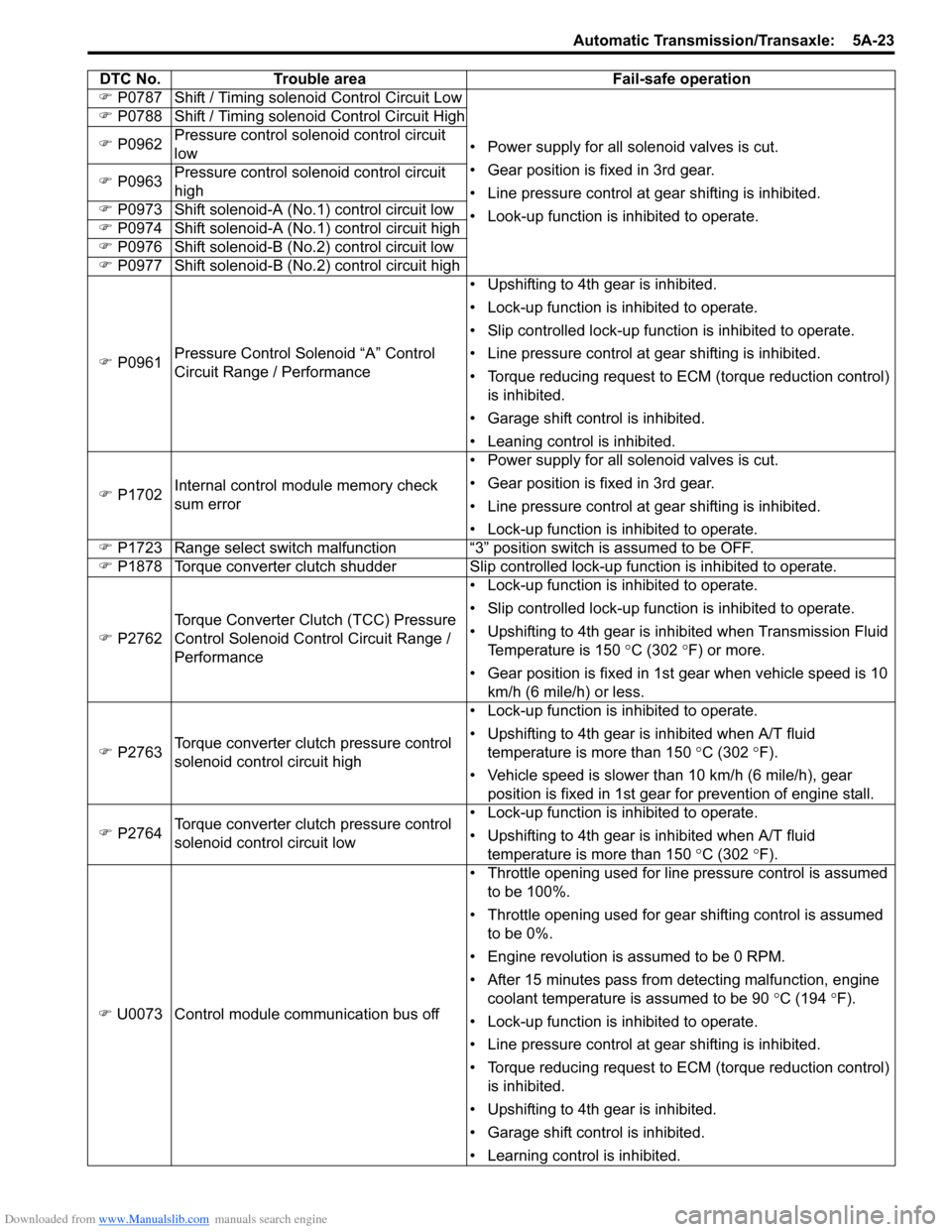
Downloaded from www.Manualslib.com manuals search engine Automatic Transmission/Transaxle: 5A-23
) P0787 Shift / Timing solenoid Control Circuit Low
• Power supply for all solenoid valves is cut.
• Gear position is fixed in 3rd gear.
• Line pressure control at gear shifting is inhibited.
• Look-up function is inhibited to operate. ) P0788 Shift / Timing solenoid Control Circuit High
) P0962Pressure control solenoid control circuit
low
) P0963Pressure control solenoid control circuit
high
) P0973 Shift solenoid-A (No.1) control circuit low
) P0974 Shift solenoid-A (No.1) control circuit high
) P0976 Shift solenoid-B (No.2) control circuit low
) P0977 Shift solenoid-B (No.2) control circuit high
) P0961Pressure Control Solenoid “A” Control
Circuit Range / Performance• Upshifting to 4th gear is inhibited.
• Lock-up function is inhibited to operate.
• Slip controlled lock-up function is inhibited to operate.
• Line pressure control at gear shifting is inhibited.
• Torque reducing request to ECM (torque reduction control)
is inhibited.
• Garage shift control is inhibited.
• Leaning control is inhibited.
) P1702Internal control module memory check
sum error• Power supply for all solenoid valves is cut.
• Gear position is fixed in 3rd gear.
• Line pressure control at gear shifting is inhibited.
• Lock-up function is inhibited to operate.
) P1723 Range select switch malfunction “3” position switch is assumed to be OFF.
) P1878 Torque converter clutch shudder Slip controlled lock-up function is inhibited to operate.
) P2762Torque Converter Clutch (TCC) Pressure
Control Solenoid Control Circuit Range /
Performance• Lock-up function is inhibited to operate.
• Slip controlled lock-up function is inhibited to operate.
• Upshifting to 4th gear is inhibited when Transmission Fluid
Temperature is 150 °C (302 °F) or more.
• Gear position is fixed in 1st gear when vehicle speed is 10
km/h (6 mile/h) or less.
) P2763Torque converter clutch pressure control
solenoid control circuit high• Lock-up function is inhibited to operate.
• Upshifting to 4th gear is inhibited when A/T fluid
temperature is more than 150 °C (302 °F).
• Vehicle speed is slower than 10 km/h (6 mile/h), gear
position is fixed in 1st gear for prevention of engine stall.
) P2764Torque converter clutch pressure control
solenoid control circuit low• Lock-up function is inhibited to operate.
• Upshifting to 4th gear is inhibited when A/T fluid
temperature is more than 150 °C (302 °F).
) U0073 Control module communication bus off• Throttle opening used for line pressure control is assumed
to be 100%.
• Throttle opening used for gear shifting control is assumed
to be 0%.
• Engine revolution is assumed to be 0 RPM.
• After 15 minutes pass from detecting malfunction, engine
coolant temperature is assumed to be 90 °C (194 °F).
• Lock-up function is inhibited to operate.
• Line pressure control at gear shifting is inhibited.
• Torque reducing request to ECM (torque reduction control)
is inhibited.
• Upshifting to 4th gear is inhibited.
• Garage shift control is inhibited.
• Learning control is inhibited. DTC No. Trouble area Fail-safe operation
Page 672 of 1556
Downloaded from www.Manualslib.com manuals search engine 5A-24 Automatic Transmission/Transaxle:
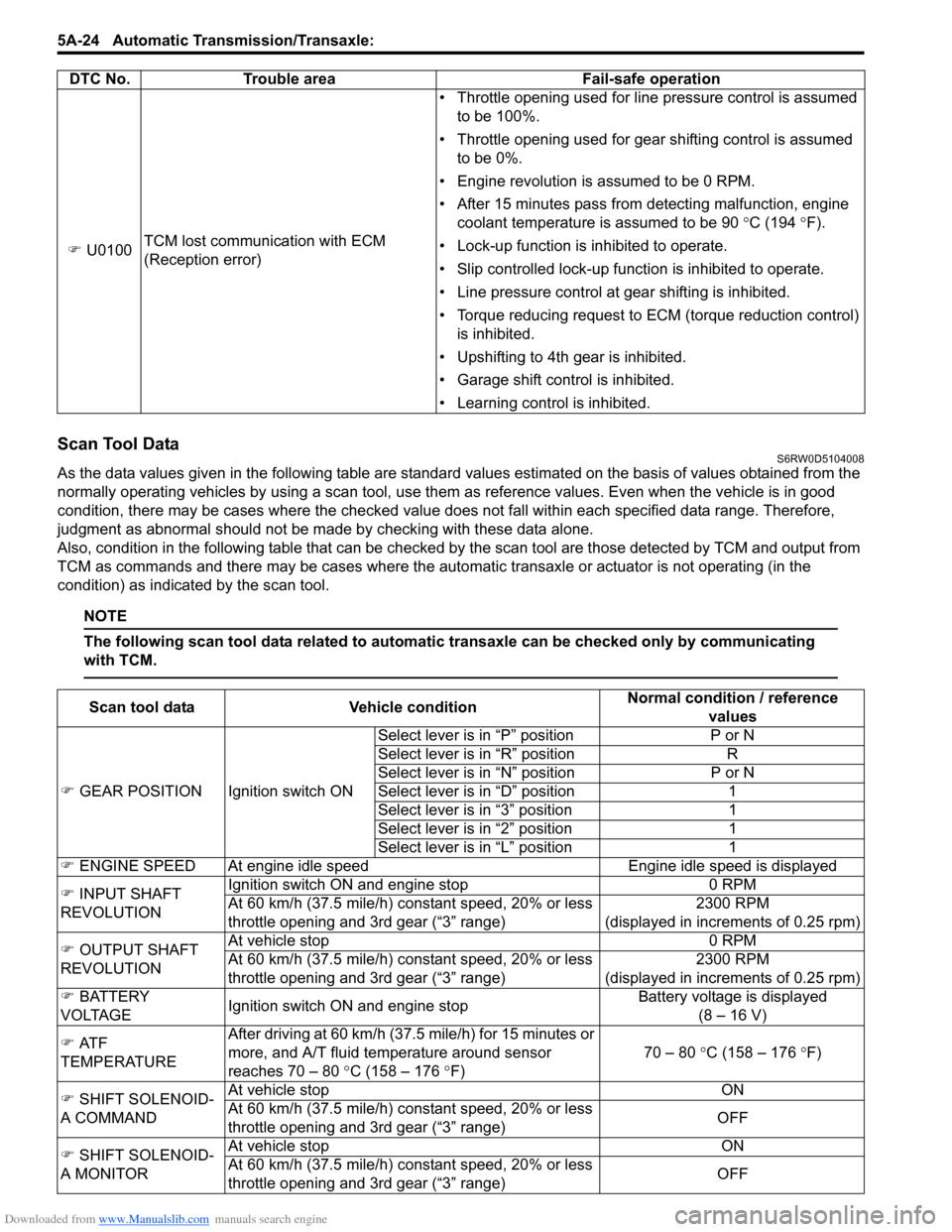
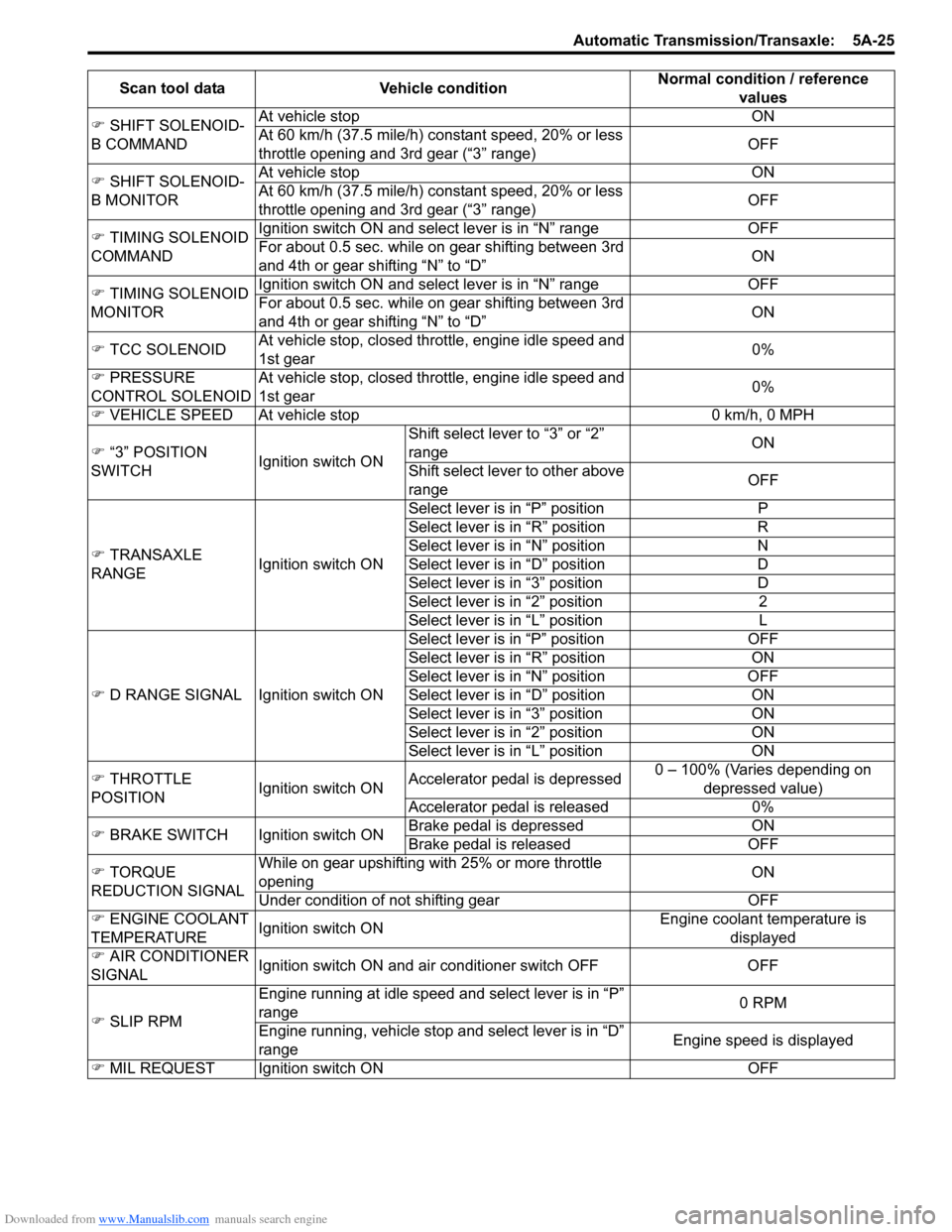
Scan Tool DataS6RW0D5104008
As the data values given in the following table are standard values estimated on the basis of values obtained from the
normally operating vehicles by using a scan tool, use them as reference values. Even when the vehicle is in good
condition, there may be cases where the checked value does not fall within each specified data range. Therefore,
judgment as abnormal should not be made by checking with these data alone.
Also, condition in the following table that can be checked by the scan tool are those detected by TCM and output from
TCM as commands and there may be cases where the automatic transaxle or actuator is not operating (in the
condition) as indicated by the scan tool.
NOTE
The following scan tool data related to automatic transaxle can be checked only by communicating
with TCM.
) U0100TCM lost communication with ECM
(Reception error)• Throttle opening used for line pressure control is assumed
to be 100%.
• Throttle opening used for gear shifting control is assumed
to be 0%.
• Engine revolution is assumed to be 0 RPM.
• After 15 minutes pass from detecting malfunction, engine
coolant temperature is assumed to be 90 °C (194 °F).
• Lock-up function is inhibited to operate.
• Slip controlled lock-up function is inhibited to operate.
• Line pressure control at gear shifting is inhibited.
• Torque reducing request to ECM (torque reduction control)
is inhibited.
• Upshifting to 4th gear is inhibited.
• Garage shift control is inhibited.
• Learning control is inhibited. DTC No. Trouble area Fail-safe operation
Scan tool data Vehicle conditionNormal condition / reference
values
) GEAR POSITION Ignition switch ONSelect lever is in “P” position P or N
Select lever is in “R” position R
Select lever is in “N” position P or N
Select lever is in “D” position 1
Select lever is in “3” position 1
Select lever is in “2” position 1
Select lever is in “L” position 1
) ENGINE SPEED At engine idle speed Engine idle speed is displayed
) INPUT SHAFT
REVOLUTIONIgnition switch ON and engine stop 0 RPM
At 60 km/h (37.5 mile/h) constant speed, 20% or less
throttle opening and 3rd gear (“3” range)2300 RPM
(displayed in increments of 0.25 rpm)
) OUTPUT SHAFT
REVOLUTIONAt vehicle stop 0 RPM
At 60 km/h (37.5 mile/h) constant speed, 20% or less
throttle opening and 3rd gear (“3” range)2300 RPM
(displayed in increments of 0.25 rpm)
) BATTERY
VOLTAGEIgnition switch ON and engine stopBattery voltage is displayed
(8 – 16 V)
) AT F
TEMPERATUREAfter driving at 60 km/h (37.5 mile/h) for 15 minutes or
more, and A/T fluid temperature around sensor
reaches 70 – 80 °C (158 – 176 °F)70 – 80 °C (158 – 176 °F)
) SHIFT SOLENOID-
A COMMANDAt vehicle stop ON
At 60 km/h (37.5 mile/h) constant speed, 20% or less
throttle opening and 3rd gear (“3” range)OFF
) SHIFT SOLENOID-
A MONITORAt vehicle stop ON
At 60 km/h (37.5 mile/h) constant speed, 20% or less
throttle opening and 3rd gear (“3” range)OFF
Page 673 of 1556
Downloaded from www.Manualslib.com manuals search engine Automatic Transmission/Transaxle: 5A-25
) SHIFT SOLENOID-
B COMMANDAt vehicle stop ON
At 60 km/h (37.5 mile/h) constant speed, 20% or less
throttle opening and 3rd gear (“3” range)OFF
) SHIFT SOLENOID-
B MONITORAt vehicle stop ON
At 60 km/h (37.5 mile/h) constant speed, 20% or less
throttle opening and 3rd gear (“3” range)OFF
) TIMING SOLENOID
COMMANDIgnition switch ON and select lever is in “N” range OFF
For about 0.5 sec. while on gear shifting between 3rd
and 4th or gear shifting “N” to “D”ON
) TIMING SOLENOID
MONITORIgnition switch ON and select lever is in “N” range OFF
For about 0.5 sec. while on gear shifting between 3rd
and 4th or gear shifting “N” to “D”ON
) TCC SOLENOID At vehicle stop, closed throttle, engine idle speed and
1st gear0%
) PRESSURE
CONTROL SOLENOIDAt vehicle stop, closed throttle, engine idle speed and
1st gear0%
) VEHICLE SPEED At vehicle stop 0 km/h, 0 MPH
) “3” POSITION
SWITCHIgnition switch ONShift select lever to “3” or “2”
rangeON
Shift select lever to other above
rangeOFF
) TRANSAXLE
RANGEIgnition switch ONSelect lever is in “P” position P
Select lever is in “R” position R
Select lever is in “N” position N
Select lever is in “D” position D
Select lever is in “3” position D
Select lever is in “2” position 2
Select lever is in “L” position L
) D RANGE SIGNAL Ignition switch ONSelect lever is in “P” position OFF
Select lever is in “R” position ON
Select lever is in “N” position OFF
Select lever is in “D” position ON
Select lever is in “3” position ON
Select lever is in “2” position ON
Select lever is in “L” position ON
) THROTTLE
POSITIONIgnition switch ONAccelerator pedal is depressed0 – 100% (Varies depending on
depressed value)
Accelerator pedal is released 0%
) BRAKE SWITCH Ignition switch ONBrake pedal is depressed ON
Brake pedal is released OFF
) TORQUE
REDUCTION SIGNALWhile on gear upshifting with 25% or more throttle
openingON
Under condition of not shifting gear OFF
) ENGINE COOLANT
TEMPERATUREIgnition switch ONEngine coolant temperature is
displayed
) AIR CONDITIONER
SIGNALIgnition switch ON and air conditioner switch OFF OFF
) SLIP RPMEngine running at idle speed and select lever is in “P”
range0 RPM
Engine running, vehicle stop and select lever is in “D”
rangeEngine speed is displayed
) MIL REQUEST Ignition switch ON OFFScan tool data Vehicle conditionNormal condition / reference
values
Page 674 of 1556
Downloaded from www.Manualslib.com manuals search engine 5A-26 Automatic Transmission/Transaxle:
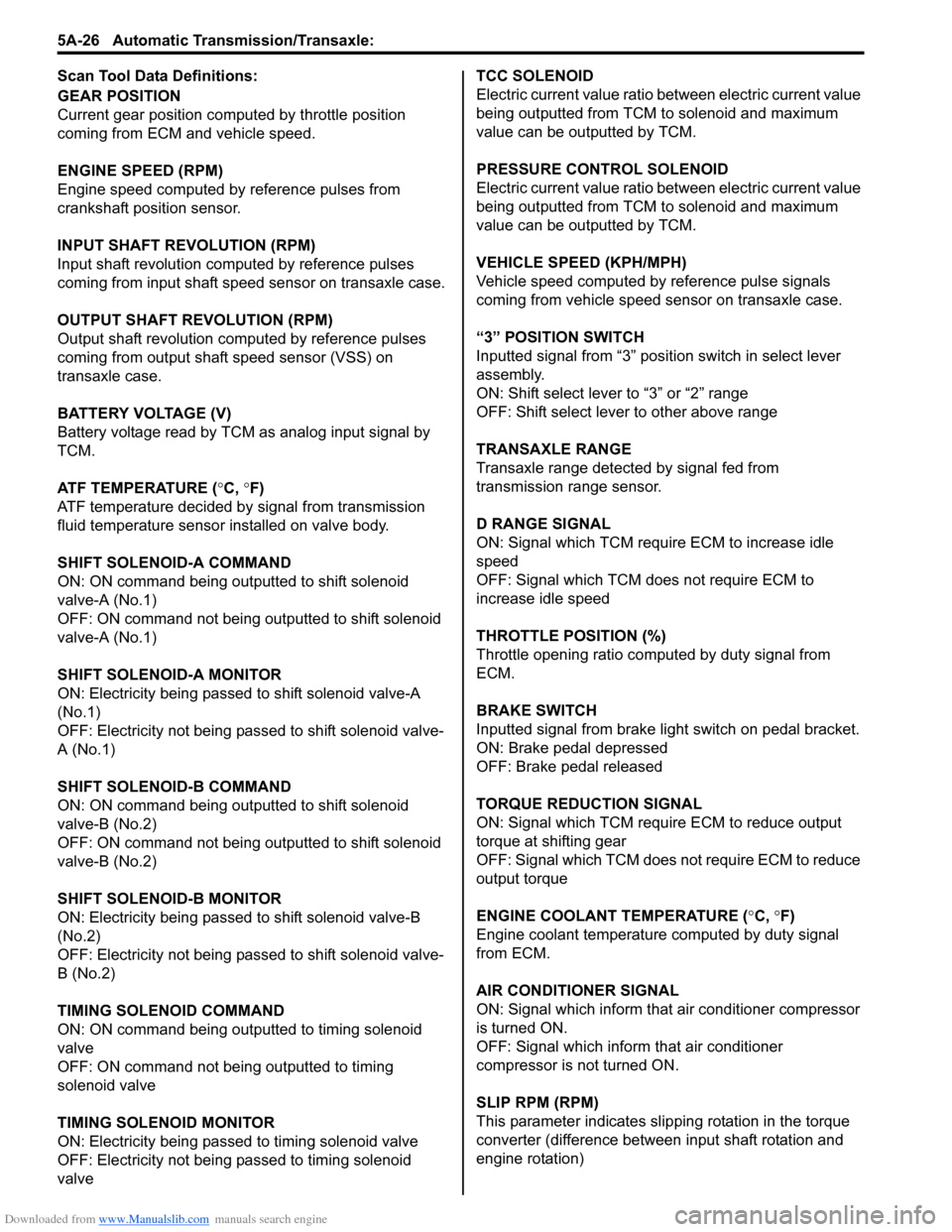
Scan Tool Data Definitions:
GEAR POSITION
Current gear position computed by throttle position
coming from ECM and vehicle speed.
ENGINE SPEED (RPM)
Engine speed computed by reference pulses from
crankshaft position sensor.
INPUT SHAFT REVOLUTION (RPM)
Input shaft revolution computed by reference pulses
coming from input shaft speed sensor on transaxle case.
OUTPUT SHAFT REVOLUTION (RPM)
Output shaft revolution computed by reference pulses
coming from output shaft speed sensor (VSS) on
transaxle case.
BATTERY VOLTAGE (V)
Battery voltage read by TCM as analog input signal by
TCM.
ATF TEMPERATURE (°C, °F)
ATF temperature decided by signal from transmission
fluid temperature sensor installed on valve body.
SHIFT SOLENOID-A COMMAND
ON: ON command being outputted to shift solenoid
valve-A (No.1)
OFF: ON command not being outputted to shift solenoid
valve-A (No.1)
SHIFT SOLENOID-A MONITOR
ON: Electricity being passed to shift solenoid valve-A
(No.1)
OFF: Electricity not being passed to shift solenoid valve-
A (No.1)
SHIFT SOLENOID-B COMMAND
ON: ON command being outputted to shift solenoid
valve-B (No.2)
OFF: ON command not being outputted to shift solenoid
valve-B (No.2)
SHIFT SOLENOID-B MONITOR
ON: Electricity being passed to shift solenoid valve-B
(No.2)
OFF: Electricity not being passed to shift solenoid valve-
B (No.2)
TIMING SOLENOID COMMAND
ON: ON command being outputted to timing solenoid
valve
OFF: ON command not being outputted to timing
solenoid valve
TIMING SOLENOID MONITOR
ON: Electricity being passed to timing solenoid valve
OFF: Electricity not being passed to timing solenoid
valveTCC SOLENOID
Electric current value ratio between electric current value
being outputted from TCM to solenoid and maximum
value can be outputted by TCM.
PRESSURE CONTROL SOLENOID
Electric current value ratio between electric current value
being outputted from TCM to solenoid and maximum
value can be outputted by TCM.
VEHICLE SPEED (KPH/MPH)
Vehicle speed computed by reference pulse signals
coming from vehicle speed sensor on transaxle case.
“3” POSITION SWITCH
Inputted signal from “3” position switch in select lever
assembly.
ON: Shift select lever to “3” or “2” range
OFF: Shift select lever to other above range
TRANSAXLE RANGE
Transaxle range detected by signal fed from
transmission range sensor.
D RANGE SIGNAL
ON: Signal which TCM require ECM to increase idle
speed
OFF: Signal which TCM does not require ECM to
increase idle speed
THROTTLE POSITION (%)
Throttle opening ratio computed by duty signal from
ECM.
BRAKE SWITCH
Inputted signal from brake light switch on pedal bracket.
ON: Brake pedal depressed
OFF: Brake pedal released
TORQUE REDUCTION SIGNAL
ON: Signal which TCM require ECM to reduce output
torque at shifting gear
OFF: Signal which TCM does not require ECM to reduce
output torque
ENGINE COOLANT TEMPERATURE (°C, °F)
Engine coolant temperature computed by duty signal
from ECM.
AIR CONDITIONER SIGNAL
ON: Signal which inform that air conditioner compressor
is turned ON.
OFF: Signal which inform that air conditioner
compressor is not turned ON.
SLIP RPM (RPM)
This parameter indicates slipping rotation in the torque
converter (difference between input shaft rotation and
engine rotation)