Dif SUZUKI SX4 2006 1.G Service Workshop Manual
[x] Cancel search | Manufacturer: SUZUKI, Model Year: 2006, Model line: SX4, Model: SUZUKI SX4 2006 1.GPages: 1556, PDF Size: 37.31 MB
Page 837 of 1556
Downloaded from www.Manualslib.com manuals search engine Manual Transmission/Transaxle: 5B-25
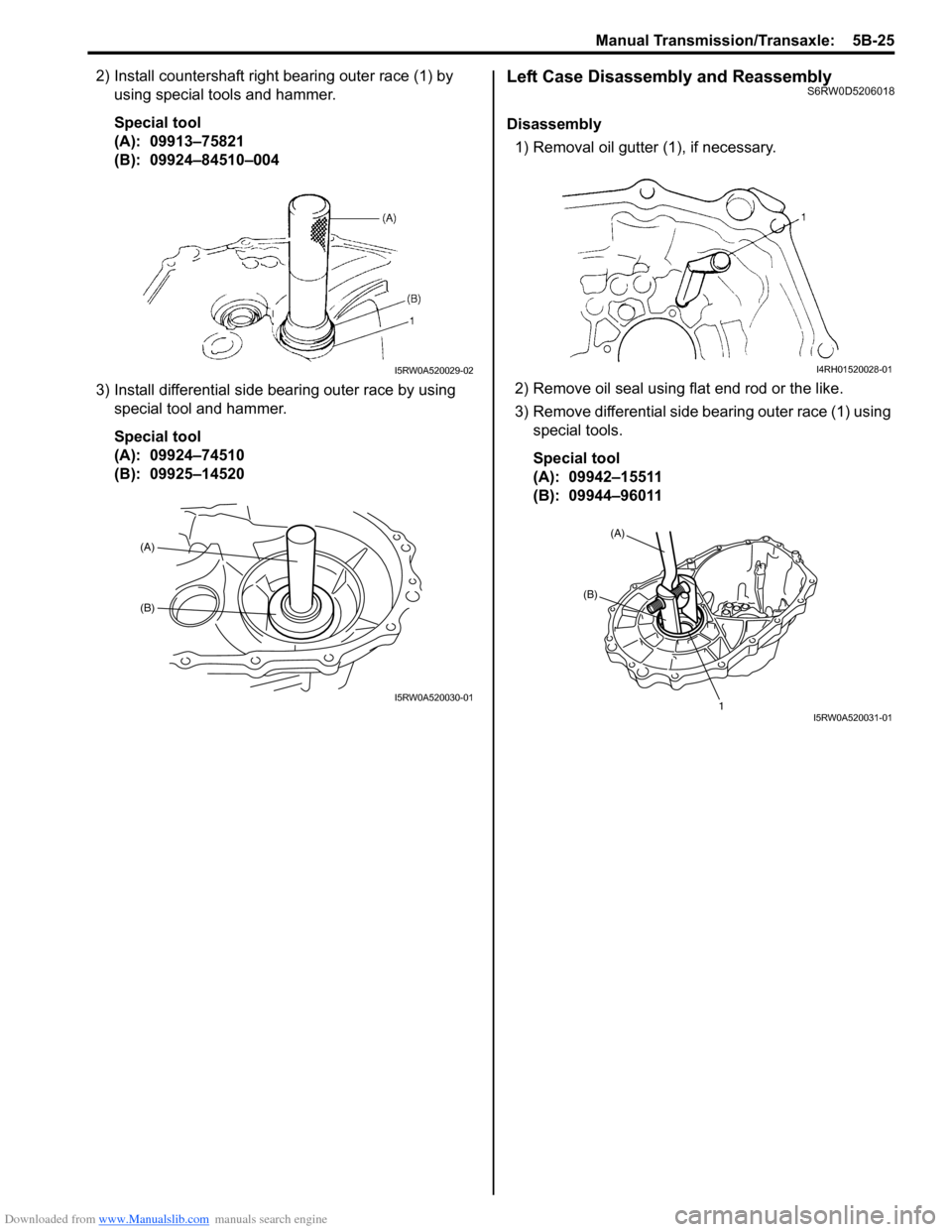
2) Install countershaft right bearing outer race (1) by
using special tools and hammer.
Special tool
(A): 09913–75821
(B): 09924–84510–004
3) Install differential side bearing outer race by using
special tool and hammer.
Special tool
(A): 09924–74510
(B): 09925–14520Left Case Disassembly and ReassemblyS6RW0D5206018
Disassembly
1) Removal oil gutter (1), if necessary.
2) Remove oil seal using flat end rod or the like.
3) Remove differential side bearing outer race (1) using
special tools.
Special tool
(A): 09942–15511
(B): 09944–96011
I5RW0A520029-02
(A)
(B)
I5RW0A520030-01
I4RH01520028-01
(A)
(B)
1I5RW0A520031-01
Page 838 of 1556
Downloaded from www.Manualslib.com manuals search engine 5B-26 Manual Transmission/Transaxle:
Reassembly
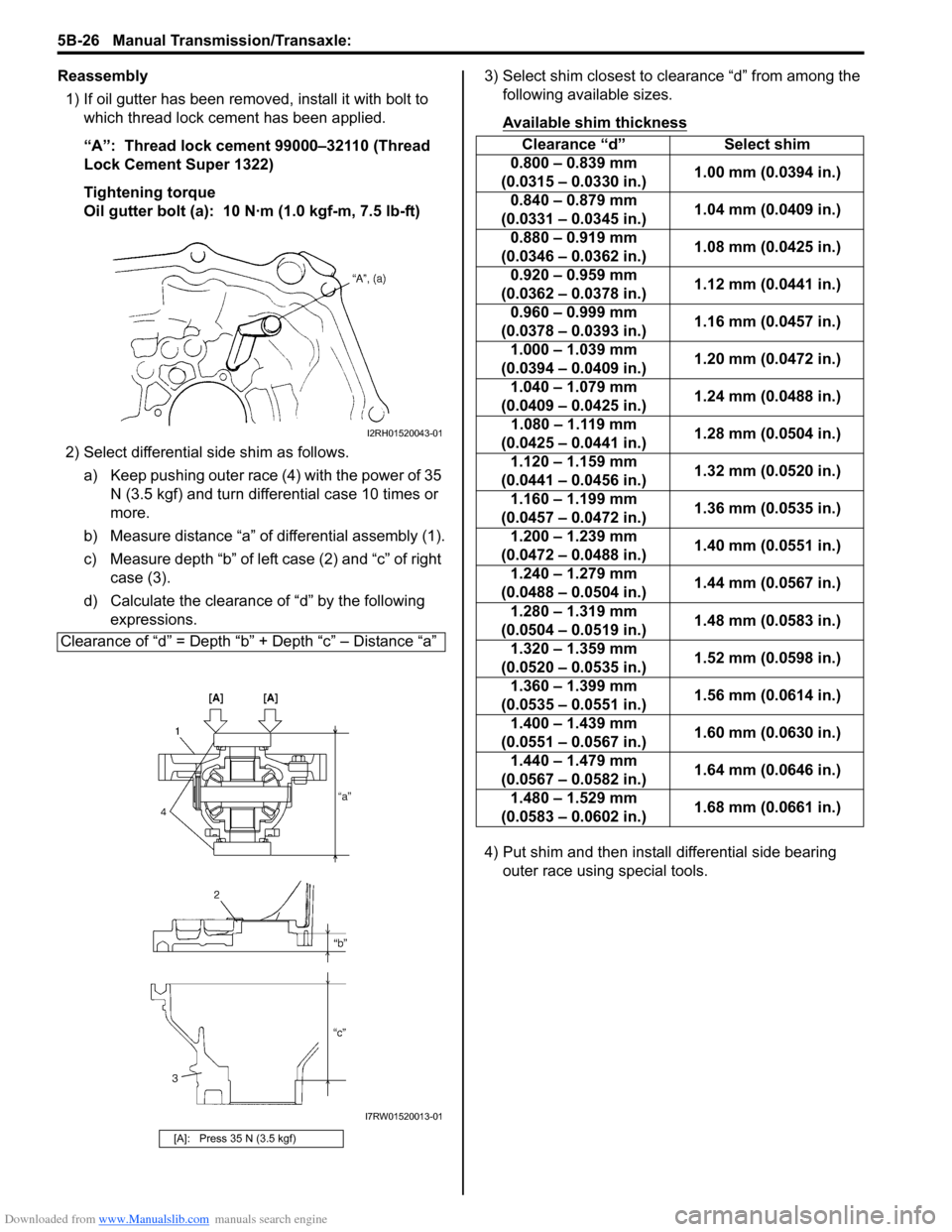
1) If oil gutter has been removed, install it with bolt to
which thread lock cement has been applied.
“A”: Thread lock cement 99000–32110 (Thread
Lock Cement Super 1322)
Tightening torque
Oil gutter bolt (a): 10 N·m (1.0 kgf-m, 7.5 lb-ft)
2) Select differential side shim as follows.
a) Keep pushing outer race (4) with the power of 35
N (3.5 kgf) and turn differential case 10 times or
more.
b) Measure distance “a” of differential assembly (1).
c) Measure depth “b” of left case (2) and “c” of right
case (3).
d) Calculate the clearance of “d” by the following
expressions.3) Select shim closest to clearance “d” from among the
following available sizes.
Available shim thickness
4) Put shim and then install differential side bearing
outer race using special tools. Clearance of “d” = Depth “b” + Depth “c” – Distance “a”
[A]: Press 35 N (3.5 kgf)
I2RH01520043-01
I7RW01520013-01
Clearance “d” Select shim
0.800 – 0.839 mm
(0.0315 – 0.0330 in.)1.00 mm (0.0394 in.)
0.840 – 0.879 mm
(0.0331 – 0.0345 in.)1.04 mm (0.0409 in.)
0.880 – 0.919 mm
(0.0346 – 0.0362 in.)1.08 mm (0.0425 in.)
0.920 – 0.959 mm
(0.0362 – 0.0378 in.)1.12 mm (0.0441 in.)
0.960 – 0.999 mm
(0.0378 – 0.0393 in.)1.16 mm (0.0457 in.)
1.000 – 1.039 mm
(0.0394 – 0.0409 in.)1.20 mm (0.0472 in.)
1.040 – 1.079 mm
(0.0409 – 0.0425 in.)1.24 mm (0.0488 in.)
1.080 – 1.119 mm
(0.0425 – 0.0441 in.)1.28 mm (0.0504 in.)
1.120 – 1.159 mm
(0.0441 – 0.0456 in.)1.32 mm (0.0520 in.)
1.160 – 1.199 mm
(0.0457 – 0.0472 in.)1.36 mm (0.0535 in.)
1.200 – 1.239 mm
(0.0472 – 0.0488 in.)1.40 mm (0.0551 in.)
1.240 – 1.279 mm
(0.0488 – 0.0504 in.)1.44 mm (0.0567 in.)
1.280 – 1.319 mm
(0.0504 – 0.0519 in.)1.48 mm (0.0583 in.)
1.320 – 1.359 mm
(0.0520 – 0.0535 in.)1.52 mm (0.0598 in.)
1.360 – 1.399 mm
(0.0535 – 0.0551 in.)1.56 mm (0.0614 in.)
1.400 – 1.439 mm
(0.0551 – 0.0567 in.)1.60 mm (0.0630 in.)
1.440 – 1.479 mm
(0.0567 – 0.0582 in.)1.64 mm (0.0646 in.)
1.480 – 1.529 mm
(0.0583 – 0.0602 in.)1.68 mm (0.0661 in.)
Page 844 of 1556
Downloaded from www.Manualslib.com manuals search engine 5B-32 Manual Transmission/Transaxle:
6) Disassemble synchronizer sleeve & hub assembly.
7) Take out 1st gear needle bearing from shaft.
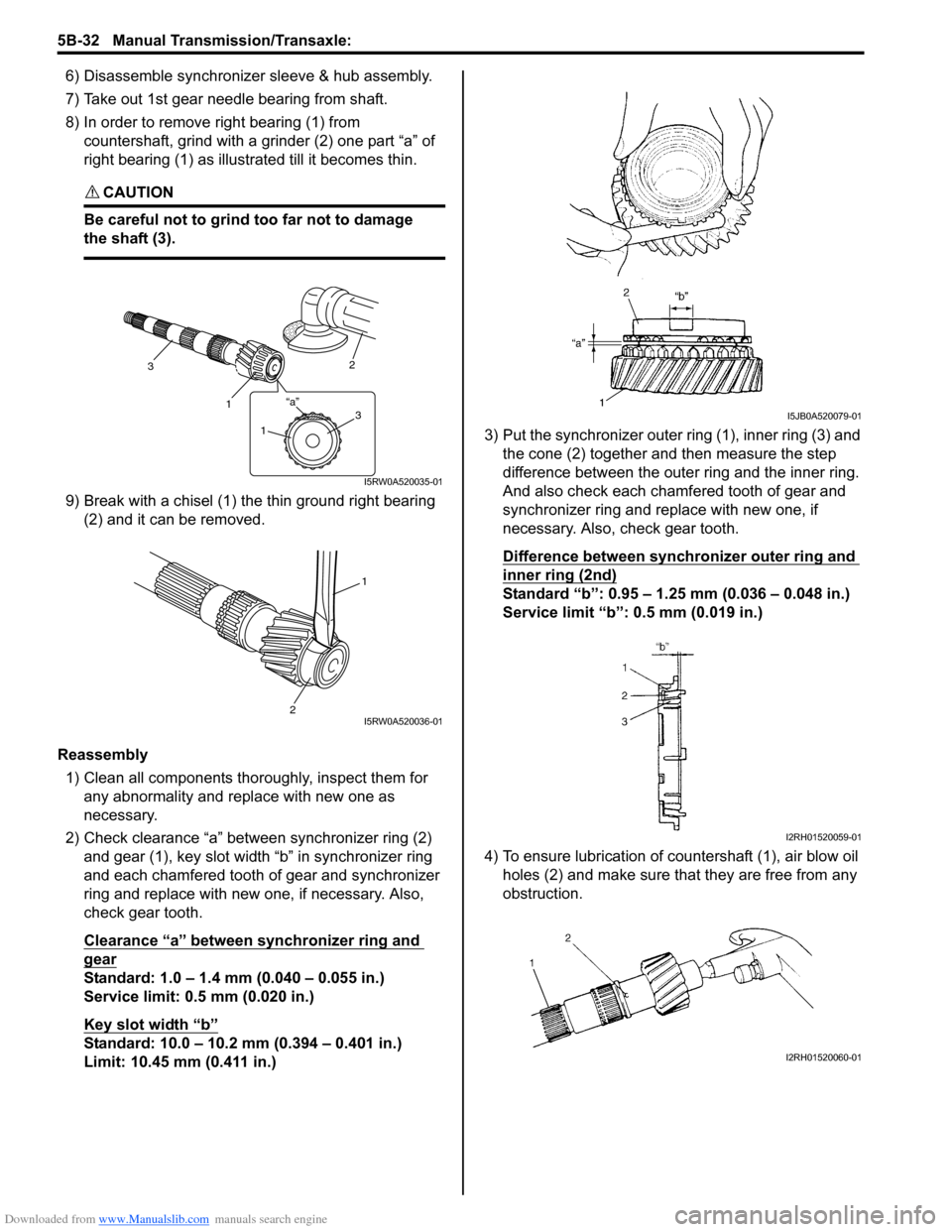
8) In order to remove right bearing (1) from
countershaft, grind with a grinder (2) one part “a” of
right bearing (1) as illustrated till it becomes thin.
CAUTION!
Be careful not to grind too far not to damage
the shaft (3).
9) Break with a chisel (1) the thin ground right bearing
(2) and it can be removed.
Reassembly
1) Clean all components thoroughly, inspect them for
any abnormality and replace with new one as
necessary.
2) Check clearance “a” between synchronizer ring (2)
and gear (1), key slot width “b” in synchronizer ring
and each chamfered tooth of gear and synchronizer
ring and replace with new one, if necessary. Also,
check gear tooth.
Clearance “a” between synchronizer ring and
gear
Standard: 1.0 – 1.4 mm (0.040 – 0.055 in.)
Service limit: 0.5 mm (0.020 in.)
Key slot width “b”
Standard: 10.0 – 10.2 mm (0.394 – 0.401 in.)
Limit: 10.45 mm (0.411 in.)3) Put the synchronizer outer ring (1), inner ring (3) and
the cone (2) together and then measure the step
difference between the outer ring and the inner ring.
And also check each chamfered tooth of gear and
synchronizer ring and replace with new one, if
necessary. Also, check gear tooth.
Difference between synchronizer outer ring and
inner ring (2nd)
Standard “b”: 0.95 – 1.25 mm (0.036 – 0.048 in.)
Service limit “b”: 0.5 mm (0.019 in.)
4) To ensure lubrication of countershaft (1), air blow oil
holes (2) and make sure that they are free from any
obstruction.
3
1
2
“a”31
I5RW0A520035-01
1
2I5RW0A520036-01
I5JB0A520079-01
I2RH01520059-01
I2RH01520060-01
Page 848 of 1556
Downloaded from www.Manualslib.com manuals search engine 5B-36 Manual Transmission/Transaxle:
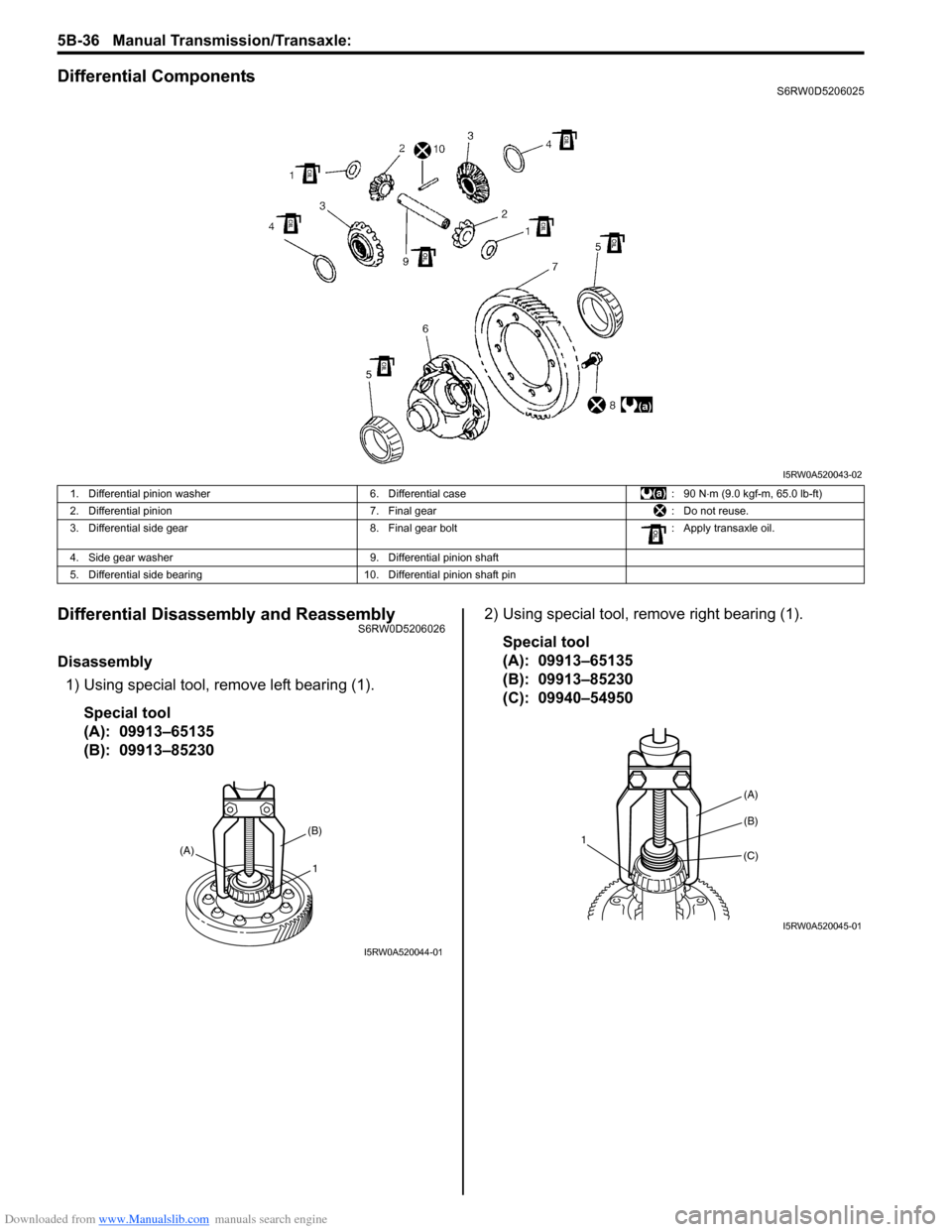
Differential ComponentsS6RW0D5206025
Differential Disassembly and ReassemblyS6RW0D5206026
Disassembly
1) Using special tool, remove left bearing (1).
Special tool
(A): 09913–65135
(B): 09913–852302) Using special tool, remove right bearing (1).
Special tool
(A): 09913–65135
(B): 09913–85230
(C): 09940–54950
I5RW0A520043-02
1. Differential pinion washer 6. Differential case : 90 N⋅m (9.0 kgf-m, 65.0 lb-ft)
2. Differential pinion 7. Final gear : Do not reuse.
3. Differential side gear 8. Final gear bolt : Apply transaxle oil.
4. Side gear washer 9. Differential pinion shaft
5. Differential side bearing 10. Differential pinion shaft pin
(B)
(A)
1
I5RW0A520044-01
(A)
1
(B)
(C)
I5RW0A520045-01
Page 849 of 1556

Downloaded from www.Manualslib.com manuals search engine Manual Transmission/Transaxle: 5B-37
3) Support differential case (1) with soft jawed vise and
remove final gear bolts then take out final gear.
4) Drive out differential pinion shaft (3) pin by using
special tool and hammer and then disassemble
components parts.
Special tool
(A): 09922–85811
Reassembly
Judging from abnormality noted before disassembly and
what is found through visual check of component parts
after disassembly, prepare replacing parts and proceed
to reassembly. Make sure that all parts are clean.
1) Install differential pinion, side gear and pinion shaft
to differential case and measure back rash and
thrust play of differential side gear as follows.
If measured value is out of specification, select
suitable side gear washer from among the following
available size, install it and check again.
Special tool
(A): 09900–20607
(B): 09900–20701
(C): 09952–06010
a) Differential side gear backlash
• Hold differential assembly with soft jawed vise
and apply measuring tip of dial gauge to side
gear as shown in figure.
• Fixing differential pinion, turn side gear back
and forth and read dial gauge.
Differential side gear backlash
0.10 – 0.15 mm (0.003 – 0.005 in.)
b) Differential side gear thrust play
• Hold differential assembly with soft jawed vise
and apply measuring tip of dial gauge to side
gear as shown in figure.
• Move side gear up and down by hand and
read dial gauge.
Differential side gear thrust play
0.03 – 0.31 mm (0.001 – 0.012 in.)Available side gear washer thickness
2) Drive in spring pin from right side till it is flush with
differential case surface.
3) Press-fit left bearing (1) by using special tool and
hydraulic press.
Special tool
(A): 09913–70123
2. Differential side gear
I5RW0A520046-01
0.85 mm (0.033 in.) 1.05 mm (0.041 in.)
0.9 mm (0.035 in.) 1.1 mm (0.043 in.)
0.95 mm (0.037 in.) 1.15 mm (0.045 in.)
1.0 mm (0.039 in.)
2. Differential case
(B)
(B)
(C)
(A)
(A)
I5RW0A520047-01
I2RH01520074-01
Page 850 of 1556
Downloaded from www.Manualslib.com manuals search engine 5B-38 Manual Transmission/Transaxle:
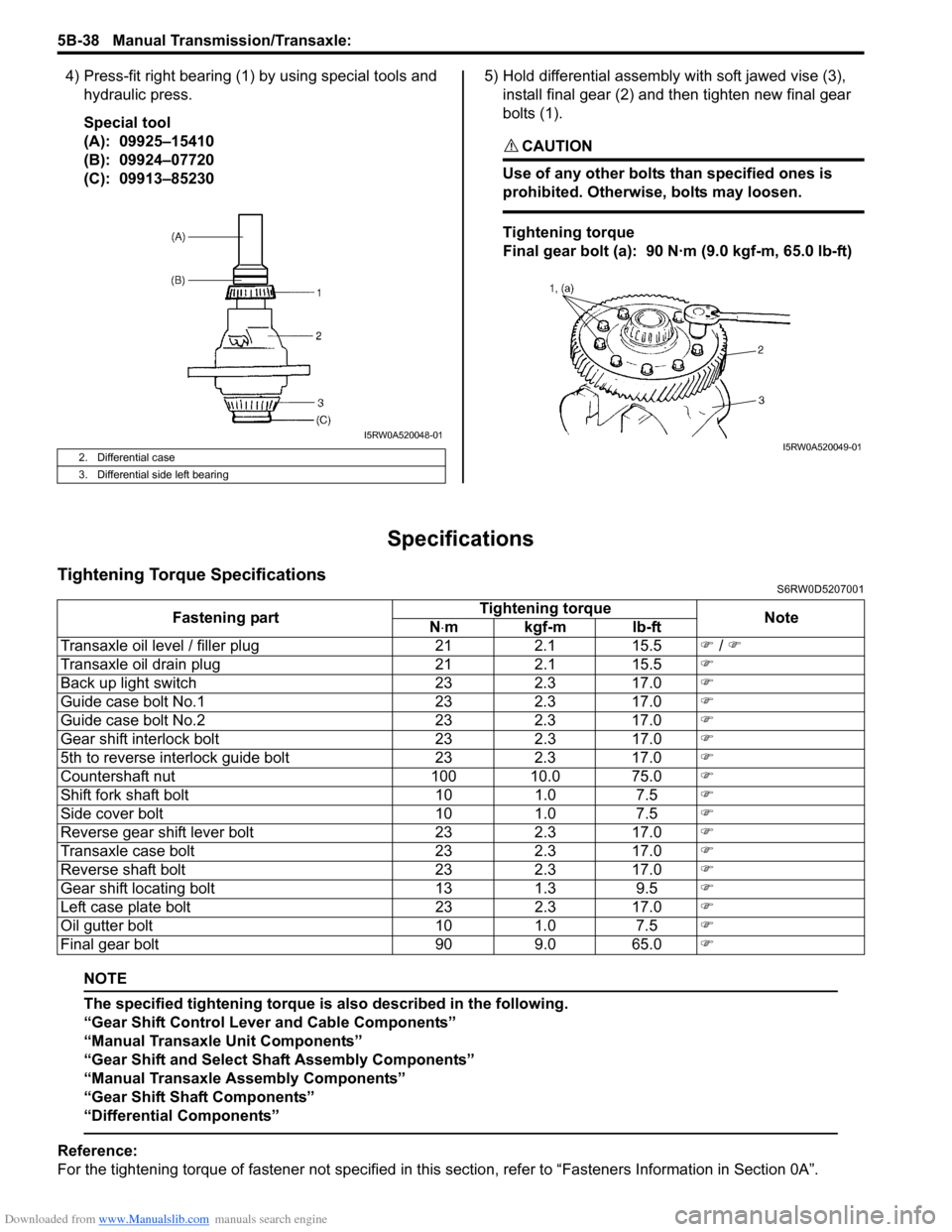
4) Press-fit right bearing (1) by using special tools and
hydraulic press.
Special tool
(A): 09925–15410
(B): 09924–07720
(C): 09913–852305) Hold differential assembly with soft jawed vise (3),
install final gear (2) and then tighten new final gear
bolts (1).
CAUTION!
Use of any other bolts than specified ones is
prohibited. Otherwise, bolts may loosen.
Tightening torque
Final gear bolt (a): 90 N·m (9.0 kgf-m, 65.0 lb-ft)
Specifications
Tightening Torque SpecificationsS6RW0D5207001
NOTE
The specified tightening torque is also described in the following.
“Gear Shift Control Lever and Cable Components”
“Manual Transaxle Unit Components”
“Gear Shift and Select Shaft Assembly Components”
“Manual Transaxle Assembly Components”
“Gear Shift Shaft Components”
“Differential Components”
Reference:
For the tightening torque of fastener not specified in this section, refer to “Fasteners Information in Section 0A”.
2. Differential case
3. Differential side left bearing
I5RW0A520048-01I5RW0A520049-01
Fastening partTightening torque
Note
N⋅mkgf-mlb-ft
Transaxle oil level / filler plug 21 2.1 15.5) / )
Transaxle oil drain plug 21 2.1 15.5)
Back up light switch 23 2.3 17.0)
Guide case bolt No.1 23 2.3 17.0)
Guide case bolt No.2 23 2.3 17.0)
Gear shift interlock bolt 23 2.3 17.0)
5th to reverse interlock guide bolt 23 2.3 17.0)
Countershaft nut 100 10.0 75.0)
Shift fork shaft bolt 10 1.0 7.5)
Side cover bolt 10 1.0 7.5)
Reverse gear shift lever bolt 23 2.3 17.0)
Transaxle case bolt 23 2.3 17.0)
Reverse shaft bolt 23 2.3 17.0)
Gear shift locating bolt 13 1.3 9.5)
Left case plate bolt 23 2.3 17.0)
Oil gutter bolt 10 1.0 7.5)
Final gear bolt 90 9.0 65.0)
Page 851 of 1556
Downloaded from www.Manualslib.com manuals search engine Manual Transmission/Transaxle: 5B-39
Special Tools and Equipment
Recommended Service MaterialS6RW0D5208001
NOTE
Required service material is also described in the following.
“Gear Shift Control Lever and Cable Components”
“Gear Shift and Select Shaft Assembly Components”
“Manual Transaxle Assembly Components”
“Input Shaft and Countershaft Components”
“Gear Shift Shaft Components”
“Differential Components”
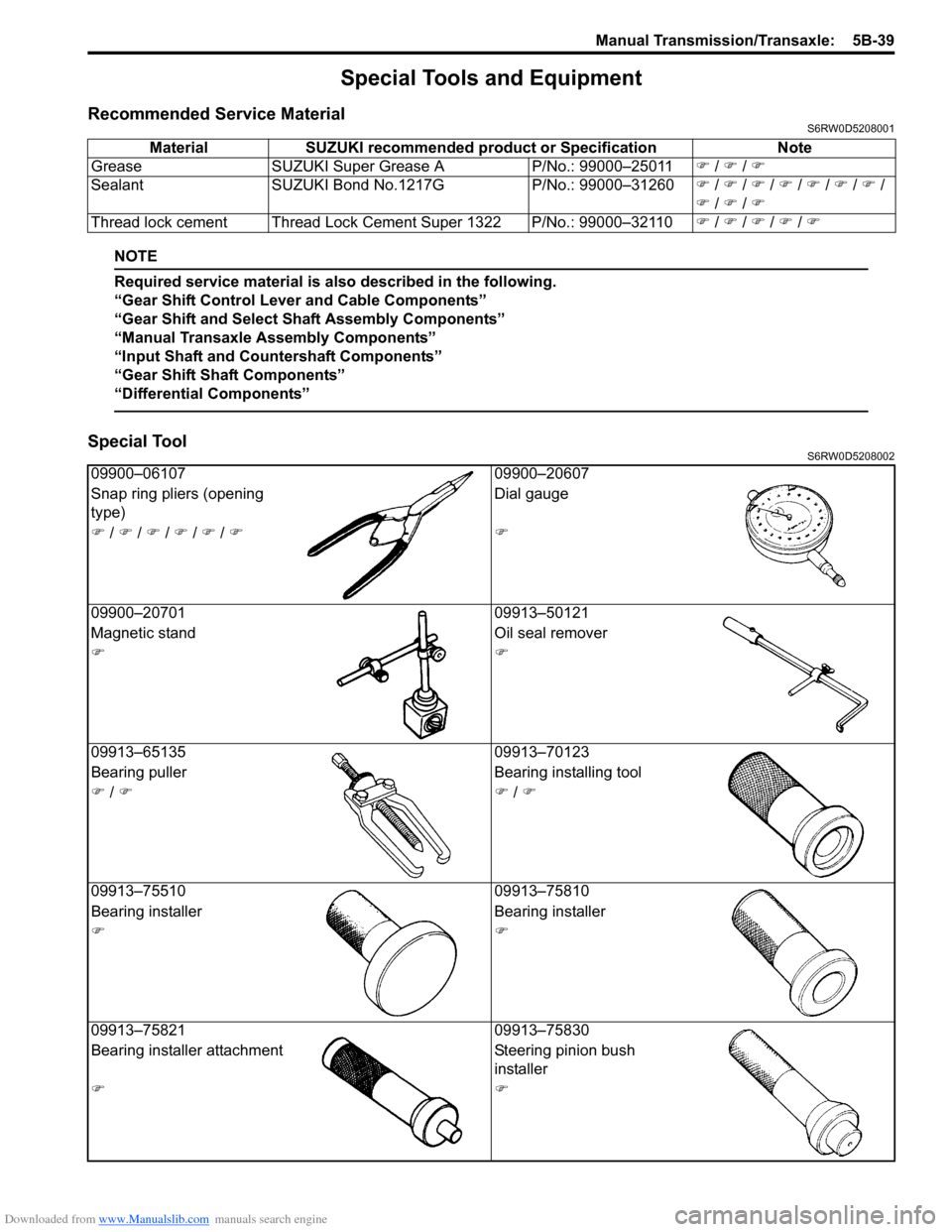
Special ToolS6RW0D5208002
Material SUZUKI recommended product or Specification Note
Grease SUZUKI Super Grease A P/No.: 99000–25011) / ) / )
Sealant SUZUKI Bond No.1217G P/No.: 99000–31260) / ) / ) / ) / ) / ) / ) /
) / ) / )
Thread lock cement Thread Lock Cement Super 1322 P/No.: 99000–32110) / ) / ) / ) / )
09900–06107 09900–20607
Snap ring pliers (opening
type)Dial gauge
) / ) / ) / ) / ) / ))
09900–20701 09913–50121
Magnetic stand Oil seal remover
))
09913–65135 09913–70123
Bearing puller Bearing installing tool
) / )) / )
09913–75510 09913–75810
Bearing installer Bearing installer
))
09913–75821 09913–75830
Bearing installer attachment Steering pinion bush
installer
))
Page 887 of 1556

Downloaded from www.Manualslib.com manuals search engine Power Assisted Steering System: 6C-7
Step 1: Customer Complaint Analysis
Record details of the problem (failure, complaint) and how it occurred as described by the customer. For this purpose,
use of such an inspection form will facilitate collecting information to the point required for proper analysis and
diagnosis. Check if the problem described in “Customer questionnaire” actually occurs in the vehicle if necessary.
(This step should be performed with the customer if possible)
Customer questionnaire (Example)
NOTE
This form is a standard sample. It should be modified according to conditions characteristic of each
market.
Step 2: DTC check, record and clearance
First, referring to “DTC Check”, check DTC (including
pending DTC). If DTC exists, print or write down DTC
and then clear them by referring to “DTC Clearance”.
DTC indicates malfunction in the system but it is not
possible to know from it whether the malfunction is
occurring now or it occurred in the past and normal
condition has been restored. In order to know that, check
symptom in question according to Step 5 and then
recheck DTC according to Step 6 and 7.
Diagnosing a trouble based on the DTC in this step only
or failure to clear the DTC in this step may result in an
faulty diagnosis, trouble diagnosis of a normal circuit or
difficulty in troubleshooting which is otherwise
unnecessary.Step 3 and Step 4: Visual inspection
As a preliminary step, be sure to perform visual check of
the items that support proper function of the P/S system
referring to “Visual Inspection”.
Step 5: Trouble Symptom Confirmation
Based on information obtained in “Step 1: Customer
Complaint Analysis:” and “Step 2: DTC Check, Record
and Clearance:”, confirm trouble symptoms. Also,
reconfirm trouble symptom by performing test drive and
turning steering wheel fully to right and left at stopped
vehicle.
Step 6 and 7: Rechecking and Record of DTC
Refer to “DTC Check” for checking procedure.
I7RW01632004-02
Page 889 of 1556
Downloaded from www.Manualslib.com manuals search engine Power Assisted Steering System: 6C-9
DTC ClearanceS6RW0D6304004
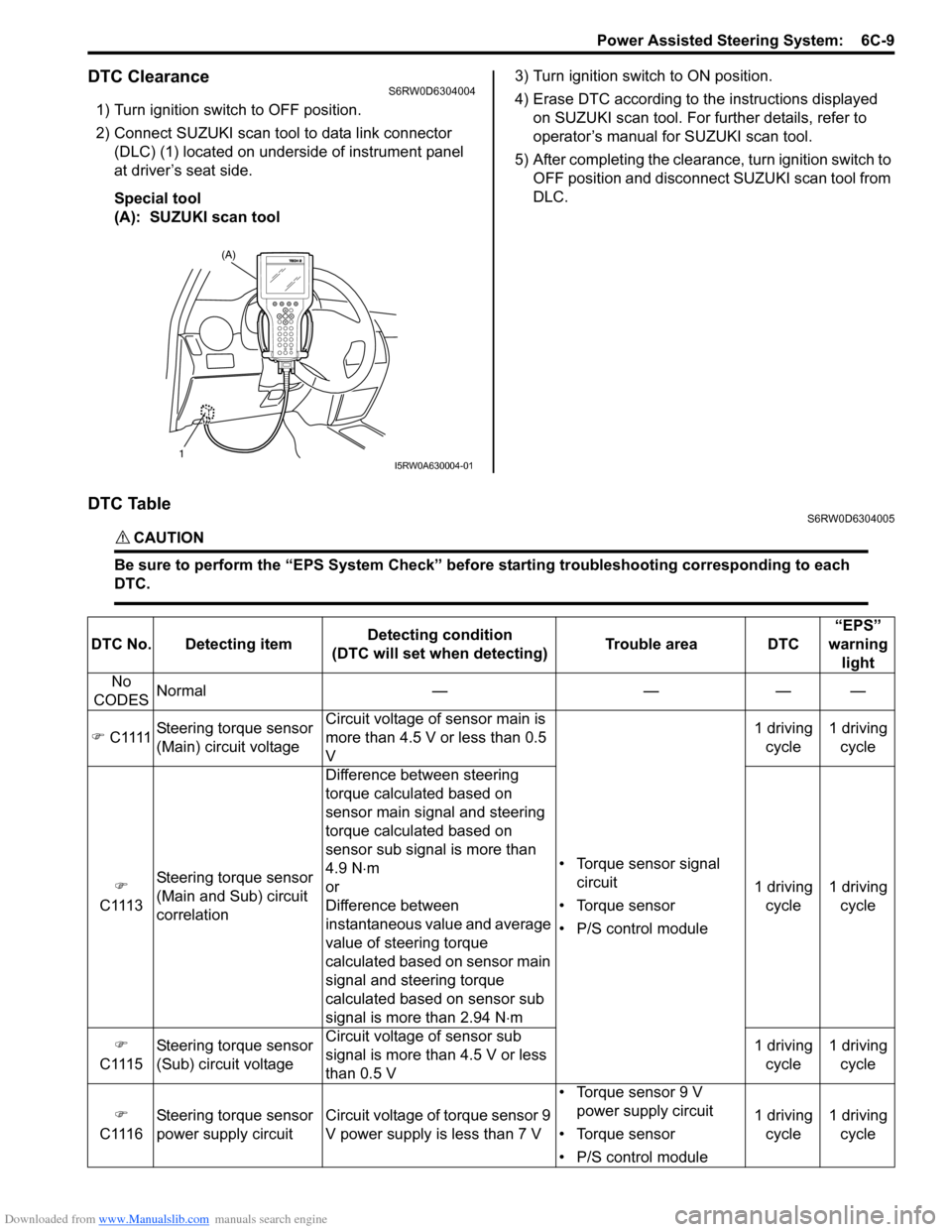
1) Turn ignition switch to OFF position.
2) Connect SUZUKI scan tool to data link connector
(DLC) (1) located on underside of instrument panel
at driver’s seat side.
Special tool
(A): SUZUKI scan tool3) Turn ignition switch to ON position.
4) Erase DTC according to the instructions displayed
on SUZUKI scan tool. For further details, refer to
operator’s manual for SUZUKI scan tool.
5) After completing the clearance, turn ignition switch to
OFF position and disconnect SUZUKI scan tool from
DLC.
DTC TableS6RW0D6304005
CAUTION!
Be sure to perform the “EPS System Check” before starting troubleshooting corresponding to each
DTC.
(A)
1I5RW0A630004-01
DTC No. Detecting itemDetecting condition
(DTC will set when detecting)Trouble area DTC“EPS”
warning
light
No
CODESNormal — — — —
) C1111Steering torque sensor
(Main) circuit voltageCircuit voltage of sensor main is
more than 4.5 V or less than 0.5
V
• Torque sensor signal
circuit
• Torque sensor
• P/S control module1 driving
cycle1 driving
cycle
)
C1113Steering torque sensor
(Main and Sub) circuit
correlationDifference between steering
torque calculated based on
sensor main signal and steering
torque calculated based on
sensor sub signal is more than
4.9 N⋅m
or
Difference between
instantaneous value and average
value of steering torque
calculated based on sensor main
signal and steering torque
calculated based on sensor sub
signal is more than 2.94 N⋅m1 driving
cycle1 driving
cycle
)
C1115Steering torque sensor
(Sub) circuit voltageCircuit voltage of sensor sub
signal is more than 4.5 V or less
than 0.5 V1 driving
cycle1 driving
cycle
)
C1116Steering torque sensor
power supply circuit Circuit voltage of torque sensor 9
V power supply is less than 7 V• Torque sensor 9 V
power supply circuit
• Torque sensor
• P/S control module1 driving
cycle1 driving
cycle
Page 899 of 1556
Downloaded from www.Manualslib.com manuals search engine Power Assisted Steering System: 6C-19
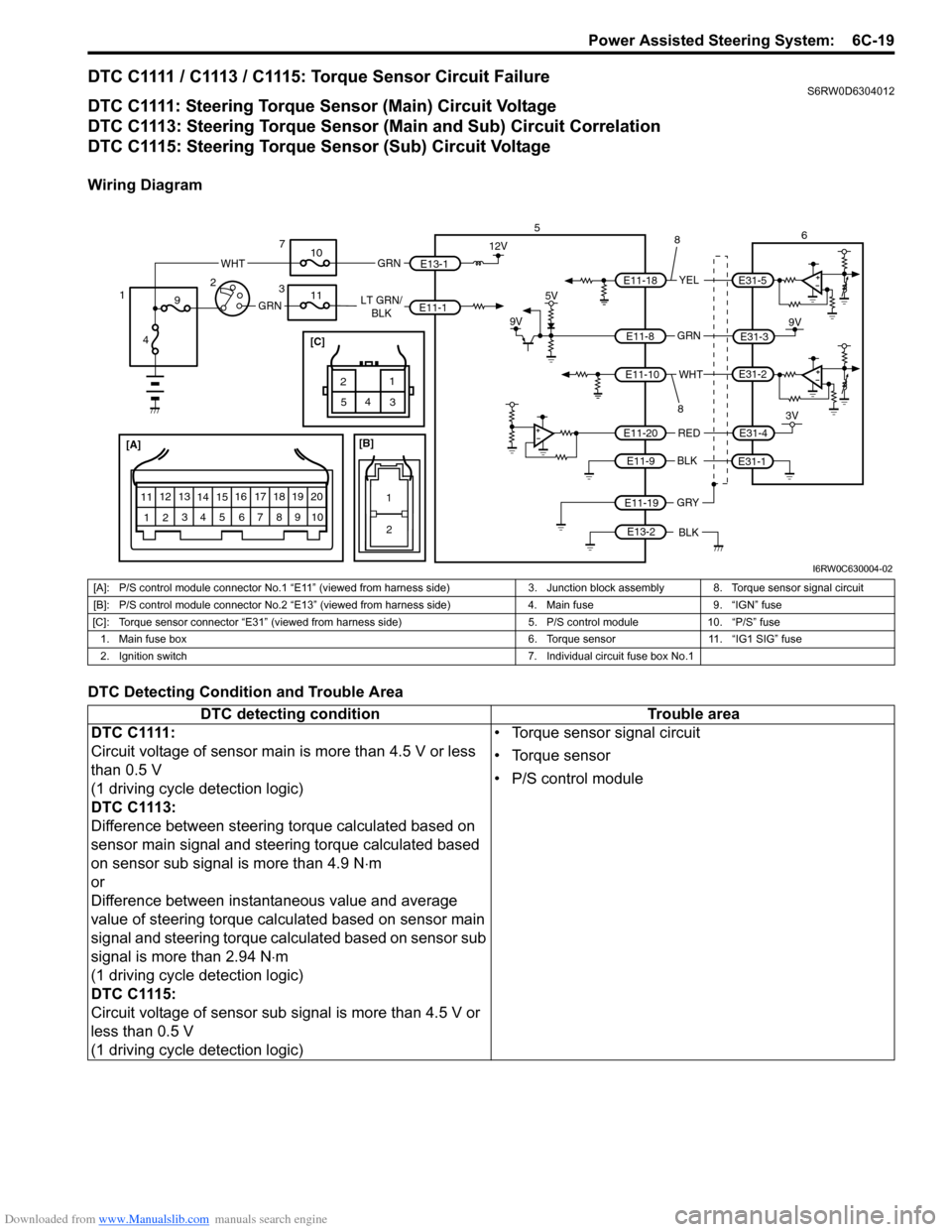
DTC C1111 / C1113 / C1115: Torque Sensor Circuit FailureS6RW0D6304012
DTC C1111: Steering Torque Sensor (Main) Circuit Voltage
DTC C1113: Steering Torque Sensor (Main and Sub) Circuit Correlation
DTC C1115: Steering Torque Sensor (Sub) Circuit Voltage
Wiring Diagram
DTC Detecting Condition and Trouble Area
[A]
123
453 21
4
5
67
8
9 11
10 12 13
141516
17 18 1920
1
2
[B]
[C]
LT GRN/
BLK
WHT GRN
BLK
E11-1
E11-10E11-8
E11-9
E11-19
E13-1 GRN
GRY
GRN
WHT
5
6
37
10
11
9
4 12
12V
E13-2BLK
9V
REDE11-20
5VYELE11-18E31-5
E31-2
E31-39V
E31-43V
E31-1
8
8
I6RW0C630004-02
[A]: P/S control module connector No.1 “E11” (viewed from harness side) 3. Junction block assembly 8. Torque sensor signal circuit
[B]: P/S control module connector No.2 “E13” (viewed from harness side) 4. Main fuse 9. “IGN” fuse
[C]: Torque sensor connector “E31” (viewed from harness side) 5. P/S control module 10. “P/S” fuse
1. Main fuse box 6. Torque sensor 11. “IG1 SIG” fuse
2. Ignition switch 7. Individual circuit fuse box No.1
DTC detecting condition Trouble area
DTC C1111:
Circuit voltage of sensor main is more than 4.5 V or less
than 0.5 V
(1 driving cycle detection logic)
DTC C1113:
Difference between steering torque calculated based on
sensor main signal and steering torque calculated based
on sensor sub signal is more than 4.9 N⋅m
or
Difference between instantaneous value and average
value of steering torque calculated based on sensor main
signal and steering torque calculated based on sensor sub
signal is more than 2.94 N⋅m
(1 driving cycle detection logic)
DTC C1115:
Circuit voltage of sensor sub signal is more than 4.5 V or
less than 0.5 V
(1 driving cycle detection logic)• Torque sensor signal circuit
• Torque sensor
• P/S control module