Automatic SUZUKI SX4 2006 1.G Service User Guide
[x] Cancel search | Manufacturer: SUZUKI, Model Year: 2006, Model line: SX4, Model: SUZUKI SX4 2006 1.GPages: 1556, PDF Size: 37.31 MB
Page 43 of 1556
Downloaded from www.Manualslib.com manuals search engine Maintenance and Lubrication: 0B-12
Steering
• Check to ensure that steering wheel is free from
instability, or abnormally heavy feeling.
• Check that the vehicle does not wander or pull to one
side.
Engine
• Check that engine responds readily at all speeds.
• Check that engine is free from abnormal noise and
abnormal vibration.
Body, Wheels and Power Transmitting System
Check that body, wheels and power transmitting system
are free from abnormal noise and abnormal vibration or
any other abnormal condition.Meters and Gauge
Check that speedometer, odometer, fuel meter,
temperature gauge, etc. are operating accurately.
Lights
Check that all lights operate properly.
Windshield Defroster
Periodically check that air comes out from defroster
outlet when operating heater or air conditioning.
Set mode control lever to defroster position and fan
switch lever to highest position for this check.
Specifications
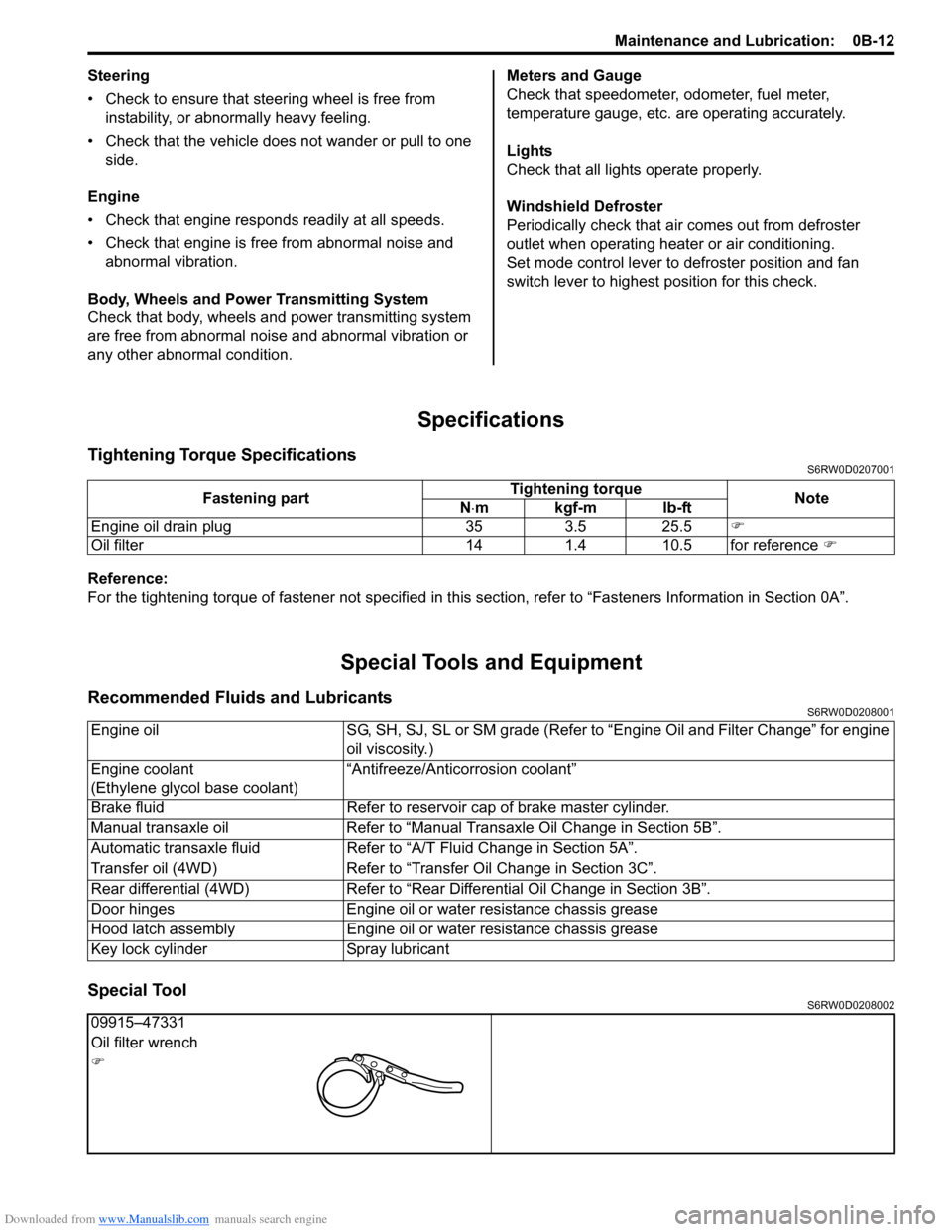
Tightening Torque SpecificationsS6RW0D0207001
Reference:
For the tightening torque of fastener not specified in this section, refer to “Fasteners Information in Section 0A”.
Special Tools and Equipment
Recommended Fluids and LubricantsS6RW0D0208001
Special ToolS6RW0D0208002
Fastening partTightening torque
Note
N⋅mkgf-mlb-ft
Engine oil drain plug 35 3.5 25.5)
Oil filter 14 1.4 10.5 for reference )
Engine oil SG, SH, SJ, SL or SM grade (Refer to “Engine Oil and Filter Change” for engine
oil viscosity.)
Engine coolant
(Ethylene glycol base coolant)“Antifreeze/Anticorrosion coolant”
Brake fluid Refer to reservoir cap of brake master cylinder.
Manual transaxle oil Refer to “Manual Transaxle Oil Change in Section 5B”.
Automatic transaxle fluid Refer to “A/T Fluid Change in Section 5A”.
Transfer oil (4WD) Refer to “Transfer Oil Change in Section 3C”.
Rear differential (4WD) Refer to “Rear Differential Oil Change in Section 3B”.
Door hinges Engine oil or water resistance chassis grease
Hood latch assembly Engine oil or water resistance chassis grease
Key lock cylinder Spray lubricant
09915–47331
Oil filter wrench
)
Page 59 of 1556
Downloaded from www.Manualslib.com manuals search engine Engine General Information and Diagnosis: 1A-9
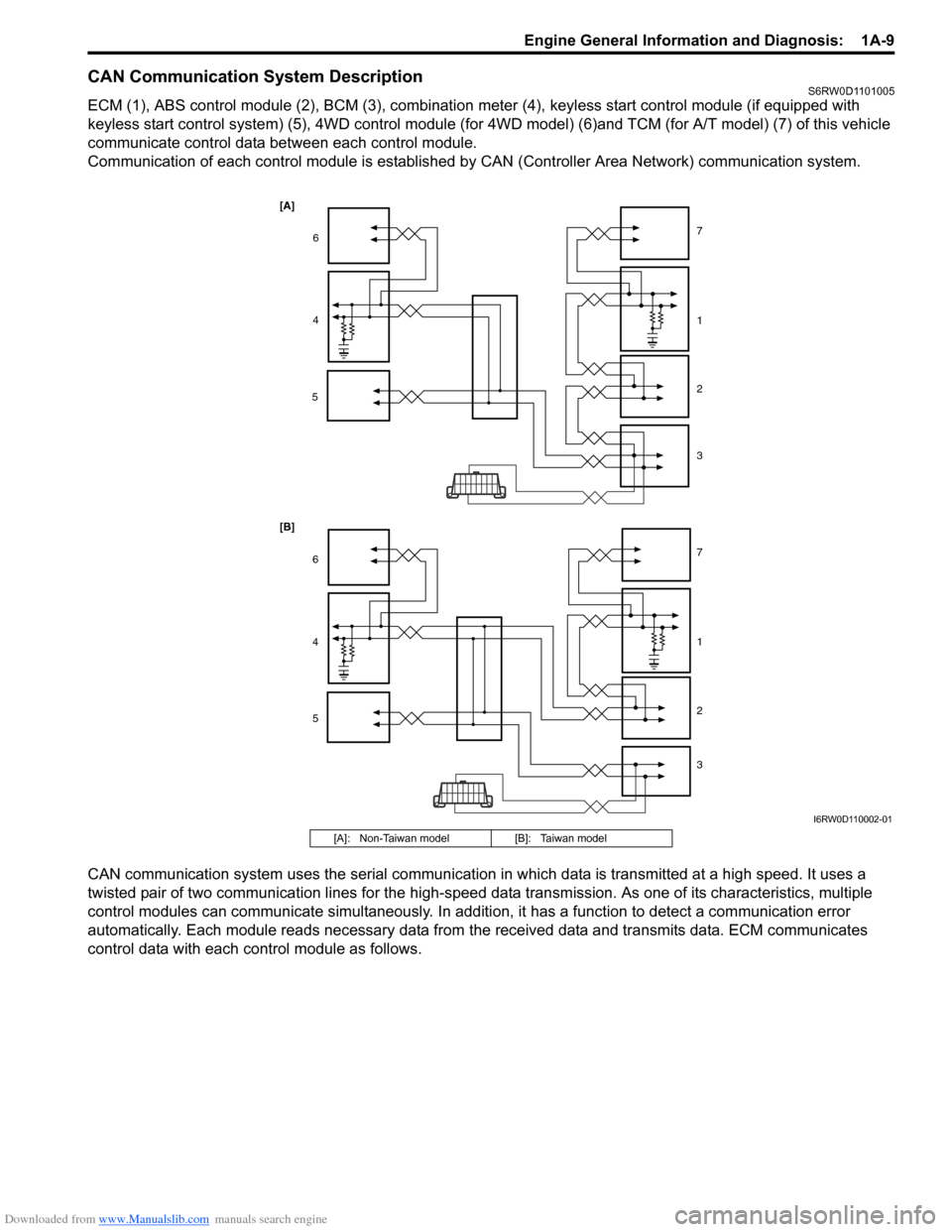
CAN Communication System DescriptionS6RW0D1101005
ECM (1), ABS control module (2), BCM (3), combination meter (4), keyless start control module (if equipped with
keyless start control system) (5), 4WD control module (for 4WD model) (6)and TCM (for A/T model) (7) of this vehicle
communicate control data between each control module.
Communication of each control module is established by CAN (Controller Area Network) communication system.
CAN communication system uses the serial communication in which data is transmitted at a high speed. It uses a
twisted pair of two communication lines for the high-speed data transmission. As one of its characteristics, multiple
control modules can communicate simultaneously. In addition, it has a function to detect a communication error
automatically. Each module reads necessary data from the received data and transmits data. ECM communicates
control data with each control module as follows.
[A]
[B]
6
4
51 7
2
3
6
4
51 7
2
3
I6RW0D110002-01
[A]: Non-Taiwan model [B]: Taiwan model
Page 230 of 1556
Downloaded from www.Manualslib.com manuals search engine 1A-180 Engine General Information and Diagnosis:
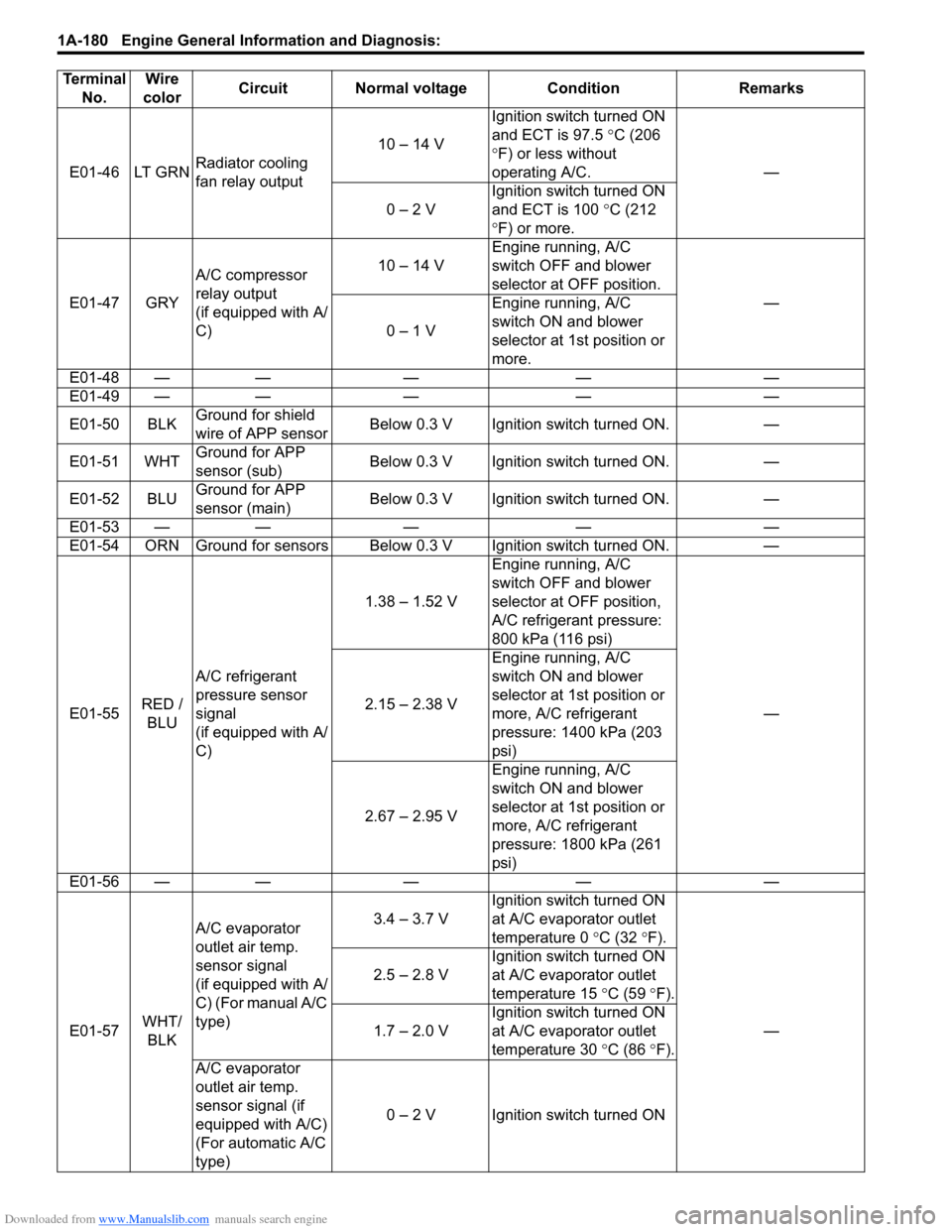
E01-46 LT GRNRadiator cooling
fan relay output10 – 14 VIgnition switch turned ON
and ECT is 97.5 °C (206
°F) or less without
operating A/C. —
0 – 2 VIgnition switch turned ON
and ECT is 100 °C (212
°F) or more.
E01-47 GRYA/C compressor
relay output
(if equipped with A/
C)10 – 14 VEngine running, A/C
switch OFF and blower
selector at OFF position.
—
0 – 1 VEngine running, A/C
switch ON and blower
selector at 1st position or
more.
E01-48 — — — — —
E01-49 — — — — —
E01-50 BLKGround for shield
wire of APP sensorBelow 0.3 V Ignition switch turned ON. —
E01-51 WHTGround for APP
sensor (sub)Below 0.3 V Ignition switch turned ON. —
E01-52 BLUGround for APP
sensor (main)Below 0.3 V Ignition switch turned ON. —
E01-53 — — — — —
E01-54 ORN Ground for sensors Below 0.3 V Ignition switch turned ON. —
E01-55RED /
BLUA/C refrigerant
pressure sensor
signal
(if equipped with A/
C)1.38 – 1.52 VEngine running, A/C
switch OFF and blower
selector at OFF position,
A/C refrigerant pressure:
800 kPa (116 psi)
— 2.15 – 2.38 VEngine running, A/C
switch ON and blower
selector at 1st position or
more, A/C refrigerant
pressure: 1400 kPa (203
psi)
2.67 – 2.95 VEngine running, A/C
switch ON and blower
selector at 1st position or
more, A/C refrigerant
pressure: 1800 kPa (261
psi)
E01-56 — — — — —
E01-57WHT/
BLKA/C evaporator
outlet air temp.
sensor signal
(if equipped with A/
C) (For manual A/C
type)3.4 – 3.7 VIgnition switch turned ON
at A/C evaporator outlet
temperature 0 °C (32 °F).
— 2.5 – 2.8 VIgnition switch turned ON
at A/C evaporator outlet
temperature 15 °C (59 °F).
1.7 – 2.0 VIgnition switch turned ON
at A/C evaporator outlet
temperature 30 °C (86 °F).
A/C evaporator
outlet air temp.
sensor signal (if
equipped with A/C)
(For automatic A/C
type)0 – 2 V Ignition switch turned ON Terminal
No.Wire
colorCircuit Normal voltage Condition Remarks
Page 260 of 1556
Downloaded from www.Manualslib.com manuals search engine 1A-210 Engine General Information and Diagnosis:
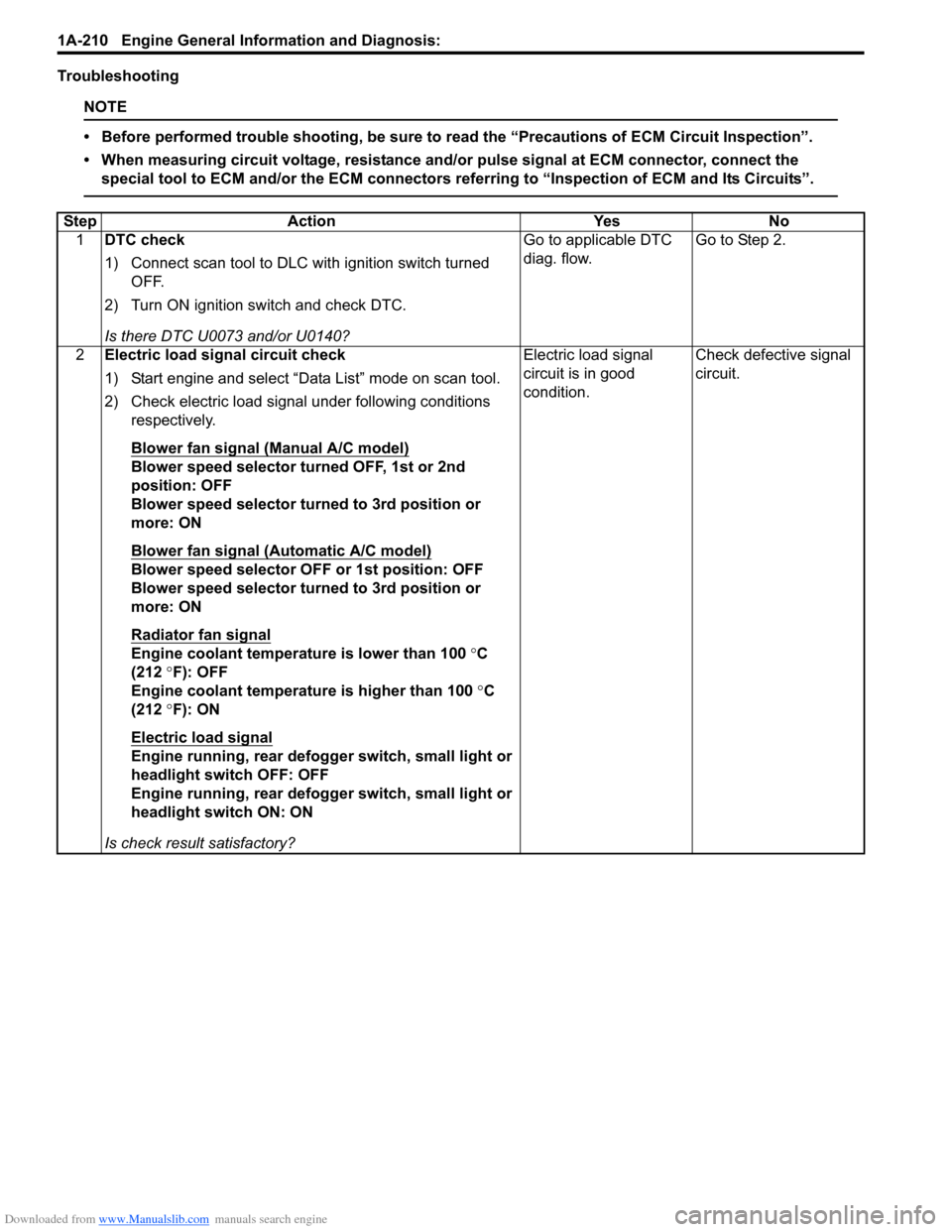
Troubleshooting
NOTE
• Before performed trouble shooting, be sure to read the “Precautions of ECM Circuit Inspection”.
• When measuring circuit voltage, resistance and/or pulse signal at ECM connector, connect the
special tool to ECM and/or the ECM connectors referring to “Inspection of ECM and Its Circuits”.
Step Action Yes No
1DTC check
1) Connect scan tool to DLC with ignition switch turned
OFF.
2) Turn ON ignition switch and check DTC.
Is there DTC U0073 and/or U0140?Go to applicable DTC
diag. flow.Go to Step 2.
2Electric load signal circuit check
1) Start engine and select “Data List” mode on scan tool.
2) Check electric load signal under following conditions
respectively.
Blower fan signal (Manual A/C model)
Blower speed selector turned OFF, 1st or 2nd
position: OFF
Blower speed selector turned to 3rd position or
more: ON
Blower fan signal (Automatic A/C model)
Blower speed selector OFF or 1st position: OFF
Blower speed selector turned to 3rd position or
more: ON
Radiator fan signal
Engine coolant temperature is lower than 100 °C
(212 °F): OFF
Engine coolant temperature is higher than 100 °C
(212 °F): ON
Electric load signal
Engine running, rear defogger switch, small light or
headlight switch OFF: OFF
Engine running, rear defogger switch, small light or
headlight switch ON: ON
Is check result satisfactory?Electric load signal
circuit is in good
condition.Check defective signal
circuit.
Page 261 of 1556
Downloaded from www.Manualslib.com manuals search engine Engine General Information and Diagnosis: 1A-211
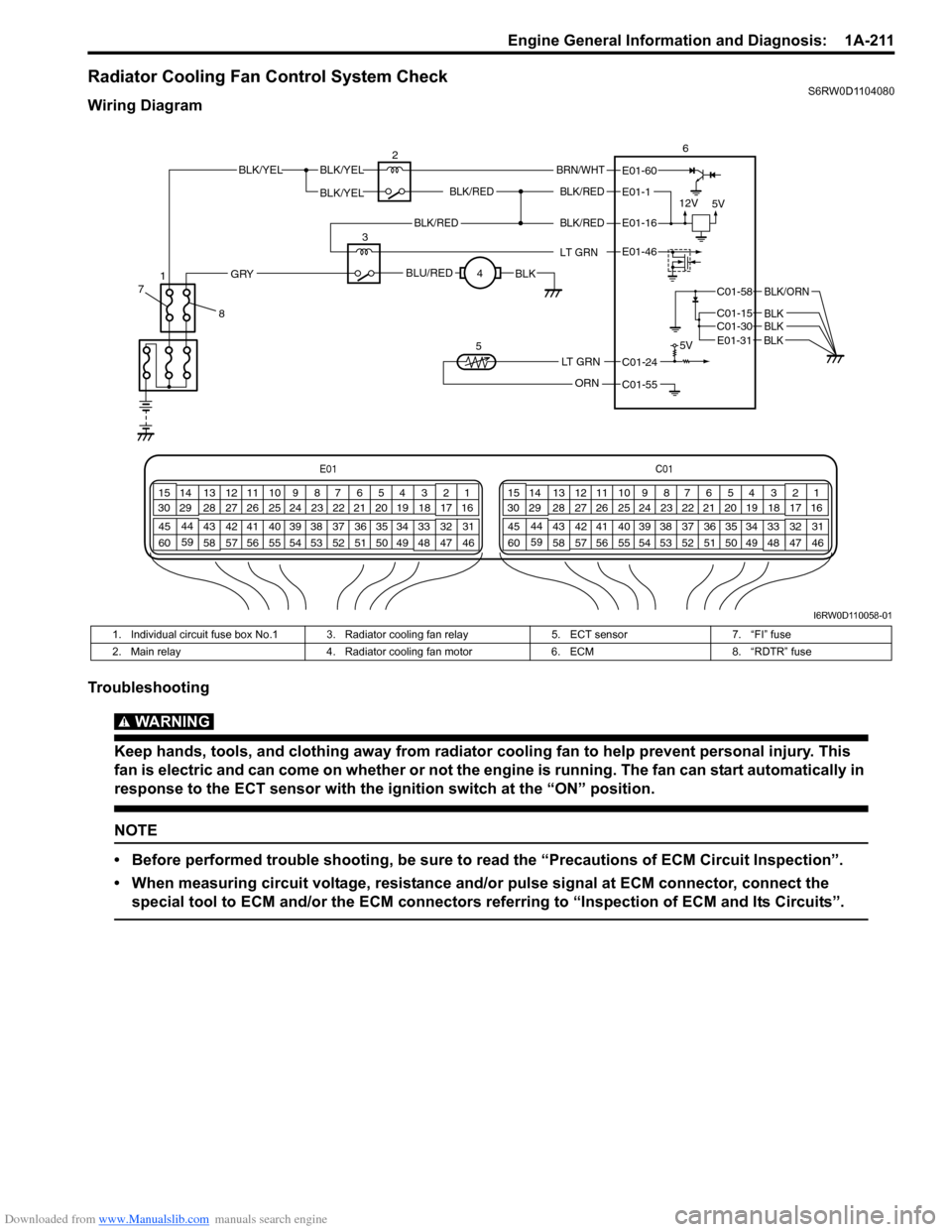
Radiator Cooling Fan Control System CheckS6RW0D1104080
Wiring Diagram
Troubleshooting
WARNING!
Keep hands, tools, and clothing away from radiator cooling fan to help prevent personal injury. This
fan is electric and can come on whether or not the engine is running. The fan can start automatically in
response to the ECT sensor with the ignition switch at the “ON” position.
NOTE
• Before performed trouble shooting, be sure to read the “Precautions of ECM Circuit Inspection”.
• When measuring circuit voltage, resistance and/or pulse signal at ECM connector, connect the
special tool to ECM and/or the ECM connectors referring to “Inspection of ECM and Its Circuits”.
E01C01
3 4
18 19 5 6 7 10 11
17 20
47 46 49 50 51 21 22
5216 259
24 14
29
55 57 54 53 59
60 582
26 27 28 15
30
56 4832 31 34 35 36 37 40 42 39 38 44
45 43 41 331 12 13
238 3 4
18 19 5 6 7 10 11
17 20
47 46 49 50 51 21 22
5216 259
24 14
29
55 57 54 53 59
60 582
26 27 28 15
30
56 4832 31 34 35 36 37 40 42 39 38 44
45 43 41 331 12 13
238
BLK/REDBLK/RED
BLK/YELBLK/YEL
BLK/YEL
BRN/WHT
12V
5V5V
26
E01-1
E01-60
C01-58
C01-15 C01-30
BLK/ORN
BLKBLK
BLK/RED
LT GRN
BLK/REDE01-16
E01-46
BLU/REDBLKGRY
LT GRN
ORN
C01-24
C01-55 3
4
5
E01-31 BLK
8 71
I6RW0D110058-01
1. Individual circuit fuse box No.1 3. Radiator cooling fan relay 5. ECT sensor 7. “FI” fuse
2. Main relay 4. Radiator cooling fan motor 6. ECM 8. “RDTR” fuse
Page 301 of 1556
Downloaded from www.Manualslib.com manuals search engine Engine Mechanical: 1D-19
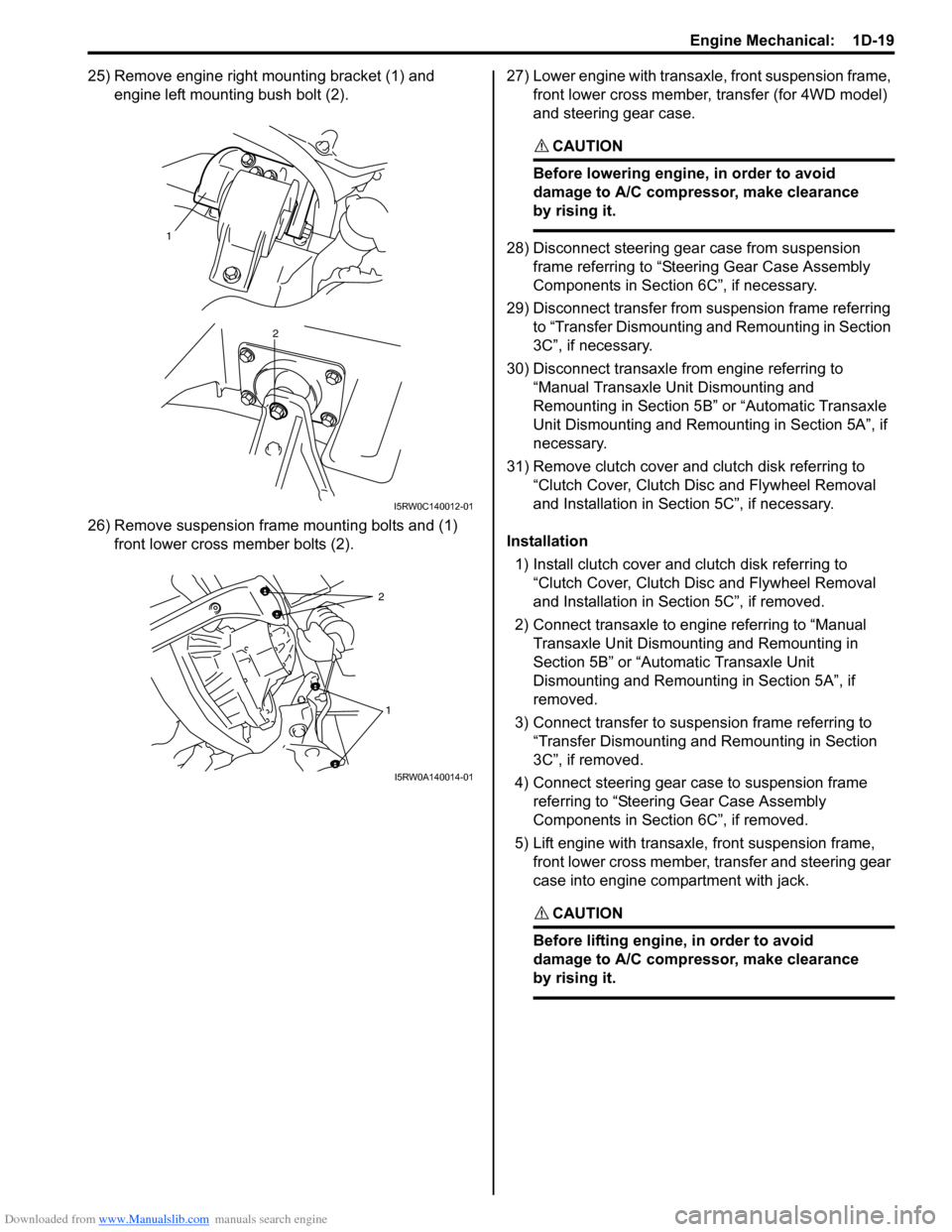
25) Remove engine right mounting bracket (1) and
engine left mounting bush bolt (2).
26) Remove suspension frame mounting bolts and (1)
front lower cross member bolts (2).27) Lower engine with transaxle, front suspension frame,
front lower cross member, transfer (for 4WD model)
and steering gear case.
CAUTION!
Before lowering engine, in order to avoid
damage to A/C compressor, make clearance
by rising it.
28) Disconnect steering gear case from suspension
frame referring to “Steering Gear Case Assembly
Components in Section 6C”, if necessary.
29) Disconnect transfer from suspension frame referring
to “Transfer Dismounting and Remounting in Section
3C”, if necessary.
30) Disconnect transaxle from engine referring to
“Manual Transaxle Unit Dismounting and
Remounting in Section 5B” or “Automatic Transaxle
Unit Dismounting and Remounting in Section 5A”, if
necessary.
31) Remove clutch cover and clutch disk referring to
“Clutch Cover, Clutch Disc and Flywheel Removal
and Installation in Section 5C”, if necessary.
Installation
1) Install clutch cover and clutch disk referring to
“Clutch Cover, Clutch Disc and Flywheel Removal
and Installation in Section 5C”, if removed.
2) Connect transaxle to engine referring to “Manual
Transaxle Unit Dismounting and Remounting in
Section 5B” or “Automatic Transaxle Unit
Dismounting and Remounting in Section 5A”, if
removed.
3) Connect transfer to suspension frame referring to
“Transfer Dismounting and Remounting in Section
3C”, if removed.
4) Connect steering gear case to suspension frame
referring to “Steering Gear Case Assembly
Components in Section 6C”, if removed.
5) Lift engine with transaxle, front suspension frame,
front lower cross member, transfer and steering gear
case into engine compartment with jack.
CAUTION!
Before lifting engine, in order to avoid
damage to A/C compressor, make clearance
by rising it.
1
2
I5RW0C140012-01
2
1
I5RW0A140014-01
Page 396 of 1556
Downloaded from www.Manualslib.com manuals search engine 1H-1 Ignition System:
Engine
Ignition System
General Description
Ignition System ConstructionS6RW0D1801001
The ignition system is an electronic (distributorless) ignition system. It consists of the parts as described below.
•ECM
It detects the engine and vehicle conditions through the signals from the sensors, determines the most suitable
ignition timing and time for electricity to flow to the primary coil and sends a signal to the ignitor (power unit) in the
ignition coil assembly.
•Ignition coil assembly (including an ignitor)
The ignition coil assembly has a built-in ignitor which turns ON and OFF the current flow to the primary coil
according to the signal from ECM. When the current flow to the primary coil is turned OFF, a high voltage is induced
in the secondary coil.
•High-tension cords and spark plugs
•CMP sensor (Camshaft position sensor) and CKP sensor (Crankshaft position sensor)
Using signals from these sensors, ECM identifies the specific cylinder whose piston is in the compression stroke,
detects the crank angle and adjusts initial ignition timing automatically.
•TP sensor, ECT sensor, MAP sensor, MAF sensor, IAT sensor, knock sensor and other sensors / switches
Although this ignition system does not have a distributor, it has two ignition coil assemblies (one is for No.1 and No.4
spark plugs and the other is for No.2 and No.3 spark plugs). When an ignition signal is sent from ECM to the ignitor in
the ignition coil assembly for No.1 and No.4 spark plugs, a high voltage is induced in the secondary coil and that
passes through the high-tension cords and causes No.1 and No.4 spark plugs to spark simultaneously. Likewise,
when an ignition signal is sent to the ignitor in the other ignition coil assembly, No.2 and No.3 spark plugs spark
simultaneously.
Page 421 of 1556
Downloaded from www.Manualslib.com manuals search engine Charging System: 1J-7
1) Set parking brake and place automatic transaxle in
PARK (NEUTRAL on manual transaxle). Turn off
ignition, turn off lights and all other electrical loads.
2) Check electrolyte level. If it is below low level line,
add distilled water.
3) Attach end of one jumper cable to positive terminal
of booster battery and the other end of the same
cable to positive terminal of discharged battery. (Use
12-volt battery only to jump start engine).
4) Attach one end of the remaining negative cable to
negative terminal of booster battery, and the other
end to a solid engine ground (such as exhaust
manifold) at least 45 cm (18 in.) away from battery of
vehicle being started.
5) Start engine of vehicle with booster battery and turn
off electrical accessories. Then start engine of the
vehicle with discharged battery.
6) Disconnect jumper cables in the exact reverse order.
With Charging Equipment
CAUTION!
When jump starting engine with charging
equipment, be sure equipment used is 12-
volt and negative ground. Do not use 24-volt
charging equipment. Using such equipment
can cause serious damage to electrical
system or electronic parts.
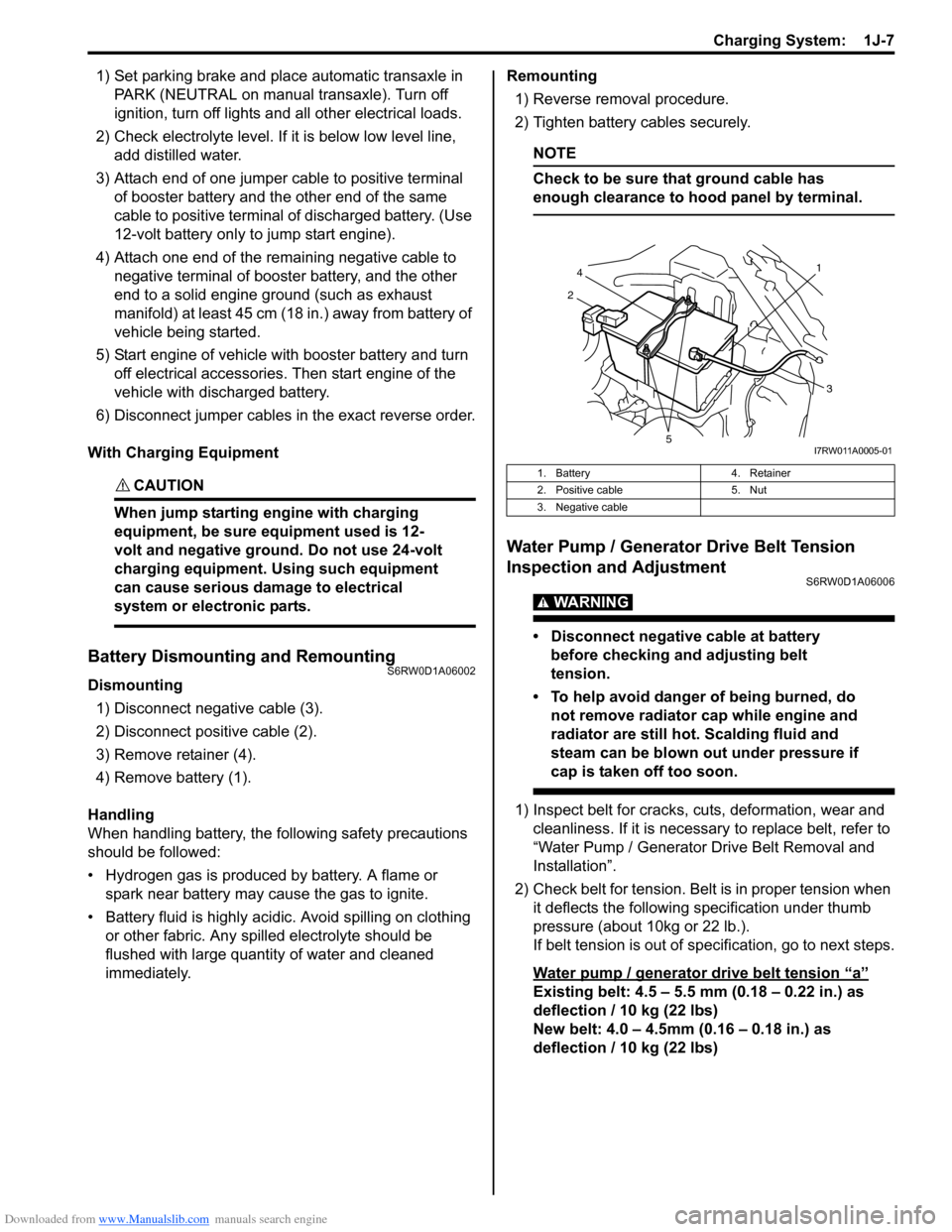
Battery Dismounting and RemountingS6RW0D1A06002
Dismounting
1) Disconnect negative cable (3).
2) Disconnect positive cable (2).
3) Remove retainer (4).
4) Remove battery (1).
Handling
When handling battery, the following safety precautions
should be followed:
• Hydrogen gas is produced by battery. A flame or
spark near battery may cause the gas to ignite.
• Battery fluid is highly acidic. Avoid spilling on clothing
or other fabric. Any spilled electrolyte should be
flushed with large quantity of water and cleaned
immediately.Remounting
1) Reverse removal procedure.
2) Tighten battery cables securely.
NOTE
Check to be sure that ground cable has
enough clearance to hood panel by terminal.
Water Pump / Generator Drive Belt Tension
Inspection and Adjustment
S6RW0D1A06006
WARNING!
• Disconnect negative cable at battery
before checking and adjusting belt
tension.
• To help avoid danger of being burned, do
not remove radiator cap while engine and
radiator are still hot. Scalding fluid and
steam can be blown out under pressure if
cap is taken off too soon.
1) Inspect belt for cracks, cuts, deformation, wear and
cleanliness. If it is necessary to replace belt, refer to
“Water Pump / Generator Drive Belt Removal and
Installation”.
2) Check belt for tension. Belt is in proper tension when
it deflects the following specification under thumb
pressure (about 10kg or 22 lb.).
If belt tension is out of specification, go to next steps.
Water pump / generator drive belt tension
“a”
Existing belt: 4.5 – 5.5 mm (0.18 – 0.22 in.) as
deflection / 10 kg (22 lbs)
New belt: 4.0 – 4.5mm (0.16 – 0.18 in.) as
deflection / 10 kg (22 lbs)
1. Battery 4. Retainer
2. Positive cable 5. Nut
3. Negative cable
21
4
3
5I7RW011A0005-01
Page 507 of 1556
Downloaded from www.Manualslib.com manuals search engine Differential: 3B-10
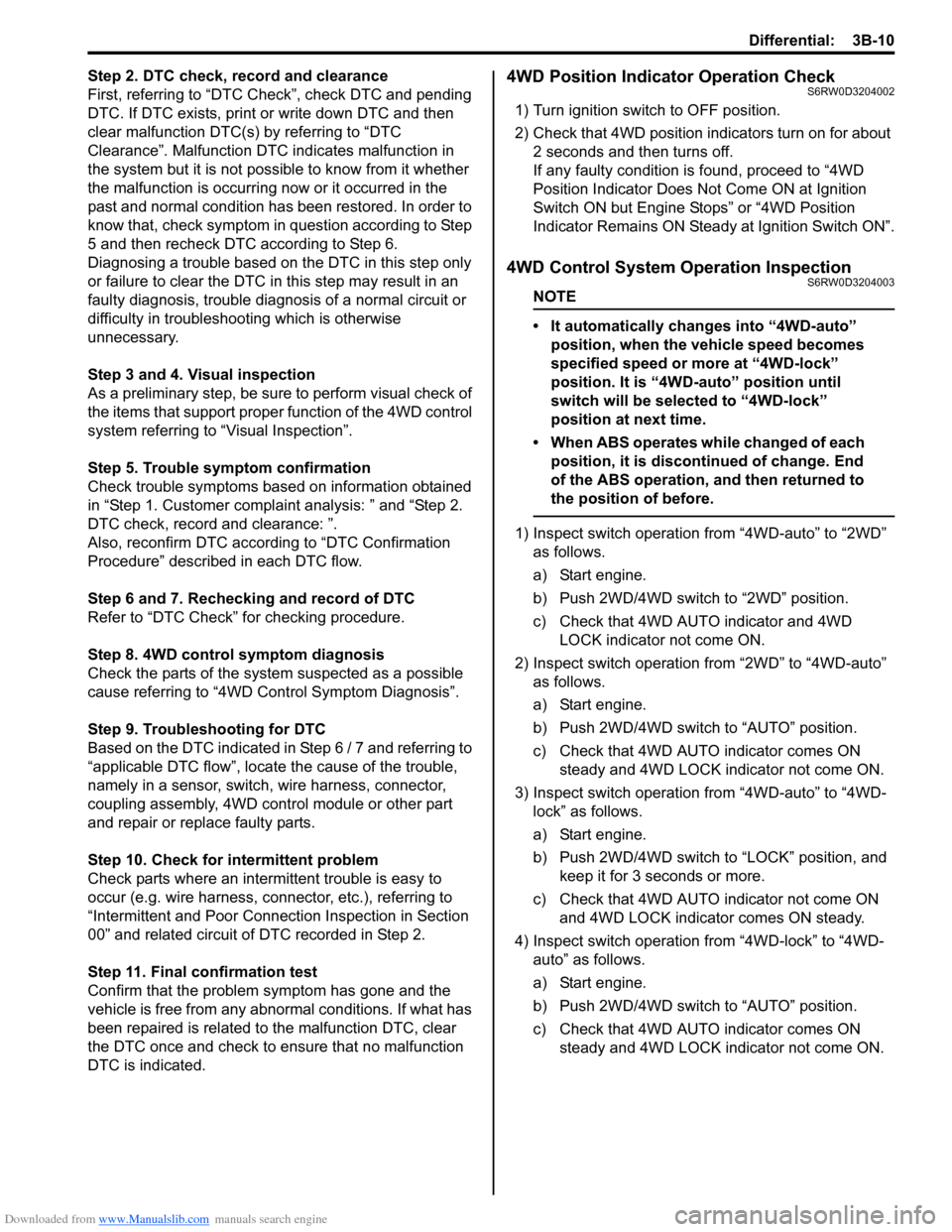
Step 2. DTC check, record and clearance
First, referring to “DTC Check”, check DTC and pending
DTC. If DTC exists, print or write down DTC and then
clear malfunction DTC(s) by referring to “DTC
Clearance”. Malfunction DTC indicates malfunction in
the system but it is not possible to know from it whether
the malfunction is occurring now or it occurred in the
past and normal condition has been restored. In order to
know that, check symptom in question according to Step
5 and then recheck DTC according to Step 6.
Diagnosing a trouble based on the DTC in this step only
or failure to clear the DTC in this step may result in an
faulty diagnosis, trouble diagnosis of a normal circuit or
difficulty in troubleshooting which is otherwise
unnecessary.
Step 3 and 4. Visual inspection
As a preliminary step, be sure to perform visual check of
the items that support proper function of the 4WD control
system referring to “Visual Inspection”.
Step 5. Trouble symptom confirmation
Check trouble symptoms based on information obtained
in “Step 1. Customer complaint analysis: ” and “Step 2.
DTC check, record and clearance: ”.
Also, reconfirm DTC according to “DTC Confirmation
Procedure” described in each DTC flow.
Step 6 and 7. Rechecking and record of DTC
Refer to “DTC Check” for checking procedure.
Step 8. 4WD control symptom diagnosis
Check the parts of the system suspected as a possible
cause referring to “4WD Control Symptom Diagnosis”.
Step 9. Troubleshooting for DTC
Based on the DTC indicated in Step 6 / 7 and referring to
“applicable DTC flow”, locate the cause of the trouble,
namely in a sensor, switch, wire harness, connector,
coupling assembly, 4WD control module or other part
and repair or replace faulty parts.
Step 10. Check for intermittent problem
Check parts where an intermittent trouble is easy to
occur (e.g. wire harness, connector, etc.), referring to
“Intermittent and Poor Connection Inspection in Section
00” and related circuit of DTC recorded in Step 2.
Step 11. Final confirmation test
Confirm that the problem symptom has gone and the
vehicle is free from any abnormal conditions. If what has
been repaired is related to the malfunction DTC, clear
the DTC once and check to ensure that no malfunction
DTC is indicated.4WD Position Indicator Operation CheckS6RW0D3204002
1) Turn ignition switch to OFF position.
2) Check that 4WD position indicators turn on for about
2 seconds and then turns off.
If any faulty condition is found, proceed to “4WD
Position Indicator Does Not Come ON at Ignition
Switch ON but Engine Stops” or “4WD Position
Indicator Remains ON Steady at Ignition Switch ON”.
4WD Control System Operation InspectionS6RW0D3204003
NOTE
• It automatically changes into “4WD-auto”
position, when the vehicle speed becomes
specified speed or more at “4WD-lock”
position. It is “4WD-auto” position until
switch will be selected to “4WD-lock”
position at next time.
• When ABS operates while changed of each
position, it is discontinued of change. End
of the ABS operation, and then returned to
the position of before.
1) Inspect switch operation from “4WD-auto” to “2WD”
as follows.
a) Start engine.
b) Push 2WD/4WD switch to “2WD” position.
c) Check that 4WD AUTO indicator and 4WD
LOCK indicator not come ON.
2) Inspect switch operation from “2WD” to “4WD-auto”
as follows.
a) Start engine.
b) Push 2WD/4WD switch to “AUTO” position.
c) Check that 4WD AUTO indicator comes ON
steady and 4WD LOCK indicator not come ON.
3) Inspect switch operation from “4WD-auto” to “4WD-
lock” as follows.
a) Start engine.
b) Push 2WD/4WD switch to “LOCK” position, and
keep it for 3 seconds or more.
c) Check that 4WD AUTO indicator not come ON
and 4WD LOCK indicator comes ON steady.
4) Inspect switch operation from “4WD-lock” to “4WD-
auto” as follows.
a) Start engine.
b) Push 2WD/4WD switch to “AUTO” position.
c) Check that 4WD AUTO indicator comes ON
steady and 4WD LOCK indicator not come ON.
Page 645 of 1556
Downloaded from www.Manualslib.com manuals search engine Table of Contents 5- i
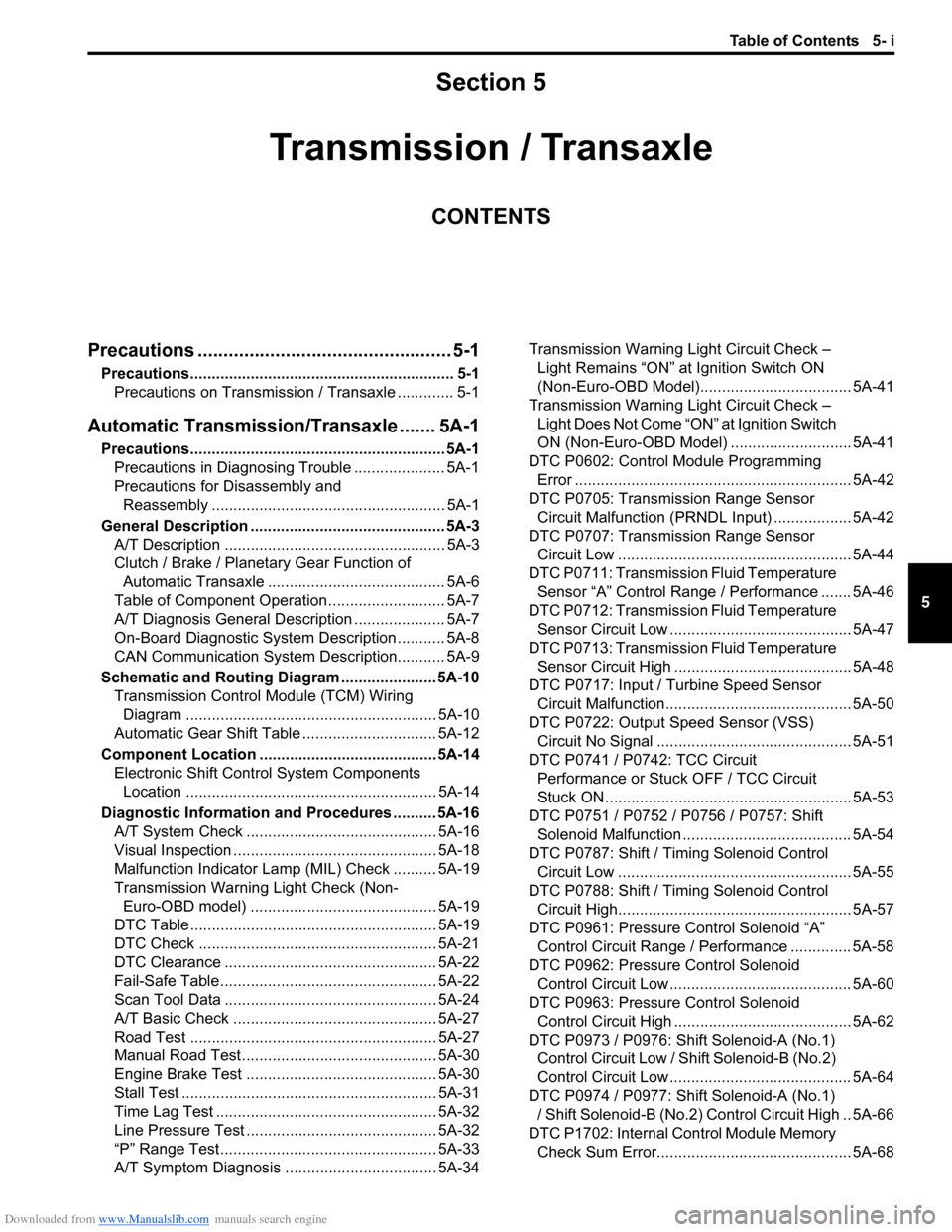
5
Section 5
CONTENTS
Transmission / Transaxle
Precautions ................................................. 5-1
Precautions............................................................. 5-1
Precautions on Transmission / Transaxle ............. 5-1
Automatic Transmission/Transaxle ....... 5A-1
Precautions........................................................... 5A-1
Precautions in Diagnosing Trouble ..................... 5A-1
Precautions for Disassembly and
Reassembly ...................................................... 5A-1
General Description ............................................. 5A-3
A/T Description ................................................... 5A-3
Clutch / Brake / Planetary Gear Function of
Automatic Transaxle ......................................... 5A-6
Table of Component Operation ........................... 5A-7
A/T Diagnosis General Description ..................... 5A-7
On-Board Diagnostic System Description ........... 5A-8
CAN Communication System Description........... 5A-9
Schematic and Routing Diagram ...................... 5A-10
Transmission Control Module (TCM) Wiring
Diagram .......................................................... 5A-10
Automatic Gear Shift Table ............................... 5A-12
Component Location ......................................... 5A-14
Electronic Shift Control System Components
Location .......................................................... 5A-14
Diagnostic Information and Procedures .......... 5A-16
A/T System Check ............................................ 5A-16
Visual Inspection ............................................... 5A-18
Malfunction Indicator Lamp (MIL) Check .......... 5A-19
Transmission Warning Light Check (Non-
Euro-OBD model) ........................................... 5A-19
DTC Table ......................................................... 5A-19
DTC Check ....................................................... 5A-21
DTC Clearance ................................................. 5A-22
Fail-Safe Table .................................................. 5A-22
Scan Tool Data ................................................. 5A-24
A/T Basic Check ............................................... 5A-27
Road Test ......................................................... 5A-27
Manual Road Test ............................................. 5A-30
Engine Brake Test ............................................ 5A-30
Stall Test ........................................................... 5A-31
Time Lag Test ................................................... 5A-32
Line Pressure Test ............................................ 5A-32
“P” Range Test.................................................. 5A-33
A/T Symptom Diagnosis ................................... 5A-34Transmission Warning Light Circuit Check –
Light Remains “ON” at Ignition Switch ON
(Non-Euro-OBD Model)................................... 5A-41
Transmission Warning Light Circuit Check –
Light Does Not Come “ON” at Ignition Switch
ON (Non-Euro-OBD Model)............................ 5A-41
DTC P0602: Control Module Programming
Error ................................................................ 5A-42
DTC P0705: Transmission Range Sensor
Circuit Malfunction (PRNDL Input) .................. 5A-42
DTC P0707: Transmission Range Sensor
Circuit Low ...................................................... 5A-44
DTC P0711: Transmission Fluid Temperature
Sensor “A” Control Range / Performance ....... 5A-46
DTC P0712: Transmission Fluid Temperature
Sensor Circuit Low .......................................... 5A-47
DTC P0713: Transmission Fluid Temperature
Sensor Circuit High ......................................... 5A-48
DTC P0717: Input / Turbine Speed Sensor
Circuit Malfunction........................................... 5A-50
DTC P0722: Output Speed Sensor (VSS)
Circuit No Signal ............................................. 5A-51
DTC P0741 / P0742: TCC Circuit
Performance or Stuck OFF / TCC Circuit
Stuck ON ......................................................... 5A-53
DTC P0751 / P0752 / P0756 / P0757: Shift
Solenoid Malfunction ....................................... 5A-54
DTC P0787: Shift / Timing Solenoid Control
Circuit Low ...................................................... 5A-55
DTC P0788: Shift / Timing Solenoid Control
Circuit High...................................................... 5A-57
DTC P0961: Pressure Control Solenoid “A”
Control Circuit Range / Performance .............. 5A-58
DTC P0962: Pressure Control Solenoid
Control Circuit Low .......................................... 5A-60
DTC P0963: Pressure Control Solenoid
Control Circuit High ......................................... 5A-62
DTC P0973 / P0976: Shift Solenoid-A (No.1)
Control Circuit Low / Shift Solenoid-B (No.2)
Control Circuit Low .......................................... 5A-64
DTC P0974 / P0977: Shift Solenoid-A (No.1)
/ Shift Solenoid-B (No.2) Control Circuit High .. 5A-66
DTC P1702: Internal Control Module Memory
Check Sum Error............................................. 5A-68