Crankshaft SUZUKI SX4 2006 1.G Service User Guide
[x] Cancel search | Manufacturer: SUZUKI, Model Year: 2006, Model line: SX4, Model: SUZUKI SX4 2006 1.GPages: 1556, PDF Size: 37.31 MB
Page 167 of 1556
Downloaded from www.Manualslib.com manuals search engine Engine General Information and Diagnosis: 1A-117
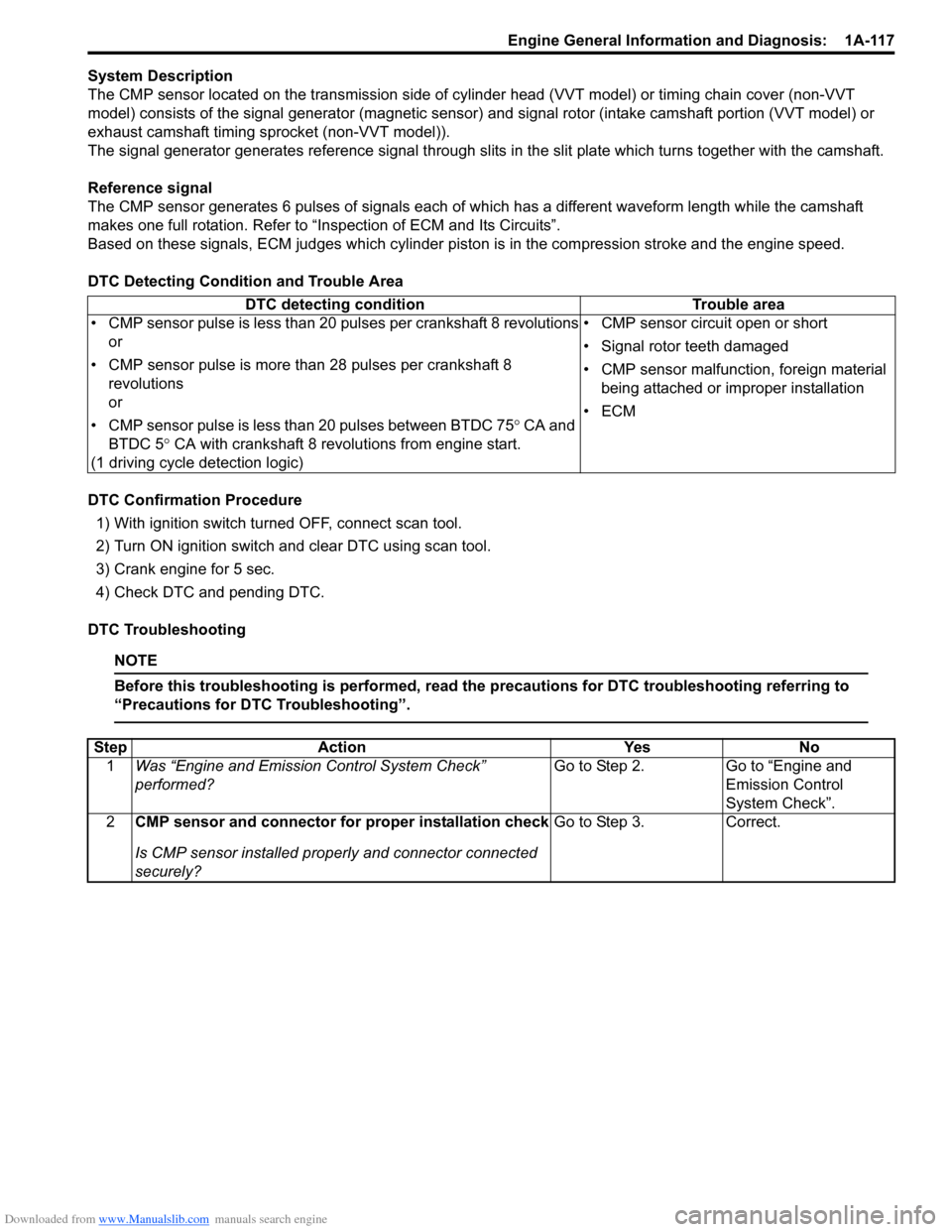
System Description
The CMP sensor located on the transmission side of cylinder head (VVT model) or timing chain cover (non-VVT
model) consists of the signal generator (magnetic sensor) and signal rotor (intake camshaft portion (VVT model) or
exhaust camshaft timing sprocket (non-VVT model)).
The signal generator generates reference signal through slits in the slit plate which turns together with the camshaft.
Reference signal
The CMP sensor generates 6 pulses of signals each of which has a different waveform length while the camshaft
makes one full rotation. Refer to “Inspection of ECM and Its Circuits”.
Based on these signals, ECM judges which cylinder piston is in the compression stroke and the engine speed.
DTC Detecting Condition and Trouble Area
DTC Confirmation Procedure
1) With ignition switch turned OFF, connect scan tool.
2) Turn ON ignition switch and clear DTC using scan tool.
3) Crank engine for 5 sec.
4) Check DTC and pending DTC.
DTC Troubleshooting
NOTE
Before this troubleshooting is performed, read the precautions for DTC troubleshooting referring to
“Precautions for DTC Troubleshooting”.
DTC detecting condition Trouble area
• CMP sensor pulse is less than 20 pulses per crankshaft 8 revolutions
or
• CMP sensor pulse is more than 28 pulses per crankshaft 8
revolutions
or
• CMP sensor pulse is less than 20 pulses between BTDC 75° CA and
BTDC 5° CA with crankshaft 8 revolutions from engine start.
(1 driving cycle detection logic)• CMP sensor circuit open or short
• Signal rotor teeth damaged
• CMP sensor malfunction, foreign material
being attached or improper installation
•ECM
Step Action Yes No
1Was “Engine and Emission Control System Check”
performed?Go to Step 2. Go to “Engine and
Emission Control
System Check”.
2CMP sensor and connector for proper installation check
Is CMP sensor installed properly and connector connected
securely?Go to Step 3. Correct.
Page 225 of 1556
Downloaded from www.Manualslib.com manuals search engine Engine General Information and Diagnosis: 1A-175
C01-19WHT/
REDEGR valve
(stepper motor coil
3) output (if
equipped10 – 14 V Ignition switch turned ON. —
*0 – 1 V
↑↓
10 – 14 V
(“Reference
waveform No.4: ”)Ignition switch is turned to
ST (cranking) position.Output signal is active low
duty pulse. Number of
pulse generated times
varies depending on
vehicle condition.
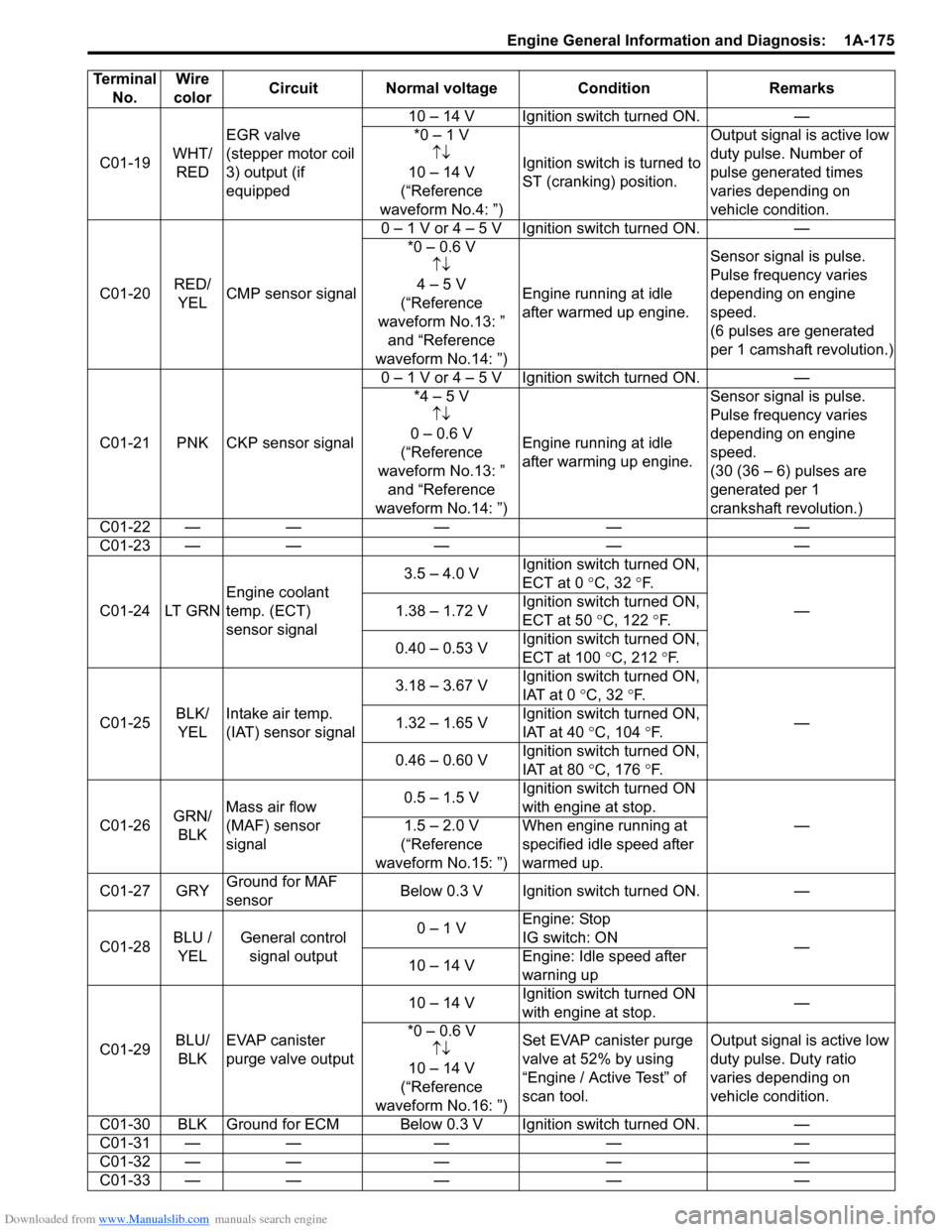
C01-20RED/
YELCMP sensor signal0 – 1 V or 4 – 5 V Ignition switch turned ON. —
*0 – 0.6 V
↑↓
4 – 5 V
(“Reference
waveform No.13: ”
and “Reference
waveform No.14: ”)Engine running at idle
after warmed up engine.Sensor signal is pulse.
Pulse frequency varies
depending on engine
speed.
(6 pulses are generated
per 1 camshaft revolution.)
C01-21 PNK CKP sensor signal0 – 1 V or 4 – 5 V Ignition switch turned ON. —
*4 – 5 V
↑↓
0 – 0.6 V
(“Reference
waveform No.13: ”
and “Reference
waveform No.14: ”)Engine running at idle
after warming up engine.Sensor signal is pulse.
Pulse frequency varies
depending on engine
speed.
(30 (36 – 6) pulses are
generated per 1
crankshaft revolution.)
C01-22 — — — — —
C01-23 — — — — —
C01-24 LT GRNEngine coolant
temp. (ECT)
sensor signal3.5 – 4.0 VIgnition switch turned ON,
ECT at 0 °C, 32 °F.
— 1.38 – 1.72 VIgnition switch turned ON,
ECT at 50 °C, 122 °F.
0.40 – 0.53 VIgnition switch turned ON,
ECT at 100 °C, 212 °F.
C01-25BLK/
YELIntake air temp.
(IAT) sensor signal3.18 – 3.67 VIgnition switch turned ON,
IAT at 0 °C, 32 °F.
— 1.32 – 1.65 VIgnition switch turned ON,
IAT at 40 °C, 104 °F.
0.46 – 0.60 VIgnition switch turned ON,
IAT at 80 °C, 176 °F.
C01-26GRN/
BLKMass air flow
(MAF) sensor
signal0.5 – 1.5 VIgnition switch turned ON
with engine at stop.
— 1.5 – 2.0 V
(“Reference
waveform No.15: ”)When engine running at
specified idle speed after
warmed up.
C01-27 GRYGround for MAF
sensorBelow 0.3 V Ignition switch turned ON. —
C01-28BLU /
YELGeneral control
signal output0 – 1 VEngine: Stop
IG switch: ON
—
10 – 14 VEngine: Idle speed after
warning up
C01-29BLU/
BLKEVAP canister
purge valve output10 – 14 VIgnition switch turned ON
with engine at stop.—
*0 – 0.6 V
↑↓
10 – 14 V
(“Reference
waveform No.16: ”)Set EVAP canister purge
valve at 52% by using
“Engine / Active Test” of
scan tool.Output signal is active low
duty pulse. Duty ratio
varies depending on
vehicle condition.
C01-30 BLK Ground for ECM Below 0.3 V Ignition switch turned ON. —
C01-31 — — — — —
C01-32 — — — — —
C01-33 — — — — — Terminal
No.Wire
colorCircuit Normal voltage Condition Remarks
Page 228 of 1556
Downloaded from www.Manualslib.com manuals search engine 1A-178 Engine General Information and Diagnosis:
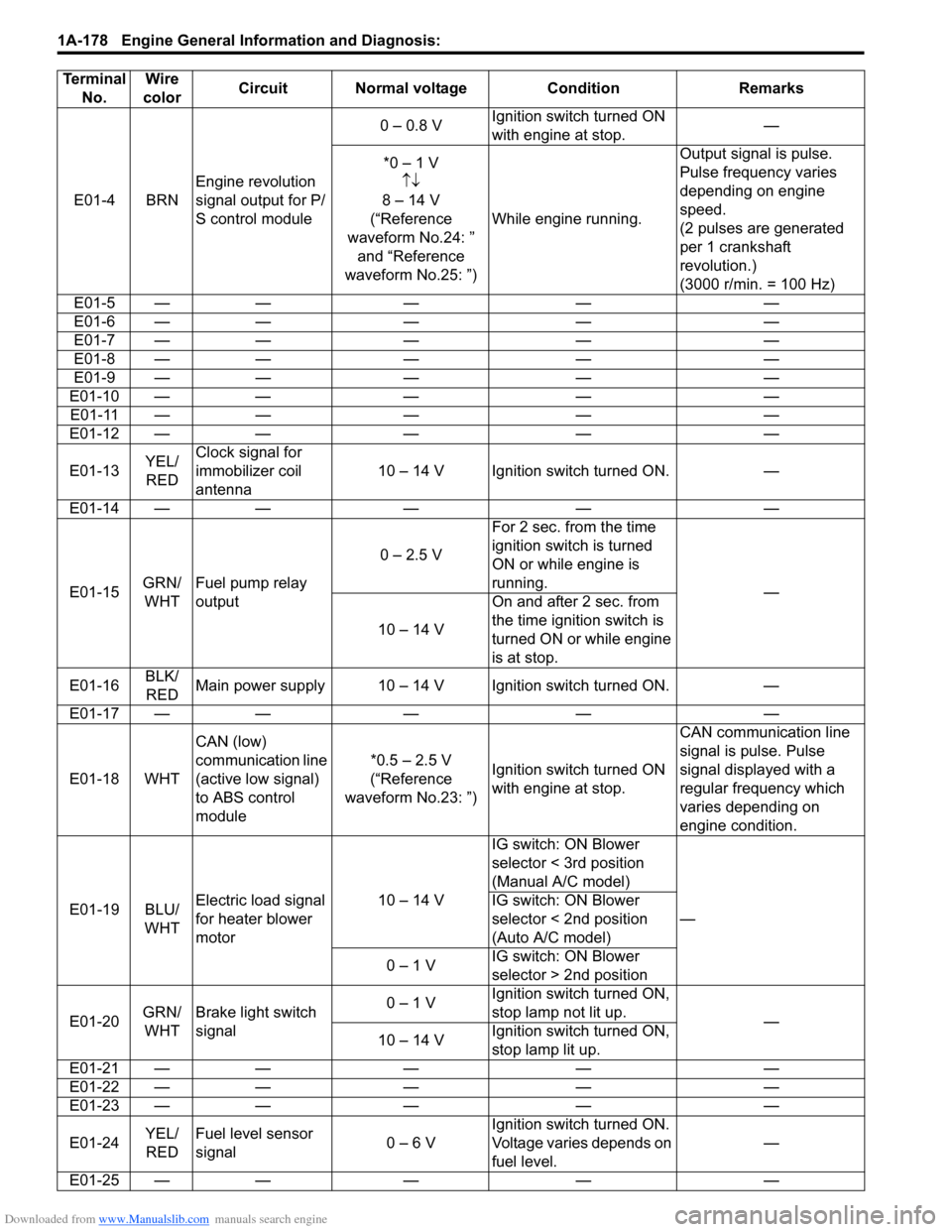
E01-4 BRNEngine revolution
signal output for P/
S control module0 – 0.8 VIgnition switch turned ON
with engine at stop.—
*0 – 1 V
↑↓
8 – 14 V
(“Reference
waveform No.24: ”
and “Reference
waveform No.25: ”)While engine running.Output signal is pulse.
Pulse frequency varies
depending on engine
speed.
(2 pulses are generated
per 1 crankshaft
revolution.)
(3000 r/min. = 100 Hz)
E01-5 — — — — —
E01-6 — — — — —
E01-7 — — — — —
E01-8 — — — — —
E01-9 — — — — —
E01-10 — — — — —
E01-11 — — — — —
E01-12 — — — — —
E01-13YEL/
REDClock signal for
immobilizer coil
antenna10 – 14 V Ignition switch turned ON. —
E01-14 — — — — —
E01-15GRN/
WHTFuel pump relay
output0 – 2.5 VFor 2 sec. from the time
ignition switch is turned
ON or while engine is
running.
—
10 – 14 VOn and after 2 sec. from
the time ignition switch is
turned ON or while engine
is at stop.
E01-16BLK/
REDMain power supply 10 – 14 V Ignition switch turned ON. —
E01-17 — — — — —
E01-18 WHTCAN (low)
communication line
(active low signal)
to ABS control
module*0.5 – 2.5 V
(“Reference
waveform No.23: ”)Ignition switch turned ON
with engine at stop.CAN communication line
signal is pulse. Pulse
signal displayed with a
regular frequency which
varies depending on
engine condition.
E01-19 BLU/
WHTElectric load signal
for heater blower
motor10 – 14 VIG switch: ON Blower
selector < 3rd position
(Manual A/C model)
— IG switch: ON Blower
selector < 2nd position
(Auto A/C model)
0 – 1 VIG switch: ON Blower
selector > 2nd position
E01-20GRN/
WHTBrake light switch
signal0 – 1 VIgnition switch turned ON,
stop lamp not lit up.
—
10 – 14 VIgnition switch turned ON,
stop lamp lit up.
E01-21 — — — — —
E01-22 — — — — —
E01-23 — — — — —
E01-24YEL/
REDFuel level sensor
signal0 – 6 VIgnition switch turned ON.
Voltage varies depends on
fuel level.—
E01-25 — — — — — Terminal
No.Wire
colorCircuit Normal voltage Condition Remarks
Page 278 of 1556
Downloaded from www.Manualslib.com manuals search engine 1C-10 Engine Electrical Devices:
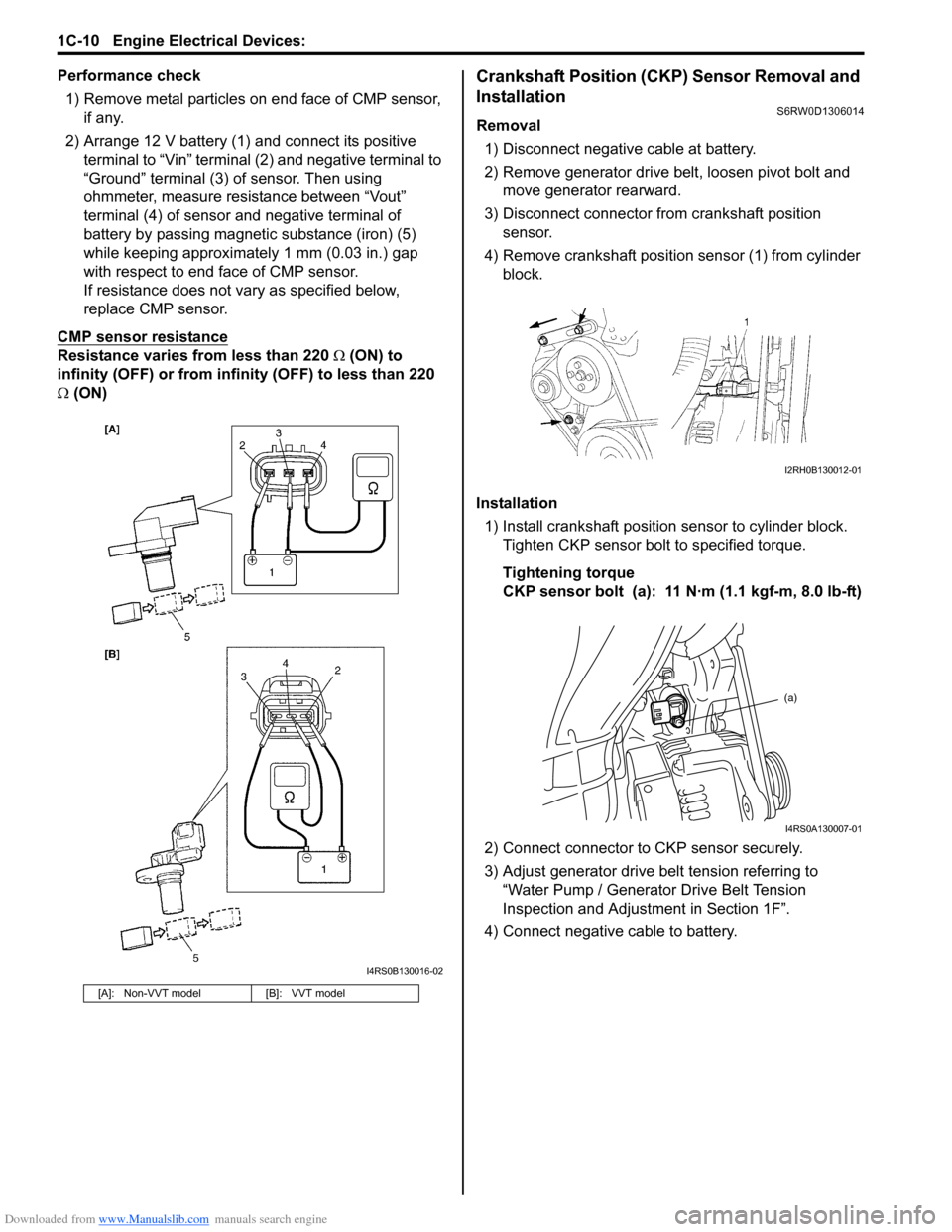
Performance check
1) Remove metal particles on end face of CMP sensor,
if any.
2) Arrange 12 V battery (1) and connect its positive
terminal to “Vin” terminal (2) and negative terminal to
“Ground” terminal (3) of sensor. Then using
ohmmeter, measure resistance between “Vout”
terminal (4) of sensor and negative terminal of
battery by passing magnetic substance (iron) (5)
while keeping approximately 1 mm (0.03 in.) gap
with respect to end face of CMP sensor.
If resistance does not vary as specified below,
replace CMP sensor.
CMP sensor resistance
Resistance varies from less than 220 Ω (ON) to
infinity (OFF) or from infinity (OFF) to less than 220
Ω (ON)
Crankshaft Position (CKP) Sensor Removal and
Installation
S6RW0D1306014
Removal
1) Disconnect negative cable at battery.
2) Remove generator drive belt, loosen pivot bolt and
move generator rearward.
3) Disconnect connector from crankshaft position
sensor.
4) Remove crankshaft position sensor (1) from cylinder
block.
Installation
1) Install crankshaft position sensor to cylinder block.
Tighten CKP sensor bolt to specified torque.
Tightening torque
CKP sensor bolt (a): 11 N·m (1.1 kgf-m, 8.0 lb-ft)
2) Connect connector to CKP sensor securely.
3) Adjust generator drive belt tension referring to
“Water Pump / Generator Drive Belt Tension
Inspection and Adjustment in Section 1F”.
4) Connect negative cable to battery.
[A]: Non-VVT model [B]: VVT model
I4RS0B130016-02
I2RH0B130012-01
(a)
I4RS0A130007-01
Page 279 of 1556
Downloaded from www.Manualslib.com manuals search engine Engine Electrical Devices: 1C-11
Crankshaft Position (CKP) Sensor InspectionS6RW0D1306015
Visual check
• Check that O-ring is free from damage.
• Check that end face of sensor and signal pulley tooth
are free from any metal particles and damage.
Performance check
1) Remove metal particles on end face of CKP sensor,
if any.
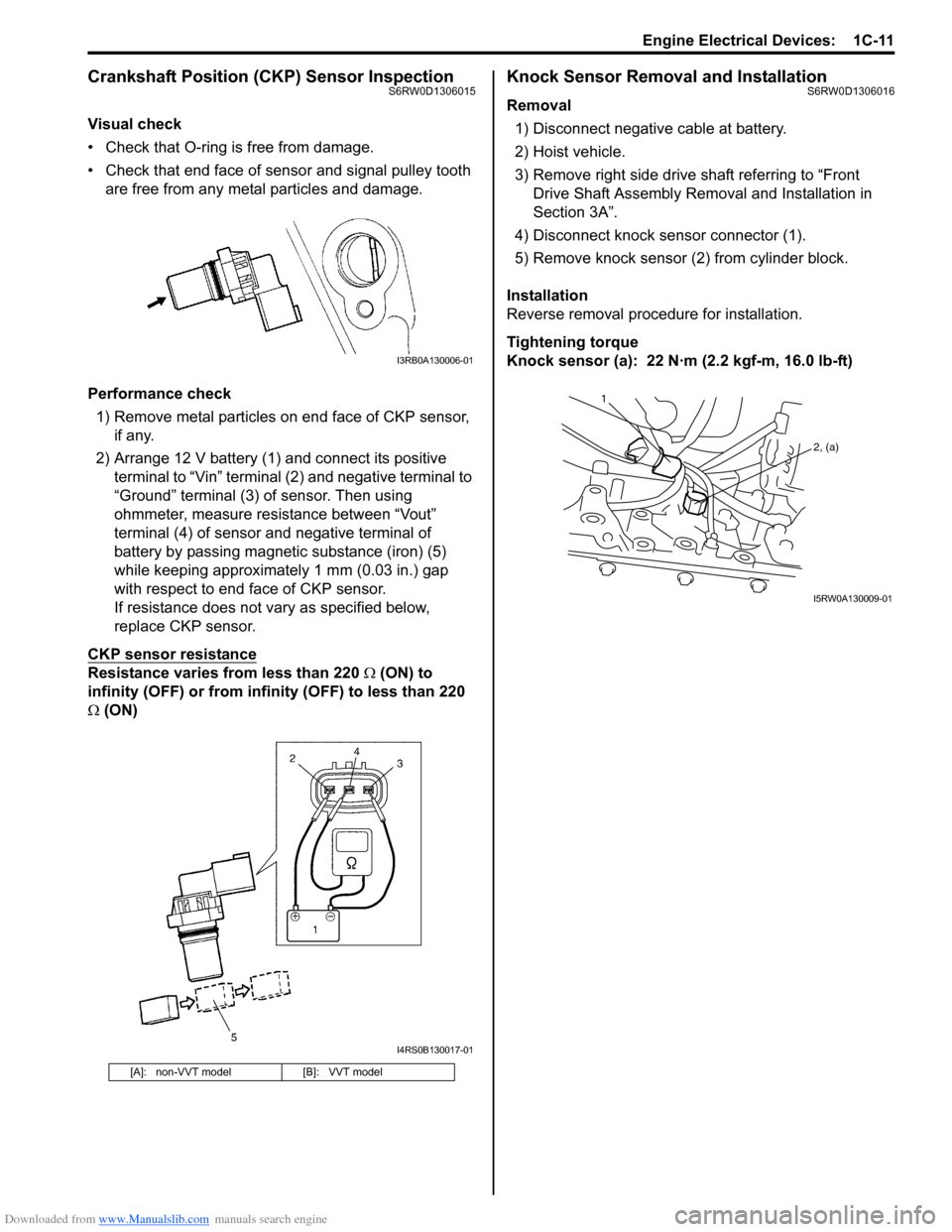
2) Arrange 12 V battery (1) and connect its positive
terminal to “Vin” terminal (2) and negative terminal to
“Ground” terminal (3) of sensor. Then using
ohmmeter, measure resistance between “Vout”
terminal (4) of sensor and negative terminal of
battery by passing magnetic substance (iron) (5)
while keeping approximately 1 mm (0.03 in.) gap
with respect to end face of CKP sensor.
If resistance does not vary as specified below,
replace CKP sensor.
CKP sensor resistance
Resistance varies from less than 220 Ω (ON) to
infinity (OFF) or from infinity (OFF) to less than 220
Ω (ON)
Knock Sensor Removal and InstallationS6RW0D1306016
Removal
1) Disconnect negative cable at battery.
2) Hoist vehicle.
3) Remove right side drive shaft referring to “Front
Drive Shaft Assembly Removal and Installation in
Section 3A”.
4) Disconnect knock sensor connector (1).
5) Remove knock sensor (2) from cylinder block.
Installation
Reverse removal procedure for installation.
Tightening torque
Knock sensor (a): 22 N·m (2.2 kgf-m, 16.0 lb-ft)
[A]: non-VVT model [B]: VVT model
I3RB0A130006-01
I4RS0B130017-01
1
2, (a)
I5RW0A130009-01
Page 283 of 1556
Downloaded from www.Manualslib.com manuals search engine Engine Mechanical: 1D-1
Engine
Engine Mechanical
General Description
Engine Construction DescriptionS6RW0D1401001
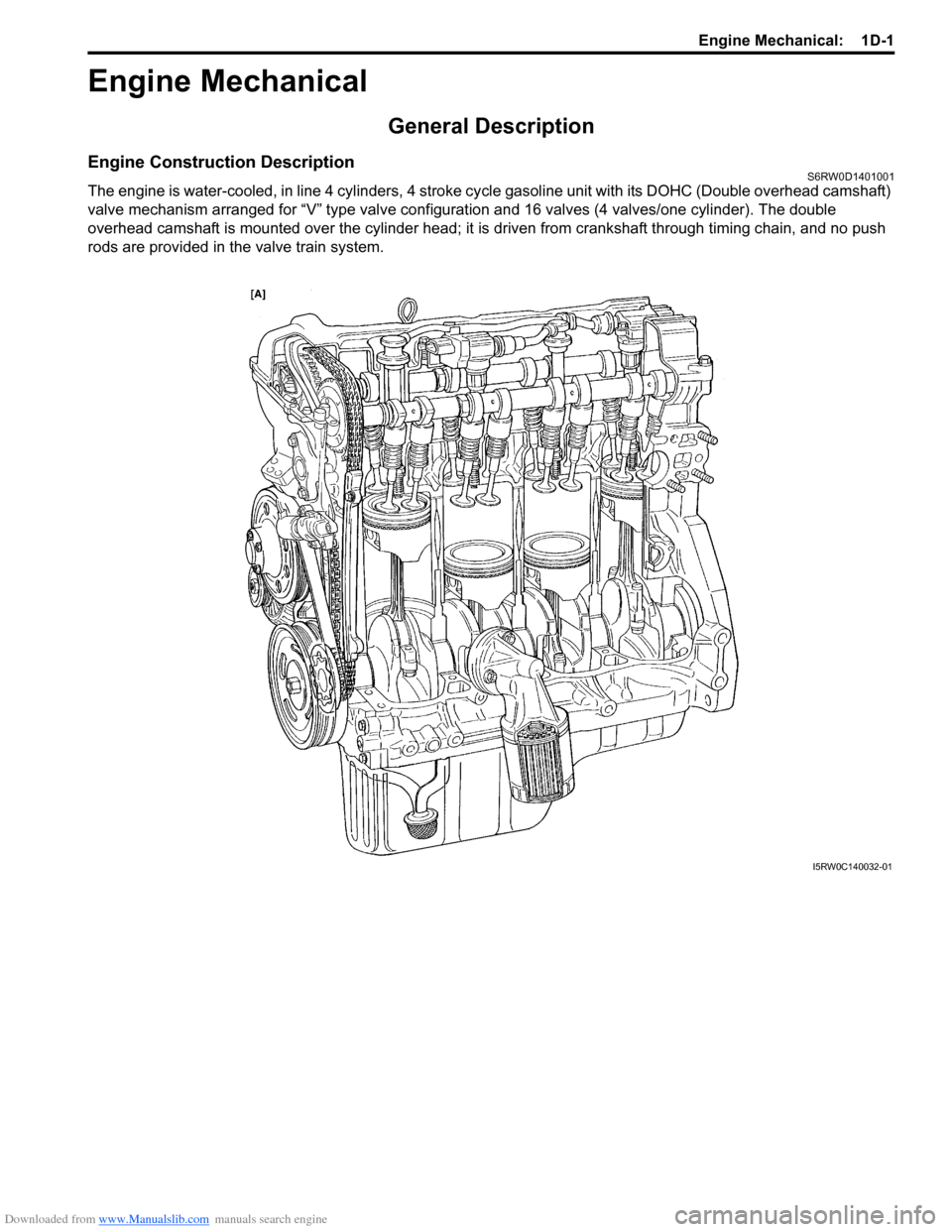
The engine is water-cooled, in line 4 cylinders, 4 stroke cycle gasoline unit with its DOHC (Double overhead camshaft)
valve mechanism arranged for “V” type valve configuration and 16 valves (4 valves/one cylinder). The double
overhead camshaft is mounted over the cylinder head; it is driven from crankshaft through timing chain, and no push
rods are provided in the valve train system.
I5RW0C140032-01
Page 289 of 1556
Downloaded from www.Manualslib.com manuals search engine Engine Mechanical: 1D-7
7) Install air cleaner assembly with air suction hose
referring to “Air Cleaner Assembly Removal and
Installation”.
8) Run engine at specified idle speed and read vacuum
gauge. Vacuum should be within specification.
Vacuum specification (at sea level)
59 – 73 kPa (45 – 55 cmHg, 17.7 – 21.6 in.Hg) at
specified idle speed
9) After checking, disconnect special tool (Vacuum
gauge) from PCV valve.
10) Detach blind cap from PCV valve.
11) Install air cleaner assembly with air suction hose
referring to “Air Cleaner Assembly Removal and
Installation”.
Valve Lash (Clearance) InspectionS6RW0D1404003
1) Remove negative cable at battery.
2) Remove cylinder head cover referring to “Cylinder
Head Cover Removal and Installation”.
3) Remove right side engine under cover, if necessary.
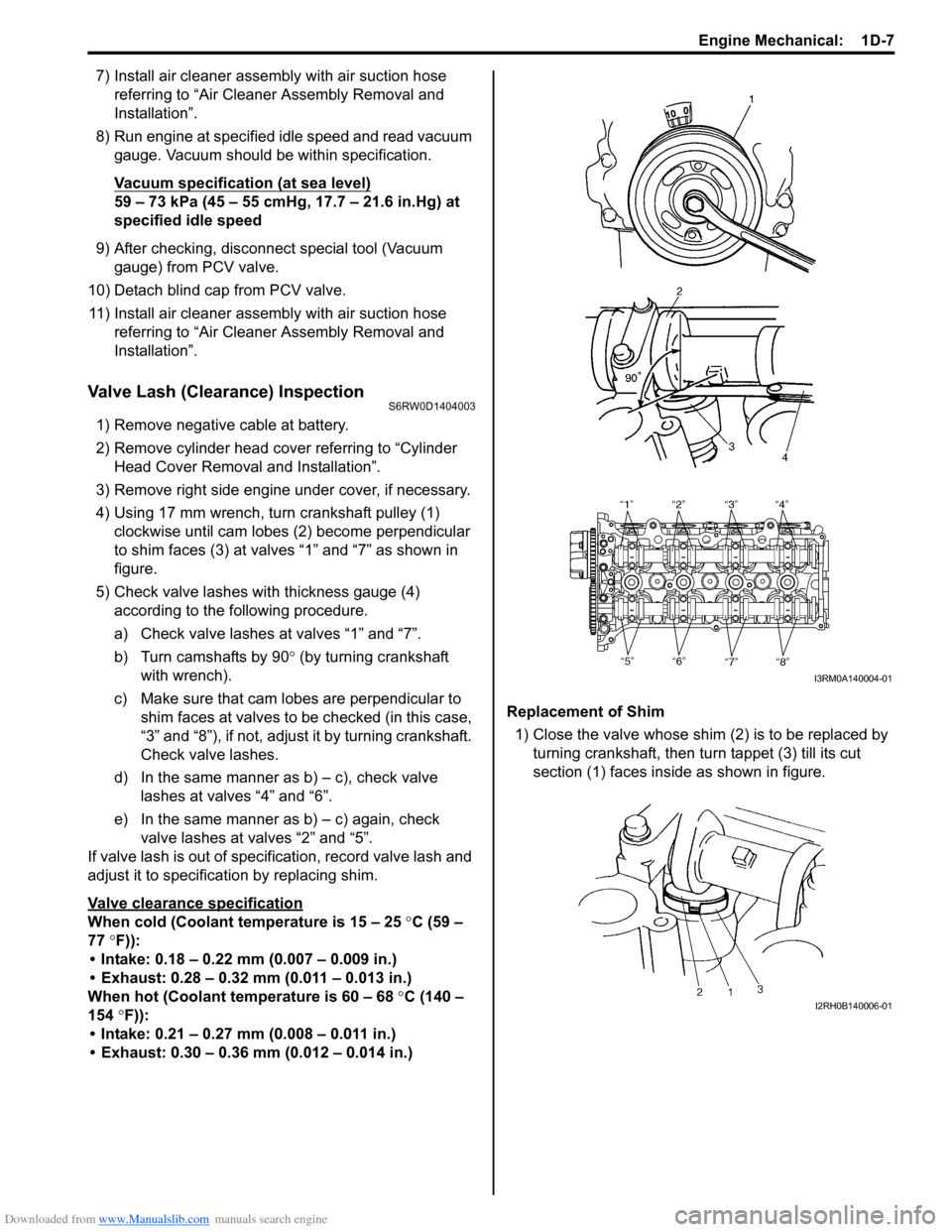
4) Using 17 mm wrench, turn crankshaft pulley (1)
clockwise until cam lobes (2) become perpendicular
to shim faces (3) at valves “1” and “7” as shown in
figure.
5) Check valve lashes with thickness gauge (4)
according to the following procedure.
a) Check valve lashes at valves “1” and “7”.
b) Turn camshafts by 90° (by turning crankshaft
with wrench).
c) Make sure that cam lobes are perpendicular to
shim faces at valves to be checked (in this case,
“3” and “8”), if not, adjust it by turning crankshaft.
Check valve lashes.
d) In the same manner as b) – c), check valve
lashes at valves “4” and “6”.
e) In the same manner as b) – c) again, check
valve lashes at valves “2” and “5”.
If valve lash is out of specification, record valve lash and
adjust it to specification by replacing shim.
Valve clearance specification
When cold (Coolant temperature is 15 – 25 °C (59 –
77 °F)):
• Intake: 0.18 – 0.22 mm (0.007 – 0.009 in.)
• Exhaust: 0.28 – 0.32 mm (0.011 – 0.013 in.)
When hot (Coolant temperature is 60 – 68 °C (140 –
154 °F)):
• Intake: 0.21 – 0.27 mm (0.008 – 0.011 in.)
• Exhaust: 0.30 – 0.36 mm (0.012 – 0.014 in.)Replacement of Shim
1) Close the valve whose shim (2) is to be replaced by
turning crankshaft, then turn tappet (3) till its cut
section (1) faces inside as shown in figure.
I3RM0A140004-01
I2RH0B140006-01
Page 290 of 1556
Downloaded from www.Manualslib.com manuals search engine 1D-8 Engine Mechanical:
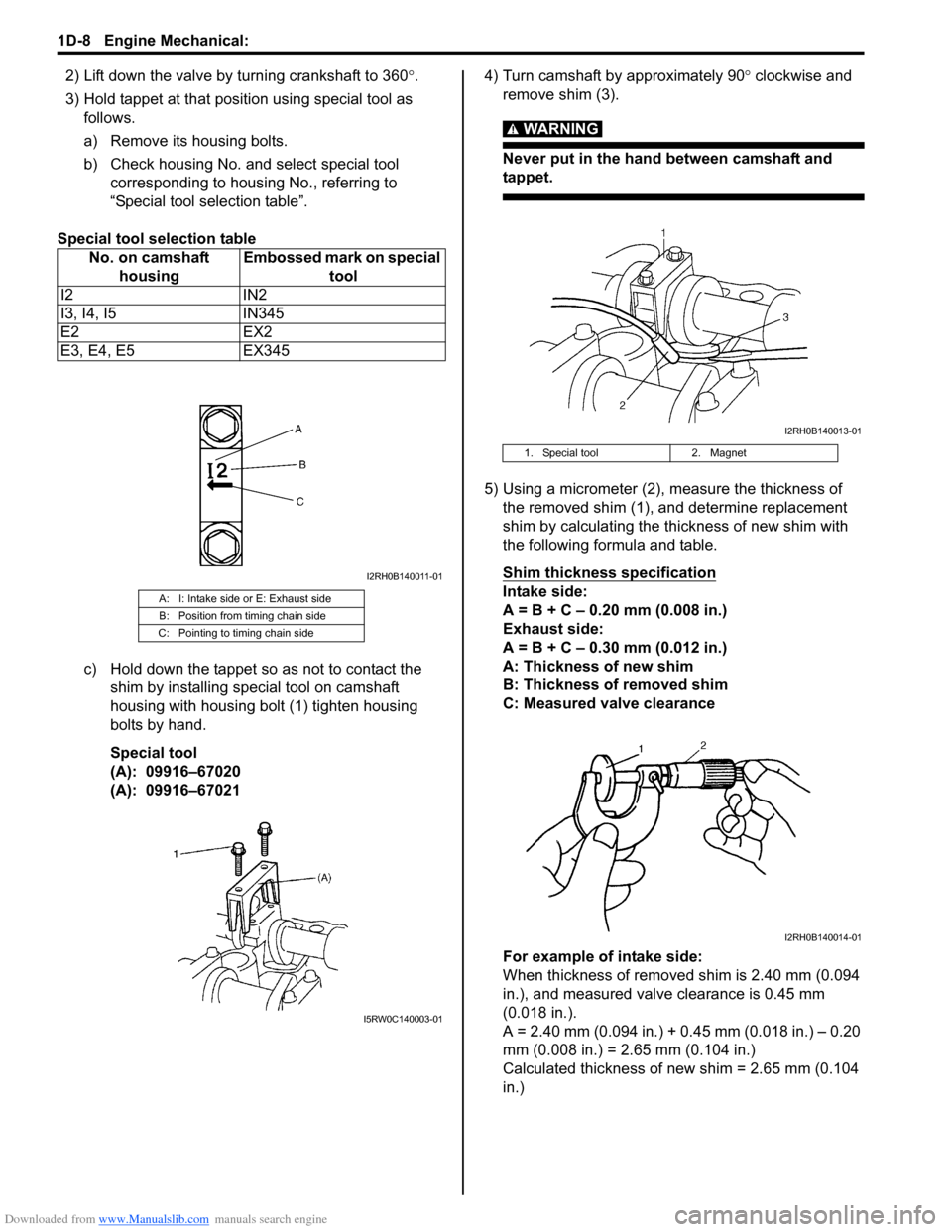
2) Lift down the valve by turning crankshaft to 360°.
3) Hold tappet at that position using special tool as
follows.
a) Remove its housing bolts.
b) Check housing No. and select special tool
corresponding to housing No., referring to
“Special tool selection table”.
Special tool selection table
c) Hold down the tappet so as not to contact the
shim by installing special tool on camshaft
housing with housing bolt (1) tighten housing
bolts by hand.
Special tool
(A): 09916–67020
(A): 09916–670214) Turn camshaft by approximately 90° clockwise and
remove shim (3).
WARNING!
Never put in the hand between camshaft and
tappet.
5) Using a micrometer (2), measure the thickness of
the removed shim (1), and determine replacement
shim by calculating the thickness of new shim with
the following formula and table.
Shim thickness specification
Intake side:
A = B + C – 0.20 mm (0.008 in.)
Exhaust side:
A = B + C – 0.30 mm (0.012 in.)
A: Thickness of new shim
B: Thickness of removed shim
C: Measured valve clearance
For example of intake side:
When thickness of removed shim is 2.40 mm (0.094
in.), and measured valve clearance is 0.45 mm
(0.018 in.).
A = 2.40 mm (0.094 in.) + 0.45 mm (0.018 in.) – 0.20
mm (0.008 in.) = 2.65 mm (0.104 in.)
Calculated thickness of new shim = 2.65 mm (0.104
in.) No. on camshaft
housingEmbossed mark on special
tool
I2 IN2
I3, I4, I5 IN345
E2 EX2
E3, E4, E5 EX345A: I: Intake side or E: Exhaust side
B: Position from timing chain side
C: Pointing to timing chain side
I2RH0B140011-01
I5RW0C140003-01
1. Special tool 2. Magnet
I2RH0B140013-01
I2RH0B140014-01
Page 291 of 1556
Downloaded from www.Manualslib.com manuals search engine Engine Mechanical: 1D-9
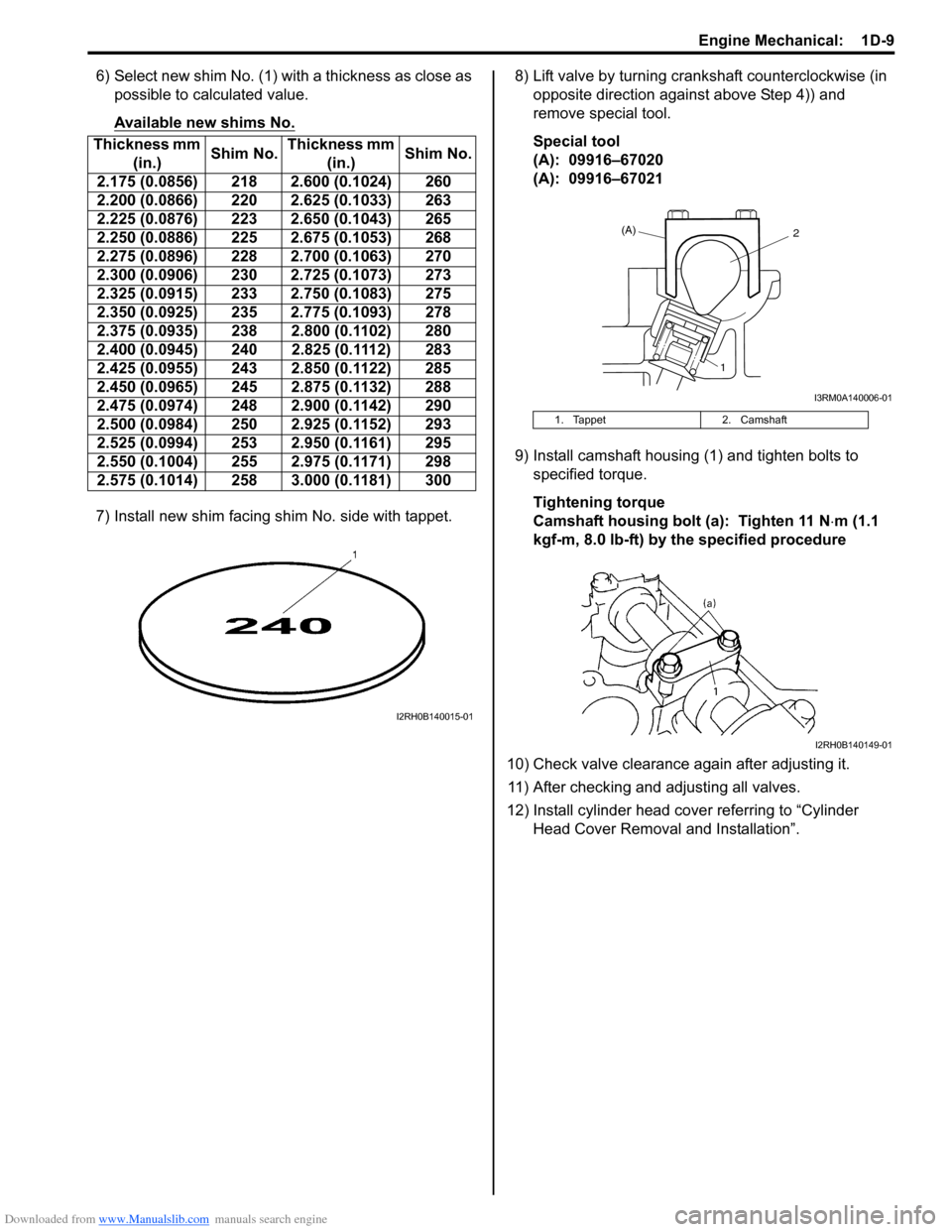
6) Select new shim No. (1) with a thickness as close as
possible to calculated value.
Available new shims No.
7) Install new shim facing shim No. side with tappet.8) Lift valve by turning crankshaft counterclockwise (in
opposite direction against above Step 4)) and
remove special tool.
Special tool
(A): 09916–67020
(A): 09916–67021
9) Install camshaft housing (1) and tighten bolts to
specified torque.
Tightening torque
Camshaft housing bolt (a): Tighten 11 N⋅m (1.1
kgf-m, 8.0 lb-ft) by the specified procedure
10) Check valve clearance again after adjusting it.
11) After checking and adjusting all valves.
12) Install cylinder head cover referring to “Cylinder
Head Cover Removal and Installation”. Thickness mm
(in.)Shim No.Thickness mm
(in.)Shim No.
2.175 (0.0856) 218 2.600 (0.1024) 260
2.200 (0.0866) 220 2.625 (0.1033) 263
2.225 (0.0876) 223 2.650 (0.1043) 265
2.250 (0.0886) 225 2.675 (0.1053) 268
2.275 (0.0896) 228 2.700 (0.1063) 270
2.300 (0.0906) 230 2.725 (0.1073) 273
2.325 (0.0915) 233 2.750 (0.1083) 275
2.350 (0.0925) 235 2.775 (0.1093) 278
2.375 (0.0935) 238 2.800 (0.1102) 280
2.400 (0.0945) 240 2.825 (0.1112) 283
2.425 (0.0955) 243 2.850 (0.1122) 285
2.450 (0.0965) 245 2.875 (0.1132) 288
2.475 (0.0974) 248 2.900 (0.1142) 290
2.500 (0.0984) 250 2.925 (0.1152) 293
2.525 (0.0994) 253 2.950 (0.1161) 295
2.550 (0.1004) 255 2.975 (0.1171) 298
2.575 (0.1014) 258 3.000 (0.1181) 300
I2RH0B140015-01
1. Tappet 2. Camshaft
(A)2
1
I3RM0A140006-01
I2RH0B140149-01
Page 304 of 1556
![SUZUKI SX4 2006 1.G Service User Guide Downloaded from www.Manualslib.com manuals search engine 1D-22 Engine Mechanical:
Timing Chain Cover ComponentsS6RW0D1406014
I5RW0C140041-01
[A]: For engine with VVT 8. Timing chain cover mounting
n](/img/20/7612/w960_7612-303.png "SUZUKI SX4 2006 1.G Service User Guide Downloaded from www.Manualslib.com manuals search engine 1D-22 Engine Mechanical:
Timing Chain Cover ComponentsS6RW0D1406014
I5RW0C140041-01
[A]: For engine with VVT 8. Timing chain cover mounting
n")
Downloaded from www.Manualslib.com manuals search engine 1D-22 Engine Mechanical:
Timing Chain Cover ComponentsS6RW0D1406014
I5RW0C140041-01
[A]: For engine with VVT 8. Timing chain cover mounting
nut17. Oil control valve
[B]: For engine without VVT 9. Oil gallery pipe No.1 18. Oil control valve mounting nut
1. Crankshaft pulley bolt 10. Copper washer 19. Cap
2. Crankshaft pulley 11. Oil gallery pipe No.1 bolt : 11 N⋅m (1.1 kgf-m, 8.0 lb-ft)
3. Oil seal
: Apply engine oil to oil seal lip.12. Oil gallery pipe No.2 : 25 N⋅m (2.5 kgf-m, 18.0 lb-ft)
4. Timing chain cover
: Apply sealant 99000-31140 to the mating
surface of cylinder and cylinder head.
: Apply sealant 99000-31260 to the mating
surface of timing chain cover referring to the
figure of Step 4) of “Installation” under “Timing
Chain Cover Removal and Installation”.13. Oil gallery pipe No.2 bolt : 30 N⋅m (3.0 kgf-m, 22.0 lb-ft)
5. Pin 14. Oil gallery pipe No.3 : 150 N⋅m (15.0 kgf-m, 108.5 lb-ft)
6. Cap bolt 15. Oil gallery pipe No.3 bolt : Do not reuse.
7. Timing chain cover mounting bolts 16. O-ring
: Apply engine oil.