ECO mode SUZUKI SX4 2006 1.G Service User Guide
[x] Cancel search | Manufacturer: SUZUKI, Model Year: 2006, Model line: SX4, Model: SUZUKI SX4 2006 1.GPages: 1556, PDF Size: 37.31 MB
Page 390 of 1556
Downloaded from www.Manualslib.com manuals search engine 1G-13 Fuel System:
Fuel Tank Removal and InstallationS6RW0D1706011
WARNING!
Before starting the following procedure, be
sure to observe “Precautions on Fuel System
Service” in order to reduce the risk of fire and
personal injury.
Removal
1) Relieve fuel pressure in fuel feed line according to
“Fuel Pressure Relief Procedure”.
2) Disconnect negative cable at battery.
3) Remove fuel filler cap.
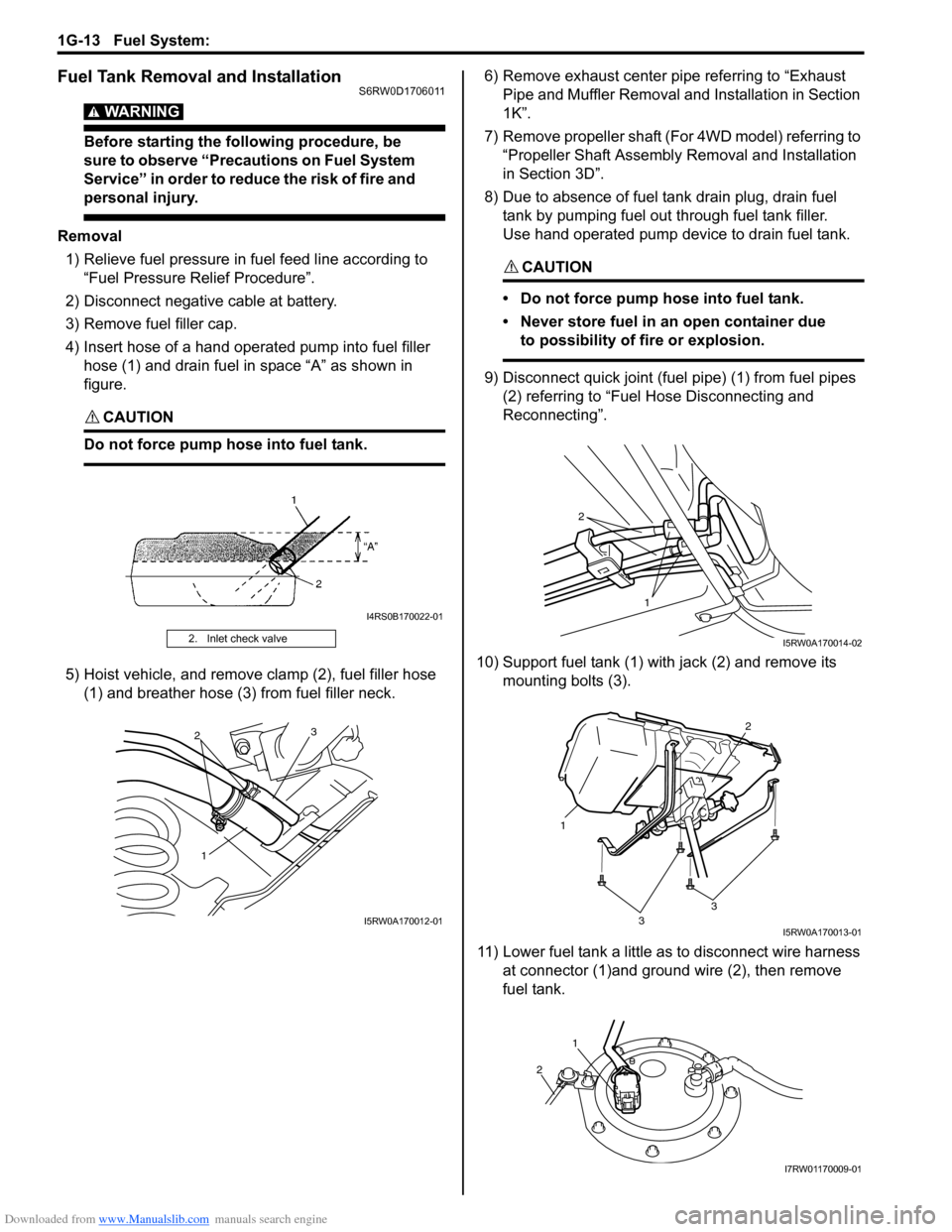
4) Insert hose of a hand operated pump into fuel filler
hose (1) and drain fuel in space “A” as shown in
figure.
CAUTION!
Do not force pump hose into fuel tank.
5) Hoist vehicle, and remove clamp (2), fuel filler hose
(1) and breather hose (3) from fuel filler neck.6) Remove exhaust center pipe referring to “Exhaust
Pipe and Muffler Removal and Installation in Section
1K”.
7) Remove propeller shaft (For 4WD model) referring to
“Propeller Shaft Assembly Removal and Installation
in Section 3D”.
8) Due to absence of fuel tank drain plug, drain fuel
tank by pumping fuel out through fuel tank filler.
Use hand operated pump device to drain fuel tank.
CAUTION!
• Do not force pump hose into fuel tank.
• Never store fuel in an open container due
to possibility of fire or explosion.
9) Disconnect quick joint (fuel pipe) (1) from fuel pipes
(2) referring to “Fuel Hose Disconnecting and
Reconnecting”.
10) Support fuel tank (1) with jack (2) and remove its
mounting bolts (3).
11) Lower fuel tank a little as to disconnect wire harness
at connector (1)and ground wire (2), then remove
fuel tank.
2. Inlet check valve
I4RS0B170022-01
1 23
I5RW0A170012-01
2
1
I5RW0A170014-02
1
2
33
I5RW0A170013-01
1
2
I7RW01170009-01
Page 470 of 1556
Downloaded from www.Manualslib.com manuals search engine 2D-1 Wheels and Tires:
Suspension
Wheels and Tires
General Description
Tires DescriptionS6RW0D2401001
The tire is of tubeless type. The tire is designed to
operate satisfactorily with loads up to the full rated load
capacity when inflated to the recommended inflation
pressures.
Correct tire pressures and driving habits have an
important influence on tire life. Heavy cornering,
excessively rapid acceleration, and unnecessary sharp
braking increase tire wear.
Tire Placard
The “Tire Placard” is located on the left or right door lock
pillar and should be referred to tire information.
The placard lists the maximum load, tire size and cold
tire pressure where applicable.
NOTE
Whether rim size and/or maximum load are
listed or not depends on regulations of each
country.
Inflation of Tires
The pressure recommended for any model is carefully
calculated to give a satisfactory ride, stability, steering,
tread wear, tire life and resistance to bruises.
Tire pressure, with tires cold, (after vehicle has set for 3
hours or more, or driven less than one mile) should be
checked monthly or before any extended trip. Set to the
specifications on the “Tire Placard” located on the left or
right door lock pillar.
It is normal for tire pressure to increase when the tires
become hot during driving.
Do not bleed or reduce tire pressure after driving.
Bleeding reduces the “Cold Inflation Pressure”.
Higher than recommended pressure can cause:
• Hard ride
• Tire bruising or carcass damage
• Rapid tread wear at center of tire
Unequal pressure on same axle can cause:
• Uneven braking
• Steering lead
• Reduced handling
• Swerve on accelerationLower than recommended pressure can cause:
• Tire squeal on turns
• Hard Steering
• Rapid and uneven wear on the edges of the tread
• Tire rim bruises and rupture
• Tire cord breakage
• High tire temperature
• Reduced handling
• High fuel consumption
Matched Tires and Wheels (Steel Type)
Tires and wheels are match mounted at the assembly
plant.
This means that the radially stiffest part of the tire, or
“high spot”, is matched to the smallest radius or “low
spot” of the wheel.
This is done to provide the smoothest possible ride.
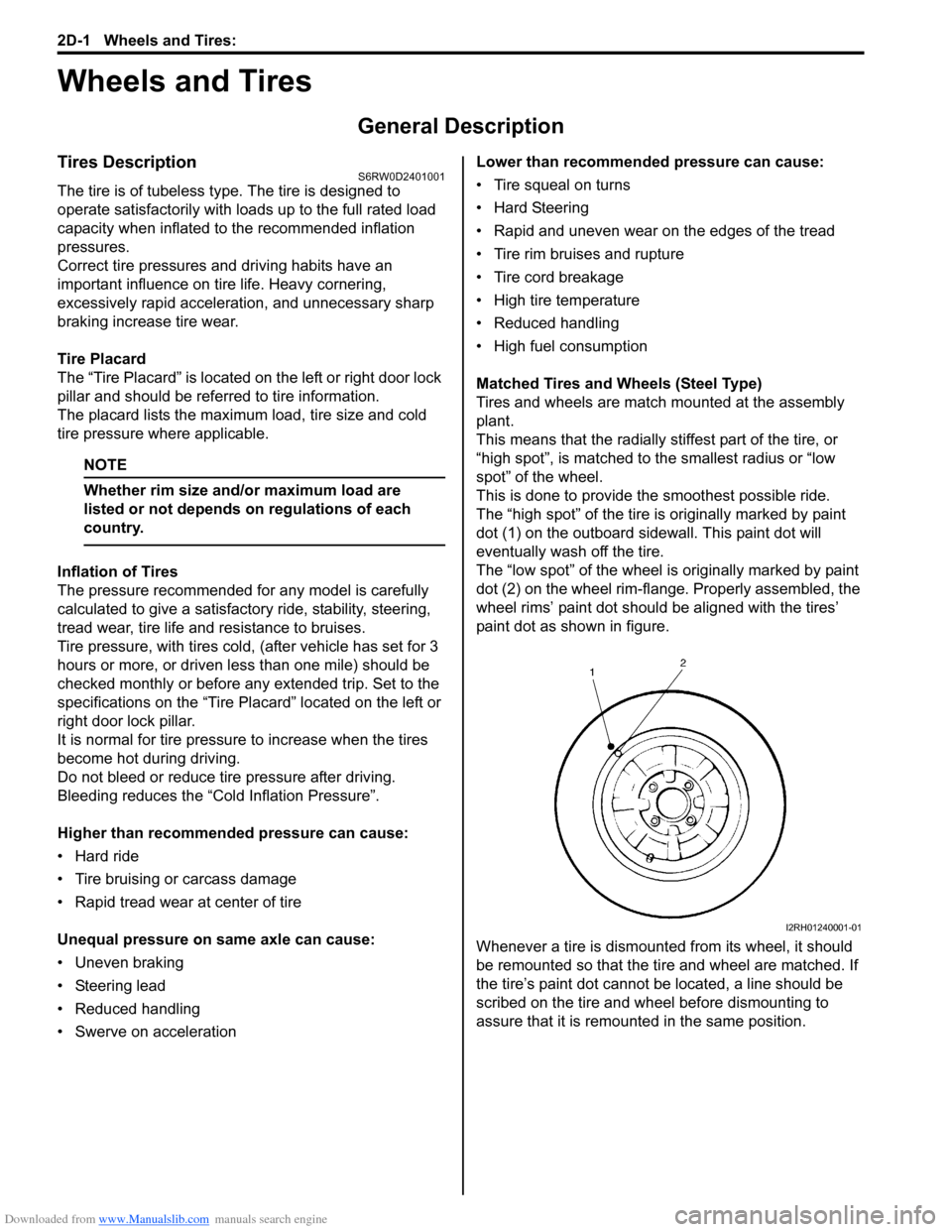
The “high spot” of the tire is originally marked by paint
dot (1) on the outboard sidewall. This paint dot will
eventually wash off the tire.
The “low spot” of the wheel is originally marked by paint
dot (2) on the wheel rim-flange. Properly assembled, the
wheel rims’ paint dot should be aligned with the tires’
paint dot as shown in figure.
Whenever a tire is dismounted from its wheel, it should
be remounted so that the tire and wheel are matched. If
the tire’s paint dot cannot be located, a line should be
scribed on the tire and wheel before dismounting to
assure that it is remounted in the same position.
I2RH01240001-01
Page 471 of 1556
Downloaded from www.Manualslib.com manuals search engine Wheels and Tires: 2D-2
Replacement Tires
When replacement is necessary, the original equipment
type tire should be used. Refer to the Tire Placard.
Replacement tires should be of the same size, load
range and construction as those originally on the vehicle.
Use of any other size or type tire may affect ride,
handling, speedometer / odometer calibration, vehicle
ground clearance and tire or snow chain clearance to the
body and chassis.
It is recommended that new tires be installed in pairs on
the same axle. If necessary to replace only one tire, it
should be paired with the tire having the most tread, to
equalize braking traction.
WARNING!
Do not mix different types of tires on the
same vehicle such as radial, bias and bias-
belted tires except in emergencies, because
handling may be seriously affected and may
result in loss of control.
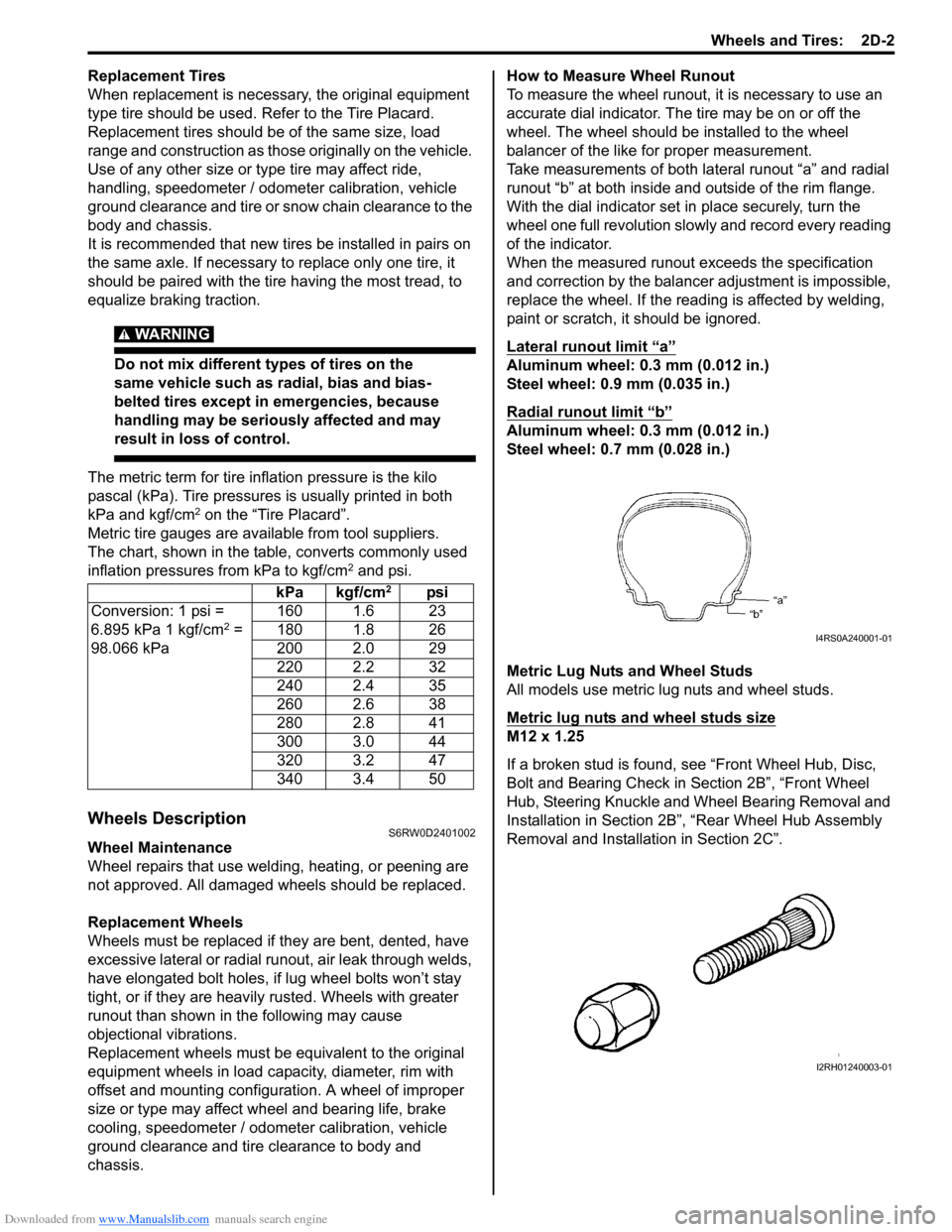
The metric term for tire inflation pressure is the kilo
pascal (kPa). Tire pressures is usually printed in both
kPa and kgf/cm
2 on the “Tire Placard”.
Metric tire gauges are available from tool suppliers.
The chart, shown in the table, converts commonly used
inflation pressures from kPa to kgf/cm
2 and psi.
Wheels DescriptionS6RW0D2401002
Wheel Maintenance
Wheel repairs that use welding, heating, or peening are
not approved. All damaged wheels should be replaced.
Replacement Wheels
Wheels must be replaced if they are bent, dented, have
excessive lateral or radial runout, air leak through welds,
have elongated bolt holes, if lug wheel bolts won’t stay
tight, or if they are heavily rusted. Wheels with greater
runout than shown in the following may cause
objectional vibrations.
Replacement wheels must be equivalent to the original
equipment wheels in load capacity, diameter, rim with
offset and mounting configuration. A wheel of improper
size or type may affect wheel and bearing life, brake
cooling, speedometer / odometer calibration, vehicle
ground clearance and tire clearance to body and
chassis.How to Measure Wheel Runout
To measure the wheel runout, it is necessary to use an
accurate dial indicator. The tire may be on or off the
wheel. The wheel should be installed to the wheel
balancer of the like for proper measurement.
Take measurements of both lateral runout “a” and radial
runout “b” at both inside and outside of the rim flange.
With the dial indicator set in place securely, turn the
wheel one full revolution slowly and record every reading
of the indicator.
When the measured runout exceeds the specification
and correction by the balancer adjustment is impossible,
replace the wheel. If the reading is affected by welding,
paint or scratch, it should be ignored.
Lateral runout limit “a”
Aluminum wheel: 0.3 mm (0.012 in.)
Steel wheel: 0.9 mm (0.035 in.)
Radial runout limit “b”
Aluminum wheel: 0.3 mm (0.012 in.)
Steel wheel: 0.7 mm (0.028 in.)
Metric Lug Nuts and Wheel Studs
All models use metric lug nuts and wheel studs.
Metric lug nuts and wheel studs size
M12 x 1.25
If a broken stud is found, see “Front Wheel Hub, Disc,
Bolt and Bearing Check in Section 2B”, “Front Wheel
Hub, Steering Knuckle and Wheel Bearing Removal and
Installation in Section 2B”, “Rear Wheel Hub Assembly
Removal and Installation in Section 2C”. kPa kgf/cm
2psi
Conversion: 1 psi =
6.895 kPa 1 kgf/cm
2 =
98.066 kPa160 1.6 23
180 1.8 26
200 2.0 29
220 2.2 32
240 2.4 35
260 2.6 38
280 2.8 41
300 3.0 44
320 3.2 47
340 3.4 50I4RS0A240001-01
I2RH01240003-01
Page 503 of 1556
Downloaded from www.Manualslib.com manuals search engine Differential: 3B-6
Input / Output Signal Table of 4WD Control ModuleS6RW0D3201008
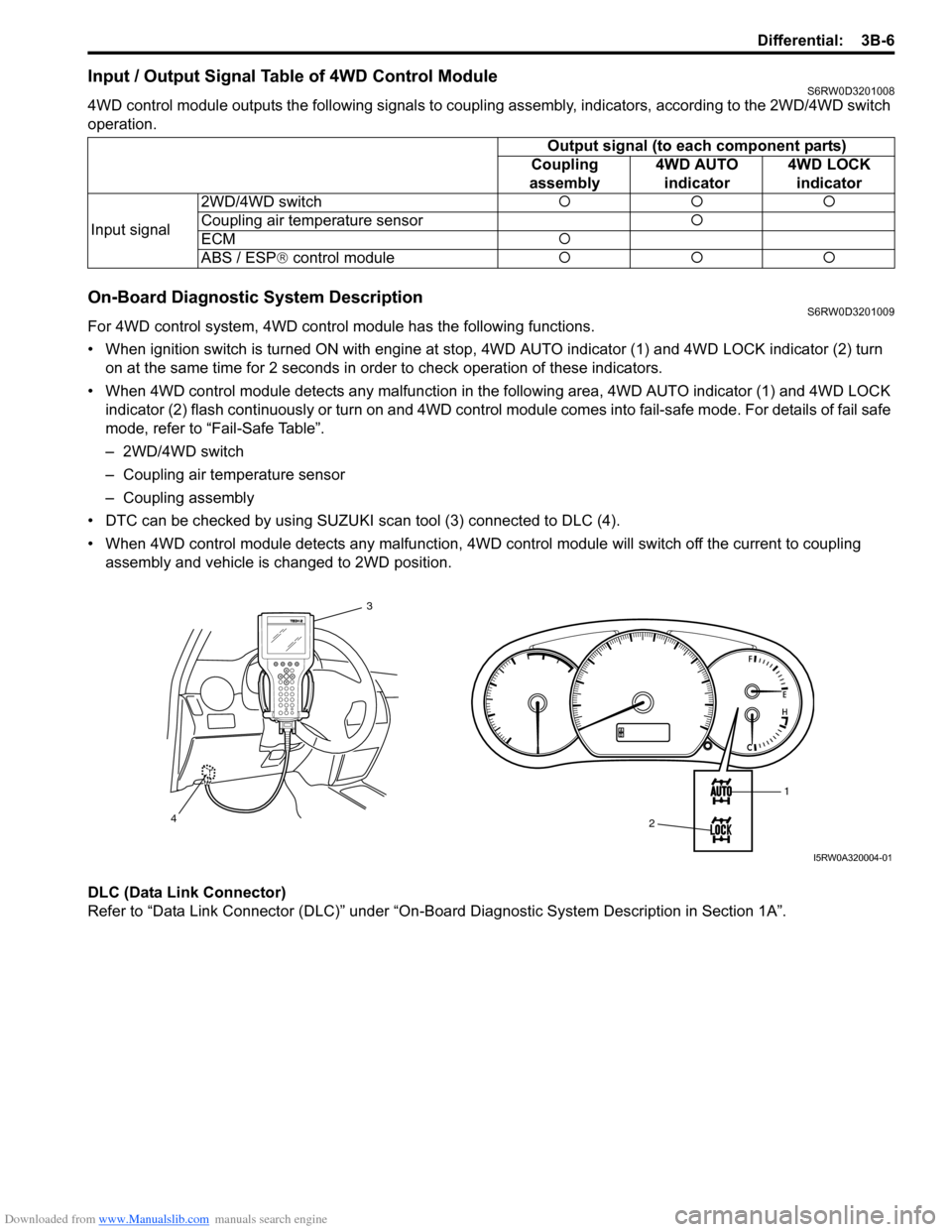
4WD control module outputs the following signals to coupling assembly, indicators, according to the 2WD/4WD switch
operation.
On-Board Diagnostic System DescriptionS6RW0D3201009
For 4WD control system, 4WD control module has the following functions.
• When ignition switch is turned ON with engine at stop, 4WD AUTO indicator (1) and 4WD LOCK indicator (2) turn
on at the same time for 2 seconds in order to check operation of these indicators.
• When 4WD control module detects any malfunction in the following area, 4WD AUTO indicator (1) and 4WD LOCK
indicator (2) flash continuously or turn on and 4WD control module comes into fail-safe mode. For details of fail safe
mode, refer to “Fail-Safe Table”.
– 2WD/4WD switch
– Coupling air temperature sensor
– Coupling assembly
• DTC can be checked by using SUZUKI scan tool (3) connected to DLC (4).
• When 4WD control module detects any malfunction, 4WD control module will switch off the current to coupling
assembly and vehicle is changed to 2WD position.
DLC (Data Link Connector)
Refer to “Data Link Connector (DLC)” under “On-Board Diagnostic System Description in Section 1A”.Output signal (to each component parts)
Coupling
assembly4WD AUTO
indicator4WD LOCK
indicator
Input signal2WD/4WD switch{{{
Coupling air temperature sensor{
ECM{
ABS / ESP® control module{{{
1
2 3
4
I5RW0A320004-01
Page 506 of 1556
Downloaded from www.Manualslib.com manuals search engine 3B-9 Differential:
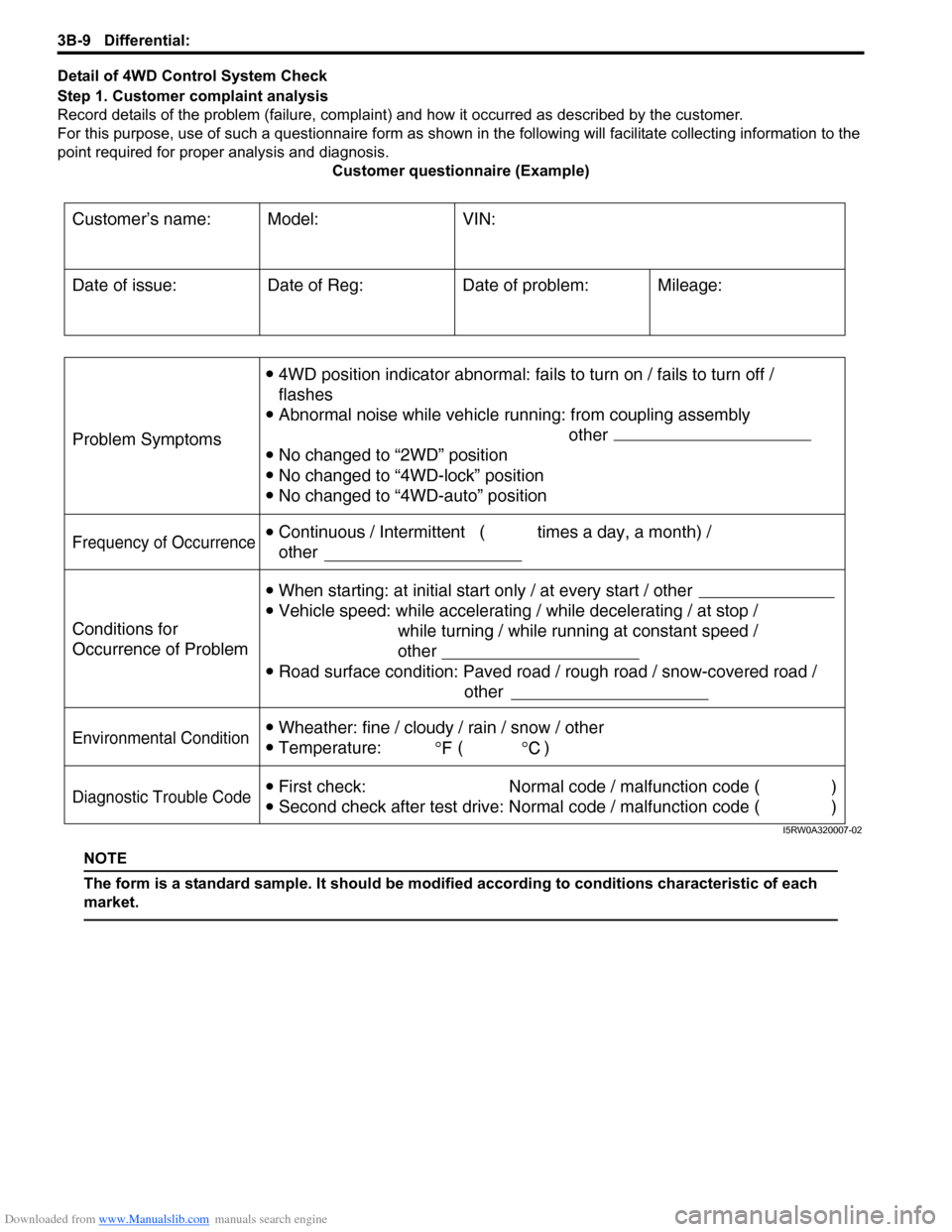
Detail of 4WD Control System Check
Step 1. Customer complaint analysis
Record details of the problem (failure, complaint) and how it occurred as described by the customer.
For this purpose, use of such a questionnaire form as shown in the following will facilitate collecting information to the
point required for proper analysis and diagnosis.
Customer questionnaire (Example)
NOTE
The form is a standard sample. It should be modified according to conditions characteristic of each
market.
Customer’s name: Model: VIN:
Problem Symptoms
Frequency of Occurrence
Conditions for
Occurrence of Problem
Environmental Condition
Diagnostic Trouble Code
Date of Reg:
4WD position indicator abnormal: fails to turn on / fails to turn off /
flashes
Abnormal noise while vehicle running: from coupling assembly
other
No changed to “2WD” position
No changed to “4WD-lock” position
No changed to “4WD-auto” position
When starting: at initial start only / at every start / other
Vehicle speed: while accelerating / while decelerating / at stop /
while turning / while running at constant speed /
other
Road surface condition: Paved road / rough road / snow-covered road /
other
Wheather: fine / cloudy / rain / snow / other
Temperature: ( )
First check: Normal code / malfunction code ( )
Second check after test drive: Normal code / malfunction code ( ) Continuous / Intermittent ( times a day, a month) /
otherDate of problem: Mileage: Date of issue:
I5RW0A320007-02
Page 525 of 1556
Downloaded from www.Manualslib.com manuals search engine Differential: 3B-28
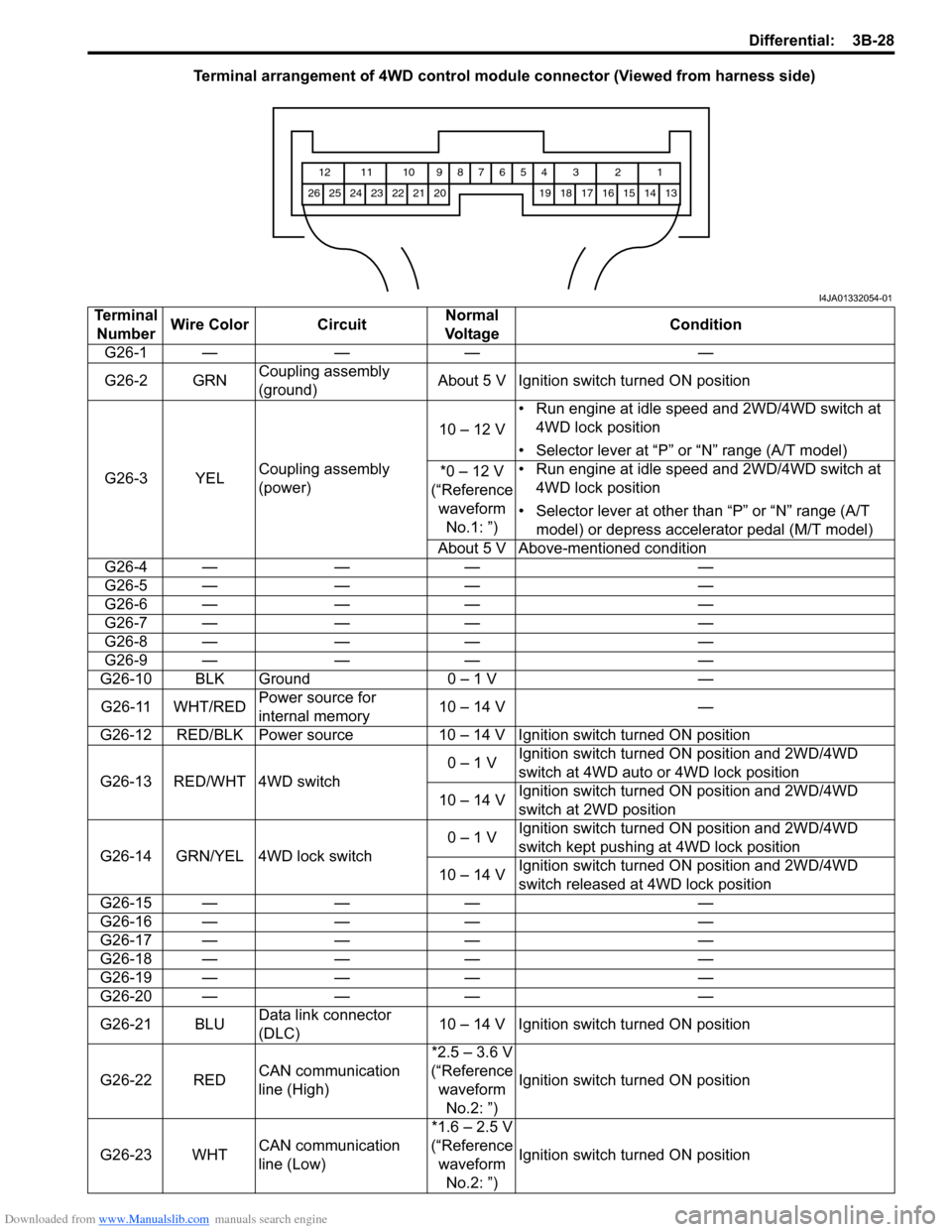
Terminal arrangement of 4WD control module connector (Viewed from harness side)
1 2 3 4 5 6 7 8 9 10 11 12
13 14 15 16 17 18 19 20 21 22 23 24 25 26
I4JA01332054-01
Terminal
NumberWire Color CircuitNormal
Vo l ta g eCondition
G26-1 — — — —
G26-2 GRNCoupling assembly
(ground)About 5 V Ignition switch turned ON position
G26-3 YELCoupling assembly
(power)10 – 12 V• Run engine at idle speed and 2WD/4WD switch at
4WD lock position
• Selector lever at “P” or “N” range (A/T model)
*0 – 12 V
(“Reference
waveform
No.1: ”)• Run engine at idle speed and 2WD/4WD switch at
4WD lock position
• Selector lever at other than “P” or “N” range (A/T
model) or depress accelerator pedal (M/T model)
About 5 V Above-mentioned condition
G26-4 — — — —
G26-5 — — — —
G26-6 — — — —
G26-7 — — — —
G26-8 — — — —
G26-9 — — — —
G26-10 BLK Ground 0 – 1 V —
G26-11 WHT/REDPower source for
internal memory10 – 14 V —
G26-12 RED/BLK Power source 10 – 14 V Ignition switch turned ON position
G26-13 RED/WHT 4WD switch0 – 1 VIgnition switch turned ON position and 2WD/4WD
switch at 4WD auto or 4WD lock position
10 – 14 VIgnition switch turned ON position and 2WD/4WD
switch at 2WD position
G26-14 GRN/YEL 4WD lock switch0 – 1 VIgnition switch turned ON position and 2WD/4WD
switch kept pushing at 4WD lock position
10 – 14 VIgnition switch turned ON position and 2WD/4WD
switch released at 4WD lock position
G26-15 — — — —
G26-16 — — — —
G26-17 — — — —
G26-18 — — — —
G26-19 — — — —
G26-20 — — — —
G26-21 BLUData link connector
(DLC)10 – 14 V Ignition switch turned ON position
G26-22 REDCAN communication
line (High)*2.5 – 3.6 V
(“Reference
waveform
No.2: ”)Ignition switch turned ON position
G26-23 WHTCAN communication
line (Low)*1.6 – 2.5 V
(“Reference
waveform
No.2: ”)Ignition switch turned ON position
Page 526 of 1556
Downloaded from www.Manualslib.com manuals search engine 3B-29 Differential:
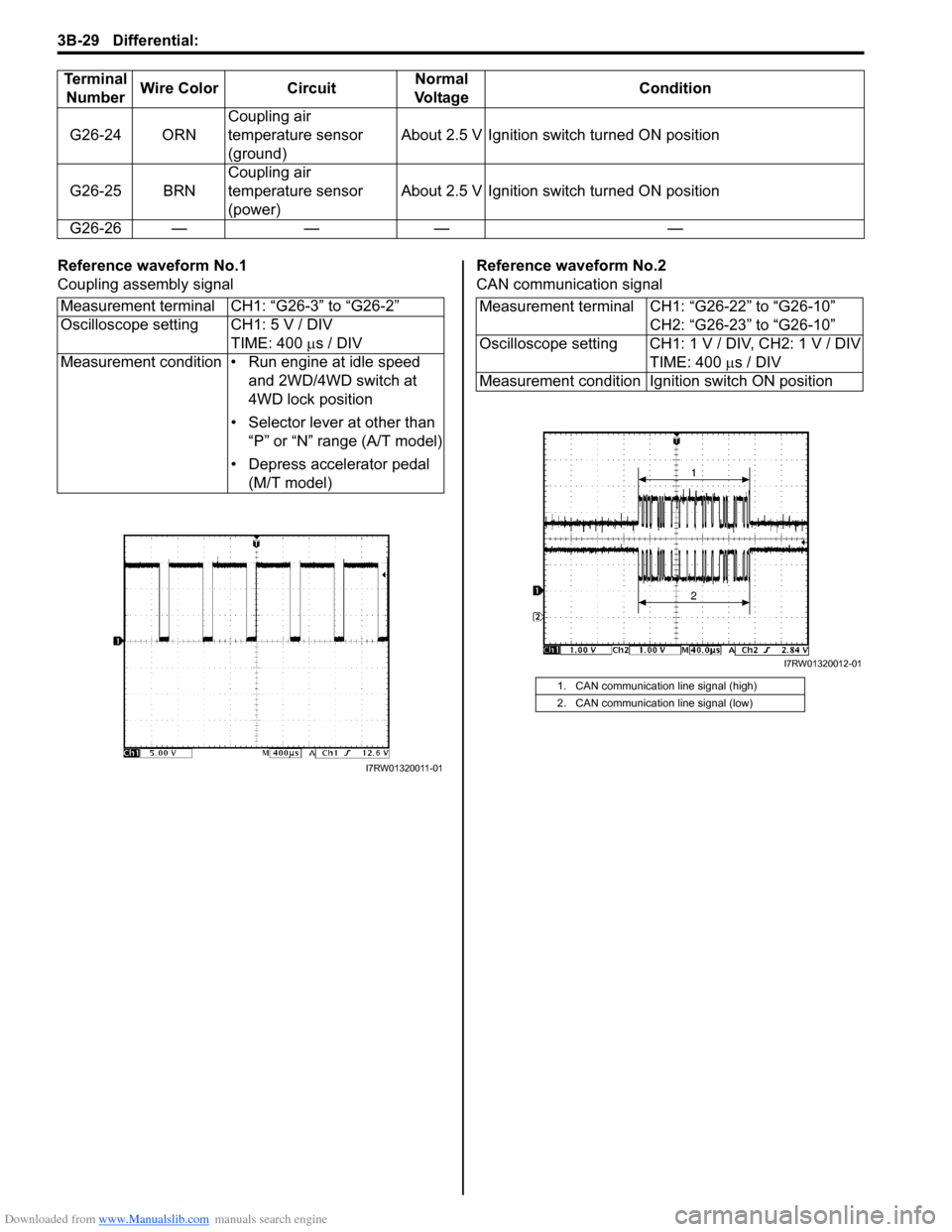
Reference waveform No.1
Coupling assembly signalReference waveform No.2
CAN communication signal G26-24 ORNCoupling air
temperature sensor
(ground)About 2.5 V Ignition switch turned ON position
G26-25 BRNCoupling air
temperature sensor
(power)About 2.5 V Ignition switch turned ON position
G26-26 — — — — Terminal
NumberWire Color CircuitNormal
Vo l ta g eCondition
Measurement terminal CH1: “G26-3” to “G26-2”
Oscilloscope setting CH1: 5 V / DIV
TIME: 400 µs / DIV
Measurement condition • Run engine at idle speed
and 2WD/4WD switch at
4WD lock position
• Selector lever at other than
“P” or “N” range (A/T model)
• Depress accelerator pedal
(M/T model)
I7RW01320011-01
Measurement terminal CH1: “G26-22” to “G26-10”
CH2: “G26-23” to “G26-10”
Oscilloscope setting CH1: 1 V / DIV, CH2: 1 V / DIV
TIME: 400 µs / DIV
Measurement condition Ignition switch ON position
1. CAN communication line signal (high)
2. CAN communication line signal (low)
I7RW01320012-01
Page 583 of 1556
Downloaded from www.Manualslib.com manuals search engine Brake Control System and Diagnosis: 4A-12
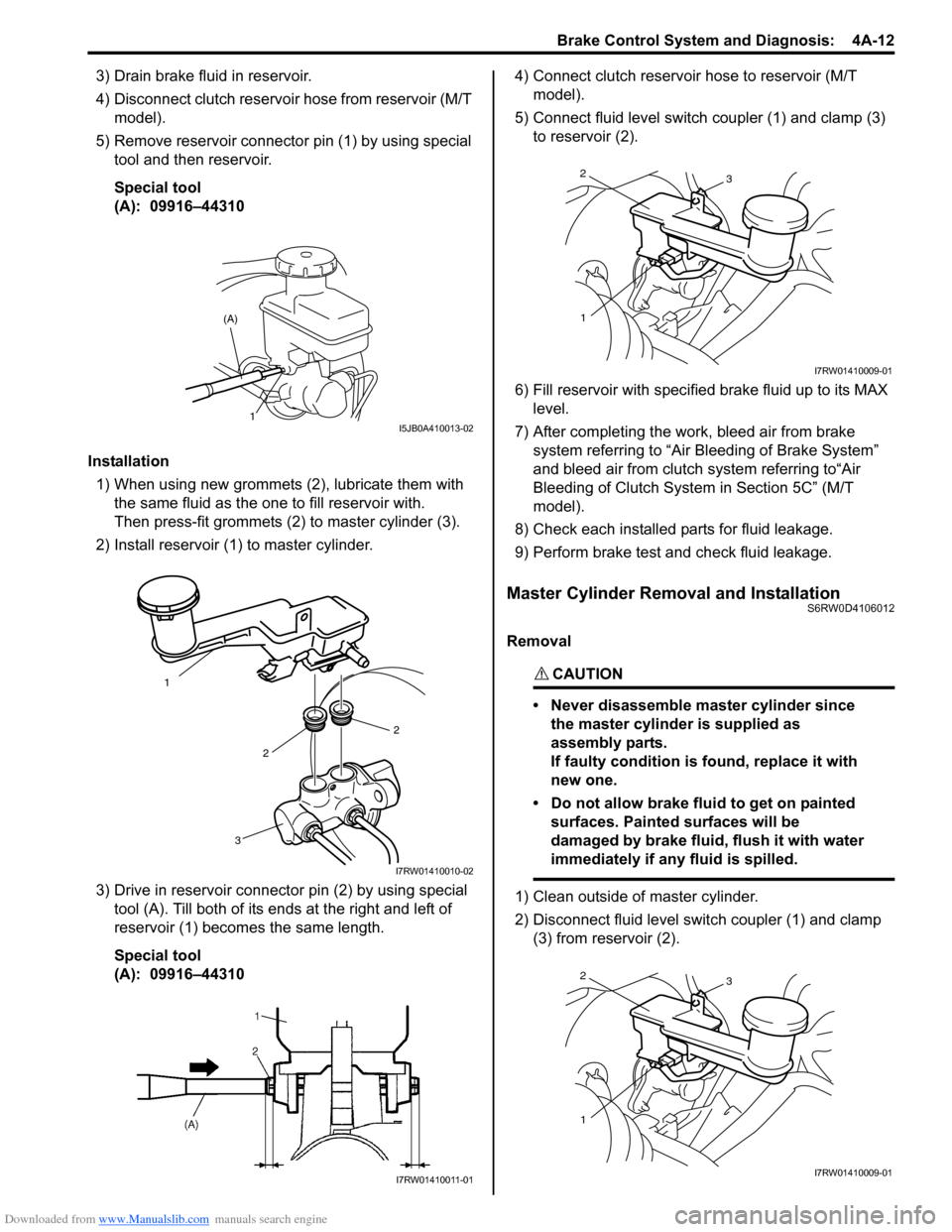
3) Drain brake fluid in reservoir.
4) Disconnect clutch reservoir hose from reservoir (M/T
model).
5) Remove reservoir connector pin (1) by using special
tool and then reservoir.
Special tool
(A): 09916–44310
Installation
1) When using new grommets (2), lubricate them with
the same fluid as the one to fill reservoir with.
Then press-fit grommets (2) to master cylinder (3).
2) Install reservoir (1) to master cylinder.
3) Drive in reservoir connector pin (2) by using special
tool (A). Till both of its ends at the right and left of
reservoir (1) becomes the same length.
Special tool
(A): 09916–44310 4) Connect clutch reservoir hose to reservoir (M/T
model).
5) Connect fluid level switch coupler (1) and clamp (3)
to reservoir (2).
6) Fill reservoir with specified brake fluid up to its MAX
level.
7) After completing the work, bleed air from brake
system referring to “Air Bleeding of Brake System”
and bleed air from clutch system referring to“Air
Bleeding of Clutch System in Section 5C” (M/T
model).
8) Check each installed parts for fluid leakage.
9) Perform brake test and check fluid leakage.
Master Cylinder Removal and InstallationS6RW0D4106012
Removal
CAUTION!
• Never disassemble master cylinder since
the master cylinder is supplied as
assembly parts.
If faulty condition is found, replace it with
new one.
• Do not allow brake fluid to get on painted
surfaces. Painted surfaces will be
damaged by brake fluid, flush it with water
immediately if any fluid is spilled.
1) Clean outside of master cylinder.
2) Disconnect fluid level switch coupler (1) and clamp
(3) from reservoir (2).
1 (A)I5JB0A410013-02
1
2
2
3
I7RW01410010-02
I7RW01410011-01
2
13
I7RW01410009-01
2
13
I7RW01410009-01
Page 586 of 1556
Downloaded from www.Manualslib.com manuals search engine 4A-15 Brake Control System and Diagnosis:
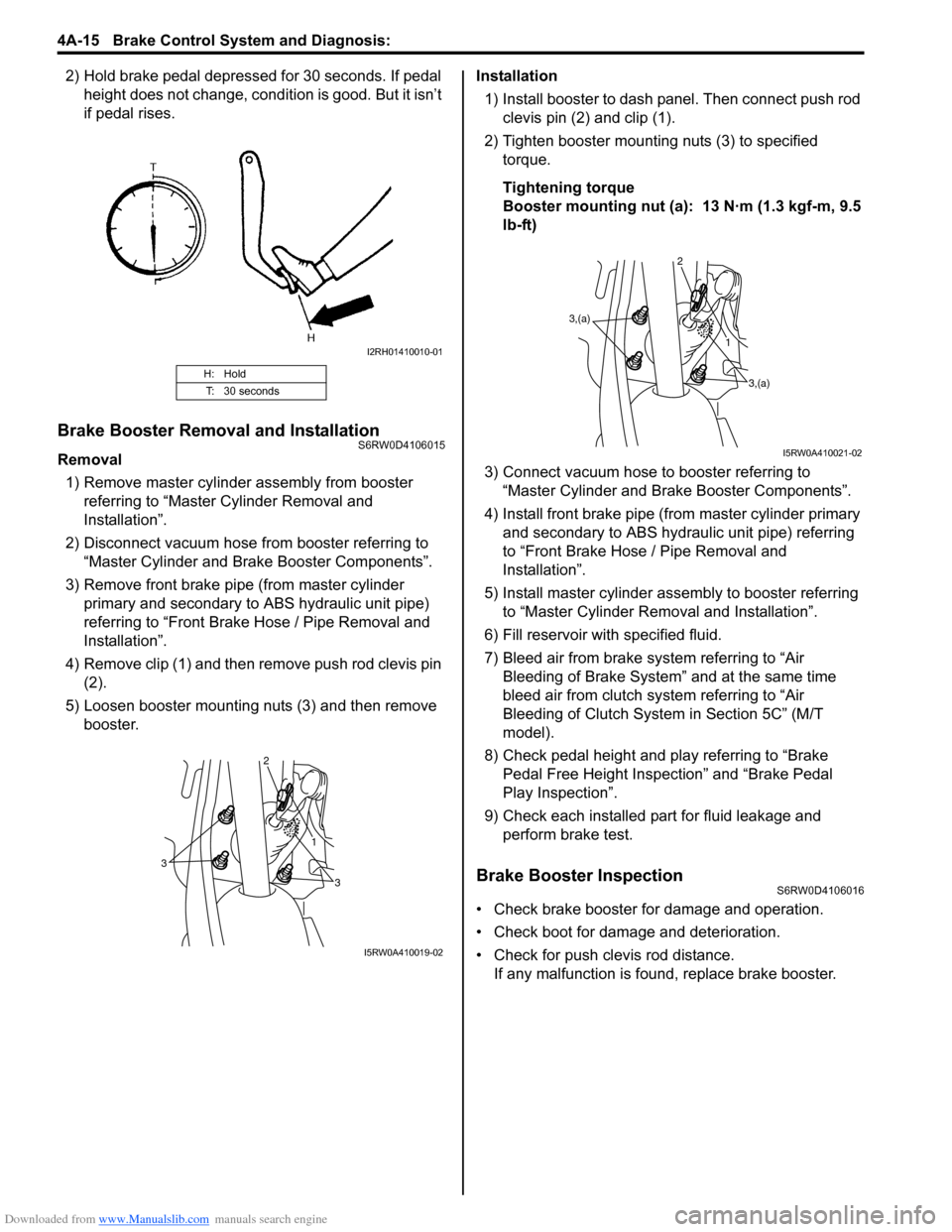
2) Hold brake pedal depressed for 30 seconds. If pedal
height does not change, condition is good. But it isn’t
if pedal rises.
Brake Booster Removal and InstallationS6RW0D4106015
Removal
1) Remove master cylinder assembly from booster
referring to “Master Cylinder Removal and
Installation”.
2) Disconnect vacuum hose from booster referring to
“Master Cylinder and Brake Booster Components”.
3) Remove front brake pipe (from master cylinder
primary and secondary to ABS hydraulic unit pipe)
referring to “Front Brake Hose / Pipe Removal and
Installation”.
4) Remove clip (1) and then remove push rod clevis pin
(2).
5) Loosen booster mounting nuts (3) and then remove
booster.Installation
1) Install booster to dash panel. Then connect push rod
clevis pin (2) and clip (1).
2) Tighten booster mounting nuts (3) to specified
torque.
Tightening torque
Booster mounting nut (a): 13 N·m (1.3 kgf-m, 9.5
lb-ft)
3) Connect vacuum hose to booster referring to
“Master Cylinder and Brake Booster Components”.
4) Install front brake pipe (from master cylinder primary
and secondary to ABS hydraulic unit pipe) referring
to “Front Brake Hose / Pipe Removal and
Installation”.
5) Install master cylinder assembly to booster referring
to “Master Cylinder Removal and Installation”.
6) Fill reservoir with specified fluid.
7) Bleed air from brake system referring to “Air
Bleeding of Brake System” and at the same time
bleed air from clutch system referring to “Air
Bleeding of Clutch System in Section 5C” (M/T
model).
8) Check pedal height and play referring to “Brake
Pedal Free Height Inspection” and “Brake Pedal
Play Inspection”.
9) Check each installed part for fluid leakage and
perform brake test.
Brake Booster InspectionS6RW0D4106016
• Check brake booster for damage and operation.
• Check boot for damage and deterioration.
• Check for push clevis rod distance.
If any malfunction is found, replace brake booster.
H: Hold
T: 30 seconds
I2RH01410010-01
3
3 1 2
I5RW0A410019-02
3,(a)
3,(a) 1 2
I5RW0A410021-02
Page 591 of 1556
Downloaded from www.Manualslib.com manuals search engine Front Brakes: 4B-4
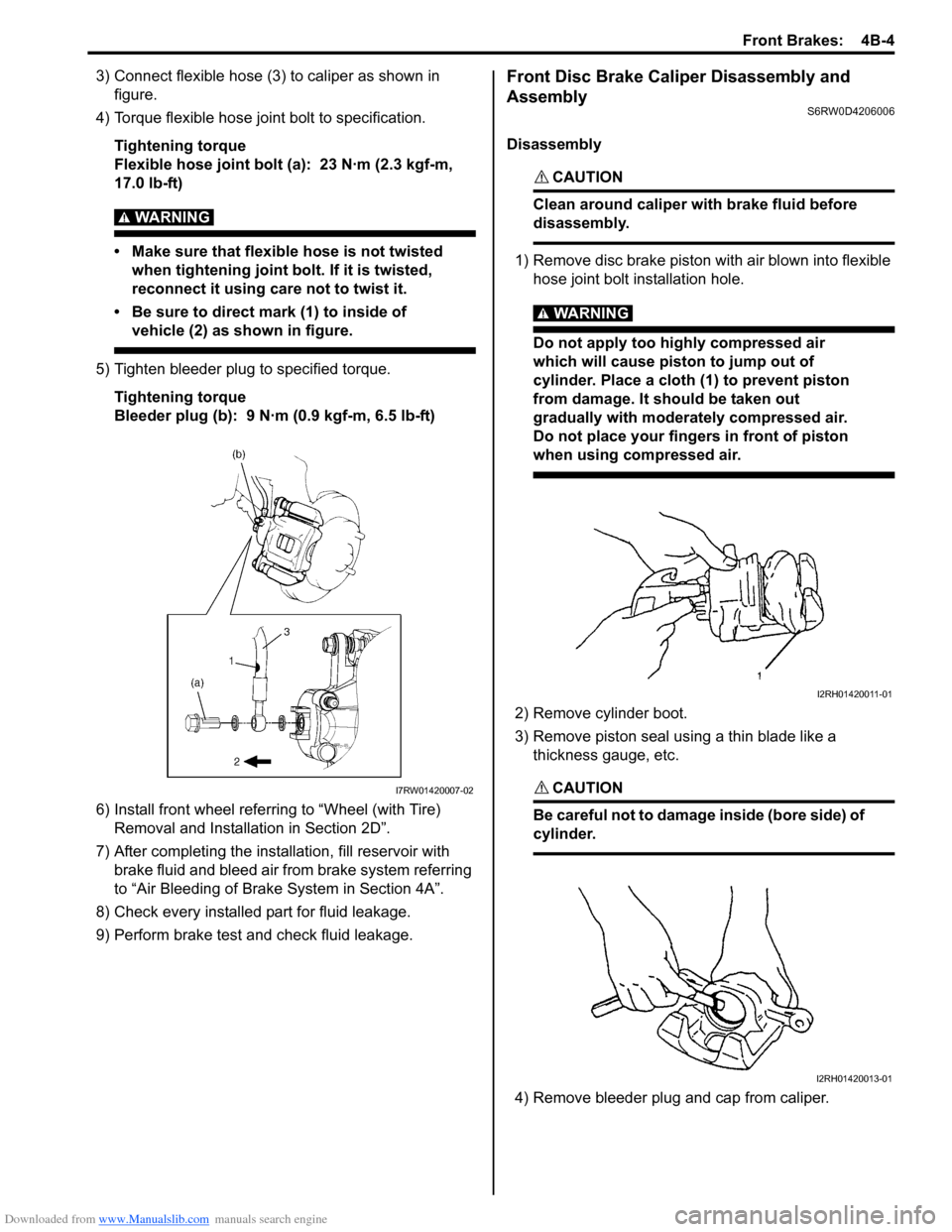
3) Connect flexible hose (3) to caliper as shown in
figure.
4) Torque flexible hose joint bolt to specification.
Tightening torque
Flexible hose joint bolt (a): 23 N·m (2.3 kgf-m,
17.0 lb-ft)
WARNING!
• Make sure that flexible hose is not twisted
when tightening joint bolt. If it is twisted,
reconnect it using care not to twist it.
• Be sure to direct mark (1) to inside of
vehicle (2) as shown in figure.
5) Tighten bleeder plug to specified torque.
Tightening torque
Bleeder plug (b): 9 N·m (0.9 kgf-m, 6.5 lb-ft)
6) Install front wheel referring to “Wheel (with Tire)
Removal and Installation in Section 2D”.
7) After completing the installation, fill reservoir with
brake fluid and bleed air from brake system referring
to “Air Bleeding of Brake System in Section 4A”.
8) Check every installed part for fluid leakage.
9) Perform brake test and check fluid leakage.
Front Disc Brake Caliper Disassembly and
Assembly
S6RW0D4206006
Disassembly
CAUTION!
Clean around caliper with brake fluid before
disassembly.
1) Remove disc brake piston with air blown into flexible
hose joint bolt installation hole.
WARNING!
Do not apply too highly compressed air
which will cause piston to jump out of
cylinder. Place a cloth (1) to prevent piston
from damage. It should be taken out
gradually with moderately compressed air.
Do not place your fingers in front of piston
when using compressed air.
2) Remove cylinder boot.
3) Remove piston seal using a thin blade like a
thickness gauge, etc.
CAUTION!
Be careful not to damage inside (bore side) of
cylinder.
4) Remove bleeder plug and cap from caliper.
I7RW01420007-02
I2RH01420011-01
I2RH01420013-01