Hub SUZUKI SX4 2006 1.G Service User Guide
[x] Cancel search | Manufacturer: SUZUKI, Model Year: 2006, Model line: SX4, Model: SUZUKI SX4 2006 1.GPages: 1556, PDF Size: 37.31 MB
Page 459 of 1556
Downloaded from www.Manualslib.com manuals search engine Front Suspension: 2B-22
Special Tools and Equipment
Recommended Service MaterialS6RW0D2208001
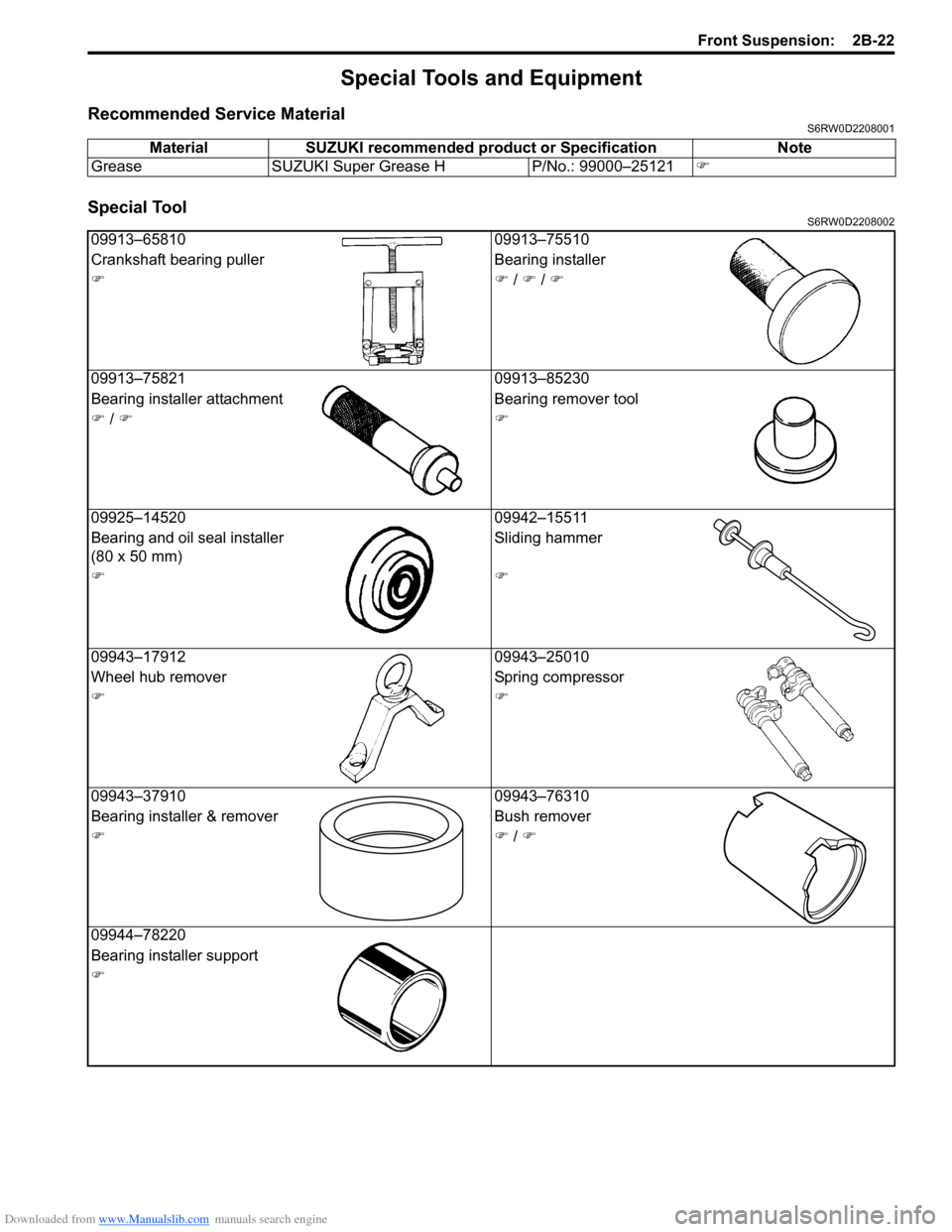
Special ToolS6RW0D2208002
Material SUZUKI recommended product or Specification Note
Grease SUZUKI Super Grease H P/No.: 99000–25121)
09913–65810 09913–75510
Crankshaft bearing puller Bearing installer
)) / ) / )
09913–75821 09913–85230
Bearing installer attachment Bearing remover tool
) / ))
09925–14520 09942–15511
Bearing and oil seal installer
(80 x 50 mm)Sliding hammer
))
09943–17912 09943–25010
Wheel hub remover Spring compressor
))
09943–37910 09943–76310
Bearing installer & remover Bush remover
)) / )
09944–78220
Bearing installer support
)
Page 460 of 1556
Downloaded from www.Manualslib.com manuals search engine 2C-1 Rear Suspension:
Suspension
Rear Suspension
Repair Instructions
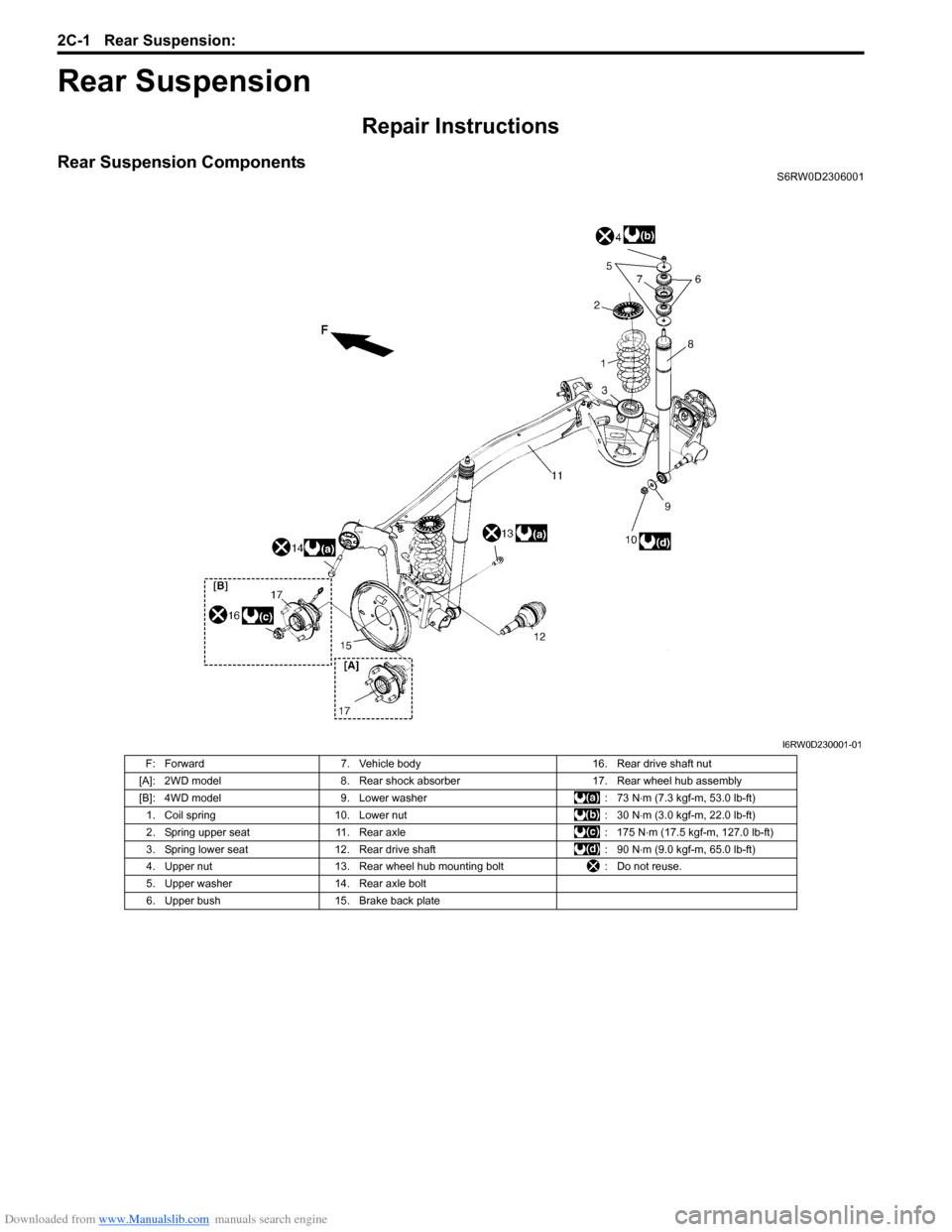
Rear Suspension ComponentsS6RW0D2306001
I6RW0D230001-01
F: Forward 7. Vehicle body 16. Rear drive shaft nut
[A]: 2WD model 8. Rear shock absorber 17. Rear wheel hub assembly
[B]: 4WD model 9. Lower washer : 73 N⋅m (7.3 kgf-m, 53.0 lb-ft)
1. Coil spring 10. Lower nut : 30 N⋅m (3.0 kgf-m, 22.0 lb-ft)
2. Spring upper seat 11. Rear axle : 175 N⋅m (17.5 kgf-m, 127.0 lb-ft)
3. Spring lower seat 12. Rear drive shaft : 90 N⋅m (9.0 kgf-m, 65.0 lb-ft)
4. Upper nut 13. Rear wheel hub mounting bolt : Do not reuse.
5. Upper washer 14. Rear axle bolt
6. Upper bush 15. Brake back plate
Page 465 of 1556
Downloaded from www.Manualslib.com manuals search engine Rear Suspension: 2C-6
Rear Axle Removal and InstallationS6RW0D2306007
CAUTION!
Do not drop brake fluid onto painted surface.
Painted surfaces will be damaged.
Removal
1) Hoist vehicle and remove exhaust center pipe and
muffler.
2) Disconnect rear height sensor link (if equipped) from
rear axle referring to “Height Sensor Removal and
Installation (If Equipped) in Section 9B”.
3) Remove rear wheel, rear brake drum and rear wheel
hub referring to “Removal” under “Rear Wheel Hub
Assembly Removal and Installation”.
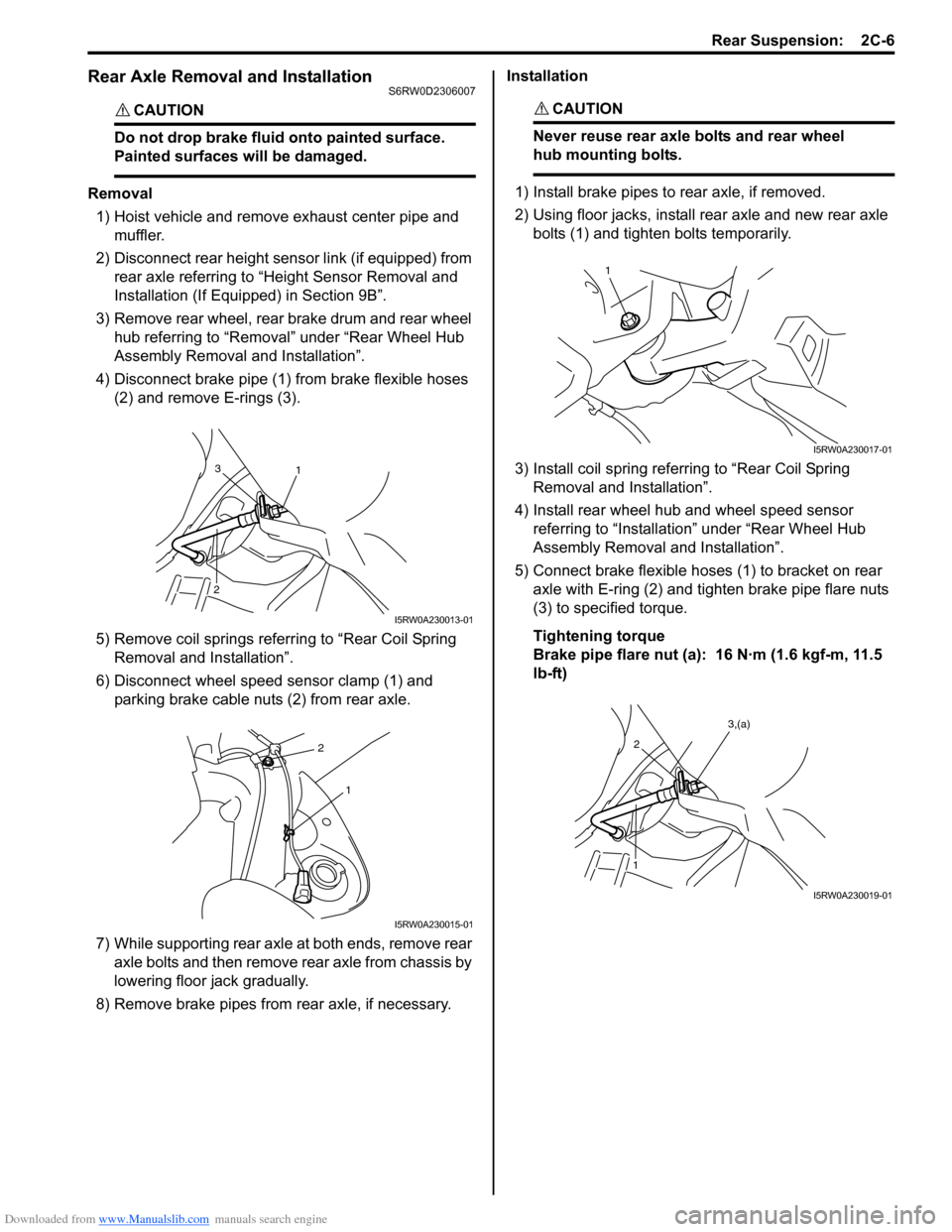
4) Disconnect brake pipe (1) from brake flexible hoses
(2) and remove E-rings (3).
5) Remove coil springs referring to “Rear Coil Spring
Removal and Installation”.
6) Disconnect wheel speed sensor clamp (1) and
parking brake cable nuts (2) from rear axle.
7) While supporting rear axle at both ends, remove rear
axle bolts and then remove rear axle from chassis by
lowering floor jack gradually.
8) Remove brake pipes from rear axle, if necessary.Installation
CAUTION!
Never reuse rear axle bolts and rear wheel
hub mounting bolts.
1) Install brake pipes to rear axle, if removed.
2) Using floor jacks, install rear axle and new rear axle
bolts (1) and tighten bolts temporarily.
3) Install coil spring referring to “Rear Coil Spring
Removal and Installation”.
4) Install rear wheel hub and wheel speed sensor
referring to “Installation” under “Rear Wheel Hub
Assembly Removal and Installation”.
5) Connect brake flexible hoses (1) to bracket on rear
axle with E-ring (2) and tighten brake pipe flare nuts
(3) to specified torque.
Tightening torque
Brake pipe flare nut (a): 16 N·m (1.6 kgf-m, 11.5
lb-ft)
1 3
2
I5RW0A230013-01
2
1
I5RW0A230015-01
1
I5RW0A230017-01
2
1
3,(a)
I5RW0A230019-01
Page 467 of 1556
Downloaded from www.Manualslib.com manuals search engine Rear Suspension: 2C-8
Rear Wheel Hub Assembly Removal and
Installation
S6RW0D2306012
CAUTION!
Do not allow brake fluid to get on painted
surfaces. Painted surface will be damaged.
Removal
1) Hoist vehicle. Then remove rear wheel and brake
drum.
2) For 4WD model, remove rear drive shaft referring to
“Rear Drive Shaft Assembly Removal and
Installation in Section 3A”.
3) Remove rear brake shoe.
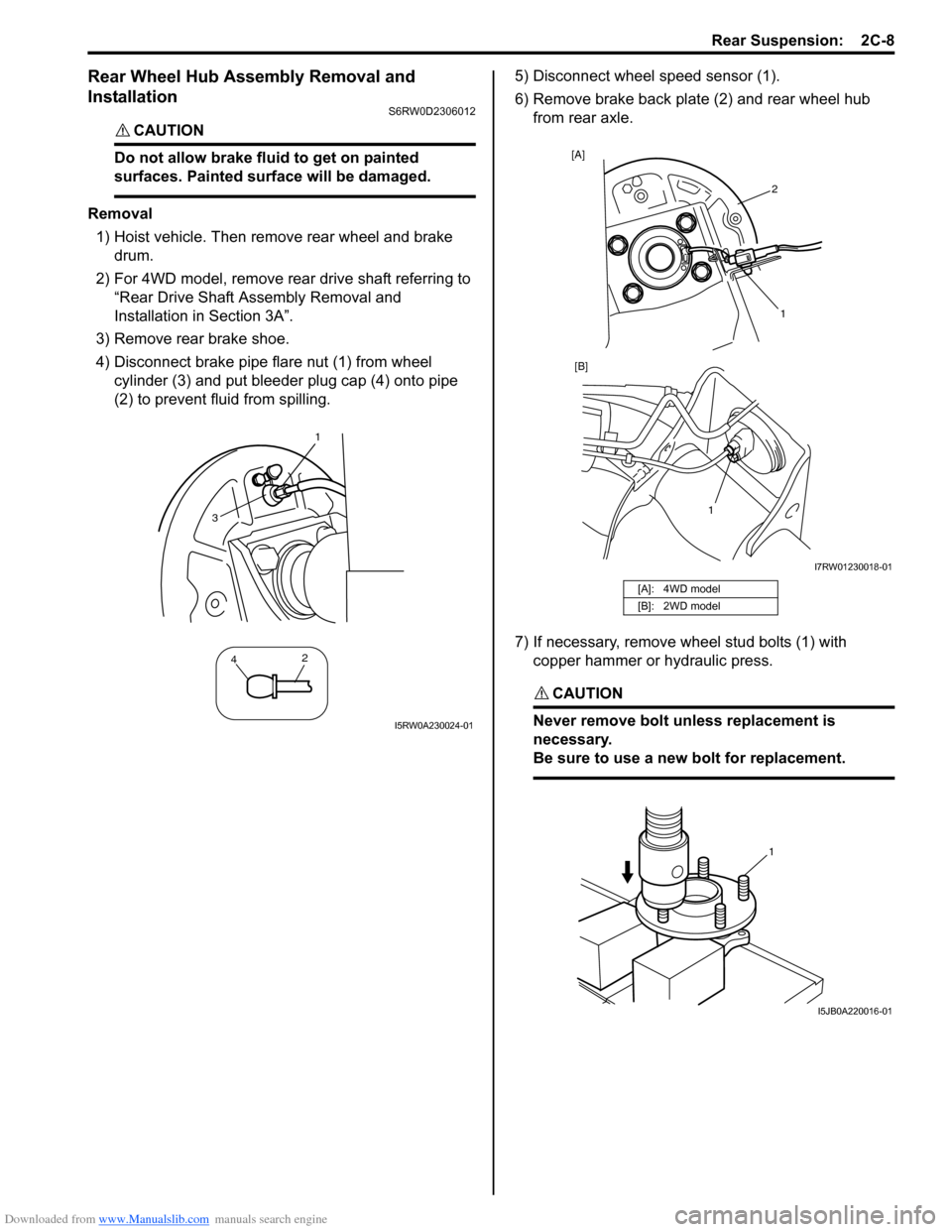
4) Disconnect brake pipe flare nut (1) from wheel
cylinder (3) and put bleeder plug cap (4) onto pipe
(2) to prevent fluid from spilling.5) Disconnect wheel speed sensor (1).
6) Remove brake back plate (2) and rear wheel hub
from rear axle.
7) If necessary, remove wheel stud bolts (1) with
copper hammer or hydraulic press.
CAUTION!
Never remove bolt unless replacement is
necessary.
Be sure to use a new bolt for replacement.
1
42
3
I5RW0A230024-01
[A]: 4WD model
[B]: 2WD model
2 [A]
1 [B]
1
I7RW01230018-01
1
I5JB0A220016-01
Page 468 of 1556
Downloaded from www.Manualslib.com manuals search engine 2C-9 Rear Suspension:
Installation
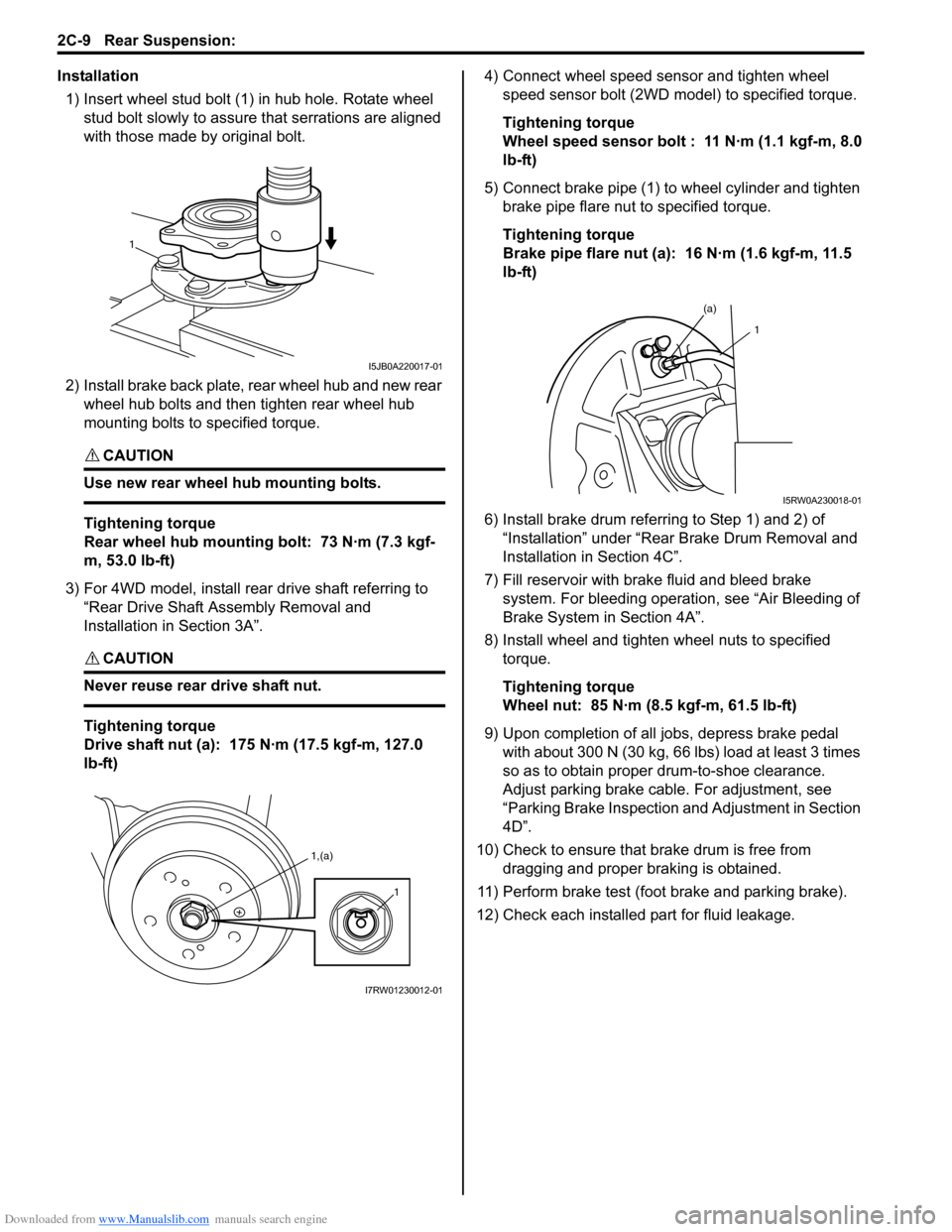
1) Insert wheel stud bolt (1) in hub hole. Rotate wheel
stud bolt slowly to assure that serrations are aligned
with those made by original bolt.
2) Install brake back plate, rear wheel hub and new rear
wheel hub bolts and then tighten rear wheel hub
mounting bolts to specified torque.
CAUTION!
Use new rear wheel hub mounting bolts.
Tightening torque
Rear wheel hub mounting bolt: 73 N·m (7.3 kgf-
m, 53.0 lb-ft)
3) For 4WD model, install rear drive shaft referring to
“Rear Drive Shaft Assembly Removal and
Installation in Section 3A”.
CAUTION!
Never reuse rear drive shaft nut.
Tightening torque
Drive shaft nut (a): 175 N·m (17.5 kgf-m, 127.0
lb-ft)4) Connect wheel speed sensor and tighten wheel
speed sensor bolt (2WD model) to specified torque.
Tightening torque
Wheel speed sensor bolt : 11 N·m (1.1 kgf-m, 8.0
lb-ft)
5) Connect brake pipe (1) to wheel cylinder and tighten
brake pipe flare nut to specified torque.
Tightening torque
Brake pipe flare nut (a): 16 N·m (1.6 kgf-m, 11.5
lb-ft)
6) Install brake drum referring to Step 1) and 2) of
“Installation” under “Rear Brake Drum Removal and
Installation in Section 4C”.
7) Fill reservoir with brake fluid and bleed brake
system. For bleeding operation, see “Air Bleeding of
Brake System in Section 4A”.
8) Install wheel and tighten wheel nuts to specified
torque.
Tightening torque
Wheel nut: 85 N·m (8.5 kgf-m, 61.5 lb-ft)
9) Upon completion of all jobs, depress brake pedal
with about 300 N (30 kg, 66 lbs) load at least 3 times
so as to obtain proper drum-to-shoe clearance.
Adjust parking brake cable. For adjustment, see
“Parking Brake Inspection and Adjustment in Section
4D”.
10) Check to ensure that brake drum is free from
dragging and proper braking is obtained.
11) Perform brake test (foot brake and parking brake).
12) Check each installed part for fluid leakage.
1
I5JB0A220017-01
1,(a)
1
I7RW01230012-01
(a)
1
I5RW0A230018-01
Page 469 of 1556
Downloaded from www.Manualslib.com manuals search engine Rear Suspension: 2C-10
Specifications
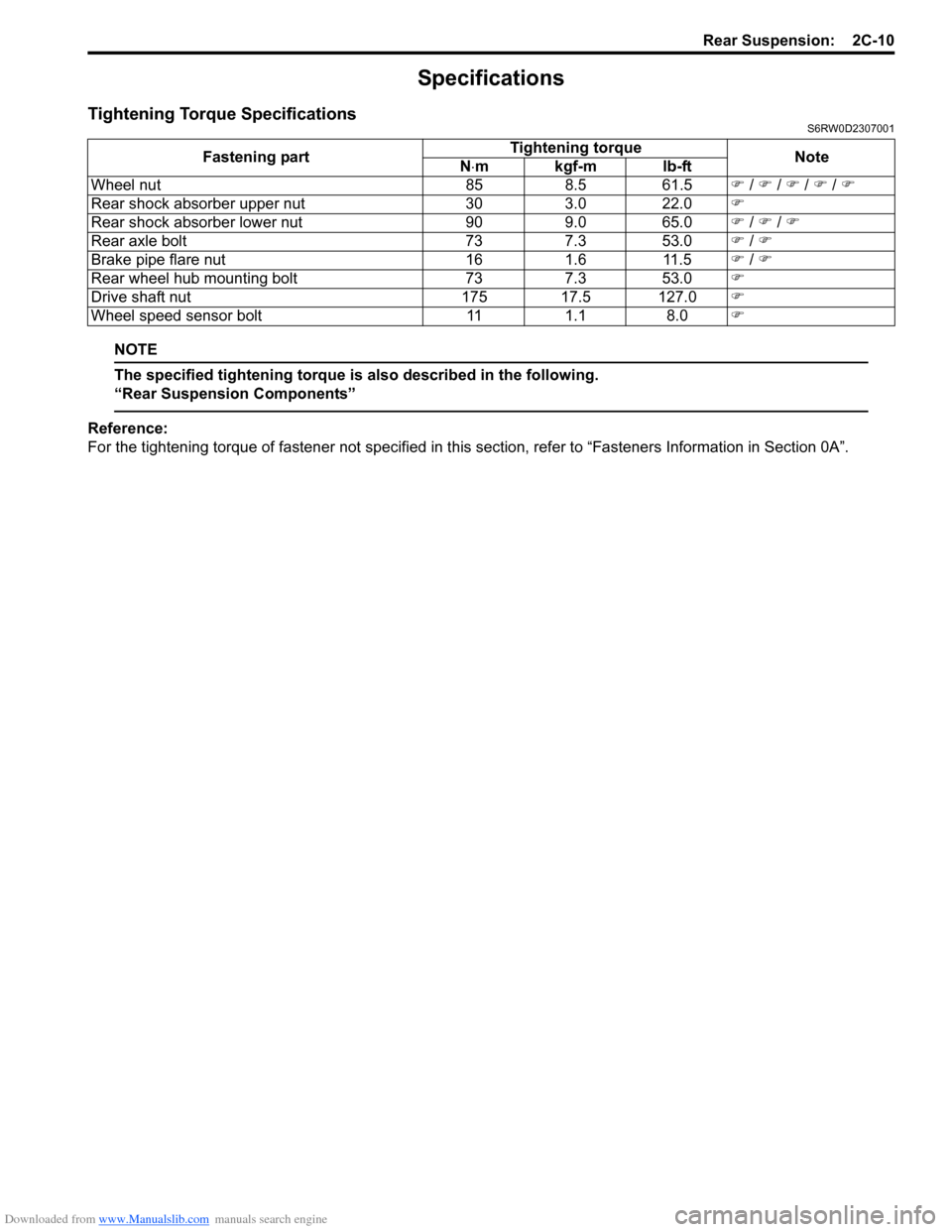
Tightening Torque SpecificationsS6RW0D2307001
NOTE
The specified tightening torque is also described in the following.
“Rear Suspension Components”
Reference:
For the tightening torque of fastener not specified in this section, refer to “Fasteners Information in Section 0A”. Fastening partTightening torque
Note
N⋅mkgf-mlb-ft
Wheel nut 85 8.5 61.5) / ) / ) / ) / )
Rear shock absorber upper nut 30 3.0 22.0)
Rear shock absorber lower nut 90 9.0 65.0) / ) / )
Rear axle bolt 73 7.3 53.0) / )
Brake pipe flare nut 16 1.6 11.5) / )
Rear wheel hub mounting bolt 73 7.3 53.0)
Drive shaft nut 175 17.5 127.0)
Wheel speed sensor bolt 11 1.1 8.0)
Page 471 of 1556
Downloaded from www.Manualslib.com manuals search engine Wheels and Tires: 2D-2
Replacement Tires
When replacement is necessary, the original equipment
type tire should be used. Refer to the Tire Placard.
Replacement tires should be of the same size, load
range and construction as those originally on the vehicle.
Use of any other size or type tire may affect ride,
handling, speedometer / odometer calibration, vehicle
ground clearance and tire or snow chain clearance to the
body and chassis.
It is recommended that new tires be installed in pairs on
the same axle. If necessary to replace only one tire, it
should be paired with the tire having the most tread, to
equalize braking traction.
WARNING!
Do not mix different types of tires on the
same vehicle such as radial, bias and bias-
belted tires except in emergencies, because
handling may be seriously affected and may
result in loss of control.
The metric term for tire inflation pressure is the kilo
pascal (kPa). Tire pressures is usually printed in both
kPa and kgf/cm
2 on the “Tire Placard”.
Metric tire gauges are available from tool suppliers.
The chart, shown in the table, converts commonly used
inflation pressures from kPa to kgf/cm
2 and psi.
Wheels DescriptionS6RW0D2401002
Wheel Maintenance
Wheel repairs that use welding, heating, or peening are
not approved. All damaged wheels should be replaced.
Replacement Wheels
Wheels must be replaced if they are bent, dented, have
excessive lateral or radial runout, air leak through welds,
have elongated bolt holes, if lug wheel bolts won’t stay
tight, or if they are heavily rusted. Wheels with greater
runout than shown in the following may cause
objectional vibrations.
Replacement wheels must be equivalent to the original
equipment wheels in load capacity, diameter, rim with
offset and mounting configuration. A wheel of improper
size or type may affect wheel and bearing life, brake
cooling, speedometer / odometer calibration, vehicle
ground clearance and tire clearance to body and
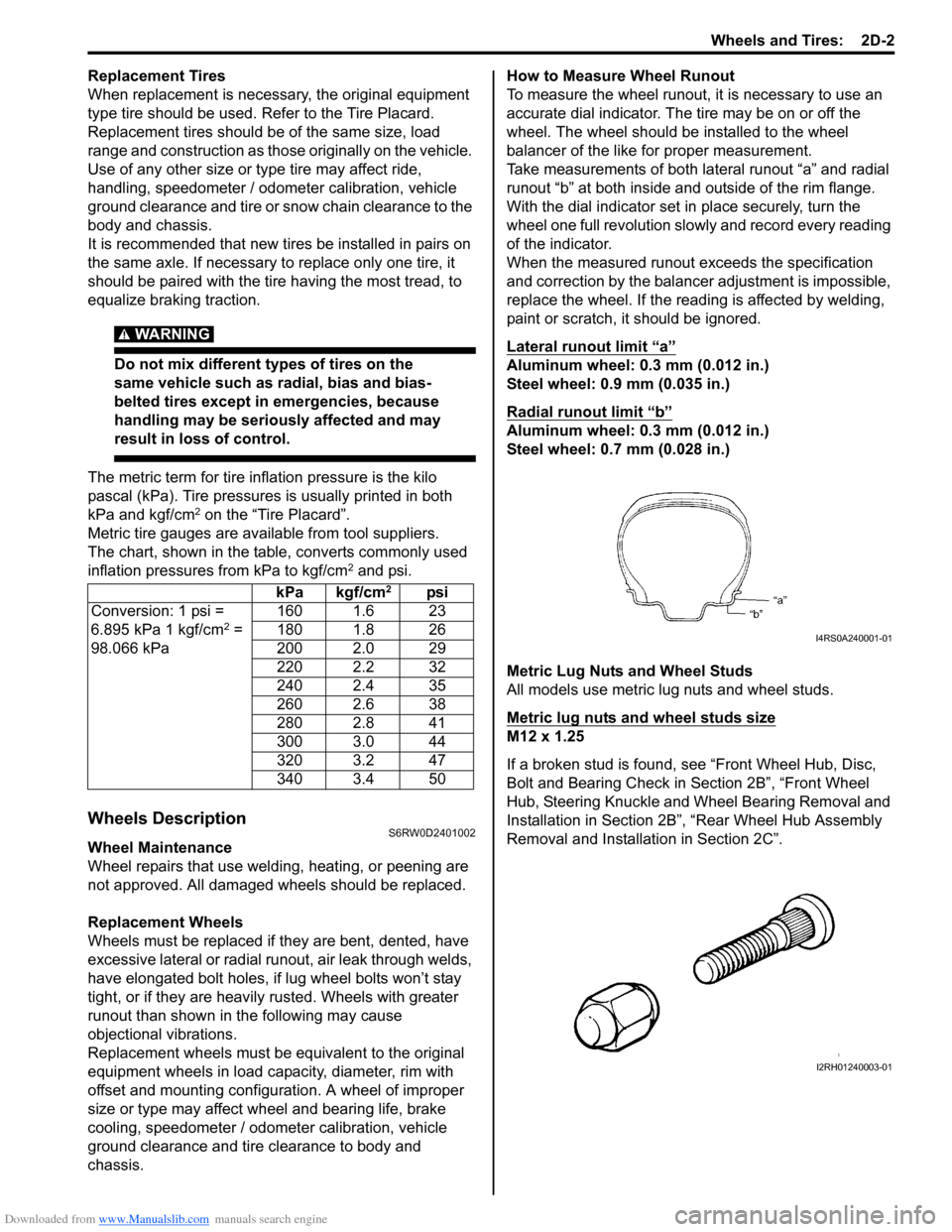
chassis.How to Measure Wheel Runout
To measure the wheel runout, it is necessary to use an
accurate dial indicator. The tire may be on or off the
wheel. The wheel should be installed to the wheel
balancer of the like for proper measurement.
Take measurements of both lateral runout “a” and radial
runout “b” at both inside and outside of the rim flange.
With the dial indicator set in place securely, turn the
wheel one full revolution slowly and record every reading
of the indicator.
When the measured runout exceeds the specification
and correction by the balancer adjustment is impossible,
replace the wheel. If the reading is affected by welding,
paint or scratch, it should be ignored.
Lateral runout limit “a”
Aluminum wheel: 0.3 mm (0.012 in.)
Steel wheel: 0.9 mm (0.035 in.)
Radial runout limit “b”
Aluminum wheel: 0.3 mm (0.012 in.)
Steel wheel: 0.7 mm (0.028 in.)
Metric Lug Nuts and Wheel Studs
All models use metric lug nuts and wheel studs.
Metric lug nuts and wheel studs size
M12 x 1.25
If a broken stud is found, see “Front Wheel Hub, Disc,
Bolt and Bearing Check in Section 2B”, “Front Wheel
Hub, Steering Knuckle and Wheel Bearing Removal and
Installation in Section 2B”, “Rear Wheel Hub Assembly
Removal and Installation in Section 2C”. kPa kgf/cm
2psi
Conversion: 1 psi =
6.895 kPa 1 kgf/cm
2 =
98.066 kPa160 1.6 23
180 1.8 26
200 2.0 29
220 2.2 32
240 2.4 35
260 2.6 38
280 2.8 41
300 3.0 44
320 3.2 47
340 3.4 50I4RS0A240001-01
I2RH01240003-01
Page 565 of 1556
Downloaded from www.Manualslib.com manuals search engine Transfer: 3C-18
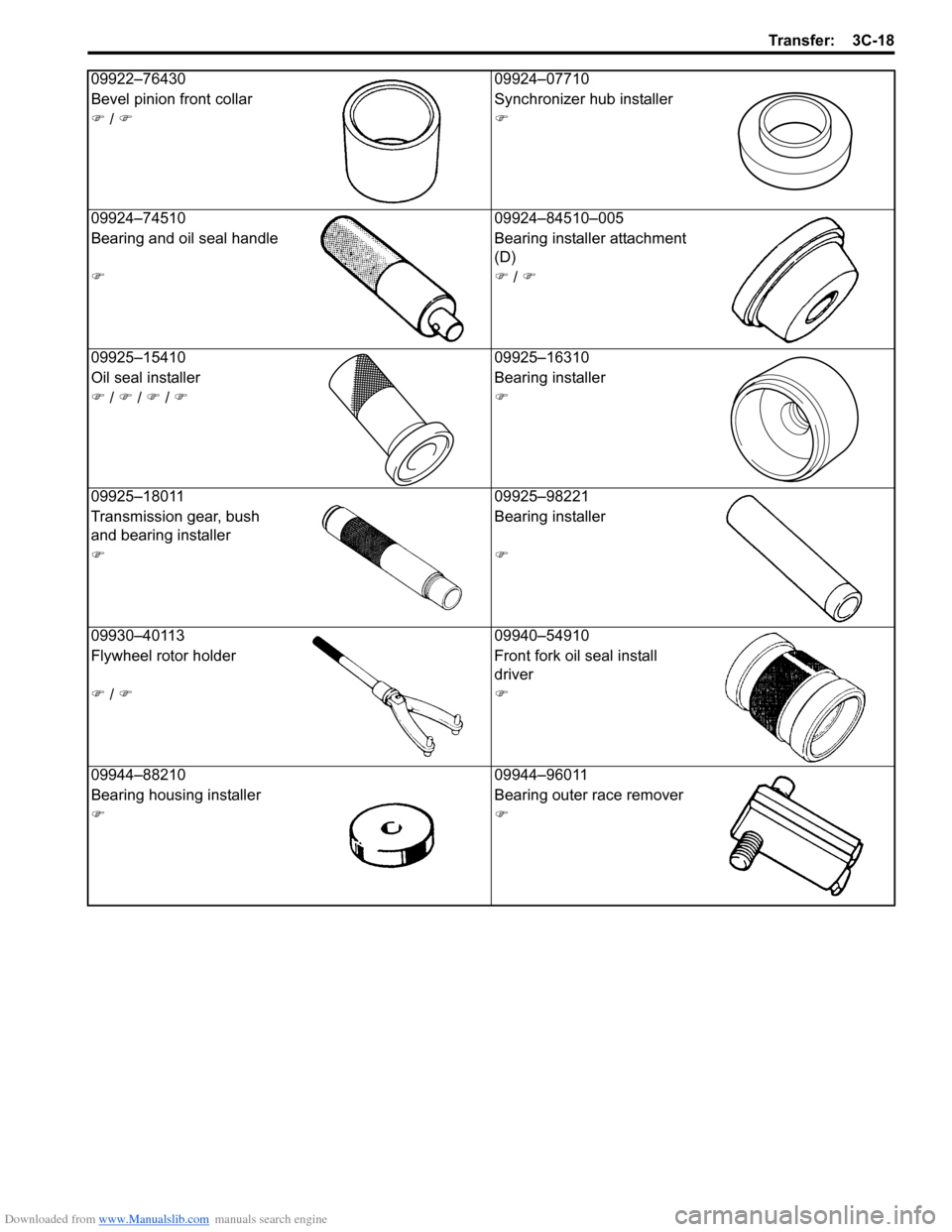
09922–76430 09924–07710
Bevel pinion front collar Synchronizer hub installer
) / ))
09924–74510 09924–84510–005
Bearing and oil seal handle Bearing installer attachment
(D)
)) / )
09925–15410 09925–16310
Oil seal installer Bearing installer
) / ) / ) / ))
09925–18011 09925–98221
Transmission gear, bush
and bearing installerBearing installer
))
09930–40113 09940–54910
Flywheel rotor holder Front fork oil seal install
driver
) / ))
09944–88210 09944–96011
Bearing housing installer Bearing outer race remover
))
Page 577 of 1556
Downloaded from www.Manualslib.com manuals search engine Brake Control System and Diagnosis: 4A-6
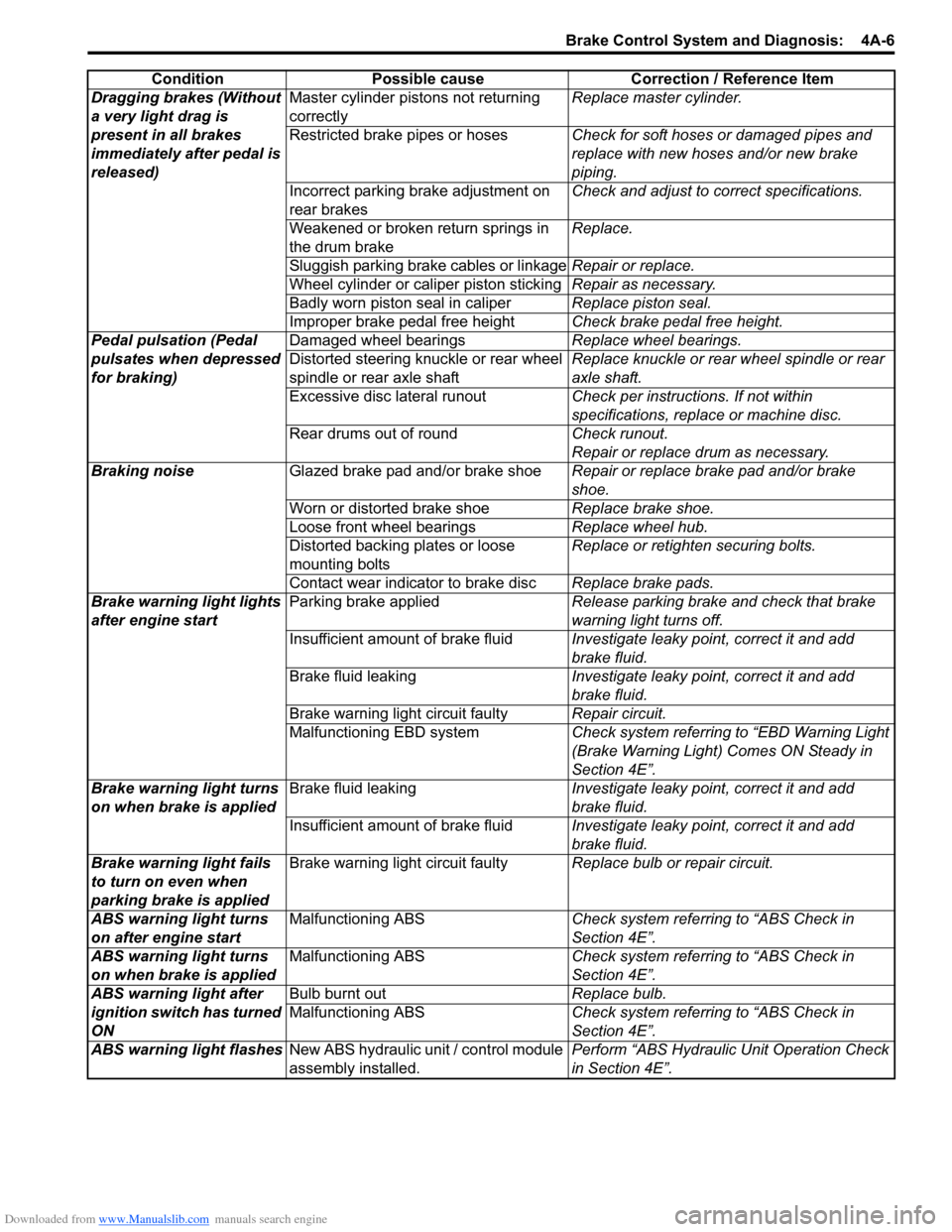
Dragging brakes (Without
a very light drag is
present in all brakes
immediately after pedal is
released)Master cylinder pistons not returning
correctlyReplace master cylinder.
Restricted brake pipes or hosesCheck for soft hoses or damaged pipes and
replace with new hoses and/or new brake
piping.
Incorrect parking brake adjustment on
rear brakesCheck and adjust to correct specifications.
Weakened or broken return springs in
the drum brakeReplace.
Sluggish parking brake cables or linkageRepair or replace.
Wheel cylinder or caliper piston stickingRepair as necessary.
Badly worn piston seal in caliperReplace piston seal.
Improper brake pedal free heightCheck brake pedal free height.
Pedal pulsation (Pedal
pulsates when depressed
for braking)Damaged wheel bearingsReplace wheel bearings.
Distorted steering knuckle or rear wheel
spindle or rear axle shaftReplace knuckle or rear wheel spindle or rear
axle shaft.
Excessive disc lateral runoutCheck per instructions. If not within
specifications, replace or machine disc.
Rear drums out of roundCheck runout.
Repair or replace drum as necessary.
Braking noiseGlazed brake pad and/or brake shoeRepair or replace brake pad and/or brake
shoe.
Worn or distorted brake shoeReplace brake shoe.
Loose front wheel bearingsReplace wheel hub.
Distorted backing plates or loose
mounting boltsReplace or retighten securing bolts.
Contact wear indicator to brake discReplace brake pads.
Brake warning light lights
after engine startParking brake appliedRelease parking brake and check that brake
warning light turns off.
Insufficient amount of brake fluidInvestigate leaky point, correct it and add
brake fluid.
Brake fluid leakingInvestigate leaky point, correct it and add
brake fluid.
Brake warning light circuit faultyRepair circuit.
Malfunctioning EBD systemCheck system referring to “EBD Warning Light
(Brake Warning Light) Comes ON Steady in
Section 4E”.
Brake warning light turns
on when brake is appliedBrake fluid leakingInvestigate leaky point, correct it and add
brake fluid.
Insufficient amount of brake fluidInvestigate leaky point, correct it and add
brake fluid.
Brake warning light fails
to turn on even when
parking brake is appliedBrake warning light circuit faultyReplace bulb or repair circuit.
ABS warning light turns
on after engine startMalfunctioning ABSCheck system referring to “ABS Check in
Section 4E”.
ABS warning light turns
on when brake is appliedMalfunctioning ABSCheck system referring to “ABS Check in
Section 4E”.
ABS warning light after
ignition switch has turned
ON Bulb burnt outReplace bulb.
Malfunctioning ABSCheck system referring to “ABS Check in
Section 4E”.
ABS warning light flashesNew ABS hydraulic unit / control module
assembly installed.Perform “ABS Hydraulic Unit Operation Check
in Section 4E”. Condition Possible cause Correction / Reference Item
Page 596 of 1556
Downloaded from www.Manualslib.com manuals search engine 4C-1 Rear Brakes:
Brakes
Rear Brakes
Repair Instructions
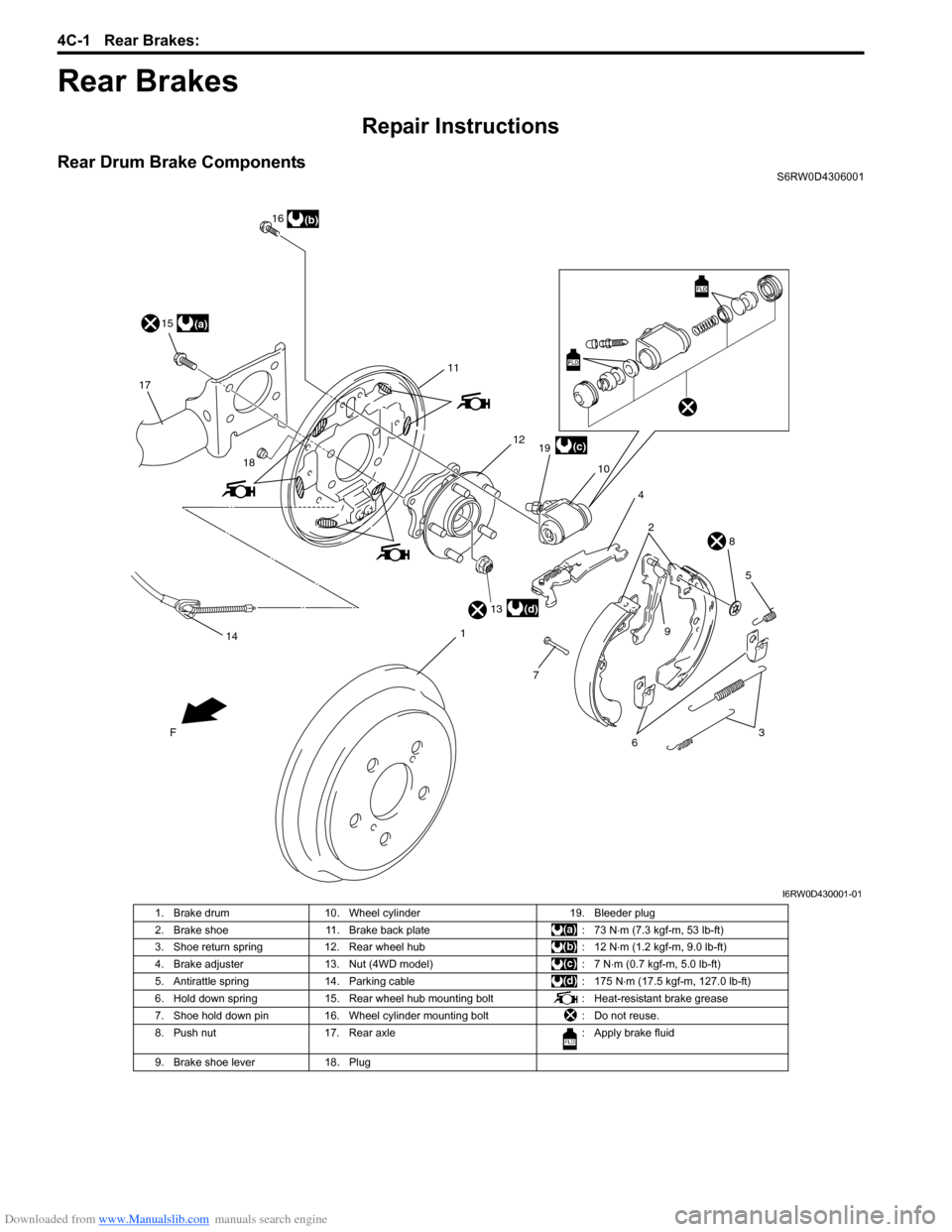
Rear Drum Brake ComponentsS6RW0D4306001
11
2
3
4
5
6 7
12
1411310 16
19 15
17
98
18
F
(a)
(b)
(c)
(d)
I6RW0D430001-01
1. Brake drum 10. Wheel cylinder 19. Bleeder plug
2. Brake shoe 11. Brake back plate : 73 N⋅m (7.3 kgf-m, 53 lb-ft)
3. Shoe return spring 12. Rear wheel hub : 12 N⋅m (1.2 kgf-m, 9.0 lb-ft)
4. Brake adjuster 13. Nut (4WD model) : 7 N⋅m (0.7 kgf-m, 5.0 lb-ft)
5. Antirattle spring 14. Parking cable : 175 N⋅m (17.5 kgf-m, 127.0 lb-ft)
6. Hold down spring 15. Rear wheel hub mounting bolt : Heat-resistant brake grease
7. Shoe hold down pin 16. Wheel cylinder mounting bolt : Do not reuse.
8. Push nut 17. Rear axle : Apply brake fluid
9. Brake shoe lever 18. Plug