Spark plug SUZUKI SX4 2006 1.G Service User Guide
[x] Cancel search | Manufacturer: SUZUKI, Model Year: 2006, Model line: SX4, Model: SUZUKI SX4 2006 1.GPages: 1556, PDF Size: 37.31 MB
Page 99 of 1556
Downloaded from www.Manualslib.com manuals search engine Engine General Information and Diagnosis: 1A-49
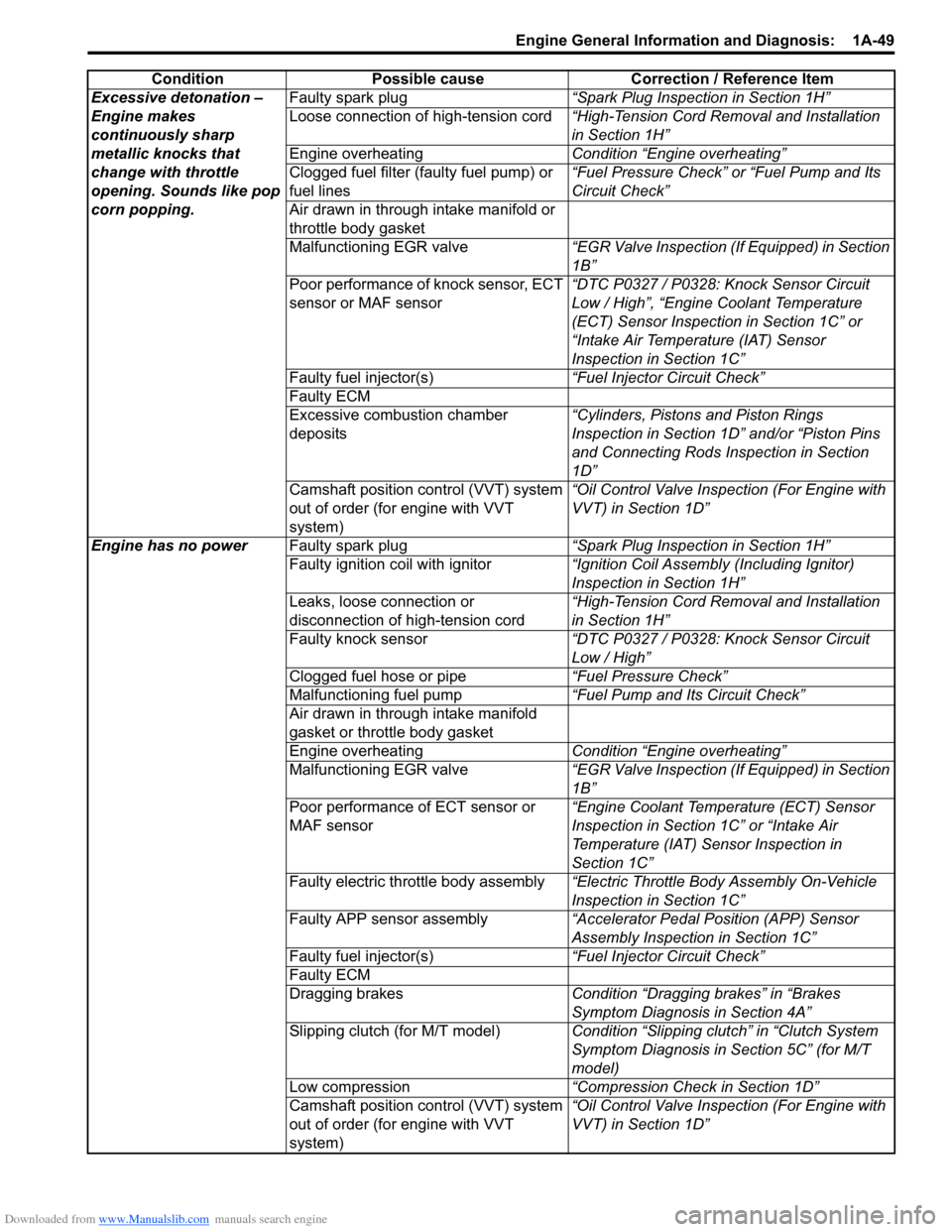
Excessive detonation –
Engine makes
continuously sharp
metallic knocks that
change with throttle
opening. Sounds like pop
corn popping.Faulty spark plug“Spark Plug Inspection in Section 1H”
Loose connection of high-tension cord“High-Tension Cord Removal and Installation
in Section 1H”
Engine overheatingCondition “Engine overheating”
Clogged fuel filter (faulty fuel pump) or
fuel lines“Fuel Pressure Check” or “Fuel Pump and Its
Circuit Check”
Air drawn in through intake manifold or
throttle body gasket
Malfunctioning EGR valve“EGR Valve Inspection (If Equipped) in Section
1B”
Poor performance of knock sensor, ECT
sensor or MAF sensor“DTC P0327 / P0328: Knock Sensor Circuit
Low / High”, “Engine Coolant Temperature
(ECT) Sensor Inspection in Section 1C” or
“Intake Air Temperature (IAT) Sensor
Inspection in Section 1C”
Faulty fuel injector(s)“Fuel Injector Circuit Check”
Faulty ECM
Excessive combustion chamber
deposits“Cylinders, Pistons and Piston Rings
Inspection in Section 1D” and/or “Piston Pins
and Connecting Rods Inspection in Section
1D”
Camshaft position control (VVT) system
out of order (for engine with VVT
system)“Oil Control Valve Inspection (For Engine with
VVT) in Section 1D”
Engine has no powerFaulty spark plug“Spark Plug Inspection in Section 1H”
Faulty ignition coil with ignitor“Ignition Coil Assembly (Including Ignitor)
Inspection in Section 1H”
Leaks, loose connection or
disconnection of high-tension cord“High-Tension Cord Removal and Installation
in Section 1H”
Faulty knock sensor“DTC P0327 / P0328: Knock Sensor Circuit
Low / High”
Clogged fuel hose or pipe“Fuel Pressure Check”
Malfunctioning fuel pump“Fuel Pump and Its Circuit Check”
Air drawn in through intake manifold
gasket or throttle body gasket
Engine overheatingCondition “Engine overheating”
Malfunctioning EGR valve“EGR Valve Inspection (If Equipped) in Section
1B”
Poor performance of ECT sensor or
MAF sensor“Engine Coolant Temperature (ECT) Sensor
Inspection in Section 1C” or “Intake Air
Temperature (IAT) Sensor Inspection in
Section 1C”
Faulty electric throttle body assembly“Electric Throttle Body Assembly On-Vehicle
Inspection in Section 1C”
Faulty APP sensor assembly“Accelerator Pedal Position (APP) Sensor
Assembly Inspection in Section 1C”
Faulty fuel injector(s)“Fuel Injector Circuit Check”
Faulty ECM
Dragging brakesCondition “Dragging brakes” in “Brakes
Symptom Diagnosis in Section 4A”
Slipping clutch (for M/T model)Condition “Slipping clutch” in “Clutch System
Symptom Diagnosis in Section 5C” (for M/T
model)
Low compression“Compression Check in Section 1D”
Camshaft position control (VVT) system
out of order (for engine with VVT
system)“Oil Control Valve Inspection (For Engine with
VVT) in Section 1D” Condition Possible cause Correction / Reference Item
Page 100 of 1556
Downloaded from www.Manualslib.com manuals search engine 1A-50 Engine General Information and Diagnosis:
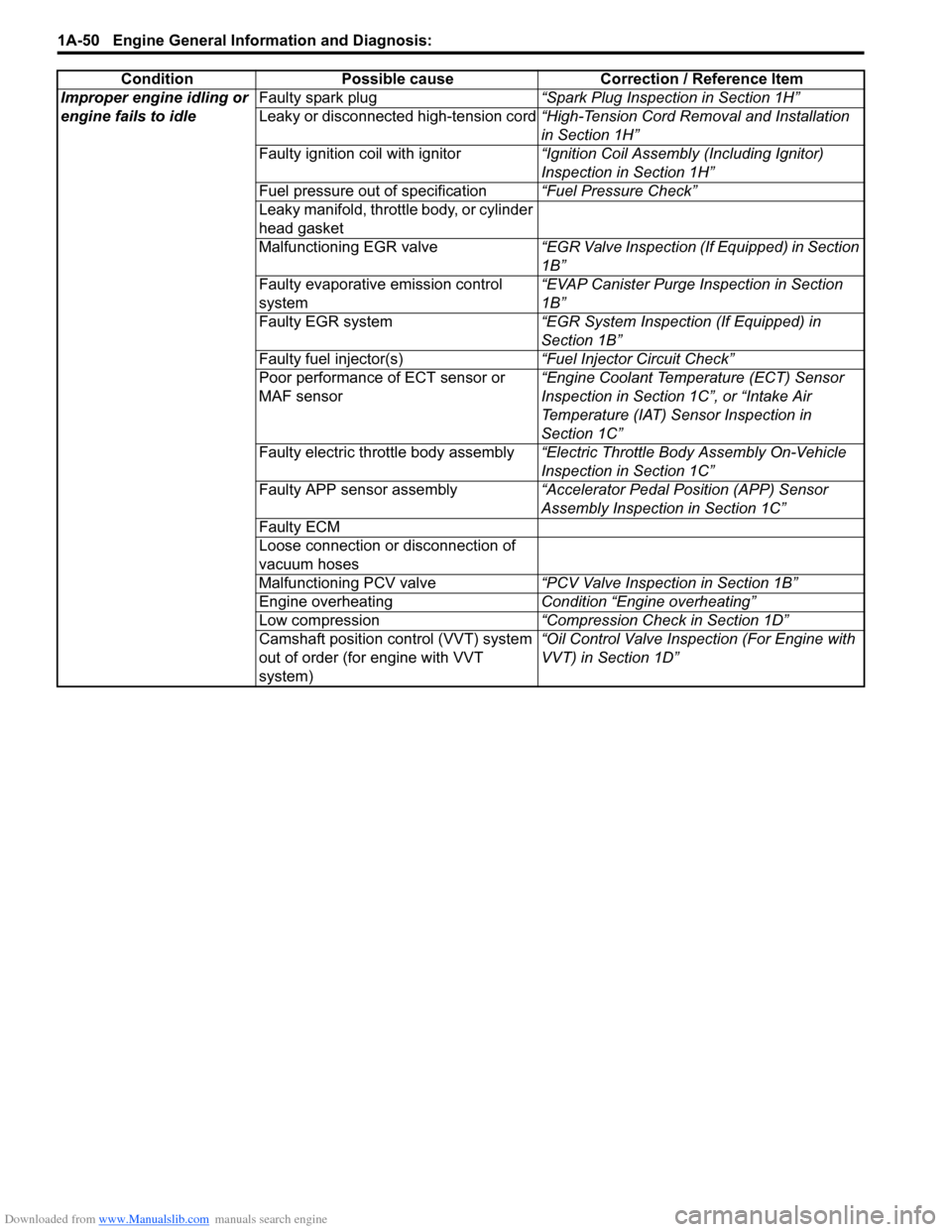
Improper engine idling or
engine fails to idleFaulty spark plug“Spark Plug Inspection in Section 1H”
Leaky or disconnected high-tension cord“High-Tension Cord Removal and Installation
in Section 1H”
Faulty ignition coil with ignitor“Ignition Coil Assembly (Including Ignitor)
Inspection in Section 1H”
Fuel pressure out of specification“Fuel Pressure Check”
Leaky manifold, throttle body, or cylinder
head gasket
Malfunctioning EGR valve“EGR Valve Inspection (If Equipped) in Section
1B”
Faulty evaporative emission control
system“EVAP Canister Purge Inspection in Section
1B”
Faulty EGR system“EGR System Inspection (If Equipped) in
Section 1B”
Faulty fuel injector(s)“Fuel Injector Circuit Check”
Poor performance of ECT sensor or
MAF sensor“Engine Coolant Temperature (ECT) Sensor
Inspection in Section 1C”, or “Intake Air
Temperature (IAT) Sensor Inspection in
Section 1C”
Faulty electric throttle body assembly“Electric Throttle Body Assembly On-Vehicle
Inspection in Section 1C”
Faulty APP sensor assembly“Accelerator Pedal Position (APP) Sensor
Assembly Inspection in Section 1C”
Faulty ECM
Loose connection or disconnection of
vacuum hoses
Malfunctioning PCV valve“PCV Valve Inspection in Section 1B”
Engine overheatingCondition “Engine overheating”
Low compression“Compression Check in Section 1D”
Camshaft position control (VVT) system
out of order (for engine with VVT
system)“Oil Control Valve Inspection (For Engine with
VVT) in Section 1D” Condition Possible cause Correction / Reference Item
Page 101 of 1556
Downloaded from www.Manualslib.com manuals search engine Engine General Information and Diagnosis: 1A-51
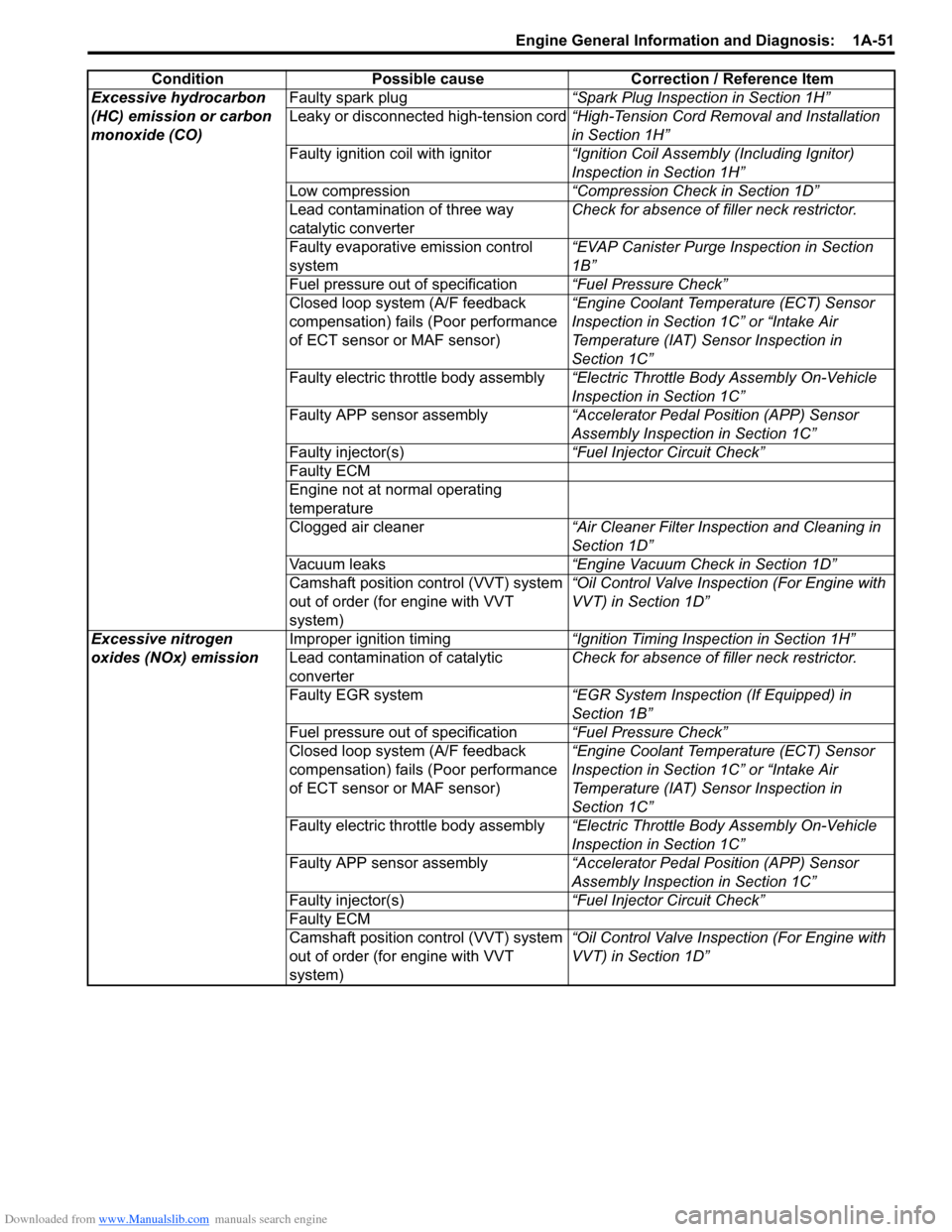
Excessive hydrocarbon
(HC) emission or carbon
monoxide (CO)Faulty spark plug“Spark Plug Inspection in Section 1H”
Leaky or disconnected high-tension cord“High-Tension Cord Removal and Installation
in Section 1H”
Faulty ignition coil with ignitor“Ignition Coil Assembly (Including Ignitor)
Inspection in Section 1H”
Low compression“Compression Check in Section 1D”
Lead contamination of three way
catalytic converterCheck for absence of filler neck restrictor.
Faulty evaporative emission control
system“EVAP Canister Purge Inspection in Section
1B”
Fuel pressure out of specification“Fuel Pressure Check”
Closed loop system (A/F feedback
compensation) fails (Poor performance
of ECT sensor or MAF sensor)“Engine Coolant Temperature (ECT) Sensor
Inspection in Section 1C” or “Intake Air
Temperature (IAT) Sensor Inspection in
Section 1C”
Faulty electric throttle body assembly“Electric Throttle Body Assembly On-Vehicle
Inspection in Section 1C”
Faulty APP sensor assembly“Accelerator Pedal Position (APP) Sensor
Assembly Inspection in Section 1C”
Faulty injector(s)“Fuel Injector Circuit Check”
Faulty ECM
Engine not at normal operating
temperature
Clogged air cleaner“Air Cleaner Filter Inspection and Cleaning in
Section 1D”
Vacuum leaks“Engine Vacuum Check in Section 1D”
Camshaft position control (VVT) system
out of order (for engine with VVT
system)“Oil Control Valve Inspection (For Engine with
VVT) in Section 1D”
Excessive nitrogen
oxides (NOx) emissionImproper ignition timing“Ignition Timing Inspection in Section 1H”
Lead contamination of catalytic
converterCheck for absence of filler neck restrictor.
Faulty EGR system“EGR System Inspection (If Equipped) in
Section 1B”
Fuel pressure out of specification“Fuel Pressure Check”
Closed loop system (A/F feedback
compensation) fails (Poor performance
of ECT sensor or MAF sensor)“Engine Coolant Temperature (ECT) Sensor
Inspection in Section 1C” or “Intake Air
Temperature (IAT) Sensor Inspection in
Section 1C”
Faulty electric throttle body assembly“Electric Throttle Body Assembly On-Vehicle
Inspection in Section 1C”
Faulty APP sensor assembly“Accelerator Pedal Position (APP) Sensor
Assembly Inspection in Section 1C”
Faulty injector(s)“Fuel Injector Circuit Check”
Faulty ECM
Camshaft position control (VVT) system
out of order (for engine with VVT
system)“Oil Control Valve Inspection (For Engine with
VVT) in Section 1D” Condition Possible cause Correction / Reference Item
Page 161 of 1556
Downloaded from www.Manualslib.com manuals search engine Engine General Information and Diagnosis: 1A-111
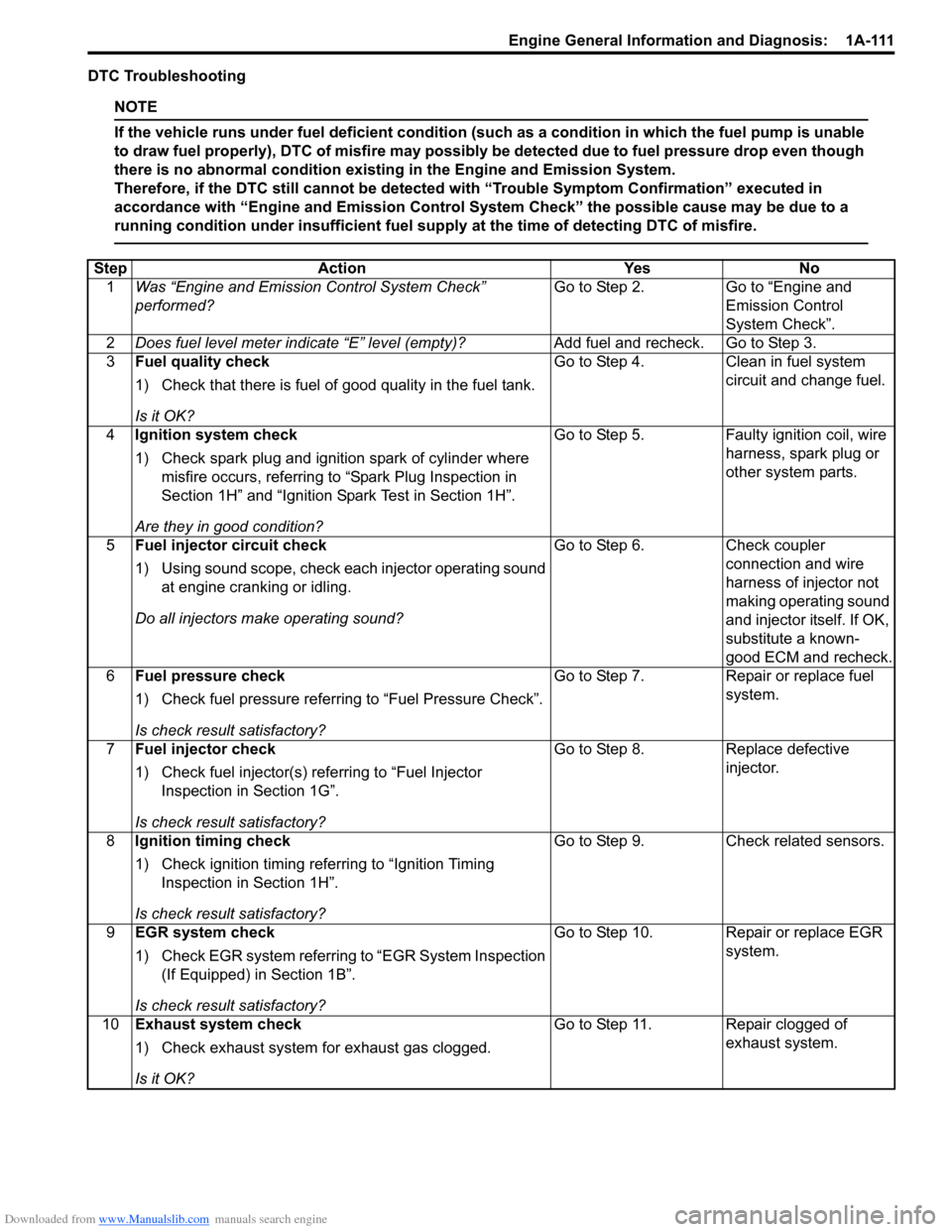
DTC Troubleshooting
NOTE
If the vehicle runs under fuel deficient condition (such as a condition in which the fuel pump is unable
to draw fuel properly), DTC of misfire may possibly be detected due to fuel pressure drop even though
there is no abnormal condition existing in the Engine and Emission System.
Therefore, if the DTC still cannot be detected with “Trouble Symptom Confirmation” executed in
accordance with “Engine and Emission Control System Check” the possible cause may be due to a
running condition under insufficient fuel supply at the time of detecting DTC of misfire.
Step Action Yes No
1Was “Engine and Emission Control System Check”
performed?Go to Step 2. Go to “Engine and
Emission Control
System Check”.
2Does fuel level meter indicate “E” level (empty)?Add fuel and recheck. Go to Step 3.
3Fuel quality check
1) Check that there is fuel of good quality in the fuel tank.
Is it OK?Go to Step 4. Clean in fuel system
circuit and change fuel.
4Ignition system check
1) Check spark plug and ignition spark of cylinder where
misfire occurs, referring to “Spark Plug Inspection in
Section 1H” and “Ignition Spark Test in Section 1H”.
Are they in good condition?Go to Step 5. Faulty ignition coil, wire
harness, spark plug or
other system parts.
5Fuel injector circuit check
1) Using sound scope, check each injector operating sound
at engine cranking or idling.
Do all injectors make operating sound?Go to Step 6. Check coupler
connection and wire
harness of injector not
making operating sound
and injector itself. If OK,
substitute a known-
good ECM and recheck.
6Fuel pressure check
1) Check fuel pressure referring to “Fuel Pressure Check”.
Is check result satisfactory?Go to Step 7. Repair or replace fuel
system.
7Fuel injector check
1) Check fuel injector(s) referring to “Fuel Injector
Inspection in Section 1G”.
Is check result satisfactory?Go to Step 8. Replace defective
injector.
8Ignition timing check
1) Check ignition timing referring to “Ignition Timing
Inspection in Section 1H”.
Is check result satisfactory?Go to Step 9. Check related sensors.
9EGR system check
1) Check EGR system referring to “EGR System Inspection
(If Equipped) in Section 1B”.
Is check result satisfactory?Go to Step 10. Repair or replace EGR
system.
10Exhaust system check
1) Check exhaust system for exhaust gas clogged.
Is it OK?Go to Step 11. Repair clogged of
exhaust system.
Page 287 of 1556
Downloaded from www.Manualslib.com manuals search engine Engine Mechanical: 1D-5
Targeted Timing Varying Operation
Diagnostic Information and Procedures
Compression CheckS6RW0D1404001
Check compression pressure on all 4 cylinders as
follows:
1) Warm up engine to normal operating temperature.
2) Stop engine after warming up.
NOTE
After warming up engine, place transmission
gear shift lever in “Neutral” (shift selector
lever to “P” range for A/T model), and set
parking brake and block drive wheels.
3) Remove air cleaner assembly with air suction hose
referring to “Air Cleaner Assembly Removal and
Installation”.
4) Remove cylinder head upper cover.
5) Remove ignition coil assemblies and all spark plugs
referring to “Spark Plug Removal and Installation in
Section 1H”.
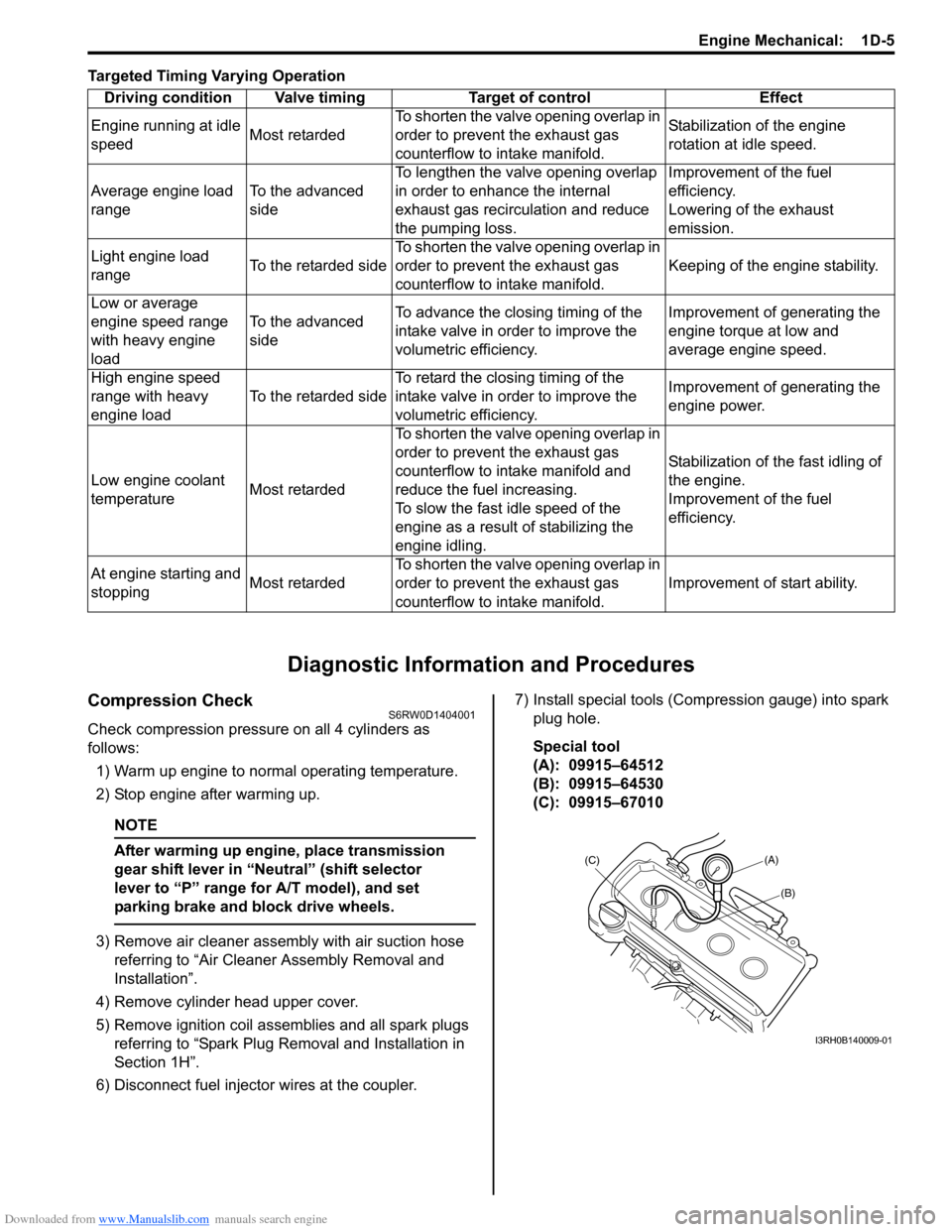
6) Disconnect fuel injector wires at the coupler.7) Install special tools (Compression gauge) into spark
plug hole.
Special tool
(A): 09915–64512
(B): 09915–64530
(C): 09915–67010 Driving condition Valve timing Target of control Effect
Engine running at idle
speedMost retardedTo shorten the valve opening overlap in
order to prevent the exhaust gas
counterflow to intake manifold.Stabilization of the engine
rotation at idle speed.
Average engine load
rangeTo the advanced
sideTo lengthen the valve opening overlap
in order to enhance the internal
exhaust gas recirculation and reduce
the pumping loss.Improvement of the fuel
efficiency.
Lowering of the exhaust
emission.
Light engine load
rangeTo the retarded sideTo shorten the valve opening overlap in
order to prevent the exhaust gas
counterflow to intake manifold.Keeping of the engine stability.
Low or average
engine speed range
with heavy engine
loadTo the advanced
sideTo advance the closing timing of the
intake valve in order to improve the
volumetric efficiency.Improvement of generating the
engine torque at low and
average engine speed.
High engine speed
range with heavy
engine loadTo the retarded sideTo retard the closing timing of the
intake valve in order to improve the
volumetric efficiency.Improvement of generating the
engine power.
Low engine coolant
temperatureMost retardedTo shorten the valve opening overlap in
order to prevent the exhaust gas
counterflow to intake manifold and
reduce the fuel increasing.
To slow the fast idle speed of the
engine as a result of stabilizing the
engine idling.Stabilization of the fast idling of
the engine.
Improvement of the fuel
efficiency.
At engine starting and
stoppingMost retardedTo shorten the valve opening overlap in
order to prevent the exhaust gas
counterflow to intake manifold.Improvement of start ability.
(A)
(C)
(B)
I3RH0B140009-01
Page 288 of 1556
Downloaded from www.Manualslib.com manuals search engine 1D-6 Engine Mechanical:
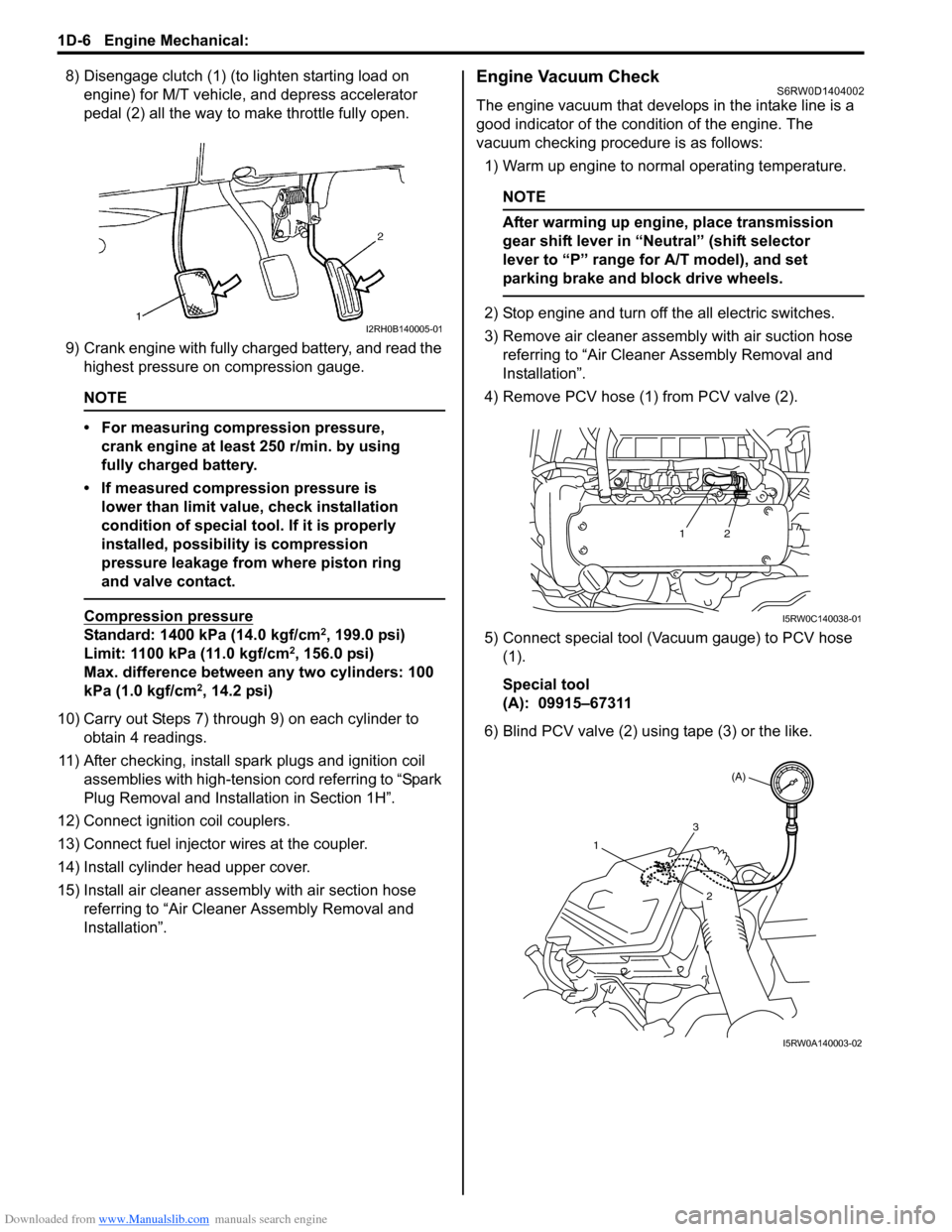
8) Disengage clutch (1) (to lighten starting load on
engine) for M/T vehicle, and depress accelerator
pedal (2) all the way to make throttle fully open.
9) Crank engine with fully charged battery, and read the
highest pressure on compression gauge.
NOTE
• For measuring compression pressure,
crank engine at least 250 r/min. by using
fully charged battery.
• If measured compression pressure is
lower than limit value, check installation
condition of special tool. If it is properly
installed, possibility is compression
pressure leakage from where piston ring
and valve contact.
Compression pressure
Standard: 1400 kPa (14.0 kgf/cm2, 199.0 psi)
Limit: 1100 kPa (11.0 kgf/cm2, 156.0 psi)
Max. difference between any two cylinders: 100
kPa (1.0 kgf/cm
2, 14.2 psi)
10) Carry out Steps 7) through 9) on each cylinder to
obtain 4 readings.
11) After checking, install spark plugs and ignition coil
assemblies with high-tension cord referring to “Spark
Plug Removal and Installation in Section 1H”.
12) Connect ignition coil couplers.
13) Connect fuel injector wires at the coupler.
14) Install cylinder head upper cover.
15) Install air cleaner assembly with air section hose
referring to “Air Cleaner Assembly Removal and
Installation”.
Engine Vacuum CheckS6RW0D1404002
The engine vacuum that develops in the intake line is a
good indicator of the condition of the engine. The
vacuum checking procedure is as follows:
1) Warm up engine to normal operating temperature.
NOTE
After warming up engine, place transmission
gear shift lever in “Neutral” (shift selector
lever to “P” range for A/T model), and set
parking brake and block drive wheels.
2) Stop engine and turn off the all electric switches.
3) Remove air cleaner assembly with air suction hose
referring to “Air Cleaner Assembly Removal and
Installation”.
4) Remove PCV hose (1) from PCV valve (2).
5) Connect special tool (Vacuum gauge) to PCV hose
(1).
Special tool
(A): 09915–67311
6) Blind PCV valve (2) using tape (3) or the like.I2RH0B140005-01
12
I5RW0C140038-01
(A)
1
2
3
I5RW0A140003-02
Page 293 of 1556
Downloaded from www.Manualslib.com manuals search engine Engine Mechanical: 1D-11
Air Cleaner Assembly Removal and InstallationS6RW0D1406046
Removal
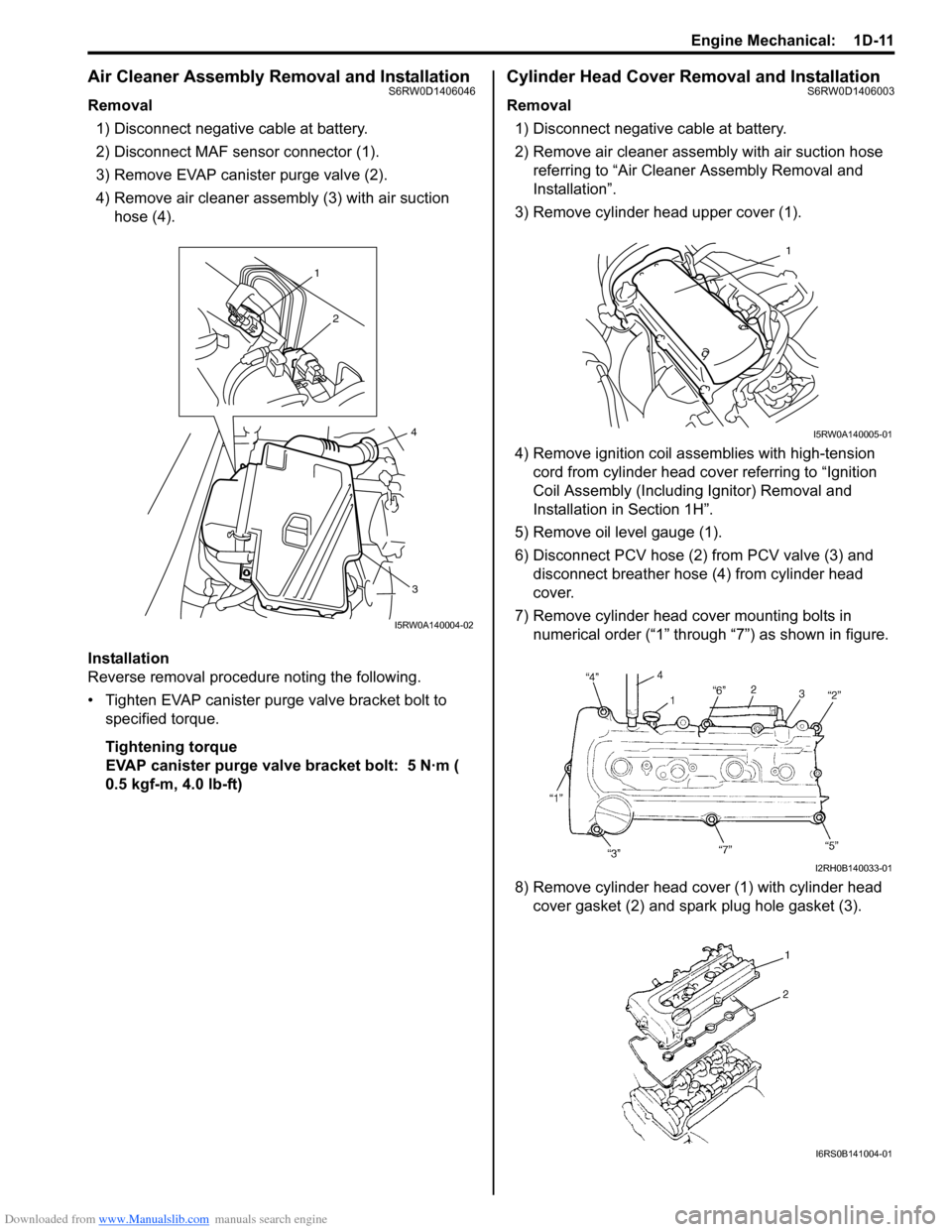
1) Disconnect negative cable at battery.
2) Disconnect MAF sensor connector (1).
3) Remove EVAP canister purge valve (2).
4) Remove air cleaner assembly (3) with air suction
hose (4).
Installation
Reverse removal procedure noting the following.
• Tighten EVAP canister purge valve bracket bolt to
specified torque.
Tightening torque
EVAP canister purge valve bracket bolt: 5 N·m (
0.5 kgf-m, 4.0 lb-ft)
Cylinder Head Cover Removal and InstallationS6RW0D1406003
Removal
1) Disconnect negative cable at battery.
2) Remove air cleaner assembly with air suction hose
referring to “Air Cleaner Assembly Removal and
Installation”.
3) Remove cylinder head upper cover (1).
4) Remove ignition coil assemblies with high-tension
cord from cylinder head cover referring to “Ignition
Coil Assembly (Including Ignitor) Removal and
Installation in Section 1H”.
5) Remove oil level gauge (1).
6) Disconnect PCV hose (2) from PCV valve (3) and
disconnect breather hose (4) from cylinder head
cover.
7) Remove cylinder head cover mounting bolts in
numerical order (“1” through “7”) as shown in figure.
8) Remove cylinder head cover (1) with cylinder head
cover gasket (2) and spark plug hole gasket (3).
1
2
3
4
I5RW0A140004-02
1
I5RW0A140005-01
I2RH0B140033-01
I6RS0B141004-01
Page 294 of 1556
Downloaded from www.Manualslib.com manuals search engine 1D-12 Engine Mechanical:
Installation
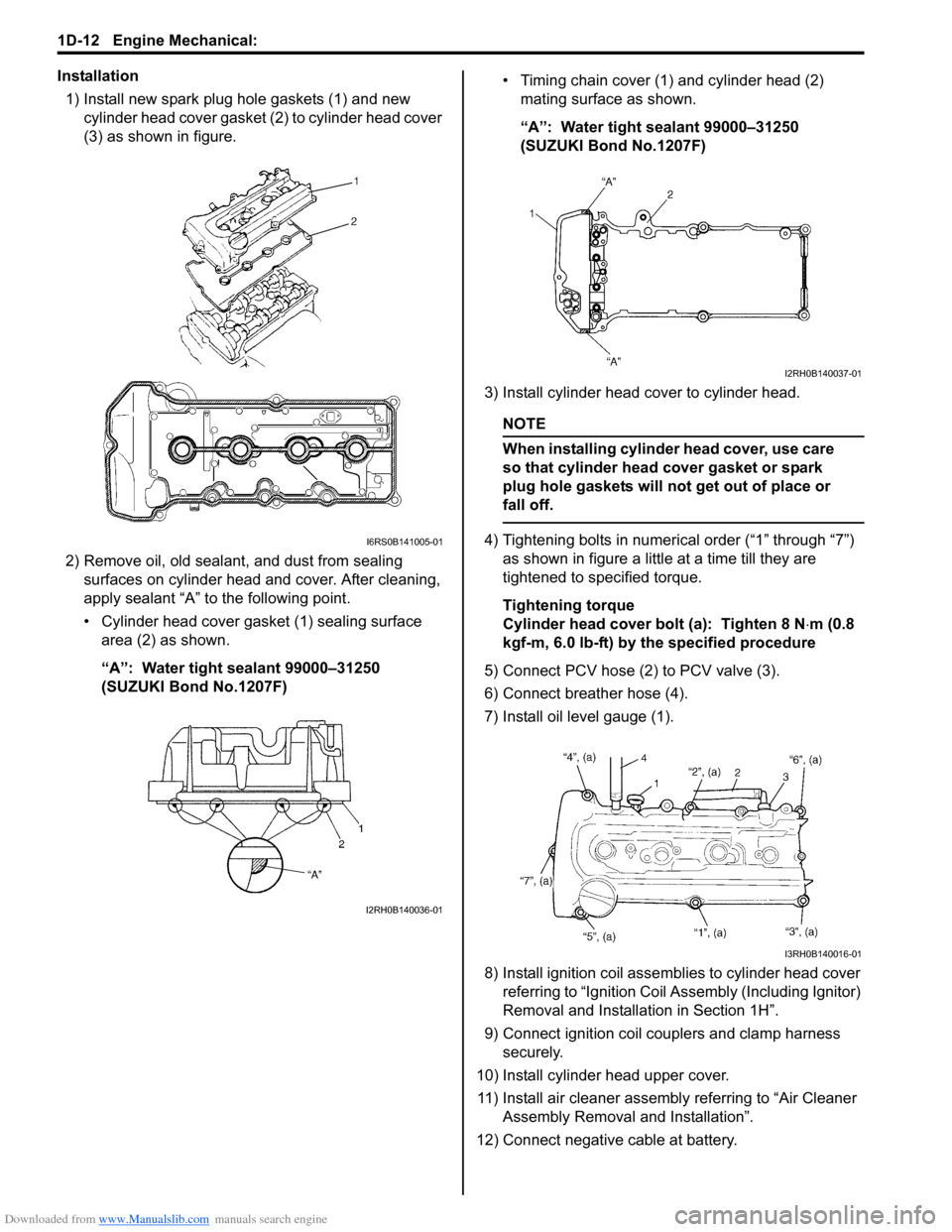
1) Install new spark plug hole gaskets (1) and new
cylinder head cover gasket (2) to cylinder head cover
(3) as shown in figure.
2) Remove oil, old sealant, and dust from sealing
surfaces on cylinder head and cover. After cleaning,
apply sealant “A” to the following point.
• Cylinder head cover gasket (1) sealing surface
area (2) as shown.
“A”: Water tight sealant 99000–31250
(SUZUKI Bond No.1207F)• Timing chain cover (1) and cylinder head (2)
mating surface as shown.
“A”: Water tight sealant 99000–31250
(SUZUKI Bond No.1207F)
3) Install cylinder head cover to cylinder head.
NOTE
When installing cylinder head cover, use care
so that cylinder head cover gasket or spark
plug hole gaskets will not get out of place or
fall off.
4) Tightening bolts in numerical order (“1” through “7”)
as shown in figure a little at a time till they are
tightened to specified torque.
Tightening torque
Cylinder head cover bolt (a): Tighten 8 N⋅m (0.8
kgf-m, 6.0 lb-ft) by the specified procedure
5) Connect PCV hose (2) to PCV valve (3).
6) Connect breather hose (4).
7) Install oil level gauge (1).
8) Install ignition coil assemblies to cylinder head cover
referring to “Ignition Coil Assembly (Including Ignitor)
Removal and Installation in Section 1H”.
9) Connect ignition coil couplers and clamp harness
securely.
10) Install cylinder head upper cover.
11) Install air cleaner assembly referring to “Air Cleaner
Assembly Removal and Installation”.
12) Connect negative cable at battery.I6RS0B141005-01
I2RH0B140036-01
I2RH0B140037-01
I3RH0B140016-01
Page 396 of 1556
Downloaded from www.Manualslib.com manuals search engine 1H-1 Ignition System:
Engine
Ignition System
General Description
Ignition System ConstructionS6RW0D1801001
The ignition system is an electronic (distributorless) ignition system. It consists of the parts as described below.
•ECM
It detects the engine and vehicle conditions through the signals from the sensors, determines the most suitable
ignition timing and time for electricity to flow to the primary coil and sends a signal to the ignitor (power unit) in the
ignition coil assembly.
•Ignition coil assembly (including an ignitor)
The ignition coil assembly has a built-in ignitor which turns ON and OFF the current flow to the primary coil
according to the signal from ECM. When the current flow to the primary coil is turned OFF, a high voltage is induced
in the secondary coil.
•High-tension cords and spark plugs
•CMP sensor (Camshaft position sensor) and CKP sensor (Crankshaft position sensor)
Using signals from these sensors, ECM identifies the specific cylinder whose piston is in the compression stroke,
detects the crank angle and adjusts initial ignition timing automatically.
•TP sensor, ECT sensor, MAP sensor, MAF sensor, IAT sensor, knock sensor and other sensors / switches
Although this ignition system does not have a distributor, it has two ignition coil assemblies (one is for No.1 and No.4
spark plugs and the other is for No.2 and No.3 spark plugs). When an ignition signal is sent from ECM to the ignitor in
the ignition coil assembly for No.1 and No.4 spark plugs, a high voltage is induced in the secondary coil and that
passes through the high-tension cords and causes No.1 and No.4 spark plugs to spark simultaneously. Likewise,
when an ignition signal is sent to the ignitor in the other ignition coil assembly, No.2 and No.3 spark plugs spark
simultaneously.
Page 397 of 1556
Downloaded from www.Manualslib.com manuals search engine Ignition System: 1H-2
Schematic and Routing Diagram
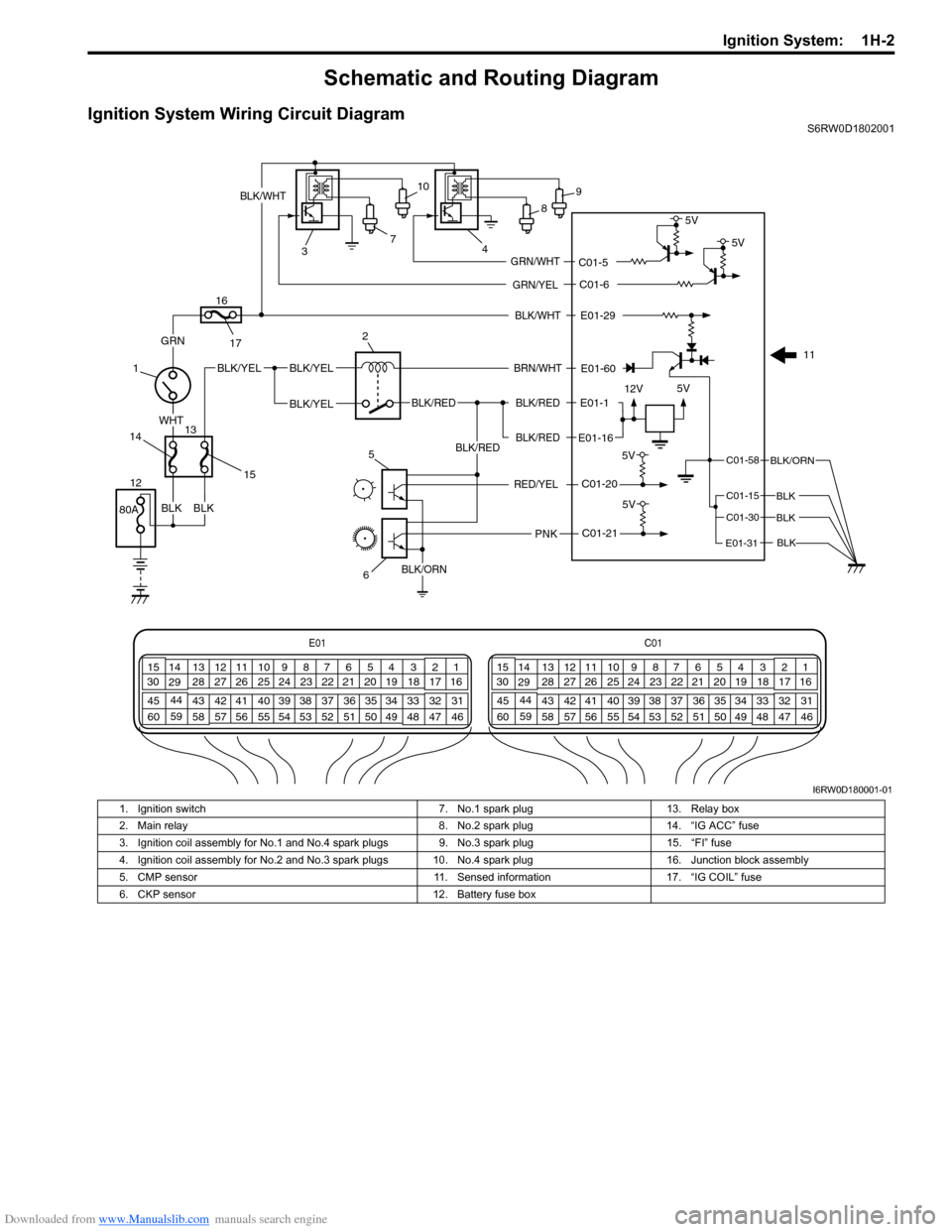
Ignition System Wiring Circuit DiagramS6RW0D1802001
E01-60
E01-29
12V5V
5V
E01-1
E01-16
BLK/WHT
BLK/RED
BLK/RED
BLK/RED
80A
BLK/YELBLK/YEL
BLK/YEL
GRN
BLK
WHT
BRN/WHT
BLK/ORN
BLK
BLK
BLK
C01-20
BLK/RED
PNK
BLK/ORN
5V
C01-21
BLK/WHT
7
34
1
125
6 2
11 89 10
GRN/YEL
GRN/WHT
C01-6
C01-55V
5V
RED/YEL
C01-58
C01-15
C01-30
E01-31
E01C01
3 4
18 19 5 6 7 10 11
17 20
47 46 49 50 51 21 22
5216 259
24 14
29
55 57 54 53 59
60 582
26 27 28 15
30
56 4832 31 34 35 36 37 40 42 39 38 44
45 43 41 331 12 13
238 3 4
18 19 5 6 7 10 11
17 20
47 46 49 50 51 21 22
5216 259
24 14
29
55 57 54 53 59
60 582
26 27 28 15
30
56 4832 31 34 35 36 37 40 42 39 38 44
45 43 41 331 12 13
238
13
14
15
16
17
BLK
I6RW0D180001-01
1. Ignition switch 7. No.1 spark plug 13. Relay box
2. Main relay 8. No.2 spark plug 14. “IG ACC” fuse
3. Ignition coil assembly for No.1 and No.4 spark plugs 9. No.3 spark plug 15. “FI” fuse
4. Ignition coil assembly for No.2 and No.3 spark plugs 10. No.4 spark plug 16. Junction block assembly
5. CMP sensor 11. Sensed information 17. “IG COIL” fuse
6. CKP sensor 12. Battery fuse box