maintenance SUZUKI SX4 2006 1.G Service User Guide
[x] Cancel search | Manufacturer: SUZUKI, Model Year: 2006, Model line: SX4, Model: SUZUKI SX4 2006 1.GPages: 1556, PDF Size: 37.31 MB
Page 38 of 1556
Downloaded from www.Manualslib.com manuals search engine 0B-7 Maintenance and Lubrication:
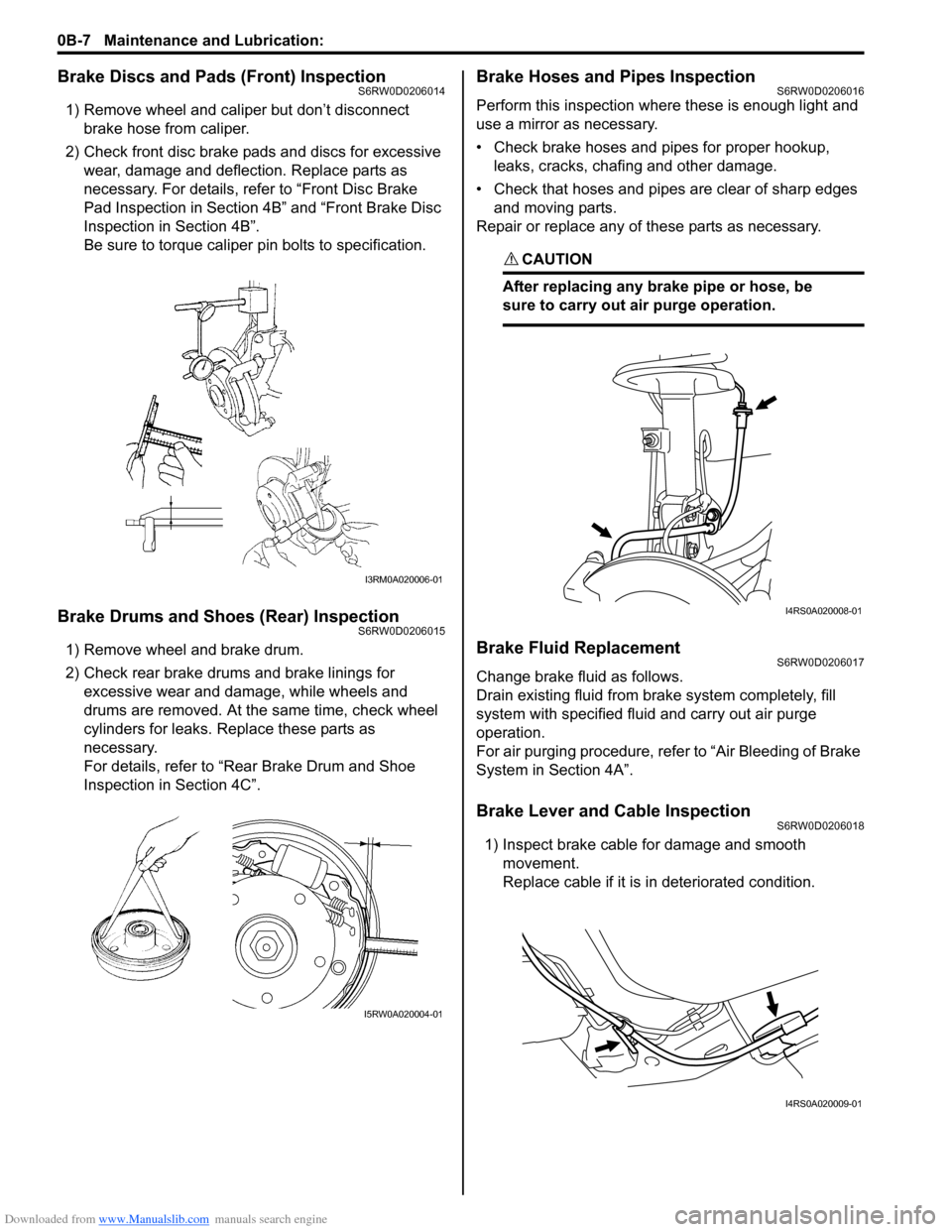
Brake Discs and Pads (Front) InspectionS6RW0D0206014
1) Remove wheel and caliper but don’t disconnect
brake hose from caliper.
2) Check front disc brake pads and discs for excessive
wear, damage and deflection. Replace parts as
necessary. For details, refer to “Front Disc Brake
Pad Inspection in Section 4B” and “Front Brake Disc
Inspection in Section 4B”.
Be sure to torque caliper pin bolts to specification.
Brake Drums and Shoes (Rear) InspectionS6RW0D0206015
1) Remove wheel and brake drum.
2) Check rear brake drums and brake linings for
excessive wear and damage, while wheels and
drums are removed. At the same time, check wheel
cylinders for leaks. Replace these parts as
necessary.
For details, refer to “Rear Brake Drum and Shoe
Inspection in Section 4C”.
Brake Hoses and Pipes InspectionS6RW0D0206016
Perform this inspection where these is enough light and
use a mirror as necessary.
• Check brake hoses and pipes for proper hookup,
leaks, cracks, chafing and other damage.
• Check that hoses and pipes are clear of sharp edges
and moving parts.
Repair or replace any of these parts as necessary.
CAUTION!
After replacing any brake pipe or hose, be
sure to carry out air purge operation.
Brake Fluid ReplacementS6RW0D0206017
Change brake fluid as follows.
Drain existing fluid from brake system completely, fill
system with specified fluid and carry out air purge
operation.
For air purging procedure, refer to “Air Bleeding of Brake
System in Section 4A”.
Brake Lever and Cable InspectionS6RW0D0206018
1) Inspect brake cable for damage and smooth
movement.
Replace cable if it is in deteriorated condition.
I3RM0A020006-01
I5RW0A020004-01
I4RS0A020008-01
I4RS0A020009-01
Page 39 of 1556
Downloaded from www.Manualslib.com manuals search engine Maintenance and Lubrication: 0B-8
2) Check tooth tip of each notch for damage or wear. If
any damage or wear is found, replace parking lever.
3) Check parking brake lever for proper operation and
stroke, and adjust it if necessary.
For checking and adjusting procedures, refer to
“Parking Brake Inspection and Adjustment in Section
4D”.
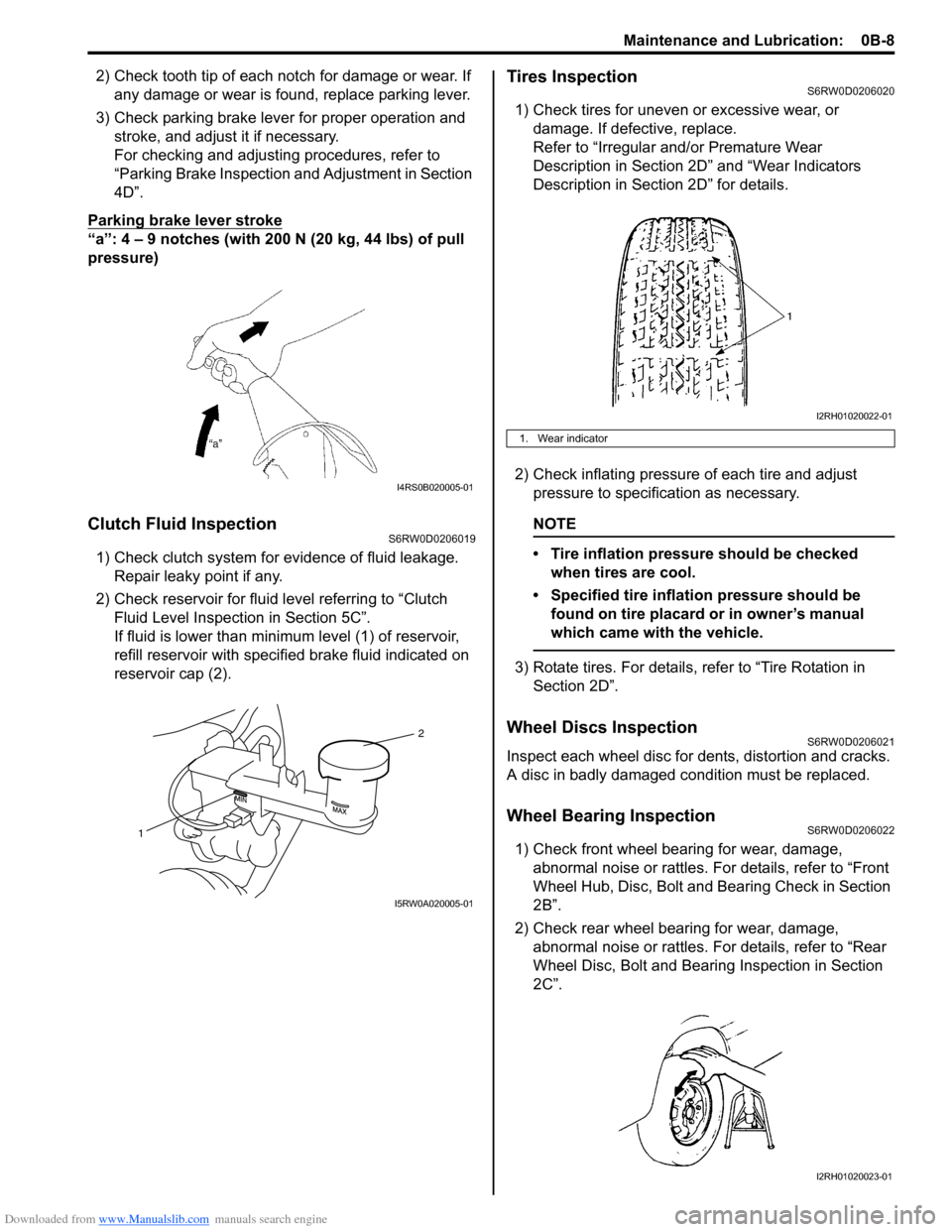
Parking brake lever stroke
“a”: 4 – 9 notches (with 200 N (20 kg, 44 lbs) of pull
pressure)
Clutch Fluid InspectionS6RW0D0206019
1) Check clutch system for evidence of fluid leakage.
Repair leaky point if any.
2) Check reservoir for fluid level referring to “Clutch
Fluid Level Inspection in Section 5C”.
If fluid is lower than minimum level (1) of reservoir,
refill reservoir with specified brake fluid indicated on
reservoir cap (2).
Tires InspectionS6RW0D0206020
1) Check tires for uneven or excessive wear, or
damage. If defective, replace.
Refer to “Irregular and/or Premature Wear
Description in Section 2D” and “Wear Indicators
Description in Section 2D” for details.
2) Check inflating pressure of each tire and adjust
pressure to specification as necessary.
NOTE
• Tire inflation pressure should be checked
when tires are cool.
• Specified tire inflation pressure should be
found on tire placard or in owner’s manual
which came with the vehicle.
3) Rotate tires. For details, refer to “Tire Rotation in
Section 2D”.
Wheel Discs InspectionS6RW0D0206021
Inspect each wheel disc for dents, distortion and cracks.
A disc in badly damaged condition must be replaced.
Wheel Bearing InspectionS6RW0D0206022
1) Check front wheel bearing for wear, damage,
abnormal noise or rattles. For details, refer to “Front
Wheel Hub, Disc, Bolt and Bearing Check in Section
2B”.
2) Check rear wheel bearing for wear, damage,
abnormal noise or rattles. For details, refer to “Rear
Wheel Disc, Bolt and Bearing Inspection in Section
2C”.
I4RS0B020005-01
1
2
I5RW0A020005-01
1. Wear indicator
I2RH01020022-01
I2RH01020023-01
Page 40 of 1556
Downloaded from www.Manualslib.com manuals search engine 0B-9 Maintenance and Lubrication:
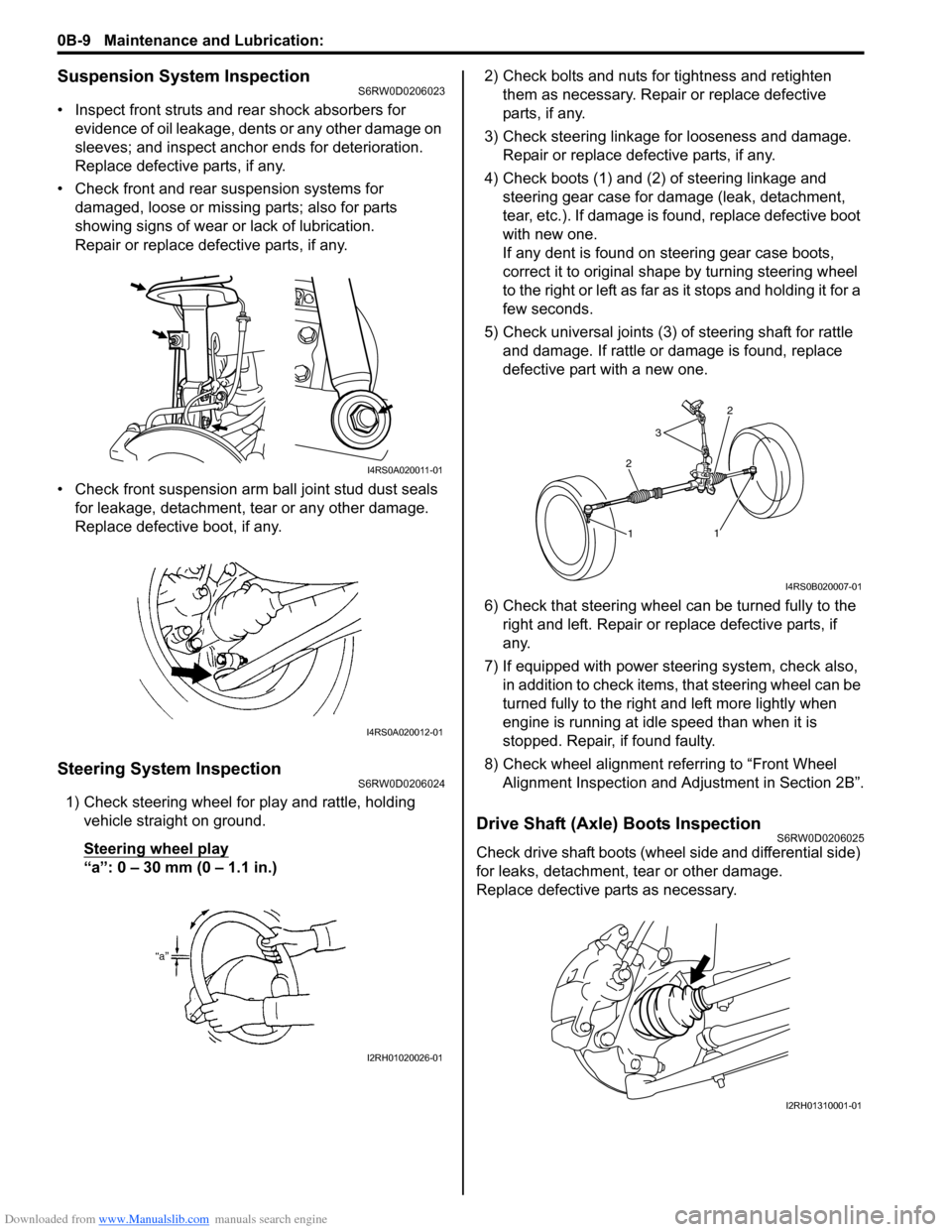
Suspension System InspectionS6RW0D0206023
• Inspect front struts and rear shock absorbers for
evidence of oil leakage, dents or any other damage on
sleeves; and inspect anchor ends for deterioration.
Replace defective parts, if any.
• Check front and rear suspension systems for
damaged, loose or missing parts; also for parts
showing signs of wear or lack of lubrication.
Repair or replace defective parts, if any.
• Check front suspension arm ball joint stud dust seals
for leakage, detachment, tear or any other damage.
Replace defective boot, if any.
Steering System InspectionS6RW0D0206024
1) Check steering wheel for play and rattle, holding
vehicle straight on ground.
Steering wheel play
“a”: 0 – 30 mm (0 – 1.1 in.)2) Check bolts and nuts for tightness and retighten
them as necessary. Repair or replace defective
parts, if any.
3) Check steering linkage for looseness and damage.
Repair or replace defective parts, if any.
4) Check boots (1) and (2) of steering linkage and
steering gear case for damage (leak, detachment,
tear, etc.). If damage is found, replace defective boot
with new one.
If any dent is found on steering gear case boots,
correct it to original shape by turning steering wheel
to the right or left as far as it stops and holding it for a
few seconds.
5) Check universal joints (3) of steering shaft for rattle
and damage. If rattle or damage is found, replace
defective part with a new one.
6) Check that steering wheel can be turned fully to the
right and left. Repair or replace defective parts, if
any.
7) If equipped with power steering system, check also,
in addition to check items, that steering wheel can be
turned fully to the right and left more lightly when
engine is running at idle speed than when it is
stopped. Repair, if found faulty.
8) Check wheel alignment referring to “Front Wheel
Alignment Inspection and Adjustment in Section 2B”.
Drive Shaft (Axle) Boots InspectionS6RW0D0206025
Check drive shaft boots (wheel side and differential side)
for leaks, detachment, tear or other damage.
Replace defective parts as necessary.
I4RS0A020011-01
I4RS0A020012-01
I2RH01020026-01
2
3
2
1
1
I4RS0B020007-01
I2RH01310001-01
Page 41 of 1556
Downloaded from www.Manualslib.com manuals search engine Maintenance and Lubrication: 0B-10
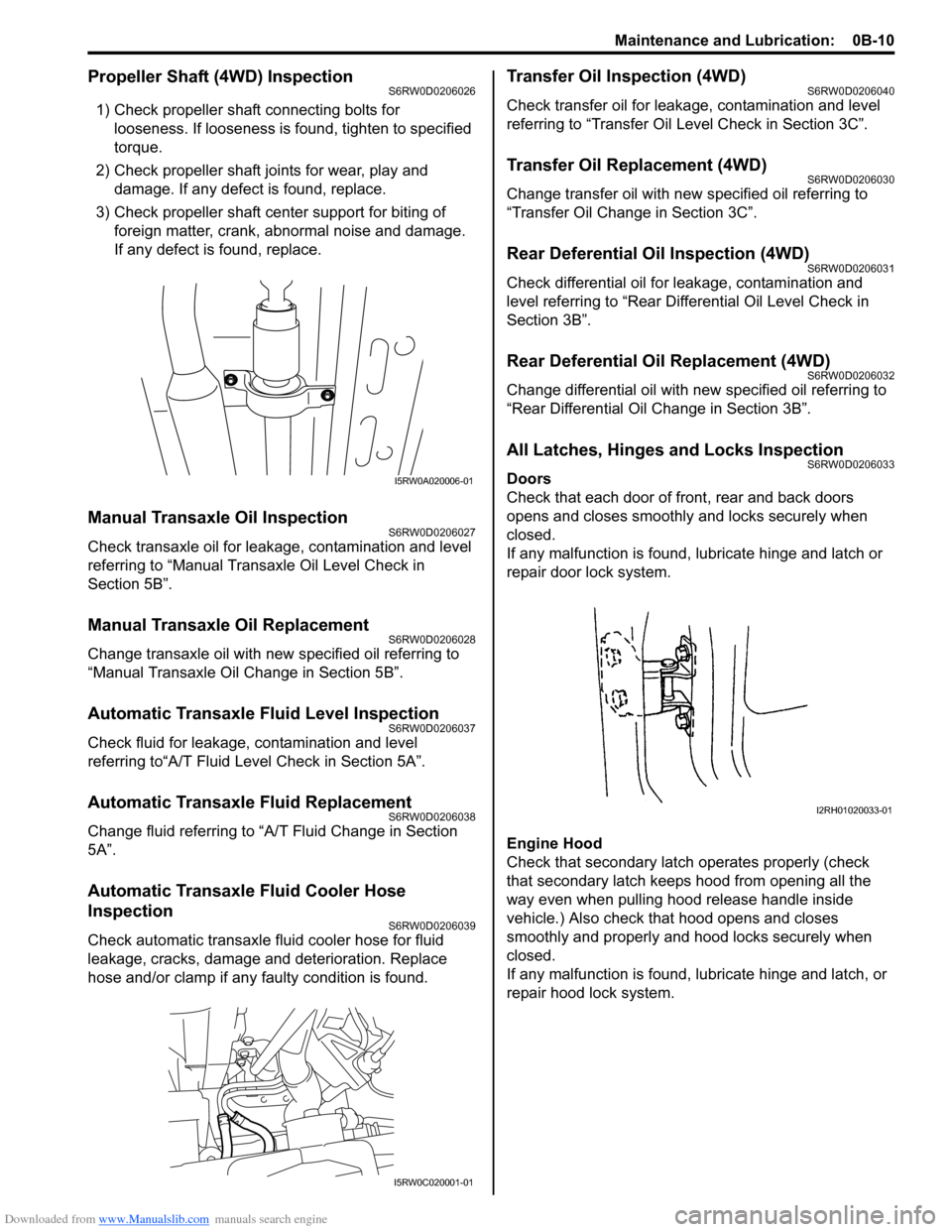
Propeller Shaft (4WD) InspectionS6RW0D0206026
1) Check propeller shaft connecting bolts for
looseness. If looseness is found, tighten to specified
torque.
2) Check propeller shaft joints for wear, play and
damage. If any defect is found, replace.
3) Check propeller shaft center support for biting of
foreign matter, crank, abnormal noise and damage.
If any defect is found, replace.
Manual Transaxle Oil InspectionS6RW0D0206027
Check transaxle oil for leakage, contamination and level
referring to “Manual Transaxle Oil Level Check in
Section 5B”.
Manual Transaxle Oil ReplacementS6RW0D0206028
Change transaxle oil with new specified oil referring to
“Manual Transaxle Oil Change in Section 5B”.
Automatic Transaxle Fluid Level InspectionS6RW0D0206037
Check fluid for leakage, contamination and level
referring to“A/T Fluid Level Check in Section 5A”.
Automatic Transaxle Fluid ReplacementS6RW0D0206038
Change fluid referring to “A/T Fluid Change in Section
5A”.
Automatic Transaxle Fluid Cooler Hose
Inspection
S6RW0D0206039
Check automatic transaxle fluid cooler hose for fluid
leakage, cracks, damage and deterioration. Replace
hose and/or clamp if any faulty condition is found.
Transfer Oil Inspection (4WD)S6RW0D0206040
Check transfer oil for leakage, contamination and level
referring to “Transfer Oil Level Check in Section 3C”.
Transfer Oil Replacement (4WD)S6RW0D0206030
Change transfer oil with new specified oil referring to
“Transfer Oil Change in Section 3C”.
Rear Deferential Oil Inspection (4WD)S6RW0D0206031
Check differential oil for leakage, contamination and
level referring to “Rear Differential Oil Level Check in
Section 3B”.
Rear Deferential Oil Replacement (4WD)S6RW0D0206032
Change differential oil with new specified oil referring to
“Rear Differential Oil Change in Section 3B”.
All Latches, Hinges and Locks InspectionS6RW0D0206033
Doors
Check that each door of front, rear and back doors
opens and closes smoothly and locks securely when
closed.
If any malfunction is found, lubricate hinge and latch or
repair door lock system.
Engine Hood
Check that secondary latch operates properly (check
that secondary latch keeps hood from opening all the
way even when pulling hood release handle inside
vehicle.) Also check that hood opens and closes
smoothly and properly and hood locks securely when
closed.
If any malfunction is found, lubricate hinge and latch, or
repair hood lock system.I5RW0A020006-01
I5RW0C020001-01
I2RH01020033-01
Page 42 of 1556
Downloaded from www.Manualslib.com manuals search engine 0B-11 Maintenance and Lubrication:
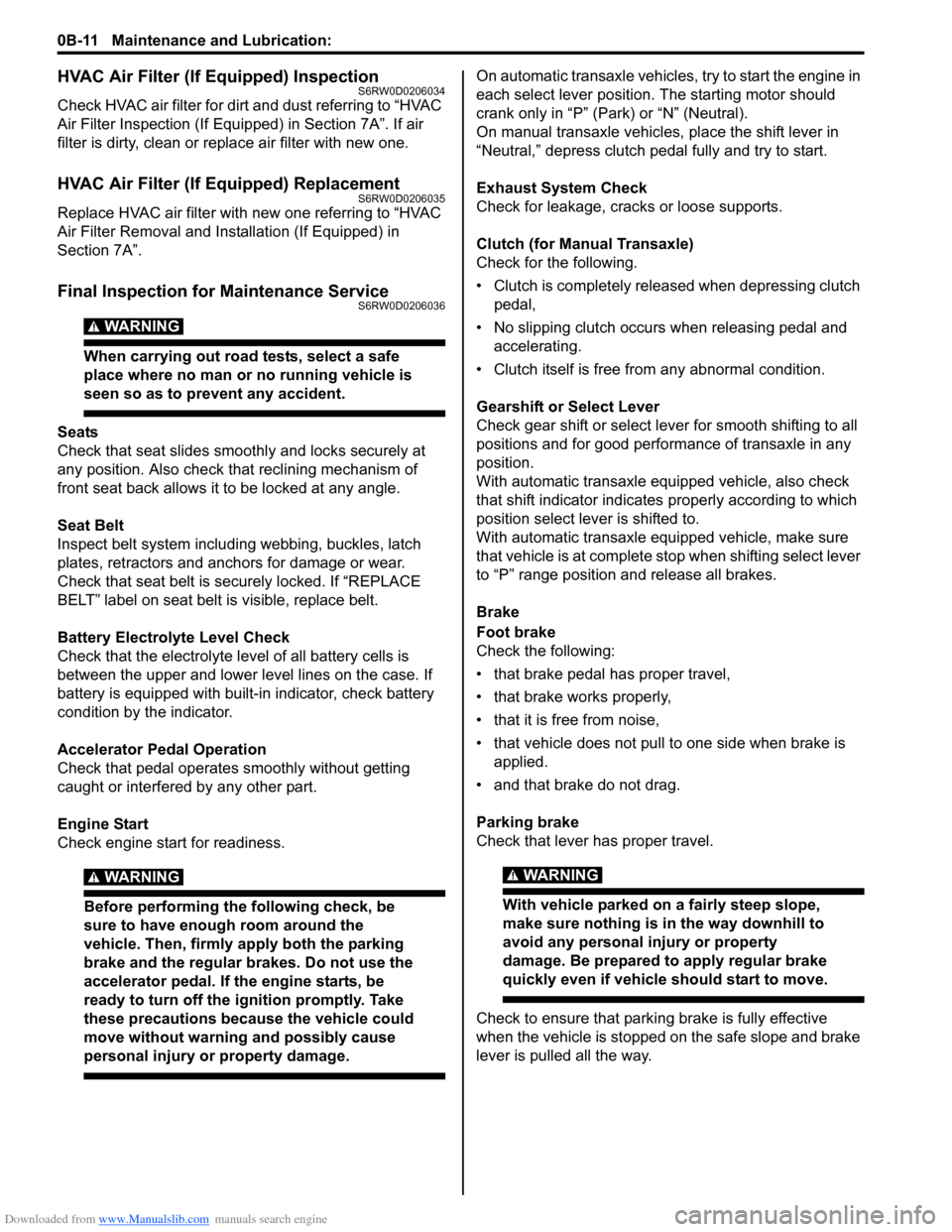
HVAC Air Filter (If Equipped) InspectionS6RW0D0206034
Check HVAC air filter for dirt and dust referring to “HVAC
Air Filter Inspection (If Equipped) in Section 7A”. If air
filter is dirty, clean or replace air filter with new one.
HVAC Air Filter (If Equipped) ReplacementS6RW0D0206035
Replace HVAC air filter with new one referring to “HVAC
Air Filter Removal and Installation (If Equipped) in
Section 7A”.
Final Inspection for Maintenance ServiceS6RW0D0206036
WARNING!
When carrying out road tests, select a safe
place where no man or no running vehicle is
seen so as to prevent any accident.
Seats
Check that seat slides smoothly and locks securely at
any position. Also check that reclining mechanism of
front seat back allows it to be locked at any angle.
Seat Belt
Inspect belt system including webbing, buckles, latch
plates, retractors and anchors for damage or wear.
Check that seat belt is securely locked. If “REPLACE
BELT” label on seat belt is visible, replace belt.
Battery Electrolyte Level Check
Check that the electrolyte level of all battery cells is
between the upper and lower level lines on the case. If
battery is equipped with built-in indicator, check battery
condition by the indicator.
Accelerator Pedal Operation
Check that pedal operates smoothly without getting
caught or interfered by any other part.
Engine Start
Check engine start for readiness.
WARNING!
Before performing the following check, be
sure to have enough room around the
vehicle. Then, firmly apply both the parking
brake and the regular brakes. Do not use the
accelerator pedal. If the engine starts, be
ready to turn off the ignition promptly. Take
these precautions because the vehicle could
move without warning and possibly cause
personal injury or property damage.
On automatic transaxle vehicles, try to start the engine in
each select lever position. The starting motor should
crank only in “P” (Park) or “N” (Neutral).
On manual transaxle vehicles, place the shift lever in
“Neutral,” depress clutch pedal fully and try to start.
Exhaust System Check
Check for leakage, cracks or loose supports.
Clutch (for Manual Transaxle)
Check for the following.
• Clutch is completely released when depressing clutch
pedal,
• No slipping clutch occurs when releasing pedal and
accelerating.
• Clutch itself is free from any abnormal condition.
Gearshift or Select Lever
Check gear shift or select lever for smooth shifting to all
positions and for good performance of transaxle in any
position.
With automatic transaxle equipped vehicle, also check
that shift indicator indicates properly according to which
position select lever is shifted to.
With automatic transaxle equipped vehicle, make sure
that vehicle is at complete stop when shifting select lever
to “P” range position and release all brakes.
Brake
Foot brake
Check the following:
• that brake pedal has proper travel,
• that brake works properly,
• that it is free from noise,
• that vehicle does not pull to one side when brake is
applied.
• and that brake do not drag.
Parking brake
Check that lever has proper travel.
WARNING!
With vehicle parked on a fairly steep slope,
make sure nothing is in the way downhill to
avoid any personal injury or property
damage. Be prepared to apply regular brake
quickly even if vehicle should start to move.
Check to ensure that parking brake is fully effective
when the vehicle is stopped on the safe slope and brake
lever is pulled all the way.
Page 43 of 1556
Downloaded from www.Manualslib.com manuals search engine Maintenance and Lubrication: 0B-12
Steering
• Check to ensure that steering wheel is free from
instability, or abnormally heavy feeling.
• Check that the vehicle does not wander or pull to one
side.
Engine
• Check that engine responds readily at all speeds.
• Check that engine is free from abnormal noise and
abnormal vibration.
Body, Wheels and Power Transmitting System
Check that body, wheels and power transmitting system
are free from abnormal noise and abnormal vibration or
any other abnormal condition.Meters and Gauge
Check that speedometer, odometer, fuel meter,
temperature gauge, etc. are operating accurately.
Lights
Check that all lights operate properly.
Windshield Defroster
Periodically check that air comes out from defroster
outlet when operating heater or air conditioning.
Set mode control lever to defroster position and fan
switch lever to highest position for this check.
Specifications
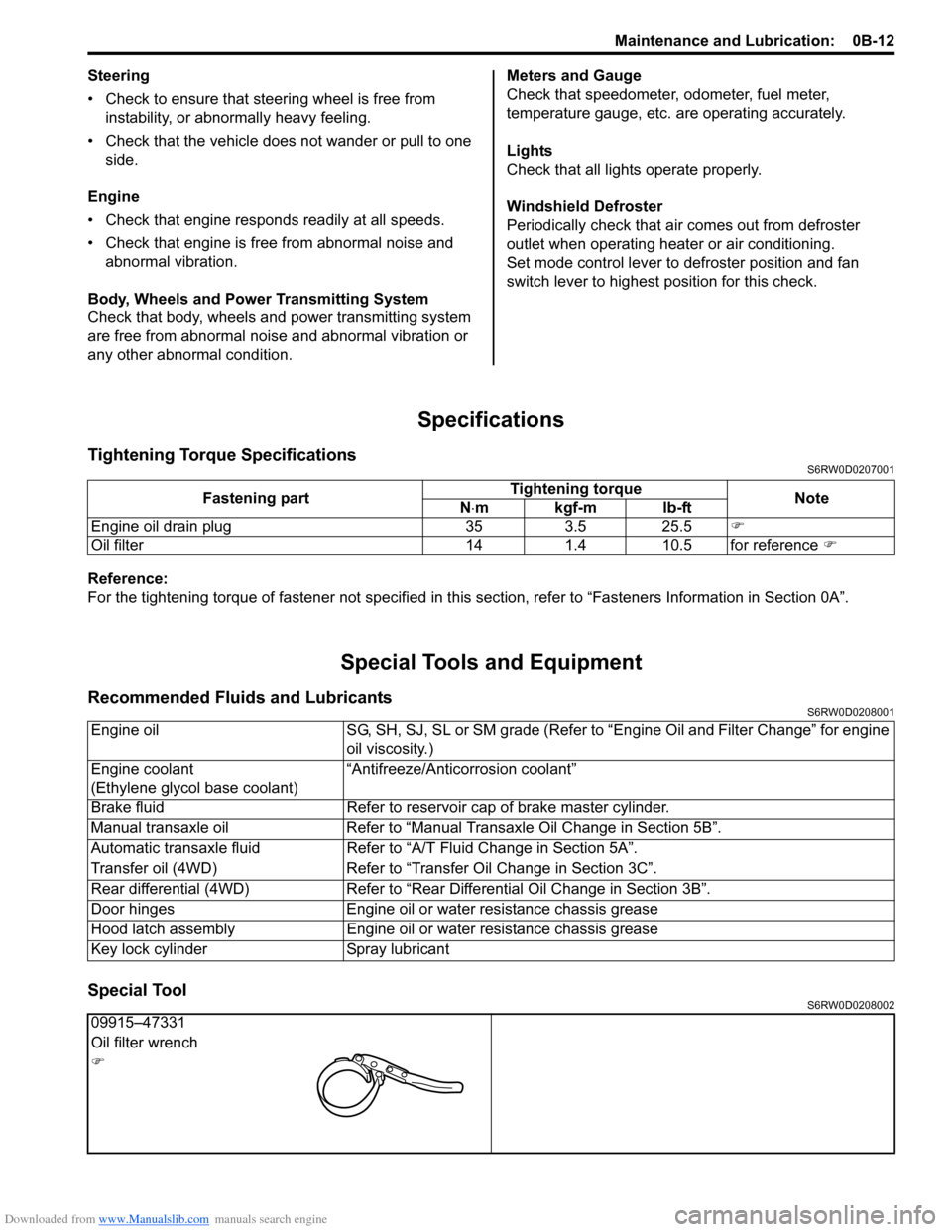
Tightening Torque SpecificationsS6RW0D0207001
Reference:
For the tightening torque of fastener not specified in this section, refer to “Fasteners Information in Section 0A”.
Special Tools and Equipment
Recommended Fluids and LubricantsS6RW0D0208001
Special ToolS6RW0D0208002
Fastening partTightening torque
Note
N⋅mkgf-mlb-ft
Engine oil drain plug 35 3.5 25.5)
Oil filter 14 1.4 10.5 for reference )
Engine oil SG, SH, SJ, SL or SM grade (Refer to “Engine Oil and Filter Change” for engine
oil viscosity.)
Engine coolant
(Ethylene glycol base coolant)“Antifreeze/Anticorrosion coolant”
Brake fluid Refer to reservoir cap of brake master cylinder.
Manual transaxle oil Refer to “Manual Transaxle Oil Change in Section 5B”.
Automatic transaxle fluid Refer to “A/T Fluid Change in Section 5A”.
Transfer oil (4WD) Refer to “Transfer Oil Change in Section 3C”.
Rear differential (4WD) Refer to “Rear Differential Oil Change in Section 3B”.
Door hinges Engine oil or water resistance chassis grease
Hood latch assembly Engine oil or water resistance chassis grease
Key lock cylinder Spray lubricant
09915–47331
Oil filter wrench
)
Page 44 of 1556
Downloaded from www.Manualslib.com manuals search engine 0B-13 Maintenance and Lubrication:
Page 262 of 1556
Downloaded from www.Manualslib.com manuals search engine 1A-212 Engine General Information and Diagnosis:
Repair Instructions
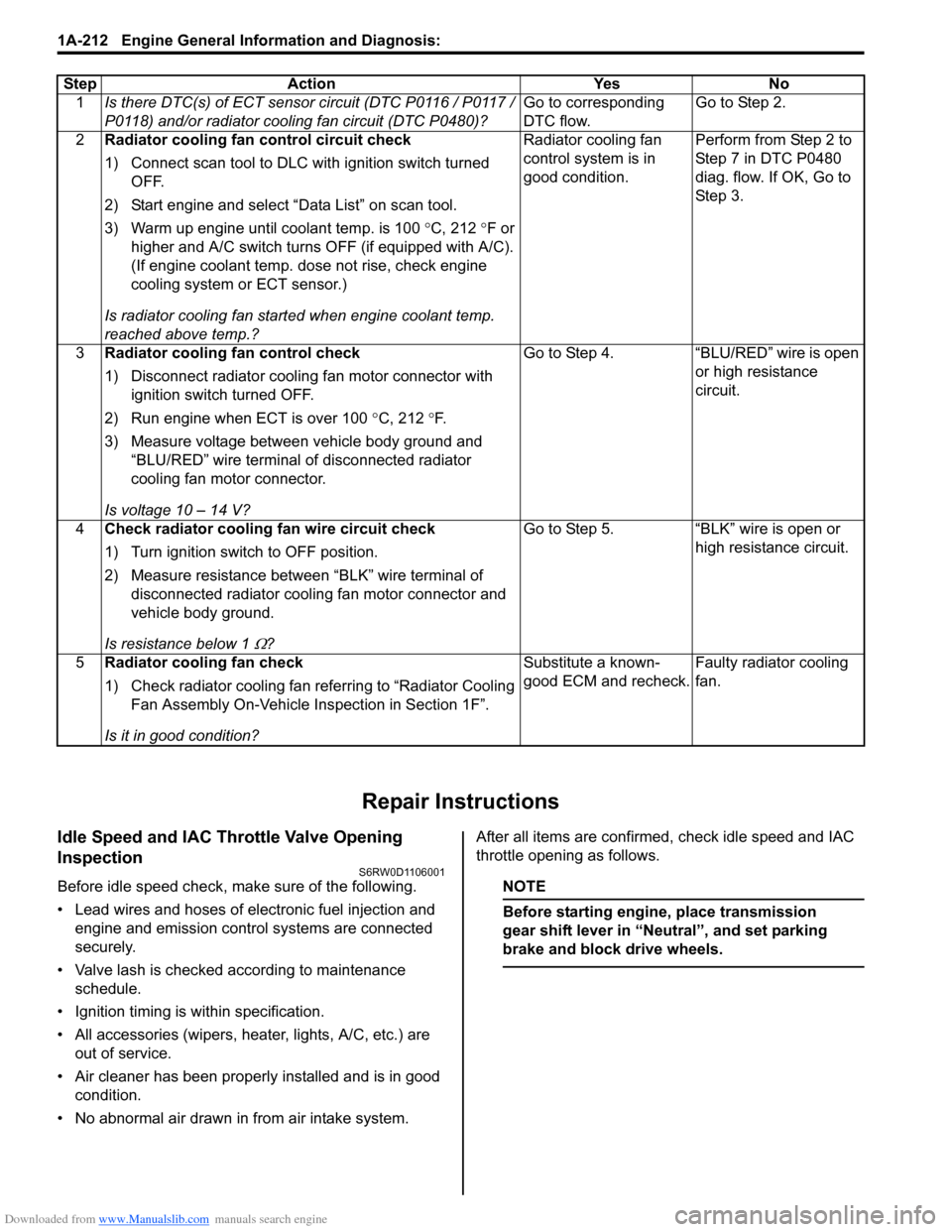
Idle Speed and IAC Throttle Valve Opening
Inspection
S6RW0D1106001
Before idle speed check, make sure of the following.
• Lead wires and hoses of electronic fuel injection and
engine and emission control systems are connected
securely.
• Valve lash is checked according to maintenance
schedule.
• Ignition timing is within specification.
• All accessories (wipers, heater, lights, A/C, etc.) are
out of service.
• Air cleaner has been properly installed and is in good
condition.
• No abnormal air drawn in from air intake system.After all items are confirmed, check idle speed and IAC
throttle opening as follows.NOTE
Before starting engine, place transmission
gear shift lever in “Neutral”, and set parking
brake and block drive wheels.
Step Action Yes No
1Is there DTC(s) of ECT sensor circuit (DTC P0116 / P0117 /
P0118) and/or radiator cooling fan circuit (DTC P0480)?Go to corresponding
DTC flow.Go to Step 2.
2Radiator cooling fan control circuit check
1) Connect scan tool to DLC with ignition switch turned
OFF.
2) Start engine and select “Data List” on scan tool.
3) Warm up engine until coolant temp. is 100 °C, 212 °F or
higher and A/C switch turns OFF (if equipped with A/C).
(If engine coolant temp. dose not rise, check engine
cooling system or ECT sensor.)
Is radiator cooling fan started when engine coolant temp.
reached above temp.?Radiator cooling fan
control system is in
good condition.Perform from Step 2 to
Step 7 in DTC P0480
diag. flow. If OK, Go to
Ste p 3.
3Radiator cooling fan control check
1) Disconnect radiator cooling fan motor connector with
ignition switch turned OFF.
2) Run engine when ECT is over 100 °C, 212 °F.
3) Measure voltage between vehicle body ground and
“BLU/RED” wire terminal of disconnected radiator
cooling fan motor connector.
Is voltage 10 – 14 V?Go to Step 4. “BLU/RED” wire is open
or high resistance
circuit.
4Check radiator cooling fan wire circuit check
1) Turn ignition switch to OFF position.
2) Measure resistance between “BLK” wire terminal of
disconnected radiator cooling fan motor connector and
vehicle body ground.
Is resistance below 1
Ω?Go to Step 5. “BLK” wire is open or
high resistance circuit.
5Radiator cooling fan check
1) Check radiator cooling fan referring to “Radiator Cooling
Fan Assembly On-Vehicle Inspection in Section 1F”.
Is it in good condition?Substitute a known-
good ECM and recheck.Faulty radiator cooling
fan.
Page 428 of 1556
Downloaded from www.Manualslib.com manuals search engine 1K-1 Exhaust System:
Engine
Exhaust System
General Description
Exhaust System DescriptionS6RW0D1B01001
The exhaust system consists of an exhaust manifold, three-way catalytic converter (TWC) in catalyst case, exhaust
pipes, a muffler and seals, gasket and etc.
The three-way catalytic converter is an emission control device added to the exhaust system to lower the levels of
Hydrocarbon (HC), Carbon Monoxide (CO), and Oxides of Nitrogen (NOx) pollutants in the exhaust gas.
Diagnostic Information and Procedures
Exhaust System CheckS6RW0D1B04001
WARNING!
To avoid the danger of being burned, do not touch the exhaust system when the system is hot. Any
service on the exhaust system should be performed when the system is cool.
At every interval of periodic maintenance service, and when vehicle is raised for other service, check exhaust system
as follows:
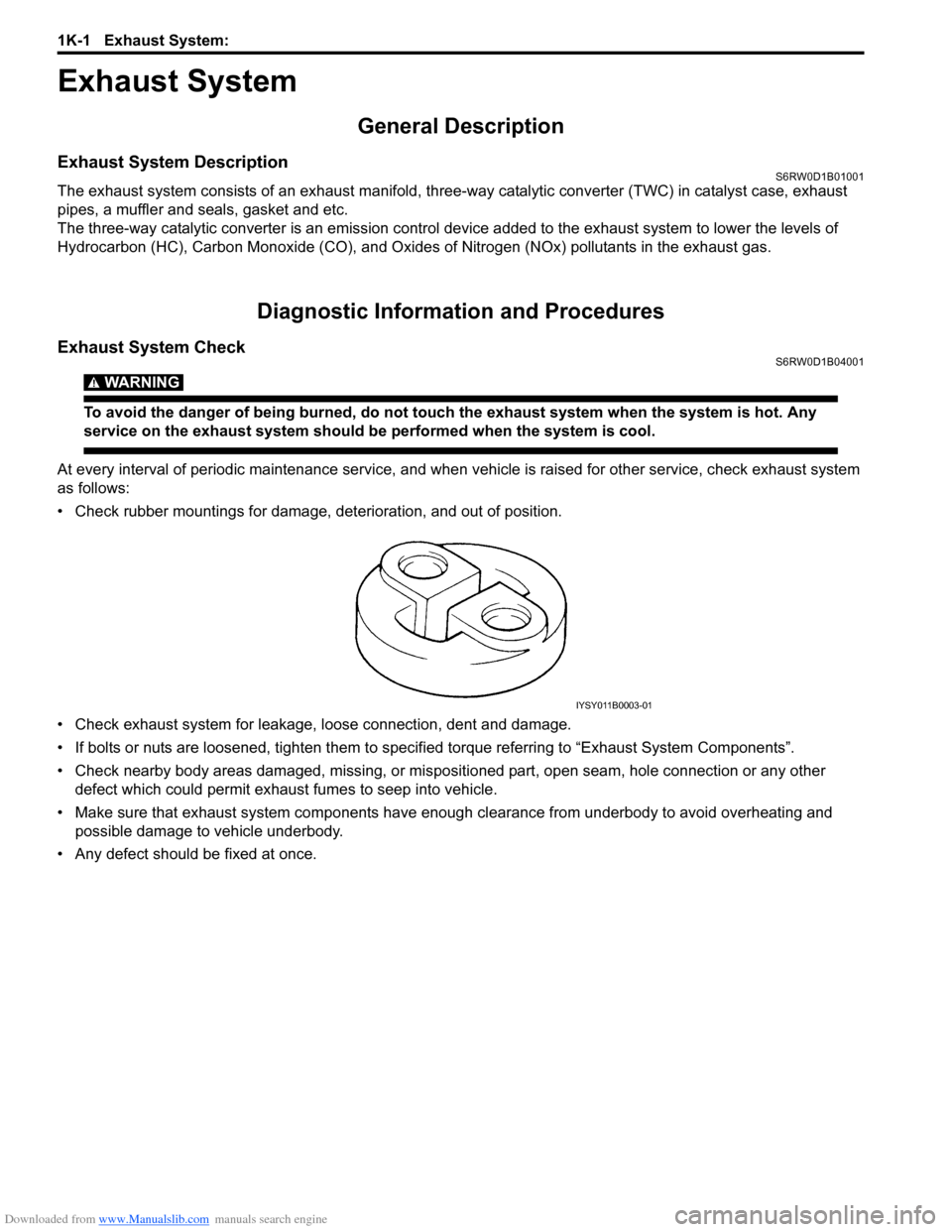
• Check rubber mountings for damage, deterioration, and out of position.
• Check exhaust system for leakage, loose connection, dent and damage.
• If bolts or nuts are loosened, tighten them to specified torque referring to “Exhaust System Components”.
• Check nearby body areas damaged, missing, or mispositioned part, open seam, hole connection or any other
defect which could permit exhaust fumes to seep into vehicle.
• Make sure that exhaust system components have enough clearance from underbody to avoid overheating and
possible damage to vehicle underbody.
• Any defect should be fixed at once.
IYSY011B0003-01
Page 471 of 1556
Downloaded from www.Manualslib.com manuals search engine Wheels and Tires: 2D-2
Replacement Tires
When replacement is necessary, the original equipment
type tire should be used. Refer to the Tire Placard.
Replacement tires should be of the same size, load
range and construction as those originally on the vehicle.
Use of any other size or type tire may affect ride,
handling, speedometer / odometer calibration, vehicle
ground clearance and tire or snow chain clearance to the
body and chassis.
It is recommended that new tires be installed in pairs on
the same axle. If necessary to replace only one tire, it
should be paired with the tire having the most tread, to
equalize braking traction.
WARNING!
Do not mix different types of tires on the
same vehicle such as radial, bias and bias-
belted tires except in emergencies, because
handling may be seriously affected and may
result in loss of control.
The metric term for tire inflation pressure is the kilo
pascal (kPa). Tire pressures is usually printed in both
kPa and kgf/cm
2 on the “Tire Placard”.
Metric tire gauges are available from tool suppliers.
The chart, shown in the table, converts commonly used
inflation pressures from kPa to kgf/cm
2 and psi.
Wheels DescriptionS6RW0D2401002
Wheel Maintenance
Wheel repairs that use welding, heating, or peening are
not approved. All damaged wheels should be replaced.
Replacement Wheels
Wheels must be replaced if they are bent, dented, have
excessive lateral or radial runout, air leak through welds,
have elongated bolt holes, if lug wheel bolts won’t stay
tight, or if they are heavily rusted. Wheels with greater
runout than shown in the following may cause
objectional vibrations.
Replacement wheels must be equivalent to the original
equipment wheels in load capacity, diameter, rim with
offset and mounting configuration. A wheel of improper
size or type may affect wheel and bearing life, brake
cooling, speedometer / odometer calibration, vehicle
ground clearance and tire clearance to body and
chassis.How to Measure Wheel Runout
To measure the wheel runout, it is necessary to use an
accurate dial indicator. The tire may be on or off the
wheel. The wheel should be installed to the wheel
balancer of the like for proper measurement.
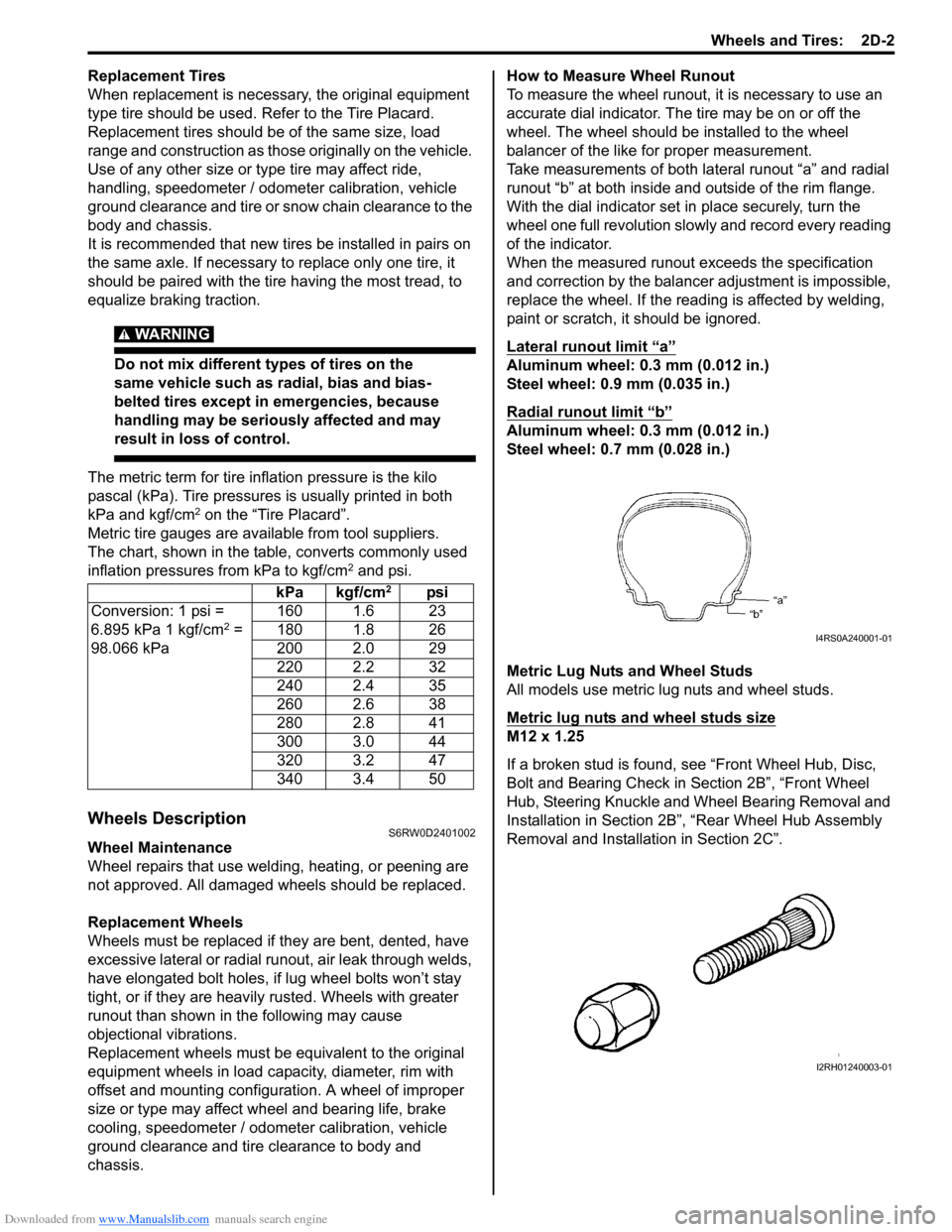
Take measurements of both lateral runout “a” and radial
runout “b” at both inside and outside of the rim flange.
With the dial indicator set in place securely, turn the
wheel one full revolution slowly and record every reading
of the indicator.
When the measured runout exceeds the specification
and correction by the balancer adjustment is impossible,
replace the wheel. If the reading is affected by welding,
paint or scratch, it should be ignored.
Lateral runout limit “a”
Aluminum wheel: 0.3 mm (0.012 in.)
Steel wheel: 0.9 mm (0.035 in.)
Radial runout limit “b”
Aluminum wheel: 0.3 mm (0.012 in.)
Steel wheel: 0.7 mm (0.028 in.)
Metric Lug Nuts and Wheel Studs
All models use metric lug nuts and wheel studs.
Metric lug nuts and wheel studs size
M12 x 1.25
If a broken stud is found, see “Front Wheel Hub, Disc,
Bolt and Bearing Check in Section 2B”, “Front Wheel
Hub, Steering Knuckle and Wheel Bearing Removal and
Installation in Section 2B”, “Rear Wheel Hub Assembly
Removal and Installation in Section 2C”. kPa kgf/cm
2psi
Conversion: 1 psi =
6.895 kPa 1 kgf/cm
2 =
98.066 kPa160 1.6 23
180 1.8 26
200 2.0 29
220 2.2 32
240 2.4 35
260 2.6 38
280 2.8 41
300 3.0 44
320 3.2 47
340 3.4 50I4RS0A240001-01
I2RH01240003-01